
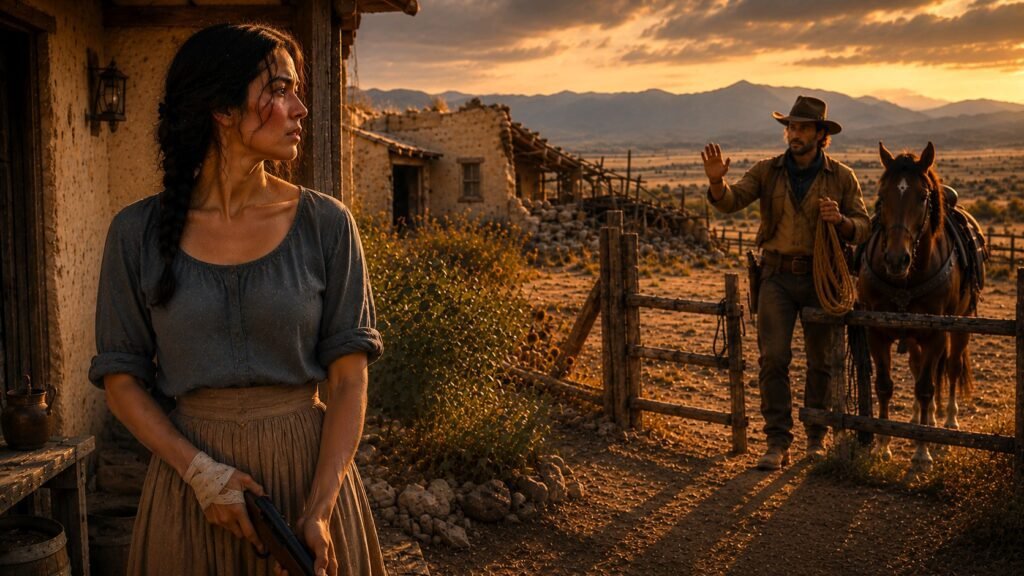
Iris Doyle had not slept in a bed since the night she buried her husband. For five nights she had kept watch on the floor of a sagging adobe house with a shotgun across her knees and a ledger book full of numbers she prayed God would let her finish balancing. She was not waiting for rescue. She was waiting for whoever came next, so she would be awake when they did.
On the sixth morning, a stranger’s horse stopped at her broken gate, and the whole shape of her life bent quietly toward somewhere new.
The high desert of the New Mexico Territory did not forgive carelessness in August. The sun came up white and merciless over the Sangre de Cristos, and by midmorning the sage flats shimmered like something seen through water. Caleb Hart had ridden through country like this more times than he could count, and he had learned, the hard way a man learns most useful things, to read a landscape before he trusted it. The tilt of the light. The way dust hung instead of drifting. The particular stillness that settled over a place when something in it had gone wrong.
He felt that stillness a full mile before he saw the Doyle spread.
His horse, a big rawboned roan named Ash, slowed on his own without being asked, ears swiveling. Caleb had learned to trust that horse’s instincts more than his own, most days, and he did now, reining up on the low bluff that looked down into the shallow bowl of the valley.
What he saw explained the stillness well enough.
The place had been something once — he could tell by the bones of it, the careful spacing of the corral rails, the long straight run of irrigation ditch cut by hand along the field’s edge. But the ditch was dry and cracked. The corral fence sagged in two places, rails down in the dirt. The barn’s east wall had buckled under some old weight of snow or wind, and nobody had righted it. The house itself, low adobe with a covered portal running its length, looked the way abandoned things look even when they aren’t quite abandoned — like a held breath.
What stopped him, the thing that made him swing down off Ash instead of simply riding on toward his own upper pasture, was the garden.
Along the south wall, in defiance of everything else about the place, someone had turned a neat plot of earth. Not a wild remnant of some better year — a deliberate planting, rows straight as fence line, soil dark and recently worked. Whoever tended that garden had gotten down on their knees in the dirt and chosen, against every visible argument to the contrary, to keep something alive.
Caleb didn’t understand it yet. But something in his chest recognized it anyway.
He led Ash down the slope and tied him at what remained of the gatepost, then crossed the yard on foot, the way a careful man approached a stranger’s home — hands loose at his sides, well clear of the Colt on his hip. He’d learned that lesson young, in country far bloodier than this one. The quickest way to get shot on someone else’s land was to walk onto it like you already owned it.
The porch boards groaned under his boots. The door stood ajar, propped with a chair because its top hinge had torn free of the frame.
“Hello the house,” he called. “Anybody home?”
Nothing.
He looked through the gap and saw her.
She lay asleep near the cold hearth, back against the stone, a wool blanket pulled to her chin despite the heat still trapped in the walls from yesterday’s sun. Dark hair had come loose from its braid and spread across the packed-earth floor. A shotgun lay beside her right hand, close enough to reach in a single motion. There was a fresh cut along her palm, wrapped in a strip of cloth gone stiff with old blood.
She looked, Caleb thought, like a woman who had been fighting something a long time and had finally gone down mid-battle, too exhausted to keep her guard fully up even in sleep.
He stepped back onto the porch and cleared his throat, loud and deliberate.
She was awake and on her feet with the shotgun leveled at his chest before he’d drawn a second breath.
“Don’t,” she said. Her voice didn’t shake. Neither did the barrel.
“Not moving,” Caleb said, raising both hands slow. “Just come to the door.”
“Why.”
“Saw the place from the bluff. Wanted to make sure everything was all right.”
“Everything’s fine. You can go.”
“Yes, ma’am.” He didn’t move. “You sure about that? That cut on your hand looks—”
“I said go.”
He studied her a moment instead — younger than he’d guessed at first look, maybe late twenties, wearing a man’s chambray shirt with the sleeves rolled and boots caked in the same pale clay as the garden outside. There was nothing fragile in the set of her shoulders, nothing in her that wanted his help. But something lived in her jaw, something that told him she was carrying more weight than one person ought to carry alone.
“Name’s Caleb Hart,” he said. “I run the Hart place, up past the second ridge. Eight miles or so.”
“I know who you are.”
The shotgun didn’t waver.
“What do you want.”
“Just to know you’re all right.”
“I’m fine.”
“You’re sleeping on your floor with a shotgun and telling a stranger on your porch you’re fine.”
Something flickered at the corner of her mouth — not quite amusement, but its distant cousin. “Then one of us has worse manners than the other. And it isn’t me.”
Caleb almost smiled. He didn’t let himself. “You’re Iris Doyle,” he said.
Something moved across her face at the name — not fear. Something quieter and harder than fear.
“My husband was Samuel Doyle,” she said. “This is Larkspur land. I intend it to stay that way. Whatever brought you up that bluff, it isn’t your business, and it’s time you rode back down it.”
“Yes, ma’am.”
He lowered his hands, stepped back once, twice. Before he turned for his horse, he let his eyes rest on the garden a moment longer than politeness required — long enough that she’d know he’d seen it and understood what it meant.
“That’s good work,” he said quietly. Not a compliment meant to soften her. Just a fact, laid down plain.
He didn’t wait for an answer. He walked back to Ash and rode for home, and he thought about that garden the whole eight miles, in a way he hadn’t let himself think about much of anything in longer than he wanted to count.
Iris watched him go from the doorway until the ridge swallowed him, then sat down hard on the porch step and pressed the heels of her hands against her eyes. Her hands were shaking now. They always did, after. While the danger was in front of her she was steady as stone. It was only once it passed, or seemed to, that her body remembered it had been afraid at all.
Samuel had been dead nineteen weeks. She had stopped counting days somewhere in the second month, though she still, without meaning to, counted the hours some nights.
He’d died in April, of a fever that started in his lungs and moved fast the way things moved out here, three days’ ride from any doctor worth the name. She had boiled water and changed compresses and sat through four nights watching his breathing change in ways that had no mercy in them. On the last morning he’d taken her hand — his grip already going strange and light — and told her the same thing he’d told her every day of their marriage.
You’ll be all right, Iris. You always land on your feet.
She hadn’t believed him then. She wasn’t entirely sure she believed him now. But she was still here, and Larkspur was still hers, and she intended to keep it that way if it cost her everything she had left to give.
The land had come to Samuel from his father, who’d broken the original two hundred acres by hand out of high desert scrub in a summer so dry it had scorched the grass black before the first cutting. It was not the richest ground in the territory, but it held water nine months out of twelve if the ditches were kept clear, and it was paid for — every acre — in a kind of labor no county ledger could properly record.
When Samuel died, Iris learned quickly that not everyone shared her understanding of what that meant.
The first man had come in May: a soft-spoken representative from the Baird Land and Mineral Company, riding a horse that cost more than she’d earned in three years of egg money. He’d held his hat in both hands the way certain men did around widows, as if grief required a special posture of politeness that excused whatever came next.
He had papers. Iris had read them three times while he stood in her front room, and each reading put something colder in her chest.
Back taxes, he’d said. Assessed against the property for the past four years. Your husband’s signature is on the assessment acknowledgment. I’m afraid if the debt isn’t settled within sixty days, the county will be obliged to proceed to tax sale.
“My husband paid every tax bill this ranch ever owed,” she’d said. “In person, at the county seat, every autumn of our marriage.”
“Records show otherwise, ma’am.”
“Records lie easier than men do, in my experience. Get out of my house.”
He had gone. He had come back twice more, different faces, same soft voices, same eyes that priced the furniture without ever quite looking at her. And now it was August, and the sixty days were nearly spent.
She went inside and sat at the table and opened the leather ledger book Samuel had given her three winters back, half-filled already with her own careful hand, and turned to a fresh page. At the top she wrote: What I know. What I can prove. What I need.
What I know: Samuel never signed an assessment acknowledgment. Baird is lying about the tax debt. Someone with access to the county assessor’s records manufactured this. The purpose is to force a sale.
What I can prove: nothing yet.
What I need: the original tax rolls. A lawyer. Time I don’t have.
She sat with the list a long while. Then, beneath it, in smaller letters, almost without deciding to: Caleb Hart.
She wasn’t sure why she wrote it. It wasn’t part of the problem she was solving. It was only a fact — a new fact, in a season that had been far too short on anything new.
Caleb didn’t ride back the next day, or the day after. He rode back on the fourth day, and he brought a fence rail, not as an excuse and not as a strategy. He brought it because he’d passed the south corner of Larkspur land on his way to check his own upper water, and he’d seen the post down and two rails on the ground, the gap wide enough for cattle to wander through — except she had no cattle left to wander, so the only thing passing through that gap now was the slow unraveling of a place without enough hands to hold it together.
He dropped the rail at the gap and went back for tools.
He was setting the second rail when he heard her boots behind him.
“What are you doing.”
He didn’t stop working. “Fixing your fence.”
“I didn’t ask you to.”
“No, ma’am. You didn’t.” He drove the rail home, straightened, turned to face her. “Want me to stop? I’ll stop. Say the word.”
She had her arms crossed, chin up, looking at him the way she’d looked at him from behind the shotgun — steady, cautious, working out what kind of man he was.
“Why are you doing this?”
Caleb set down his hammer, pushed his hat back, and met her eyes straight on. He’d learned, in forty-some years of living, that most trouble between people started with somebody failing to look at somebody else straight.
“Because your fence is down,” he said. “And I know how to fix a fence. And fixing it takes an hour, and not fixing it, with everything else you’ve got sitting on your shoulders, might take a week, or never happen at all. That’s my problem with it.”
“It’s my land.”
“Yes, ma’am. It is.” He picked the hammer back up. “But I’m already here.”
She stared at him. He went back to work. He heard her make a sound that wasn’t quite a word. A few minutes later her footsteps returned, and she was carrying the fence rail he’d left in the grass. She handed it to him without a word. He took it the same way.
They worked in silence after that, and Caleb had always believed silence, shared honestly, told a man more about another person than an hour’s conversation ever would. Iris moved careful and economical, no wasted motion. She held a rail steady when he needed it held and kept her hands clear when he swung the hammer, without being told. She knew the work. That much was plain in every motion.
“How long have you had this place,” he asked, after a while.
“Samuel’s father raised the first walls when Samuel was ten. We’ve had it together seven years.” A pause. “You?”
“North of Santa Fe, originally. My family ran cattle before the war took most of the men who knew how.”
“You know the work, then.”
“I know the work,” he said.
There was something under her voice when she said it. Not pride exactly. Something closer to grief that had made a kind of peace with being permanent. She knew the work. She had always known it. And the knowing hadn’t been enough to save him.
Caleb didn’t push. They finished the fence in a little over an hour.
She stood with her hands on her hips looking at the repaired line, and her face carried something that wasn’t quite gratitude — something adjacent to it, an exhausted relief she was working hard not to show.
“What do you actually want,” she said finally, turning to him. “Nobody does something for nothing out here.”
“I need water,” he said. “There’s a spring on your upper pasture, feeds down through the northeast draw. My own creek’s run near dry all summer. There’s an old water right that comes bundled with this land — I’d like to work out an arrangement with you for access.”
She studied him. He could see her processing the offer, turning it for the hidden clause, the buried cost.
“You want to buy the right?”
“I want to lease it. Monthly. Fair price, negotiated between the two of us. No middleman.”
“And the fence?”
“The fence needed fixing. That’s the whole of it.”
She looked away — at the fence, then the house, then the garden along the south wall — her jaw working like she was chewing over words before she’d let them out.
“My husband trusted people too easy,” she said at last. “Saw the good in a man before he’d earned the right to be seen that way. I loved that about him. I also watched it cost him more than once.” She turned back to Caleb. “So you’ll understand if I’m not in the habit of taking a man at his word.”
“I understand that completely.”
“Then you’ll understand I’m not making any arrangement with you today.”
“Yes, ma’am.”
He gathered his tools, tipped his hat, and started for his horse. He was mounting when she called after him.
“Mr. Hart.”
He looked back. She stood with her arms uncrossed now, and for just a moment she looked like a woman who was very tired and very alone and was deciding how much of that to let show.
“The spring’s in the northeast corner of the upper pasture,” she said. “I’ll want to see any arrangement in writing. Both our names. Equal terms.”
He held her gaze. “I’ll have something drawn up by week’s end.”
She didn’t smile, but something in her expression shifted, barely, toward something that wasn’t quite the weariness she’d been carrying since he arrived.
“Week’s end,” she said, and turned back toward the house.
The papers from Baird sat on Iris’s table when she came back inside, and she took them out again that evening to read for what felt like the hundredth time, hunting the exact thread of evidence she knew must exist somewhere to prove what the papers claimed was a lie.
Samuel’s signature sat at the bottom of three documents — an assessment acknowledgment, a lien notice, a payment schedule — in the same careful, even hand he’d written everything in. Except that it wasn’t his hand. Iris had lived with Samuel Doyle seven years. She had read every letter he’d ever sent her, every note left on the kitchen table, every line of the deed they’d signed together the day they finally paid the land clear. She knew the particular slant of his capital S, the way he crossed a lowercase T high and sharp, the small flourish he could never quite train out of his lowercase Y.
The signatures on the Baird papers were close. Very close. Someone had taken real time and care over them.
But they were wrong.
She had known it from the first moment she’d seen them, and the knowing had sat in her chest like a swallowed stone ever since, because knowing and proving were two entirely separate country roads, and she was standing at the start of a long one.
Three days later a man named Otis Rourke rode up to Larkspur wearing a county deputy’s badge polished bright as everything else about him, and just as honest. He didn’t tie his horse at the gate — rode it right up to the porch steps, the kind of thing a man does when he wants you to understand who’s setting the terms of the conversation.
Iris came to the door with the shotgun, because she had learned.
“Morning, deputy.”
“Mrs. Doyle.” He looked at the shotgun with patient amusement. “Don’t suppose you need that for a courtesy call.”
“I decide what I need on my own porch. What do you want.”
“Just to convey the situation plain. Baird’s attorneys tell me the payment deadline’s coming up fast. If it isn’t met, they’ll commence formal proceedings to take the property to tax sale.”
The words landed in her chest like stones dropped in cold water. She’d known this was coming. Hearing it said aloud, official, by a man with a badge, made it different.
She kept her face still. “They can try.”
“Mrs. Doyle, I say this with no wish to see a widow woman put off her land, but Baird’s got lawyers in three territories and they’ve done this before. More than once. There’s no shame in taking a fair settlement and starting fresh somewhere else.”
“There’s no settlement that’s fair,” she said. “My husband never signed those papers, deputy. Whoever forged them, it wasn’t Samuel Doyle. And I intend to prove it.”
It was the first time she’d said the words aloud to anyone but herself. They’d been a gamble even in her own head. Standing on her porch now, morning sun at her back, shotgun steady in her hands, she found she was beginning, slowly, to believe them.
Rourke studied her a long moment, then looked past her at the house, the garden, the mountains beyond.
“I hope you know what you’re doing,” he said.
“I know exactly what I’m doing. Good morning, deputy.”
He tipped his hat and rode away. Iris stood on the porch until the dust settled, then went inside and started a new list.
Caleb came Friday with two pages in his hand — a lease agreement, clean and plainly worded, spring access in exchange for monthly consideration, both their names in the proper places, a blank line at the bottom for her signature and another beside it for a witness.
“Had a lawyer in Santa Fe draw it up,” he said. “Man named Aldous Pratt. Straight as they come. You’re welcome to take it to someone else for a second look. I don’t mind waiting.”
She read it twice, the way she read everything now — hunting the hidden clause, the buried cost. There wasn’t one.
“Why a witness line?”
“Because any agreement worth making is worth making in front of somebody who’ll remember it. That’s how I do things.”
She looked at the paper a moment longer, then said, “Come inside.”
He followed her in. She set the ledger book beside the Baird documents on the table and stood looking at both piles a long moment before she spoke.
“I need to tell you something before I can take whatever help you’re offering without thinking twice on it.”
“All right.”
She told him. The tax fraud, the forged signatures, the deputy’s visit, the sixty-day clock ticking down like something with teeth. She told it plain, the way she told herself things when she needed to think clearly.
When she finished, the house held a long quiet.
“I knew Samuel,” Caleb said finally.
Iris looked up.
“Not well. We met twice at the county land office, three years back, over some boundary filing on my upper pasture. He was there about a water dispute. We talked an hour or two, across two visits.” He paused. “Struck me as a careful man. The kind who wouldn’t sign a thing he hadn’t read three times.”
“He was,” she said, her voice quieter than she’d meant it. “Exactly that kind.”
“Then those aren’t his signatures. And the county land office will have records from those filings — original documents in his hand, dated, witnessed, official.”
Iris stared at him. She had been so deep inside the immediate fight — the fence, the food, the daily labor of keeping the place from falling further apart — that she hadn’t thought three years back to a courthouse vault where Samuel’s own careful hand sat waiting, untouched by anyone’s forgery.
“I have business at the land office next week,” Caleb said. “I can pull the file. Request copies.” He looked at her steadily. “With your permission.”
She looked at the documents on the table, then at the lease still in her hand, then at him.
She picked up the pen and signed the lease agreement.
“Get the documents,” she said.
Something moved through his expression — not triumph. Something quieter, like a man who’d been waiting to see if a thing was real and had just gotten his answer.
He came back on Thursday with a leather satchel and three county forms, stamped and dated three years prior, Samuel’s name at the bottom of each. Iris knew his hand before she’d even leaned close — felt the specific, electric ache of seeing a dead man’s writing reach out of the past in ink and paper.
She laid one of the Baird documents beside a county original. The difference wasn’t large. Someone had studied Samuel’s hand and practiced it and done competent work. But Iris had seven years of grocery lists and love notes behind her eyes, and she could see it — the slant that was almost right, the flourish that curled the wrong direction.
“These are his,” she said, of the county forms. “That one isn’t.”
“Someone had to see his real hand to copy it that close,” Caleb said.
“Someone with access to his records.” She sat back. “Or someone at the land office who pulled his file and kept it long enough to study.”
They looked at each other across the table.
“I’ll find out who,” Caleb said.
It took a week of careful asking, letters sent under Caleb’s name to men who owed him favors, before a name surfaced: a former assessment clerk named Mossley, dismissed from the county office eight months back under circumstances nobody wanted to describe plainly, last seen boarding a stage for the Colorado line.
And it took a visit to a widow named Odessa Finch — whose husband Warren had lost his own homestead to Baird two years before, under papers bearing his forged name — before Iris understood she wasn’t the only one.
Odessa’s kitchen was small and neat and smelled of woodsmoke and dried chile. She listened to Iris’s story without interrupting, her hands folded in her lap, her jaw set like a woman who had long since run out of patience for anything but plain speech.
“Same story,” she said when Iris finished. “Different names on the paper.” She rose, went to a cedar chest by the stove, and drew out a bundle of letters tied in twine. “Warren kept everything. Every filing, every county receipt, fifteen years of it.” She set the bundle on the table. “What I didn’t have was proof of who pulled his file before the forgery. What I do have—” she reached back into the chest and drew out a sealed envelope “—is a letter from a woman who worked the desk beside Mossley. She saw him take Warren’s records the week before the papers were filed. She didn’t speak up then. She was afraid of losing her position.”
“Is she willing to say so now?”
“She wrote to me from Trinidad last winter, unasked. Said she couldn’t carry it any longer.” Odessa slid the envelope across the table. “I’ve been waiting for someone with a reason to use it properly.”
Iris looked at the envelope a long moment. “Why me?”
“Because you’re still fighting,” Odessa said simply. “I’m sixty-one years old and I buried Warren a year past and I have nothing left for them to take. You still have your land. Don’t waste what I’m handing you.”
Iris put the envelope in her coat. “I won’t.”
The lawyer arrived from Santa Fe on a Friday — a lean, unhurried man named Franklin Voss, close-trimmed beard, sharp eyes that moved across a room the way a surveyor’s moved across land, measuring without seeming to. He read every document at Iris’s table in near total silence, then set his pen down and looked at her.
“Tell me plain,” he said. “What you know, what you believe, and the difference between them.”
She told him. The forged signatures, the deputy’s visit, Odessa’s letter, the vanished clerk. Voss listened without interrupting, and when she finished he tapped the sealed envelope.
“This witness — will she come testify?”
“I don’t know yet.”
“I’ll need to find out. Without her, we have a strong argument. With her, we have a case that could end Baird’s operation in this territory entirely.” He looked between Iris and Caleb. “This isn’t a property dispute anymore. If Baird directed a county clerk to falsify records for the purpose of stripping land from widows and small owners, that’s federal fraud. Wire fraud, conspiracy, corruption of public office.”
The room went very still.
“How long to build it,” Caleb asked.
“Depends how many families we can document, and how much time we’re given.” Voss looked at Iris. “How much time do you have?”
“Fifty-three days,” she said.
They worked through the weeks that followed the way a fence gets built — post by patient post. Voss filed for federal jurisdiction, staying the county tax sale pending investigation. Caleb rode two counties gathering names: the Alvarez family, who’d lost their orchard to an identical scheme; a rancher named Otto Krieg, farming rented ground now because his own acres sat in Baird’s hands; a young couple, the Farrs, whose letter arrived shaking and brief and asked only whether coming forward would matter.
Iris wrote back to every one of them herself: It will matter. Come to Larkspur if you can.
They came. Odessa moved into the spare room at Iris’s insistence, after a Baird attorney was seen loitering near her rented house in town. Otto Krieg slept in the barn out of an old rancher’s stubbornness about taking a lady’s second room. The kitchen table filled with letters, receipts, canceled deeds, a small tin box of the Farrs’ unanswered petitions to the county — proof, Voss said, of a pattern too wide to be coincidence.
And the witness came. Naomi Sharpe stepped off the Santa Fe stage on a Wednesday, small and gray-haired and carrying herself forward like a woman perpetually on the verge of finally saying the thing she’d swallowed for years.
“I should have spoken when it would have helped the Krieg family,” she told Iris, taking her hand at the depot. “I didn’t. I won’t make that mistake twice.”
She testified two days later in the territorial circuit court in Cimarron, in a converted meeting hall crowded with more onlookers than Iris had expected — neighbors, shopkeepers, the schoolteacher, ordinary people come to watch a widow fight a company for her husband’s name. Warrick Baird sat at the plaintiff’s table in a suit that cost more than most men’s land, flanked by attorneys who grew visibly less certain with every witness Voss called.
Iris testified last. She told the court about Samuel — the boy who’d grown up on that ground, the man who read every document twice before signing, the particular unclosed loop in his lowercase Y that had never once, in seven years, closed itself on any page she’d seen. She told them it didn’t close on the Baird documents either. That was not her husband’s hand.
When Baird’s young attorney tried to argue she’d been led to her conclusions by a neighboring rancher with financial interest in the outcome, Iris looked at him steady and said, “I pointed a shotgun at Caleb Hart the morning he first came to my gate, sir. I made him put a witness line on our water lease before I’d give him the time of day. I have been making my own decisions on my own land since the day I buried my husband, and I’ll thank you not to suggest otherwise in front of these families who came here to tell the truth.”
The judge did not deliberate long. The stay was confirmed. The matter was referred to federal prosecution. Baird’s attorney was told, in open court, to retain better counsel than he currently employed.
The courtroom broke apart in noise and relief — Odessa’s hands gripping Iris’s arms, Otto Krieg shaking Voss’s hand with both of his, the Farrs holding each other the way people hold on when a thing they’d stopped hoping for finally arrives.
In the back row, hat in his hands, having sat through the entire hearing without once being called forward — because Iris had asked him not to be, because he understood exactly why — Caleb Hart rose last, and waited for the room to thin before he came toward her.
“You came,” she said.
“Wasn’t in the case,” he said. “Just in the room.”
“I know the difference.”
They rode back to Larkspur together in the long gold light of early evening, mostly quiet, the kind of quiet that had enough already living inside it. When the ranch came into view below the ridge — the mended fence, the solid barn door, the garden heavy now with tomatoes and a row of sunflowers that served no purpose but the one that mattered — Iris felt something move through her that had no clean name. Not the grief of March. Something on the far side of it, carrying the grief forward instead of stopping there.
She dismounted. Caleb stood a few feet off, hat in his hands.
“What happens now?” he asked, and she heard in the question that it meant more than the practical.
“Now I fix what’s broken,” she said. “The east wall of the barn. The garden fence. I’ve got half a season of feed on credit at the mercantile — a federal ruling changes what a shopkeeper’s willing to front you.” She paused. “And I need to talk to you about the water lease. Extending it, come spring.”
“Iris,” he said.
She stopped.
“I know what we are,” he said. “Neighbors with a legal agreement and a water right and a fraud case that’s going federal.” He turned his hat once in his hands. “I’m not asking you to be anything other than what you are.”
“Then what are you asking?”
He was quiet a moment. “Nothing yet,” he said. “I’m just not riding away.”
She looked at him a long moment — at the man who’d shown up with a fence rail and no explanation, who’d stayed out of the one room where his presence could have cost her everything, who was standing here now with his hat in his hands telling her nothing yet and meaning, she understood, considerably more than that.
“All right,” she said.
It wasn’t an answer to everything. It was enough of one.
That night she took the ledger down from its shelf and opened it to the last page she’d written, the night before the hearing: Tomorrow we tell the truth in front of people with the power to do something about it.
Beneath it, she wrote: Today we did.
Then she turned to a fresh page, and sat a moment with the pen in her hand, thinking of the barn wall and the garden fence and the water lease and the families now sleeping under her roof who would need more than lawyers in the months ahead — who would need the particular, ordinary kindness of people who had already come out the other side.
She thought of Odessa, who deserved a room that was hers and not borrowed. She thought of sunflowers planted for no reason but beauty, because a home without something beautiful in it is only a building.
At the top of the new page she wrote: What comes next.
And below it, for the first time in nineteen weeks, she did not write a list of what she needed, or what she had to prove, or what stood against her.
She wrote a list of what she meant to build.
Outside, the desert evening came down gold and long across the mountains, and the garden kept growing, and the land was hers — not because anyone had saved her, but because she had never once stopped fighting for the right to save herself. No forged signature, no vanished clerk, no man in an expensive suit with a practiced smile, and no quiet, patient silence from a town that had once believed her beaten, could ever take that away from her now.
The ledger lay open under the lamp. The page kept filling.
She kept writing.