
The Envelope No One Opens
The mailbox at the end of Mara Voss’s drive leaned two degrees to the left, the way it had since the winter a delivery truck clipped it and nobody ever came to fix it right. She still checked it every evening at six, not because she expected anything, but because the walk gave her something to do with her hands, which otherwise wanted to fold into themselves and stay that way.
Cedar Hollow in late September smelled like woodsmoke and cut grass going dry. The porch light buzzed on a timer she’d never bothered to reset after daylight saving ended last spring, so it came on too early now, casting a small yellow circle on the steps before the sky had even finished deciding on dusk. She liked that circle. It was the only part of her life that arrived on a schedule and kept its promise.
Inside the bakery she ran two blocks from Main Street — Voss & Daughters, though there had only ever been one daughter and she had never had children of her own — the ovens were cooling from the day’s last batch. Cardamom rolls, the recipe her grandmother wrote on an index card so worn the ink had gone the color of weak tea. Mara did not deviate from that card. She measured flour to the gram, proofed dough exactly ninety minutes, set a timer even when she knew, by smell alone, precisely when something was ready. The precision wasn’t about the bread. It was about not letting anything catch her by surprise again.
The envelope had come three days ago, cream-colored, a little too formal for Cedar Hollow’s taste, with the high school’s mascot — a hawk mid-strike — embossed in gold along the top. You’re invited: Cedar Hollow High, Class of 2004, Twenty-Year Reunion. Below it, in smaller print, a line asking for an RSVP by the fifteenth.
It sat on the kitchen counter, unopened past the first glance, propped against the sugar canister like a guest who hadn’t been properly welcomed in. Every night when she came home from the bakery, she saw it there. Every night she left it exactly where it was.
There was a particular kind of stillness that came from deciding, long ago, not to hope for things. It wasn’t sadness, not the loud kind anyone could point to and name. It was quieter than that — more like a room where someone had removed all the furniture and gotten used to standing. Mara had built an entire life inside that room. She liked her mornings alone with flour dust settling in shafts of early light. She liked closing the shop at four and walking home past the same maples, watching them go from green to rust to bare, a clock she trusted more than any other. She had stopped opening envelopes that asked her to remember things. Memory, in Mara’s experience, was a door that swung only one way — you could walk through it, but nothing on the other side ever walked back out with you.
Twenty years ago this town had a boy in it who filled every hallway he stood in, who used to leave notes folded into impossible little shapes and tuck them through the vents of her locker — a paper crane, a boat, once an origami hawk that made her laugh so hard a teacher sent her into the hall. Sawyer Reyes had a voice made for radio and hands that never stopped moving when he talked, like his thoughts came out too fast for his mouth alone. On the night of their own graduation, under the same gymnasium rafters this new invitation promised to fill again, he had held both her hands and promised, with the specific, reckless certainty only eighteen-year-olds could afford, that distance was nothing, that he would call every single night from basic training, that four years was no time at all when two people had already decided.
He had called for six weeks. Then three weeks. Then a single voicemail in October that Mara still, if she let herself, could recite from memory — not because she wanted to, but because grief had teeth and this was the shape they’d left. Something’s come up. I’ll explain everything. Just — give me some time. No explanation ever came. No goodbye came either, which was somehow worse, because a goodbye at least closed a door. This just left it standing open, banging in a wind that never stopped.
She had built her whole architecture of self around never standing in a doorway like that again. She did not check phones for messages that wouldn’t come. She did not save a place at any table. She dated, occasionally, men who were kind and predictable and entirely forgettable, and she let those things end the way overripe fruit ends, without ceremony, without grief. She had decided, without ever saying the decision out loud to anyone, that returning was not a thing people reliably did. Reunions asked you to believe otherwise. That was precisely the trouble with them.
Her business partner and oldest friend, Dee, had already RSVP’d for both of them without asking — “the committee needs headcounts by Friday, Mara, and you owe yourself one good night out even if you’re going to stand in the corner and judge everyone’s highlights” — and so, technically, an answer already existed on some spreadsheet in the reunion committee’s shared folder. Mara hadn’t corrected it. That, in itself, felt like the loudest thing she’d done in years.
That evening, flour still ghosting the creases of her knuckles, she finally picked the envelope up. She turned it over once, twice, the way she might have turned over a coin before a decision she didn’t want to be responsible for making. On the response card inside, two boxes: Will attend and Regretfully decline. A small pencil-line square asking for a single mark, waiting the way small things wait for large decisions to catch up to them.
She did not check either box that night. She set the card back on the counter, propped once more against the sugar canister, and went to bed listening to the porch light click off on its own schedule, keeping the one promise in her life that had never once been broken.
Under the Gym Lights, Early
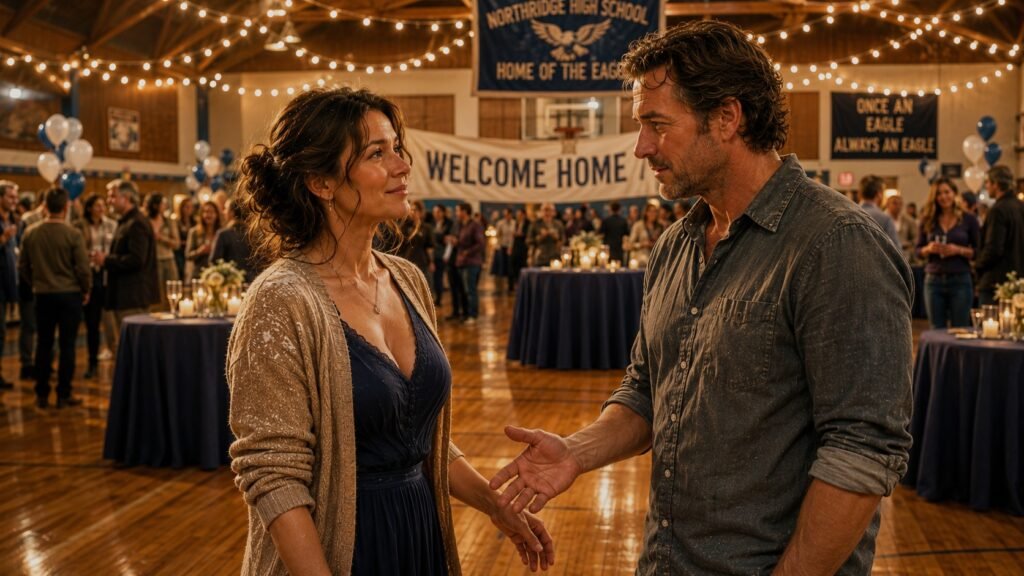
The gymnasium hadn’t changed as much as memory insisted it would. Same scuffed hardwood, same championship banners sagging slightly from decades of humidity, same particular echo that swallowed voices and gave them back thinner. What had changed was the string of fairy lights someone on the committee had strung along the rafters, and the round tables draped in navy cloth where the folding bleachers used to be, and the banner reading WELCOME HOME, HAWKS in letters clearly printed at a copy shop that morning.
Mara arrived early — deliberately, strategically early, the way a person arrives at a dentist’s office wanting to get the waiting room over with before the crowd thickens the air. Dee was still at the bakery finishing a wedding order and would meet her later, which meant Mara had a solid hour of empty gymnasium ahead of her and a folding chair with her name on it, figuratively, in the sense that no one else wanted to claim it yet either.
She was adjusting a centerpiece that didn’t need adjusting — small mason jars of baby’s breath and fairy lights, someone’s earnest Pinterest project — when the side door by the equipment room swung open and a man walked in carrying two enormous speakers stacked one on top of the other, muscles in his forearms standing out from the effort, swearing softly at the doorframe that hadn’t gotten any wider in twenty years.
“Somebody said the DJ’s running late,” he said to no one in particular, setting the speakers down with a grunt near the outlet by the stage. “Guess that’s me now.”
He straightened, wiped his palms on his jeans, and looked up — and something in his face did the thing faces do when twenty years try to collapse into a single second and mostly succeed. Sawyer Reyes stood there in a gymnasium that smelled exactly the same as it had the last night either of them had stood in it together, looking at Mara like a man who’d just walked into the wrong decade by accident and wasn’t sure whether to apologize or stay.
“You’re early,” he said, which was not what either of them expected to be the first thing said, after everything.
“So are you.” Her voice came out steadier than the ground currently felt.
“I volunteered for setup. Seemed safer than showing up cold.” He glanced at the speakers, then back at her, a small, helpless laugh escaping before he could stop it. “Didn’t account for the part where the first person I’d see would be —” He didn’t finish the sentence. He didn’t need to.
There was a version of this reunion where Mara turned and walked straight back out the double doors and drove home and never opened another cream-colored envelope as long as she lived. She felt that version pass through her like a held breath, and then, for reasons she couldn’t have defended to anyone, she didn’t take it. She crossed her arms instead, mostly to keep her hands from doing anything embarrassing, and tipped her chin toward the speakers.
“You always were bad at directions. Pretty sure DJ Marco said seven, not five.”
“I got nervous and left early.” He said it plainly, without the practiced ease she remembered him wearing like armor at eighteen. Twenty years had worn some kind of honesty into him that hadn’t been there before, or maybe it had always been there and she’d simply never had the patience, back then, to wait for it to surface. “Been sitting in the parking lot for twenty minutes trying to decide if coming in counted as a good idea.”
“And?”
“Jury’s still out.” His eyes moved over the gym — the banner, the lights, the ghost of every dance either of them had ever stood too near the edge of — before landing back on her, steady in a way that made her stomach do something she’d have called reckless twenty years ago and refused to name now. “You look exactly like someone who still measures flour by the gram.”
The laugh came out of her before she could catch it — a real one, surprised out of her chest, the kind that startled the empty gymnasium into echoing it back twice. “Dee told you about the bakery.”
“Dee’s been telling everyone about the bakery for a decade. Half the state’s heard of Voss and Daughters.” He crouched to untangle a speaker cable, not quite hiding the small, private satisfaction crossing his face at having made her laugh, at having landed something that mattered on the first try after twenty years of not trying at all. “There’s a review online. Somebody called your cardamom rolls a religious experience. I read it more times than I’d care to admit.”
“That was probably Dee’s mother. She leaves five stars on everything, including her own oven.”
“Could be.” He didn’t sound like he believed it, and didn’t sound like he needed to.
They worked in a loose, unspoken rhythm after that — Mara straightening centerpieces she’d already straightened, Sawyer running cables and testing the ancient sound system, both of them circling the gym’s perimeter without quite circling each other, though awareness sat in the room like static before a storm. When the speakers finally crackled to life with a test track — something upbeat and forgettable, the kind of song built for exactly this occasion — Sawyer turned, extended a hand with mock formality, an old joke resurrected from some homecoming a lifetime ago.
“One dance. Before the room fills up and turns this into a whole production.”
She should have said no. She had a whole architecture built for saying no to exactly this kind of invitation, walls reinforced over twenty patient years. Instead her hand found his, and the gymnasium’s fluorescent lights hummed overhead, and for three minutes and twelve seconds neither of them mentioned basic training or unanswered calls or the particular silence of an October voicemail that changed the shape of a life. There was only the scuffed hardwood underfoot and his palm warm against the small of her back and the specific, dangerous comfort of a body that still remembered how to move with hers.
When the song ended, neither stepped back right away.
“I RSVP’d about eleven times before I actually sent it,” he admitted, quiet now, the joking gone out of his voice. “Kept filling out the card and putting it in a drawer.”
“What changed?”
“Somebody told me you’d probably be here.” He didn’t look away when he said it, which was its own kind of answer. “Figured a coward only gets so many chances to stop being one.”
Mara didn’t have a response for that — not a safe one, not one that didn’t risk cracking something she’d spent two decades keeping sealed — so she said nothing at all, and let the silence stand between them the way it hadn’t been allowed to, the last time either of them had faced it head-on. Outside, more headlights were arriving, gravel crunching under new tires. The gymnasium doors would swing open any minute and fill the room with twenty years’ worth of other people’s stories.
Neither of them moved to unclasp their hands until the doors actually did.
What the Silence Carries
The week after the reunion unfolded the way certain weather systems do — no single dramatic event, just pressure building steadily behind an otherwise ordinary sky. Sawyer had come back to Cedar Hollow, it turned out, not for the reunion alone but because his father’s health had brought him home for an open-ended stretch, and an open-ended stretch, Mara was slowly discovering, left room for a person to reappear in small, deliberate increments rather than one overwhelming return.
He started showing up at the bakery around closing, always with some flimsy pretext — needing bread for his father’s dinner, claiming a sudden craving for something cardamom-adjacent, once simply admitting he’d walked past twice already and finally made himself come in. Mara let him sit at the counter while she cleaned down the ovens, flour ghosting the air between them in the low evening light, and they talked around things more than through them. Neither mentioned basic training. Neither mentioned October.
“You still do that thing,” he said one evening, watching her measure the next morning’s dough with the same exacting care she’d used at seventeen, spooning flour rather than scooping it, leveling it flat with the back of a knife.
“What thing.”
“Making sure everything’s exact. Like if you get the number right, nothing can go wrong on you.”
She didn’t answer that directly. She set the bowl down, wiped her hands on her apron, met his eyes for a beat longer than the moment strictly required. “Some things need to be measured. Otherwise the whole thing collapses.”
“Some things,” he agreed, and left it there, the way he’d been leaving so many things there lately — half-said, hovering, both of them circling a center neither was ready to name aloud.
There were other moments that week that did more work than any conversation could have. A walk along the river path at dusk where their hands brushed twice, deliberately, and neither pulled away the second time. An afternoon he showed up unannounced with a thermos of coffee exactly the way she took it — a detail he had no reasonable way of remembering after twenty years, and yet had. A night they sat on her porch steps under that too-early yellow light, saying almost nothing, the quiet between them thick with everything both were too careful to spend.
“Ask me something,” he said that night, elbows on his knees, looking out at the dark maples rather than at her.
“Like what.”
“Anything. Something you actually want to know. You’ve been circling it for a week.”
Her pulse did something complicated. She could have asked the obvious thing — the only thing, really, that mattered, the thing that had sat in her chest like a stone since the gymnasium — but the question that came out instead was smaller, safer, a door left slightly open rather than thrown wide.
“Why’d you volunteer for setup? Really.”
He was quiet long enough that she thought he might dodge it the way he used to, at eighteen, when a question cut too close. Then: “Because I needed a reason to be in that gym before anyone else got there to watch me flinch.” His jaw worked once. “I’ve spent twenty years getting good at not flinching in front of people. Didn’t want the one time it slipped to have an audience.”
“And did it slip?”
“The second I saw you standing by that centerpiece.” He turned, finally, and the porch light caught something raw and unguarded in his face that made her chest tighten in a way she hadn’t allowed in years. “Still does. Every night I show up here with some excuse about bread.”
Mara’s hands went still in her lap. There was a version of this moment where she reached over and closed the small distance between them on the step, where twenty years dissolved into something as simple as two adults choosing each other in real time instead of theory. She felt the pull of it low in her stomach, insistent, the same gravity she remembered from being seventeen and certain the whole world bent toward one particular boy’s voice.
But there was also the other memory, the one that lived under the first like a splinter under skin — his voice on a voicemail, promising an explanation that never came, teaching her exactly what happened to people who let themselves lean.
“I should get inside,” she said instead, standing before the moment could ask anything more of her. “Early morning. Dough doesn’t proof itself.”
Something flickered across his face — not hurt exactly, something closer to recognition, like he’d watched her build that wall before and knew precisely which brick she’d just laid. “Right. Of course.” He stood too, hands in his pockets, the space between them suddenly formal again, careful, the way strangers stand. “See you around, Mara.”
She watched him walk to his truck under a sky gone fully dark, the porch light clicking off behind her exactly on schedule, and told herself the ache low in her chest was only the cold coming in early this year.
It wasn’t the cold. Both of them knew it. Neither said so.
The Distance Neither Chose
The silence that followed lasted eleven days, though Mara stopped consciously counting after the first four. Sawyer didn’t come by the bakery. She told herself this was fine, was in fact the outcome she’d engineered on the porch steps, was proof the walls still held weight after all these years. She measured flour to the gram. She closed the shop at four. She walked home past the maples, now fully rust-colored, and did not check her phone the way she’d trained herself not to for two decades.
What she didn’t account for was how loud an absence could get once a person had let themselves, even briefly, imagine the alternative.
The break, when she finally understood its shape, hadn’t come from anything Sawyer did. It came from what she assumed he’d meant by the not-doing — the same silence that had swallowed a voice on the other end of a phone twenty years ago, dressed now in new clothes but unmistakably the same animal. When Dee mentioned, in passing, that Sawyer’s father had taken a turn and been moved to a hospital two counties over, Mara didn’t hear his father is sick and he’s overwhelmed. She heard he’s disappearing exactly the way he disappeared before, and this time he didn’t even bother with a voicemail.
She recognized, distantly, that this reasoning didn’t hold up to scrutiny. She recognized it and reached for the fear anyway, because fear was familiar ground and hope was a country she’d stopped carrying a passport for. By the time Dee corrected the record — “he’s been sleeping in a hospital chair for a week, Mara, the man hasn’t checked his phone in days, this isn’t about you” — the shape of the wound had already reasserted itself, old and practiced, closing over the last two weeks like water over a dropped stone.
She stopped walking past his father’s street on her evening route, adjusting the path two blocks out of her way. She let a text from him — three days late, apologetic, exhausted, sorry for going quiet, everything’s been a lot, can we talk — sit unanswered on her phone for two full days, then answered with something clipped and safe: No worries. Hope your dad’s okay. No mention of the porch. No mention of the coffee made exactly the way she took it. A door, quietly, deliberately, pulled most of the way shut.
The cost showed up in both of them, though neither would have called it that. Mara’s hands, usually so precise, over-proofed a batch of dough two mornings running, timers set and ignored, the whole rhythm of her measured life going slightly, stubbornly off. She caught herself standing at the ovens some evenings with her palms flat on the cool steel, breathing like she’d been running, though she hadn’t moved from that spot in twenty minutes.
Sawyer, for his part, sat in a hospital chair two counties over with a phone he checked compulsively and a reply that grew shorter and colder with each rereading, and understood — slowly, the way understanding often arrives too late to be useful — exactly what her silence was built from and exactly whose fault its foundation was. He didn’t call again. He told himself this was respect, giving her the room she’d clearly asked for. It was also, if he’d let himself look closer, the same old fear wearing his clothes this time — the fear that reaching again meant reaching for something already decided against.
Two people who had spent two weeks closing twenty years of distance spent the next two closing it right back up, brick by careful brick, neither cruel, both afraid, the whole quiet collapse assembled from nothing louder than misread silence and the old, familiar logic of expecting to be left.
The Card Left on the Counter
Cedar Hollow’s first hard frost came early that year, whitening the maples overnight and sending everyone scrambling for coats they’d left packed away too long. Mara opened the bakery that morning at the usual hour, moving through the motions with the particular carefulness of someone handling something they suspect might already be broken.
The bell over the door rang at 6:40, well before opening, well before Dee’s shift, well before anyone with legitimate business had reason to be standing on the mat shaking frost from their boots.
Sawyer stood in the doorway holding something small and cream-colored between two fingers, his jaw rough with several days he clearly hadn’t spent in front of a mirror, his eyes carrying the particular exhaustion of a person who’d been sitting in hospital chairs and turning one sentence over and over until it wore smooth.
“My dad’s stable,” he said first, because he could see the question forming and wanted it answered before anything else got in the way. “Stubborn old man scared the hospital half to death and then decided against dying. Should’ve called you the second I knew. Didn’t, because by then I figured the door was already shut, and I’ve gotten real good, over the years, at believing doors stay shut once they start closing.”
Mara’s hands went still on the counter. “Sawyer —”
“Let me finish. Please.” He crossed the small distance between them, and she saw now what he was holding — the reunion RSVP card, the same cream cardstock, the same small pencil-line boxes, Will attend and Regretfully decline, except this one had been filled in fresh, a new box checked, a line added underneath in handwriting she recognized instantly, jagged and fast, like his thoughts had outrun his hand again the way they always used to.
He set it on the counter between them, turned so she could read it.
Will attend — every day it’s offered, if she’ll still have me. No more silence. That’s the only thing I know how to promise and actually keep.
“I know a card doesn’t undo two weeks of me going quiet when it mattered most,” he said, voice rough now, unguarded in a way the porch step had only gestured toward. “I know it doesn’t undo twenty years before that either. But I’m done RSVPing to my own life a decade late. I’m here. I’m asking. Whatever that’s worth to you now.”
Mara looked at the card for a long moment — the small checked box, the ink still slightly smudged where his hand had moved too fast for it to dry — and felt something in her chest that had been braced for twenty years finally, carefully, begin to unclench.
She reached past the counter, picked up a pencil from the register drawer, and turned the card to face herself. Under his line, in her own steadier hand, she wrote one sentence and slid it back across the counter between them like a decision finally allowed to land.
Same. Starting now.
Sawyer read it twice, like a man checking a gift wasn’t about to be taken back, and something in his shoulders came down from where they’d been braced all morning. He reached across the counter — flour still dusting its surface from the morning’s first batch — and covered her hand with his, warm and certain, no hesitation left in it at all.
Outside, the first frost was already burning off in thin ribbons of steam rising from the street, and the porch light down the block clicked on early again, right on schedule, keeping its one small promise the way it always had. Mara looked at the card between them, both boxes finally checked the way they were always meant to be, and for the first time in twenty years let herself believe that some doors, once closed, could still be walked back through — not by accident, not by fate, but by two people choosing, on purpose, morning after ordinary morning, to show up.
Suggested category: Slow Burn Romance (fits the second-chance, small-town pacing better than a generic “Romantic Stories” label)
Suggested tags: second chance romance, high school reunion story, small town love story, slow burn reunion romance