
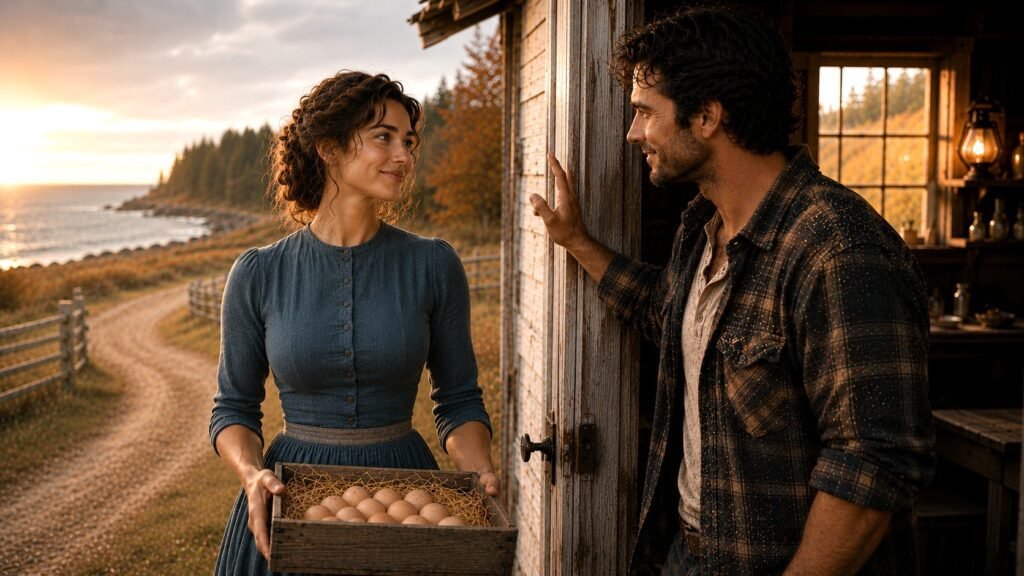
Thornhollow Cove, Maine, 1946
Clara Whitfield left the house before the gulls did, which in October meant walking down to the henhouse in a dark so complete it had a weight to it, a wool coat over her nightclothes and a lantern swinging cold light across the frost-stiffened grass. It had been her life for three years now, since her father’s dory went down in a squall off Widow’s Point and left her a flock of forty hens, a smokehouse, eleven acres running down to the tide flats, and a debt she had never once spoken about outside the walls of her own kitchen.
She did not know it yet, but the hurricane of ’38 was the reason any of it had happened at all. It had come through eight years earlier and torn the coast to pieces — boats splintered on the rocks, weirs gone, whole families with nothing left to fish from or farm with. The ones who survived it with anything standing knew exactly who had come around afterward with cash money and a patient smile, buying up ruined land for a fraction of what it had been worth the week before.
One of those men was Elias Vane.
Clara carried her eggs in wooden flats she padded herself with straw, packed into the bed of a hand cart she pulled along the shore road because the family never had money enough to keep a truck running. To keep the eggs cool through the warm months she stored them in the springhouse dug into the hill behind the barn, the one built by her grandfather, stone-walled, spring-fed, the only icebox a family like hers could afford.
That was how it was done in Thornhollow Cove, and it worked well enough. The route took two hours on a good morning, eleven houses, starting at the Pruitt place at the top of the ridge road. The list had changed the month before. The old Ashford cottage, empty for four years since Peter Ashford disappeared rather than stand trial for a theft everyone in the cove still argued about over supper, had a new light in its window.
Six weeks earlier, a man had come down from Bangor on the mail boat and started putting the place back together board by board. Nobody in town could say for certain who he was, only that he worked from can’t-see to can’t-see and kept to himself, and that once, when old Mrs. Pruitt asked him straight out, he’d said only that his name was Ashford too.
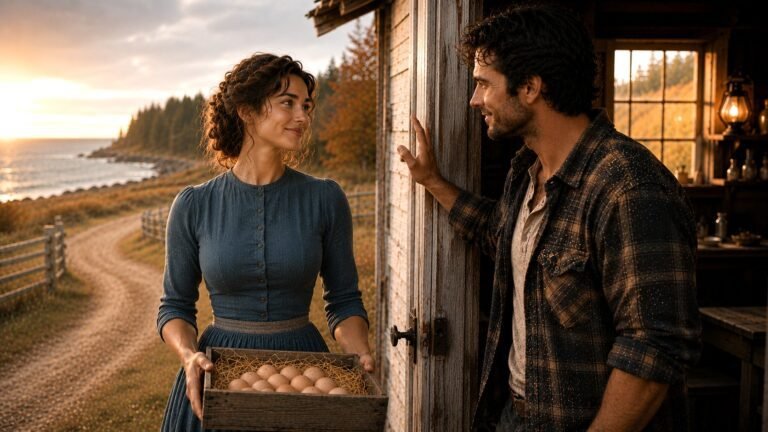
Clara knocked twice on the cottage door on the second Thursday of October. No one answered either time. She knocked again the following week, and this time the door swung open on a man with sea-dark hair gone unruly, sawdust on the shoulders of his flannel, and the look of someone who had been awake working since before the light came up.
“Fresh eggs,” she said, holding up the flat between them like a shield. “Twelve cents a dozen.”
He looked at the eggs. He looked at her.
“I’ll take two dozen,” he said, “if you’ll stay long enough for breakfast.”
She looked at the sawdust on his shirt, the coffee pot she could hear ticking on the stove behind him, the cold gray morning at her back and the two hours of route already behind her, and nowhere in particular she had to be for the next hour of her life.
“I’ve got the stove hot already,” he said, “and biscuits that just came out.”
She went in. It was not ten minutes before she’d forgotten to be careful about it.
The Ashford cottage was not what she expected. The front room still smelled faintly of the smoke damage from the year it had stood empty, but someone had scrubbed the hearthstones white and hung the cookware in neat rows by size, and a window over the washbasin faced the water so the whole kitchen filled up gold when the sun cleared the point. He moved through that small space like a man who’d built it with his own hands, which, she would learn, he very nearly had.
He split the biscuits without ceremony, laid the bacon without fuss, poured her coffee before he’d asked how she took it, and when she reached for the sugar tin, it was already sitting by her elbow, which told her he had planned for her to stay before she’d agreed to.
“You’re Peter’s brother,” she said.
“I am. Samuel.” He set the pot back on the stove. “Samuel Ashford.”
“Clara Whitfield. My family keeps the henhouse and the smoke shed at the south end of the cove road.”
“I know. I’ve seen your cart on the ridge three mornings running.” He sat across from her. “I’ve been six weeks learning how this town works. Who talks to who, who owes who. Easier to understand a place before you try to live in it again.”
She ate the biscuit, which was good, and the bacon, which was better, and drank coffee that was the best she’d had since her father used to make it too strong on Sunday mornings before church. She didn’t say any of that aloud. She said, “What happened to Peter?”
His face went still the way a door goes still when someone’s holding it, deciding which way it means to swing. “He was accused of hauling traps that weren’t his off the Hollis grounds, four years back,” he said. “He didn’t do it.”
“How do you know?”
“Because I know my brother. And because those traps turned up the next spring re-branded and sold off a stretch of shoreline that got bought up not long after by a man who had every reason to want Peter gone and discredited.”
“What man?”
“Elias Vane.”
Clara went quiet in a way that made him look at her twice.
“I know that name,” she said.
She did not tell him everything that morning. She told him the surface of it — that Vane ran the cannery and the general store and had a hand in half the cove’s business, that his name had a way of turning up in every transaction nobody could quite explain to your satisfaction. She did not tell him about the note her father had signed, or who held it now. That was her own trouble, and she had been carrying it alone for three years, the way you carry a weight so long you forget it has a shape other than your own back.
She left the cottage forty minutes after she’d arrived, later than she meant to and not sorry for it.
“Same time next Thursday?” Samuel asked at the door.
She looked at the flat in her hand, two dozen eggs lighter. “You only took two dozen.”
“I’ll need more by Thursday,” he said. “Seems I’ve taken up baking.”
On the walk back down to the cart, she thought about Vane, about Peter Ashford, about traps that weren’t his and a man well connected enough that nobody in the cove had ever thought to ask a hard question out loud. She thought about her own father’s note and who held it, a question she had been putting off for the better part of a year, because some answers, once you have them, cannot be unknown again.
She decided that week she was going to find out.
Thursday she came with three dozen. He’d laid out a real breakfast this time — fried potatoes, eggs done soft the way she hadn’t mentioned but he’d guessed, bread still warm enough to steam when she tore it.
“You planned for this,” she said.
“I knew you were coming.” He set the plate in front of her. “Seemed sensible to be ready.”
“This is not a man who needs three dozen eggs a week.”
“I’ve taken up baking,” he said again, and left it there, which made her laugh before she could stop herself, a short surprised sound that seemed to please him more than anything he’d said all morning.
She looked at him a long moment over the steam off her coffee. “Samuel. Why’d you come back here, of all the places you could’ve gone?”
He thought about it — not the quick answer, the true one, the way a man does when he’s decided a question deserves the extra silence. “Because Peter is somewhere out there in the world still carrying what was done to him, and whatever was done was done here. The only way I know to fix it is to be where it happened and understand it well enough to undo it.” He turned his cup a quarter turn on the table. “And because the land’s ours. Was ours before Vane ever got a foothold on this coast, and I’m not going to let that be the end of the story.”
“That’s two reasons.”
“It is. There’s a third, but it’s not fully formed yet.”
She almost asked. She saw him see her almost ask, and something in his face made her look at her plate instead.
They talked an hour past when she should have been back on her route. When she finally stood to go, he walked her out to the cart.
“Saturday?” he said.
“I don’t run deliveries Saturdays.”
“I know,” he said. “I wasn’t asking about the eggs.”
She pulled the cart the rest of the way home turning that sentence over the whole time, the plainness of it, like he’d handed her something and expected her to already know what it was for. She told her mother she’d be out Saturday morning. Her mother, who had watched her daughter leave before light for three years without once complaining, said only, “Wear the blue dress. Not the work one.”
Clara wore the blue dress.
Samuel took her walking along the tide flats that Saturday, the water gone out so far it left the mudflats bare and glistening under a low gray sky, gulls working the shallows for whatever the tide had left behind. He’d brought a pail of steamed clams wrapped in cloth to keep the heat in, and they sat on an overturned dory hull above the wrack line and ate them with their fingers, salt and butter and woodsmoke on the wind.
“You don’t talk about the war,” she said, watching him work a clam shell open with a thumbnail.
“No.” He set the empty shell in a small growing pile between them. “There’s not much of it that improves in the telling.”
“You don’t have to tell it.”
“I know.” He looked out at the water a moment, at some point past the horizon she couldn’t follow him to. “Peter used to say I came back quieter than I left. I think that’s true. There’s a kind of quiet that settles into a man out there and doesn’t leave when the fighting’s done. You just learn to carry it different.” He glanced at her. “You’d know something about carrying things different. You’ve been doing it three years.”
“That’s not the same as war.”
“No,” he agreed. “But grief doesn’t much care what shape it takes getting into a person. Your father, my brother — different griefs, same weight, near enough.” He handed her another clam, still warm. “I noticed you don’t talk about him either. Your father.”
“Not much to say that isn’t just missing him.”
“That’s plenty,” he said. “That’s the whole of it, most days.”
They sat a long while after that without either one of them saying much of anything, the tide beginning its slow crawl back in around the dory hull, and Clara found she did not mind the silence at all — found, in fact, that she had not felt this unhurried in longer than she could easily count.
“I should get back,” she said eventually, though she made no move to stand.
“Should,” he agreed, and neither of them moved for another quarter hour.
She confirmed it on a Monday at the county registry office in Ellsworth, a forty-minute wagon ride she made up an excuse to take. The original note on the Whitfield land had been held by Merchant’s Trust in Bangor. It had been quietly transferred, fourteen months back, into the private holding of one Elias Vane.
But there was something else in the file, something the clerk had no particular reason to point out to her and that she very nearly missed on her way past it. Buried in the original loan papers from 1938 — the year of the storm, the year everything in the cove had gone sideways at once — was a co-signer’s clause. The name on it, ink gone brown with age, was the same one.
Elias Vane.
It meant Vane had known about her family’s debt, and the value of their shorefront acreage, since before the storm ever hit. It meant he had held a financial interest in the Whitfield land he had never once disclosed to the family whose note he later bought and whose farm he was, patiently, quietly, buying out from under them. Under Maine law, a co-signer who purchased a note without disclosing that conflict to the original borrower wasn’t operating in some gray, defensible corner of the law. It was fraud, plain and documented, sitting right there in his own signature gone faint with time.
Clara stood at the counter a long while. She walked out onto the street and did the arithmetic in her head the whole way to the wagon. The interest on a transferred note ran different from what the bank itself would have charged. The payment she’d been counting on making in the spring wouldn’t cover it. Ten months, if the hens laid well and the winter wasn’t cruel.
She thought about the spring that fed her family’s springhouse, cold and constant for sixty years, and how under Maine water law the rights to it were worth more than the eleven acres sitting above it, because whoever held those rights controlled everything that depended on that water downhill.
She thought about Vane’s cannery, less than a mile down the shore from that spring, always short of clean fresh water in the smoking sheds.
She understood.
She didn’t tell Samuel. Not yet. It was her trouble, and she’d been carrying it alone long enough that the carrying itself had started to feel like the only proof she had that she could.
Before the story goes on, I want to ask you something. If this one’s keeping you company tonight, tell me in the comments what you’re doing while you listen. I read every one.
Now, back to the cove — because Samuel Ashford had been doing some digging of his own.
He’d been at it for weeks, not out of some vague hunch but the way a man works a problem when he means to actually solve it: back to the beginning, and through it in order. The beginning was the Hollis grounds, the autumn of 1937. Twelve strings of traps gone missing, turned up the following spring off a stretch of shore two coves over, one that got folded into Vane’s holdings not long after, sold for well under what any waterman would have called it worth. The fellow who’d owned it left the county inside a month, and no one ever got a straight answer why.
The buoys on the recovered traps carried the Ashford colors, repainted — a second color worked in over the first in a way that took real knowledge of the original scheme to disguise properly. The man who’d reported the theft to the county sheriff hadn’t been Hollis at all. It had been Vane, who ran no traps of his own on that stretch of water and had no obvious business noticing whose gear sat where. He’d simply mentioned, in passing, seeing Ashford buoys where they had no cause to be.
The sheriff’s original inquiry had been thin — no warrant, no depositions, the whole matter closed the hour Peter left town rather than face a charge with nothing standing between him and it.
Samuel spent three weeks writing letters to anyone who’d fished those waters in ’37. Two wrote back. One, a widow in her seventies who still kept a skiff tied at her own dock, remembered seeing Peter the night before the traps went missing — miles up the coast, helping four other men re-float a grounded schooner off Corbett’s Ledge, men who could all still vouch for where he’d been. None of that had ever made it into the sheriff’s file.
Samuel knew it wasn’t enough on its own to reopen anything. He’d need the state to agree to a formal review, with authority to examine the county’s buoy and sale records, and that would take weeks he wasn’t sure he had. He wrote to the Attorney General’s office in Augusta requesting exactly that, and attached his witnesses’ names.
The answer came back in early November. A state investigator would come down to Thornhollow Cove in person, with authority to examine the records and take depositions under oath.
That was the same week Samuel went to the registry office himself — the same Monday Clara had gone, neither of them yet knowing the other had stood at that same counter.
He told her on a Saturday what he’d found about the debt and the spring, because it was her situation and she had a right to the shape of it, even the part of the shape that touched him.
She listened without interrupting. “I already knew,” she said when he finished. “Found it out myself, weeks ago.”
“And you didn’t say.”
“It’s my trouble. I was handling it.”
“You’ve been handling it alone three years,” he said. “That’s not the same as it not being anyone else’s business to help with.”
“I don’t want charity.”
“It isn’t charity.” He said it plainly, the way he said most things. “I’ve got a cousin who runs the fish house in Bar Harbor who’d buy eggs and cured hams straight off you if you could put up more than the cove can eat — that’s a market, not a favor. I’ve got a smokehouse standing empty on my own land I’ve no earthly use for by myself. In return, you tell me everything you know about Vane’s dealings in this cove, because I mean to put a stop to them.”
She considered it the way she considered everything — practically, turning it over for the sense in it the way she’d once rebuilt her own cart wheel with scavenged spokes rather than pay a wheelwright. The offer made the kind of sense the things worth doing usually make.
“All right,” she said.
Vane heard about the state’s inquiry sooner than anyone expected. A clerk in Ellsworth owed him favors going back a decade. He did not back off it. Vane had come through the storm of ’38 by buying land off desperate people at a fair remove from the law, and he was not the sort to fold over one old witness and a stack of yellowed paper.
He started a rumor instead — that Samuel Ashford’s interest in the Whitfield place ran deeper than eggs, and that the interest had a name: the spring. And he did more than talk.
One night in the second week of November, two men working for Vane came out along the Whitfield property line where it ran down toward the springhouse. They had not come to burn anything or steal anything. They had come to survey. They drove iron stakes along the bank of the stream that fed the springhouse, close enough to the water that the meaning wasn’t lost on anybody who found them. One of the men, on his way back out, put a boot through a section of the hen-yard fence, and eleven birds got loose onto the shore road before morning.
Not an accident. A message.
Clara found the stakes at first light, out looking for the missing hens in a cold that put a burn in her chest with every breath. She stood over the iron a long time before she pulled each one out of the ground with her bare hands, the metal so cold it took the skin off her palms in thin red lines she didn’t feel until later.
She didn’t tell her mother. She told Samuel, and this time she didn’t hesitate over it.
He turned the stakes over on his own kitchen table, reading the maker’s stamp burned into each one. “That’s not a rumor,” he said. “That’s intimidation. And intimidation leaves a trail a rumor never does.”
He brought the stakes to the state investigator, who was still in the cove finishing depositions on Peter’s case. The man examined the stamp, matched it to the lumber mill that supplied Vane’s own cannery sheds, and added it without a word to what he was already building.
Even so, for two weeks after, Clara stopped delivering to the Ashford cottage. She left the eggs at the gatepost and kept walking. She told herself it was caution — that she couldn’t afford to be seen tied too close to a land dispute with Vane watching every cart on the ridge road. It was easier to tell herself that than to admit what she was actually afraid of, which wasn’t Samuel at all, but what it would cost her to let herself get closer to someone and then lose him and the spring both to the same man in the same season.
He left her payment tucked under a stone at the gate every time and never once came looking for her to ask why.
On the fifteenth morning, he was waiting at the gate when she came up the road.
“I know you heard the talk,” he said. “And I know the stakes frightened you plenty. I want to say one thing, and then I’ll let you go on with your route, and whatever you decide after that is yours to decide, not mine.”
She held her ground and let him say it.
“I found that spring in the county records two weeks before I ever learned about your father’s note,” he said. “Found the note after. Understood what Vane meant to do with the both of them after that. I did not come to your gate because of water rights, Clara. I came because the same man who ruined my brother’s name is working to ruin yours, and staying quiet about that wasn’t a thing I was built to do.”
She stood there with the cart handle biting into her cold hands. “The spring’s mine,” she said finally, testing it.
“It’ll stay yours,” he said. “I’ve no interest in your eleven acres or your water right or anything at all on the Whitfield place except the woman who hauls eggs up this ridge before the sun’s over the water and mends her own fences and won’t take a thing from a man unless the trade’s fair on both sides.”
She was quiet a moment, the wind coming up cold off the cove behind her.
“I owe you an apology,” she said. “I knew you well enough by then to know better. I took the easier answer for two weeks running.”
“The easier answer’s the one that lets you not look straight at a thing,” he said. “You look at everything straight on. It’s one of the — ” He stopped himself before the sentence finished, like he’d heard how far it was about to go.
“Come in for breakfast,” she said instead of asking him to finish it.
“I’m off my own route today,” he said, and opened the gate for her before she’d even set the cart handle down.
Inside, he put the coffee on without asking and she found herself watching his hands the way she hadn’t quite let herself before — the deliberate, unhurried way he did every small thing, like the doing of it mattered as much as the thing done.
“I nearly didn’t come today,” she admitted, turning her cup slowly on the table. “I stood at my own gate a full ten minutes deciding.”
“What decided you?”
“My mother, if you want the truth of it. She said I was wearing a groove into the kitchen floor with all my pacing and either I should go up the ridge or stop pretending I wasn’t thinking about going.” Clara looked at her hands. “She’s not wrong about much, my mother.”
“I’d like to meet her properly. Not just waving from the road.”
“She’d like that. She’s been asking after the man who bakes bread twice a week for a girl who only asked for eggs money.” Clara allowed herself a small smile. “Word travels fast on the ridge road.”
“Word travels fast everywhere there’s fewer than a hundred people in it,” he said. “I grew up here, remember. I know exactly how fast.”
“Then you know what it’ll do with this. Two weeks of me leaving eggs at your gatepost and not coming in — half the cove probably has us married and divorced twice over by now.”
“Let them talk,” Samuel said, and there was nothing careless in the way he said it, only a kind of settled certainty that made her look up at him. “I’ve got nothing to be ashamed of in how I’ve gone about this, and neither do you. A woman being careful with her heart after three hard years isn’t a scandal. It’s good sense.”
She held his gaze a moment longer than was strictly comfortable, and did not look away first.
Samuel brought everything to the Thornhollow Cove town meeting in the first week of December — the widow’s sworn statement, the repainted buoy records, the questionable land sale two coves over, the buried co-signer clause on the Whitfield note, and the survey stakes stamped with the mill mark that traced straight back to Vane’s own sheds.
By then the state investigator had authority from Augusta not to arrest Vane on the spot, but to formally summon him to answer for fraud on the note, and to reopen the Hollis trap case for good.
Vane knew the meeting was coming. He came anyway. Not coming would have meant admitting, before he’d decided to, that he had already lost.
When Samuel finished laying it all out, Vane stood at the back of the grange hall. “Old paper’s worth nothing,” he said, his voice dry as the woodstove heat. “A woman’s memory of a man on a road nine years gone in the dark isn’t proof of a thing in front of a judge.”
“Maybe not alone,” the investigator said from the front, holding the summons up where the whole room could see it. “But set alongside a repainted buoy, a land sale that doesn’t add up, and a co-signer’s clause you kept hidden from your own borrower, it’s enough to bring you to Augusta to answer for it. Formally. On the record.”
Vane looked around the hall — sixty people he’d known twenty years and more, looking back at him the way a town looks at a man once it’s understood how long it’s been trusting him past what he’d earned. There was nowhere left in that room for him to go, and no one in it left willing to stand up on his behalf.
He sat down. Silent. Knowing the summons would go through whether he cooperated with it or not.
He rose again only when the investigator walked him to the door.
The hall stayed quiet a long moment after. Then old Mrs. Pruitt, who’d lived in the cove longer than anyone left in it, said from the front row, “Well. Does anyone have other business for the meeting?” And the meeting went on, the way a town does, because a town has to.
Peter Ashford came home in the second week of December. He’d been in Nova Scotia under a name that wasn’t his own since the year he left, not out of guilt but because a man with nothing standing between him and a charge like that knows exactly what staying means. Samuel’s letter had taken weeks to find him.
He arrived on a Tuesday, the day of the Ashford delivery. Clara was at the gate when the wagon came up the shore road, and from fifty feet off she watched two brothers see each other for the first time in four years.
She set the egg flat down on the gatepost and walked home without a word. She cried in the henhouse for twenty minutes, sitting on an overturned bucket among the roosting birds, the first time she’d cried like that since her father’s funeral. Then she washed her face at the pump and went in to check on her mother.
Samuel came by that afternoon, still with the look of a man who hadn’t quite believed the morning until he’d lived through the whole of it.
“He’s home,” he said. “Thinner than I expected. Angrier too, which is actually the better sign — it means he never stopped believing it would come right eventually.” He looked at her a long moment. “He’d like to meet you. He’s heard plenty about the egg woman on the ridge road.”
She looked at him. “Samuel Ashford. You’ve been baking bread Tuesdays and Thursdays since the middle of October. You’ve had the coffee on before I ever got up the hill, every single time. You spent three months finding out exactly what trouble I was in and doing something about it without being asked.”
“I did.”
“Why?”
“Not for the spring,” he said. “Not for the land, and God knows not for the eggs, though I’ve come to be fond of them. For you.” He turned his hat once in his hands, an old habit she’d noticed and never mentioned. “I’d like to court you properly, Clara, if that’s a thing you’d consider.”
She thought about the bread getting better every single week, about the coffee that was always hot no matter what hour she made it up the ridge.
“Samuel,” she said, “I’ve been considering it since the first Thursday.”
He didn’t quite laugh. It came out instead as the smile she already knew by heart, the one that changed the whole shape of his face when it arrived.
They were married in April, in the little white church at the head of the cove, the marsh grass just starting to green up along the tide flats and the alders in bud along the ridge road. The whole town turned out. After watching Vane get walked out of the grange hall in December, and spending the winter understanding just how long he’d been quietly working the cove over, Thornhollow Cove had been more than ready to gather for something simple and good.
Peter stood up front beside his brother. He and Samuel had been rebuilding the cottage and the boat shed together since the day he came home, and it had always gone easier between the two of them working side by side than it ever had apart. He’d met Clara for the first time on a gray Wednesday afternoon in her family’s henhouse, of all places, and told his brother afterward, “Well. You always did have sense about the things that actually matter.”
Clara’s mother sat in the front pew in the blue dress she’d once told her daughter to wear on a Saturday morning. Her breathing had eased since December — not all at once, not dramatically, but the way it does when a weight someone’s been quietly carrying finally sets itself down.
After the ceremony, Peter found his brother out by the church steps. “I’ll be needing eggs of my own now,” he said. “Twelve cents a dozen, same as always.”
“There’s no discount for family,” Samuel told him.
“Wouldn’t take one if you offered.” Peter looked out toward the water. “She’s got the spring, and the sense to go with it. That’s worth more than a fair price.”
The henhouse grew slow and careful, the way things meant to last generally do. By the following spring Clara kept sixty birds and a proper new coop Samuel and Peter had raised together over three weekends in March. By the second year she had a standing order with two hotels in Bar Harbor and a name for herself along that whole stretch of coast that had taken two years to build and would take a good deal longer than that for anyone to unseat.
The spring behind the springhouse, on what the county now recorded as Ashford-Whitfield land, ran clean and cold, same as it had for sixty years and more. The water rights sat properly filed at the county seat, and no one ever again thought to question them.
Elias Vane was taken to Augusta to answer the charges not long after the December meeting. The case dragged on through the winter and into the spring after that. He never came back to Thornhollow Cove. No one in the cove ever heard his name spoken again except as a caution to newcomers about what patience in the wrong hands could do to a town that trusted too easily.
On a Tuesday morning in the second spring after the wedding, Clara loaded her egg flats into the cart before first light, same as she had every working morning of her adult life. Samuel came out onto the step with two cups of coffee and handed her one, the steam rising white into the cold air between them.
“Same route?” he asked.
“Same route.”
“I’ll have breakfast on when you’re back.”
She climbed up onto the cart seat and looked out at the dark ridge road ahead of her, the water still black beyond it, the first gray beginning to come up along the horizon line where the sky met the sea.
“Samuel,” she said. He was still on the step.
“Thursday’s bread,” she said. “It was better than the week before.”
“I know,” he said. “Changed the ratio.”
“Don’t change it again,” she said. “It’s right the way it is now.”
“It is,” he agreed, and lifted his cup to her the way a man does when he means it as a small private toast, meant for no one else on the road but her.
She drove off down the ridge, and the Maine morning opened up slow around her — vast and cold and just beginning to turn from black to the first dark blue of day. And everything, the route, the henhouse, the spring, the man on the step with his coffee going cold in his hand while he watched her go, was exactly where it was meant to be.
Clara Whitfield knocked on a stranger’s door with two dozen eggs and a price already set in her mind. She had not planned for anything that came after. Neither had Samuel Ashford. He’d had a kitchen turned toward the water to catch the morning light, coffee on, biscuits in the oven, and the readiness of a man who had been watching the ridge road for weeks and noticed the same cart passing three mornings running.
He said, “I’ll take two dozen, if you’ll stay for breakfast.”
She stayed forty minutes. Not just for the biscuits, though they were good. Not just for the coffee, though it was the best she’d had in years. Because something in that small kitchen felt like a room that had been waiting a long time to be used the right way by the right people.
And what came after was not charity, and it was not rescue. It was two people who already knew how to stand on their own ground, choosing, in the end, to stand it together instead — because together turned out to be better, and they were both honest enough, in the end, to admit it.
Every morning after, he had the coffee ready. Every morning after, she came home to it.
Some things really are that simple. And exactly that hard to find.