
Waiting Tables, Waiting on Life
The Formica counter at Ruthie’s Diner had a burn mark shaped like Ohio, and Delia Marsh had stopped noticing it the way she’d stopped noticing most things about her own life — which was to say, completely, and on purpose. She wiped it anyway, out of habit, the rag moving in slow circles while the overhead fan ticked through its same tired rotation and the coffee machine hissed its four o’clock complaint.
Twenty years of waiting tables did something to a person’s hands. Delia’s were quick now, economical, folding napkins into perfect triangles without her eyes ever leaving whatever she was actually thinking about, which tonight was the cream-colored envelope sitting unopened on the shelf beneath the register. Class of 2004 — Twenty Years Later! Join us at the Kensington Grand. She’d read it exactly once, standing in the walk-in cooler where nobody could see her face do whatever it was doing, and then she’d shoved it under a stack of receipt tape and gone back to work.
She reached into the front pocket of her apron, the way she did a dozen times a shift without registering she was doing it, and felt the smooth, worn edge of the silver dollar there. It was old, older than her — 1962, her thumb had traced the date so many times the numbers had gone soft as a scar. For luck, he’d said, pressing it into her palm on the hood of his mother’s Buick the night before he left for college, his voice cracking on the word like he already knew it wasn’t going to be enough. She’d carried it every day since. Not because she believed in luck. Because at some point believing in it and carrying it around had become two entirely separate things, and only one of them had survived.
Nathaniel Calloway had left this town at eighteen with a scholarship and a promise, and the promise had lasted exactly four months, which was as long as it took for the letters to slow from every week, to every month, to nothing at all. No fight. No ending. Just a silence that grew wider the way distances do, until Delia was twenty-two and pregnant by a man who left even faster than Nate had, and she was working double shifts at Ruthie’s to keep the lights on, and somewhere along the way she’d stopped expecting anyone to come back for her at all. She’d stopped believing that leaving and staying were choices some people got to make about her. Mostly she’d stopped believing it was worth flinching over.
She had a daughter now — Josie, seventeen, sharp as a tack and twice as stubborn, currently upstairs at the apartment doing homework Delia couldn’t help with anymore, not the calculus part anyway. Josie was the one good, unarguable thing that had come out of a life that otherwise read, on paper, like a cautionary tale. Delia didn’t regret much. She’d trained herself not to. Regret required believing things could have gone differently, and believing that took an energy she needed for double shifts and grocery budgets and the particular exhaustion of raising a person alone.
The bell over the door jangled and Marisol came in shaking rain off her jacket, dropping her purse on the counter stool with the theatrical flop of a woman who had something to say and intended to be dramatic about saying it.
“You didn’t RSVP,” Marisol said. No greeting. Twenty-two years of friendship had worn most greetings down to nothing.
“I’m working the reunion, apparently,” Delia said, nodding at the shelf. “Right there under the receipt tape.”
“Delia.”
“I’ve got a shift.”
“You own the diner, you can give yourself a night off.” Marisol slid onto the stool and fixed her with the look — the one that had gotten Delia into a homecoming dress freshman year and a community college enrollment form a decade later. “Everybody’s going to be there. Even Coach Ferris, God help us. It’s twenty years, Dee. You don’t get this one back.”
Delia didn’t answer right away. Outside, the rain had picked up, streaking the diner’s front window into something soft and blurred, the streetlight beyond it smeared to a warm gold smudge, and for a moment she let herself look at nothing in particular, which was its own kind of rest.
“He’s not going to be there,” she said finally, and hated how much it sounded like a question.
Marisol’s face did something complicated. “You saw the article?”
“What article.”
“He’s in Forbes, Dee. He built some kind of — I don’t even know, some software thing, defense contracts, satellites, something. Sold half of it for more money than this whole county’s worth. He’s coming back for the reunion, there was a whole thing about it in the alumni newsletter, ‘hometown boy makes good,’ they practically wrote him a parade.” Marisol reached across the counter and closed her hand over Delia’s, the one still resting near the apron pocket. “I didn’t want you finding out from someone else.”
Delia looked down at their hands, and then, without quite meaning to, at the counter, at the burn mark shaped like Ohio, at the reflection of herself in the napkin dispenser’s chrome — tired around the eyes in a way that had crept up on her slowly, an apron with someone else’s ketchup stain on the hem, hair pulled back the same practical way it had been pulled back for twenty years because there was never quite enough time to do anything else with it.
Twenty years. A software company. Satellites. And her, still standing exactly where he’d left her, still worth exactly one silver dollar and a promise that had lasted a season.
“I’ve got a shift Friday,” she said again, and this time it came out steadier, the door of it closing with something that almost sounded like relief.
Marisol didn’t push. She never did, not really, not past the first three attempts. She just squeezed Delia’s hand once, ordered a coffee she didn’t drink, and left a five-dollar tip on a two-dollar cup, the way she always did, the way she’d been doing since the year everything fell apart and neither of them had ever once talked about it directly.
That night, after close, Delia sat on the back step of the diner with her feet in the alley and the coin turned over twice in her palm, heads, tails, heads, the metal cool and unbothered by the twenty years that had passed since a boy who loved her had pressed it there and told her it would bring her luck. She didn’t cry. She’d used up whatever tears that particular story deserved a long time ago. She just sat, and let the rain-washed dark hold her a while, and thought that some doors, once they’d been closed long enough, simply became wall.
She went in Friday anyway. Not because Marisol talked her into it — though Marisol tried, right up until she pulled the dress out of the bag herself and physically laid it across Delia’s bed with the particular stubbornness of a woman who had run out of patience for other people’s fear. Delia went in because some small, unkillable part of her, the part that still carried a silver dollar in her apron pocket after two decades, wanted — just once — to walk into that ballroom and be seen as something other than the woman who’d stayed.
The Reunion Collision
The Kensington Grand had chandeliers the size of Delia’s first apartment, and she stood just inside the ballroom doors for a long moment, feeling entirely too visible in Marisol’s borrowed green dress, watching two hundred forty-year-olds try to reconstruct the confidence they’d worn at eighteen. A string quartet played something that had no business being played at a high school reunion, all cello and quiet ambition, and the room smelled of candle wax and expensive perfume layered over the particular nervous sweat of people about to be measured against who they used to be.
She found her name tag on the table by the door — DELIA MARSH, and beneath it, in smaller print, Class of 2004 — and pinned it on with hands that weren’t quite steady, and told herself that was the champagne she hadn’t had yet, not nerves, not anything about who might or might not be standing across that room in a suit that cost more than her car.
She saw him before she was ready to.
He was near the bar, half-turned away, and it wasn’t even his face that gave him away first — it was the particular way he stood, weight shifted onto one leg, head tilted slightly like he was listening to something no one else could hear, a stillness she’d have known blindfolded from a hundred yards. Eighteen years old on the hood of a Buick. Thirty-eight now, gray threading in at his temples, a suit cut close enough that it hadn’t come off any rack in this state, but the stillness was exactly the same, and something in Delia’s chest folded quietly in on itself.
She didn’t get the chance to decide whether to approach or retreat. He turned, scanning the room the restless way people do at these things, and his eyes crossed hers and stopped, and for one full second neither of them moved at all.
“Delia.” Her name in his mouth sounded exactly the way it used to, which she hadn’t expected, hadn’t braced for, and it landed somewhere just beneath her ribs.
“Nate.” She managed it evenly. Mostly evenly. “Or should I be saying Mr. Calloway now. I hear you’re a big deal.”
Something flickered across his face — not quite embarrassment, something closer to relief, like he’d been waiting all night for someone to make fun of him instead of asking for a business card. “God, don’t. Please don’t.” He crossed the space between them, and up close the twenty years showed more honestly — the lines at his eyes, a small scar above one eyebrow that hadn’t been there before, the weight of something in his shoulders that money apparently hadn’t fixed. “You look —” He stopped, seemed to reconsider several words, and landed on, “Exactly like yourself. Which is a strange thing to say. I mean it as a compliment.”
“I’ll allow it.” She managed a smile that surprised her by being almost genuine. “You look like you own a satellite.”
“Four of them, actually,” he said, and then immediately winced at himself. “That’s — I don’t know why I said that. I don’t usually lead with the satellites.”
“What do you usually lead with?”
“Honestly? I haven’t been to one of these in twenty years. I don’t have a lead.”
A waiter drifted past with a tray of champagne, and Nate reached for two without asking, handed her one, and their fingers brushed in the handoff in a way that felt, absurdly, like the entire ballroom had gone quiet around it, though the quartet kept sawing away obliviously in the corner.
“To surviving high school,” he said, lifting his glass with the crooked, self-deprecating half-smile she remembered from a hundred years ago, back when it had belonged to her more days than not.
“To surviving everything after it,” she said, and clinked her glass to his, and something in the way he flinched, almost imperceptibly, told her the toast had landed exactly where she’d half-intended it to.
They ended up at a table near the back, away from the dance floor, and the conversation moved the careful way conversations move between two people who used to know each other’s whole interior weather and now had to relearn the coastline from scratch. He asked about the diner — he already knew about the diner, she realized with a small jolt, someone must have told him, or he’d looked — and she gave him the short version, the version that didn’t require either of them to sit with the long one.
“I heard you own it now,” he said. “Ruthie’s. Not just work there.”
“Five years next spring. Ruthie retired to Florida, I took over the lease before I really thought it through.” She turned her champagne glass by the stem. “It’s not satellites.”
“It’s a diner that’s fed this whole town for forty years,” he said, and there was no condescension in it at all, which was somehow worse, because it would have been easier if there had been. “I ate breakfast there the morning I left for college. Did you know that? Table by the window. Ruthie gave me the pancakes on the house and told me not to get too big for the place I came from.”
“Did you listen to her?”
He was quiet a moment, turning his own glass, and when he answered his voice had dropped into something rougher, more honest. “Not for a long time. I got exactly as big as she warned me not to get. Built companies. Sold companies. Woke up in hotel rooms in four different time zones and couldn’t have told you what town I grew up in if you’d asked me at three a.m.” He looked at her directly then, and there was nothing performed about it. “This is the first reunion I’ve come back for. I almost didn’t come to this one either.”
“Why did you?”
He didn’t answer that right away, and the not-answering said something she wasn’t ready to examine at a ballroom table with two hundred people fifteen feet away. Instead he nodded at her hand, where it rested near her champagne glass, the apron long gone but the habit apparently permanent — her thumb moving in a small unconscious circle against the pad of her index finger, the exact motion of turning a coin.
“You still do that,” he said quietly. “The little — with your hand.”
She stilled it, self-conscious. “Do what.”
“You used to do that with the coin. When you were nervous. I used to watch you do it across a cafeteria table and think it was the most honest thing about you — everybody else performing being fine, and you just quietly turning that coin over like it was the only true thing in the room.”
Delia’s throat tightened around something she refused to let show on her face. “I still have it,” she said, before she’d decided to say it. “The coin.”
Something crossed his face that she couldn’t name — not quite surprise, closer to a held breath finally let go — and for a moment the whole overdressed, overlit ballroom fell away and it was just the two of them and twenty years folding down to almost nothing at all.
“I have to tell you something,” he said, “and it’s going to sound insane.”
“Try me. I run a diner. Nothing sounds insane to me anymore.”
“I’ve thought about that Buick more times in the last twenty years than I’ve thought about most of the companies I’ve built.” He laughed, short and disbelieving at himself. “I gave a keynote in Singapore last spring in front of four thousand people and half of what I was thinking about was whether you still had that stupid coin.”
“It’s not stupid,” she said, quieter than she meant to.
“No,” he agreed, watching her steadily. “I don’t think it is either.”
Someone from their old homeroom crashed the moment with a shriek of recognition and a demand for a photo, and the spell broke the ordinary way spells do, dissolved into small talk and old jokes and the general noise of two hundred people trying to out-remember each other. But when Delia finally drove home that night, the coin heavy in her clutch where she’d tucked it before leaving the apartment — she hadn’t planned to bring it, hadn’t consciously decided to, and yet there it was — she understood with a kind of quiet dread that something in her had shifted that wasn’t shifting back. And somewhere across town, in a hotel room four times the size of her apartment, Nathaniel Calloway lay awake staring at a ceiling he couldn’t afford to care about, turning over in his mind not a single satellite contract, but the exact sound of Delia Marsh saying I still have it like it was the truest thing he’d heard in twenty years.
What the Reunion Left Behind
He came into Ruthie’s the following Tuesday at 7:40 in the morning, which Delia would later learn was intentional — he’d asked Marisol, discreetly, when the diner was quiet enough for conversation and busy enough not to look like a scene. He sat at the counter, not a booth, ordered black coffee and the pancakes, and when Delia set the plate down in front of him he said, “Ruthie used to make these better,” with a completely straight face, and she laughed before she could stop herself, loud enough that old Mr. Pruitt looked up from his crossword in the corner booth.
“I’ll let her know you said so, she’s very reachable in Florida.”
“Please don’t.”
It became a thing that happened, without either of them naming it as a thing. Tuesdays, sometimes Thursdays, always the counter, always black coffee, and a conversation that moved slower each time, less like two people catching up and more like two people carefully, deliberately relearning a language they’d both once been fluent in. He never made it about the money, never once mentioned a number or a deal or a headline, and she noticed that as its own kind of tenderness — the specific effort it took a man worth what he was worth to sit at a diner counter and simply ask what time Josie got out of school.
“She wants to study astrophysics,” Delia told him one gray Thursday in October, wiping down the counter beside where he sat, the rhythm of the wiping as automatic as breathing. “I don’t have the first idea how to help her with any of it. I got through algebra by the skin of my teeth.”
“I could—” he started, and then stopped himself, visibly recalibrating. “I know some people. If she ever wanted to talk to someone who actually does that for a living.”
“You mean if she ever wanted to talk to a literal satellite guy.”
“I mean exactly that, yes.” His mouth curved. “It’s a small offer. It’s not — I’m not trying to fix anything, Delia. I just have a Rolodex full of people who’d genuinely love to talk to a seventeen-year-old who wants to study stars.”
She let the offer sit between them a moment, turning it over the way she turned the coin, weighing what it would cost her to accept help from him after twenty years of building a life specifically designed not to need anyone’s help. “Maybe,” she said finally, which from Delia Marsh was as good as a yes, and they both seemed to understand that without either one saying so.
The silences between them had started doing something strange — instead of the awkward gaps of two strangers running out of small talk, they’d become their own form of conversation, comfortable and dense with things neither of them said aloud. He’d watch her work a rush, moving between the register and the pass-through window with the exact fluid competence of someone who’d spent twenty years learning a trade with her hands, and something in his face when he watched her would go soft and unguarded in a way she suspected he didn’t let happen in boardrooms.
“You built an actual thing,” he said once, apropos of nothing, watching her count out change for a trucker at the register. “A place that runs on time, that people depend on, that’s still standing after twenty years of this town’s worst winters. I build things that exist mostly as numbers on a screen. I forget sometimes that isn’t the only kind of building there is.”
“You don’t have to romanticize a diner, Nate. Trust me, at four a.m. during the breakfast rush it does not feel romantic.”
“I’m not romanticizing it.” He was quiet a beat. “I think I’m just noticing, for the first time in a long time, that I’m sitting in a room I actually want to be in. That’s different from most of my week.”
She didn’t have an answer for that, so she refilled his coffee instead, and their eyes held a half-second longer than the task required, and neither of them looked away first, which felt, in its own quiet way, like an answer.
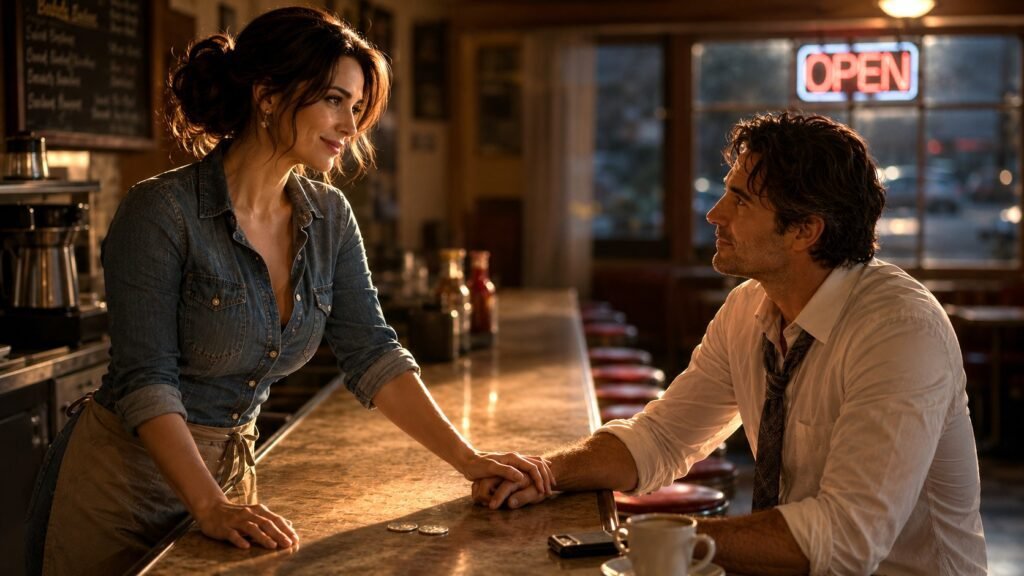
The coin came up again on a night in late October, the diner closed and dark except for the single light over the register, Delia doing the books at the counter while he waited, ostensibly to walk her to her car, though they both understood the walking-to-the-car had become an excuse that neither of them examined too closely.
“Can I see it,” he said. “The coin.”
She hesitated only a second before drawing it from her jacket pocket and setting it on the counter between them, the metal catching the low light, worn smooth as a river stone from twenty years of her thumb.
“You kept it this whole time,” he said, and it wasn’t a question anymore, just a fact he was turning over the way she turned the coin, trying to find its full weight.
“I told myself it wasn’t about you,” she admitted, quieter than she meant to. “I told myself it was just a habit. Something to hold onto during a bad shift.” She looked at him directly, and something in her had decided, somewhere in the last hour without her fully noticing, to stop being careful. “It was never just a habit.”
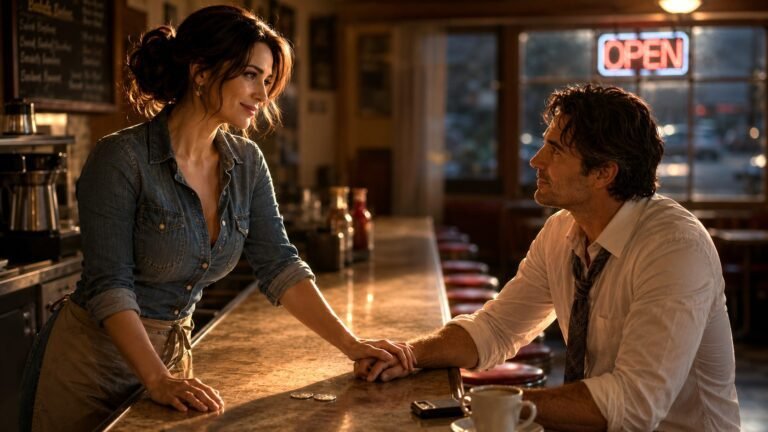
He didn’t reach for the coin. He reached for her hand instead, resting his fingers lightly over hers where they still held it, and the touch went through her like something remembered rather than new. “I’ve spent twenty years building things so I’d never have to feel like that eighteen-year-old on the hood of the Buick again,” he said. “Small. Broke. About to lose the one thing that actually mattered. And somehow I ended up right back here, in a diner at midnight, feeling exactly that small, over exactly the same person.”
“That’s not an insult, if that’s what you’re bracing for,” Delia said, her voice unsteady in a way she couldn’t fully hide anymore. “Feeling small isn’t the same as being small.”
“I know that now,” he said. “It took me twenty years and four satellites to figure it out, but I know it now.”
Neither of them closed the last few inches between them that night. It wasn’t fear exactly, not on the surface — it felt more like reverence, like two people standing at the edge of something too large to rush. But when he finally left, the cold October air sharp against the open door, Delia stood alone in the dim diner a long while after, the coin warm now instead of cool, held so tightly in her palm the edge left a small pink mark, and understood that whatever this was, it had already stopped being something she could talk herself out of feeling.
The Silence That Grew Teeth
It fell apart over a photograph, the way most quiet catastrophes do — small, ordinary, entirely explainable, and utterly devastating anyway.
Marisol showed her the article on her phone at the diner counter on a Wednesday morning, not unkindly, more out of the reflex to warn a friend before the internet did it for her. A gossip site, the kind that lived on grainy long-lens photography and speculation dressed up as reporting: Tech Titan Nathaniel Calloway Spotted With Mystery Blonde at Private Aspen Retreat. The photo showed him at some outdoor bar, laughing, a woman’s hand on his forearm, both of them lit gold by a mountain sunset that had nothing to do with Delia’s town or Delia’s diner or any part of the life she’d let herself, carefully and against her better judgment, begin to imagine sharing with him.
She didn’t ask him about it. That was the thing she’d think about later, turning it over the same way she turned the coin — she never once asked him directly, never gave him the chance to explain a business trip, an investor’s wife, a photograph stripped of all the context that might have made it nothing at all. She simply felt the old, familiar floor of herself give way beneath her — the boy on the hood of the Buick, the promise, the letters that slowed and stopped — and some ancient, well-worn part of her decided, without consulting the rest of her, that this was simply what always happened. That she had been foolish to let it start feeling like something else.
She stopped answering his texts. Not dramatically — she never sent an angry message, never accused him of anything. She simply let his good mornings sit unread for hours, then a day, then two, her thumb hovering over the reply and then setting the phone face-down on the counter instead, back to work, back to the version of herself that didn’t need anyone to come back for her because she’d never let them close enough to leave.
He came into the diner on the Thursday of that second week, and she was polite. That was the worst of it, she thought later — not cold, not cruel, just polite, the particular flat courtesy of a woman who had already decided the conversation was over before it started.
“Delia.” He sat at the counter like always, but his shoulders were wrong, braced. “Did I do something.”
“You didn’t do anything,” she said, and refilled a coffee that didn’t need refilling, two booths down, buying herself the length of the diner to get her face back under control.
“That’s not an answer.”
“It’s the only one I’ve got today.” She came back behind the counter, put both hands flat on it, and made herself look at him, because some part of her still believed she owed him that much honesty even while the rest of her was busy building the wall back up brick by silent brick. “I saw the photo, Nate.”
Understanding crossed his face, followed immediately by something that looked almost like relief, which only made it worse. “That was an investor’s wife. It was a business dinner, there were nine other people at that table, the photographer just—”
“I know how it probably works,” she said, quieter. “I’m not asking you to defend yourself. I just—” Her voice caught, and she hated that it caught, hated giving him that much visible evidence of how deep this had already gone. “I’ve done this before. Waited for someone who left. I don’t think I have it in me to do it twice.”
“I haven’t left anywhere,” he said, and there was real hurt under the words now, unguarded in a way she hadn’t seen from him since the ballroom. “Delia, look at me. I flew back from Aspen a day early because you stopped answering. I’ve been in this town more in the last two months than I have in the last fifteen years. That’s not what leaving looks like.”
But something in her had already closed the door, quietly, the way doors close when they’ve been braced to close for twenty years, needing only the smallest excuse to finally do it. She didn’t say anything else. She topped off a coffee that still didn’t need it, and after a long, terrible silence, he left a twenty on the counter for a four-dollar breakfast and walked out into a gray morning without either of them saying the thing that needed saying.
The two weeks that followed cost them both, visibly, in the small physical ways grief always does. Delia stopped sleeping properly, lay awake turning the coin over in the dark until her thumb ached, lost weight she didn’t have to lose, snapped at Josie over nothing and then cried about it in the walk-in cooler where no customer could see. Marisol reported, with the particular grim satisfaction of a friend who’d told her so, that Nate had been seen at the gym at five in the morning three days running, hollow-eyed, and had turned down a flight to Geneva he’d apparently been planning for months. Two people, built out of the same old fear, doing exactly what fear always does — mistaking distance for safety, and paying for the mistake in the currency of everything they’d almost let themselves have.
The Return, Counted Out in Coins
Delia found the envelope on the counter on a Sunday morning, slid under the diner’s front door sometime before opening, no name on it, just her own handwriting staring back at her from an old memory she hadn’t expected to see again — because it wasn’t an envelope at all, not really. It was a small velvet pouch, and inside it, resting against the fabric, was a coin.
Not her coin. A different one, newer, and when she tipped it into her palm she saw it had been struck custom, deliberately — 1962 on one face, matching the year of the one she still carried, and on the other, where an eagle should have been, two small figures instead: a girl on the hood of a car, a boy beside her, rendered simple and unmistakable.
There was a note folded beneath it, three lines in handwriting she remembered from decades-old birthday cards.
You don’t have to believe in luck. I’m not asking you to. I’m asking you to let me keep showing up, the ordinary way, until showing up is the only thing either of us remembers about this. — N.
She stood behind the counter a long time with both coins in her palm, the old worn one and the new one, weighing exactly the same, and something in her chest that had been clenched for two weeks — for twenty years, if she let herself be honest about it — finally, quietly, let go.
She found him three hours later, not at some grand address, not at a corner office with a view of the whole coastline, but exactly where Marisol had told her he’d be — sitting alone at the counter of Ruthie’s Diner during the slow Sunday stretch between breakfast and lunch, a cup of coffee going cold in front of him, looking like a man who had run out of better places to wait.
She didn’t say anything grand. She’d thought, on the drive over, about what she might say, some speech that would undo two weeks of silence in a single breath, and in the end none of it survived the walk from the door to the counter. She simply set both coins down in front of him, side by side, old and new, and said, “I’m scared of exactly one thing in this world, and it isn’t losing the diner.”
He looked up at her, and whatever he saw in her face made him go very still, the same stillness she’d have known blindfolded from across a crowded ballroom twenty years ago.
“I know,” he said. “I built you a coin instead of a speech because I figured you’d trust that more.”
“You figured right.” She came around the counter, tying her apron back on out of pure habit, and stood close enough now that she could see the exhaustion under his eyes, matching hers, matching the two weeks they’d both spent failing separately at the exact same fear. “I don’t need satellites, Nate. I don’t need Aspen. I need someone who shows up on a Tuesday for pancakes he claims aren’t as good as Ruthie’s and keeps showing up until it stops being news.”
“I can do Tuesdays,” he said, and something cracked open in his voice, relief chasing hard on the heels of it. “I can do every day you’ll let me.”
She reached for his hand across the counter, and this time neither of them hesitated, neither of them left the last few inches unclosed. Outside, the Sunday light came soft and gold through the diner’s front window, catching the two coins where they still lay together on the counter, old silver and new, twenty years apart and finally, quietly, the same weight in the palm of her hand.
Suggested Category: Slow Burn Romance
Suggested Tags: