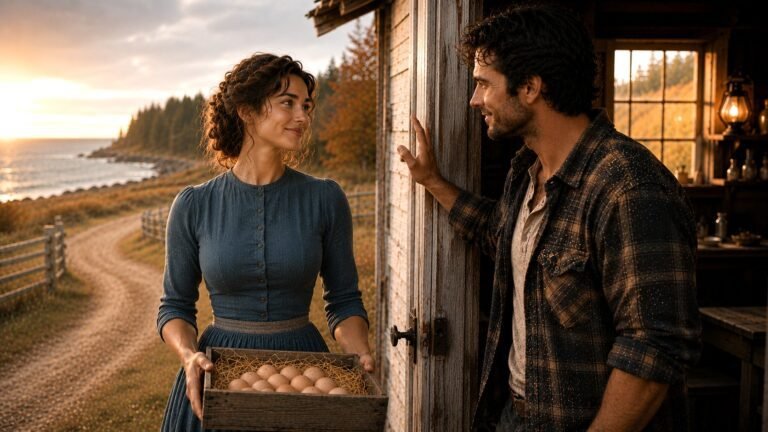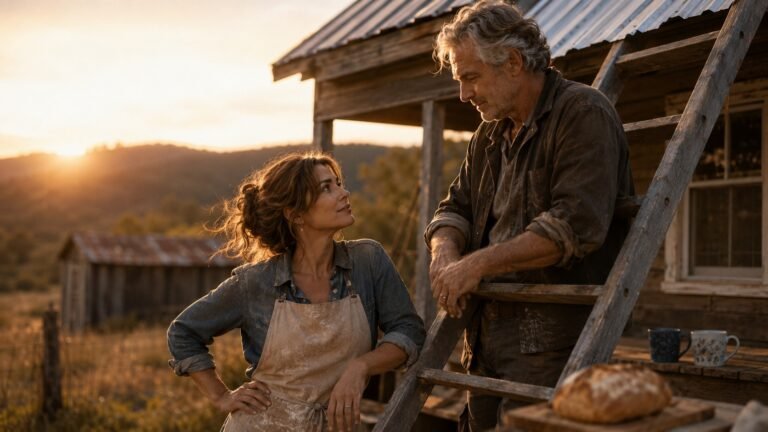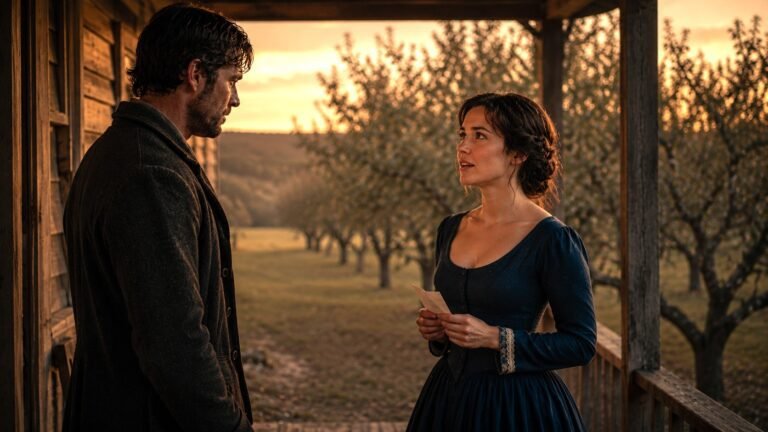

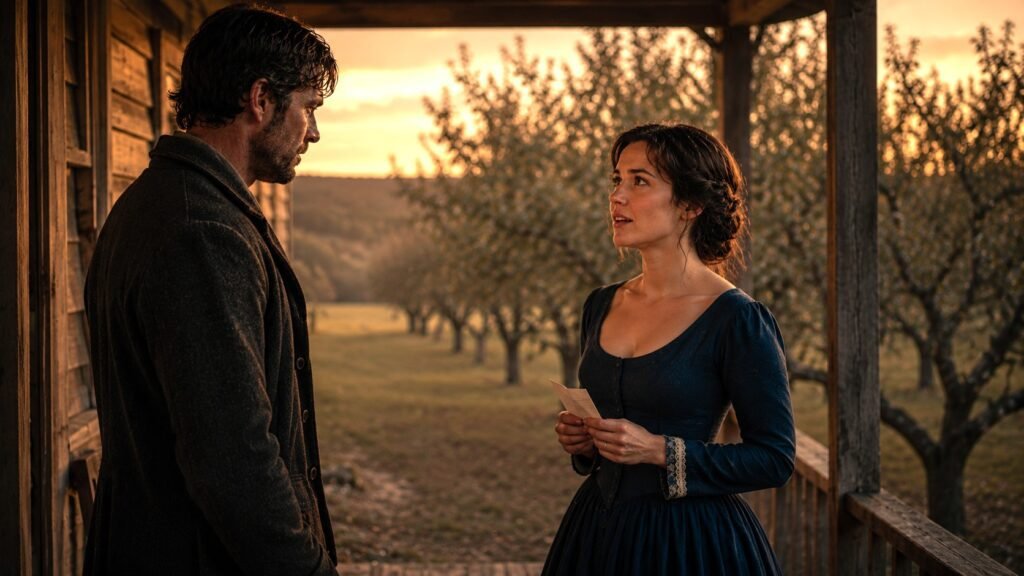
Elias Thorne had told the town of Thistle Hollow, more than once and never gently, that no one was welcome at Marsh Hill Orchard after dark. He did not say this out of cruelty. He said it because a man who has buried the only future he ever planned for learns, eventually, that closed doors hurt less than open ones.
So when the knock came on the night of the last hard frost in March of 1923 — three knocks, spaced evenly, patient in a way that unsettled him more than urgency would have — Elias sat very still at his kitchen table before he rose to answer it.
The wind had been screaming down off the ridge since noon, dragging sleet sideways across the bare apple rows. Elias was thirty-four and had lived alone in that farmhouse for nine years, ever since the fire that took the granary, the toolshed, and Clara Bishop, who was three weeks from becoming his wife when she went back inside for her mother’s quilt and the roof came down before she came out again.
He did not talk about Clara. He talked to almost no one, except Jonah Pratt, who ran the cider press and the hired hands with the quiet competence of a man who valued loyalty over wages, and who had stayed through nine winters because, as he’d put it once, somebody’s got to remember how to laugh around here, even if it isn’t you.
The knock came again. Three, slow, deliberate.
Elias opened the door.
The woman on his porch was soaked to the bone, her wool coat plastered dark against her shoulders, her hat long since abandoned to the wind. She held a scarred leather satchel in one hand and, tucked against her ribs with her other arm, a wooden crate of books — he could see the spines through the slats, a whole life’s worth of well-read paper going soft in the wet.
“My motorcar went into the ditch at the county line,” she said, before he could ask. Her voice did not shake, though her lips had gone the color of skim milk. “I understand there’s no garage open this late, and I understand I’m asking a great deal of a stranger. I only need somewhere dry until the roads are passable. I’ll trouble you as little as I possibly can.”
Elias looked at the crate of books first. That was the detail that undid him, though he would not have been able to explain why — that a woman standing in a Vermont sleet storm with nothing evidently intact in her life except this one wooden box was still holding it like the most important thing in the world.
“Come inside,” he said, and stepped back to let her pass.
Her name was Margaret Doyle — Meg, she told him, though it took three days to earn the shortened version, and he understood by then she did not hand out familiarity easily. She stood dripping by his hearth that first night, still in her wet coat because no one had told her she could take it off, watching the fire with the flat, careful attention of someone who had trained herself not to want things out loud.
He gave her a blanket from the cedar chest. She took it with a small nod and nothing more.
“Where were you headed?” he asked, mostly because the silence had teeth and he wanted something to blunt them.
“Thistle Hollow,” she said. “There’s a teaching position. I’m to start after the term break.” She wrapped both hands around the mug of coffee he set in front of her. “I came up from Boston.”
“Long way for a schoolhouse.”
“Long way from a great many things,” she said, and did not elaborate, and he did not ask.
Outside, the storm worsened. Ice found the windows in hard little volleys. Somewhere under the noise of it, Elias was aware — sharply, uncomfortably aware — of another person breathing in his house. It had been nine years since that was true, and his body seemed to have forgotten how to hold it without flinching.
“There’s a room down the hall,” he said finally. “It’s not been used in some time, but it’s dry.”
She studied him the way a person studies an offer they’ve learned to distrust. “Thank you,” she said. “I mean it. It’s only a room,” he said. “Don’t make it more than that.”
He did not sleep. He sat at the table with the fire burning low and then built back up, and he listened to the ice on the glass, and he thought — against every instinction he had spent nine years cultivating — about the fact that his house sounded different with someone else’s breath in it.
By morning the storm had buried the county road under two feet of drifted snow, and Meg Doyle came out of the spare room already dressed, her satchel packed, prepared, it seemed, to leave on foot if necessary.
“How long?” she asked, looking at the white wall beyond the window.
“Hard to say. A day. Maybe two.” Elias was already at the stove. “Pruitt won’t bring the plow through till the wind lays down, and it hasn’t laid down since Tuesday.”
She set her satchel on a chair — not dramatically, just the practical motion of a person adjusting to a fact she couldn’t argue with. “I’ll earn my keep,” she said. “Tell me what needs doing.”
He had housed stranded travelers twice before in nine years, and both times they had spent the delay complaining, restless, treating the storm like a personal insult. Meg Doyle treated it like weather. She moved into his kitchen without waiting to be asked twice, found the flour and the lard without help, and by the time Jonah Pratt came stamping in from the bunkhouse with frost in his mustache, she was correcting figures in a small notebook at the table like she’d been doing it there for years.
Jonah stopped dead in the doorway. He looked at Elias. Elias gave him a look that said, plainly, don’t.
“Morning,” Meg said, without glancing up.
“Ma’am,” Jonah managed.
“There’s coffee,” she said.
Later, out at the woodpile, Jonah lasted about thirty seconds before he said, low, “Who is she?”
“Traveler. Car went in the ditch. She’s waiting on the roads.”
“She’s sitting in your kitchen.”
“There’s nowhere else to sit, Jonah.”
“You’ve never let a soul sit in that kitchen in nine years.” Jonah pulled his collar up against the wind, something working at the corner of his mouth that was very nearly a smile. “Just weather, is it?”
“Drop it.”
“Dropped,” Jonah said, and was smiling outright when he said it.
The first real conversation happened that afternoon, while the storm held the world in a fist outside the windows and Meg sat with her notebook and Elias mended a bridle at the far end of the table.
“How long have you lived here alone?” she asked, without preamble.
“Nine years.”
“The whole time?”
“No,” he said. “Not the whole time.”
She did not push. She only nodded, the way you nod at a door you understand is closed, and went back to her writing. Five minutes passed before she offered, unprompted, “I had two brothers. Both gone in the war. My father followed them eighteen months later — his heart, the doctor said, though I’ve always thought a man can only carry so much before something in him simply agrees to stop.” She said it the way you set a fact on a table, not for sympathy, just for truth. “I came west — or north, I suppose, from where I started — because there wasn’t a single room left in that house that didn’t hurt to walk through.”
“I’m sorry,” Elias said.
“Thank you.” She looked up, something dry and rueful in her expression. “It’s why I wanted to teach somewhere new. I thought if I could be useful to people who didn’t know what I’d lost, I might remember how to be a person instead of a grief.”
Elias set down the bridle. “That’s not a bad reason.”
“No,” she said, surprised, as if she hadn’t expected him to agree. “I suppose it isn’t.”
She found the photograph on the second morning, not from prying — she’d gone looking for preserves on the pantry shelf, and there beside the jars sat a small tin box with a photograph balanced on its lid. Elias, younger, stood beside a laughing woman in front of the granary that no longer existed, her face caught mid-joy, turned toward something outside the frame.
Meg said nothing about it. But that evening, with the lamp burning low and the wind still working at the walls, she said quietly, “You’re not alone because you prefer it.”
Elias went very still.
“People who prefer solitude are comfortable in it,” she said. “You’re not comfortable. You’re guarding something. Those aren’t the same.”
“You don’t know me,” he said. Not sharp. A warning.
“No,” she agreed. “I don’t.” She held his gaze anyway. “But I know that face. I wore it for the better part of a year after my father died.”
The fire cracked. Neither of them spoke again for a long time.
“You should sleep,” he said eventually.
“Probably,” she said, and closed her notebook, and said his name — goodnight, Elias — as easily as if she’d been saying it for years.
He sat at the table long after she’d gone, staring at nothing, and did not know what to do with the fact that he wanted, very badly, to have said something else.
The roads cleared on the fourth day. Meg came out already dressed, her satchel packed, the blanket folded with a care that told him she’d been raised to leave things better than she found them.
“Jonah can drive you into the Hollow,” Elias said.
“I know. I heard the plow.” She looked around the kitchen once, taking stock. “Thank you for taking in a stranger.”
“It would have been cruel not to.”
“Most people find a reason to be cruel when kindness is inconvenient,” she said, and picked up her bag.
“There’s a teaching post standing empty at the Hollow schoolhouse,” Elias said, before he’d decided to say it. “Has been for two terms. If you’re going to be settling nearby — Ruth Callahan runs the school committee. She’ll want to meet you.”
Meg turned. Something moved behind her eyes. “I already have the position,” she said gently.
“I know. I only meant — the road between here and town isn’t always kind in winter. If you ever needed—” He stopped. He wasn’t entirely sure how the sentence ended.
She watched him struggle with it, and then she smiled — not politely, but warm, the smile of someone who understood exactly what he hadn’t managed to say and found it more than enough.
“I’ll find you if I need anything,” she said, and walked out into the cold, her satchel and her books tucked against her side.
Elias stood at the window and watched the wagon turn out of the gate until the sound of it disappeared into the white distance. Then he looked at the empty kitchen. Her coffee cup was still on the table. He picked it up, washed it, set it back on the shelf, and stood there another full minute with something small and dangerous unfurling in his chest — the first unmistakable sensation, after nine years of careful numbness, of caring again.
He told himself he would not think about her. He was exceptionally poor at keeping that promise.
The first week, he worked the orchard into the ground the way he always did when something was troubling him — up before light, pruning dead wood off the Baldwins until his hands cramped, back inside only when there was nothing left outside to occupy him. Jonah watched all of it with the expression of a man who understood exactly what was happening and had the good sense to say nothing.
The second week, Elias rode into the Hollow for feed and lamp oil and told himself he had no reason to pass the schoolhouse. He did it anyway. The sound found him before the building did — children’s voices, bright and overlapping, the particular chaos of young minds being herded toward attention and mostly succeeding. Through the window he could see Meg at the chalkboard, chalk dust catching the light, the children leaning forward in their seats the way plants lean toward a window.
He did not stop. But he thought about it the whole ride home.
Jonah was waiting at the barn when he returned. “School’s doing well, I hear,” Jonah said, unprompted, entirely too pleased with himself. “Ruth says Miss Doyle’s got every child in that district showing up daily, including the two Kellerman boys, who I don’t believe have set foot in a schoolroom since Coolidge was governor.”
“Jonah.”
“Just passing along news, boss. Which you’d have heard yourself if you’d stayed in town long enough to talk to a living soul.”
Elias unsaddled his horse and said nothing at all, which Jonah correctly read as a great deal.
The third week, Meg came to him, arriving on a borrowed mare with the directness of a woman who hadn’t ridden four miles to pass the time.
“I need a favor,” she said, before he’d fully straightened from the woodpile. “Three of my students live out past Miller’s Crossing — the Whitfield children. Their father’s got a bad hip and one horse for eighty acres, and the thaw’s turning the low road to mud. I want a regular pickup, three mornings a week.”
“Monday, Wednesday, Friday,” Elias said, before she’d finished making her case.
“Why?” she asked, direct as ever.
“Children ought to be in school. And I know that road better than anyone in this valley.”
She reached into her saddlebag and produced a jar of honey and a loaf of bread. “For the trouble of the storm. I was raised to return what I borrow.” Her fingers, cold from the ride, held the exchange one second longer than necessary.
“Monday morning, then,” she said, and rode off, and Elias stood there with bread and honey in his hands like they were something considerably more important.
The Monday run became the shape of the following two months. Elias brought the team out before first light three mornings a week, collected the Whitfield children — Silas, ten and solemn; June, eight, restless as a lit fuse; and little Opal, six, who decided within her first ride that Elias belonged to her personally — and delivered them to the schoolhouse steps, where Meg was always present in the doorway or the yard, always finding five minutes of conversation before the children climbed down.
Five minutes, three mornings a week. It should not have amounted to much. It amounted to nearly everything.
She told him about the children, not as gossip but as a doctor gives a family update: Silas was gifted with numbers but struggled to read the board, and she suspected his eyes rather than his mind. Elias found he was noticing things himself now — that Silas’s boots were splitting at the seam.
He mentioned it to her one Friday, careful not to presume. She went very still.
“I hadn’t noticed,” she said quietly.
“Could’ve started since term began.”
“No. I should have seen it.” She was quiet a moment. “I’ll speak to Ruth about the clothing fund.”
“Or,” Elias said, and then stopped, surprised at himself.
“Or?” she prompted.
“Hollingsworth’s has good leather. I know enough to cobble a repair, if you’d bring me his size.”
She looked at him a long moment, something shifting in her face — not surprise exactly, but the look of a person discovering a room in a house they’d thought they already knew completely.
“Elias.”
“It’s a practical problem,” he said quickly. “I’m offering a practical solution.”
“I know,” she said, and then, softer, “I know you are.”
Silas came to school the following Monday with resoled boots and a baffled expression when Meg told him an anonymous benefactor had seen to it. He spent thirty seconds confused and went back to his arithmetic, because he was ten and practical and the boots fit. Opal, unconvinced by his story of anonymity, informed Elias on the ride home that she knew exactly whose worktable that leather had come from, and allowed him to keep his secret only out of pure generosity.
Meg began coming to the orchard on Tuesday afternoons, her one free day, and the pattern held without either of them naming it. Elias began, without quite admitting it, arranging his week so he was reliably home when she arrived.
He told her about the orchard, his father’s failing years, the frost of 1917 that had cost half the young trees. She listened like it was a skill she’d spent years perfecting. She told him about teaching in Boston before the war took her brothers — forty children in two rooms, under a headmaster who believed girls needed schooling only enough to keep a household ledger, and how she’d spent three years quietly teaching them everything else in the margins.
“You undermined the man,” Elias said.
“I educated children. The undermining was incidental.”
He laughed — surprised himself with it, rough and unpracticed, like something rusted finally turning. Meg went still, watching him with an expression he couldn’t quite place.
“What,” he said.
“Nothing.” She was smiling. “I wasn’t certain you could do that.”
“Laugh.”
“It’s the first time I’ve heard it.”
“I laugh.”
“Not when I’m there to see it,” she said, not unkindly. “Until now.”
He didn’t have an answer for that. That night, alone at the table, he understood the laugh had arrived without his permission — that it had felt, for one unguarded second, like something he remembered from a life he’d thought was sealed shut for good. That was when he understood he was in trouble, and that he no longer entirely minded.
The trouble arrived fully formed on the first genuinely warm afternoon of the year, when the snow had pulled back far enough to make the world feel like a promise again.
Meg came on her usual Tuesday and was quiet longer than usual — the stillness he’d learned meant she was working something through before speaking it.
“Ruth Callahan told me something this morning,” she said finally. “About a woman named Clara.”
The silence that followed was so complete Elias could hear the fire.
“Ruth talks too much,” he said, flat.
“I’m not asking to pry,” Meg said. “I’m asking because I think I’ve been reading you wrong. I thought you’d chosen to be alone. But it wasn’t a choice. It was done to you. And then you built a whole life around the wound instead of around anything you might have chosen for yourself.”
He stared at her. Nobody had ever put it quite that precisely.
“Her name was Clara,” he said, the words strange, like a language he hadn’t spoken in years. “We’d known each other since we were children. We were three weeks from marrying. There was a fire in the granary. She went back in for her mother’s quilt. The roof came down before she came back out.”
“I’m so sorry.”
“It was nine years ago.”
“That isn’t how grief works, and you know it.” She held his gaze. “I’m only saying I know she was real, and I think you’ve spent nine years punishing yourself for surviving her.”
His throat tightened. “You don’t survive a fire because you deserve to more than she did.”
“No,” Meg said gently. “Fires don’t make those decisions. They just happen. Then the living are left making sense of them, or refusing to.”
“How do you know that?”
“Because I nearly didn’t survive my own losing,” she said. “After my father, I stopped answering letters, stopped eating properly, worked until I couldn’t think. And then I understood I was only waiting to disappear. And I decided I didn’t want to. So I came north.”
“Her name was Clara,” Elias said again, testing whether it still cut the same way. It did — but differently now. Like something alive instead of something dead.
Meg reached across the table, not taking his hand, only setting hers near it. “She sounds like she was worth loving,” she said.
When she rose to leave, she paused at the gate. “The wound doesn’t have to be the whole architecture forever. That’s all I’m saying.”
He stood in the gold of the late afternoon and felt, for the first time in nine years, not happiness — not nearly — but the possibility of it. That evening, alone, he said Clara’s name out loud to the empty kitchen, not as a wound this time, but as a goodbye.
March gave way to a hard, contrary spring, the kind that pretended at winter one day and offered something close to hope the next. The orchard woke around him — buds swelling on the Baldwins, the ewes dropping lambs in the lower pasture — and Elias noticed, with something like wonder, that he no longer minded the noise of it.
Meg’s presence had, without either of them agreeing to anything, become a fixture rather than an occasion. Her shawl hung on the hook by his door. Her coffee cup lived on the second shelf. Neither of them acknowledged this out loud, which suited them both.
It was Ruth Callahan who forced the matter into daylight. She drove out to Marsh Hill on a Thursday and said without preamble, “People are talking. About the Tuesdays, about the boots. I’m not here to scold you, Elias. That woman came to this valley with nothing but her wits and her decency, and I will not stand by while her name gets dragged through gossip because a man can’t make up his mind.” She fixed him with a look that had humbled sturdier men. “Either you’re serious, or you put some distance between yourself and her before the distance gets chosen for you.”
She left him standing at the fence with those words lodged under his ribs. That night he turned them over the way he turned a stubborn ledger, until the answer arrived without fanfare — flat, quiet certainty, like solid ground found after a long time on uncertain footing. He was serious. The question was whether he had the courage to be serious out loud.
The news that changed everything came on a Friday morning, riding hard on a lathered horse.
Tom Kellerman pulled into the yard, face tight. “There’s trouble at the millpond crossing. The Delaneys’ wagon went through where the ice broke up early — mother, father, three children. Two can’t walk. The little one’s not answering.”
Elias was moving before the sentence finished. “Get Doc Ambrose. Tell Ruth to open the church hall for blankets. I’ll have them at the schoolhouse within two hours.”
He rode north hard through mud and standing meltwater and found the Delaneys strung along the bank, their wagon half-swallowed by black water, the horses gone, all five soaked and shaking hard enough that two of the children had bitten their own lips bloody. The youngest, a girl no older than four, lay unmoving in her mother’s arms.
He wrapped her in his own coat, organized the rest with the same methodical calm he brought to a bad calving season, and set the father — arm broken, still clear-headed — on horseback with the two older boys, pointed south toward Marsh Hill and Jonah.
He carried the girl himself, two miles on foot, talking to her the whole way — not certain she could hear him, but silence, in that moment, felt like giving up, and Elias had never learned how to do that. “You’re all right,” he told her. “I’ve got you. Nobody’s letting go.”
He met Meg on the road, riding hard with blankets across her saddle. She took in the scene in two seconds — the child, his missing coat, the exhaustion he hadn’t let himself feel — and was off the horse before it fully stopped.
“How long’s she been like this?”
“Near forty minutes. Her breathing’s steadied some.”
Meg pressed a hand to the girl’s face. “She’s cold, but she’s coming around — look.” The child’s eyelids fluttered.
Elias exhaled — the first full breath since he’d lifted her from the bank.
“Doc’s behind me,” Meg said. “Tom found me first. I told him you’d bring them south. I knew you’d be on foot, if you had a child in your arms.”
“How did you know that?”
“Because I know you,” she said simply, and there was no room in the middle of a crisis to sit with what that meant — but he did anyway, briefly, the way a man touches something warm when the rest of the world has gone to ice.
The Delaneys stayed at Marsh Hill four days while the roads dried. The little girl — Ivy — ran a fever for two nights, watched over in shifts by her mother and by Meg, who arrived each morning and stayed until dark.
On the second night, Elias found her still awake at midnight, reading by lamplight beside the child’s bed.
“You should sleep,” he said.
“Soon.” She closed the book. “You didn’t have to do any of this.”
“It’s my land.”
“It’s your kindness. The land’s incidental.” She looked up. “You rode out not knowing what you’d find.”
“Tom said you rode out before you knew either.”
“I came because I didn’t want you out there alone. That’s all.”
“Meg,” he started.
“Don’t,” she said gently. “Not something you’re not ready to say. There’s no hurry.”
“I’d like to be ready,” he said, the words unplanned but certain.
She went very still, then crossed the small room and stopped two feet from him. “I’ve been hoping you’d say something like that for about six weeks,” she said. “I’m a patient woman. I am not an infinitely patient one.”
Something broke open in his chest — not painfully, the way river ice breaks from beneath when the water underneath has finally warmed enough to demand it.
“When this is settled,” he said. “When the Delaneys are home and things have quieted—”
“I know,” she said. “I’ll be here.”
“Tuesday,” he said.
She smiled. “Tuesday.”
The Delaneys went home eight miles east, and word of the rescue traveled through Thistle Hollow fast and embellished, as it always did. Elias found he no longer minded being spoken of.
On the porch, four days later, he told her the rest of it — the fear underneath the reluctance.
“I’ve been afraid,” he said. “Not of you. Of wanting something again and having to learn how to lose it a second time.”
“That’s an honest thing to say.”
“I’m working on honesty. You’ve been a considerable influence.”
“I don’t know how to do this slowly,” he admitted. “I don’t know if I have the patience left to be careful. I’ve been alone too long, and I’ve gotten particular, and I’m not always—”
“I teach fifteen children,” Meg said, “three of whom are Kellermans. I have a considerable tolerance for difficult.”
“I’m serious,” he said.
“So am I.” Her voice was warm, steady, certain. “I didn’t ride out to that millpond because it was convenient, Elias. And I didn’t come to your kitchen for two months of Tuesdays because I had nowhere better to be.”
He took her hand — not dramatically, just the way a person takes hold of something they’ve decided belongs in their grip. Her fingers, cold as always in the early hours, closed around his.
“I’d like to court you properly,” he said. “If that’s acceptable.”
“It’s more than acceptable,” she said, and squeezed his hand once, and that, as far as either of them was concerned, was that.
What neither of them yet understood was that the hardest test had not arrived. It came three weeks later, in the person of a timber speculator named Corwin Vance, who rode into Thistle Hollow with two men and the confidence of someone who considers himself clever and has come to collect.
Friday morning, Mayor Alden Fitch arrived at Marsh Hill, hat in both hands, with news he clearly couldn’t soften. “Elias, there’s a man in town — Vance. He’s got papers, filed and registered, claiming the north forty under a timber reservation clause from ’96. Says your father’s original grant never satisfied the improvement condition.”
“That land’s been ours since 1889. I have the deed.”
“I know. But he’s got a Burlington lawyer, and I don’t have the standing to sort out whose paper trumps whose. This is past what the town can settle.”
Elias stared at him a long moment. “Get off my property,” he said — not in anger, but with the flat calm of a man saving his fury for where it would do the most good.
The north ridge was the best hardwood stand on the property, the timber that fed the cider press through every hard winter and paid for seed in lean springs. Losing it wouldn’t break the orchard outright, but it would starve it slowly — and slow starvation meant letting hands go, meant Jonah Pratt, after eleven years, having to find his living somewhere else.
Elias was not going to let that happen.
Meg came within the hour, having heard in town, which in Thistle Hollow meant within about forty minutes of the mayor’s buggy leaving Marsh Hill.
“Tell me everything you have,” she said, sitting across from him at the table already covered in deed boxes.
He told her. She listened without interrupting — one of her particular gifts, receiving information fully before responding to it — and when he’d finished, she was quiet a moment.
“The improvement clause he’s citing — what’s the exact statute language?”
“I don’t know it precisely.”
“Then we find it,” she said. “Because the statute’s the weapon, and if it doesn’t say what his lawyer claims it says, the whole claim collapses. Is there anyone in Montpelier who could get you the original registry file?”
There was — a clerk named Osgood whose nephew Elias had once pulled, alive, from a flooded quarry. He wrote that night. Meg helped him draft the letter, insisting he ask not for interpretation but for the raw original file.
“If Vance’s lawyer’s building his case on a document you haven’t seen,” she said, “you need the original, not somebody’s reading of it.”
Elias looked at her. “That’s exactly right.”
“I know,” she said, without a trace of false modesty.
Vance did not wait for letters. He came to Marsh Hill himself two days later, alone — which Elias found telling. A man confident in his claim came with lawyers. A man alone had come to make an offer.
“I’m not an unreasonable man,” Vance said, pleasant in the practiced way of someone used to getting what he wanted. “I’m prepared to offer you a settlement for the north forty — assessed value plus twenty percent.”
“You’re offering to buy land that’s already mine.”
“I’m resolving an ambiguity.”
“There’s no ambiguity. There’s your claim, and there’s my deed.”
Something thinned at the edges of Vance’s expression. “Proceedings take time, Mr. Thorne, and the parcel in dispute typically sits under administrative hold while they run. Could be a year. Two summers without that timber stand would be significant.” He let the arithmetic land, then added, quieter, “I understand you’ve grown close to the schoolteacher. It would be unfortunate if her position here were complicated by association with a contested legal matter. Small towns remember these things.”
Elias did not answer. He watched Vance ride out and stood very still afterward — not with hot rage, but something colder and clearer. Vance wasn’t only after timber. He was after leverage, and he’d correctly identified the one thing Elias would do nearly anything to protect. Which meant Meg was in this now, whether she knew it or not.
He almost didn’t tell her — handle it alone, don’t drag anyone into your trouble — before Meg dismantled that instinct without knowing she was doing it, arriving Sunday and finding him at the table with the stillness of a man managing something internal.
“What else happened?” she asked. He told her, unsoftened.
“He thinks you’ll fold to protect me,” she said finally.
“Yes. And I was considering it. For about a day.”
“Don’t,” she said, firmer now. “I am not something to be managed at a safe distance so I don’t get damaged. I came to Vermont alone with a satchel and a box of books. Corwin Vance does not frighten me.”
“It should concern you.”
“It does. There’s a difference between something that concerns me and something that makes me want you to fight less.” She held his gaze. “Fight hard. I’ll manage whatever comes at me.”
“You are the most—” he started.
“I know,” she said, smiling, sudden and fierce. “It’s why you like me.”
Something in his chest broke loose, warm and involuntary. “Yes,” he said. “It is.”
The Osgood letter arrived nine days later, eleven pages, and Elias read it twice before he breathed properly for the first time in a week. Meg arrived within the hour, having left a lesson mid-sentence.
She read it in silence, her expression moving through concentration, then something sharp and satisfied. “The clause he’s citing wasn’t added to statute until 1904. Your father’s grant was 1889 — it can’t apply retroactively, and Osgood’s registry shows no extension was ever filed under it, because the clause didn’t exist yet.”
“His lawyer knows this.”
“His lawyer is betting you don’t.” She set the letter down. “We need to correct that bet. Publicly.”
The plan she built anticipated the counterargument before it arrived. It involved Ruth Callahan, whose opinion carried the weight of small government, and a town meeting at the Grange hall, every lamp lit, every chair filled, Vance seated in the second row beside his lawyer with the growing expression of a man beginning to understand he’d misjudged his opponent.
Elias did not speak. Meg did — standing at the front with the Osgood letter and a calm, exact voice, walking the room through what the claim asserted, what the statute actually said, and what the gap between the two meant for every family holding land under a pre-1904 grant, which was most of them. By the time she finished, the temperature of the room had shifted entirely. Vance’s lawyer attempted a response and was met with a silence louder than argument.
The meeting ended without formal resolution but with something more durable: every farmer there walked home understanding this would not be Elias Thorne fighting alone.
Outside afterward, Ruth Callahan found them by the door. “Miss Doyle, I owe you an apology. I told Elias he ought to settle his mind about you before your reputation suffered. I implied you were something needing protecting.”
“You were wrong,” Meg said, gently, before Ruth could finish apologizing properly.
“I was,” Ruth admitted. “You’re something this valley needed.”
She went for her buggy. Jonah went for the horses. Elias and Meg stood alone in the cold, lamplight spilling gold from the Grange windows.
“You didn’t have to do that,” he said.
“Neither did you,” she said, and he touched her cheek, brief and careful, and she leaned into it the way a person leans toward warmth without deciding to.
Vance left Thistle Hollow ten days later. The county registrar had submitted his own report to Montpelier after the town meeting, and the claim quietly collapsed under it. The north ridge stayed exactly where it had always been — his father’s land, his.
The morning Jonah confirmed Vance’s men had gone, Elias walked out to the ridge and stood a long while among the hardwoods, feeling the solid, ordinary fact of ground that was his. He thought of his father, of what it meant not merely to hold something but to choose it, every day, against everything trying to take it. Then he thought of Meg, and walked down to the house, where she was on the porch, coffee in both hands, hair still down.
“I want you to stay,” he said plainly. “Not just Tuesdays. I want to build something here, with you.”
She looked up, eyes bright. “I’ve been thinking about direction too. When I left Boston with my bag and my books, I think this was always where I was headed. I just didn’t know it yet.”
He took the cup from her hands and set it on the rail, and took her hands instead — cold, as always in the mornings — and it was nothing like the drowning he’d spent nine years afraid of. It was the opposite. The feeling of finding the surface after a long time under.
“I’d like to ask you something properly,” he said, “when the time is right, if you’ll let me.”
“I’ll let you,” she said, steady and a little unsteady all at once.
The time arrived faster than he expected, because he’d stopped arguing himself out of what he wanted. It was Opal Whitfield who forced it into the open, the way only a six-year-old with total conviction can.
“Are you going to marry Miss Doyle?” she asked one Monday morning, wedged against his arm in the wagon.
Elias’s hands tightened on the reins. “That’s a private matter, Opal.”
“Mrs. Callahan says you are,” Opal said, serene, citing her source like scripture. “She told my mama the whole valley was waiting on you.”
June, having considered the matter fully, delivered her verdict. “I think you should marry her. She teaches us poems. Somebody ought to be nice to her for it.”
Elias kept his eyes on the road, something shifting hard in his chest. He dropped the children at the schoolhouse, where Meg looked at him with the expression Opal had rightly identified as different from her school face.
“I’ll come by this evening,” he said.
“All right,” she said, something changing in her own face too.
He spent the afternoon at his father’s old writing desk, a thing he hadn’t done in years, and after considerable effort wrote exactly three words on a scrap of paper, folded it, and put on the good jacket he hadn’t worn since Clara’s funeral.
He rode into town. Meg was on the Callahans’ porch, wearing not her school dress but the deep blue one that had been her mother’s. She had known he was coming.
“You wore your good jacket,” she said.
“You’re in your good dress.”
“I didn’t want to be underdressed for whatever this is.”
He held out the folded paper. She unfolded it, read the three words — Stay with me — and looked up with bright eyes.
“That’s what you want,” she said. Not a question.
“Everything that comes with it.”
“I came to Vermont with nothing,” she said. “A bag, some books, an address in Thistle Hollow. That was my entire plan. And then you opened your door in a March storm and looked at my books before you looked at anything else about me. I thought — here is a man who notices the right things.”
They stood together on the porch in the fading light, and neither of them needed to say anything more, because that had said everything worth saying for the whole of the life ahead of them.
The wedding happened the way things happen in small towns — all at once, with tremendous enthusiasm. Ruth organized it in four weeks and made it look effortless, which fooled no one. Jonah wore a suit that had clearly not seen daylight since before the war. The Whitfield children came, Silas standing very straight in his resoled boots, Opal performing flower girl with the conviction of someone collecting her due after personally orchestrating the entire courtship.
On the morning of it, Jonah tied Elias’s cravat because his hands weren’t quite steady, and both men pretended not to notice.
“Clara would have liked her,” Jonah said, without preamble.
Elias went still. “Yes.”
“Don’t thank me,” Jonah added, before he could. “Just don’t stand in your own way anymore.”
“I won’t,” Elias said, and meant it in a way he never had before.
Years assembled themselves the way years do — faster than anyone expects, gentler than anyone deserves. Marsh Hill grew: a new stand of Baldwins on the reclaimed north ridge, a cider operation Elias built with a satisfaction he never once tired of, and, in time, two children — James, the second year, and Ruth, two years after, named for the debt Meg wanted honored, which Ruth Callahan denied fiercely having earned even as she cried over it.
The Whitfield children grew too. Silas got his spectacles at twelve and stood very still the first time he wore them, saying, in a voice trying hard to sound older than it was, “Everything’s got edges now.” He became a surveyor. Ivy Delaney grew up to study medicine, which surprised no one who remembered a four-year-old barely breathing in Elias Thorne’s back bedroom while Meg kept the lamp burning through the night.
Jonah stayed. He had always been going to.
On the tenth anniversary of the March storm, Elias and Meg sat on the porch in the evening — the same porch where she had once answered stay with me with one word. The children’s noise drifted from inside, James’s laugh loud and unguarded, then quiet again.
“Ten years,” Meg said, leaning into his shoulder.
“Ten years.” His arm around her had long since stopped feeling like a choice and started feeling like something structural.
“Tell me what you were thinking. When I knocked.”
“You always ask that.”
“You always give a different answer.”
He was quiet a moment, the night settling around them, warm and full of early stars.
“I was thinking you were a complication,” he said. “I was thinking about your books — why you were protecting them like that, in the middle of losing everything else. And then I thought, here’s a person still thinking about what she came here to do, even now. I couldn’t send someone like that back into the cold.”
Meg was quiet, then said, “I was so tired that night. Not just from the road. From being alone, from being afraid, and from not being able to stop.” She looked up at him. “And then you opened the door and looked at my books before anything else, and said come inside, and didn’t make it into anything at all. You just made room.”
He held her. She let herself be held. Somewhere above the ridge, the stars burned steady and indifferent and beautiful over a house that no longer stood as a monument to what had been lost, but as proof of what two people, wounded separately, had chosen to build together instead.
For years afterward, people in Thistle Hollow told the story — not as tragedy redeemed, not even quite as romance, but as something plainer and more lasting: the story of a man who answered a knock in a March storm, and a woman who knocked on the right door. And when people asked Elias, in later years, how he’d changed so completely, he always gave the same answer.
“Someone knocked,” he’d say. “And I opened the door.”
That was the whole of it. That was enough. That was everything.