
The train cut east to west across a country that seemed to Margaret Ashworth to have no edges at all, and she sat in her berth each night with her gloves still on, buttoning and unbuttoning the small pearl fastenings at the wrist the way another woman might have counted rosary beads. The gloves were kid leather, the color of clotted cream, and had cost more than most of the passengers in the second-class car earned in a month, and Margaret had worn some version of them — silk in summer, kid in winter, always spotless, always fastened to the last button — every day since she was twelve years old and her mother had first told her that a lady’s hands were the first thing a room noticed and the last thing it forgave.
Boston was three days behind her now, and still she could not stop her hands from performing the old rituals. At the vanity in her berth she rubbed a thin film of glycerin into her knuckles before bed, though there was no one left to inspect them, no mother running a thumb along her fingers checking for the roughness of a dropped needle or an unchaperoned afternoon spent doing something with her hands that mattered. She had spent nineteen years being taught that her hands existed to be looked at and never to be used, and the habit had gone all the way to the bone, so that even now, fleeing the very rooms that had taught her this, she caught herself smoothing her gloves flat across her palm before she let herself touch a train door handle, a coin, a stranger’s offered arm.
She told herself the gloves were a costume, a piece of the old life she wore until she could shed it entirely, but some nights, watching the dark plains slide by the window with nothing in them but the occasional far scatter of light from some homestead she would never know the name of, she understood, with a coldness that sat under her sternum like a swallowed stone, that the gloves were not costume at all. They were the truest thing about her. She had spent her whole life being handled — displayed at dinners, walked on arms, discussed in terms of dowries and bloodlines and the excellent shape of her wrist when she poured tea — and somewhere in all that handling she had gone still inside the way a hand goes still inside a glove, present but untouched, shaped by the outside pressing in rather than by anything moving from within. She was engaged, when she left, to a man eleven years her senior named Whitfield Cabot Lowe, who had inspected her the way he inspected horses at auction, and who had once, over dessert, corrected the way she held her fork with the mild, bottomless patience of a man correcting a servant, certain of his right to do so and certain she would thank him for it eventually. She had smiled. She had always smiled. Smiling, like the gloves, went all the way to the bone too.
The advertisement had been in a newspaper left behind on a park bench, of all things, an accident so small it barely qualified as fate — a single column notice from a rancher in the Montana Territory named Thomas Reilly seeking a wife of good character, willing to work, not afraid of a hard life or an honest one. She had read it twice, on the bench, in her good coat, with her mother’s luncheon waiting for her three blocks away, and something in the word honest, sitting there so plainly among the other words, had gone into her like a hook set deep in something she had not known was still alive enough to catch. She had written back that same afternoon, in a hand she disguised as plainer than her own, and had not told a single soul, and had packed one trunk — leaving behind twelve — and had walked out of her mother’s house before dawn eleven days later with the particular quiet of someone who understands that if she stops walking even once to consider what she is doing, she will not do it.
She did not know, sitting in her berth with the gloves buttoned to her wrists and the West sliding past dark and enormous outside the glass, whether she was running toward a life or simply away from one, and she had decided, somewhere around Chicago, that she did not need to know yet, that the not-knowing was itself a kind of freedom she had never once been permitted to feel — the freedom of a door with no one standing on the other side of it deciding, in advance, what she would find when she opened it.
What she did know, turning her gloved hands over in her lap as the train slowed for a water stop somewhere in the flat, grass-colored middle of everything, was that she had spent her whole life being told what her hands were for, and had never once, not a single time, been asked what they might want to do.
She reached the depot at Larkspur Junction on a wind-scoured afternoon in early April, the platform nothing more than a plank walk and a water tower and a general store with a faded awning, the sky above it so wide and unbroken it made her chest ache in a way she did not have a word for yet, a sky that did not care in the least what a lady’s hands looked like, and she stood beside her single trunk in her traveling dress, gloves immaculate, watching the train pull away east without her, and felt, for the first time in longer than she could remember, entirely and terrifyingly free — and entirely, terrifyingly alone.
Thomas Reilly was late, and he knew he was late, and he stood in the wagon bed for the last half mile into Larkspur Junction trying to beat the worst of the trail dust off his good coat with his hat, which mostly succeeded in transferring the dust from the coat to his hair and adding a fine new layer to both. He had spent eleven days telling himself he was not nervous about a woman he had never met arriving off a train to marry him, and had spent the better part of that morning proving himself a liar — up before light, the good shirt pressed under a flatiron heated on the stove, boots blacked, and then, at the last, forty minutes lost to a heifer down in a gully that had chosen that particular morning to remind him that a ranch did not care what a man had planned for himself.
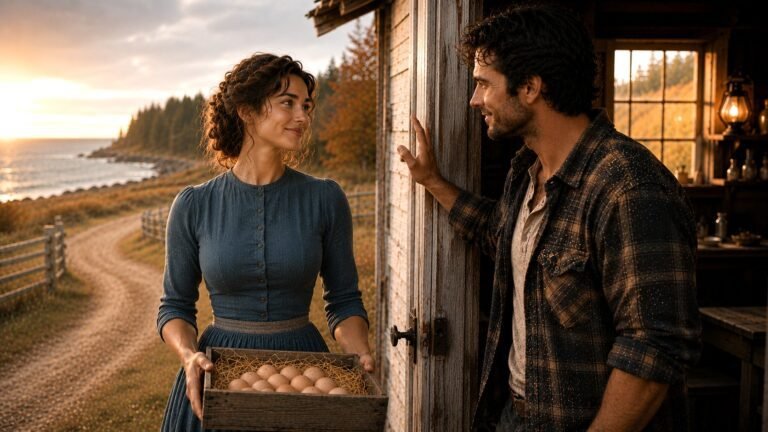
He came onto the platform at a near-run, hat in hand, hair doing exactly what he’d feared, and found her standing very straight beside a single leather trunk with brass corners, in a dress the color of a good claret, gloves so pale and clean they seemed to glow faintly against the dust-brown of everything around her, and Thomas Reilly, thirty-one years old, six feet of him weathered the color of the country he’d been born into, stopped dead on the platform boards and thought, with the flat clarity of a man realizing he has misjudged a fence line badly, there is no earthly way this is going to work.
She was watching him with the same thought written, more politely, across her face — he could see her taking the measure of him, the dust, the hair, the hands that had never in their life worn a glove of any kind and looked it, and he felt the whole of his life laid bare in the space of that look, the leaking roof, the cattle that didn’t sell for what they should, the single good shirt he owned pressed for an occasion that suddenly seemed to call for several shirts he did not have.
“Mr. Reilly,” she said, and her voice had an edge to it he hadn’t expected from the careful, looping hand in her letters, a dry precision, like a schoolteacher reading a name off a roll she already suspected would misbehave.
“Ma’am,” he said, and then, because his mouth had apparently decided to operate independently of any sense, “you’re taller than your letters.”
Something crossed her face — not quite a smile, but its close cousin, caught and suppressed before it could fully arrive. “I wasn’t aware letters had a height requirement, Mr. Reilly.”
“No, ma’am. Only I pictured you smaller. On account of the handwriting. Small hand, I figured small woman.” He heard himself and wanted, briefly and sincerely, to be struck by lightning where he stood.
“I assure you my hand is the only small thing about me,” Margaret said, and this time the smile did arrive, brief and startled, as if it had gotten past a guard usually more reliable, and Thomas felt something in his chest give the particular lurch a green colt gives the first time it’s asked to trust a rider it doesn’t yet know.
He reached for her trunk and she reached at the same moment, and their hands collided over the leather handle, her gloved fingers against his bare ones, and she drew back as though burned, tucking her hand against her skirts, and Thomas, watching that small violent retreat, understood — not in words yet, only in the animal part of him that read horses and weather and the set of a man’s shoulders before trouble — that he had just watched a woman flinch from an ordinary touch the way another person might flinch from a blow, and that whatever had brought her out here on a train alone with one trunk and no family seeing her off, it had left a mark on her he was going to need to be careful of.
The wagon ride out to the ranch took the better part of two hours over a road that was mostly a suggestion, and for the first hour neither of them said much, Margaret sitting very upright on the bench with her hands folded in her lap, watching the country roll by with an expression Thomas could not read, until they crested a low rise and the whole valley opened out below them, grass silvering in the wind in long moving sheets like something alive, the mountains standing blue and serrated along the western edge of the world, and Margaret made a small sound, not quite a word, and Thomas glanced over and saw her sitting forward on the bench, gloved hand pressed flat against her collarbone, looking at the country the way he imagined people in Boston looked at paintings in museums, except realer, hungrier.
“It doesn’t stop,” she said. “I keep waiting for it to stop and it doesn’t.”
“No, ma’am. Rest of your life it won’t.”
She looked at him then, a long, searching look, and something in her face had gone quiet and open in a way it hadn’t been on the platform, and Thomas, not knowing what else to do with a silence that had gotten suddenly larger than the two of them, said, “There’s a den of prairie dogs about a half mile on that’ll come up out of their holes if we go slow enough. My sister used to make me stop the wagon every single time, wouldn’t hear otherwise, and she’s thirty-four years old now with four children of her own and I still can’t drive this stretch of road without near stopping out of habit.”
“Stop, then,” Margaret said, and it came out of her fast, almost startled at itself, and Thomas reined the team in without another word.
They sat in the stopped wagon while small brown heads popped up out of the grass one after another, whistling their thin alarm calls, and Margaret laughed — an unguarded, surprised sound, nothing at all like the composed smile from the platform, and clapped one gloved hand over her mouth as if the laugh itself were something that had gotten loose without permission, and Thomas found himself laughing too, at nothing really, at the plain unlikely fact of two strangers sitting in a wagon laughing at prairie dogs an hour before they were meant to be married, and understood, with the same flat clarity as before, only inverted now, that whatever this was going to be, it was not going to be nothing.
Margaret watched the small heads duck and reappear and thought, distinctly and for the first time in longer than she could name, that she had not once, not a single time in nineteen years of drawing rooms and dinners and men inspecting her like livestock, laughed like that — loud, unplanned, entirely her own — and understood that she had just handed a stranger, without meaning to, a piece of herself she had not even known she was still keeping in reserve.
They married three days later in front of the county clerk and four witnesses pulled off the street, Margaret in the claret dress with her gloves on, Thomas in the pressed shirt gone soft again with a day’s honest sweat, and afterward there was no wedding trip, only the ranch, and the long slow work of two strangers learning the shape of a shared life one ordinary day at a time.
The ranch house was small and sound, built by Thomas’s father and added onto crookedly by Thomas himself, and Margaret walked through it the first week with her gloves still on, touching nothing directly — not the flour bin, not the cookstove, not the rough plank table — until Thomas noticed, the way he noticed a horse favoring a leg, quietly and without comment at first, filing it away.
It was three weeks in that she tried to help with the branding and ruined the gloves entirely, ash and blood and rope-burn ground into the kid leather past any hope of cleaning, and she stood by the corral fence afterward peeling them off her hands with a stricken look, as though she had lost something more than a pair of gloves, and Thomas, coming up beside her with a bucket of water she hadn’t asked for, said nothing about the gloves at all, only handed her the bucket and said, “Water trough’s low. Horses’ll thank you,” and walked off, leaving her to decide for herself whether bare hands could still be useful hands.
She washed them at the trough, turning her hands over in the cold water, watching the dirt come off her actual skin for what felt like the first time in her adult life, and something in her chest came loose the way a knot comes loose under warm water, and that night at supper she set the table with her hands bare, and Thomas noticed and did not say a word, only passed her the bread, and the not-saying was its own kind of tenderness, one Margaret was still learning to read.
The gloves themselves he found a use for without asking — cut the good leather down small and neat and sewed, badly but earnestly, into a set of half-mitts for handling hot pans off the stove, and left them on the kitchen table one evening with no explanation, and Margaret picked them up and turned them over and understood exactly what they had once been and what they had become, and did not know what to do with the size of the feeling that rose up in her, so she said only, “You’ve a terrible hand with a needle, Mr. Reilly,” and Thomas said, “Never claimed different,” and neither of them said the other thing sitting underneath that exchange, which was that something given away had come back transformed into something used every single day, which was, in its own crooked way, a kind of vow neither of them had spoken aloud yet.
Evenings, they sat on the narrow porch while the light went copper and then ash-blue over the western ridge, Thomas mending tack, Margaret with a book she mostly didn’t read, and the silences between them had begun to carry weight the way a held breath carries weight, full of things circling close to the surface and choosing, each time, not quite to break it.
“You never say why you left,” Thomas said one such evening, not looking up from the strap in his hands, careful, the question offered sideways so she could refuse it easily if she needed to.
“You never ask outright,” Margaret said, matching his care with her own.
“Didn’t figure it was mine to ask outright.”
She was quiet a long moment, watching the ridge go dark. “There was a man,” she said finally. “Chosen for me the way a horse is chosen. Good bloodline. Sound conformation.” A small, humorless huff of breath. “He corrected the way I held a fork once. In front of eleven people. Very kindly. As though he were doing me a favor nobody else had thought to do.” She turned her bare hands over in her lap, examining them as if they belonged to someone else. “I have spent the whole of my life being looked at and never once being seen, Mr. Reilly, and I did not understand there was a difference until I was on a train five hundred miles from anyone who knew my name.”
Thomas set the strap down. “Folks around here’ll tell you I’m not much to look at,” he said. “Never had the trick of it — the talking, the manners, the being looked at kindly. I can build a fence that’ll stand thirty years and I can’t hardly get through a supper without saying something wrong-footed. Man like your Mr. Lowe, he’d have this whole valley eating out of his hand inside a week.” He looked at her then, direct, the way he looked at weather coming in, reading it honestly because there was no profit in reading it any other way. “I keep waiting on the day you look around this place and do the arithmetic on what you traded for what you got.”
“That is not an answer to what I said,” Margaret said quietly, and Thomas, caught, looked back down at the strap in his hands.
“No,” he said. “Reckon it isn’t.”
They let it sit there, the both of them circling the same unlit lamp, each holding a match neither was yet brave enough to strike, and the silence that followed had a different weight than the ones before it — not comfortable exactly, but honest, two people standing very close to a door neither had opened, listening to what might be on the other side of it and not yet trusting themselves to look.
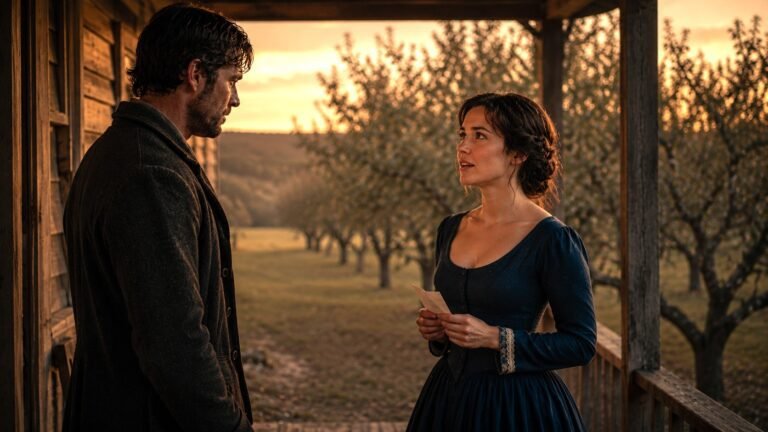
The letter came in June, forwarded twice, Whitfield Cabot Lowe’s hand unmistakable even in decline, informing Margaret that her mother had taken ill and asking, in language so correct it curdled, whether Margaret intended to continue this unfortunate experiment or return to the life and the family that had raised her to better. Margaret read it standing at the kitchen table and felt the old rooms close around her again, the smiling, the correcting, the fork held just so, and something in her went cold and small and familiar, the exact shape she had spent nineteen years being folded into, and she did not tell Thomas about the letter at all — folded it instead into the bottom of her trunk beneath the ruined kid gloves, telling herself it was nothing, telling herself the not-telling was a kindness, a small private grief she would carry alone so as not to burden a man who had enough weighing on him already.
But a letter carried alone has weight, and it showed in her — a distance settling into her shoulders, a new carefulness in the way she moved through the house, the bare-handed ease of the past weeks retreating back toward gloved politeness even with nothing on her hands at all, and Thomas, reading her the way he read a horse gone quiet in a stall, understood something had shifted and misread, entirely and honestly, what it was.
He had spent his whole life certain of his own insufficiency measured against anything fine, and here was the proof arriving at last, he told himself, watching her go quiet and careful again — here was a woman remembering, three months in, exactly what she’d traded down for, and he did not ask her outright what was wrong because some fear-hardened part of him did not want the answer confirmed aloud, and instead he did what he had always done with a wound he couldn’t fix: worked longer hours, came in later, let the silence between them stretch until it stopped being a listening silence and became simply an absence, two people occupying the same rooms without ever quite arriving in them together.
Margaret watched him pull away and read it, with the same terrible precision, as confirmation of her own oldest fear — that whatever she brought into a room, however plainly, however honestly, would in the end prove to be too much handling for anyone to want to keep close, that she was, at bottom, exactly what she had always been told she was, a thing to be looked at from a correct and comfortable distance and not a thing anyone truly wanted to hold.
She began wearing the ruined half-mitts less at the stove and reached instead for a spare pair of Thomas’s own leather work gloves left drying by the door, oversized on her hands, and wore them longer than any task required, as if the wearing were less about the work now and more about having something between her skin and the world again, a small retreat she was not proud of and could not, for weeks, make herself stop.
It came to a head on a night in late June with a storm building violet and heavy over the western ridge, the air gone thick and metal-smelling the way it does before hail, and Thomas came in late from moving stock to lower ground, soaked through, and found Margaret sitting at the table with the lamp unlit, the letter — found, at last, by accident, tucked in the trunk when she’d gone looking for a shawl — open in front of her, and something in him that had been holding steady for weeks simply gave way.
“You mean to go back,” he said. Not a question. A man bracing for a kick he’d decided was already coming.
“I mean nothing of the kind,” Margaret said, but it came out too fast, too defensive, the words of someone caught rather than someone confident, and Thomas heard the fastness of it and not the truth underneath.
“You’ve been going quiet for weeks. Didn’t need a letter to tell me that.” His voice had gone rough, not unkind, but stripped of its usual careful sideways approach. “Reckon a man doesn’t need reading lessons to see when someone’s already halfway out the door.”
“That is not what this is,” Margaret said, standing now, and her hands, still gloved in his oversized leather, came up helpless at her sides, unable to gesture the way they wanted to, muffled the way her whole self had gone muffled these past weeks, and the sight of her own hands, thick and wrong and borrowed, undid something in her. “I didn’t tell you because I did not want to be one more burden set on a man already carrying more than his share, and you have looked at me for a month now like a debt you’re waiting to be called on, and I do not know how to fix a thing neither of us will say aloud.”
“Then say it,” Thomas said, and the storm broke outside, first hail rattling the tin roof like flung gravel, both of them standing three feet apart in a dark kitchen with a decade of separate silences between them, neither one reaching first, both of them certain, in the old worn grooves of their oldest fears, that reaching would only prove what they’d always suspected — that they were, each of them, more trouble to hold onto than they were worth keeping.
The storm blew itself out by midnight, and Thomas slept, or lay pretending to, in the barn loft rather than the house, telling himself it was for the stock and knowing it was not, and Margaret lay awake in the bed they had shared for three months, listening to the last of the rain drip off the eaves, her hands — bare now, the borrowed gloves shed somewhere on the kitchen floor — lying open and empty on top of the quilt, and she thought, with a clarity that felt almost violent in its plainness, that she had done exactly what she had come five hundred miles to stop doing. She had gone quiet. She had let the fear decide for her, the way it had always decided for her, folding herself smaller and smaller until there was nothing left in the room a person could reach.
She rose before light, dressed plainly, and walked out to the barn with nothing rehearsed, no correct sentence prepared, because correct sentences had never once, in her whole life, gotten her anything real.
Thomas was already awake, sitting on an upturned crate with a lantern turned low, mending the same strap of tack he’d been mending for weeks, hands moving out of habit more than purpose, and he looked up when the barn door creaked and did not say anything, only watched her cross the straw-strewn floor toward him with the particular caution of a man who has already decided, somewhere in the dark hours, what the morning is going to cost him.
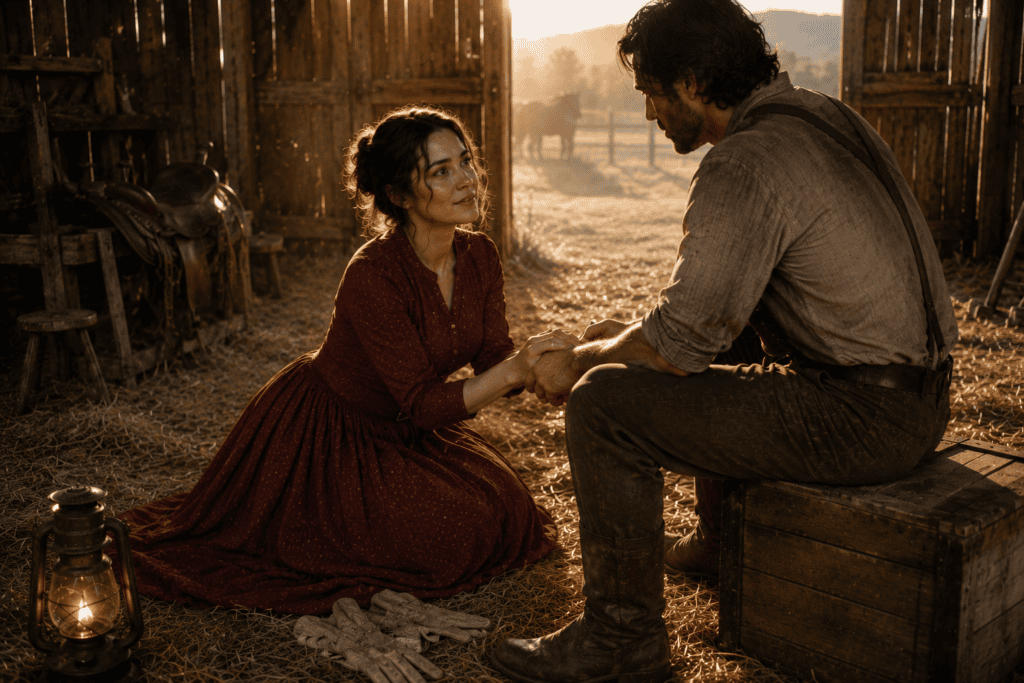
Margaret stopped in front of him and, without a word, without any of the careful sideways approach either of them had spent a lifetime perfecting, reached down and took his hand — his actual hand, rope-scarred and sun-dark and calloused in a way no hand at any Boston dinner table had ever been — and held it, plainly, both of hers wrapped around it, the way she had never once let herself hold anything, not a fork, not a rail, not another person, without the old glove of politeness folded carefully between herself and the touch.
“I didn’t tell you because I was frightened,” she said, and her voice did not do the thing it usually did, the careful modulation, the schoolteacher’s precision — it came out plain and a little rough, the way his had come out the night before. “Not of you. Of what it would mean, needing you to stay steady when I told you something true. I have spent my whole life being handled and never once held, Thomas, and I did not know, until I stood in your kitchen with your gloves on my hands trying to disappear into them, that I had started doing the very thing to myself that I ran five hundred miles to stop anyone else doing to me.”
Thomas sat very still under the weight of her hands around his, the lantern light catching the wet at the corners of his eyes though neither of them named it, and said, low, “I’ve spent mine certain that anything fine that came near me was only passing through on its way to somewhere better suited. Watched you go quiet these weeks and told myself, well — there it is. There’s the arithmetic finally coming due.” His thumb moved, small, uncertain, along the back of her bare hand. “Didn’t occur to me you might be scared of the very same thing I was. Man can be a fool a long while before it teaches him anything.”
“Then let it teach you now,” Margaret said, and knelt in the straw in front of him, her skirts pooling, so that they were level, her hands still wrapped around his, and reached into the pocket of her plain work dress and drew out the ruined kid gloves — not the half-mitts he’d made, but the original pair, the ones she’d kept folded at the bottom of her trunk beside the letter, stained past any redemption, the last physical remnant of the woman who had stepped off the train three months ago believing her hands existed only to be looked at.
She set them down in the straw between them, deliberately, the way a person sets down something they have decided, at last, to stop carrying, and then took both of Thomas Reilly’s hands in both of her own, bare skin to bare skin, nothing left between them to soften or disguise or protect either one from the plain fact of being touched and known and, for once in either of their lives, chosen on purpose, in daylight, by someone who had seen exactly what there was to see and had not looked away — and outside the barn door the last of the storm cleared off the western ridge, and the first ordinary light of morning came up gold and unremarkable across the wet grass, catching, for just a moment, on the small worn pearl buttons of the gloves lying forgotten and finally still in the straw.