
The frost came early that year to the bottomland along the Bighorn, silvering the cottonwood leaves before they had properly turned, so that the whole river seemed dressed for a funeral nobody had called. Wyatt Calder sat on the step of the bunkhouse with a coal-oil lamp turned low beside him and a length of horsehair working through his fingers, three strands over two, the rhythm older than thinking. He had learned it at his father’s knee on a step much like this one, the old man’s hands broad and cracked as creek-bed mud, saying nothing because there was nothing that needed saying when the hands were saying it for him. Wyatt did the same now. He had gotten good at it, the way a man gets good at whatever keeps his hands too busy to reach for anything else.
The rope he was making had no horse waiting for it. He told himself that was beside the point.
Below the bunkhouse the herd moved like a dark tide against the paler grass, and beyond them the Absarokas stood up sharp and blue-black against a sky gone the color of a healing bruise, the last light bleeding out along their teeth. Wyatt had ridden this range since he was nine years old, had buried his father at the base of the second ridge where the ground didn’t flood, had buried his mother eleven months later beside him though the doctor over in Junction City called it fever and Wyatt privately called it something else, something with no name he’d ever say out loud. Grief, maybe, if a man let himself call it that. He didn’t. He called it Tuesday, and Wednesday, and every other day since, and he built fence and broke horses and salted cattle against the winter and braided rope in the evenings until his fingers ached, and he told anyone who asked that he was doing just fine on his own, thank you kindly, and most days he half believed it.
There was a second saddle in the tack room that hadn’t been sat in four years. He oiled it anyway, every spring, out of some obligation he couldn’t have explained to a living soul.
His father had taught him the braiding the winter Wyatt turned twelve, the two of them shut up in the barn against a blizzard that kept the whole outfit indoors for the better part of a week, the old man’s voice going low and patient over the mechanics of it — three over two, keep your tension even, a rope braided angry comes apart angry, first hard pull it gets. Wyatt had thought it was foolishness at the time, a game to keep a boy’s hands busy while the weather did its worst outside. He understood it different now. There had been a year, right after the fever took his mother, when the braiding was the only thing that kept him inside his own skin past dark — the counting of the strands, the small tyrannical order of it, a thing a man could get right when nothing else in the world seemed built to be gotten right at all. He had gone on doing it long after the grief that started it had worn down to something duller and more permanent, a scar rather than a wound, and some nights he caught himself at it without remembering having sat down to start.
He kept his father’s braiding awl in a tobacco tin on the shelf above his bunk, the bone handle gone smooth and dark with two men’s handling now instead of one, and some nights, before he blew out the lamp, he would take it down and turn it over once in his palm before putting it back, the way another man might touch a rosary or check a door was locked, not out of any real doubt but because the checking itself was the comfort.
He finished the length he was working, tied it off, and sat looking at it in the lamplight the way another man might look at a letter he wasn’t sure he wanted to finish reading. It was near seven feet of clean four-strand braid, black and silver-gray mixed through, tight as a fiddle string. He’d made one just like it once, smaller, for a girl’s paint mare, back when he was nineteen and fool enough to believe the things he wanted might simply be given to him for wanting them hard enough. That was five years gone now. He had not braided one for anybody since. He told himself this one was for the gray gelding he’d been meaning to break to a hackamore, and he coiled it and hung it on the peg by the door, and he did not examine too closely why his hands had shaken a little at the tying-off.
Old Emmett Fisk, who’d cowboyed on the Calder spread since before Wyatt was born and had earned the right to say what he pleased, spat into the dust the next morning and said it plain. “Stage comes through Junction City on Thursday next. You aiming to be there, or you aiming to keep telling yourself you ain’t counting the days.”
“Got fence needs mending on the north section,” Wyatt said, not looking up from the cinch he was checking.
“Fence has needed mending on the north section since April,” Emmett said. “Reckon it can wait one more day for a man to go meet his intended off the coach, seeing as her pa asked you personal and you give your word on it four years back, standing right there by that busted corral gate, sober as a judge.”
Wyatt didn’t answer that, because there wasn’t an answer that wouldn’t give away more than he cared to. He’d given his word to Bear That Walks the autumn the man’s daughter left for the government school back East, the two of them standing in a hard rain neither had bothered to get out of, and he had meant every syllable of it the way a young man means things — with his whole undivided chest, no room left over for doubt. But four years was a long enough time for a man to learn what doubt was for. Long enough to wonder whether the version of a person a body carries around in memory bears any true resemblance to the person that comes walking back. Long enough to build a life shaped entirely around not hoping for things, because hope, in Wyatt Calder’s experience, was mostly just grief that hadn’t happened yet.
He went out and mended fence on the north section anyway, that whole week, driving staples with more force than the work called for, and told himself it wasn’t a way of making the days go faster. The frost held. The cottonwoods let go their leaves all at once on the Wednesday, a whole hillside of gold coming down together in no wind at all, and Wyatt stood at the fence line and watched it happen and felt something in his chest come loose the same way, and did not have a name for that either.
Thursday morning he oiled the second saddle, the one that hadn’t been sat in four years, and did not examine that either. He put on a clean shirt, the collar stiff from being folded so long in the bottom of his trunk, and stood a minute in front of the small scrap of mirror nailed to the bunkhouse wall studying a face that looked, to his own eye, older than twenty-four had any right to look — sun-cracked at the corners of the eyes, a white seam of scar through one eyebrow from a rope that had gotten away from him three winters back, nothing in it of the boy who had stood in the rain at that busted corral gate and made a promise he’d half believed, even then, he might not get to keep.
He told Emmett he was riding to Junction City to see about ordering barbed wire, and Emmett said “Mm,” in the particular tone of a man who has decided not to call another man a liar to his face, and Wyatt rode out at first light with the mended rope coiled behind his saddle for no reason he would admit to, the frost still lying white and unbroken in the shadowed draws, his own breath and the gelding’s mingling in a single pale cloud that hung a moment behind them before the wind took it. He passed the fork where the road split toward the Crow Agency and did not turn onto it, though his hands wanted to, the same way a man’s hands want to reach for a fire he knows will burn him. He passed the low mounded graves at the base of the second ridge where he did not stop, though his horse slowed there out of old habit, the way horses will learn a man’s habits better than the man knows them himself, and for a moment Wyatt sat the saddle looking at the two weathered plank markers, gray as driftwood now, and thought that his father, at least, would have understood exactly what four years of silence could do to a young man’s nerve, and would not have thought less of him for riding toward Junction City with his hat pulled low and his jaw set like a man riding toward a reckoning rather than a reunion. He put his heels to the gelding and did not look back at the ridge again.
Junction City on a stage day was two dozen buildings’ worth of noise trying to sound like a town. A false-fronted saloon, a livery, Pruett’s mercantile with its window full of canned peaches and coils of new rope, a Chinese laundry that did a brisk trade in starched collars for men who owned exactly one, and a hitching rail worn smooth and pale by four years of restless horses. The whole street smelled of horse and dust and, faintly, of the bakery two doors down, where a woman named Odessa Pruett made bread every stage day on the theory that a town ought to smell like something worth arriving in. Wyatt tied his horse at the rail outside the mercantile and stood in the thin autumn sun with his hat pushed back, watching the road east go pale with dust long before the coach itself came into view, the sound of it arriving ahead of the sight — traces jingling, the driver’s voice going up and down over the team, six horses lathered and blowing as they hauled the Concord in through the ruts at a rattling trot.
His stomach had gone tight sometime around sunup and had not eased since, a feeling he associated mostly with cattle drives and river crossings running high, not with standing still on a boardwalk in his good shirt. He had counted the boards under his boots twice already, and was starting a third count, when Bear That Walks came up beside him without any particular sound, the way the man did most things.
Bear That Walks was already there, standing off a little from the crowd the way he generally stood, in a blanket coat and a flat-brimmed hat, watching the road with no more visible feeling than the fence post beside him, though Wyatt had known the man four years now and had learned to read the stillness the way he read weather — the particular quality of waiting a man does when he is not permitting himself to hope out loud.
“Calder,” Bear That Walks said, by way of greeting.
“Sir.”
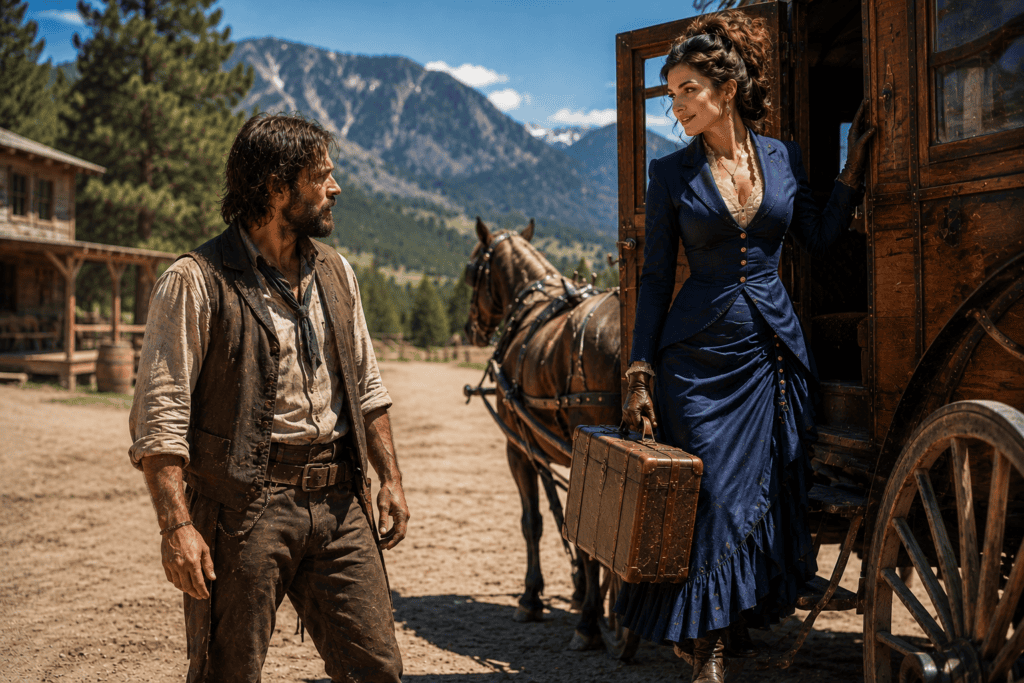
Neither said anything further. The coach ground to a stop in a wash of dust and horse sweat, and the driver climbed down cursing genially at his team, and the door swung open, and an drummer in a checked suit climbed out first, complaining about his back, and after him a woman in a gray traveling dress with a small dark hat pinned at an angle over hair done up smooth and city-fashion, stepping down with one gloved hand light on the door frame like she’d practiced the motion in a mirror somewhere and gotten it exactly right.
Wyatt looked at her the way a man looks at a stranger, taking his hat off out of manners more than recognition, and it was a full three seconds — long enough for the drummer to notice and grin — before the shape of her jaw and the particular way she held her chin when she was deciding whether to laugh at something reassembled themselves in his memory into a face he had carried around for four years like a coal banked under ash.
“That,” Wyatt said, out loud, to nobody, his hat still in his hand, “can’t be my bride.”
The drummer laughed outright. The driver, unhitching the lead team, laughed too, not unkindly. And the woman in the gray dress turned her head and looked at Wyatt Calder standing there bareheaded in the dust with an expression on his face like a man who has just watched a river run backward, and something in her own face — schooled smooth for four years by teachers who valued composure above nearly everything — came loose at the corner of her mouth despite herself.
“You’ve gone and forgotten how to talk, Wyatt Calder,” she said. Her voice had picked up something of the East in its edges, rounder vowels, but underneath it ran the same low, unhurried current he remembered, and hearing his own name in it undid something in his chest as thoroughly as the cottonwoods letting go their leaves.
“No, ma’am,” he said. “I recall how. Just having some trouble locating the right ones.”
She came down the last step without his hand, though he’d half-offered it, and stood there in the dust in her fine gray dress and her small angled hat, and it was only when she moved to gather her skirt that Wyatt saw, beneath the hem, not the buttoned boots a lady from back East would wear but a pair of moccasins, quilled at the instep in a pattern he recognized because her mother had made a matching pair for him once, four winters back, as a joke about his own clumsy feet.
“They let you keep those,” he said, nodding at them, because it was easier than saying anything about her face.
“They didn’t let me do much of anything,” she said, and something flickered behind her eyes that he filed away to ask about later, in private, when there weren’t a drummer and a driver and half of Junction City watching. “But some things travel better hidden than others.”
Bear That Walks stepped forward then and took his daughter by both shoulders, formal as a handshake, and said something low in Apsáalooke that Wyatt didn’t have the words for but understood well enough by the way the woman’s composure finally, fully broke, her eyes going bright and her mouth working, four years of careful schooled stillness coming apart all at once in the dust outside Pruett’s mercantile. Wyatt stood back and let that happen, because some things a man has no business intruding on even when his whole chest is aching to.
It was the drummer’s mule, spooked by a barking dog, that saved the moment from turning into more sentiment than Junction City generally allowed itself in public. The animal bolted three steps sideways and knocked her trunk clean off the boot of the coach, and it burst open in the street, spilling a green wool dress and a Bible and a paper sack of peppermint candy across the dirt, and the woman said a word in Apsáalooke that made her father’s eyebrows go up and made Wyatt laugh out loud for the first time in longer than he cared to count, a real laugh, startled out of him, and she looked over at him laughing and something passed between them that had nothing at all to do with schooled composure or four years or the whole watching town, and everything to do with two people discovering, in the space of about ninety seconds, that whatever they’d been to each other before, it hadn’t gone anywhere. It had only been waiting.
She got down on her knees right there in the street in her fine gray dress, heedless of the dust, and began gathering the spilled things back into the trunk with quick, efficient hands, and Wyatt knelt down across from her to help, close enough now that he could see the schooling had not touched everything — there was a chip out of one front tooth from some childhood spill he remembered exactly, a fall from the very paint mare tied now behind the agency wagon, and a small white scar through her eyebrow that answered, near enough, to the one through his own, though neither of them had gotten theirs from the same rope.
“They taught you needlepoint back there,” he said, nodding at the careful hem of the green dress, hunting for something ordinary to say with his hands full of another man’s scattered candy. “Didn’t teach you to pack a trunk so it don’t explode.”
“They taught me a great many things, Wyatt Calder, most of which I intend never to use again,” she said, tucking the Bible back in with more force than the book strictly required. “Packing a trunk that survives a spooked mule was not among the curriculum.” She looked up at him, still on her knees in the street, and for a moment neither of them moved to stand, the dust settling slow around them both in the low sun, the whole noisy business of Junction City going on unconcerned a few feet away. “You cut your hair,” she said, as though she’d only just noticed, reaching up before she seemed to decide to and then stopping herself an inch short, her hand dropping back to her lap.
“Figured a man courting oughtn’t look like he’d been dragged through a fence backward,” Wyatt said, and then heard the word courting land in the air between them, larger than he’d meant to let it, and did not take it back.
She didn’t either. She only closed the trunk lid, latched it, and let him carry it to the wagon, and that was the whole of what either of them said about it that day, though it sat between them the rest of the ride to the agency like a lit lamp neither one wanted to be the first to blow out.
The weeks after the coach came in settled into a shape neither of them named out loud. Wyatt rode to the agency two, three times a week, always with some errand that could have waited and never did — a mare needing a look at her hock, a load of flour Bear That Walks had ordered through the Junction City store, a hundred small excuses that fooled nobody, least of all Bear That Walks, who watched Wyatt come and go with the patient, unhurried attention of a man counting cards he already knew the value of.
There were rules to how it was done, and Wyatt learned them the way he learned everything, by watching and by getting it wrong once and being corrected without cruelty. He did not address her mother direct, not once, not even to pass the salt, but spoke instead to whichever cousin or aunt happened to be sitting nearest, who would carry the words the three feet necessary and hand back an answer the same roundabout way, and after the first awkward week of it Wyatt found something in the practice he came almost to prefer — a kind of respect built right into the grammar of a family, the plain understanding that some doors are not opened by simply wanting through them.
Her name — the one her people had given her, the one that in English came out closest to Magpie Woman, for the bird’s boldness and its habit of carrying off bright things and making a nest of them — was not a name Wyatt trusted his tongue with entire, so he called her Magpie the way he always had, and she let him, the way she let very little else pass without comment.
She had not forgotten how to sit a horse. That was the first thing Wyatt learned watching her those weeks, out at the agency corral in the low gold light of October afternoons, breaking a green colt her father had traded for — she came up into the saddle like water finding its level, no wasted motion anywhere in her, and the four years of stiff collars and recitation and correct posture at somebody else’s dinner table fell off her the moment her weight settled over the animal’s spine. Wyatt sat the fence rail and watched her work the colt in slow circles, talking to it low and steady in a language the horse seemed to understand better than English, and felt something in his own chest loosen that four years of solitary rope-braiding had never once managed to touch.
“You’re staring, Wyatt Calder,” she said, not turning her head, the colt still circling under her.
“Man’s allowed to look at a good piece of horsemanship.”
“Is that what you’re looking at.”
He didn’t have an answer for that one that wouldn’t cost him more than he was ready to spend, so he climbed down off the fence instead and went to check the colt’s off hind foot, which didn’t need checking, and she let him have the silence, though the corner of her mouth was doing that thing again.
The old rope was in her tack, he noticed — the small one, worn thin and gray now, the horsehair gone soft and pale with years of handling, tied around the neck of the paint mare she’d left behind when she went East and had gotten back, somehow, thinner and older and still hers. She’d kept it the whole four years. He didn’t ask how, or why, because asking would have meant saying out loud what the not-asking already said plain enough.
He thought of it again a few days later, hauling water up from the river for her mother’s cook fire, the yoke biting into his shoulders and Magpie walking alongside empty-handed on the theory, loudly stated, that a guest who insisted on working oughtn’t also expect help doing it. The ice had crusted thick along the bank overnight, and where he set the buckets down to break through it with his boot heel, she crouched beside him and pointed out, without being asked, the places the current ran too fast underneath to trust, marking them the way a person marks a map they have long since memorized and simply enjoys walking again. He watched her hands more than the ice, the quick certain way they moved, and thought that four years of somebody else’s East Coast manners had not touched this in her at all — this competence, this ease in her own skin against her own country — and something in his chest went tight and grateful at once, the two feelings so close together he could not have said where one left off and the other started.
“You’re doing it again,” she said, not looking up from the ice.
“Doing what.”
“Watching instead of talking.” She straightened, brushing frost from her knees, and looked at him a long, level moment, close enough now that he could see the exact place her breath clouded and dissolved in the cold air between them. “I used to think you’d say something plain to me one of these days, Wyatt Calder, and just about wear myself out waiting on it.”
“Might be worth the wait yet,” he said, and did not move any closer, though every part of him wanted to, because there were eyes at the lodge behind them and rules to the thing he had come, slowly, to respect rather than resent, and because some hungers, he was learning, kept better for being let alone a while longer. She seemed to understand exactly what he’d decided and why, and did not press it, only picked up one of the filled buckets herself despite her stated policy, and carried it up the bank ahead of him, and the look she gave him over her shoulder on the way said plainer than any words could have that the waiting, whatever it cost either of them, was not going to go on forever.
He brought the new one out the second week of November, the seven-foot length he’d braided the night before her coach came in, coiled behind his saddle like it had been that first day at Junction City, and he handed it over without much ceremony while she was cooling the colt out, said it was for whichever horse she settled on keeping, and she took it in both hands and ran her thumb along the tight even braid of it, black and silver-gray mixed clean through, and looked at him a long moment with an expression he could not read and did not try to, because some things a man learns to leave alone until he’s invited closer.
“You made this the night before the coach,” she said. It wasn’t a question.
“Might have.”
“Before you knew I was coming back different.”
“You ain’t different,” he said, before he’d thought it all the way through, and regretted the quickness of it even as the words left him, because it wasn’t entirely true and they both knew it, and the not-entirely-true sat between them in the cold air a moment before she looked back down at the rope in her hands and didn’t answer at all.
There was trouble that same week from the Bar Diamond outfit to the south, whose cattle kept drifting onto Crow allotment grass along the river bottom and whose foreman, a broad red-faced man named Tull, made no particular secret of what he thought about a white rancher spending his afternoons at the agency corral instead of riding fence to keep his neighbors’ cows where they belonged. Wyatt found Tull’s stock in the bottomland twice that month and pushed them back himself, quiet, before Bear That Walks’s nephews had to do it and risk the kind of trouble that started over cattle and didn’t stop there. He said nothing of it to Magpie. She found out anyway, the way people at an agency always found out everything, and she looked at him different after that — not softer, exactly, but like she was recalculating some sum she’d been carrying since she was seventeen and finding it came out better than she’d let herself expect.
There was a hand game at the agency the last Saturday of October, families come in from the outlying allotments with wagons and saddle horses, drums going steady past dark and the firelight throwing long shapes against the canvas of the lodges, and Wyatt went because Bear That Walks had told him plainly he was expected, and stood at the edge of it in his good shirt feeling every inch the outsider he was, until Magpie came and sat down cross-legged in the dirt beside him without asking permission, close enough that her shoulder found his, and began explaining the game in a low running commentary — which hand held the bone, which team was bluffing, why her youngest cousin’s terrible singing voice was, in fact, a deliberate strategy, since a guesser distracted by bad music guessed wrong more often than not. Wyatt lost four bits betting on her cousin’s team purely on her say-so and did not mind losing it one bit, watching her face in the firelight, animated in a way the gray traveling dress and the stiff collar of four years back East had never once let him see, laughing outright when her cousin won the round, throwing her head back with it the way he remembered from before she left, the sound of it going straight through him like cold water on a hot day.
“You don’t talk much when you’re happy,” she said to him later, when the drums had slowed and people were drifting toward their fires, catching him watching her instead of the dying game. “You get quiet. I noticed it before, too, when we were young and foolish. Figured you’d have grown out of it.”
“Man talks less when he’s got less he’s willing to risk saying wrong,” Wyatt said.
“That a fact.” She studied him a moment in the firelight, her breath showing faint in the cold. “My mother says a man who watches that careful is either very wise or very afraid, and there’s no telling which from the outside.”
“Which do you reckon.”
“I reckon,” she said, standing and brushing the dirt from her skirt, “you’ve got until spring to convince me it’s the first one,” and walked off toward her mother’s fire before he could think of anything to say back, which was, he understood by then, exactly the kind of thing she liked doing to him.
They stood at the corral rail one evening in the last of the light, the colt dozing in the far corner, her mother’s lodge fire showing pale smoke against a sky gone the color of a healed-over bruise, and neither of them said much of anything, and the not-saying went on long enough and close enough that Wyatt’s hand found the rail an inch from hers and stayed there, not touching, close enough to feel the warmth of her skin without the nerve to close the distance, and she did not move her hand away, and the two of them stood like that until full dark came down and somebody’s dog started barking at nothing down by the river, and it was, Wyatt thought riding home under a sky gone thick with stars, about the finest hour he’d spent in five years.
The letter came the second week of December, and it wasn’t even addressed to Wyatt, which was somehow the worst part — a printed circular from the school back East, offering Magpie a teaching position in the primary classroom there, board and a wage both, the kind of offer that got made to maybe one student in twenty and said plain, in its careful institutional language, that she had been good enough, out of all of them, to be asked to stay.
He heard about it from Emmett, who’d heard it from the Junction City postmaster, who read more of other people’s mail than was strictly his business, and Wyatt rode to the agency that same afternoon with something cold sitting low in his gut that he told himself was nothing, was just the wind coming down off the Absarokas early that year, and found her at the corral with the letter still in her coat pocket, and asked her straight out, no roundabout kinship channel to soften it, whether it was true.
“It’s true there’s an offer,” she said. “It ain’t true I’ve answered it.”
“When were you fixing to tell me.”
“When I’d decided something worth telling.”
The cold in his gut climbed up into his chest then, fast, the way weather comes down off a mountain before a man’s even seen the cloud that’s bringing it, and what came out of his mouth was not what he meant, not exactly, though it took the shape of meaning and he let it, because meaning something honest felt safer, in that moment, than saying the true thing underneath it, which was that he had spent four years learning not to want anything he might lose and here it was again, the wanting, right on schedule to be taken from him.
“Reckon that’s your answer, then,” he said. “Man’d be a fool to stand between you and a life you’re better fit for than this one.”
“That ain’t what I asked you.”
“Didn’t figure you were asking anything. Figured you were telling me. Same as your pa telling me four years back you’d gone East, same as I stood there and give my word like a fool and you come back changed enough a man near didn’t know his own — ” He stopped himself there, but not soon enough, the word bride sitting unspoken and enormous in the space he’d left for it, and her face did something he had not seen it do since the day of the trunk spilling open in the Junction City dust — went still, all the way still, schooled smooth in a way that had nothing to do with four years back East and everything to do with a door closing somewhere behind her eyes that he had, with his own mouth, just finished shutting.
“You think I came back to be measured against who I was at seventeen,” she said, quiet, “and found wanting for having grown.”
“I didn’t say —”
“You didn’t have to.” She unhitched the paint mare’s lead from the rail, the worn gray rope still knotted at its neck, and did not look at him again. “Go on home, Wyatt Calder. Go braid your rope for a horse that don’t exist. Seems you’re better company for it than for me.”
He rode home in a wind that had, in fact, come down off the mountains while they stood there, sharp enough to cut through his coat, and he did not stop at the fork toward the agency the next morning, or the morning after that, or any morning through the whole white, silent stretch of December that followed, the coldest anyone in Junction City could recall, the river skinning over with ice thick enough by New Year’s to bear a horse’s weight. He rode fence in it. He broke ice on the stock tanks with a maul, morning and evening, his hands going raw and then numb and then raw again, the skin at the knuckles splitting and healing over rough, and in the evenings he sat on the bunkhouse step with the lamp turned low and did not braid rope, could not make his hands do it, the rhythm gone dead in his fingers the way a hymn goes dead in a man’s mouth once he’s stopped believing the words.
He ate less than he cooked, most nights, and cooked less than he ought, and Emmett took to leaving a plate at his elbow without comment and taking it away again half touched without comment either, which was, from Emmett, its own kind of verdict. Wyatt caught himself twice that January standing at the tack room door with his hand on the latch and no memory of what he’d come for, and once, riding the north section in a wind that peeled tears sideways off his face before they’d gone an inch, he found himself at the fork toward the agency with the gelding already half turned onto it before he hauled the animal back around, hard enough that the horse threw its head and fought the bit the rest of the ride home, as if it, too, had an opinion about the direction its rider kept refusing to take. He lost eleven pounds between the hand game in October and the second week of February, weight he did not have to spare to begin with, and slept badly enough that Emmett heard him some nights through the bunkhouse wall, not talking, just restless, the particular restlessness of a man arguing with himself in the dark and losing.
It was Bear That Walks who finally rode out to the Calder place, the first week of February, in a cold clear enough that his horse’s breath hung in ropes ahead of it, and found Wyatt in the corral working a green horse he had no earthly reason to be working in that weather, both of them, man and animal, worn thin and short-tempered from it.
“You are a hard man to watch make the same mistake twice,” Bear That Walks said, from horseback, not dismounting.
Wyatt didn’t answer that directly. “She take the position back East?”
“She has not answered it,” Bear That Walks said. “She says she is waiting to see if there is a reason not to.” He looked down at Wyatt a long moment, weighing something. “My daughter did not go to that school to learn to leave us, Calder. She went because her mother and I sent her, so that she would have what we could not give her, so that she could stand in both worlds and not be swallowed by either. You have known her four years and you still believe an education is a door with only one side.”
“I said a fool thing,” Wyatt said.
“You said an afraid thing,” Bear That Walks said. “There is a difference, though a man your age ought to know it.” He gathered his reins. “She is at the river tomorrow, cutting willow for baskets with her aunts. If you have got anything true to say to her, that would be the place and the hour to say it. If you have got nothing but more fear dressed up as sense, stay home and finish breaking that horse you are ruining out of spite.”
He rode off without waiting for an answer, and Wyatt stood in the corral a long while after, the green horse blowing and stamping behind him, and looked north toward the river bottom where the willow grew thick along the ice, watching his own breath go out white and ragged in the cold, and something in him that had been clenched tight since December let go all at once, the way a cinch lets go when a man finally finds the right notch for it.
He went into the bunkhouse and sat down at the small table by the stove and did not sleep that whole night, working instead by lamplight with the old worn rope — he had ridden to the agency at dusk and asked for it back from her cousin under some excuse about needing to check the splice, a small lie he was not proud of, though the cousin’s knowing look told him the lie had fooled nobody — unbraiding it strand by strand under the lamp, his father’s bone-handled awl warm in his palm from the stove heat, the pale soft horsehair gone four years gentle with handling, smelling faintly still of woodsmoke and horse and something underneath that he could not have named but that put him in mind of her exactly. He worked it back in with new hair cut clean from his own gelding’s tail, black and silver-gray, his fingers finding the old rhythm again after a month and a half of dead silence in them, three over two, keep the tension even, first hard pull it gets is the one that tells a man whether he braided it angry or braided it true. He did not braid this one angry. He worked at it slow and careful past midnight and past the second lamp trimming, until the whole seven feet of it ran old and new together clean through, indistinguishable to any eye but his own, and only a man who knew exactly what he was looking for could hold it close to the light and find the seam, and see that the whole of it, old strand and new both, had held.
She was at the river the next afternoon exactly as her father had said, kneeling in the frost-burned grass at the ice edge with two aunts and a pile of cut willow between them, her breath showing white, her hands quick and sure at the peeling as they had always been at everything her hands undertook. She heard the horse before she saw him and did not stand, did not stop the work, though her hands slowed enough that Wyatt, watching from a still-respectful distance the way four years of learning her family’s rules had taught him to, understood she was giving him the chance to turn around and ride home if that was the kind of man he still meant to be.
He didn’t take it. He got down, and he did not go to her first — he went instead to where her mother sat a little apart with the youngest of the willow-cutters, and he stood at the correct distance a son-in-law was permitted, and he said, in the handful of Apsáalooke words he had spent the whole cold sleepless night learning off a scrap of paper Bear That Walks had once, patiently, written out for him, a greeting and then a request for permission to speak with her daughter, the words coming out clumsy and badly accented and entirely, visibly, sincere.
Her mother looked at him a long moment. Then she said something to the aunt beside her, low, and the aunt laughed, not unkindly, and waved a willow switch toward the river in a gesture that needed no translation at all.
Magpie had stood by then, willow stalks still in one hand, watching him cross the frozen grass toward her with something guarded still sitting behind her eyes, though it was a different guard than the one he’d shut there in December — this one had a door in it, at least, even if the door hadn’t opened yet.
“I said an afraid thing at the corral,” Wyatt said, before she could speak first, because he had rehearsed getting this part right the whole ride over and did not trust himself to remember it twice. “Wasn’t about you leaving. Was about me having spent five years learning not to want anything on account of everything I ever wanted got taken from me one way or another, and then you come walking off that coach and I wanted you so bad it scared the sense clean out of my mouth, and what came out instead was ugly, and it wasn’t true, and I’m asking you to let me say the true thing now, however late it’s come.”
“Say it, then.”
“I don’t care what door that school opens for you. I ain’t standing in front of any of them. I’m asking you to walk through whichever ones you want, and asking would you let me be the one waiting on the other side of this one, here, on this river, for however long that turns out to be. That’s all. That’s the whole of it.”
She looked at him a long moment, the willow switches still in her hand, the aunts a discreet distance off pretending very hard not to listen and failing entirely.
Wyatt held out the rope then, the whole seven feet of it re-worked overnight, old pale hair and new black-and-gray run together the length of it so close a person had to hold it near the light to find the seam. “It’s the same one,” he said. “Mostly. Worked some new into the old so it’d hold up better. Didn’t throw away nothing that was good in it to start.”
She took it from him with both hands, the way she had the first time, and ran her thumb along the braid slow, feeling for the place where the old strands gave way to new, and found it — he watched her find it, watched her thumb slow right over the seam — and did not say anything for a moment, and then looked up at him with the corner of her mouth doing the thing it had done in the Junction City dust the day the coach came in, the thing that undid him every single time.
“You’re a fool with your mouth, Wyatt Calder,” she said, “but your hands have always known what they were doing.”
She looped the rope once, easy, around both their joined wrists, the way a person ties off a knot that isn’t going anywhere, and the willow switches lay forgotten in the frost-burned grass beside them, and somewhere behind her one of the aunts said something low that set the others laughing, though neither Wyatt nor Magpie turned to hear what it was. Behind her the paint mare came picking her way down through the willow to the river’s edge, breath clouding thick in the cold, and put her nose down into the water where the ice had cracked open in the afternoon sun and let the current show through, black and moving and alive under the white crust of the morning, and drank, long and unhurried, the way an animal drinks when it has come home to water it has always known and trusts entirely will still be there.
Heartfelt characters sharing love, emotions, and romantic journeys filled with hope, trust, and unforgettable bonds