
The truck idled in the yard at 4:40 every morning whether Cole Hargrove had anywhere to be or not, because a stopped engine, in his experience, took longer to get moving than a man liked when the moving needed doing fast. He kept the tank above half. He kept a duffel packed by the door of the bunkhouse he rented from a rancher outside Ashford, Montana, the zipper pull turned inward so it wouldn’t snag in the dark, though he had not, in eleven months, packed or unpacked that duffel a single time. He simply moved it from one temporary floor to the next, the way another man might carry a chair he never sat in.
He worked with his hands now — framing, fence line, the odd roof — because the work tired the parts of him that needed tiring and left the rest alone. He was good at it the way he had been good at everything the Navy taught him, which is to say without apparent effort and at some private cost nobody but him could see the ledger of. He ate standing up most nights, out of the pan, because a table set for one had always struck him as a small, unnecessary cruelty, a place laid for a guest that would not be coming.
There was a certain way he still knelt when a dog came near him on a job site — down on one knee, weight settled back on the heel, right hand closed loose into a fist and held low, palm down, letting the animal come to the back of his knuckles first before anything opened. He did it without deciding to. He had done it a thousand times in a country whose dust still lived somewhere behind his back teeth, kneeling in exactly that posture for a dog that did not exist anymore, and some mornings, alone in the bunkhouse with no dog anywhere in the county wanting his hand, he caught himself down on one knee in the middle of the floor, fist closed, palm to the cold boards, and had to sit there a moment before he understood what his own body had gone and done without asking him.
He did not talk about the dog. He did not talk about much of anything from before, and the men he worked fence with had learned, the way men in that country generally learned things, by watching what happened to the ones who asked twice.
The land itself seemed built for his particular silence — big, indifferent, honest about its distances. Ashford sat where the coulee opened out into hay ground, the Bull Mountains standing blue and serrated to the south, and in November the whole valley went the color of a bruise healing, gold going to gray going to the flat white nothing of the first real snow. Cole liked working outdoors in weather that gave a man something legitimate to think about besides himself. He liked jobs that ended clean — a fence finished was finished, a roof either shed water or it didn’t, and there was a mercy in that kind of arithmetic he had stopped expecting from anything else.
He had been in three towns in eleven months. He told himself it was the nature of the work, following the jobs, and there was truth enough in that to make the lie comfortable. The larger truth, the one he kept as carefully packed as the duffel, was that he had learned what it cost to let a place, or a creature, or a person start keeping a record of him, and he had decided, somewhere over a stretch of road and years he did not let himself drive back over even in memory, that he would rather be a man passing through than a man who left a hole behind him when he went. He had left one of those already. He knew exactly the size and shape of the hole a good man leaves, because he had watched his team leave several, one after another, and had come home the only shape left standing, and did not trust himself, some days, not to be the next one.
He was driving the county road above Ashford Coulee on the second Saturday of November, hauling a load of salvaged lumber back from a job in Roundup, when he saw the sign.
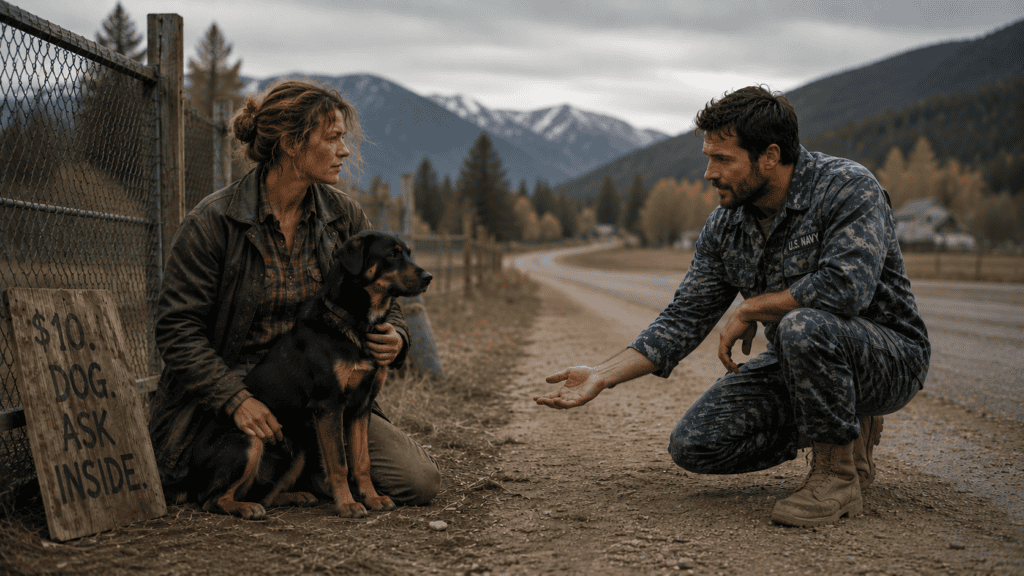
It was hand-lettered on a slab of unpainted plywood, nailed crooked to a fence post at the end of a long gravel drive, the paint already running thin from one hard rain: $10 DOG. ASK INSIDE. Underneath, smaller, added later in a different hand or a different mood: (negotiable if you’re broke, but you gotta mean it.)
Cole slowed without deciding to, the same way his hand closed into a fist without deciding to, and turned the truck up the drive before the rational part of him had finished objecting.
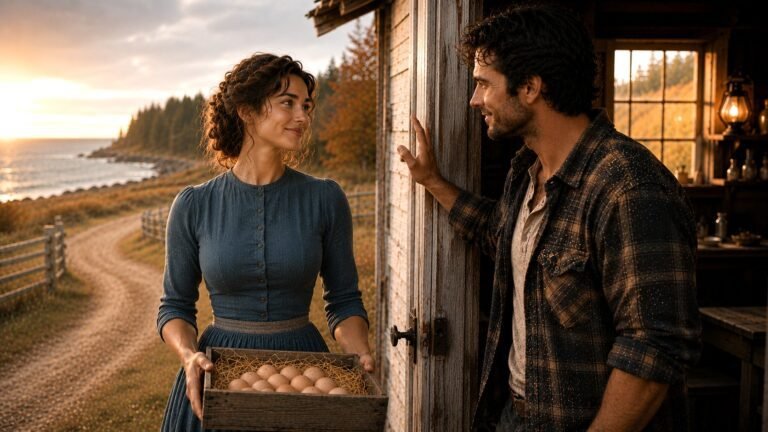
The house at the top of the drive was a low ranch place gone silver-gray at the eaves, a hip-roofed barn behind it in better repair than the house, and a scatter of dog lots fenced with chain-link and cattle panel wired together in a way that spoke less of money than of a person who had run out of both patience and store-bought solutions and simply built what worked. Six or seven dogs came off their feet at the sound of his truck, a chorus of barking that had more curiosity in it than menace, and in the middle of that noise a woman came around the corner of the barn with a hay hook in one hand and sawdust caught in her hair, wiping her forearm across her face before she got close enough to need manners.
“You lost,” she said, “or you here about the sign.”
“Sign,” Cole said.
She looked at him a beat longer than the question required — at the truck bed loaded with lumber, at his boots, at whatever it is people learn to read off a man standing still in a yard — and something in her face settled into a kind of weary, undecided welcome. “Figures. Nobody gets lost enough to end up all the way out here by accident.” She set the hay hook against the fence rail. “Marlow Reyes.”
“Cole Hargrove.”
“Well, Cole Hargrove, I got nine dogs and eleven dollars in the coffee can, so you can see why the math bothers me some nights.” She said it dry, no bid for sympathy in it, the way a person states a fact about weather. “Come on. They’ll tell you themselves which one wants you.”
He followed her along the fence line, and the dogs came up out of the straw and the mud in a wave, noses through the wire, and Cole did what he always did, dropped to one knee in the frozen dirt without thinking about it, fist closed, held low, and let the nearest one — a black-and-tan shepherd mix with one ear that would not stand up no matter what the other one was doing — work its nose along his knuckles before he opened his hand.
Marlow watched him do it. “You’ve done that before,” she said. Not a question.
“Some.”
“Most folks just stick their hand straight out like they’re at a job interview. Dogs hate that.” She crouched a few feet off, elbows on her knees, watching the shepherd lean its whole crooked-eared weight into Cole’s open palm. “This one’s called Biscuit, on account of she used to steal them right off the porch rail before I caught her doing it. Her and the little one there” — she nodded toward a low black-and-white pup half-hidden behind a water trough, watching them both with the particular sideways caution of an animal that had learned people were not automatically safe — “came off the same litter, dumped out past the county line back in September. Little one won’t come to nobody yet.”
“He’ll come,” Cole said, and did not know, until he’d said it, how certain he sounded, or how long it had been since he’d said anything about the future like he had a stake in whether it turned out right.
Marlow glanced at him sideways at that, something flickering behind her eyes and gone again before he could read it. “You always this chatty,” she said, “or is today special.”
“Today’s Saturday.”
“Lord help us all, then,” she said, and the corner of her mouth went up despite whatever effort she was making to keep it from doing so, and it was that — not the dogs, not the sign, not the frost coming up silver off the fence wire — that Cole carried back down the drive with him an hour later, no dog in the truck yet, a promise instead to come back Tuesday and look at the barn roof she’d mentioned was shedding shingles into the hay. He drove the rest of the way to Ashford with the radio off, turning over in his mind the exact sound of her laugh catching itself halfway out, like a woman who had gotten out of practice and was surprised to find the muscle for it hadn’t atrophied after all.
Marlow, for her part, stood at the fence a long while after his taillights went small on the county road, one hand resting on Biscuit’s head, watching the black-and-white pup finally creep out from behind the trough to sniff at the exact spot in the dirt where the stranger’s knee had pressed a shallow print into the frost, and did not examine too closely why she’d found herself, for the first time since the divorce papers came back signed two winters before, standing in her own yard hoping a particular truck might come back up that drive again on purpose.
He came back Tuesday, and then the Thursday after that, and by the time the first real snow closed in over the coulee in early December, Cole Hargrove’s truck in Marlow Reyes’s yard had stopped being a thing either of them remarked on out loud.
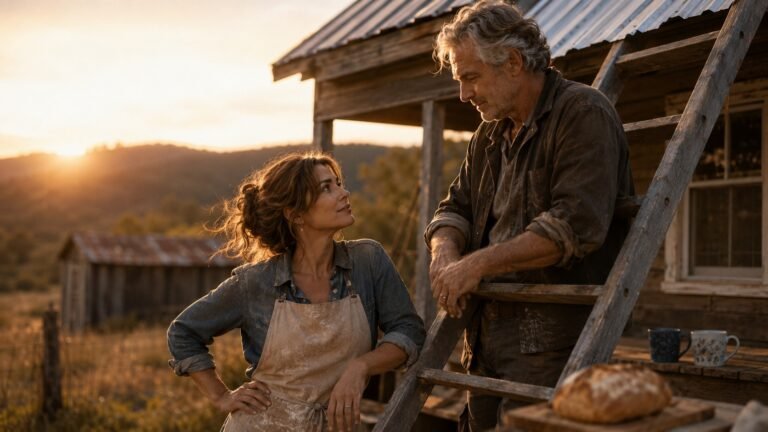
He fixed the barn roof in a day and a half, and when that was done he found other things that wanted fixing, the way a man will when the alternative is admitting he has run out of reasons to keep showing up. A gate hinge. A water line that froze every night and needed lagging. He built, without being asked, a proper run off the south side of the barn, sheltered from the wind, and moved the whelping box into it before anybody’s asking made the gesture cost him anything in the currency he was most careful with.
The black-and-white pup — Marlow had taken to calling him Radar, for the way his ears worked independent of the rest of him, tracking every sound in the yard before his body decided whether to follow — came to Cole first, out of all nine dogs, before he came to anyone. It took three weeks of Cole kneeling at the fence line every visit, fist low, patient as weather, before the pup crossed the last six feet of open ground and put his nose, finally, against the back of Cole’s closed hand, and Cole had gone still in a way Marlow, watching from the porch with a cup of coffee cooling in her hands, recognized as something considerably larger than a man being polite to a shy dog.
“He don’t do that for me yet,” she said, when Cole came up to the porch after, “and I’ve fed him every meal of his life.”
“He will.”
“That a promise or a guess.”
“Little of both,” Cole said, and took the coffee she handed him, and neither of them said anything further about it, though the not-saying sat between them on the porch steps with a weight that felt, to both of them, considerably more honest than conversation.
They fell into a rhythm that had nothing formal in its shape and everything formal in its keeping — supper most Tuesdays and Thursdays, Cole showing up with some tool or some excuse, Marlow feeding him at a table that had, Cole noticed without remarking on it, only ever been set for one before he started turning up. She talked more than he did, which suited them both; she told him about the ranch her grandfather had built and her ex-husband had nearly lost at cards and cattle prices before she’d taken the whole operation apart and rebuilt it smaller, meaner, entirely her own, dog by dog, dollar by dollar. She did not ask him where he’d been before Ashford, not directly, though her silences, when he went quiet mid-sentence over something as small as a spoon dropped too loud on the table, had a particular careful quality that told him she had already guessed most of the shape of it and was waiting, without pressing, for him to fill in whatever color he was willing to give.
“You ever think about staying somewhere,” she asked him once, out at the dog runs in the blue hour after sundown, the question aimed at the middle distance rather than at him directly, the way a person asks something they are not sure they want answered honestly.
“Staying’s a decision,” Cole said. “I’ve mostly just been arriving places.”
“There a difference.”
“Staying means somebody’s counting on you being there in the morning.” He watched Radar work a stick loose from the frozen ground, worrying it with the single-minded patience of a young dog who has not yet learned the stick will still be there tomorrow. “Arriving don’t cost anybody anything if you leave again.”
Marlow was quiet a moment, her breath showing pale in the cold. “Costs the leaving something too,” she said. “Eventually. Just takes longer to come due.”
He didn’t answer that, because there wasn’t an answer that wouldn’t have said more than he’d decided he was ready to say, and she let the silence stand, the two of them watching the dog work at its stick in the failing light, close enough on the fence rail that the sleeve of his coat rested against the sleeve of hers, neither one moving away from it, both of them entirely aware of the six inches of cold Montana air that was, for the moment, the only thing left between them.
The break came on a night in January when the wind came down off the Bulls hard enough to rattle the barn tin, and Radar — nine months old now, bold enough by then to test the fence he’d once been too frightened to approach — pushed loose a gate latch gone soft with rust and went missing into a whiteout that erased the coulee road within twenty minutes of full dark.
Marlow called Cole from the kitchen phone with her voice held together by something that was mostly training and only a little bit panic, and he was in his truck before she’d finished the sentence, and it was there, out in the blowing dark with a flashlight and a length of rope over his shoulder and Marlow’s voice going hoarse calling the dog’s name into wind that ate the sound before it traveled ten feet, that something in Cole came loose that he had spent eleven months keeping bolted down.
He found the pup forty minutes later, wedged shivering under the loading dock at the old grain elevator half a mile down the county road, and the relief that went through him when the small body pressed itself against his open palm was so complete, so entirely unguarded, that it frightened him considerably worse than the search had. He carried the dog back to the truck with his coat wrapped around it, and Marlow met him in the yard and put both arms around the animal the second Cole handed it over, her face pressed into its wet fur, and Cole stood there in the blowing snow watching a woman hold onto something the way a person holds onto something they cannot bear the idea of losing, and felt the whole architecture of the last eleven months — every mile logged, every duffel left zipped, every meal eaten standing — come apart in his chest like ice going off a roof all at once.
“You should get that latch replaced,” he said, when what he meant was something else entirely, something too large to say standing in a yard at eleven at night with his hands still shaking from cold and from something considerably less simple than cold.
“I will,” Marlow said, looking up at him, snow catching in her hair, waiting for whatever came next.
What came next was Cole saying he had a job starting up near Miles City end of the week, said it flat and sudden the way a man says a thing he has decided rather than a thing that is true, and watching something close in her face the way a door closes when nobody slams it, quiet and final and worse for the quiet. He left before she could answer, because answering was exactly what he could not survive standing there for, and he drove back to Ashford with both hands locked on the wheel and did not turn the radio on, and somewhere around the second cattle guard he had to pull onto the shoulder and sit with the engine running and his forehead against the wheel for the better part of ten minutes before his hands would agree to drive again.
Marlow stood in her kitchen a long while after his taillights disappeared into the snow, Radar asleep and shivering against her feet, and did not cry, because crying, she had found over two winters of learning it the hard way, cost more than it returned. She only stood there with one hand still resting on the dog’s damp fur and understood, with the flat, unsurprised clarity of a woman who had watched this particular shape of leaving before, that she had gone and let herself hope again despite every intention not to, and that the hoping, this time, had apparently not been enough on its own to keep a man’s truck in the yard.
Cole did not go to Miles City. He told himself for three days that he would, packed nothing, took no calls about work, and spent those three days doing the kind of labor a man does when he is trying to out-tire something that does not tire — split a season’s worth of firewood in an afternoon, mucked out a bunkhouse stall that hadn’t held a horse in a decade, walked the fence line above Ashford in weather no sane man walked it in, until his hands were raw inside his gloves and his mind was, for exactly as long as the work lasted, mercifully empty.
It was the duffel that finally did it. He came in on the third night, half-frozen, and went to move it off the floor the way he had moved it a hundred times before, one temporary place to the next, and stood there instead with it in his hands, the zipper pull turned inward the way he always kept it, and understood, holding the weight of eleven months of never-unpacking, that he had gotten so good at being ready to leave that he had built an entire life around never once being asked to stay, and that the asking, when it had finally come — not in words, Marlow was not a woman who asked in words, but in a table set for two and a dog that came to his hand before it came to hers — had frightened him worse than anything in a decade of actual fighting ever had.
He set the duffel down. He did not zip it shut again.
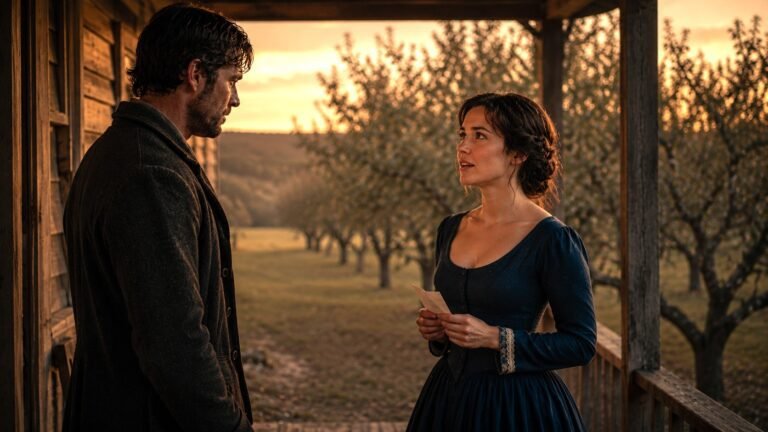
He drove out to her place the next morning before light, the coulee road still rutted with the storm’s leavings, and found her already up, breaking ice on the stock tank with the flat of a shovel, her breath coming hard and white in the cold, and she looked up at the sound of his truck with an expression schooled carefully into something that gave nothing away, though her hands had gone still on the shovel handle.
“Didn’t figure you for a man who circles back,” she said.
“I didn’t figure me for one either.” He got out, left the door open behind him, the engine still running. “Man I used to be would’ve kept driving to Miles City on principle. Would’ve called it smart. Called it not owing anybody the trouble of missing him.” He crossed the yard slow, snow crunching, hands loose at his sides. “I’m not real practiced at the other thing.”
“What other thing.”
“Staying somewhere on purpose.” He stopped a few feet off, close enough now that he could see the exact place her jaw had set against whatever she was working to keep out of her face. “I got a duffel back at the bunkhouse I haven’t unpacked in eleven months, on account of unpacking felt like admitting I meant to be somewhere long enough to need my own things around me. Unpacked it last night.” He looked at her steady, no hedge left in it. “Figured that ought to count for something, even if it’s not much of a gesture.”
Marlow set the shovel against the tank, slow, giving herself the beat she needed. “That’s not nothing,” she said finally, and something in her shoulders came down a half inch, the particular give of a person who has been braced a long while against a blow that has decided, after all, not to land.
Radar came around the corner of the barn at the sound of voices, full grown into his ears now, and crossed the yard at a run, and instead of going to Marlow first, the way he had every morning since the whiteout, he came straight to Cole and sat, waiting, tail sweeping a clean arc through the snow.
Cole went down on one knee the way he always did, fist closed, held low. Then, for the first time in eleven months, he did not wait for the dog to close the distance. He reached out and put his open palm flat against the animal’s chest instead, no fist between them at all, nothing held back and offered slow — just his hand, bare in the cold, resting where he could feel the fast, steady drum of a small living heart going on entirely unafraid beneath it, and Marlow standing over both of them in the blue morning light with her breath showing white and her hand, when he looked up, already reaching down to rest against his shoulder like it had never once considered doing anything else.