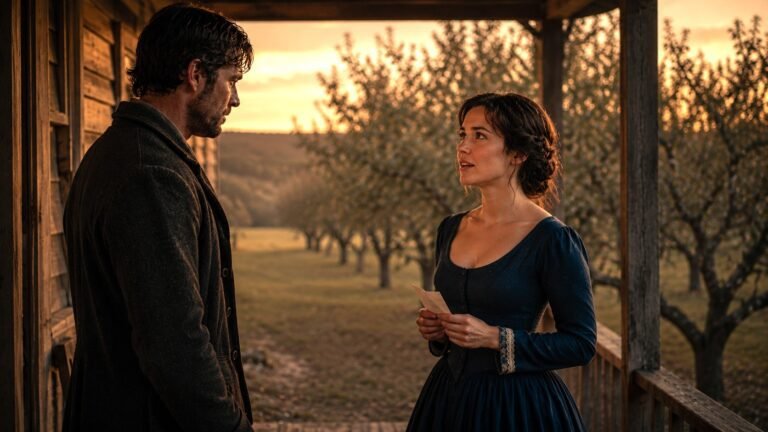

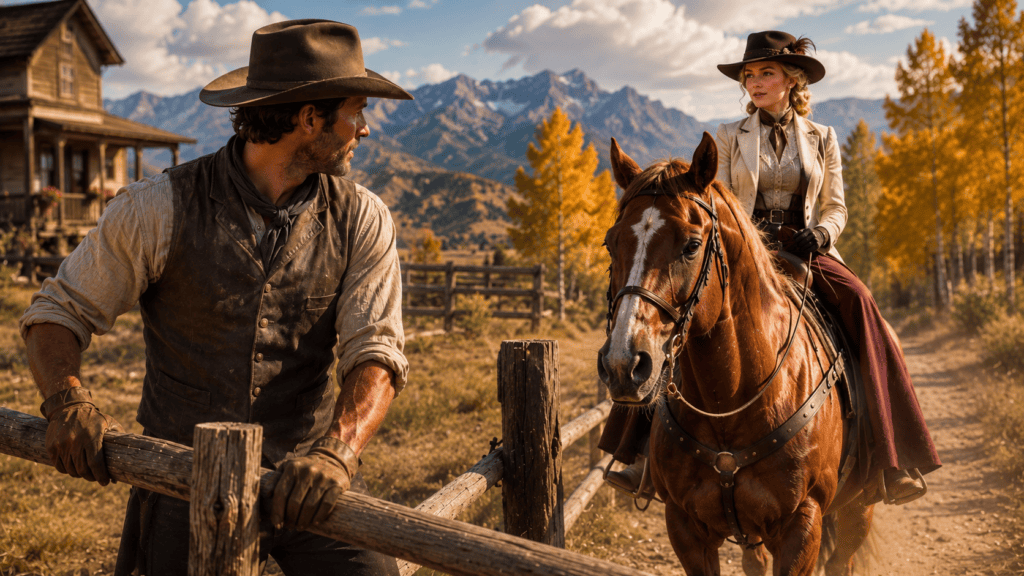
Colorado Territory, 1891.
The Cray place had stood empty for three years, and before that it had been Emmett Cray’s whole life — two hundred and twenty acres tucked into the throat of Larkspur Valley, where the creek came down off the Sangre de Cristos cold enough to ache your teeth. Cray had worked it for seventeen years before the Cinder Summer took it from him in a single week of orange sky in August of 1888, a wind-driven fire that took the hay barn, both corrals, four hundred fence posts, and Emmett Cray’s mind, which never fully returned from watching it happen. He sold what was left for less than the cost of the standing lumber and went to live with a sister in Pueblo. Nobody expected the land to sell again. Burned range holds a reputation the way a man holds a limp — visible, permanent, discouraging.
Jonah Rourke got off his horse anyway.
He stood in the middle of the scorched home pasture on a gray Tuesday morning in April and looked at what the fire had left. The blackened skeleton of the hay barn, ribs of char against the sky. The creek running low and brown through a ditch nobody had cleaned in three years, its headgate rotted half off its hinges. Fence line down for most of a mile, the wire gone to rust-colored threads in the grass. And underneath all of it, when Jonah crouched and pushed his fingers into the soil, black loam that still smelled faintly of smoke but crumbled rich and dark between his fingers, the way good ground does.
He felt something he had not felt in twenty-nine years of a life that had given him very few occasions to feel it. He felt certain.
Nine years of Army wages — teamster pay, mule-skinning pay, the kind of money a man earns hauling freight through country that wants to kill him — sat in a coffee tin buried under the floor of a boarding house in Trinidad. Three hundred and ninety dollars. Every dollar of it went to the county at auction that morning, and Jonah Rourke walked out of the courthouse with a deed, eleven dollars, and two hundred and twenty acres that had frightened off every other bidder in the room.
He rode out that same afternoon and sat on the porch step of a house that needed considerable imagination to call his, and watched the valley go gold with the last of the light, and began, in his head, the order of things. The headgate first. Without water there was no ranch at all, only two hundred acres of good intentions.
He was still working out the sequence — headgate, then fence, then the barn — when he heard a horse coming up the two-rut road from the north, moving at a clip that suggested someone with somewhere to be and no patience for the getting there.
He stood. He set his hat straight. He waited.
She came through the gap where his gate used to hang, a young woman on a chestnut mare with clean lines and better shoes than most men in the territory, riding astride in a divided skirt with the unbothered posture of someone who had learned to sit a horse before she’d learned to sit at a dinner table. She pulled up ten feet short of him and looked him over the way a buyer looks over stock — quickly, completely, without apology.
“Mr. Rourke,” she said.
“Miss,” he said. He hadn’t given his name to a soul in the valley yet, which told him she’d come already knowing it.
“Celia Bannerman. My father is Augustin Bannerman. The Circle B, north of here, along the whole east rim.” She didn’t wait for him to place the name, though he already had — five thousand acres and the largest cattle operation between Trinidad and the Sangre de Cristos, a name that got said in the valley with a certain careful respect, the kind reserved for weather and men with money. “My father asked me to bring you this.”
She held out a folded paper. Jonah didn’t take it.
“What is it,” he said.
“A notice. The Cray headgate diverts off Larkspur Creek above the point where my father’s decree rights begin. He’s held senior water rights on this creek since 1874. If you repair that gate and take more than the old Cray allotment, he intends to see you in district court in Pueblo, and he intends to win.”
Jonah looked at the creek, brown and low, running past a rotted gate that hadn’t diverted a gallon in three years.
“I haven’t taken a drop yet,” he said.
“You will,” she said. “You didn’t buy burned land for the view.”
He almost smiled at that, in spite of himself. “No,” he agreed. “I bought it for the water. Same as your father did, once, I’d guess, before he had five thousand acres to make him forget what it felt like to need it.”
Something moved behind her eyes — not anger, something closer to interest, quickly suppressed. “I wouldn’t know,” she said. “I’ve only ever known him with the five thousand acres.”
“Then you don’t know your father as well as you think,” Jonah said, and took the paper from her hand at last, though he didn’t unfold it. “Tell him I’ve read Cray’s original filing. Eighteen-seventy-one. Three years senior to his. Tell him I intend to take exactly what that filing allows, no more, and if he wants to argue decree dates in Pueblo, I’ll see him there with the paper to prove it.”
She studied him for a long moment, the way she might study a horse she was deciding whether to bid on.
“You’ve read the water code,” she said. It wasn’t quite a question.
“I’ve read everything Cray left in that house. Two nights of oil lamp and a headache.” He met her eyes. “A man who doesn’t understand water in this country doesn’t own land here. He rents trouble.”
She turned her horse without another word, but at the gate she paused and looked back with an expression he couldn’t read.
“I’ll tell him,” she said, and rode north.
Jonah watched her go and thought, with the plain certainty of a man reading weather, that will not be the last I see of her.
He was right. She came back four days later — not with another paper, not with the formal posture of an errand run for her father, but alone, on the same chestnut mare, and something in the set of her shoulders said she’d come for a reason she hadn’t fully admitted to herself yet.
She found him at the headgate, up to his knees in cold creek water, wrestling a rotted timber out of the frame with a pry bar and losing the argument.
“You’re doing that wrong,” she said, from the bank.
He looked up, water running off his forearms. “I’m doing it the only way I know.”
“The frame’s failing because the sill log rotted from underneath, not the top. You’re prying at the part that’s still sound. You’ll break your bar before you break that timber.” She swung down from the mare, tied her off to a scrub oak, and came down the bank in her good boots without any apparent concern for what the mud would do to them. “May I?”
He straightened, considering her — the fine clothes, the ease with which she’d already ruined a boot heel in the silt. “You know headgates.”
“I grew up on a creek my father has fought three lawsuits to keep control of. I know headgates the way other girls know embroidery.” She crouched at the waterline and put her hand flat against the submerged base of the sill log, feeling for the give in the wood. “Here. It’s soft to the elbow. The whole underside’s gone. You could pry from now until August and that top timber will hold because it’s the bottom that’s rotten. You need to jack the frame, not lever it.”
“I don’t have a jack.”
“You have a wagon,” she said. “And enough chain to make one.”
They worked until the light went copper over the ridgeline, Jonah driving the wagon axle into position while Celia directed the angle of the chain with the calm specificity of someone who had watched this exact repair made a dozen times and never once been permitted to make it herself. When the rotted sill finally groaned free of the frame, sucking loose from the mud with a sound like something exhaling, she allowed herself something close to a smile, quickly folded away.
“There,” she said. “Now you can pry the rest.”
“Thank you,” Jonah said. He meant it plainly, without decoration.
She looked at the creek, at the half-repaired gate, at the scale of the work still ahead of him — the barn a burned ruin, the fence down for a mile, one man and one horse against two hundred and twenty acres.
“How long will this take you,” she said. “Alone?”
“The gate, a week. The fence, three more. The barn waits till fall.” He wrung water from his shirt cuff. “Water first. Nothing else matters if the ditch is dry.”
“Your priorities are backward from every rancher in this valley,” she said. “Most men build the barn first. Something to show for the work.”
“Most men aren’t planning to still be standing here in twenty years,” Jonah said. “A barn without water is a monument. I’m not building a monument.”
She was quiet at that, looking at him with an attention that made him aware, for the first time in longer than he could easily place, of being looked at rather than merely seen.
“My father doesn’t know I’m here,” she said finally.
“Does that happen often?” Jonah asked.
“No,” she said. She picked her way back up the bank toward her tied horse, then stopped with one hand on the pommel and looked back at him, water-soaked and pry-bar in hand in the last of the light. “Thursday,” she said. “I’ll bring a proper jack. My father has three he never uses.”
She came Thursdays, and then Tuesdays as well, though she never once said in advance that she was coming, only appeared at the edge of his land at some hour of the morning like weather arriving on schedule only she could read. She did not treat the work as a novelty. She did not perform reluctance at getting mud to her elbows or blood under her nails from wire, the way Jonah had half expected a rancher’s educated daughter to perform it. She worked the way a person works who has simply never been permitted to before and has decided, quietly, to stop asking permission.
By the second week the headgate held true, diverting exactly the Cray allotment and not a drop more, which Celia measured herself with a notched stick and pronounced, grudgingly, correct. By the third week they had moved to the fence, and it was there that Jonah’s pride met its first real test.
“You’re setting them straight,” she said, watching him drive a post. “They need to lean into the slope, or the spring melt undercuts them and they walk downhill by June. Fire changes how the ground holds water for years. Everyone who’s fenced a burn scar straight around here has redone it within two seasons.”
He set the next post exactly as he had the last, out of the particular stubbornness of a man who has done a great deal in his life with no one to correct him.
She didn’t argue further. She simply checked the post with the level, said nothing, and handed it to him.
He checked it himself. It was off by four degrees.
Something in his chest that had been braced for a fight found, instead, that there was nothing to fight — only a fact, offered plainly, by a woman with no stake in whether his pride survived it.
“Show me the angle,” he said.
She showed him. He reset the post. It held.
That night, alone at Cray’s kitchen table, Jonah turned the four degrees over for a long while, the way a man turns over something that’s told him more about himself than expected. Nine years he’d taken orders from men he didn’t respect, without complaint, because the wage depended on it — and apparently built a pride that couldn’t take a simple correction from a woman he was starting, against every plan he’d made, to respect enormously.
He decided it was a flaw worth fixing. The next morning, when she rode up, he handed her the level before she asked for it.
“Check every one before I drive it,” he said. “I’d rather be slow and right.”
She looked at him for a moment with an expression that had nothing to do with fence posts.
“All right,” she said, and took the level.
They talked while they worked, the way people talk when their hands are busy and the words can arrive sideways. She told him which fields flooded in spring runoff and which held grain — things no county map would show, known only from a life spent riding the valley since before she could read. He told her, in pieces, about the nine years: the freight roads through country that could kill a man for a mistake as small as a missed rock, the winters in canvas tents, the loneliness of a life spent saving toward one unspoken thing.
“Why this land,” she asked him one evening in May, sitting on the top rail of the finished section of fence, the valley going violet around them. “There were other parcels. Ones that hadn’t burned.”
He considered the question longer than she’d expected him to.
“Because nobody else wanted it,” he said finally. “Land that’s been through fire and left for dead still has good ground under the ash. It just needs someone willing to believe that before anyone else can see it.” He looked at her. “Same as most things, I expect.”
She was quiet, looking out at the burn scar, at the fence now standing straight and true where three weeks ago there had been nothing but rusted wire in the grass.
“My father’s land has never needed anybody,” she said slowly, working it out as she said it. “It’s always been wanted. Fought over, even. But never needed.” She turned the thought over. “That’s a different thing, isn’t it. Than being cared for.”
Jonah said nothing. But something that had been building since a woman in ruined boots had corrected the angle of his fence post moved one careful step nearer to being spoken aloud.
Neither of them noticed the rider on the ridge above the north pasture, sitting very still on a gray gelding, watching. He was not paid to keep confidences, and he did not intend to keep this one.
Augustin Bannerman rode down into the valley on a Sunday morning two days later, and Jonah understood at once why the man’s name got said with such care in every store between here and Trinidad. He was sixty years old, built like something poured rather than born, with the flat, appraising stare of a man not surprised by anything in a long time and not intending to start now.
He dismounted at the fence line uninvited, looked at the straight new wire running the length of what had been, three months ago, a mile of rust and ruin, and something crossed his face — brief, unwilling, quickly suppressed.
“You’ve done work here,” he said.
“Yes, sir.”
“My daughter’s been helping you.”
“She corrected my post angle the second week,” Jonah said. “She was right to. I’ve had her check every post since.” There seemed no purpose in pretending otherwise.
Bannerman’s jaw worked once. “My daughter was raised for better than a burned homestead and a man with eleven dollars to his name,” he said. “She’s had tutors from Denver. She reads Latin. She’s going to marry into a life that matches what I’ve built for her, not what some drifter can scratch out of ash.”
Jonah looked at him directly. “Mr. Bannerman, I haven’t asked your daughter for a single thing. I’ve been repairing a headgate and a fence line, and she’s chosen, on her own account, to help.”
“I know exactly what I’ve watched happening on this land for six weeks,” Bannerman said. “And I know precisely where it leads if I don’t stop it now.” He stepped closer, close enough that Jonah could smell the leather and pipe smoke on him. “I’ll say this once, so there’s no confusion between us. Celia is not for you. It’s not a matter of your character — I’ve heard enough about the headgate and the fence to have no complaint there. It’s a matter of what you don’t have, and won’t have, for years, if ever. She deserves better than years of waiting to find out.”
“With respect,” Jonah said, “I think that’s a decision that belongs to her.”
Something went hard and flat in Bannerman’s eyes, the specific stillness of a man who had not been contradicted in a very long time and had forgotten how it felt.
“Not while she’s my daughter, it isn’t,” he said. He remounted without another word and rode north.
Jonah stood at his fence line a long while, thinking about a woman on a rail saying that’s a different thing than being cared for, then went back to driving posts, because the fence, at least, was a thing he knew how to finish correctly.
Her father told her that evening, across a dinner table set with more silver than the occasion required, in the flat and final tone of a man announcing a decision rather than opening a discussion. He had ridden to the Cray place. He had said what needed saying to Rourke. The visits were finished.
Celia sat through all of it without argument, because she had learned, across twenty-two years under this roof, that confronting her father head-on was like driving a fence post straight into bedrock — you broke the post, and the rock never noticed. Her father’s positions moved, when they moved at all, under the pressure of evidence and patience, never declaration.
She went to her room. She sat at the window a long time, watching the dark come down over land that had never once, in her memory, needed anyone — land that had always simply been wanted, acquired, defended in court. She thought about a man sleeping in a burned house because water came before shelter in his accounting of what mattered. She thought about her father’s exact words. Not a matter of your character. Which meant he already knew who Jonah Rourke was. He had simply not yet decided whether who he was could be permitted to be enough.
She rose, and found her father in his study, bent over ledgers by lamplight, and stood in the doorway until he looked up.
“I’m not going to stop seeing him,” she said.
“Celia—”
“I am twenty-two years old,” she said. “I have done everything you have ever asked of me. Denver, Latin, the tutors, the piano, the dinners with men whose fathers you wanted something from. I have never once asked you for anything you didn’t already want to give me.” She held his eyes. “I’m asking now. Not your approval. Your trust that I know my own mind.”
Augustin Bannerman set down his pen and was quiet for a long moment, looking at his daughter — who had her mother’s eyes and his own stubbornness and something else besides, something entirely, stubbornly her own.
“He has nothing,” he said, at last, and it came out less like an accusation than an old wound reopening.
“He has everything that matters,” she said, and left before he could find an answer to that, which she understood, even as she walked away, was itself an answer.
He sat alone with the ledgers for a long time after. He had built five thousand acres and a name that got said carefully in three counties. His daughter had just looked at him the way her mother used to, on the rare occasions he’d been wrong about something and too proud yet to know it.
He picked the pen back up. He set it down again. He could not remember the last time he had been unable to work.
June came, and the ranch began, slowly, to look like a ranch again. The fence stood entire around the home pasture. The ditch ran clean through the repaired headgate, exactly the Cray allotment, not a drop more — Celia checked the notched stick each visit, found it correct, and said nothing, which Jonah had come to understand was its own kind of compliment.
He turned the burned ground with a borrowed plow, planted oats near the creek, and bought, on credit, six head of cattle — the smallest beginning of a herd, grazing now on grass that hadn’t been grazed in three years.
She still came, though she’d told her father plainly that she would. He had not forbidden it a second time, which was not permission but was, Jonah came to understand, a kind of exhausted acknowledgment that she was going regardless.
She noticed, on a Tuesday in late June, that he’d patched the worst gap in the barn’s collapsed roof — not properly, just enough to keep the rain off the little grain he’d managed to store — using scavenged, half-burned lumber rather than anything bought.
“That patch won’t survive the first real storm,” she said.
“I know,” he said. “It’ll hold till I can do it right. Water and fence came first. Roof waits its turn.”
She looked at the patched roof, and then at him, and understood something she hadn’t quite let herself understand before — that his pride was not the kind that refused correction outright. It was the kind that needed a moment, sometimes a whole night with cold beans, to arrive at being wrong, and then moved forward without resentment. That, she thought, was rarer than most people knew, and worth more.
“The oat field,” she said. “The strip nearest the burned barn footprint — the ash changed the drainage there. It’ll drown by August if you don’t move the rows.”
He looked at the field for a long moment. “You’re certain.”
“I’ve watched that field flood since I was nine years old, sitting my horse on the ridge, before I ever knew whose land it was,” she said.
“All right,” he said, and the next morning moved the rows exactly as she’d said, and neither of them noticed that the ridge above the north pasture, this time, was empty — the gray gelding and its rider already three miles north, delivering a report to a man who had been waiting, with poorly concealed impatience, to hear it.
The flood came on a Wednesday night in the second week of July, born of a cloudburst high in the Sangres that nobody in the valley had seen fall.
Jonah woke to a sound he didn’t recognize at first — not wind, not rain on the roof, but a low continuous roar coming up out of the dark like the earth clearing its throat. He was at the window in his shirtsleeves before he was fully awake, and what he saw by the thin light of a clouded moon stopped his breath: Larkspur Creek, a modest two feet deep that morning, was a brown and violent thing now, swollen past its banks, tearing sections of fence downstream in the dark.
And upstream, on the flattest, most convenient ground along the whole creek, sat the Circle B’s low horse barn — built there, Bannerman’s foreman had once told Jonah, because in twenty years Bannerman had never seen that creek do what it was doing tonight.
Jonah was saddled and riding north within four minutes, before he had consciously decided to do anything at all, moving on the same instinct that nine years of hauling freight through country that wanted to kill him had built into muscle rather than thought.
By the time he reached the Circle B, the yard was chaos lit by lantern and torch — hands shouting, water already knee-deep and rising across the low ground, the roar of the flooding creek swallowing half of every order given. The horse barn stood in water to its sills, and inside, Jonah could hear what he would remember for the rest of his life as the worst sound he’d ever heard: horses screaming, trapped, the water climbing toward the stall floors.
He found the foreman waist-deep at the barn’s uphill corner, directing men toward the house and the equipment sheds instead.
“The horses,” Jonah said.
“Current’s too strong at the door,” the foreman shouted back. “Man goes in that water, man doesn’t come out. I’m not sending anybody.”
Jonah looked at the barn, at the water climbing the walls, at the particular rhythm of the current where it funneled hardest against the downstream corner, and understood, the way he’d learned to understand moving water on freight crossings that had nearly killed him twice, exactly where the danger actually was and where it wasn’t.
He got down off his horse. He looped a picket rope twice around his waist and handed the end to the nearest hand.
“Anchor this to the corral post. Pay it out slow. I go in against the current side, not the downstream — that’s where the drowning happens.”
“You’ll die in there,” the foreman said.
“How many horses,” Jonah said.
“Nine. The stallion and eight mares.”
He went in.
The water inside was black and cold enough to stop a man’s heart, rising by inches while he worked stall by stall in the dark, finding each terrified animal by touch, talking to each one not with words but with the low, steady tone that says, without language, I am not the danger. He led the stallion out first, then went back, and again, the rope paying out and drawing taut as men on the bank hauled each horse clear once he got it near enough to the door.
On the sixth trip, a support timber overhead groaned with the specific sound of wood deciding it had held long enough, and something shifted in the dark above him, and Jonah went down to one knee in water that was now chest-deep, and the mare he was leading pulled him back upright by pure animal momentum and towed him, half-stumbling, the rest of the way to the door.
Three horses remained. The foreman caught his arm on the bank. “That’s enough. The roof’s going.”
“Three more,” Jonah said, and went back in.
When he came out the last time, towing the final mare through water that had risen to his shoulders, the barn’s downstream wall gave way behind him with a sound like the whole night breaking in half, and the current took what was left of the structure downstream in pieces. Jonah made the bank on his hands and knees and simply stayed there, in the mud, because standing had become, for the moment, more than his body had left to give.
He heard Bannerman’s voice above the roar before he saw him — not directed at Jonah, just present, counting. Nine. The counting stopped. Then a hand closed on Jonah’s arm, and Augustin Bannerman pulled him to his feet and held his arm steady until his legs remembered how to work, and neither man said a word.
The cold water had done something to Jonah’s chest that the ranch’s part-time doctor, summoned at dawn, described with the careful hedging of a man at the edge of his knowledge — not permanent, likely, but heavy labor was out of the question for weeks yet. Jonah understood what that meant. The oats needed cutting. The fence needed a second wire strung. Summer did not wait on a man’s lungs to heal.
He went home two days later, sat on the porch step, and did the arithmetic. It came out badly no matter which way he worked it.
On the third day, four of Bannerman’s hands appeared at his gate without a word of warning, tied their horses, and walked out to the oat field and began cutting with the unhurried efficiency of men who’d been given an order and intended to see it through.
Jonah came out onto the porch. “Bannerman send you.”
The oldest of the four looked up from his scythe. “Said the oats won’t wait on your chest to mend, and he wasn’t of a mind to let good grain drown for want of four extra hands he already had standing idle.”
Jonah looked at his field. He looked at his own bandaged palms — burned raw in places by the picket rope, blistered by three years of a fence line rebuilt mostly alone. Eleven years of managing without asking anyone for anything sat in his chest like a stone he’d carried so long he’d stopped noticing its weight. It would have been easy — it was right there, ready — to send the men home and cut the oats himself, slow and wrong and alone, the way he’d have done it a year ago.
He thought about Celia correcting his post angle in the second week, and how he’d fought her on it for exactly one post before handing her the level. He thought about how much faster, and how much better, everything on this land had gone since he’d learned to let someone else be right when someone else was right.
“Thank you,” he said.
He went inside and sat at the kitchen table and listened to Bannerman’s men cutting his oats, and found it was, in its way, the hardest thing the whole summer had asked of him — harder than the fire in the water, harder than the four days of pride over a fence post. And he understood, sitting there with his bandaged hands flat on the table, that it was also the thing that had finally, fully changed him.
Bannerman himself came ten days later, unannounced, on horseback, and walked the property the way he walked his own — reading it, arriving at conclusions without asking permission to. He looked at the standing fence, the second wire now strung true along its whole length. He looked at the cut and stacked oats. He looked at the patched barn roof and said nothing about it. He stopped, finally, at the headgate, and crouched, and ran his thumb along the notched measuring stick still lashed to the frame.
“Cray allotment,” he said. “Not a drop more, all summer. My foreman’s checked it twice a week since June, on my order, and never once found you over.”
“I told your daughter I’d take exactly what the filing allowed,” Jonah said. “I meant it.”
Bannerman stood, brushing the mud from his knees. “The Cinder Summer took Emmett Cray’s mind before it took his land. I bought his cattle for a dime on the dollar and told myself that was simply business. I’ve been watching this valley heal around your fence line for four months, and I’ve come to think business was never the whole of what I felt, watching a man lose everything he’d built.” He looked north, toward the ruined footprint where his own horse barn had stood. “You went into that water three times after my own men told you plainly you’d die if you went a fourth.”
“There were still horses inside,” Jonah said, as though that settled it, because to him it did.
“That’s precisely the thing I can’t argue with,” Bannerman said. “Not that you saved them. That you went back a fourth time when nothing was owed you and no one was watching close enough to matter, and the only reason available was that three horses were still inside, in a barn belonging to a man who’d told you to stay away from his daughter.” Something in his face, briefly, was not the flat and certain thing Jonah had first seen in April. “I’m not offering my blessing today. I’m telling you I’ve stopped being your enemy. Those aren’t the same thing, but they’re not nothing.”
He mounted his horse. At the gate he paused. “That barn roof,” he said. “Before the fall storms. I’ll have lumber sent.”
“I’ll pay for the lumber,” Jonah said.
Bannerman looked back at him for a long moment. “Yes,” he said. “You will.” And he rode north, and did not look back, and Jonah stood at the mended headgate and thought, that is a man who has just done the hardest thing he’s done in years.
They married in September, in the small stone chapel at the crossroads store, on a decision made simply on Jonah’s porch one evening when the light went the particular gold that only comes to that valley before the first frost. He had asked her plainly. She told him afterward she’d said yes before he’d finished the sentence, ready since a Tuesday in May when he’d told her that land nobody wanted still needed someone willing to believe in it.
Celia dressed in the small room behind the chapel with Ida Pruitt from the crossroads store fussing over the details. She wore her mother’s cameo, given to her at her mother’s grave nine years before and worn only on occasions that had earned it.
The chapel filled. Her father was not among the pews.
She had known he might not come. He had said I’ve stopped being your enemy. He had never once said I give you my blessing, and she had told herself, for three weeks, with steadily thinning conviction, that she was prepared for the difference.
Ida fixed the last pin in her hair and stepped back to admire the effect. Celia picked up her flowers — late asters, all the valley had left to offer in September — and put her hand to the door.
“Celia.” Ida’s voice, soft, pointed somewhere past her shoulder.
She turned. The chapel’s rear door stood open. In the doorway, in his good black coat, hat already in his hands, stood Augustin Bannerman.
He looked at his daughter the way a man looks at a decision he has spent weeks reconsidering and has finally, fully arrived at. He came up the aisle slowly, with the deliberate weight of a man doing something that was costing him something real to do, and stopped in front of her, and studied her face for a long moment.
“You look like your mother,” he said, and his voice was not entirely steady.
She said nothing. She was not going to make this easy for him, because it should not, after everything, be easy. But she was not going to make it hard, either.
“I’ve watched that man build something out of ash since April,” her father said. “The water first, then the fence, then he went into a flood three times for horses that belonged to an enemy, when every sensible man on my payroll told him not to go a second time, let alone a fourth.” He looked at her. “A man who does that when nobody’s counting and nothing’s owed him isn’t doing it to be seen. He’s doing it because it’s simply who he is, all the way down. I was slow to see that. I’ve never in my life been slow to see anything, and I was slow to see that.”
He offered her his arm.
“My daughter,” he said quietly, “is not walking to that altar without me beside her.”
She looked at his arm a long moment. She looked at his face — the sixty years of it, the pride and the stubbornness, and underneath both, plainly visible now for perhaps the first time in her adult life, the love that had always, in its own difficult way, been there. She took his arm — the same arm she had held at her mother’s grave.
They walked the aisle together. Jonah stood at the front of the small chapel and watched them come — the woman he was about to marry, and the man who had told him in April to stay away from her, arriving now at the only honest conclusion six months of watching had left him with. Bannerman met Jonah’s eyes as he handed his daughter across. It was not warm. It was not quite a smile. It was the look of a man delivering a verdict he intended to keep, and from Augustin Bannerman, that was everything.
They stayed on the Cray place. This surprised the valley, which had assumed, as a matter of course, that the marriage meant Jonah moving to the Circle B and the comfort of five thousand acres bearing the Bannerman name. It was the sensible assumption. It was wrong. They stayed because the land was Jonah’s, built up out of ash by his own hands, and because Celia had spent an entire summer on it and understood, better than anyone, exactly what it was becoming — and because both of them had learned, across one long difficult year, that the easy path and the right one were very rarely the same road.
Bannerman sent breeding stock that October — a dozen head from his own careful bloodlines, delivered without ceremony, with a note that read only: For the north pasture. The grass will suit them, and so will the ground, once it forgets what fire did to it. — A.B. Jonah read it twice and put it in the kitchen drawer where he kept the things that mattered.
The herd grew slowly, honestly — a dozen becoming thirty-five by the third year, breeding true on grass that had been nothing but ash and rusted wire. The barn was rebuilt properly that October, lumber paid for by Jonah, frame raised with Bannerman’s own hands helping — an arrangement Bannerman proposed and Jonah accepted without argument, itself a measure of everything that had changed since April.
Augustin Bannerman came for Sunday supper starting that November, not every week, but often enough, with the particular irregularity of a man moving steadily toward something and refusing to be hurried in the getting there. He sat at Jonah’s kitchen table and talked cattle prices and creek levels and the coming winter with the total, unfeigned focus of a man for whom such things had never once, in sixty years, been merely conversation.
On a Sunday evening in the second year, walking to his horse after supper, he stopped at the headgate — the one Jonah had been fighting, badly, with a pry bar, the very first afternoon Celia had ridden through his gate. He crouched, and pressed his thumb against the notched measuring stick, still lashed exactly where it had always been.
He said nothing. He nodded once — the particular nod of a man delivering a verdict — and mounted his horse and rode north toward the Circle B.
Celia came to stand beside Jonah at the gate, watching her father go.
“He’ll never say it outright,” she said.
“I know,” Jonah said.
“He doesn’t need to,” she said.
“No,” Jonah agreed, and put his arm around her.
The Colorado evening settled over them at the headgate of a ranch the fire had once tried to erase from the valley entirely, and that was now, by every measure the valley used, the most carefully tended land between the crossroads and the ridge. The mountains did what they had always done. The herd grazed where it belonged. And the fence stood true, and the water ran clean through the gate at exactly the allotment the law allowed and not a drop more, and the woman beside him, and the old man riding north who would, without question, be back the following Sunday, made the whole of it, at last, exactly right.
Jonah Rourke had spent nine years saving three hundred and ninety dollars, and every cent of it on land a fire had broken and nobody else wanted — barn burned to its bones, fence rusted to threads, ditch dry for three years running. He had gotten off his horse in the ash of it and felt, for the first time in a hard and solitary life, something entirely certain.
That certainty was the whole of the story: a man who could see what neglected ground might still become, and had the patience to bring it back one repair at a time, in the correct order rather than the easy one. A woman who rode out to deliver a warning and stayed to fix a headgate, and found, somewhere between the pitch of a fence post and the long gold evenings of that first summer, that what he was building was something she wanted, entirely, to be part of. And a father who had built five thousand acres from thirty dollars and a saddle blanket, and had somehow let himself forget that what a man makes of his life is never the acreage of it, but the character.
He remembered, in the end, a night in July when the water was rising and the roof beams gave way, and a man went back into a flood a fourth time for horses that belonged, on paper, to his enemy. No calculation in it. No one left to perform for. Only three horses still inside, and a man for whom that fact alone was reason enough — which was, in this country, still the only honest measure anyone had found for what a man was worth.
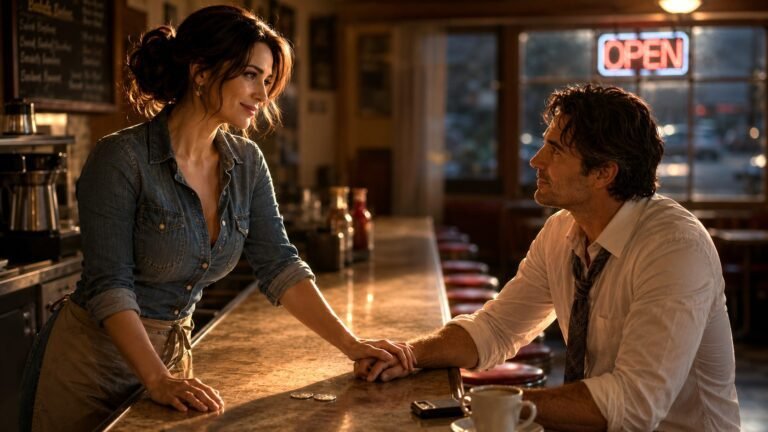
Heartfelt characters sharing love, emotions, and romantic journeys filled with hope, trust, and unforgettable bonds