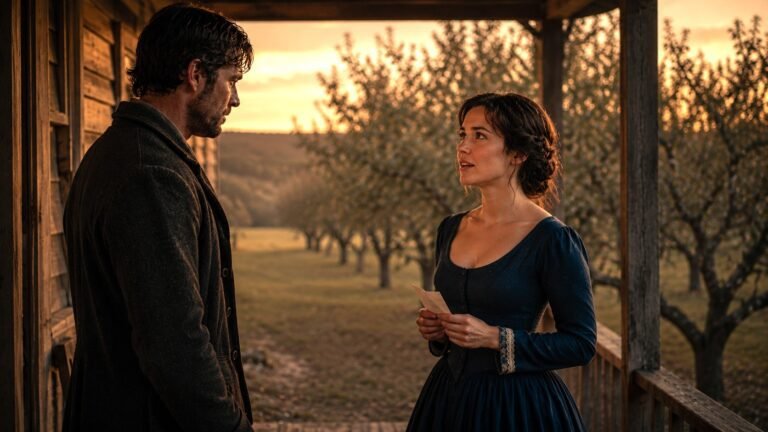


The letter came on a Tuesday, carried by a boy on a mule who would not meet Ada Whitfield’s eyes when he handed it over. She knew before she broke the wax what it would say, because Silas Pruitt did not write letters for any reason but one.
Thirty days, it read, in a clerk’s careful hand that Pruitt had surely paid for, since his own writing ran to scratches. Two hundred dollars owed on the note held against the Whitfield section, or the land reverts to the lender as agreed. Failing payment, Mr. Pruitt is prepared to discuss other arrangements.
She read the last line twice, though she understood it the first time. Other arrangements. She had heard those words from Pruitt’s own mouth in June, standing in the dry goods store with her basket half full of flour she could not really afford, and she had not answered him then either, only walked out into the white glare of the street and driven the wagon home with her back straight as a fence post the whole way.
Ada folded the letter along its old creases and set it on the table beside the lamp, where it would sit for three days before she could make herself put it in the tin box with the others. Outside, the wind moved through the wheat that was not going to make a crop this year, not with the color it had taken on in July, and the sound of it was the only voice she heard most days besides her own, talking to the mule or the hens or the empty rooms of the house Elias had built with his own hands before the fever took him two winters back.
She was twenty-six years old and she had buried a husband and a stillborn son within four months of each other, and she had not cried in front of another living soul since the second of those burials, not because she was made of stone but because there had been no one left standing close enough to cry in front of. The house had two rooms and a lean-to kitchen, and of an evening the silence in it had a weight to it, like water, like something she waded through to get from the stove to the bed.
She was not a woman who waited for rescue. She had told herself that on the morning after Elias died, kneeling over the fresh grave with dirt still under her nails, and she had held to it since — through the drought, through the debt Elias had left without meaning to, through learning to shoe the mule herself because there was no money to pay Otis Granger for it anymore. But there were nights, now, when the wind sounded less like company and more like something circling, and she lay awake doing the arithmetic of what two hundred dollars might mean against the seven dollars and forty cents she kept in a coffee can under the floorboard, and she did not like the shape the numbers made.
The stranger came three days after the letter, though she did not know yet that he was the answer to anything.
She was at the well when she heard the wagon, and her first thought — the only thought a woman alone learns to have first — was for the rifle propped inside the door, twelve feet away and much too far. But the wagon that came up the track was moving slow and easy, the way a man drives who is not in any hurry to arrive anywhere, and the man on the seat lifted one hand when he saw her, not in greeting exactly, more the way a man might signal he meant no trouble.
He did not come far. He stopped the wagon at the fence line, climbed down, and stood with his hat in his hand looking at the well rope, which had frayed through the summer to little more than fiber and hope.
“Rope’s about gone,” he said. It was not a question, and it was the whole of his introduction.
“I’m aware of it,” Ada said, because she had learned that the safest thing a woman living alone could do was let a stranger know at once that she was not foolish and not afraid, whether or not either was strictly true.
He nodded slowly, as if that were a reasonable answer, and looked past her at the house, the barn with its sagging door, the wheat gone the color of old teeth. He was a big man, though not young — closer to forty than thirty, she judged, with gray coming into a dark beard and hands that hung at his sides like tools set down mid-task. There was a stillness in him that she noticed even standing forty feet off. He did not fidget the way most men did under a woman’s gaze.
“Got rope in the wagon,” he said. “Was headed on to Larimer’s, but I could leave you a length before I go, if you’ll allow it.”
“I can’t pay you for it.”
“Didn’t ask for pay.” He said this without any particular weight, the way another man might have said it was hot, or that the road was dusty, and then he went to the wagon bed and pulled a coil of new hemp rope off the top of whatever else he was hauling, and he carried it to the well and knelt and began working the old frayed rope free without waiting for her to say yes or no.
She watched him for a while from ten feet off, arms crossed, ready to tell him to stop if he asked for anything more than he’d offered. He did not ask for anything more. He fixed the rope, tested the bucket’s drop and draw twice, coiled the old rope and set it neatly by the well housing as if she might want the fiber for something, and then he stood, put his hat back on, and said, “Obliged for the water, if you’ll spare a dipperful. Mule’s thirsty.”
She gave him the water. He drank standing at a respectful distance, thanked her, and drove on toward Larimer’s place without another word, and Ada stood at the well a long while after the dust of his wagon had settled, turning the small strange kindness over like a coin she was not sure was real currency.
She did not learn his name until he came back through eleven days later, and even then, he offered it the way he offered everything — without ceremony, as if it cost him something to spend more words than the occasion required.
“Thomas Bell,” he said, when she asked, because a woman ought to know the name of a man who kept turning up. He was mending her chicken coop by then, a task she had not asked him to do and had only discovered him at when she came out at dawn to find him already crouched at the wire with wire cutters and a coil of new fencing in his kit, working quiet as a man in church.
“You don’t have to keep doing that,” she said, standing in the yard in her nightdress and shawl, feeling the strangeness of finding a man at work on her land before the sun was properly up.
“I know it,” he said, and kept working.
“Then why do you?”
He considered this the way he seemed to consider most things, slow and without hurry, before he answered. “Passing through a lot of empty country,” he said. “Man gets used to fixing what’s broke when he comes across it. Habit, I guess. Costs me nothing but time, and I’ve got more of that than use for.”
It was, she would learn, the longest speech she would get out of him for some while, and even it told her only the surface of a thing. She did not press him for more. She had her own reasons for not wanting to be asked too many questions, and she extended him the same courtesy she wanted extended to herself.
He came through Cutter’s Bend perhaps once a fortnight, hauling goods between the railhead and the mining camps up in the hills, and each time his route brought him near the Whitfield place, he found some reason to stop, and each time he stopped, he found some small task to do with his hands before he moved on. He never asked to come in. He never lingered past what the work required. He ate, when she offered, sitting on the porch step rather than at her table, as if he understood without being told that a widow living alone could not have a strange man sitting across from her in her own kitchen without setting the whole county’s tongues wagging, and did not want to put her in that position even by accident.
“You don’t talk much,” she said to him once, in September, watching him replace a rotted board in the porch floor while she shelled beans into her apron.
“Don’t have much worth saying,” he said, not looking up from his work.
“Everybody’s got something worth saying.”
He was quiet long enough that she thought he would not answer at all, and then he set down his hammer and looked out at the wheat, what there was left of it, gone gold-brown and thin in the September light.
“Had a wife,” he said. “Down in the Nations, before the war ended things down there the way it ended them. Had a boy, near four years old. Lost them both to the cholera inside a week, back in ’69. Been on the move since. Don’t much like the sound of my own voice in an empty room, so I quit talking to myself, and after that I guess I quit talking much at all.” He picked the hammer back up. “That answer your question?”
Ada sat with the beans forgotten in her lap. “I’m sorry,” she said, and meant it in the particular way that only a person who has buried her own dead can mean it — not as a polite phrase but as a recognition passed between two people who spoke the same private language of loss.
“Long time ago,” he said, though his voice did not sound as though it believed its own words.
“Not so long you don’t feel it.”
He looked at her then, directly, for perhaps the first time since he’d started coming around, and something passed over his face that was not quite a smile but was some cousin to one. “No,” he said. “Not so long as that.”
He drove the last nail and stood and tested the board with his boot heel, and neither of them said anything further about it, but something had shifted in the air between them, the way weather shifts before a person can name what’s coming — not rain exactly, not yet, but a lowering of pressure, a sense that something was gathering.
The work he did was never large. A hinge reset. A chimney flue cleared of a bird’s nest before the cold weather made it dangerous. The mule reshod, over her protest that she had no way to pay him, met only with his usual flat statement that he had not asked for pay. He brought coffee once, and a sack of cornmeal another time, setting both on the porch step without comment, the way another man might have left flowers, though flowers would have alarmed her and the cornmeal did not, because the cornmeal was the kind of gift that let her keep her pride intact — it looked like practicality, even if both of them understood it as something gentler.
She began, without deciding to, watching for the sound of his wagon wheels. She began keeping the coffee pot on longer of an afternoon than she had cause to, on the days when his route might bring him by. She told herself this was only sensible — a woman alone was glad of any pair of capable hands, glad of any face that was not Silas Pruitt’s — and there was truth enough in that to let her go on believing it a while longer than perhaps she should have.
It was Thomas who taught her, without seeming to teach her anything, that a silence could be companionable rather than merely empty. They sat some evenings on the porch step, him with his pipe unlit — he chewed the stem more than he smoked it, she noticed, another habit that seemed a way of having something to do with his hands and mouth without spending words — and her with mending in her lap, and neither of them spoke for the better part of an hour, and it did not feel to her like the old silence of the house, the one that pressed and waited. It felt, instead, like two people occupying the same quiet on purpose.
“You ever think of moving on?” she asked him once, into that kind of silence. “Settling somewhere, instead of hauling freight up and down these roads forever?”
“Thought about it,” he said. “Never had cause to pick a place over any other place. One stretch of empty country’s about like the next, when there’s nobody in it waiting on you.”
She did not ask him what might make a place different from another. She was not ready yet to hear an answer that might commit her to something, not with Pruitt’s letter still sitting in the tin box, not with the thirty days ticking down to something nearer twenty, and then twelve, and she carried that arithmetic with her everywhere now like a stone in her apron pocket, worn smooth from handling.
She rode into Cutter’s Bend on the ninth day before the deadline, alone, because she had decided — sitting up past midnight with the lamp burning low and the tin box open on the table — that she would not simply wait for the ax to fall. She went to the bank first, though she already knew what Mr. Averill would tell her, and he told her exactly that: no loan to be had against land already mortgaged to another man’s note, not with the wheat crop failed the way it had, not for a widow with no kin to stand surety.
She went from there to Doc Reinholt, who bought her mother’s silver locket for eleven dollars, not because he had any use for it but because he had known Elias Whitfield and felt the weight of what was owed to his memory, and he did not haggle her down the way another man might have. Eleven dollars, added to the seven forty in the coffee can and three dollars she got for a length of good rope she did not truly need to keep, brought her to twenty-one dollars and forty cents, which was not two hundred, was not close to two hundred, but was hers, earned by her own hand and her own reckoning, and she held that fact to her like something warm on a cold morning.
She was standing outside the mercantile counting the coins into her purse when Silas Pruitt found her.
He was a soft-looking man, going to fat around the middle in the way of men who did their labor with other men’s hands rather than their own, and he wore a watch chain heavy enough to anchor a boat, and he smiled at her the particular smile he always wore, the one that never once reached his eyes.
“Mrs. Whitfield,” he said. “I trust you got my letter.”
“I got it.”
“Twenty-one days left to you now, I make it. Less, come to think, with today counted.” He glanced at the purse in her hand, at the coins, and something in his face made plain he had done his own arithmetic and found her sum wanting, and enjoyed knowing it. “I’d hate to see you lose that place, Mrs. Whitfield. Your husband worked hard on it, God rest him.”
“I intend to keep it.”
“There’s a way you could.” He stepped a little closer, lowering his voice as if he were doing her some particular kindness by keeping the offer private, though half the street could see the shape of the conversation even if they couldn’t hear its words. “I’ve said it before and I’ll say it plain again. Marry me, and the debt’s forgiven the day the ring’s on your finger. You’d want for nothing. I’d see to that section same as my own, better than my own, and nobody in this county would think less of a widow doing right by herself.”
Ada felt her spine go straight, the way it had that day in June, and this time she did not simply walk away. She looked at him — really looked, the way she had not quite let herself before, at the soft hands that had never split a rail or turned a plow, at the watch chain bought with interest collected off men’s misfortunes — and she found that whatever fear he had counted on had gone somewhere out of her, worn away perhaps by two winters of doing for herself what she had once thought only a husband could do.
“Mr. Pruitt,” she said, “I’d sooner lose the land.”
His smile did not change, but something behind it did, some small flicker of surprise or offense that he covered quickly. “That a fact.”
“It’s a fact.” She closed her purse. “I’ll have your two hundred dollars, or I’ll have none of it, but I will not have you, not for the land and not for anything else. I’d be obliged if you’d stop asking.”
She walked away from him with her back straight and her chin level, and she did not look back to see his face, though she could feel his stare on her the length of the street, and it took every bit of the discipline she’d built these two hard years not to let her hands shake on the wagon reins until she was well clear of town.
She told Thomas about it two days later, not meaning to, the words simply arriving on their own while he was setting new shingles on the section of roof that leaked over the lean-to.
“You told him no,” Thomas said, when she’d finished, and there was something in the way he said it — not a question, but not quite a statement either — that made her look up at him on the roof.
“I did.”
“Good,” he said, and went back to his shingles, and that was the whole of his comment on it, but she noticed that his hands, usually so steady and unhurried, drove the next several nails harder than the wood strictly required, and she understood that Thomas Bell, for all his silence, was not indifferent to what Pruitt had asked of her, and the understanding sat warm in her chest the rest of that day.
That evening, over coffee on the porch step, he was quieter even than usual, working the pipe stem between his teeth, and she let the silence run long before she spoke into it.
“You’ve heard of him before, then. Pruitt.”
“Heard of him.” Thomas turned his cup in his hands. “Man like that, buying up notes on hard-luck places and waiting for the owner to break — I’ve seen his kind before, other counties, other names. They count on a person having nobody to stand behind them. Count on it the way a trapper counts on a cold winter.” He looked at her sideways. “You don’t have to stand alone in it, Ada.”
It was the first time he had used her given name, and it landed on her with more weight than she’d have guessed three plain syllables could carry. She did not answer right away, and he did not press her to, only sat beside her in the deepening dark with the crickets starting up in the grass, and let the offer — whatever exactly it was an offer of — sit open between them, unhurried, the way he did everything.
“I don’t know how to,” she said at last, quietly. “Stand with somebody. Forgot how, maybe. Or never rightly learned.”
“Ain’t hard,” he said. “Same as standing alone, mostly. Just happens there’s another set of boots beside yours.”
She laughed — a small sound, surprised out of her, the first real laugh she’d let escape in longer than she could easily reckon — and Thomas Bell, watching her in the lamplight through the window behind them, allowed himself something that was almost, though not quite, a smile of his own.
There came an evening in early October when Thomas’s help ran the other direction, and Ada was glad, after, that it had, because it let her show him something of herself that all his quiet fixing had not yet given her occasion to show.
He arrived at dusk with his wagon axle cracked clean through, having struck a rut some two miles back, and he had walked the mule the rest of the way rather than risk the load, and he stood in her yard in the last light looking, for the first time since she’d known him, at a loss for what to do next.
“I’ve got no tools to speak of for axle work,” he admitted, turning his hat in his hands. “Was hoping I might trouble you for the loan of a lantern and a place to leave the wagon till morning.”
“You’ll do no such thing as leave it sitting in a rut two miles off,” Ada said. “I’ve got Elias’s forge tools in the barn, and I know enough of iron work to get you a temporary strap on that axle, if you’ll trust a woman’s hand at it.”
He looked at her a long moment, and something crossed his face that was not doubt exactly, more the simple surprise of a man discovering a door he had not known was there. “I’d be glad of the help,” he said, “and gladder still to see how you do it.”
She lit the forge herself, working the bellows with an ease that spoke of long practice — Elias had taught her, in the early months of their marriage, more out of necessity than instruction, since a farm two days’ ride from the nearest smith could not always wait on him — and she heated and bent a length of strap iron and fitted it to the cracked axle with a competence that left Thomas standing back in the firelight, arms crossed, watching her with open admiration he did not trouble to hide.
“Elias teach you that?” he asked, when she’d finished and stood wiping soot from her hands with a rag.
“Taught me that and a good deal else. Didn’t figure a wife ought to sit idle while there was work only a husband was supposed to know how to do.” She looked at the mended axle, satisfied with the join. “It’ll hold you to the county seat and back, if you’re careful over the rough patches.”
“I don’t doubt it,” Thomas said, and there was something new in the way he said it, a kind of respect that sat differently on him than his usual quiet approval, and Ada understood, walking back to the house in the dark with the smell of the forge still clinging to her hands, that she had given him something that evening beyond a mended axle — she had let him see the whole of her capability rather than only the parts that needed a man’s help to shore up, and he had not flinched from it, had not been made smaller by it the way some men were made smaller by a woman’s competence. He had only watched her work, and been glad of it.
The blow fell nine days later, and it fell in the worst possible place — in front of the whole of Cutter’s Bend, gathered at the church social held to raise funds for the new schoolhouse roof, where half the county had come with pie and quilts and their Sunday clothes, and where Ada had let herself be talked into coming by Mrs. Larimer, who had grown fond of her over the two years of her widowhood and thought it past time the girl had an evening among neighbors instead of alone with her chickens.
Silas Pruitt arrived late, and he arrived with papers.
He made his way through the crowd with the particular unhurried confidence of a man who has planned his entrance, and he stopped before Ada with enough carrying volume in his voice that heads turned all along the churchyard.
“Mrs. Whitfield,” he said. “I’m afraid I’ve an unhappy piece of business to raise, and I’d rather do it here, plain, before witnesses, than let there be any question of fair dealing later.” He held up a folded document, its creases sharp, its paper crisp in a way that struck Ada immediately as wrong — the paper of Elias’s own notes and letters, kept in that same tin box, had gone soft and yellow with handling within a season, and this looked fresh-pressed, unweathered by any real passage of time. “This is a bill of sale, signed by your late husband some four months before his passing, transferring the whole of the Whitfield section to myself in settlement of a prior debt. I’ve held off presenting it, out of respect for your grief. But given as you’ve declined my offer of — other arrangements — I find I’ve no choice left but to press the claim as written.”
A murmur went through the gathered crowd. Ada felt the blood drop out of her face, felt every eye in the churchyard swing toward her, and for one terrible moment the old fear rose in her throat, the fear of standing exposed and friendless before a crowd with no one behind her — and then she felt, without quite understanding how she felt it, Thomas Bell step up at her shoulder, not touching her, not speaking yet, simply present, the way he had been present at her well eleven weeks before, offering nothing but himself and letting that be enough.
“Let me see the paper,” Ada said, and her voice, to her own faint surprise, came out steady.
Pruitt handed it over with the air of a man performing a kindness he did not owe her. She unfolded it and read it in the lamplight spilling from the church windows, and her husband’s signature sat at the bottom of it, and it was — she made herself look hard at it, made herself set aside the fear long enough to truly see — nearly right. Nearly, but not quite. Elias had made his capital E with a small hooked flourish at the top stroke, a habit from a schoolmaster years back who’d rapped his knuckles until it stuck, and the E on this paper had no hook at all. It was a signature made by someone who had studied Elias’s hand from an old letter or a note of debt, and had gotten the shape of it close, and had missed the one small thing that only a wife, only someone who had watched that hand write a hundred grocery lists and love notes and prayers scrawled in the family Bible, would ever think to look for.
“This is a forgery,” Ada said, and her voice carried now, pitched to reach the whole churchyard, because she understood in that instant that this was not a moment for quiet dignity but for plain, public truth. “My husband’s E always carried a hook at the top, taught him by Mr. Danvers who kept school in Ohio. This E has none. I’ll show you a dozen letters in his own hand that prove it, and I’ll show them to the sheriff besides.”
“A woman’s memory of a flourish,” Pruitt said, with a short laugh meant to carry the crowd with him, “is a thin thing to set against a signed document, Mrs. Whitfield.”
“Then let’s set something less thin against it,” Thomas said.
It was the first time he had spoken since arriving, and something about the low, unhurried certainty of his voice cut through the churchyard’s murmur more sharply than any shout could have. He looked at Pruitt with the same stillness he brought to a length of frayed rope or a rotted porch board — the stillness of a man assessing a problem he intends to fix.
“I hauled freight through the county seat three weeks back,” Thomas said. “Stopped at the land office to check a filing for another man’s business, and while I was there the clerk was complaining, friendly-like, about a fellow who’d come in asking to see old deeds and notes bearing Elias Whitfield’s signature — said he wanted to look over some family paper, nothing that raised suspicion at the time. Clerk remembered him on account of he came back twice more to look the same papers over. I didn’t think much of it till tonight.” He looked at Pruitt. “Clerk’s name is Purdy. He’ll remember your face, I expect, if the sheriff cares to ask him.”
The color that had drained from Ada’s face seemed, in that moment, to drain instead from Pruitt’s. The murmur in the crowd shifted, sharpened, turned from sympathy toward Ada into something with an edge to it, aimed now at the man standing exposed in the lamplight with a false paper in his own hand.
“I’ll thank you to keep to your own business,” Pruitt said, but the confidence had gone thin in his voice.
“This is my business,” Thomas said, quiet and plain, “seeing as it concerns a neighbor of mine, and a piece of forged paper meant to steal a widow’s land out from under her. I expect the sheriff will find it his business too, once Mr. Purdy tells him what he told me.”
The sheriff, as it happened, was standing not ten feet off with a plate of Mrs. Larimer’s pie in his hand, and he set the pie down on the nearest table with the particular deliberateness of a man about to do his job. “Silas,” he said, “I believe you and I ought to walk down to my office and have a look at that paper somewhere quieter.”
Pruitt’s gaze went from the sheriff to the crowd to Ada, and whatever calculation ran behind his eyes concluded, evidently, that there was no smile broad enough to talk his way clear of it. He folded the paper back into his coat with hands that were not quite steady, and he went with the sheriff without further protest, and the churchyard watched him go in a silence that had, this time, nothing sympathetic in it at all.
It took the better part of two weeks for the whole of it to unravel — the county seat clerk confirmed what Thomas had reported, and under the sheriff’s questioning, a young man who did odd copying work for lawyers over in Larimer confessed, white-faced and shaking, to having been paid four dollars by Pruitt to study a genuine note of Elias’s and produce a close imitation of his signature on a bill of sale Pruitt had drafted himself. Pruitt left the county inside a month, his notes bought up hastily by a bank in Cheyenne that wanted nothing to do with the scandal attached to his name, and Ada never saw him again, though she heard, secondhand, that he’d tried the same scheme once more in a county two hundred miles west, and been run out of that one too, faster the second time, on account of word traveling.
The debt itself, once Pruitt’s claim collapsed, proved smaller and more honest than his letter had made it sound — a genuine note of Elias’s, but one the bank in Cutter’s Bend was willing to carry another season on, given the wheat crop’s failure was common knowledge and no fault of the widow’s own hard work. Ada paid what she could from her twenty-one dollars and forty cents, and Mr. Averill, moved by something in her account of the whole business, agreed to let the rest ride against next year’s harvest.
But it was not the debt that occupied Ada’s thoughts most, in the days after the churchyard. It was the shape of what Thomas had done — quietly, without asking her leave, without making of it any grand declaration, simply going to the land office on some ordinary errand of his own and noticing a thing that did not sit right, and holding onto that noticing until the moment it was needed, and then standing at her shoulder in front of the whole county and spending, for her sake, more words in five minutes than she had heard him spend in the five months prior.
She found him three evenings later mending the last of the porch boards, the very last one, the length of floor he had never quite finished back in September, and she stood in the doorway a while watching him work before she spoke.
“You went to that land office on your own business,” she said. “Weeks before Pruitt ever showed his paper. Why’d you go asking about Elias’s old deeds at all?”
Thomas did not look up from the board. “Wasn’t asking about deeds,” he said. “Asked the clerk, offhand, whether the Whitfield note was clear or clouded. Man in my position, hauling freight regular past a widow’s place, doing what work I could for her — seemed a sensible thing to know, in case there ever came a day I needed to know it.”
“You were looking out for me. Before there was any trouble to look out from.”
“Seemed worth doing.” He set the hammer down and finally looked up at her, and there was something unguarded in his face that she had not seen there before, not even in September when he’d told her about his wife and boy. “I’ve been keeping half an eye on your account with the bank and half an eye on Pruitt’s dealings since near the first week I stopped here, Ada. Didn’t tell you, because I didn’t want you thinking I meant anything by it beyond a neighborly caution. But I’d be lying now if I let you go on believing it was only chance.”
“Why didn’t you want me thinking you meant anything by it?”
“Because a woman fighting to hold her own land, with a man like Pruitt circling, doesn’t need another man adding his own weight to the scale before she’s ready to bear it.” He stood, slow, the way he did everything, and faced her fully. “Wanted you to know I was steady, before I ever asked you to lean on it.”
The wind moved through what remained of the wheat, dry and papery, and somewhere off in the dusk a nighthawk called, and Ada Whitfield stood in her own doorway looking at a man who had spent five months proving himself in the only language he seemed to trust — not words, but work, done quietly, done without asking credit for it — and she understood, all at once and yet not suddenly at all, that she had been leaning on that steadiness for longer than she’d let herself admit.
“I’m ready now,” she said. “If the offer’s still open.”
He came back through Cutter’s Bend the following week with a small object wrapped in a square of oilcloth, and he did not give it to her right away. He waited until the evening chores were done, until they were sitting on the porch step in the last gold light with the crickets starting their evening chorus and the mule stamping quietly in the barn, and then he took the little bundle from his coat and turned it over in his hands a moment before he spoke.
“Haven’t got much to offer a woman,” he said. “Freight wages and a wagon and a habit of not talking. But I’ve been carving on this a while now, whittling at it of an evening when the fire was low and there was nothing else to do with my hands, and I’d like you to have it, if you’ll take it.”
He unwrapped the oilcloth and held out, on his broad, work-scarred palm, a ring carved from pale cottonwood, sanded smooth as river stone, the grain of the wood running through it in a soft, warm pattern like something alive still moving beneath the surface. It was not gold. It was not silver. It was a small, humble, patient thing, made slowly by a man with more time than money and more feeling than words to spend on it, and Ada looked at it sitting in his palm and felt something rise in her chest that she had not let herself feel in the two years since Elias’s grave, not grief this time but its opposite, a fullness where there had been only echo.
“I know it ain’t much to look at,” Thomas said, watching her face with something careful in his own. “I can save toward a proper one, given time—”
“It’s exactly what I want,” Ada said, and her voice caught on the words, and she did not try to hide that it caught. “Thomas Bell, it’s exactly right.”
He slid it onto her finger himself, his hands, so steady at every other task, not quite steady now, and it fit close and warm against her skin, worn smooth by his own patient carving the way the porch step beneath them had been worn smooth by years of feet, and she sat there in the gold light with her hand in his and the wheat stirring soft beyond the fence and thought that this — this quiet, unhurried, hard-won thing — was worth more to her than anything Silas Pruitt’s watch chain and soft hands could ever have bought.
They were married in the spring, in the same small church where Pruitt had made his failed accusation, and half of Cutter’s Bend came, bringing pie and quilts the same as they had for the schoolhouse social, only this time the whole occasion was given over to gladness rather than scandal, and Mrs. Larimer cried into her handkerchief through the entire short ceremony and told anyone who’d listen afterward that she’d known it from the very first, watching Thomas Bell mend that porch board back in September, though she had, in truth, known no such thing and only wanted to have known it.
The wheat came in that year, thin still from the ground’s slow recovery, but enough, with two sets of hands to work it and two backs to bend to the labor, and by autumn there was a second room added onto the house, framed and raised by Thomas in the long evenings after freight runs, because a man who had spent years fixing what was broken in other people’s lives had found, at last, something of his own worth building rather than mending.
On the evening the last of the harvest was in, Ada sat on the porch step in the falling light, the same step Thomas had rebuilt board by board across a whole slow season of courtship neither of them had called courtship at the time, and she turned the cottonwood ring on her finger, warm from the day’s sun, worn smoother now by six months of wear the way it had once been worn smooth by his knife.
Thomas came out from the barn, wiping his hands on a rag, and sat down beside her without a word, the way he had sat beside her a hundred evenings now, and the silence between them settled the way it always did, not empty but full, two people occupying the same quiet on purpose. Somewhere inside the house a lamp burned low, throwing warm light out through the window and across the porch boards, across the two of them sitting there together, and beyond the fence the wheat stood gold and full and finished, waiting for nothing, needing nothing more than what it had already been given.
“Good crop,” Thomas said, after a while, looking out over the field.
“Good year,” Ada said, and leaned her shoulder against his, and felt, for the first time in longer than she could rightly measure, that the word home meant something whole again, something with two sets of boots standing in it instead of one, a porch that held them both, a house with light enough in its windows now to reach clear out to the road.



Heartfelt characters sharing love, emotions, and romantic journeys filled with hope, trust, and unforgettable bonds