

The fog off Saltmere harbor smelled of diesel and low tide, and Wyatt Calder had his shoulders wedged into the engine well of a thirty-two-foot wooden sloop when Corinne Voss told him, for the third time, that he didn’t need to be there.
“I called a marina in Rockport,” she said from the dock above him, her voice carrying over the slap of water against hull. “You didn’t have to drive an hour on a Saturday.”
“You called me first.” Wyatt’s hands moved by memory through the tangle of fuel lines, feeling for the crack he already knew was there. “The Rockport guys wouldn’t have gotten here before Tuesday.”
“That’s not the point.”
“It’s exactly the point.” He found the split hose, pinched it between two fingers, and allowed himself a small, satisfied breath. Diesel had crept along the fitting in a thin black ribbon, staining the fiberglass. Cheap hose, twelve years old, the kind that always failed in cold weather right when you needed the boat least and wanted it most. “Hand me the three-eighths line. Blue bag.”
Corinne crouched at the edge of the cockpit and passed it down without complaint. She wore a canvas jacket too big for her, sleeves rolled twice, and there was engine grease already smudged along one forearm from steadying a wrench an hour earlier. She’d insisted on helping in ways that were mostly not helping, and Wyatt had let her, because it was easier than telling a fifty-four-year-old woman to sit still.
“You know,” she said, watching him work, “most men your age wouldn’t drive out to fix an old woman’s boat for free.”
“You’re not old.” He tightened the clamp, wiped his hands on a rag gone black at the edges. “And I’m not free. I’m expensive. I just don’t send invoices to people who fed me Thanksgiving dinner for six years.”
“That was a long time ago.”
“Feels like yesterday when I still can’t parallel park without hearing your voice in my head telling me I’m too far from the curb.”
That got a laugh out of her, short and surprised, like it had escaped before she’d decided whether to allow it. Wyatt climbed out of the well, straightened, and rolled his shoulders until something in his back popped. The Bonnie Jean rocked gently under him, tied off at her slip, gulls wheeling overhead in the flat gray light. Beyond the breakwater the ocean was the color of old nickel, restless, smelling of salt and rot and coming weather.
He crouched again to check the fitting one more time, more out of habit than necessity, and Corinne settled onto the transom seat above him, watching his hands with the particular attention of someone who had spent a lifetime being handed explanations she hadn’t asked for and had learned, eventually, to just watch instead.
“You still do that thing,” she said.
“What thing?”
“Talk to engines like they’re capable of taking offense.”
“They are. This one’s been sulking for years. Somebody let the impeller go dry back in — what, 2019? It’s held a grudge ever since.”
“That would’ve been my husband’s doing. Before he passed, boat maintenance was his one hobby and his one blind spot, in equal measure.”
Wyatt glanced up at that, something gentling in his face. “I didn’t know that was this boat.”
“It’s the only boat. He bought her the year we married, promised me forty years of Sunday sails, and delivered maybe a dozen good ones before he got too sick to climb aboard.” She said it plainly, without inviting pity, the way she said most things that had cost her something. “I kept her because getting rid of her felt like agreeing he was really gone. Then she just sat here rotting quietly instead, which I’m told is its own kind of denial.”
“It’s a decent kind, as denials go.” He wiped his hands, considering her. “I can have her running sweet again if you want to actually use her instead of just keeping her afloat as a monument.”
“I might like that,” Corinne said, surprising herself with how much she meant it.
“Try her now,” he said.
Corinne turned the key. The old diesel coughed, caught, then settled into a steady thrum that vibrated up through the deck boards. She let it run, hand resting lightly on the wheel, and looked at him with an expression he didn’t have a name for yet.
“You’re a menace,” she said. “You make it look easy.”
“It is easy. For me.” He began gathering his tools, working methodical and quick, the way he did everything with an engine — no wasted motion, no sentiment. “Let her run twenty minutes before you take her out again. If she stutters, don’t push it, just call.”
“Call you?”
“Call somebody closer. I’m not planning on making this a regular Saturday thing.”
Something in her face shifted, and it wasn’t hurt exactly — Corinne Voss did not do wounded, not out loud — but it was close enough to make him regret the flatness of his own voice.
“Because of Sabrina,” she said.
“Because I’ve been rained on enough by that particular weather system. I don’t need a forecast telling me it’s coming back.”
She looked toward the little gray-shingled house above the dock, then back at him, and didn’t argue. He zipped his tool bag, hopped up onto the dock, and had one boot already pointed toward his truck when her hand closed around his wrist.
Not hard. Not dramatic. Just enough.
“Not so fast,” she said.
He turned. She was looking at her own hand like she hadn’t quite authorized it, and then she let go, but she didn’t step back, and she didn’t apologize.
“You’re not driving off after fixing my boat and eating nothing all day,” she said. “Come up to the house. I’m feeding you.”
“That’s not necessary, Corinne.”
“I didn’t ask if it was necessary.” She was already moving, expecting him to follow, the way she’d once directed him around a Thanksgiving kitchen without ever raising her voice. “I’m making chowder. You look like a man who hasn’t had a home-cooked meal since the engagement ended.”
“That’s specific.”
“I’m an observant woman.”
He should have driven off. He knew it standing right there on the weathered planks with the smell of low tide in his nose and the whole easy exit of his truck ten steps away. But she looked tired in the particular way he recognized — not helpless, never helpless, just worn thin by the effort of holding herself upright for people who didn’t notice the cost of it — and something in him that had been closed for the better part of a year came unlatched half an inch.
“One bowl,” he said.
“One bowl,” she agreed, and led him up the hill toward the house.
The kitchen still smelled like the life he’d almost married into — woodsmoke and rosemary and the particular vanilla candle Corinne always kept burning by the window — and it unsettled him more than he expected. He’d sat at that same scrubbed pine table during holidays, hauled boxes through that same narrow hallway when Sabrina moved apartments twice in one year, listened to a thousand stories about people he’d never meet. The house hadn’t changed. It only felt strange now for the shape of what wasn’t in it.
Corinne ladled chowder into two bowls and sat across from him instead of beside him — a small, deliberate choice, and he noticed her noticing that he noticed.
“Wine?” she asked. “Or are you one of those men who thinks abstaining builds character?”
“I’ll take the wine. My character’s already built. Poorly, but built.”
She poured two glasses, and for a while they ate without much talk, just the tick of the old stove clock and the wind working at the shutters. Then she set her spoon down with the particular quiet of someone about to say something they’d rehearsed.
“Wyatt. I’m not going to pretend what Sabrina did was some small thing.”
His jaw tightened before he could stop it. “We don’t have to do this.”
“I think we do.” Her voice was steady, but her hands weren’t, and she wrapped them around the stem of her glass to still them. “I raised her. I love her. That doesn’t make me blind to her. What she did to you at that wedding was cruel, and everyone in this family spent a year pretending it was complicated instead of just calling it what it was.”
He looked down at the chowder, at the steam curling off it. “That’s more than anyone else in your family ever said to my face.”
“I told them they were making excuses for her. My sister especially. She kept saying you two got cold feet at the same time, like feet make decisions independently of the person attached to them.”
He laughed without much humor in it. “Sweet of her. I’ll remember that next time someone sets my life on fire in front of eighty guests and a string quartet.”
Corinne’s mouth tightened, not at him — at the memory. “I watched her walk out of that reception hall in her dress like it was someone else’s tragedy. I watched you stand there in a rented tux with the ring box still in your jacket pocket, and I have never in my life been more ashamed to share blood with someone.”
He hadn’t expected that — the bluntness of it, delivered without flourish, like a woman setting down a heavy box she’d been carrying too long.
“You don’t have to tell me anything,” she added, quieter now, “but you can. I’m not going to defend her to you. Not anymore.”
He turned his glass slowly on the table, watching the wine catch the low kitchen light. “There isn’t much to tell that you didn’t already see. She’d been seeing someone else for two months before the wedding. I found out the week of. She cried when I confronted her, then got angry that I wasn’t comforting her fast enough. That was the part that actually finished it. Not the affair. The waiting to be forgiven for it before I’d even agreed to be hurt.”
Corinne closed her eyes briefly. “I’m sorry.”
“You didn’t do it.”
“No. But I spent a year making room for her version of events at every holiday table, and I let you sit at the far end like a stranger while I did it. That’s its own kind of failure.”
He didn’t answer that. There wasn’t a clean response to it, and he respected her too much to hand her a hollow one.
“I’m getting over it,” he said finally.
“No,” Corinne said, standing to clear the bowls though his wasn’t finished. “You’re functioning. That’s what getting over it looks like when you still have rent to pay.” She caught herself mid-motion, looked down at his half-full bowl, and set it back with an apologetic wince. “Sorry. Habit.”
“It’s fine.”
“It’s not. I’m fussing because I don’t know what else to do with my hands right now.”
That honesty disarmed him more than sympathy would have. He rubbed his face, the day’s fatigue and the wine and the strange gravity of the kitchen catching up to him all at once.
“I didn’t want to come today,” he admitted.
“I know. I almost didn’t send the text.”
“Then why did you?”
She leaned against the counter, arms folded, looking at him with an expression that was trying very hard to be casual and mostly failing. “Because I kept picturing you stranded with a dead engine, and then I remembered you at my sister’s cabin two Christmases ago, telling Sabrina not to talk over me at my own table. She hated that.”
“She needed the practice.”
“She still does.” Corinne almost smiled. “I’ve missed that. Someone in the room who notices when I go quiet.”
Something passed between them then — not words, just a held second too long — and Wyatt stood abruptly, chair scraping against the old floorboards.
“I should go.”
“Did I say something wrong?”
“No. This is just—” He gestured vaguely at the kitchen, at her, at the whole complicated architecture of the evening. “This is a lot for chowder.”
“It’s clam chowder, Wyatt, not a marriage proposal.”
“You realize how strange this whole thing is.”
“Yes. And I invited you anyway.” She stepped closer, not quite closing the distance but narrowing it enough that the air between them felt charged in a way he hadn’t allowed himself to register until just then. “Come out with me next weekend. There’s a lighthouse up in Penrose Cove I’ve always meant to see properly. We could drive up, walk the point, get lunch at the chowder shack that isn’t trying to compete with my chowder and losing badly.”
“That sounds exactly like a date.”
“It’s a scenic drive and a sandwich. Don’t dramatize it.”
He studied her face for a long moment — the fine lines at the corners of her eyes, the steadiness underneath the nerves she was trying to hide, the particular quality of someone who had spent years being useful to everyone and had almost forgotten how to ask for something back.
“One day,” he said.
“One day,” she agreed. “And if it’s strange, I’m blaming you entirely.”
“That’s fair. I’ll put it in writing.”
The following Saturday, Wyatt sat in his truck outside her house for four full minutes before he made himself get out. The sky over Saltmere hung low and pewter-colored, threatening rain that never quite arrived, and by the time Corinne came down the porch steps in a wool coat the color of rust, he’d talked himself out of leaving twice.
“You look like you’re headed to a tax audit,” she said, climbing in.
“I dressed for emotional safety.”
“A flannel shirt is not a safety measure.”
“It’s the closest thing I own to armor.”
She laughed, and the drive north along the coast road unspooled easy after that — traffic, weather, her consulting work, his shop. Somewhere past the second bridge the conversation slid into gentler territory. She asked about his father, and he told her about the old man teaching him engines in a garage that smelled permanently of motor oil and Marlboros, how patience was the one thing his father had never quite managed to teach alongside the mechanics.
“He sounds like he loved you in a very quiet way,” Corinne said, watching the gray water flash between the pines.
“He wasn’t good at saying it. He was good at handing me a wrench and standing close enough that I knew he wasn’t going anywhere.”
“That’s not nothing.”
“No,” Wyatt agreed. “It’s not.”
At Penrose Cove they parked near the old lighthouse, its white paint peeling in long curls, and walked the rocky point with the wind pulling at their coats and the smell of brine and kelp thick in the air. Waves broke against the rocks below in slow, deliberate collapses, throwing spray that caught the weak sunlight in brief, glittering arcs.
Inside the little chowder shack near the point, they’d eaten lobster rolls at a table sticky with someone else’s spilled soda, and Corinne had laughed so hard at his impression of a customer who’d once described his own engine as “making a sound like a sad tuba” that she’d had to set down her sandwich and press a napkin to her mouth.
“You’re good at that,” she said, once she’d recovered. “Making a person forget what they came in carrying.”
“It’s a survival skill. Customers arrive angry at their boats. I can’t fix the boat if they’re still busy being angry.”
“Is that what I am? A boat you’re fixing?”
“No,” he said, and something in the flatness of it, the sudden absence of a joke, made her look at him more closely. “You’re the first thing in a year I haven’t had to talk myself into showing up for.”
She hadn’t expected that, and it showed — a small catch of breath, quickly covered by reaching for her water glass. They finished the meal in a comfortable quiet after that, the kind that didn’t need filling, and walked the last stretch to the lighthouse with their shoulders occasionally brushing, neither one moving away from it.
“I was lonely before any of this,” Corinne said, apropos of nothing, her eyes fixed on the horizon. “Before the wedding fell apart. Before you started fixing my boat like it was a hobby.”
“Lonely how?”
“Not abandoned. Just — unused. You get used to being a role instead of a person. Mother, hostess, the one who remembers everyone’s allergies at Christmas dinner. People forget there’s a woman standing underneath all of it.”
He didn’t answer right away, turning that over. “That’s a hard thing to say out loud.”
“It’s the honest one.” She glanced sideways at him. “Too much?”
“Just accurate. Accuracy scares men, sometimes.”
“Does it scare you?”
“I fix engines for a living. I like things that are named correctly. A leak is a leak. A crack is a crack.” He paused at the railing overlooking the water. “It’s efficient not to lie about what’s broken.”
They stopped there, the wind snapping at her coat, close enough now that if either of them shifted the wrong way it would stop being an accident. He felt it first — the particular gravity of two people standing near something they weren’t naming — and stepped back before it could resolve into anything.
“Sorry,” he said.
“For what?”
“I don’t know. Existing in the wrong direction.”
“That’s a terrible apology.”
“It’s my specialty.”
She leaned against the railing, studying him with a directness that made his skin feel too thin. “Wyatt, I’m not confused about what this looks like.”
“Good,” he said. “Because I am.”
“No, you’re not.”
That should have irritated him. It didn’t. “Corinne.”
“I know,” she said, before he could finish. “I’m Sabrina’s mother. That sentence should end the conversation.”
“It should.”
“But it isn’t ending it.”
“No,” he admitted. “It isn’t.”
They didn’t kiss that afternoon. They came close enough that the absence of it felt louder than the act would have — a held breath that neither of them released. At the truck afterward, she touched his arm and let her hand rest there.
“I had a good day,” she said.
“So did I.”
“That sounds like you’re confessing to something.”
“I’m consulting my attorney before I say more.”
She smiled, but her voice dropped lower. “Would you like to see me again?”
He should have stepped back, thanked her for the sandwich, and let the question die quietly in the gravel lot. Instead he asked, “As what?”
Her hand slipped from his arm. “I don’t know,” she said. “But not as a favor. Not as grief. Not as something either of us lies about later.”
He nodded slowly. “Then yes.”
“Yes,” she echoed, quieter.
“Quietly,” he added.
“Quietly,” she agreed. “For now.”
The weeks that followed moved carefully, the way things do when both people know exactly how much is at stake. He came by the dock after work under the pretense of checking the boat’s engine, though they both knew it no longer needed checking. She made coffee and pretended that was the reason he stayed until nine, then ten, then past eleven some nights, the two of them talking on her back porch while the harbor lights blinked against the dark water below.
Small things shifted first. She stopped filling every silence to keep him comfortable. He stopped bolting the moment a conversation edged toward something real. She asked direct questions and didn’t dig further than he offered, and he learned that when Corinne said tell me the truth, she meant it — not a polished version assembled for peace.
One night, sitting at her kitchen table with two mugs of tea going cold between them, he said, “I’m worried this isn’t fair to you.”
“Unfair how?”
“Your daughter. Your family. People are going to talk.”
“People breathe, too. I don’t organize my life around every basic function.” She folded her hands. “This could cost me things, Wyatt. I know that better than you do.”
“I don’t want to be the reason you lose people.”
“You’re not that powerful.”
He almost laughed. “Thanks.”
“You’re welcome.” Her expression softened. “I know exactly what this is and exactly why it’s complicated. I’m not asking you to fix my life. I’m asking you to be honest inside it.”
That sentence stayed lodged in him long after he’d driven home that night, turning it over the way he turned over an engine problem he hadn’t quite solved.
The first time they kissed, it happened in her kitchen doorway on an ordinary Tuesday, no candles, no plan. He’d stood to leave and she hadn’t moved out of the way.
“You do this a lot,” he said. “Block exits.”
“Only with men who leave too early.”
“I’m trying to behave.”
“I’ve noticed. It’s becoming irritating.” She looked at him plainly, no games in it. “Say no, Wyatt, and I’ll step back.”
There it was — clean, no guilt folded into it, no pressure disguised as invitation. He should have said no. He didn’t. He kissed her slow and careful, and she kissed him back like she’d made the decision long before he arrived and had simply been waiting, patiently, for him to catch up.
“This is going to complicate the boat maintenance schedule,” he said when they broke apart.
She laughed softly against his shoulder. “The schedule was already compromised.”
Sabrina still had a key to the house. Corinne had talked more than once about asking for it back and had never quite done it, not wanting to turn the situation into a formal wall between them. Wyatt understood, even as he disliked it.
He was at the house on a gray Sunday afternoon, fixing a loose cabinet hinge in the kitchen — because apparently touching one boat engine had made him the unofficial repair department for Corinne’s entire property — when the front door opened without a knock.
“Mom?”
Sabrina stopped in the kitchen doorway, keys still in hand, and stared. At her mother, standing close beside Wyatt with a hand resting on his shoulder blade. At Wyatt, screwdriver still in his fingers. Back at her mother.
“What is this?” she said, her voice flat with the particular calm that came right before it wasn’t.
Corinne didn’t step back the way someone caught might. She simply straightened, making sure the room had enough air for what was coming.
“Sabrina. You should have called.”
“I should have called?” Sabrina’s laugh had no warmth in it. “I walk into my mother’s kitchen and find my ex-fiancé here, and I should have called?”
“Lower your voice,” Corinne said.
“No. Then I’ll leave.”
“That’s your choice.”
Sabrina’s eyes cut to Wyatt. “You’re disgusting.”
“Good to see you too,” he said, setting the screwdriver down carefully, refusing to let his hands shake.
“Don’t act like we’re casual about this.”
“I think I’m done letting you decide what this is,” Wyatt said. “What happened between us ended because of your choices. What’s happening now started after that. You don’t have to like it. You don’t have to bless it. But you don’t get to walk in here and rewrite it so it’s easier for you to swallow.”
Sabrina’s face went red, fury and something more fragile underneath it fighting for control. “You couldn’t handle that I moved on, so this is what — payback? You go after my mother?”
“He was mine,” she said to Corinne, voice cracking.
Corinne’s answer was quiet, and colder for it. “No. He was never property, Sabrina. Not yours to keep and not mine to take. I am choosing him because I finally remembered who I am to myself, not because I forgot who you are to me.”
Sabrina looked, for one unguarded second, genuinely stunned. Then the anger closed back over it. “You’re my mother.”
“Yes.”
“And you’re choosing him over me?”
“I am choosing the truth over your comfort. I did that once already, the week of your wedding, when I told your aunts and your cousins to stop dressing up cruelty as cold feet. I’m doing it again now.”
Sabrina’s mouth opened and shut. She pulled the house key off her ring with shaking fingers and threw it onto the counter, where it skidded and struck a mug with a small, sharp clink.
“You’ll regret this,” she said.
“I regret letting you keep that key as long as I did,” Corinne answered, and did not raise her voice once.
The door slammed hard enough to rattle the very hinge Wyatt had just tightened. He looked at it, absurdly, and said, “Well. At least that held.”
Corinne sat down slowly at the table and covered her face with one hand. He crouched beside her chair.
“Hey. I’m all right,” she said into her palm.
“No. You’re functioning.”
She lowered her hand, gave him a tired, watery look. “Don’t use my own lines against me.”
“They were good lines. I meant every word of them, too.”
“I know.” Her voice steadied even as her eyes stayed wet. “I need you to understand — I didn’t say any of that because you were standing here. I said it because it’s true.”
“I believe you.”
By Monday, word had traveled the way it does in a town small enough that everyone parked their boats at the same three docks. His phone filled with messages from people he hadn’t heard from since the wedding fell apart. Man, tell me this isn’t true. You and Corinne Voss? Seriously? One old friend sent something dressed up as concern that read, underneath it, exactly like gossip wanting an audience.
At the shop, Eli Marsh leaned against the parts counter and watched Wyatt scroll through his phone with a face like a held breath.
“That bad?”
“Depends how you rate being called a calculated creep before you’ve had coffee.”
Eli whistled low. “Efficient. Sabrina’s always respected a tight schedule.”
Eli had known Wyatt since high school, had worked the shop with him part-time whenever the contracting jobs slowed, and had the rare, useful habit of never dressing up an ugly thing to make it prettier. He took the phone, read one message, and set it down without ceremony.
“That’s garbage. You want me to answer any of them?”
“No.”
“Good, I was going to say no regardless.” He crossed his arms. “You care about her? Corinne, I mean.”
Wyatt wiped his hands slow on a shop rag. “Yes.”
“Not because Sabrina hurt you?”
“No.”
“You sure?”
“I ask myself that most days,” Wyatt admitted. “If this were about getting back at Sabrina, I’d feel something like satisfaction watching her spin out over it. I don’t. I feel tired. I feel angry that Corinne has to pay a price for wanting one honest thing in her life.”
Eli nodded slowly, the way he did when he’d decided something and wasn’t going to make a production of it. “Then don’t run.”
“I wasn’t planning to.”
“Good,” Eli said, “because I was going to say that next regardless of your answer.”
That night Wyatt found Corinne at her kitchen table, phone turned face-down like she couldn’t stand to look at it anymore.
“Bad?” he asked.
“My sister called me immoral before nine in the morning. Then in the same breath asked if I was still bringing the pie to her harvest dinner.”
“Family multitasks.”
“I told her no.”
“To the insult, or the pie?”
“The pie.” A faint, tired smile. “The insult I let stand uncontested. Didn’t have the energy.”
He sat across from her. “This is coming at you from every direction.”
“Yes. And I’m the reason.”
“You’re part of it. Sabrina’s the reason. The rest is just noise looking for somewhere to land.”
“That’s a generous distinction.”
“It’s an accurate one.”
A woman Corinne had met for lunch every month for eleven years called to say, gently, that she needed to think about appearances before she could be seen with her in public again. Corinne listened to the whole call without interrupting, then said, “I have thought about them. They’re exhausting,” and blocked the number before the woman could answer. She made a pot of tea afterward with hands that were almost steady, and when Wyatt came by that evening and found her at the stove, she didn’t mention the call at all until he noticed the number missing from her recent contacts, still open on the counter.
“Bad one?” he asked, nodding at the phone.
“Marjorie. Eleven years of Thursday lunches, ended over a phone call that lasted ninety seconds.” She poured the tea, hands finally steady. “I keep waiting to feel worse about that than I do.”
“Maybe you don’t, because you already knew what she was worth before she told you.”
“That’s an ungenerous way of putting it.”
“I specialize in ungenerous and accurate.” He took the mug she offered. “You lost a lunch date, Corinne. Not an artery.”
She almost smiled at that, then didn’t quite manage it, staring instead into the tea like it might offer something steadier to hold onto. “I keep telling myself that. Some days it even works.”
Her brother called two nights later while she was chopping vegetables, speaker on because her hands were full. “Ellie,” he said, and Wyatt watched her brace before the sentence even finished. “I heard Sabrina’s version of events.”
“I’m sure you did.”
“Then I heard Renata’s version, which was Sabrina’s version with more volume attached.”
Wyatt had to press his knuckles to his mouth to keep from laughing.
“I’m not calling to lecture you,” her brother went on. “I’m calling to ask if this man treats you well.”
Corinne looked across the kitchen at Wyatt. “He does.”
“Does he make you happy?”
“Yes.”
“Then I’ve got no speech prepared. I’ll adjust.” A pause, then, dryer: “Sabrina called me a traitor for asking. I told her I retired from unpaid theater years ago.”
Corinne laughed then, real and sudden, and it sounded like something loosening in her chest.
The town’s harvest dinner happened at the grange hall the third Saturday of October, and Corinne almost didn’t go. Then, three days out, she asked Wyatt to come with her.
“You sure?” he asked.
“No. That’s the honest answer. I’m sure I don’t want to walk in alone.”
“Then you won’t.”
The hall was loud enough that night to give people something else to look at, and small enough that everyone still noticed exactly when the two of them walked in together, her hand in his, unhidden. Conversations dipped and recovered and dipped again like a boat crossing a wake.
Her brother crossed the room first, hugged her, then shook Wyatt’s hand. “Good to finally meet you without a crisis attached.”
“I’m starting to think that’s not possible around this family.”
“You’ll fit in fine, then.”
Dinner went strange for twenty minutes, then almost normal for ten, then strange again the moment Sabrina walked through the door. No one had warned them. Or someone had, and Corinne had chosen not to pass it along.
Sabrina stopped near their table, eyes catching on their joined hands. “You brought him.”
Corinne set her napkin down with deliberate calm. “Yes. To dinner. Yes.”
Sabrina looked around the hall, waiting for the room to rise up with her the way it once might have. It didn’t. Chairs shifted. Someone cleared a throat and looked hard at their plate.
“Are you all seriously fine with this?” Sabrina’s voice climbed.
Her uncle didn’t look up from his food. “Sit down or don’t, Sabrina, but don’t start something here.”
“You’re taking her side?”
“I’m taking the side of finishing my dinner in peace.”
Sabrina turned back to Wyatt, pointing. “He did this to hurt me.”
Wyatt stood, unhurried, no aggression in it, just enough to make clear he wasn’t going to sit there and absorb it. “Sabrina. I’ll say this once. What ended between us ended because of what you did, not what I did and not what Corinne did. What’s between me and her started after. You don’t have to bless it. But you don’t get to turn noise into evidence.”
Her face went red. “You think you’re so decent?”
“No,” he said. “I think I’m done letting you use volume as proof of anything.”
The hall had gone quiet enough now that the kitchen sounds carried through from the back — pots, a spoon against a pot rim, someone’s low laugh cut short.
Corinne rose beside him. “And I’m done letting you speak for me,” she told her daughter, voice even. “Wyatt is with me because I want him here. I am with him because I chose him, with clear eyes, knowing exactly what it costs. If that costs me your approval, Sabrina, I will live without it.”
Sabrina’s eyes filled, but this time no one moved to soften the moment for her. “You’re pathetic,” she said to her mother.
Corinne only nodded once. “Then don’t call me.”
It landed colder than shouting would have. Sabrina looked around the hall one more time, searching for an ally that didn’t materialize, then turned and left before her plate arrived. Under the table, Corinne’s hand found Wyatt’s, and this time it wasn’t shaking.
After that night, Wyatt stopped parking two streets over. It didn’t make things simple — Sabrina cut her mother off entirely, and stayed cut off for the better part of a year, her silence arriving through relatives in secondhand fragments Corinne eventually stopped asking to hear. Some of the family drifted quietly rather than choose a side out loud. A few never fully warmed to Wyatt, and he didn’t entirely blame them for it. It was a complicated thing to watch from outside. He might not have applauded it either, seen from a stranger’s distance.
But complicated wasn’t the same as wrong.
They built something with their eyes open. They talked about the difference in their ages without letting it dominate every dinner. They talked about Sabrina without letting her haunt the room as its permanent third guest. They talked, plainly, about what they wanted and what frightened them and what they would not allow the fear to do to either of them.
“We’re not rushing this to prove it’s real,” Corinne told him one evening on the back porch, the harbor lights blinking below them in the dark.
“Agreed.”
“And we’re not slowing down to make other people comfortable.”
“Also agreed.”
She narrowed her eyes at him. “That was too easy.”
“I’m growing.”
“Dangerous.”
“Extremely.”
Months slid by. His apartment stopped feeling like a place to wait things out in. Corinne started bringing lunch to the shop some afternoons, and Eli made a production of wiping down the good chair for her like she was visiting royalty.
“Thank you,” he told her once, “for improving his personality.”
“Has it improved?” she asked, glancing at Wyatt.
Eli considered. “No. But we like having hope.”
Wyatt threw a rag at him. He deserved it. Corinne’s laugh didn’t sound borrowed anymore. It sounded like it belonged to the room.
One evening, closing up the shop, he found her waiting by his truck with the particular look she wore when she’d already made a decision and was letting him catch up to it.
“What?” he asked.
“I sold the house.”
He stared. “You what?”
“Accepted an offer this morning.”
“That’s big, Corinne.”
“Yes.”
“You okay?”
“Yes.”
“Because of Sabrina?”
“Partly. Not only. That house was full of old versions of me. I want a place that belongs to who I am now.” She tilted her head. “There’s a cottage near the point. Small. Good light.”
“Ten minutes from the shop,” he said, working it out.
“Very convenient.”
“You’re not asking me to move in.”
“No. Not yet.” A small smile. “I’m not rushing you.”
“I know.”
“I’m also not pretending I don’t want a future with someone in it who isn’t afraid to say the word.”
That landed somewhere good and somewhere frightening at once, the way the true things always did. He stepped closer.
“I want one too,” he said.
“With me?”
“No, with Eli. You’re just the obstacle.”
She rolled her eyes, fighting a smile. “You’re impossible.”
“Medium impossible.”
“High.” He reached for her hand. “With you,” he said again, no joke folded into it this time. “I want a future with you, Corinne.”
Her smile changed — smaller, and far more real than the ones that had come before it.
He didn’t become some entirely different man overnight. There were still nights the old fear surfaced and tried to sound like wisdom, still moments he braced for a drop that never came, a bill for happiness he didn’t remember agreeing to pay. Corinne never punished him for that. She also never let him live there for long.
“Trust isn’t a trap,” she told him once, when he’d gone quiet at dinner for no reason he could name.
“I know.”
“No,” she said gently. “You’re learning it.”
She was usually right, which remained, he thought, deeply inconvenient.
A year to the week after he’d first slid out from under her boat with grease on his hands, they drove up to Penrose Cove again — same road, same lighthouse, entirely different air moving between them.
She caught him watching her across the little table at the chowder shack. “What?”
“Nothing.”
“That’s never true, coming from you.”
“I was thinking you’re trouble. I knew it that first day on the dock. I just underestimated the scale of it.”
She leaned back, thoroughly pleased with herself. “And yet, here you are.”
“Poor judgment, clearly.”
He reached across the table and took her hand — no scanning the room first, no calculation, no old habit of checking who might be watching. She looked down at their joined hands and said, low, “Not so fast.”
He laughed. “You already used that line. A year ago. On the dock.”
“It worked the first time. I don’t retire strategies that work.”
After lunch they walked the same rocky point, wind pulling at their coats exactly as it had the first time, waves collapsing against the rocks in the same slow, patient rhythm. This time, at the railing, there was no almost. He kissed her because she was his, in the only way that had ever mattered — by choice, freely made, twice now — and he was hers the same way.
He used to believe the wrong ring, the wrong wedding, the wrong year of his life, had ruined something in him permanently. It hadn’t. It had only ended a life he’d been forcing himself to want. What came after was messier than he’d have chosen, harder to explain at family dinners, costly in ways no one had warned him about.
But it was honest. It was adult. It was entirely, irrevocably theirs.
And standing at that railing with the gray Atlantic breaking below them and Corinne’s hand warm inside his, Wyatt Calder did not feel like a man who had survived something.
He felt, for the first time in longer than he could remember, like he had finally arrived somewhere on purpose.


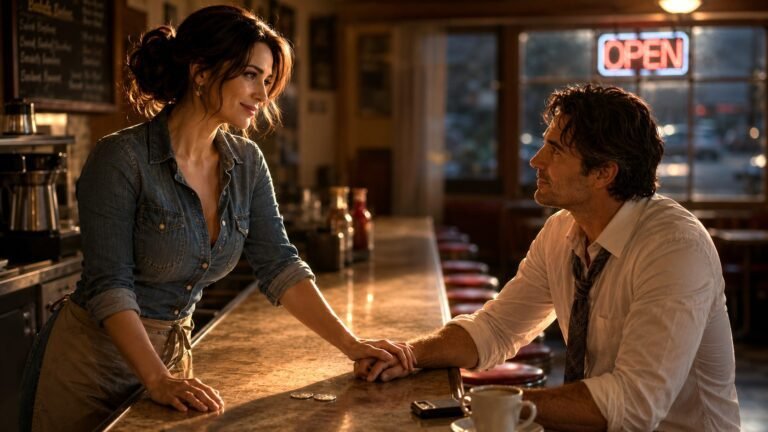
Heartfelt characters sharing love, emotions, and romantic journeys filled with hope, trust, and unforgettable bonds