

The snow had been falling over Port Solace since noon, and by the time the streetlamps flickered on along the harbor road, the town looked like something shaken loose from inside a glass globe. Elias Cormac stood at the window of his workshop, a plane in one hand, sawdust dusting the shoulders of his flannel like a second, finer snow, and watched the flakes come down sideways off the water.
“Dad. Dad. The boat’s not going anywhere,” said Juniper, his daughter, from the doorway. She was eight, small and serious in a way that made strangers assume she was older, and she had her coat already zipped to the chin, her mittens dangling from clips at her sleeves like two useless red paws. “You said we’d get cocoa before the fireworks.”
“I did say that.” Elias set the plane down on the hull of the half-finished skiff that had occupied his bench for going on three months now — a client’s restoration job, cedar strip over oak ribs, the kind of slow and exacting work that had been his father’s trade before it was his. He wiped his hands on a rag that did nothing but rearrange the grime. “Let me lock up.”
“It’s New Year’s Eve. Nobody’s stealing a boat that isn’t finished.”
“Somebody could still admire it,” he said, and she rolled her eyes in the specific, theatrical way that told him she’d learned it from television, because he certainly hadn’t taught her that, and neither, as far as he knew, had anyone else in this town of four hundred people who mostly kept their opinions to themselves and their doors unlocked.
They walked the six blocks to the harbor with the wind coming hard off Penobscot Bay, needling their faces, and Junie’s hand found his without either of them discussing it, the way it always did when the cold got serious. Port Solace at holiday dusk was a postcard of itself — strings of white lights looped along the wharf pilings, the big blue spruce in the square wearing its lobster-buoy ornaments, red and green and yellow globes that the fire department hung every December in a tradition nobody could quite explain the origin of anymore. Smoke stood up straight from every chimney before the wind bent it sideways. Somewhere down near the breakwater, someone was already testing fireworks, a single dull thud rolling out over the water like a held breath released too early.
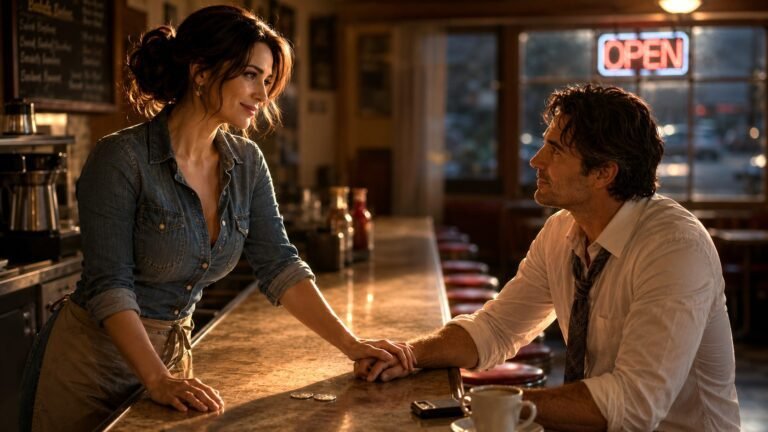
The Anchor & Ash sat on the corner where the ferry road met Main, a squat clapboard building with fogged windows and a wood stove that had been running since Thanksgiving and would keep running, Elias suspected, until Easter. He and Junie had been coming here on ferry-delay nights for years — not because the ferry was often late, though tonight it would be, with the crossing to Digby closed for weather and the six-fifteen boat pushed to who knew when — but because it was warm, and because Dot Pelletier, who ran the place, kept a jar of peppermint sticks by the register that she pretended to forget to charge for.
They stamped snow off their boots in the vestibule. The bell over the door gave its small brass complaint, and the warmth inside hit Elias the way it always did, all at once, cinnamon and coffee and the particular sweetish smell of a wood stove that had been burning applewood.
“Two cocoas,” he told Dot, “one with the works.”
“The works meaning marshmallows,” Junie clarified, in case there was any confusion, and Dot laughed and said she’d never dream of skimping.
They took the table by the window, the one with the initials someone had carved into the wood decades ago, half-worn smooth now, and Junie pressed her palm flat to the cold glass and watched her own handprint fog and fade. Elias watched the snow instead, and the harbor beyond it, black water frothing white where it met the breakwater, the ferry terminal’s lights smeared gold through the storm.
Five years he had been coming to this window. Five New Year’s Eves, five ferry delays, five cocoas with the works, and every single one of them he had told himself — quietly, the way you tell yourself things you don’t entirely believe — that he had stopped watching that terminal for a boat that wasn’t going to bring anyone back.
He had not stopped. He understood that now, the way you understand the weather has turned only once you’re already soaked.
Wren had left on a night almost exactly like this one. Not this exact bar stool, not this exact storm, but close enough that the body remembered even when the mind tried to argue otherwise. Five years since she’d zipped her duffel in their bedroom with her back to him, since she’d said the thing that ended it, since the door had shut with a sound so ordinary it hadn’t seemed to deserve the weight it carried.
He had not remarried. He had, in the specific and unglamorous way of men who raise a child alone in a town with more boats than eligible women, mostly stopped trying. There had been a dinner with the elementary school’s new librarian two winters back, pleasant enough, wrong in every particular that mattered. There had been coffee with a woman from Bath who did marine insurance, who was kind and funny and utterly unable to make him feel anything but the low, familiar hum of a house with one too many empty chairs. He had stopped blaming himself for it eventually. Some doors, he had decided, simply weren’t meant to open twice.
The bell over the door rang.
He looked up out of nothing but reflex — the sound a room makes when it changes — and the cold came in first, a gust that scattered napkins off the counter, and then a shape stamping snow from her boots, unwinding a scarf from around her throat.
Burgundy wool. Small embroidered anchors along the fringe, done by hand, a little crooked, because he had knitted it himself the winter before they married, badly, from a book, as a joke that had somehow turned into a real gift. He would have known that scarf on a stranger from across an ocean.
Wren looked up. And stopped.
For a moment neither of them did anything at all. She stood in the doorway with one hand still on the frame, snow melting into dark spots on the shoulders of a navy peacoat he didn’t recognize, and her face went through something too fast and too complete to be called surprise — more like the particular vertigo of a person who has, for years, rehearsed a hundred versions of a moment and is now living none of them.
“Mom?” Junie said.
It came out small, uncertain, a question aimed less at Wren than at the air itself, as if she needed someone to confirm the evidence of her own eyes before she trusted it.
Wren’s gaze dropped to the girl at the window table, and something in her face broke open entirely — not the composed shock she’d shown looking at Elias, but something rawer, unguarded, the look of a woman doing arithmetic on years she couldn’t get back. “Junie,” she said, and her voice cracked on the single syllable. “You’ve gotten so — ” She didn’t finish. She didn’t need to.
Dot, sensing the particular gravity that had settled over her café, made a small business of wiping the counter and did not, for once, offer commentary.
“Sit down,” Elias said, before he’d decided to say anything. It wasn’t gracious, exactly. It came out rough, low, the words of a man testing whether his own voice still worked. “You’re letting the cold in.”
—
They had met sixteen years before at a coastal conservation symposium in Portland, of all unlikely places to fall in love — a hotel conference room with bad lighting and worse coffee, three hundred marine scientists and boatbuilders and harbor engineers packed into folding chairs to argue about erosion. Elias had been presenting a hull design meant to reduce wake damage along eroding shorelines, more craft than science, and a young researcher in the third row had raised her hand during the question period and asked something so precisely, devastatingly on point — about turbulence coefficients he’d fudged in his second slide — that he’d laughed out loud at the podium, in front of everyone, and then had to spend a full minute apologizing while she went the color of a boiled lobster.
He’d found her afterward by the coffee urn and told her it was the best question he’d been asked all year, and that he had, in fact, fudged the numbers, and would she like to get dinner and help him not do that again. She’d said yes before she’d finished deciding whether it was a professional invitation or something else. By the time dessert came, neither of them was under any illusion it was the former.
They were married two years later, in October, on the courthouse steps in Rockland because neither of them wanted a production, with Dot Pelletier’s late husband standing witness and a lobster boat blowing its horn as they came down the steps, which neither of them had arranged and both of them chose to believe was a sign. The early years had the particular gold cast that only shows up in memory afterward — their first Christmas in the saltbox house, a tree too big for the room that had to be lashed to the wall with sail line so it wouldn’t topple, Wren singing off-key to records on a turntable that had belonged to her grandmother, Elias assembling a bookshelf backward and refusing, for years afterward, to admit it. There had been a summer they’d sailed the coast of Nova Scotia on a borrowed sloop and gotten fogged in for two days off Digby Neck, which should have been frightening and instead had been one of the best weeks of either of their lives, because the fog didn’t matter when the person beside you was the only compass you needed.
Junie arrived in their sixth year, and for a while the widening world of a small child had filled every gap that might otherwise have shown. But the fellowship offer came that same year — a research post at a marine station on Digby Neck, four hundred miles north, studying reef systems nobody else in the field had the patience or the funding to study long-term. It was the kind of opportunity that arrives once, if it arrives at all, and Wren had told him about it with the careful, contained excitement of someone bracing to be told no.
He hadn’t told her no. He’d said all the right things, and meant them, at first. But the boatyard was his father’s before it was his, forty years of goodwill built up along that stretch of coast, clients who trusted the name Cormac on a hull the way they trusted the tide charts, and it was not the kind of thing a man packed into a moving truck. The conversations about logistics grew heavier every week — who would move, whether the house would sell, what it would mean for a toddler to grow up split between two harbors — until the conversations stopped happening altogether, replaced by a silence that felt, at the time, like peace, and was in fact only the quiet before a long slow fracture.
She went north for stretches that grew longer with each season. He stayed, ran the yard, kept Junie fed and dressed and delivered to preschool on time, told himself this was simply what a marriage between two people with real work in the world sometimes required. The calls between them thinned from nightly to every few days to whenever the schedules aligned, and the terrible thing — the thing it took him years to understand — was that there had been no single betrayal in it, no dishonesty, nothing either of them could point to and call the cause. There had only been two people who loved each other, failing by small and unremarkable degrees to say the things that most needed saying, until the distance between them had become a language all its own.
The end had come on a Tuesday in autumn, in the kitchen of the saltbox house, over something so trivial neither of them could recall it clearly even a year later. “Maybe we should stop,” she’d said, quiet, not looking at him, and he had heard those three words as a verdict already rendered, a door already closing, and had said nothing in response — not out of cruelty, but out of a kind of paralysis he still didn’t have adequate language for. She had taken his silence as its own answer. She had packed a bag that same night. He had stood in the hallway and watched her go and told himself that stopping her would be selfish, that this was what she wanted, that a man who loved someone let them go when they asked to be let go.
He had not understood, not for years, that what she’d actually been asking for — buried under those three plain words — was for him to stop her.
—
She had been in Nova Scotia for eleven months this stretch — the longest yet — heading the winter phase of a kelp-restoration study off Digby Neck, and she’d caught the last ferry crossing before the harbor authority shut the route down for the storm, only to have that boat turn back at the breakwater when the wind hit forty knots. She’d walked from the terminal to the only place in town she knew would still have its lights on, because five years ago it had been the only place in town that mattered, and some habits, it turned out, survived even divorce.
She told all this haltingly, in fragments, while Junie sat between them working a marshmallow with singular concentration and stealing glances up at her mother every few seconds like she was checking a photograph against the real thing. Wren had aged the way people age when their work keeps them outdoors — a little more weathered at the eyes, hair cut shorter and threaded through now with a few strands of grey she hadn’t had before, hands rough in a way Elias remembered from his own, callused from rope and cold water and specimen trays.
“You look well,” he said, which was true and also entirely inadequate, the way most true things were.
“You look like you haven’t slept since October,” she said, and it was such a precisely Wren thing to say — affectionate insult wrapped around an actual observation — that he laughed before he could stop himself, and something in his chest, some muscle that had been clenched for half a decade, loosened by a single degree.
They talked the way people talk when there is too much to say and no acceptable order to say it in. She asked about the boatyard. He told her about the skiff on his bench, cedar strip, oak ribs, a rich man’s toy that was, despite itself, becoming beautiful under his hands. She told him about the reef beds off Digby, the slow return of kelp forest where a storm surge had scoured it bare three years back, the particular satisfaction of watching something come back from nothing when you’d stopped expecting it to.
“It’s the same thing you always loved,” he said. “Watching something get put back together.”
She looked at him for a second too long. “I suppose it is.”
Junie, bored of a conversation that had drifted into water chemistry, tugged Elias’s sleeve. “Dad. The tree lighting’s at seven. And the fireworks.”
He checked his watch. Six-forty. Outside, the snow had eased to a fine, steady sifting, the kind that coats the world rather than assaulting it, and the wind had dropped enough that the harbor’s flags hung nearly still. “Ferry’s not coming tonight,” he said to Wren, more statement than question. “Terminal’s showing the crossing cancelled till morning.”
“I saw.” She wrapped both hands around her mug, thumbs touching at the rim, a habit so unchanged by five years that it landed on him with an almost physical weight. “I don’t suppose Port Solace has a hotel that isn’t fully booked for New Year’s.”
“It has one hotel,” he said. “The Gull. And it’s been fully booked since Thanksgiving.”
She exhaled, half a laugh, half something else. “Of course it has.”
Junie, who possessed the particular unfiltered clarity of an eight-year-old operating entirely on hope, said, “You could stay with us. We have the guest room. Nobody uses it except when Aunt Ro visits.”
The table went quiet in a way that had nothing to do with the wood stove’s crackle or the murmur of other tables. Elias did not look at his daughter. He looked at Wren, and Wren looked back at him, and something passed between them that neither of the adults was prepared to name out loud in front of an eight-year-old holding the string of a helium balloon someone had given her at the register.
“We’ll figure it out,” Elias said finally, which was not a no. “Come watch the fireworks first. Then we’ll sort logistics.”
—
The square was filling when they got there, the whole town it seemed turned out in coats and boots, children weaving between the legs of adults holding paper cups of cider that steamed in the cold. The big spruce stood dark and waiting at the center, its lobster-buoy ornaments catching what light there was, and a wire had been strung overhead between two lampposts, a banner reading HAPPY NEW YEAR PORT SOLACE that had clearly been repainted by the same unsteady hand for a decade running.
A four-piece band — fiddle, accordion, upright bass, a snare drum played by a boy who couldn’t have been older than fifteen — worked through sea shanties and half-remembered carols near the gazebo, and a cart by the war memorial sold mulled cider and fried dough dusted in cinnamon sugar, the smell of it thick and sweet enough to taste on the back of the throat before you’d bought any.
They bought three orders. Junie ate hers with the particular fierce joy of a child who has decided this is, without question, the best night of her entire life, powdered sugar snowing down the front of her coat. Wren ate hers more slowly, watching the crowd, watching her daughter, watching — Elias noticed, because after fourteen years of loving someone you notice these things even against your own will — the way the fried dough’s steam curled up past her face into the cold, and the way something in her posture had begun, gradually, to unclench.
“I used to think about this square,” she said quietly, while Junie ran off toward a cluster of kids launching sparklers a safe distance from the tree. “More than I probably should have. Digby’s beautiful, in its way. Wilder. But it doesn’t have — ” She gestured, a small motion that took in the whole scene, the crooked banner, the fifteen-year-old drummer, the smell of applewood smoke drifting from every chimney on Main. “It doesn’t have this.”
“You could have come back,” he said, before he’d fully decided the words were safe to say out loud.
“I know.” She didn’t look at him. “I told myself for a long time that I couldn’t. That there wasn’t a version of coming back that didn’t mean giving something up. And then I told myself it was too late, that too much time had passed, that you’d built a life that didn’t have room in it anymore.” She finally turned to face him, and her eyes in the string-light glow were bright and unguarded in a way he hadn’t seen since before the fracture, before the silence, before any of it. “I don’t actually know which of those was ever true. I think I just needed a reason it wasn’t my fault, and I picked whichever one was closest to hand.”
The band shifted into something slower, a waltz-time carol played mostly on fiddle, and around them couples began, loosely, unhurriedly, to sway in place, the way people do at small-town gatherings where nobody’s watching closely enough to be embarrassed.
“The night you left,” Elias said. The words came out lower than he intended, nearly lost under the fiddle. “I need to tell you something I never told you.”
Wren went still in the particular way of someone bracing for a wound they’ve long since decided they deserve. “Okay.”
“I had a ticket for the midnight boat. That same night.” He watched her face change, watched the confusion arrive before the understanding did. “I sat in the truck for twenty minutes after you drove off, telling myself I was an idiot, that I should’ve said something instead of standing there like a post while you packed. And then I drove to the terminal. I was going to get on that boat and find you in Halifax or wherever the fellowship had you staying and tell you I’d go. Digby, Halifax, wherever. That I’d figure out the boatyard from a distance if I had to. That I was done being quiet about the thing that mattered most.”
“What happened?” Her voice had gone thin.
“The Halloran boat ran aground on the outer bar in that same storm. Three men on it, engine dead, taking on water. I was closest with a working winch, so I went out instead.” He looked at the harbor, dark now beyond the string lights, remembering the particular black cold of that water, the shouting, the hours it had taken to get all three men onto dry land alive. “By the time we got them in, it was near three in the morning. The last ferry was long gone. I told myself I’d go the next day instead. And then the next day I told myself you needed space. And then a week became a month, and I never bought another ticket, because by then I’d convinced myself the moment for it had already closed.”
Wren had stopped moving entirely, the sway of the crowd going on around her like water around a stone. “I waited,” she said. “Almost two weeks, in a rented room in Halifax with terrible plumbing, telling myself if you were coming, you’d have come by now. I thought your silence was the answer. I thought — ” She stopped, swallowed. “I thought it confirmed something I’d already been afraid of. That I’d left, and you’d let me, and that told me everything I needed to know about what I meant to you.”
“You meant—” His voice broke on it, unexpectedly, roughly. “You meant everything. You still do. I don’t think that part ever stopped being true, even when I was too much of a coward to say it out loud.”
The band eased into the final measures of the carol, and somewhere near the gazebo a child let out a delighted shriek at a sparkler, and the whole ordinary machinery of a small-town New Year’s Eve kept turning around the two of them, indifferent to the fact that something between them had just quietly, irrevocably shifted.
“I’m sorry,” Wren said. Just that. Two words, barely audible under the fiddle’s last note, but he heard in them the whole five years — the leaving, the silence after, the years of telling herself it was simpler not to reach back across the distance she’d helped create.
“So am I,” he said. And something in his chest that had been held tight since a February night five years gone finally, quietly, came undone.
—
The fireworks went up at midnight over the breakwater, gold and white blooming against a sky that had finally cleared of snow, and Junie stood between them with a mitten in each of their hands, her small face tipped up, lit gold and blue in turn, saying “whoa” every few seconds with an earnestness that made both adults laugh despite everything, or because of everything.
When the last shell had faded and the crowd began drifting toward home and warm beds, there was no more discussion of hotels. They walked back together, the three of them, Junie between them swinging their joined hands until her energy finally broke and Elias carried her the last two blocks, her head heavy and warm against his shoulder, breath even with sleep.
The house on Cormorant Point was the same saltbox it had always been — same weathered shingles, same crooked porch step he kept meaning to fix, same kitchen window that faced the water and caught the first light every morning. Wren stood in the doorway for a long moment after he’d carried Junie up to bed, looking at the front room the way you look at a photograph of a place you used to live, finding it both entirely familiar and subtly, permanently changed.
“You kept the buoy,” she said, nodding to a battered orange mooring buoy that still hung above the mantel, the one they’d found together on their honeymoon, half-buried in sand on a beach in Nova Scotia, years before either of them had known that coast would come to mean something else entirely.
“Couldn’t bring myself to move it.” He built the fire back up, more for something to do with his hands than for warmth, though the room had gone cold in the hours they’d been out. “There’s a box in the hall closet. I should’ve thrown it out years ago. Never did.”
She found it while he worked the fire — a shoebox, taped shut, the tape yellowed and brittle at the edges. Inside: photographs, mostly. Their wedding, small and courthouse-plain, the two of them laughing at something out of frame. A hand-drawn card she’d made him one Christmas when money had been tight, before either of them had steady work, ink smudged where she’d pressed too hard. A stack of letters from the year she’d spent doing fieldwork in the Aleutians, before Junie, before the fracture, when distance had still felt like something they could write their way across.
And beneath all of it, a sealed envelope in his own handwriting, addressed to her, never sent.
“I wrote it the night of the storm,” he said, watching her turn it over in her hands. “After the rescue. I never mailed it. Didn’t seem like it would mean anything by the time I worked up the nerve.”
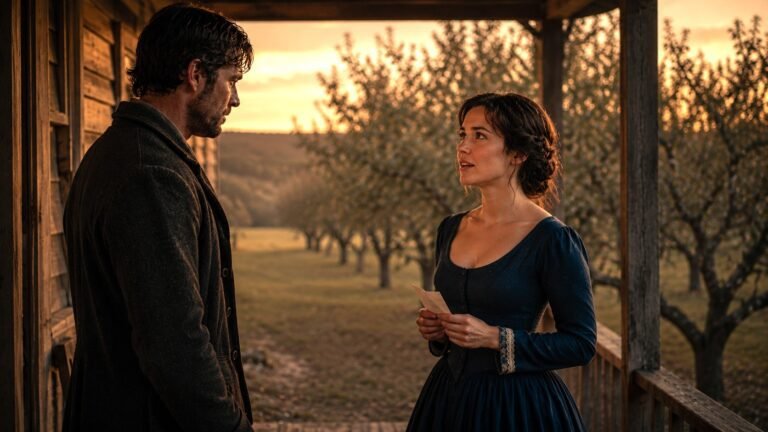
She broke the seal carefully and read it by firelight while he sat across from her, not watching her face, because he remembered every word of it and didn’t need to. It said, in language plainer than he generally allowed himself, that he had been wrong to let her walk out without a fight, that the distance between them had never really been about geography, that losing her had cost him something he didn’t have adequate words for even now, years later, still trying.
When she finished, she folded it back along its worn creases and held it a long moment, head bowed, and then looked up, and her eyes were dry, but something in her face had settled into a kind of stillness he hadn’t seen there in years.
She reached up and unwound the burgundy scarf from around her neck — she’d kept it on, he realized, the entire evening, even indoors, even by the fire — and laid it carefully across the arm of the couch between them.
“I wore this on purpose today,” she said. “I wear it most days, actually. Have for years. Told myself it was just a good scarf. Warm, well-made.” A small, unsteady laugh. “I think I know now why I never could put it away.”
He reached into the drawer of the side table, where it had sat, unremarked, since the day the divorce was finalized — his wedding ring, not silver or gold but a plain band of dark walnut he’d turned on his own lathe the winter they’d married, because a boatwright’s hands knew wood better than metal and he’d wanted to give her something he’d actually made. He’d worn it seven years and taken it off the day the papers were signed, unable to think where else it belonged, and simply never put it anywhere else since.
He held it out to her, not as a question, not yet, but as evidence — proof that some things, however long left unspoken, do not simply disappear.
She looked at it, and then at him, and did not take it. Not yet. But she did not look away from it either.
They sat by the fire a long time after that, past the point where either of them was performing composure, talking in the low, unguarded register of two people who have run out of reasons to hold anything back. About the years in between. About what they’d each gotten wrong — his silence mistaken for indifference, her leaving mistaken for a closed door instead of an open question. About Junie, and what shared custody across four hundred miles of coastline might someday, carefully, become something less divided. They made no promises that night beyond the immediate one of morning coffee and a ferry that would, eventually, resume its crossings. But something had entered the room that had not been there in five years, small and tentative and entirely real, the fragile first architecture of a thing neither of them had been able, in the end, to finish letting go of.
—
The storm had cleared by morning, leaving the harbor scoured clean and impossibly bright, sun coming up hard and gold over water still capped with the last of the night’s chop. Wren woke first, in the guest room that had not held a guest since Elias’s sister’s visit the previous spring, and came down to find the kitchen filled with the smell of coffee she hadn’t made. She stood at the east window in her socked feet, mug in both hands, watching the light come up over Cormorant Point, the snow lying thick and undisturbed across the yard, the bare apple tree by the fence dressed in white down to its smallest twigs.
Elias came down a few minutes later, hair uncombed, and stood beside her without speaking. A harbor seal surfaced out past the mooring float, dark and sleek against all that brightness, held them both in its flat black gaze for a long moment, and slid back under without a ripple to mark where it had gone.
“Junie’s still asleep,” Wren said.
“She sleeps like the dead until nine most mornings. Comes from her mother.”
“It comes from you. You used to sleep through my alarm, my shower, and an entire pot of coffee brewing six feet from your head.”
He laughed, low, and for a moment it was so easy, so entirely like every ordinary morning they’d once shared in this kitchen, that neither of them wanted to be the one to break it by mentioning the ferry, the schedule, the four hundred miles that still, this morning, stood unresolved between them. But the boat would only wait so long, and eventually he checked his watch and she checked hers, and they left a note on the counter for a girl who wouldn’t wake for another hour, and drove down to the terminal in a silence that held nothing unfinished in it, only the particular hush of two people bracing, gently, for a goodbye that was for once not the same thing as an ending.
Elias drove Wren to the terminal himself, Junie asleep still in her bed, a note left on the counter in case she woke before they were back — a small, ordinary act of trust that neither of them commented on but both of them noticed.
The ferry sat at the dock, gangway down, a handful of early travelers already boarding with the particular brisk cheer of people glad to have their New Year’s plans back on schedule. Wren stood at the rail of the parking lot with her duffel over one shoulder, the burgundy scarf still wound at her throat, and looked at him with the directness he remembered from a conference hall sixteen years gone, the same quality that had first made him laugh out loud in front of two hundred strangers.
“If none of this had happened,” he said. “If you walked into that café last night and I was a stranger sitting at the window, and neither of us knew a single thing about the other five years — would you still have crossed the room?”
It wasn’t a small question, and she heard it for what it was — not a request for reassurance about the past, but an honest inquiry into what she actually wanted, stripped of history and obligation and the long momentum of things already begun.
“Every single time,” she said, without a beat of hesitation, and something in her face told him she meant it more completely than any vow either of them had made at a courthouse sixteen years before.
He had carried the ring in his coat pocket all morning without deciding whether he’d take it out. When she said those three words, he closed his hand around it anyway, and drew it out, and held it in his open palm between them — not a proposal, not yet, not with a child asleep at home and four hundred miles of coastline still to figure out how to close. Just an offering. A compass held out toward whichever direction had always, despite everything, still pointed toward her.
She looked at the ring, and then at him, and reached out and took it — not to wear, not yet, but the way you take hold of something you’re finally ready to stop setting down.
The ferry’s horn sounded, low and long across the harbor. She turned toward the gangway, then turned back once more, holding the ring closed inside her fist.
“Call me,” she said. “Tonight.”
“Every night, if you’ll let me.”
She smiled — the real one, unguarded, the one he’d been waiting five years to see again — and walked up the gangway into the cold bright morning, and he stood on the dock and watched the boat pull out past the breakwater and grow small against the horizon until it was only a white shape and then nothing at all.
—
He called her that evening, and the evening after that, and by the third week of January the calls had stretched past two hours most nights, filled with the unhurried, curious talk of two people re-learning each other’s days — the kelp beds recovering faster than her models had predicted, the skiff on his bench finally getting her first coat of varnish, Junie’s insistence on video-calling every Sunday to report, with great seriousness, on the state of the harbor ice.
He drove north to Digby in the second week of February, on a Saturday when the sky was flat winter grey and the highway ran empty between snow-banked fields, four hundred miles that felt, by the last hour, considerably shorter than they had any right to. She met him outside a small waterfront restaurant two blocks from the research station, wearing a coat he didn’t recognize and the same burgundy scarf, and when she saw him she didn’t wait for him to reach the door — she crossed the parking lot herself, in the cold, and put her arms around him before either of them had said a word.
Over dinner they talked about logistics without fear for the first time — what a slow, careful merging of two lives four hundred miles apart might actually look like, what Junie would need, what neither of them was willing to sacrifice and what both of them, quietly, already were.
Afterward they walked along the harbor, past boats laid up for winter and a small park where someone had strung lights in the bare trees and never taken them down. She stopped beneath them and reached into her coat pocket and drew out the walnut ring, which she had carried, he realized, every day since the ferry dock, and pressed it back into his palm.
“Not yet,” she said gently, and it was not a refusal but a beginning. “I want you to hold it a while longer. There’s still ground to build under it first.”
He closed his hand around the ring and understood exactly what she meant — that some things, built right, are built slowly, the way he’d spent his whole working life joining wood to wood, plank by plank, until what emerged could hold the weight of open water. The ring was not an ending. It was a keel laid down, the first true line a boat is built around, everything else still to come.
For now, on a cold February night beneath out-of-season lights, four hundred miles and five hard years behind them and an unmarked distance still ahead, it was enough. It was, in fact, exactly where they needed to start.