
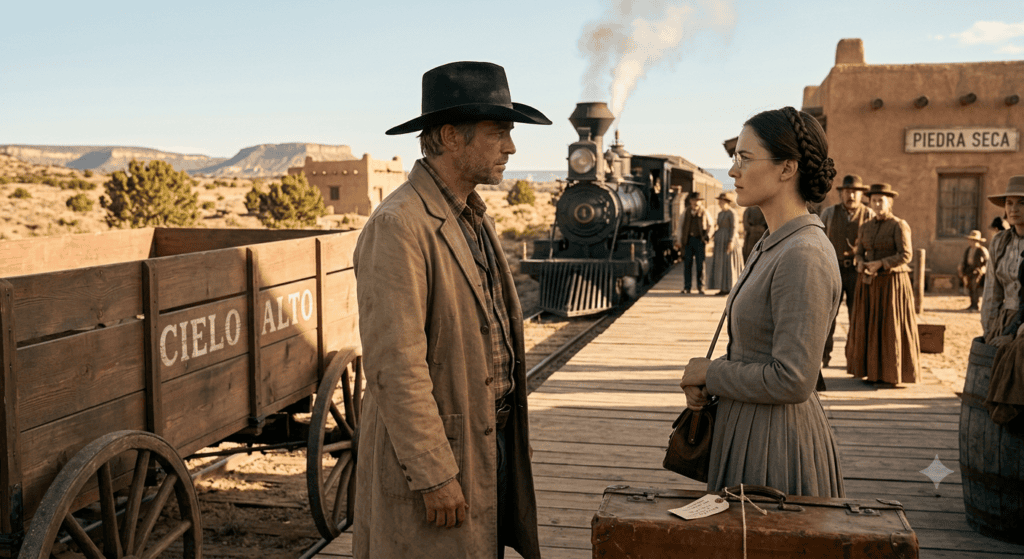
Adaline Hargrove stepped down from the westbound car at Piedra Seca with a marriage contract folded inside her glove and a shipping tag lashed to the handle of her trunk. The tag was pasteboard, the ink still tacky in the heat, and it read RETURNED — UNSOUND, NOT AS ORDERED in a clerk’s cramped hand. She did not see it until a boy stacking flour sacks pointed and laughed behind his hand, and by then half the depot yard had already read it for her.
The stationmaster busied himself with a manifest he did not need to check. A rancher’s wife waiting on a parcel turned her face toward the mountains as if the peaks had suddenly become very interesting. Dust moved along the platform in a low gold haze, carrying the smell of creosote ties and mule sweat, and underneath it, so faint she almost missed it, the sweet oily tang of raw wool from the loading dock.
Ambrose Kane did not look away. He stood near the freight scale in a linen coat too fine for a territory town, turning a gold watch chain between two fingers as though he had all the patience in the world and had simply chosen, generously, to spend some of it here.
“There she is, Vane,” he called, pitching his voice for the crowd. “The bride we ordered you. Small enough not to eat your winter feed, plain enough to ask no questions, and damaged enough to finish what the drought started.”
Silas Vane stood at the far rail with a coil of new rope over one shoulder and dust ground into the creases of his hands. He had come to town for barbed wire and a spool of medicated dip, not a wife. His ranch, Cielo Alto, lay eleven miles north along a dry wash, and every man in the valley knew that Ambrose Kane wanted the spring that fed it more than he wanted the ranch itself.
Adaline kept her chin level though the word on the tag burned hotter than any insult she had carried across three states. She was twenty-eight, no girl to be freighted like damaged goods, and she had crossed half a continent believing the marriage bureau had matched her, fairly, to a rancher who had written that he needed a partner who understood wool.
“Did you send for me?” she asked Silas directly, because she had learned in Ohio that the surest way to find a lie was to walk straight at it.
“No, ma’am.” He looked at the tag first, then at her face, and something in his jaw tightened that had nothing to do with her. “But I didn’t ask any man to shame you on my account, either.”
Kane laughed, easy and unhurried. “Careful, Vane. Refuse the bride and the bureau calls it breach, and I hold that paper too. Keep her and you feed another mouth on a ranch that can’t feed the mouths it has. Either road, I own Cielo Alto before the first snow closes the pass.”
Silas crossed the platform and untied the tag from her trunk with two efficient pulls, folded it once, and put it in his shirt pocket the way a man pockets a splinter he means to deal with later. “She isn’t freight,” he said, “and she isn’t your joke to tell.”
The yard went quiet in the particular way a crowd goes quiet when it has decided, without voting on it, to watch rather than speak. Adaline should have felt relief. Instead she felt something close around her ribs like a hand — not fear exactly, but the sense of a door shutting behind her that she had not chosen to walk through.
“I’ve a wagon out back,” Silas said, lifting her trunk before she could protest the weight of it. “I can put you on the four o’clock east with fare enough in your hand to reach Cincinnati again, or I can drive you out to Cielo Alto so you can see plainly what kind of trouble you were mailed into. No vows asked. Your choice to make, not mine and not his.”
It was the first sentence anyone had offered her since the conductor called the stop that did not have an edge folded into it somewhere. She looked toward the waiting cars, steam sighing white against the blue afternoon, and for one long breath the easy path glittered in front of her — climb aboard, carry the insult home, let this stranger lose his ranch without her.
Then she looked at Ambrose Kane, still amused, still certain, and something in her that had been quiet through three states of humiliation finally lifted its head.
“I’ll see the ranch,” she said.
Kane’s smile thinned by exactly one degree. “See it quick, then. It won’t wear his name much longer.”
Silas said nothing to that. He set her trunk in the wagon bed, handed her up without letting his palm linger on hers, and drove them out past the last adobe wall of town and into open country where the land went gold-brown and enormous in every direction, wide enough to make a lie feel small and foolish in comparison.
For the first mile neither of them spoke. Piñon and juniper broke the flats in dark clumps; somewhere off to the west a hawk turned slow circles over nothing. Adaline held the marriage contract in her lap, unread again, because she already knew every clause and none of them had prepared her for a depot yard full of laughing men.
“You truly never sent for a bride,” she said at last. Not quite a question.
“No.”
“Then why take me out at all? You could have let me get back on that train and washed your hands of the whole business.”
“Because Kane wanted you to beg on that platform,” Silas said, eyes on the road. “I’ve done plenty of foolish things in my life, Mrs. Hargrove. That wasn’t going to be one of them.”
The answer settled something in her chest more thoroughly than kindness would have. Kindness could be worn like a coat, put on for an audience and shed the moment the audience left. A man refusing an easy cruelty when it cost him nothing to grant it — that was different. That was harder to counterfeit, and she had gotten very good, this past year, at spotting counterfeits.
Cielo Alto came into view as the sun dropped low and orange behind the far ridge, throwing the whole valley into a wash of copper light that made even ruin look briefly beautiful. A low adobe house with a sagging portal. Two sheds, one leaning hard enough to worry her. A pole gate with a sun-bleached wooden sign, hand-carved, reading CIELO ALTO, one corner splintered where something had struck it long ago and never been mended.
In the near pasture, ewes stood scattered and listless, their fleeces dull and matted with burr, ribs showing plain through wool that should have hidden them. A dog barked once from the shed and did not come out. A man leaning on the corral rail spat into the dust as the wagon rolled past and did not offer to help with the trunk.
“That’s Emmett,” Silas said. “He thinks any new mouth on this place is one more reason it fails faster.”
“He may not be wrong.”
Silas looked at her then — not measuring her for use, the way Kane had, but the way a man looks at someone who has just told him an uncomfortable truth without flinching from it. “Trouble’s already here,” he said. “Question is what kind you turn out to be.”
He carried her trunk inside himself and set it down in a small back room that smelled of adobe dust and dried chile ristras hanging forgotten from a roof beam, and then he left her to it without ceremony, the way a man leaves a guest room he has not had occasion to use in years. Adaline sat alone on the edge of a narrow bed with a quilt gone thin at the corners and listened to the house settle around her — a screen door easing on its hinge, boots crossing the yard, the low murmur of Emmett grumbling to the dog. It was not so different, she thought, from the sound of her father’s warehouse at closing time, men trading complaints in low voices while somewhere behind it all the real work of the day quietly finished itself.
She unpacked only what she needed for morning. Her father’s wool shears, wrapped in oilcloth and still faintly bright at the blades though he had been three years in the ground. A tin of pine tar salve she had mixed herself back in Ohio, more out of habit than plan, the way some women packed a good dress for occasions that might never come. A single photograph, curling at one corner, of a thin man in shirtsleeves standing before a mountain of baled fleece, squinting at whoever had held the camera. She set it on the sill where the last of the light could reach it and did not cry, though she allowed herself, for exactly as long as it took the sun to drop behind the ridge, to miss him plainly and without apology.
Supper was quiet — beans and stiff tortillas and coffee gone bitter from sitting too long on the stove — and no one at the table pretended the day had gone easily. Silas ate without much appetite, his mind clearly still turning over the tag folded in his shirt pocket, and Emmett watched Adaline across the table the way a man watches weather he does not yet trust. She did not try to charm either of them. She had learned, somewhere between the depot platform and this table, that trying to be liked too quickly only made a person easier to dismiss later. Better, she thought, to be useful first and liked whenever it followed.
The morning answered part of it before Adaline had finished pinning up her hair.
She came out to the near pasture in a gray traveling dress with the sleeves rolled and pinned, her father’s old wool shears looped through her belt out of habit rather than plan, and asked Emmett where the feed was kept. He looked her up and down with the particular contempt reserved for people who have not yet earned the right to be listened to.
“Bride wants to play shepherd,” he said to the other hand, a lanky boy named Tobias who laughed on cue.
“Bride wants to know why you’re grazing the whole flock together,” Adaline said, “when a third of these ewes are carrying scab and passing it to the rest every time they crowd the trough.”
That stopped the laughing. Emmett’s face went hard and careful. “Ain’t scab. It’s dust mange, same as every year.”
“It’s scab,” she said, and crouched at the nearest ewe’s flank without asking permission, parting the wool with two fingers to show the crusted, reddened skin beneath. Her father had died coughing wool dust into a handkerchief after thirty years of grading fleece in a Cincinnati warehouse, and if he had left her nothing else, he had left her this — an eye that could read a fleece the way other people read a face. “Look here. If you’d separated the affected animals two weeks back you’d have a third of a flock sick instead of the whole herd going thin.”
Emmett looked to Silas, waiting for the order to laugh her off the property. Silas did not give it.
“Do as she says,” Silas said. “Split the flock. Whatever she calls for.”
That cost him something with the men, and Adaline saw the cost land on Emmett’s face — the particular resentment of a man already frightened for his job, being told to take instruction from a stranger the whole town had just watched get mailed in like a crate of returned goods.
By noon Adaline had the flock separated into three groups by the shed rails, marked the worst-affected ewes with a smear of pine tar behind the ear so no one would mistake them again, and started mixing a dip from sulfur and lard that her father had used on his own small flock before the warehouse work took him from Ohio altogether. She did not speak of miracles. She spoke of days — how many it would take before the crusting broke, how many before the wool came back in clean, how much of the feed to hold back from the sick pens so it went further among the well ones.
Silas watched from the gate rail with his forearms crossed, dust settling gold in the last light. “You’ve done this before.”
“I’ve watched men refuse to do it before,” she said, “right up until it cost them the whole flock instead of a third of it.”
The corner of his mouth moved — not quite a smile, but its early cousin. “That I believe.”
By the third day the marked ewes had stopped hanging at the rear of the pen. By the fifth, two that Emmett had already written off in his head were shouldering their way to the trough with the healthy stock. Adaline said nothing of victory. The hired men stopped laughing where she could hear it, which in a place like this passed for high praise.
Before Kane could make his next move, Adaline made one of her own.
She asked Silas to walk her up along the acequia — the narrow irrigation ditch that carried water down off the mountain spring and through the home pastures — to the place where it ran thin and cracked at the edges instead of full. Emmett muttered that a bride from Ohio wouldn’t know a live ditch from a dead one. Adaline didn’t answer him. She knelt at the ditch bank, pushed her fingers into the silted bed, and drew up a handful of gray sludge that smelled faintly of rot.
“This water hasn’t dried up,” she said. “It’s been dammed somewhere above, and what’s left of it is drowning in its own silt.”
Silas crouched beside her, frowning at the sludge in her palm. “Ojo Bendito’s a mile up canyon, on land that’s mine by the old grant. Nobody’s got right to touch that ditch but me.”
“Then someone’s touching it anyway.”
He looked toward the canyon mouth, jaw tight. “Kane sits on the water commission. He’s been telling the territorial office for two years that my grant water rights want re-surveying. If he can prove the ditch runs dry on its own, he can argue the spring’s gone bad and ought to revert to district control — which he chairs.”
“And if the ditch runs full again?”
“Then he’s got no argument left.” Silas turned the wet silt over in her palm with one finger, thoughtful in a way that made her chest go strange and warm despite the ridiculousness of admiring a man over a handful of mud. “It’d take clearing the head gate. A week’s labor, maybe more, and men I don’t rightly have to spare.”
“Then don’t look at what you don’t have,” Adaline said. “Look at what a week of labor buys you if it works.”
He didn’t smile, but something in his eyes warmed the way the canyon light warmed at dusk, slow and total. He was beginning, she thought, to like the way she spoke when a thing needed saving — not soft, not decorated for his comfort, just clear.
They walked the ditch for the better part of an hour. Adaline pointed out where spring runoff had cut the bank thin in two places, where cattle — Kane’s cattle, grazing on land they had no clear right to graze — had trampled the same soft crossing until it collapsed into the channel each season. A few days of rock-work and brush fencing could hold the bank long enough for the water to scour its own silt clean again.
“And if it fails,” Silas said, “if we spend the week and the ditch stays dead?”
“Then you can say you lost a week trusting a damaged bride,” she said, and regretted the bitterness in it the instant it left her mouth.
He didn’t scold her for it. Instead he drew the folded shipping tag from his shirt pocket — he had been carrying it three days now, she realized, not thrown away but kept, like evidence — and held it up between two fingers.
“This is Kane’s word,” he said. “Don’t you go doing his work for him free of charge.”
No one had spoken to her so plainly in longer than she cared to count. It struck her harder than any comfort could have.
By sundown Silas had Emmett and Tobias hauling flat river rock up from the wash, and he worked beside them until his palms split and bled through his gloves. When Emmett grumbled that they were breaking their backs on a woman’s notion, Silas held up his torn hands without heat.
“Her notion, my ranch, our note at the bank,” he said. “If it fails, both our names answer for it.”
Adaline turned away before anyone could read what was plain on her face just then. Far up on the canyon rim, unmistakable even at that distance, a rider sat his horse and watched the work below for a long moment before turning back toward town. She said nothing about it to Silas that night. She didn’t need to. She had already understood that Kane would not wait much longer to answer clearness with cruelty of his own.
On the eighth morning Silas rode to the mercantile for salt blocks and dip sulfur and came home with an empty wagon and a face like a closed door.
“Kane’s bought controlling shares in Torres’s store,” he said, tossing the reins to Tobias without looking at him. “No more credit for Cielo Alto. No feed, no salt, and he’s had my name struck from the Wool Growers Exchange registry — which means no grader will bag my clip at shearing, and no buyer on that Exchange floor can bid on wool that hasn’t been graded and bagged proper.”
He held out a printed notice, ink still sharp. Adaline read it once, twice, understanding growing cold in her stomach with each pass. Cielo Alto clip deemed unfit for territorial grading pending water rights review.
“He can simply decide that?”
“He chairs the grading board same as he chairs the water commission. Man wears three hats in this territory and every one of them sits on my throat.” Silas’s voice had gone flat, the particular flatness of a man holding something back because letting it out would cost him more than he could afford to spend. “Kane sent you here to make this place look too broken to save. When that didn’t work fast enough, he’s simply cutting off everything that keeps it breathing.”
Adaline folded the notice along its crease and pressed it flat against the corral rail with both hands, steadying herself more than the paper. “I can still take you to the depot,” Silas said quietly. “Fare’s still good.”
“Do you want me gone?”
He looked away, toward the crooked ranch sign at the gate, toward anywhere that wasn’t her face. “No.” The word came out rough, stripped of all the polish a courting man might have dressed it in, too honest to be gallant, and she felt it land somewhere under her ribs before she’d decided whether to let it.
“Then don’t offer me that train because you’re frightened for me,” she said. “Offer it only the day you want me to take it.”
He turned back to her fully then, gray eyes tired and careful in the lamp light spilling from the portal. “I want you to stay,” he said. “But wanting isn’t asking. Not yet. Not while Kane’s got a rope around both our necks.”
That evening they sat together on the corral fence with two tin cups of coffee cooling untouched between them, close enough that she could smell woodsmoke and dust and the clean animal warmth of him, and neither one of them in a hurry to close the distance further. Adaline had lanolin worked into the cracks of her fingers from the dip mixing. Silas had a line between his brows that deepened every time a ewe coughed in the near pen.
“Your father built this place,” she said, nodding toward the crooked sign at the gate.
“Carved that sign himself, with a knife he always said was too dull for real work.” Silas turned his cup slowly between his palms. “He believed this valley would outlast anything Kane’s kind could throw at it. I’ve spent three years proving him wrong.”
“No,” Adaline said. “You’ve spent three years being strangled slowly by a man who owns the rope. That isn’t the same thing as failing.”
He gave a short laugh with no real humor in it. “That’s a kinder way to put it than I’ve managed for myself.”
“It isn’t kinder. It’s more accurate.”
The Exchange floor opened for shearing bids in five days. After that, no tenderness in the world would keep a bank examiner from locking a gate that had stood open, however crookedly, for thirty years. For a moment the ranch held still around them — sheep shifting and murmuring in the near pen, a nighthawk somewhere overhead — and Silas reached to take her empty cup at the same moment she reached to hand it over, and their fingers met and held a half-second longer than the errand required.
It was no grand thing. Just a brush of calloused skin against calloused skin, brief and entirely unpolished. But Silas went still as though the whole valley had gone silent around that single point of contact, and then he drew his hand back first, deliberate, like a man setting down something precious before he trusted himself to hold it properly.
“If I ever ask anything of you, Adaline Hargrove,” he said, low, “I want it to be after Kane’s got no rope left to hold over either of us.”
She looked at him fully then, unguarded for the first time since the depot platform. “Then let’s cut the rope.”
The rope tightened before it cut.
Two mornings later a buggy came up the ranch road bearing the small brass plaque of the Western Marriage Bureau bolted to its side. The woman driving wore a neat traveling coat and a mouth pressed thin with nerves she could not quite master. Adaline recognized her before the wheels had fully stopped.
“Nell,” she said, and heard her own voice go flat.
Nell Ashworth had shared a boarding-house room with Adaline the winter after her father’s cough finally won, back in Cincinnati, copying names into the bureau’s ledgers and swearing up and down that the matching work was honest, that no woman on those pages was sent anywhere she hadn’t been fairly promised.
Now Nell would not meet her eyes.
“I told them you were sensible, practical, that you’d manage whatever came,” Nell said, voice thin as paper. “I didn’t know he meant to put that tag on your trunk. I swear to you I didn’t know that part.”
“But you knew he paid the bureau to send me specifically.”
Nell’s hands tightened around the reins until her knuckles whitened. “He said Mr. Vane had written asking for a bride who wouldn’t expect comfort. Someone plain, someone with no people behind her to come asking questions if things went wrong out here.”
“Say the rest of it.”
Silas stood a step behind Adaline, silent, letting the truth find its own path without his weight pressing on it either way.
Nell swallowed hard. “Kane said a woman with no family left and no money of her own would make the ranch easier to break. He paid your bureau fee out of his own pocket, and told me if I refused to send you, I’d lose my desk and every reference I had. He said—” her voice cracked, “—he said to choose you because your father was dead and there’d be no one left to ask why.”
The words landed worse than anything Kane himself had said on that depot platform. Kane was simply an enemy, and enemies were easy enough to hate cleanly. Nell had known Adaline’s hunger, her thin purse, her dead father, the particular way a grieving woman alone in the world could be made to feel grateful for even a cruel kind of rescue.
Nell drew a train ticket from her coat pocket, hand shaking. “Take it. Leave before the shearing floor opens. He means to shame you there worse than the platform, in front of every buyer in the territory.”
Adaline took the ticket. Silas’s face changed at that, some careful hope dimming, but he said nothing to stop her — and that silence, she understood, was its own kind of proof. He would not beg her into staying just because leaving frightened him.
“Thank you,” Adaline said to Nell, and meant it, and folded the ticket into her apron pocket without another word.
Nell’s shoulders sagged, mistaking the silence for forgiveness. “Then you’ll go.”
“I didn’t say that.”
That night, someone opened the head gate on Ojo Bendito and let the whole week’s repair work wash out into the wash below in a single ruinous flood, and in the confusion two dozen ewes found the broken fence line and scattered into the dark canyon beyond.
Emmett found the gap first, cursing, already reaching for his horse. Silas was mounted before Adaline had her boots laced. She came out of the shed with her skirt hitched and knotted at the knee and a coil of rope over her shoulder, and one of the youngest ewes — one of the very lambs she had marked and dipped and coaxed back to the trough with her own hands — bawled from somewhere down in the rocks, cut off from the rest, and something in Adaline’s chest simply refused the word no before Silas could even finish shaping it.
“It’s rough ground in the dark,” he said instead, already knowing the argument was lost.
“Then keep up.”
She rode harder than Emmett expected and steadier than Silas feared. When the scattered ewes bunched, panicked, at the mouth of a rocky draw, she didn’t chase the lead animal the way Tobias tried to and only drove it further into the rocks. She circled wide instead, slow and quiet, letting the frightened ewe believe the turn back toward the ranch had been her own idea all along. Emmett, watching from his horse, wore an expression Adaline had not seen on him before — something that had entered his face like a stone dropped through still water, and did not leave it again.
They brought back all but four head by first light. One lamb had gone down hard on the rocks with a gashed foreleg, and Adaline knelt in the cold dust binding it with strips torn from her own petticoat, murmuring low and steady until the animal’s shaking eased under her hands.
Silas dismounted beside her, dust-caked and gray with exhaustion. “You could still take that ticket.”
“I know.”
“Kane will have buyers lined up to watch you humiliated at the shearing floor. He’ll make certain of it.”
“Then they can watch my face while they try.” She stood, dust streaked across one cheek, her braid come half undone, exhausted enough to fold and stubborn enough to shame anyone who expected her to. “He sent me here to be a burden, Silas. If I leave before that floor opens, that is the only thing I will have been in this whole story. A burden, mailed and returned.”
Silas looked at the mended fence line, pale in the growing light, then at the woman who had ridden into rough dark canyon country beside him without being asked twice.
“No,” he said quietly. “Not in mine.”
They drove the Cielo Alto clip into Piedra Seca on the morning the shearing floor opened, three wagons of clean, well-grown wool that four weeks ago had been matted, burr-choked, and half sick with scab.
Kane had arranged a proper audience for it. His grading platform stood near the Exchange scales, a long rail hung with brass buyer tokens, each one marking a merchant willing to bid sight-bagged wool sold through the territorial Exchange. Cielo Alto’s hook on that rail hung bare. Men gathered the way men always gather when a wealthy one has arranged to finish off a poor one in public.
Nell stood near the depot fence, pale as unbleached muslin. The stationmaster watched from the freight door, no longer quite so interested in his manifest. Emmett and Tobias held the wagons at the scale gate.
Kane lifted Silas’s mortgage note in one gloved hand, voice pitched to carry. “Vane’s brought his charity clip,” he called, “graded, he claims, by the bride who was sent to teach him better sense. Any buyer who hangs a token on that empty hook answers to me and to this board come renewal season.”
Adaline walked to the scale gate before Silas could move to stop her. She had traded her traveling coat for a plain work dress, lanolin still worked deep into the creases of her hands, and she did not look at Kane first. She looked at the buyers.
“You were told this clip was unfit for grading,” she said, loud and clear across the yard. “Then look at it.”
Tobias swung the wagon gate wide. The fleeces spilled into the light — not the glossy show-fleece of a rich man’s flock, but clean, well-grown, evenly crimped wool with none of the scabbing or burr that had choked it a month before. Several buyers stepped closer despite themselves, one reaching out to test the staple length between two fingers before catching himself.
Kane’s mouth hardened. “Pretty fleece doesn’t pay a bank note.”
“No,” Adaline said. “Bids do.”
He snapped his fingers toward Nell. “Tell them what the bureau sent this man. Tell them plainly.”
Nell looked at Adaline, shame plain on her face, but shame that stays silent is cheap currency. Adaline said nothing, only waited to see whether Nell would pay more than that this time.
Nell stepped away from Kane’s side. “He paid the bureau fee himself,” she said, voice shaking but carrying. “He told me to send a woman alone in the world, one I knew he thought would break easy and take the ranch down with her. He said if she could be shamed off that platform, Silas Vane would have no fight left in him at all.”
The ticket-window clerk lowered her eyes, remembering, no doubt, the tag she had pretended not to read weeks before. The stationmaster stopped pretending not to listen entirely.
Kane lunged for Nell’s arm, but Silas caught his wrist first — not hard enough to break it, hard enough that every buyer on that floor saw plainly who had reached first to hurt someone smaller than himself.
“Careful,” Silas said, low.
Kane wrenched free and slapped the mortgage note against the rail. “The note comes due at sundown regardless of what theater you stage here. Tokens or no tokens, I hold the paper.”
Adaline turned back to the buyers. “Then bid before sundown. Not out of pity, and not for Silas Vane’s sake. Bid because this clip is worth more than you were told, and because a man who’ll lie about a bride will lie about a fleece just as easily.”
For one long breath, nothing moved. Then old Mr. Salazar, who bought wool on contract for two territorial mills, unhooked his brass token from Kane’s board and hung it, deliberately, on Cielo Alto’s empty rail. The sound of it — brass striking iron — was small and enormous at once. A second buyer followed. Then a third.
“Any man who moves his token loses his winter freight rate through my warehouse,” Kane said, and there was real strain under the smoothness now.
Mr. Salazar unpinned Kane’s printed rate sheet from the board without hurry and folded it into his coat. “Then I’ll haggle my own freight.”
Emmett stepped forward then, dark-faced with an anger he had clearly been carrying since the flood two nights before. “And any man keeping his token with Kane ought to know he’s the one who opened our head gate and cut our fence line. I found his rider’s tracks myself, not two hundred yards from the break, boot heel worn crooked on the left same as always.”
Two more buyers moved their tokens before Emmett had even finished speaking. That settled it. The rail filled steadily, brass catching the noon light. Kane looked at the board, at the clean fleece piled in the wagon bed, at the woman he had once called damaged goods on a shipping tag, and for the first time his easy, certain smile had nowhere left to stand.
The bids came fast after that. Silas stood beside Adaline and did not speak over her once through the whole of it. When the final figure landed, it paid the bank note in full, bought back Cielo Alto’s Exchange registry outright, and left enough besides to lease the upper canyon grass Kane had been maneuvering two years to steal.
Adaline took the mortgage note from Kane’s own hand. “Paid,” she said, “by Cielo Alto wool.”
No one laughed at her hands then. They watched the lanolin worked into her fingers the way men watch a brand — proof of ownership, of work actually done. No one cheered, either. The quiet that followed was better than cheering. It was the particular quiet of men deciding, without a vote, that Ambrose Kane’s permission no longer bought them any profit worth having.
“Vane’s wool,” Kane spat, one last try at the old order of things.
Silas looked at the buyers, then at Adaline. “Cielo Alto wool,” he said. “Graded and managed by Adaline Hargrove — partner, if she’ll put her name to the ledger.”
The scale yard went quiet in a different register this time. She had arrived under a shipping tag calling her unsound. Now men waited, genuinely curious, to hear whether she would accept a place no one could hang a slur around like a tag ever again.
She looked at Silas. His face held hope plainly, but no demand riding underneath it — wanting, and willing to wait for an answer on her own terms.
“Partner,” she said, “first.”
His eyes went soft in a way she felt more than saw. “Partner first,” he agreed.
Nell lost her desk at the bureau before the week was out, once word of Kane’s fee reached the territorial office. The stationmaster refused to handle another marriage contract routed through her name until the fee itself was repaid to Adaline in full. Nell signed the repayment paper with a shaking hand and pressed the first five dollars of it into Adaline’s palm from her own thin purse.
“I’m sorry,” Nell said again, smaller this time.
“Be better before you ask to be forgiven for it,” Adaline told her, and took the money, and did not soften the words for either of their sakes.
Kane lost more than his smile that day at the scale yard. Buyers pulled their winter freight contracts from his warehouse one by one over the following month. The mercantile reopened Cielo Alto’s credit line, though Silas paid cash out of simple stubbornness for the rest of that year. The upper canyon lease was recorded under both names — Adaline Hargrove and Silas Vane — witnessed by men who had moved their own tokens with their own hands and meant to remember that they had.
When Silas and Adaline drove home that evening, the old shipping tag lay tucked beneath the paid mortgage note in the wagon box, folded soft now from weeks in his shirt pocket.
By first frost, the Piedra Seca paper had begun calling Cielo Alto the fastest-recovering spread on the upper Rio Salado. By the following spring, men who had laughed on the depot platform were riding out to ask Adaline how she had brought a scab-sick flock through winter whole.
She gave them all the same answer. “I counted the sick ones first, and I didn’t pretend they weren’t sick to spare anyone’s feelings.”
On the day they rehung the ranch’s crooked wooden sign — mended now, the split corner spliced and pegged — Silas brought out a fresh plank of cedar and painted CIELO ALTO across the top in careful white letters. Beneath it he had left two blank lines. On the first he had already written Silas Vane. The second waited empty.
Adaline took up the brush. Her hand did not shake. She wrote Adaline Hargrove beside his name, then walked into the small gatehouse shed and pinned the old shipping tag to the wall beneath the framed and paid mortgage note, where every hired hand who ever passed through would see it plainly.
The same tag that had once hung from her trunk calling her unsound now hung under a paid note inside a gate that no man alive could close on her again.
“Leave it there?” Silas asked from the doorway.
“Yes,” she said. “So we both remember what a thing is truly worth, before a cruel man gets the chance to name it for us first.”
Silas took off his hat. The evening wind lifted his hair and made him look, for a moment, younger than three years of debt had allowed him to look at any point since she’d known him. “Adaline,” he said, “I asked you for partnership in front of the whole buyers’ floor, with a bank note still hanging over my head and half the territory watching. I’m asking you something different now, with no note over either of us and no train waiting at the depot to save either one of us the trouble. May I court you properly?”
She looked past him — at the gate, at the cedar sign still tacky with fresh paint, at the ranch that had very nearly died and had refused to, and then at the man who had called her free before he had ever once called her wanted.
“Yes,” she said. “But don’t expect me to stop counting the sick ones first.”
Silas smiled then, fully, for what she suspected was the first time in longer than three years. “Wouldn’t have asked otherwise,” he said. “Wasn’t counting on anything less.”
Together they turned the mended sign outward, so that every rider coming up the Piedra Seca road would see both names before ever passing through the gate. Inside the small gatehouse, the tag that had once called Adaline Hargrove damaged and unsound hung quietly beneath the note that proved, in Ambrose Kane’s own ink, exactly what she had been worth all along.
No one on that road ever called her freight again.
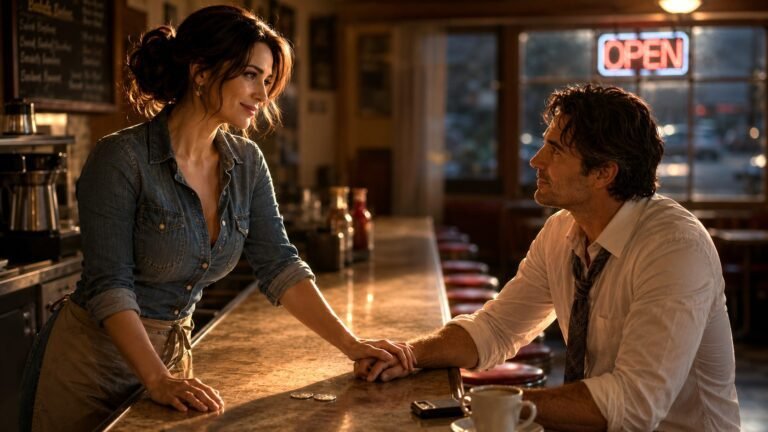
Heartfelt characters sharing love, emotions, and romantic journeys filled with hope, trust, and unforgettable bonds