


The fog came in off Port Isley Bay the way it always did in late October, rolling low over the breakwater until the fishing boats at their moorings looked like ghosts of themselves, masts fading into gray before the hulls did. Daniel Reyes had lived in this town for six years and had never once gotten used to it — the way the whole world could go soft and quiet in the space of twenty minutes, sound muffled, smells sharpened. Salt. Diesel. Something baking, somewhere.
He pushed open the door of the Salt Note Café because the coffee at the dry-dock break room had gone bitter weeks ago and nobody had bothered to descale the machine, and because he had forty minutes before he needed to pick Sophie up from her after-school program, and because the bell over the door made a sound he liked — an old brass thing, slightly cracked, more clunk than chime.
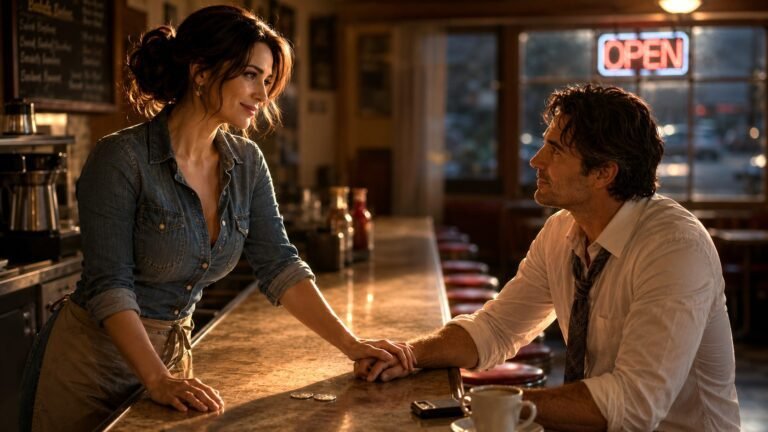
Desmond was behind the counter, same as always, wiping down the espresso machine with the unhurried thoroughness of a man who had been doing it for twenty-two years and saw no reason to rush now. Two stools were open at the far end of the counter, the ones by the window that looked out at the harbor when the fog allowed it, which today it did not.
Daniel took the second stool from the end. He ordered a coffee, black, and a sandwich he didn’t especially want but that gave him something to do with his hands while he waited for his heart rate to come down from the day. The dry dock had been short two men and the automated crane on Bay Three had jammed twice, and he was tired in the specific, low-grade way that had become his baseline over the last several years — not exhausted, just permanently a little worn at the edges, like a coin that had passed through enough hands to lose its shine.
Someone sat down one stool over. He didn’t look up right away. Then a voice said, “Is the coffee actually good here, or did you just need somewhere to sit down?”
He looked over. She had dark hair cut just above her shoulders, damp at the ends from the fog, and she was watching him with a half-smile that wasn’t flirtatious so much as curious, like she’d asked the question purely to see what he’d do with it.
“Honestly,” he said, “both.”
She laughed — a real one, quick and unguarded, and something in her face snagged at him. Not quite recognition. More like the beginning of it, a shape he almost knew the outline of.
“Do I know you?” he asked.
She considered him for a second, head tilted slightly. “Fairhaven Academy,” she said. “Class of oh-four.”
It hit him like a wave he hadn’t seen coming, cold and sudden and entirely clarifying. Maren Ostergaard. The girl who used to sit in the back corner of AP Chemistry with her hood up, who ate lunch alone by the radiator in the library and seemed, at the time, perfectly content there. He hadn’t thought about her in — he genuinely could not say how long. Fifteen years, maybe more.
“Maren,” he said.
“You remembered.” She sounded pleased, in a low-key way. “Most people don’t. I was pretty invisible back then.”
“I remember you correcting Mr. Halvorsen’s stoichiometry on the board. In front of the whole class.”
“He deserved it. He’d been teaching it wrong for a decade.” She wrapped both hands around her coffee cup. “You’re Daniel Reyes. You played hockey. You had a truck with a bumper sticker that said something about the Coast Guard.”
“My dad’s truck. I was in the Navy, actually. Machinist’s mate.”
“Close enough for seventeen-year-old me.” She smiled again, and this time it reached somewhere further back in her eyes. “You look — I don’t know. Steadier than I remember.”
“Fifteen years will do that. Or it should.”
They talked. That was the strange, easy thing about it — they simply talked, the way you do with someone who has no leverage over any part of your current life, no stake in how you’re doing, nothing to prove and nothing to protect. He told her about the Navy, four years, an honorable discharge he was quietly proud of, and about how he’d ended up back on this stretch of coast because his daughter’s mother’s family had roots here and it had seemed, at the time, like the responsible thing — stability, a fixed address, a school district. He told her about Sophie without softening any of it, the way he always did, because he’d learned a long time ago that how a person reacted to hearing I’m raising my daughter alone told him almost everything he needed to know about them.
Maren hadn’t flinched. She’d asked questions — real ones. What was Sophie like. What did she love. He’d shown her a photo on his phone, Sophie squinting into the sun on the tide flats with a bucket of hermit crabs, and Maren had looked at it for a long moment with an expression he couldn’t quite name, something between delight and a kind of ache.
“She looks like she runs the operation,” Maren said.
“She absolutely runs the operation.”
In turn, she told him she worked in tech — robotics, automation, something to do with logistics, vague in the way people are vague when they’ve learned that specifics invite a certain kind of attention they’d rather not have on a Tuesday afternoon. He hadn’t pressed. He’d been too busy talking about himself, if he was honest, caught up in the rare, uncomplicated pleasure of being listened to by someone who wasn’t tired or distracted or half-present. By the time he thought to ask more about what she actually did, the moment had passed, and asking felt like it would break something that didn’t need breaking.
They stayed almost three hours. He bought her a second coffee. She bought him a third without asking, and he objected for exactly as long as pride required before accepting it. Outside, the fog thickened toward evening, and Desmond turned the lights up gold against the gray windows, and at some point Daniel realized he had laughed more in that stretch of afternoon than he had in months.
When he finally said he had to go — Sophie, pickup, the after-school program closed at six sharp and charged a dollar a minute after — Maren walked him to the door.
“This was good,” she said. Simply, like a fact she was reporting.
“Yeah,” he said. “It really was.”
He didn’t get her number. Neither of them suggested it, and afterward, driving to get Sophie with the heater blasting and the wipers on intermittent, he wondered why not, and decided it didn’t matter. It had been a good afternoon between two people whose paths weren’t likely to cross again. He didn’t think much more about it — or told himself he didn’t, which was not quite the same thing.
Four days later, he stood in front of the old Sorensen Cannery building on Wharf Street, freshly converted into the glass-and-timber headquarters of Tidewater Robotics, and felt his stomach do something complicated.
He needed this job. That wasn’t a motivational phrase he told himself in the car. It was arithmetic. His lease at the Bayview apartments was going up in January. Sophie’s aftercare program had raised its rates twice since spring. The Corolla needed a transmission repair he’d been putting off for two months, and every week he put it off was a week closer to the whole thing failing on the coast highway with his daughter in the back seat.
The position was operations manager, mid-level, overseeing a floor team of fourteen in the sorting and dispatch division — not glamorous, but nearly double his current pay, full benefits, a real path upward if he produced. He’d made it through two rounds of applications elsewhere this year and gotten nowhere. Once, an internal candidate. Once, silence. Once, a recruiter’s email that used the phrase not quite the right fit for the team’s current stage, which he’d read twice and then put his phone face-down on the counter for an hour.
This one felt different, though he couldn’t have said why, and he distrusted the feeling exactly because he wanted it to be true.
He’d ironed his one good shirt that morning until the collar had a crease sharp enough to cut paper. Mrs. Okafor from the second floor had come up at half past seven to watch Sophie, same as she’d done for two years now, ever since her own kids had grown and moved inland and she’d found herself, in her words, “with entirely too much quiet.”
“You look like a man who means business,” she’d said at the door.
“I look like a man who’s terrified.”
“Same thing, dressed better.” She’d shooed him toward the stairs.
Sophie had appeared in the hallway in her pajamas, hair a wild tangle from sleep, and studied him with the grave seriousness she brought to all important assessments.
“You look different,” she said.
“Different bad?”
“Different like you’re trying to look like a grown-up who knows things.”
“I am a grown-up who knows things.”
“Sometimes,” she allowed, and let him kiss the top of her head before he left.
The lobby of Tidewater smelled like cedar and new carpet, salt air still faintly present through the old cannery’s bones no matter how much money had been poured into the renovation. A young man in a blazer checked his name against a list on the fourteenth — no, the building only went up four floors, converted warehouses didn’t stack that high — the third floor, and asked him to wait. Two other candidates sat in low chairs by the window: a woman with a leather portfolio, and a man in a suit that had clearly cost more than everything in Daniel’s closet combined. Both had the polished stillness of people who’d interviewed for a living.
He was called in eleven minutes later.
The conference room had a wall of old warehouse windows facing the harbor, fog still clinging low over the water, fishing boats reduced to blurred silhouettes. A long table. Four people on the far side of it.
Owen Castellan, director of operations, gray at the temples, the compact energy of a man who’d solved problems his whole career and had limited patience left for people who hadn’t. Renata Kip, HR director, formal but not cold. A younger man, Priti Anand, head of team integration. And at the center, a woman who hadn’t looked up yet, still reading something in the folder in front of her.
She looked up.
The recognition landed in Daniel’s chest like a missed stair. Dark hair, same as four days ago, though pulled back now, professional. The same eyes — that particular quality of attention, like she was actually seeing you rather than glancing past you. The quiet that had always surrounded her, except it wasn’t shyness anymore. It had turned into something with weight to it, something built.
Maren Ostergaard.
He said nothing. For roughly two full seconds — two seconds longer than any job interview could comfortably absorb — he simply stood there. She held his gaze just long enough that he understood she recognized him too, understood she’d known this whole time, before her expression settled back into something composed and unreadable.
“Mr. Reyes,” she said. “Thank you for coming in. Please, sit.”
Her voice was the same voice from the café, lower, steadier, honed by years of running rooms exactly like this one — but the same voice. He sat. He had approximately forty questions. He asked none of them.
The interview lasted an hour and six minutes; he checked his watch both ways and did the math without meaning to. Owen asked about bottlenecks, about a six-week stretch at his last job when the intake conveyor had jammed twice weekly and he’d redesigned the queue order to cut idle time by nineteen percent — he gave the number without hesitation, because it was true and he’d lived it. Renata asked how he handled staff who’d been in their roles longer than he’d held his own; he said he’d learned the hard way that tenure and expertise weren’t always the same thing, and that the fastest way to lose a floor’s trust was to walk in assuming you already understood it.
Priti asked about the automated sorting software specifically; Daniel gave an honest account — competent, not a specialist, a fast learner when the stakes were real, and he mentioned teaching himself the Navy’s old logistics platform in nine days flat because nobody else on his ship had the patience to.
Maren asked two questions. The first, about long-term goals, he answered plainly: stability for his daughter, work that mattered, no interest in a role he’d outgrow in eight months or one that existed only to fill a box on someone’s org chart.
The second came near the end, after the others had wound down. She looked at him for a beat before asking it, and he had the distinct sense the question wasn’t really for the room.
“What made you apply for this role specifically?”
He could have given the rehearsed answer about the company’s growth trajectory. Instead something in him shifted.
“Because I’ve spent seven years making decisions for someone besides myself,” he said. “I know how to carry more than my own outcome. That’s not a weakness. I think it’s the thing most candidates in that waiting room can’t actually offer you.”
Nobody spoke for a moment. Owen wrote something down. Maren’s face didn’t change, but she looked at him a half-second longer than necessary before saying, “Thank you, Mr. Reyes. We’ll be in touch.”
He rode the elevator down in silence, walked out through the cannery’s old freight doors into air thick with brine and diesel, and stood on the wharf for a full minute before he could make his legs carry him toward the parking lot. She’d known. She’d sat across from him for three hours and asked about his daughter’s hermit crabs and never once said a word about who she now was. He tried to find a clean feeling about that and couldn’t.
The callback came six days later — a Thursday morning, Renata Kip’s voice on an unfamiliar number while he stood in the loading bay at his current warehouse job with grease on his forearms. Would Tuesday work for a second round? He said Tuesday would work, hung up, and stood very still by the loading door for a moment before a coworker asked if he was all right and he realized he was smiling.
The second round was longer, messier, more honest — a scenario session with the integration team about managing two floor leads who despised each other (he’d lived a version of this exact situation for four months once and answered from memory, not theory), followed by a one-on-one with Owen Castellan, who did not waste language and asked him to walk through three decisions he stood behind and one he’d have made differently. Daniel gave him all four, including the fourth — a staffing call that had looked efficient on paper and had quietly poisoned morale for six weeks before he understood why.
Owen had listened with his arms crossed, said almost nothing, and at the end stood and shook his hand. “You’re not what I expected when I pulled your file.”
“Good or bad?”
“Mostly good.” A pause. “We’ll be in touch.”
Maren was in neither session. He told himself that was normal, appropriate, that CEOs of companies this size didn’t sit in on second-round interviews for mid-level managers, and mostly believed it.
The offer came eight days after that, on a Friday evening, Sophie in the next room watching something with too much music in it. Renata’s voice again, the number, the salary, the start date pending a background check. He kept his own voice level while something in his chest rearranged itself. He said the terms sounded right, that he’d like to see the formal letter before signing, that he’d be in touch by Monday.
He hung up. He opened the door to the living room.
“Soph.”
She looked up from the couch.
“We got it.”
She came off the cushions at him with the full-body commitment of an eight-year-old delivering herself as a projectile, and he caught her and lifted her, and she squeezed his neck hard enough to leave a mark, which was exactly right.
His first weeks at Tidewater required all his concentration just to survive without looking incompetent. His team of fourteen assembled Wednesday morning for what the calendar called an integration session and turned out to be everyone sitting around a table sizing each other up. There was Noor Delacroix, easily the sharpest person on the floor and visibly aware of it, watching him with the evaluating stare of someone assessing a new piece of equipment that hadn’t been tested yet. There was Callum Wexler, who asked three technically neutral questions in that first meeting that were actually one question repeated three ways: are you going to blow up everything that already works, for no reason.
Daniel answered them straight, because the only way through that particular current was to be plainly, boringly useful. He came in early. He stayed reasonably late. He ate lunch at his desk more often than not, working through the sprawling, half-organized documentation folder someone had dumped on him, piecing together a picture of how the place actually ran versus how the org chart said it ran. The two were never the same. He’d always found that particular archaeology satisfying, privately.
He saw Maren three times that first week, always in passing — once in a hallway deep in conversation with two other executives, a nod of precisely calibrated welcome-to-the-company warmth and nothing more; once in the elevator with Renata, the doors opening just long enough for her to ask, “How’s the first week?” and for him to say, “Getting there,” before the doors closed again; once past his open office door, glancing in without slowing while he was on a call. He noticed all three and told himself he was reading too much into an absence of anything, which was probably true.
The thing that actually shifted the current between them wasn’t dramatic. It was a spreadsheet.
Three weeks in, he found a discrepancy — a small, persistent gap between the intake scanner counts on incoming catch bins and the outbound manifest weights, invisible unless you were cross-referencing both sides of the process at once, which apparently nobody had bothered to do in some time. He ran the numbers twice to be sure he wasn’t misreading the data. He wasn’t. He wrote it up, plain and specific, and sent it to Owen.
Owen appeared in his doorway forty minutes later holding the printout. “Where’d you find this?”
Daniel showed him.
“How long’s this been running?”
“Based on what I can access, at least eight months. Possibly longer.”
“What’s the exposure?”
“Rough estimate — eleven to fourteen percent loss on that segment. Not catastrophic. But it compounds.”
Owen took the printout with him. He came back two hours later to say the executive team wanted a briefing the next morning, and would Daniel be prepared to present.
He was.
The briefing happened in the same converted cannery conference room where he’d first sat across from Maren, fog thinning outside the old warehouse glass. Seven people this time, Maren at the far end with a notebook open and a coffee cup that had clearly been refilled. She watched him with the specific attention of someone already briefed on the content and interested in what he’d do with it live.
He walked them through the numbers cleanly — here’s the gap, here’s where it lives, here’s what’s likely causing it, here are three remediation paths ranked by disruption. He said I don’t know that yet twice, and each time followed it immediately with the specific action he’d take to find out.
At the end, Maren asked, “How long would option three take to implement fully?”
“Six weeks. But we’d see measurable movement within the first two if we hit the critical sequencing right.”
She made a note. “Thank you. Owen, let’s get implementation on next week’s calendar.”
That was it. A work meeting. He drove home that evening with the quiet satisfaction of a problem identified and moving toward solution, and underneath it, the awareness that she’d watched him for forty minutes and he still had no idea where they actually stood.
The conversation happened on a Thursday five weeks in. He’d stayed past seven finishing a review document, the floor emptied out, and he heard footsteps in the hall and looked up to find Maren in his doorway, jacket on, bag over her shoulder, clearly on her way out.
“You’re still here,” she said.
“Just leaving.”
She stood there a moment. Something in her posture was looser than it was in meeting rooms — a small crack in the composure, like a mode she only stepped out of when the audience was small enough to trust.
“I wanted to say something,” she said. “About the café.”
“Okay.”
“I recognized you the second you sat down.” She said it plainly, no apology loaded into it yet, just laying the fact on the table. “I wasn’t — I didn’t arrange it. I really was just there for tea. But once I knew who you were, I made a choice not to say anything about what I do.”
“Why?”
She thought about that in the way of someone who’d already turned the question over many times and was deciding how much of the answer to give him. “Because you were talking to me,” she said. “Not to whoever you thought I was. I didn’t want that to change.”
He thought about the three hours at that counter, the ease of it, the drive home afterward and the specific, unnamed sense that something rare had happened that afternoon.
“That’s either the most reasonable thing I’ve ever heard,” he said, “or a very good excuse.”
Something flickered across her face — not quite a smile. “Probably both.”
“And then I walked into your boardroom.”
“Yes.”
“And you acted like we’d never met.”
“I acted like we’d met once, at a coffee counter, and I didn’t know you well. Which was accurate.”
He wasn’t angry — he’d worked that out somewhere in the previous five weeks without ever announcing it to himself — but he wanted to hear her say it out loud rather than let it sit unspoken between them, the way things left unsaid have a habit of quietly reshaping everything around them.
“All right,” he said.
“All right?”
“You protected the process. I got the job on the merits. That’s the whole thing. I just wanted to hear you say it.”
She exhaled, something in her shoulders easing. They walked out together, stood at the elevator bank in the after-hours quiet, fluorescents still humming overhead.
“How’s Sophie?” she asked.
“She made me practice handshakes with her the night before my second interview. She’s deeply invested in my career.”
Maren laughed — the real one, the café one, not the boardroom version.
The elevator arrived. They stepped in.
“Do you want to have dinner sometime?” he said. “Not a work thing.”
She looked at him for a second while the doors closed and the floor numbers began ticking down. “Yes.”
Dinner was a Tuesday, a quiet place two streets back from the harbor that neither of them had strong feelings about, chosen for exactly that reason — nobody from Tidewater would be there. He arrived three minutes early and ordered water and felt, at forty-one, roughly seventeen years old, which he had not expected. She came in with her hair down for the first time since the café, and sat across from him and said, “I genuinely don’t know what I want,” and he said, “Same,” and something in the room loosened.
They talked without the careful edges of the last five weeks. She asked more about Sophie and he gave it freely — the three-month phase of drawing nothing but octopi, the strong opinions about which library books counted as “actually good,” the fact that she was reading two grades above level and had firm views about stories needing to happen rather than set up.
“What counts as a good story to an eight-year-old?” Maren asked.
“Things occur. She has zero patience for atmosphere.”
“She’s not wrong.”
He asked about her family. She told him her parents had died in a boating accident off the point when she was twelve, and that her grandmother had raised her afterward with a kind of stern, undemonstrative love that had gotten her through but hadn’t taught her much about the softer parts of things. She said it without self-pity, the way you describe a fact you’ve made peace with.
“I’ve mostly been on my own since college,” she said. “I had the company. That was enough, for a long time.”
“Is it still?”
She turned her wine glass slowly by the stem, a habit he’d already started cataloguing. “I’m not sure it still is.”
She told him things about Tidewater’s early years that weren’t in any press packet — the year she’d had to let nineteen people go and had sat in the parking garage afterward for forty minutes unable to make herself go inside; the board member from the initial funding round who’d spent two years trying to have her pushed out and finally backed down after a quarter so strong even he couldn’t argue with it. She told the stories plainly, like reading from a record she now had permission to share.
When the check came they argued about it, briefly and genuinely, and split it, which felt correct.
Outside, the fog had lifted into a clear, cold November night, stars actually visible for once over the water. “I’d like to do this again,” he said.
“Me too.”
“There’s a thing. Sophie’s school. The harvest festival, this Sunday. It’s going to be loud and chaotic and there will absolutely be face paint.” He paused. “I want to be honest — I’m not entirely sure why I’m asking you to that specifically.”
She studied him. “Because you want to see how it goes.”
“Yeah.”
“I’ll come.”
The Harvest Tide Festival took over the elementary school’s gymnasium and the gravel lot behind it every year — folding tables, a bake sale that sold out of anything worth having in the first fifteen minutes, a ring-toss booth manned by the PTA, and a line for face painting that snaked into the hallway before the doors even officially opened. Maren showed up in jeans and a canvas jacket, hair pulled back, and stood beside Daniel at the entrance taking it all in.
“You weren’t exaggerating,” she said.
“I never exaggerate about chaos.”
Sophie had met her once before, briefly, when Maren had come by the apartment to collect Daniel for something work-related, and had appeared in the hallway in her socks with the unbothered authority of someone who owned the building, looked Maren over, and announced, “You’re tall,” which Maren had accepted with grace. Now Sophie grabbed her hand without ceremony.
“There’s a thing where you knock down cans,” she informed her, and towed her off before Maren had any real say in the matter.
Daniel followed and watched his daughter explain bean-bag physics to a woman who ran a company worth more than he could reasonably picture, and found himself thinking that nothing had prepared him for how good this particular thing would feel.
Maren knocked down more cans than Sophie did, which Sophie found deeply unjust and said so at volume. Maren offered to throw the next round badly on purpose. Sophie refused on principle — “I don’t want to win if you’re letting me” — which Daniel privately filed away as an excellent rule for living. They played it straight. Sophie won the fourth round. He never found out if it was real, and decided it didn’t matter.
On the drive home, Sophie sat in the back with her face-painted cheek against the cold window glass. “I like her,” she said.
“Yeah?”
“She doesn’t talk to me like grown-ups do, where they already decided what you’re going to say before you say it.”
He watched the road. “Good observation.”
“I know,” Sophie said, and went back to the window.
The trouble started the way trouble at a small company always starts — quietly, and then all at once.
It was a Wednesday in the second week of January when Noor found him in the break room. She got her own coffee, didn’t leave, which was unlike her.
“There’s talk,” she said.
“What kind.”
“That you got the job because Ostergaard liked you personally. That the whole process was theater.” She set her cup down. “Someone posted it on the internal forum. Anonymous. It’s been moving since yesterday.”
He kept his face still. “How far?”
“Far enough that three people mentioned it to me this morning, and I’m not usually anyone’s first call for gossip.” Which meant it had already crossed from rumor into something people considered worth passing along. “It says she had a personal relationship with you before the hire and didn’t disclose it. Used those exact words. Didn’t disclose.“
The phrasing mattered. That wasn’t idle gossip; that was a structured accusation from someone who knew the difference.
“Thanks for telling me,” he said.
Noor picked up her cup. “I’ve been here four years. I know how long that manifest gap sat there before you walked in and found it.” She held his eyes for a beat. “For what it’s worth.” Then she left.
He didn’t go to Maren that day. Going to her immediately would look like exactly what the post implied — two people coordinating around a shared problem. He called his sister instead, three hours behind in Tucson.
“Did you know who she was before the interview?” Bea asked, once he’d walked her through it.
“No. I found out when I walked into the room.”
“And you didn’t say anything to the panel.”
“It didn’t feel like mine to use.”
“So the accusation is she gave you the job because she knew you. The real story is she already knew you and didn’t use it.” A pause. “That’s either going to protect you completely, or be very hard to explain to people who’ve already decided.”
“I know.”
“What are you doing right now?”
“Nothing. Waiting.”
“And her?”
He looked at Sophie’s tide-pool drawings taped to the fridge in his peripheral vision. “I don’t know yet.”
“Ethan.” She caught herself. “Daniel. You like her.”
He didn’t answer, which was answer enough.
Maren found out the same day, via a screenshot from Renata with two lines of context. She read it once, set the phone face-down, and sat very still for the better part of a minute, because she already knew what would follow. It didn’t matter that the truth was documented and clean. It mattered that the accusation was simple and the evidence required context, and simple always traveled faster.
“I need the complete hiring file on Daniel Reyes,” she told Renata. “Every score, every note, side by side with the other candidates. Today.”
“I’ll have it in two hours.”
“And find out who posted it.”
The board review was requested by two members within the week — a man named Foster Lange chief among them, a founding-round investor who had never fully made peace with owning a piece of a company he didn’t control, and who had tried twice before to manufacture instability and been outmaneuvered both times by results. This time he had better leverage: a real question, dressed up as procedure.
Owen came to warn her before the formal notice landed. “It’s a process review. Whether conflict-of-interest protocol was followed.”
“It was followed. There was nothing to disclose that affected the outcome.”
“I know that. You know that. But someone on the board asked, Maren. That’s not nothing.” He held her eyes. “You need to think about whether staying in contact with him during the review creates more exposure.”
She looked out at the fog rolling back in over the harbor. “I’ve already thought about that.”
She called Daniel that night.
“I know,” he said, before she’d finished the first sentence. “Noor told me. I figured the board wasn’t far behind.”
“I have to disclose the timeline. All of it. There’s no version where I don’t.”
“I know.”
“And while it’s active, we can’t —” She stopped. No way to finish the sentence felt right. “We need to not be in contact outside of work. For now.”
Silence on the line, longer than she expected.
“I understand,” he said finally. His voice was level, which was somehow worse than if he’d been angry.
“This will confirm what actually happened. The panel’s notes are complete. Nobody did anything improper.”
“I know that too.”
“So it’s temporary.”
“I know,” he said again, quieter. “Doesn’t make it easier.”
“No,” she said. “It doesn’t.”
She hung up and sat in her apartment in a silence that had always been fine before and, for the first time in longer than she could remember, was not fine now.
The weeks that followed had a texture Daniel hadn’t experienced before — a suspended, careful quality, like holding a full glass while walking. He went to work. He finished the sorting-bin project and ran the thirty-day report, which showed a fourteen percent improvement on the targeted segment, and sent it to Owen without fanfare, because his work was evidence now and evidence needed to stay clean.
He saw Maren in meetings twice a week and treated her with the same professional neutrality she used back, and neither of them made it look effortful, though he was fairly sure it took effort for both of them.
Sophie noticed something. She didn’t ask directly — she was eight, not oblivious, and had already learned that the best information came from watching rather than asking. One Saturday morning she climbed onto the chair across from him at the kitchen table and studied him over her cereal.
“You’re doing the face,” she said.
“What face?”
“The one where something’s wrong but you don’t want to say it.”
“Work stuff. It’s fine.”
“Is Maren coming Sunday?”
“Not this week, kiddo.”
“Is she okay?”
“She’s okay. She’s just got a lot going on.”
Sophie seemed to weigh whether that was the whole truth, decided not to push, and returned to her cereal with the particular grace of a kid who knew when to let something be. He sat there a while longer in the quiet apartment, in the gray middle of January, holding a patience he wasn’t sure he had and doing it anyway, because there wasn’t another option.
The review closed six weeks later, on a Thursday afternoon. Daniel found out the way you find out about things that happen above you — in stages. First, Owen appearing in his doorway at two o’clock. “You got a minute?” Then Owen sitting down across from him, which he never did, which told Daniel this would take more than thirty seconds.
“The board finished this morning,” Owen said. “I wanted you to hear it from a person before the formal notice goes out.”
Daniel waited.
“No impropriety in the hiring process. Your scores across both rounds were the highest of any candidate. The panel documentation is clean and consistent. There’s no evidence your prior acquaintance with Ostergaard influenced anything materially.” He paused. “Both of you have been formally cleared.”
Daniel let it settle. He’d believed it would land here — he’d had to, or he wouldn’t have made it through six weeks of showing up and doing the work regardless. Believing it and hearing it were two different things.
“The individual who posted originally has been identified,” Owen went on. “Two others involved in spreading it are on formal review. The original poster’s employment has been terminated.”
“Who was it?”
“Not something I’m going to share.”
Daniel hadn’t really expected a name. “Is Lange still on the board?”
“The board’s composition is public record.” Which was an answer.
Owen stood, shook his hand at the door. “For what it’s worth — I told the panel in your second interview you were the right hire. I said it again during the review. The numbers you’ve put up since made it an easy position to keep holding.”
He left. Daniel sat alone with the fog outside doing its usual February business, thinking about the six weeks — the drives in knowing the review sat somewhere above him in the building, the twice-weekly meetings where he and Maren had been careful and accurate and insufficient with each other at once, Sophie asking twice more if Maren was coming on Sunday.
He picked up his phone, put it back down. The formal notice hadn’t gone out yet. Calling her in the gap felt like jumping a signal that wasn’t his to jump.
The all-hands meeting was framed as a quarterly update — and it partly was — but everyone in the building understood it was also a formal close to six weeks of internal weather. Daniel sat in the middle of the converted warehouse floor that served as their auditorium, an unwritten notebook in his lap, a coffee gone cold beside him.
Maren opened with the business review, direct as always — numbers, honest gaps, the path forward. Then she addressed the review itself, plainly, without turning it into a speech about values. She said the hiring protocol had been examined and confirmed sound. She named the sorting-bin project by result. She said the conduct violations had been addressed. She was about to move back into the quarterly numbers when Daniel stood up.
He hadn’t planned it. He’d been carrying something for two weeks since Owen’s visit, and somewhere in the last two days he’d stopped arguing himself out of it. Three hundred faces turned toward him.
“Sorry to interrupt,” he said. “I just want to say something.”
The room went still.
“My name’s Daniel Reyes. I run the fulfillment floor. Most of you know what the last six weeks were about, and I’m not going to relitigate it — you just heard the record, and the record speaks.” He looked at Maren, not with the professional distance of the last month and a half, just looked at her. “Before I ever set foot in an interview here, there was a woman who sat down next to me at a coffee counter and treated me like a person worth talking to. Not a résumé. Not a candidate. A person.”
He paused.
“I found out later she already knew exactly who I was — that she was already looking at my application when she chose not to tell me. And instead of using that to move the process in any direction, for me or against me, she made sure it stayed clean, even when that cost her something real.” His voice held. “I earned this job. I know that. But I’m standing here to say thank you to the person who made sure the proof of that stayed protected. That’s a kind of leadership that doesn’t get named enough. It deserves to be named.”
He sat down.
The silence lasted three seconds. Then someone near the back started clapping, and it moved through the room the way something does when people have been waiting for permission to let it out.
He didn’t see her afterward — the crowd dispersed fast, and he was stopped four times on his way out by people wanting to say something kind. He extracted himself and found a quiet corridor near the stairwell to just breathe.
His phone buzzed. My office. Fifteen minutes.
Her office was on the top floor of the old cannery, the harbor spread out gray and glittering behind her desk. She was standing at the windows when he came in.
“That was unexpected,” she said, turning.
“I know.”
“You didn’t have to do that.”
“I know.” He stayed by the door. “It’s all still accurate.”
“The board’s going to read that as a public statement of solidarity between us.”
“Let them read it however they want. I told the truth in front of three hundred people. That’s a harder thing to undermine than an anonymous post.”
She crossed her arms, not defensively — more like she needed somewhere to put her hands. “Foster Lange resigned this morning.”
“Owen didn’t tell me that.”
“Owen didn’t know at nine a.m. It went badly for him in more than one direction. Yours was just the last one.”
Daniel nodded slowly. “Good.”
Something almost like a smile touched the corner of her mouth before it faded. “Six weeks,” she said. “I kept thinking about the festival, about that ridiculous bean-bag toss, and every time I had to sit across from you in a meeting and not —” She stopped. “I’m not good at this. The personal part. I need you to know that plainly.”
“I’ve noticed.”
“I’m telling you directly this time.” She held his eyes. “I heard you.”
The gray light off the harbor did nothing to soften the room, and neither of them moved toward the other, but something in the space between them had shifted. The careful distance had done its job, and now it was done.
“Sophie asked about you,” he said. “Both Sundays.”
Something moved across her face. “What did you tell her?”
“That you were okay. That you were busy.”
“Was that true?”
“The first part.”
She was quiet a moment. “I’d like to see her Sunday. If that’s still all right.”
“Yeah,” he said. “It’s still all right.”
She showed up that Sunday with a bag of groceries she hadn’t mentioned in advance. He opened the door, looked at the bag. “You’re cooking?”
“I’m going to try.”
Sophie appeared from the hallway in her sock feet and stopped at the sight of her.
“I brought stuff for lunch,” Maren said, crouching to eye level without making it a production. “Want to help?”
“I know how to stir,” Sophie said, establishing credentials.
“Good. I need a stirrer.”
The pasta took considerably longer than it should have, because Sophie had firm opinions about stirring speed and Maren had firm opinions about heat, and the two of them spent twelve minutes locked in respectful disagreement over a pot of sauce while Daniel sat at the counter with his coffee, thoroughly unwilling to intervene.
“You’re going too fast,” Maren said.
“It’s not fast enough.”
“If you stir it that hard you break up the tomatoes.”
Sophie paused for exactly one second. “What if I want them broken up?”
Maren opened her mouth, closed it, glanced at Daniel for backup.
“Don’t look at me,” he said. “She’s the head chef. I don’t outrank her in this kitchen.”
Sophie went back to stirring at precisely her original speed, victorious. Maren, leaning against the counter with her arms crossed, started smiling despite herself — not the composed version, the real one — and Daniel filed it away with the things he didn’t want to forget.
Lunch was slightly overdone and a little too thick and completely good, because that was never really the point. Afterward, while Sophie was occupied with a marine-biology worksheet at the coffee table, Maren helped him with the dishes, moving at maybe sixty percent normal speed because she thought while she washed and sometimes just stopped entirely.
“This is nice,” she said, simply, more to herself than to him.
“Yeah.”
“I don’t do this. Any of it. The Sunday part. Being somewhere that isn’t mine, with people who aren’t professional contacts.” She paused. “That sounds more isolated than I mean it to.”
“Maybe it’s exactly as isolated as it sounds.”
She was quiet, and he let it sit instead of rushing to soften it, because sometimes the kindest response to a hard truth is to just let it take up the room it needs.
“I’ve been thinking about what you said at the meeting,” she said eventually. “The part about me protecting the process. I’ve been wondering if it was actually just avoidance. I didn’t tell you who I was at the café because I didn’t want the dynamic to change — but that was for me. Not for you.”
“I think both things can be true.”
“That’s an annoyingly reasonable answer.”
“I’ve had six weeks to think about it.”
She almost laughed, and pulled the drain plug, and watched the water go down, and he recognized the look on her face — someone who’d been arguing with herself for a long time and had just heard something that made the argument harder to keep making.
From the living room, Sophie’s voice: “Maren, do sea otters actually hold hands when they sleep so they don’t drift apart?”
“Yes,” Maren called back. “It’s true. It’s called rafting.”
“That’s the nicest thing I’ve ever heard.”
Maren looked at Daniel, and something in her face had gone soft in a way he hadn’t seen before. “She’s good,” she said quietly.
“You’re good with her.”
“She makes it easy. Most people don’t.”
Spring came in fits, the way it always did on that stretch of coast — warm for a week, then cold again, gorse blooming and reconsidering. By the time the weather settled, Daniel had been at Tidewater eight months, and the shape of his work life had gone from uncertain terrain to something with real structure. The sorting project had folded into standard operations, and he’d moved on to a cross-team integration effort Owen had handed him in March — messier work, full of competing histories and stalled resentments, progress slow and honest. He liked it more than the clean project, if he was honest. The resistance in it was real.
His team had changed shape without changing much in roster. Noor had gone from wary evaluator to something closer to an ally. Callum had stopped testing him and started just asking, which worked better for everyone.
He and Maren had found their rhythm — not a label, not an announced thing, just a rhythm. Dinners when the weeks allowed it, which wasn’t every week. Sundays that worked. Late calls after Sophie was asleep, talking about nothing, the way you talk to someone who’s become part of your internal furniture rather than a performance for one.
She wasn’t easy. He’d known that early and hadn’t been wrong. She held things close until they couldn’t stay close anymore, and the release was never graceful — she’d say something she’d been sitting on for two weeks and immediately look like she regretted it. He learned when to push and when to let her circle back on her own. She worked too much and knew it and mostly kept doing it anyway. She had opinions delivered with the force of legal argument.
He wasn’t easy either. He had a wall that went up fastest exactly when he least wanted it to, built from years of managing alone. He solved problems before being asked, which was useful at the warehouse and occasionally maddening at home. She told him this directly one evening in April, and it landed uncomfortably because it was true.
“You do this thing,” she’d said, “where you’ve already decided what the problem is and what to do about it before I finish the sentence.”
“I was trying to help.”
“I know. Sometimes I’m just telling you something. I’m not always handing you a problem to fix.”
He’d sat with that. “Okay. Point taken.”
She’d looked slightly surprised he hadn’t defended himself harder. He understood the surprise. He was forty-one and had spent a long time learning things about himself he didn’t love, and one of them was that arguing against accurate feedback cost more than it was worth.
That was the shape of them. Not smooth. Not a story where proximity alone sanded down all the rough edges, as if love were a home renovation. More like two people who’d each spent a long time being only themselves, now in the slow, ungraceful process of learning to build room for someone else into the load-bearing parts.
Sophie turned nine that June. She wanted her party on the tide flats because there was more room to run, and she got it — a dozen kids from school, a banner Daniel bought and Sophie rehung twice because it wasn’t level, a cake from Desmond’s cousin’s bakery shaped like a hermit crab wearing a tiny party hat, which Sophie had specifically requested and which the baker had executed with more sincerity than anyone expected.
Maren came with a wrapped gift that turned out to be a set of tide-pool field guides and a container of the pasta sauce from February, remade because Sophie had asked for it weeks earlier. The party ran loud and only loosely organized, as parties for children do when no adult is willing to enforce actual rules, and when the energy finally dipped in the late afternoon, Sophie flopped down on the blanket beside Maren.
“I’m extremely tired,” she announced.
“You’ve been moving for three hours. That checks out.”
Sophie turned her head sideways. “Did you have good birthdays when you were a kid?”
Maren was quiet a second. “Some years. Other years it was quieter than this.”
“That sounds sad.”
“It was what it was.” A pause. “This is better than most of mine.”
Sophie filed that away with her customary seriousness, rolled onto her back to watch the gulls wheel over the flats, and after a moment asked, “Are you going to be around a lot? Like a lot-a-lot. Not just sometimes.”
Maren glanced across the blanket at Daniel, who was suddenly very interested in the leftover cake. He was absolutely listening.
“I’d like to be,” she said.
“Okay,” Sophie said, satisfied, and got up to go get more cake, leaving the two of them on the blanket in the late light.
Daniel looked at Maren. “She’s going to run something someday.”
“I know.” Maren pulled her knees up. “It’s mildly terrifying.”
“Try being her father.”
“I’m starting to imagine it,” she said quietly, and the thing that had been building since February — not a decision exactly, more an accumulation — settled into something clearer. Not yet. Soon.
October came back around, a year almost to the week from the café. There was no marked date on any calendar, no agreement between them that it meant anything official, but Daniel was aware of it the way you’re aware of the dates that reshape your life — not because you watch for them, but because they watch for you.
He asked Desmond if he could hold the two end stools at the counter for an hour on a Saturday evening.
Desmond looked at him. “You want to reserve two stools at a coffee counter.”
“Yes.”
“Fine. But you’re buying dinner.”
“I was going to anyway.”
He told Maren only that he wanted to show her something. She asked what. He said it was the place where they’d started. She was quiet a moment, then said okay.
The evening was cold and clear, the fog holding off for once, stars sharp over the harbor. She recognized the street before he’d fully parked.
“Salt Note,” she said. “It’s been almost a year.”
“That’s why we’re here. Partly.”
Desmond had the reserved sign propped between the two end stools and removed it the moment they sat, unceremonious about a favor he considered complete. The café was quiet — a couple by the window, someone reading near the door, something low and instrumental drifting from the speakers.
“I was sitting two stools that way,” Maren said, pointing.
“I was here.”
“You were here. You said you were both there for the coffee and because you needed somewhere to sit.”
“Both were true.”
“I already knew who you were.” She wrapped her hands around her cup. “I was doing math the whole time about how to handle the next five minutes.”
“How’d that go?”
“I asked about the coffee. Seemed low-stakes.”
“Good opener.”
She looked around the space, at the counter’s wear marks, the coffee rings worn into the wood over years of use. “I’ve thought about this place more than I’d have expected. What would’ve happened if I’d been somewhere else that Tuesday.”
“You’d have found some other café.”
“You wouldn’t have found me.”
“No.”
She was quiet. “I wasn’t expecting any of it.”
He set his cup down and reached into his jacket pocket, where he’d been carrying the ring for six days, since he’d picked it up from the jeweler two streets over after three weeks of getting the design right — simple, a single stone, the kind of thing she’d actually wear every day. He set it on the counter between them.
“I walked in here looking for a cup of coffee,” he said. “I never expected to find my future.”
She didn’t move for a moment. He watched something arrive in her face, slow, the kind of thing she’d maybe been afraid to let herself reach for — and then the moment it landed, fully. Her eyes were bright when she looked up.
“That’s a good line,” she said, voice unsteady.
“I’ve had a while to work on it.”
“How long?”
“Since about February.”
“You’ve seen all of it,” she said. “The whole year. Every part of me that isn’t the polished version.”
“Yeah,” he said. “That’s why I’m asking.”
Something in her settled — not dramatic, just quiet, the way a person looks when they’ve stopped arguing with themselves and landed somewhere they recognize as right. She picked up the ring with careful hands, the light catching the stone.
“Yes,” she said.
He exhaled like he’d been holding it since October of the year before. She laughed through the start of tears, and he leaned in and she let him, and for a moment the rest of the café simply didn’t exist, which was exactly how it had felt the first time, too.
Desmond appeared at the far end of the counter, looked at the ring, looked at them, and went back to wiping down the espresso machine without a word — but Daniel caught the small movement at the corner of his mouth.
They married in March, small, at Gull Point on the north headland where the cliffs dropped to the water and the light in late afternoon turned everything the color of the inside of a shell. Forty people. Bea flew in from Tucson. Mrs. Okafor cried from the second row. Owen shook Daniel’s hand before the ceremony with the satisfied grip of a man who’d been right about something.
Sophie wore a blue dress she’d chosen after rejecting seven others, self-appointed as assistant flower girl and future CEO, a title she’d announced to at least a dozen guests before the ceremony began, performing both roles with the full seriousness of someone who understood that a supporting job done well was still a job done well.
Afterward, in the loosened, golden part of the evening, Daniel stood near the cliffside railing with a drink he wasn’t really touching, watching Maren across the lawn talking with Bea, whatever they were saying pulling a real laugh out of his sister — the kind she never performed for politeness. He filed that away too. It mattered.
Sophie appeared at his elbow, a smear of cake frosting near her ear she didn’t know about.
“Dad.”
“Hey.”
“This was good.”
“Yeah. It was.”
She leaned against him, shoulder to arm, easy the way she always was. “I’m glad we found her.”
“We?”
She considered this with the gravity she brought to all important matters. “You found her. I helped keep her.”
He looked across the lawn. Maren chose that exact moment to glance back at him, something private and direct passing between them that belonged to no one else.
“Yeah,” he said. “You did.”
The years that followed did what years do — the ordinary accumulation of good decisions and corrected mistakes and circumstances nobody had fully predicted. Tidewater kept growing. Daniel kept running his division the way he always had: plain, specific, honest about what he didn’t know yet. He was promoted once more, took the wider scope with the same absence of ceremony he brought to everything.
Maren kept running the company the way she always had, too. She worked too much, got marginally better about it, remained imperfect at it in a way that was simply true to who she was. There were hard stretches — a bad six weeks in the second year of their marriage when company pressure spiked and she pulled inward the way she always did, and the distance lasted long enough to become a real argument rather than a passing one, messy, with things said that needed walking back. They got through it not because they were effortlessly suited to each other, but because they’d both decided, separately and together, that getting through it was simply what you did with something real.
Sophie grew the way children do when there’s enough steadiness around them to risk finding out who they are — opinionated, curious, occasionally impossible, forever asking Maren pointed questions about the company with the focus of someone taking notes for later use. Maren always answered seriously, because she’d learned early that Sophie’s questions were never idle.
“She’s going to run something someday,” Maren told him once, when Sophie was eleven and had spent twenty minutes at dinner outlining what she called a serious inefficiency in the school’s recess schedule.
“I know.”
“It might be my company.”
“Would that bother you?”
Maren thought about it, genuinely. “No,” she said. “I think I’d be fine with that.”
There’s a version of this that wants to end as a lesson — something neat, something you could carry away in one hand. The real version is messier and more honest than that. What it comes down to is two people who nearly missed each other entirely because their lives were pointed in different directions — a man who’d spent years making himself smaller to fit the space he had, a woman who’d built something large and impressive and found herself standing at the center of it, alone. They found each other by accident, on an ordinary foggy Tuesday, at a coffee counter neither of them had planned to be at.
And then they had to keep choosing — not once, in some cinematic instant, but again and again, in the small specific friction of two actual lives. The choice to be honest when silence would’ve been easier. The choice to stay when staying cost something. The choice to show up on a Sunday with a bag of groceries and admit, quietly, without ceremony, that you’d like to belong somewhere.
That’s the part the tidier stories always leave out. The choosing isn’t singular. It gets made over and over, in ordinary rooms, on ordinary days — and it never gets easier, exactly. It just gets more familiar. And the familiarity, given enough time, becomes its own kind of trust.
Daniel Reyes had learned a long time ago that the world didn’t owe him anything, and that the only argument that held up over time was the plain, specific, provable work of showing up. Maren Ostergaard had built something real out of nothing and knew precisely what it cost — what she hadn’t known, hadn’t let herself know, was that success and solitude weren’t the same thing as safety, and that the hardest thing she’d ever build wouldn’t be a company. It would be learning, in her late thirties, how to let someone in past the place where it stopped being safe.
And Sophie — who was no one’s plan, simply herself, bright and specific and impossible to fool — had a way of asking the one question that actually mattered, of knowing what counted by the age of eight in a way some people never manage to learn at all.
The family they built didn’t arrive on any schedule, or in any shape either of them had mapped out. It came from a chance afternoon at a coffee counter, and a job interview, and six hard weeks, and a harvest festival with badly refereed bean-bag toss, and Sunday lunches that ran long, and a clear October night on a quiet stretch of coast.
It was imperfect in every specific way.
It was exactly enough.


Heartfelt characters sharing love, emotions, and romantic journeys filled with hope, trust, and unforgettable bonds