
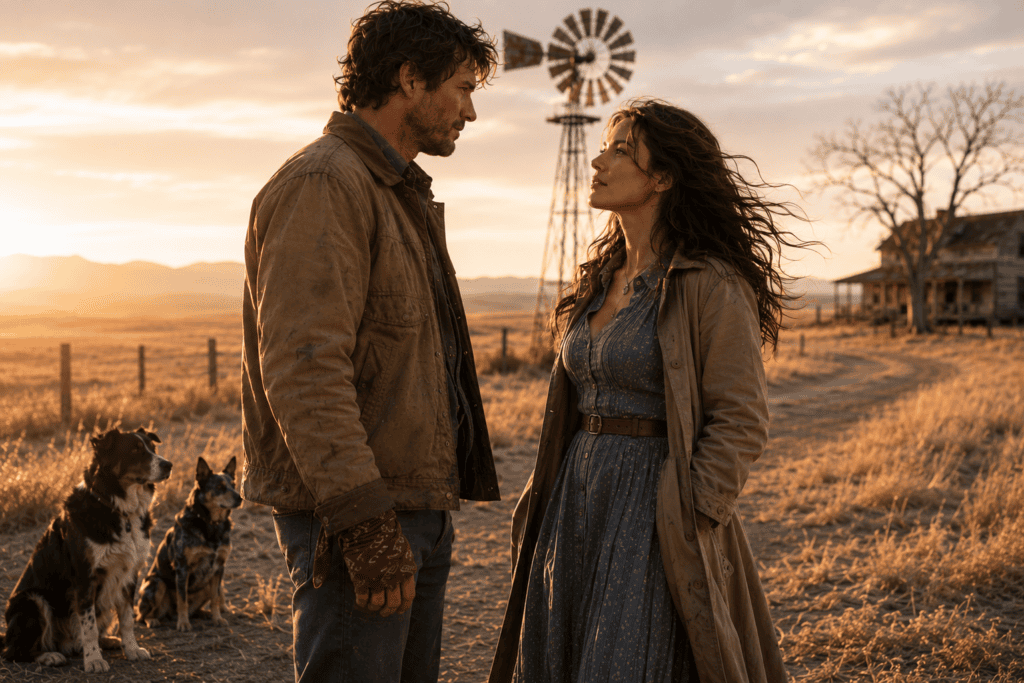
The wind had been at the mill most of the night, and by the gray hour when Cole Ostrander came out to the truck it had knocked the tail loose again, the wheel spinning free and useless against a sky the color of dishwater. He could hear it from the yard, that flat metallic clatter, the sound of something turning without purpose. He stood by the truck door a moment with his thermos under one arm, looking at it the way a man looks at a horse he already knows is lame, and then he got in and drove the two miles of two-track out to the Section Nine mill without hurrying, because hurrying never fixed a tail vane, and because the coffee was better drunk on the way than cold at the base of the tower.
Corrigan County lay flat and vast in every direction that morning, the grass gone the color of a manila envelope, the far buttes still holding a rind of blue shadow though the sun had cleared the horizon twenty minutes before. Frost lay in the wheel ruts. A jackrabbit broke from the borrow ditch and ran the fence line for a hundred yards before it found a gap and was gone. Cole drove with the window down two inches, the cold coming in thin and clean, carrying woodsmoke from somewhere he couldn’t place and the mineral smell of the creek two sections over, swollen with the last of the runoff.
He had run cattle and leased grass across eleven thousand acres of Bureau allotment for going on fourteen years now, since his father’s hands had gotten too stiff for fence work and stayed stiff until they stopped altogether, and in all that time the windmills had been the one part of the operation that never once let him down without warning first. A tail knocked loose, a sucker rod that had started to sing instead of pump — the mills told you before they failed you. He had come to trust that about them more than he trusted most things that walked on two legs.
At the base of the tower he set the thermos on the running board and stood looking up. Nine head of steers stood off a little ways at the empty tank, patient in the manner of cattle who had learned that a man arriving usually meant water arriving behind him. The tail vane hung askew, twisted nearly broadside to the wind instead of trailing true behind the wheel, and the whole apparatus creaked with each gust like a door somebody kept forgetting to latch.
He climbed. The rungs were iron pipe sunk through the angle-iron legs, and in the cold they took the warmth out of a bare hand inside four rungs, so he climbed with his canvas gloves on, one hand and then the other, counting without meaning to the way he always counted, not out of superstition exactly but because counting kept a man’s mind on the climb and off the sixty feet of nothing underneath him. At the platform he braced one boot against the crossbrace, took hold of the tail with both hands, and swung it back into the wind until the wheel caught and began, reluctantly, to turn true again, the whole tower groaning once and then settling into its old rhythm, blade and shadow, blade and shadow, water beginning its low complaint up through the pipe below.
From his vest pocket he took the loop of wire he kept there, a foot and a half of baling wire bent double and twisted at the fold into a grip, its far end worn smooth and slightly flattened where it had done its work a thousand times before. He worked it down into the gearbox oil cup, drew it back, held it to the light. The oil sat where it should. He had made the wire himself, years back, from a stretch cut off a bale in a hard winter when he’d been down to his last few dollars and unwilling to drive forty miles for a proper dipstick, and it had simply stayed in his pocket ever since, moved from vest to vest, jacket to jacket, the way certain small tools outlast the reasons a man first reached for them.
He came down the way he’d gone up, one hand and then the other, and stood a moment at the bottom with his palm still faintly stinging from the cold iron, watching the wheel turn, listening to the water start to fall into the tank in a bright unbroken rope. The steers moved in without hurry. He poured the last of his coffee into the enamel cup that rode the truck dash, drank it lukewarm, and did not look at the empty half of the front seat, which was a thing he had gotten good at not doing, the way a man gets good at not touching a bruise once he has learned exactly how much pressure it takes to make it hurt.
He ran six more mills that morning before the sun had cleared the second bank of cloud, the Section Twelve pump, the Dry Fork tank, the one out past the old homestead cellar hole that his father had always called the Widowmaker on account of a tower leg that had never sat quite plumb since a truck backed into it in nineteen-sixty-something, and at each one he went through the same motions in the same order — climb, true the tail if the wind had knocked it loose, work the wire down into the cup, read the oil, climb down — because a man who kept the same order at six mills in a row had less room left over in his skull for anything the order wasn’t built to hold. The cattle at Dry Fork stood off from the tank until he’d finished and gone, the way cattle do around any machine still working out its own noise, and he sat in the truck cab afterward a minute longer than the work required, watching a hawk work the thermals along the rim of a coulee, not thinking about anything he could have named if pressed.
The house he drove back to sat at the end of a lane lined with dead cottonwoods his grandfather had planted and nobody had gotten around to cutting, and it had two bedrooms, only one of which had held a bed in three winters. Cole slept on a cot on the enclosed porch even when the thermometer nailed to the post read four degrees below what any sensible man would call sleeping weather, and if anyone had asked him why — nobody had, in three winters, because there was nobody left close enough to ask — he would not have had an answer that made it out of his mouth in a shape anyone could use. The bedroom door stayed shut. Behind it, a closet held four dresses on hangers and a windbreaker with a broken zipper that had never once, in the trying, gotten fixed. He did not go in there. He kept the porch cot instead, close enough to the kitchen to hear the propane furnace kick on, far enough from that closed door that its silence stayed a closed door’s silence and did not follow him into sleep.
Some mornings, before the mill run, he stood at the kitchen window with his coffee and watched the light come up over the buttes and thought of nothing in particular, which was its own kind of achievement, arrived at slowly, the way a field goes from stubble to bare dirt to green over a season nobody watches closely enough to catch happening. Other mornings a gust would take the storm door and slam it, and for one whole unguarded second before his mind caught up to the sound, he would turn toward the porch the way he used to turn when she came in from the clothesline with her arms full and the door too heavy for her hip to manage quietly, and then the second would pass, and the door would just be a door, banging in the wind the way doors do on a ranch with no one left to fix the latch.
There was a coat still on the hook by the mudroom door, canvas, cut small, the sleeves gone stiff with three winters of not being worn, and he had gotten so used to stepping around it on his way to his boots that his body had built the maneuver into muscle before his mind ever had to agree to it. Twice a year, when the mudroom got swept out, he took every other coat down off every other hook to get at the floor beneath them, and put every one of them back exactly where it had hung, including that one, and did not examine too closely why the sweeping never seemed to take him more than the ten minutes it had always taken, nor why he always managed to finish it before the coffee in the pot had gone entirely cold.
The calendar tacked to the inside of the pantry door still ran on a year two years gone, its months long since caught up and passed by, a feed company’s promotional photograph of a red barn under a sky too blue to be real curling a little at the corner where damp had gotten to it once. He had never taken it down. He told himself, on the rare occasion the thought surfaced at all, that a new calendar was an errand for town, and town was forty minutes each way, and there were mills to run.
He ate breakfast standing at the counter that morning, same as most mornings, eggs and the last of a loaf gone stiff enough to want toasting twice, and while the pan cooled he ran a thumb along the edge of the counter where a burn mark had scorched the laminate some years back, a scar he had never sanded down or covered, though he could no longer have said with any confidence which of them had left the pan too long in that particular spot, himself or her, and had stopped, some winter or other, trying to decide. Outside, frost still held to the shadowed side of the fence posts though the sun had been up an hour, and a magpie worked the yard’s edge with the brisk proprietary air of a bird that considered the place, by now, more its own than his.
Out the window he watched a company truck he did not recognize come up the county road at a clip too fast for the washboard ruts, throwing a rooster tail of dust fifteen feet into the pale sky, and something in him — not quite curiosity, not quite dread, something with the flat neutral weight of both — turned to watch it slow, and signal, unnecessarily, at the empty crossroads, and turn in toward his gate. — The truck was a white three-quarter-ton with a company decal on the door too dusty to read from where Cole stood, and it came to a stop in the yard at an angle that suggested its driver had not spent much time judging the give of gravel under new-model tires. The door opened before the engine had finished ticking down. A woman got out — forty or near it, dark hair cut short enough to not require the vanity of tending it, a canvas coat gone pale at the elbows, boots that had clearly walked more pavement than pasture in their working life — and she stood a moment with one hand still on the door frame, taking in the house, the dead cottonwoods, the two dogs coming off the porch stiff-legged and suspicious, in the particular unhurried way of someone cataloguing a place before deciding how to speak to the man standing in the middle of it.
“You’ll be Ostrander,” she said. Not quite a question. She had a folder under one arm, papers dog-eared at the corners, and she held out a hand that turned out, when he took it, to be rope-callused in a way that surprised him more than it should have.
“Depends some on what you’re selling.”
“Nothing you’d want.” A corner of her mouth moved, not quite a smile, filed away for later use. “Merritt Fallon. Contracted through Bridger Wind to run anemometer surveys on the allotment leases — yours and the Section Twelve permit both. Bureau’s already cleared access. I’m just the one who has to drive it and put the poles in.”
Cole looked past her at the truck bed, where a coil of guy-wire and three collapsed aluminum mast sections lay strapped down under a tarp gone brittle with age and sun. “Wind company,” he said, the way a man repeats a diagnosis he intends to argue with later.
“That’s the one.” She followed his look to the mast sections and did not apologize for them. “I know how the mills feel about the competition.”
“Mills don’t feel anything. They just turn.”
“So do the towers I’m here to measure for.” She said it mild, no edge on it, and something about the flatness of the answer — not defensive, not needing him to agree — caught him a half-second off guard, the way a stone in a boot catches you only once you’ve already taken the next three steps on it.
He walked her the section line on foot because the truck couldn’t make the low crossing where spring runoff had cut a gully through the two-track, water still running fast and brown six inches deep where a culvert had washed half out from under the road the winter before last and never gotten replaced. She stopped at the edge of it, boots planted, doing the particular still calculation of someone raised somewhere without moving water this close to a road.
“Ford’s not bad here,” Cole said. “Rocks are set. Just walk it like you’d walk ice — feet under you, not ahead of you.”
“I grew up in Nebraska,” she said. “Flattest state in the union. We didn’t get much practice at water that moved.”
“This one moves plenty.”
She went in anyway, boots and all, arms out a little for balance, and made it three-quarters of the way across before a rock rolled under her heel and put her down hard on one knee in eight inches of snowmelt, folder and papers scattering downstream in a sudden white flock before Cole had even finished the thought of reaching for her. He waded in without deciding to, got a fistful of her coat collar and hauled her upright while she swore in a low, thorough, entirely unpanicked way that suggested this was neither the first nor likely the last time the ground had done this to her, and then both of them stood knee-deep in creek water watching three separate pages of a wind survey sail off downstream toward the Bureau allotment like a slow, deliberate resignation.
“There goes February,” she said.
“You’ve got it memorized?”
“I’ve got it memorized.” She wrung out one sleeve, watching the last page turn a slow circle around a half-submerged rock and go under. “It’s the part of the job where I stand in a landowner’s kitchen and rebuild three weeks of readings from a legal pad and whatever’s still in the truck’s data logger, while he decides whether I look competent enough to trust with a key to his gate.”
“You look wet.”
“That’s not usually the deciding factor, but I’ll take it as a start.”
Something came up in Cole’s chest then that he didn’t immediately recognize, because it had been long enough since anything had provoked it — a short involuntary huff of air through the nose, not quite a laugh, more the ghost of one, startled loose before he’d given it permission. Merritt Fallon looked at him with the flat, assessing attention of someone filing away a data point that hadn’t been on the survey form, and did not comment on it, which he found, climbing out of the creek behind her with cold water working its way down into his boots, its own kind of mercy.
She waded the rest of the crossing on her own after that, refusing the hand he offered on principle, and stood dripping on the far bank surveying the damage to her boots with the resigned expression of a woman who had ruined a great many pairs of boots in service of jobs that did not, in the end, pay enough to justify it. A killdeer went up off the gravel bar downstream, crying its broken-wing complaint, wheeling low over the water before it settled again fifty yards on, and both of them watched it go without comment, the way two strangers will sometimes share a small piece of weather or wildlife as a kind of truce, an agreement to notice the same thing at the same moment before returning to whatever distance had stood between them a minute before.
They dried out standing by the truck tailgate, her coat spread over the hot hood, both dogs finally deciding the visitor’s smell was interesting enough to warrant closer investigation, and Cole found himself talking about the mill at Section Nine and the tail that kept coming loose in a north wind, some fault in the fantail bracket his father had welded twenty years back and never trusted to hold, and Merritt Fallon listened with the particular quality of someone who had spent a working life around machinery that told you what was wrong with it if you knew how to read the sound, and asked exactly two questions, both of them the right ones. By the time her coat had dried enough to wear, something had shifted in the yard that neither of them named out loud — nothing large, nothing that would have shown on any survey she carried, just the small, irreversible fact of two people who had stood knee-deep in the same cold water and come up the other side of it still talking. — She came back the following Tuesday to reset the anemometer mast at Section Twelve, and again the Tuesday after that to check the data logger, and by the third Tuesday neither of them pretended the visits were only about wind speed anymore, though neither said so plainly either. She took to arriving a little before noon, when Cole would be in from the morning’s mill run, and he took, without deciding to, to putting a second cup out on the counter before he heard her truck.
They talked around things the way two people do who have each buried something they are not yet willing to hand across a kitchen table. She told him about Nebraska in fragments — a father who had run four hundred head on land his own father cleared, a bank that came for it the autumn she turned twelve, a house that changed owners inside a single winter while she watched from a rented duplex two towns over and learned, young, the particular vertigo of watching a place that was supposed to be permanent get folded up and driven away in other people’s moving trucks. She did not say devastating. She said, stirring her coffee longer than the coffee required it, “We moved four times in two years after that. I got good at not unpacking the last box.” Cole heard what she wasn’t saying the way he heard a sucker rod starting to complain before it broke, and did not push further, because he understood exactly the shape of a door somebody keeps shut on purpose.
He, in turn, told her about the wire in his vest pocket — how his father had bent it from a bale strand in a lean winter, how it had ridden every coat he’d owned since, gearbox dipstick and tail-latch pry-bar and, once, memorably, the thing that had held a truck’s alternator belt together for eleven miles of bad road. He did not tell her about the closed bedroom door, or the cot on the porch in weather no sensible man slept out in, and she did not ask directly, though once, standing at the window with her coffee, she said, mild as weather, “Big house for one man and two dogs,” and let it sit there in the room without further comment, a stone dropped into water she was patient enough to let ripple out on its own time.
The motif deepened without either of them naming it as such. She asked him to teach her the wire trick on a mill out past the county line where a rancher three sections over had complained his gearbox oil was running low faster than it should, and Cole climbed first, showed her the grip, the fold, the particular half-inch of give a man needed to feel for before he trusted the reading, and then stood below with one boot braced on the ladder while she climbed it herself, slower than he had, testing each rung with a caution that read less like fear of height and more like fear of trusting iron she hadn’t tested herself. At the top she worked the wire down into the cup with a concentration that pulled her whole face still, drew it back, held it to what light there was, and something in her posture eased by a single degree when the reading came back exactly where he’d told her it should. She came down the ladder grinning in a way he hadn’t yet seen on her, and at the bottom she held the wire out to him, and for a moment neither of them took it back, both hands loosely on the same foot and a half of bent metal, the cold morning standing around them uncommented on.
“Your father made a good tool,” she said.
“Wasn’t trying to. Man just didn’t want to drive forty miles for a dipstick.”
“Some of the best tools start that way.” She let go of the wire first. “Accident of stubbornness.”
She climbed down ahead of him, and at the bottom stood a moment with her face tipped back toward the platform, watching the wheel she had helped set true turn its slow unhurried circles against a sky gone the pale, scoured blue that only comes after a hard frost, and said nothing further, though something in the line of her shoulders had loosened in a way Cole noted without remarking on, filing it away the same careful, wordless way she had been filing him.
There were evenings, three or four of them across that stretch of weeks, when her survey work ran past dark and she stayed for supper rather than drive the washboard road back to the motel in Absher with deer thick on the shoulders and her headlights the only light for eleven miles. Cole cooked the way he always had, plain and without apology — beans, cornbread, whatever the freezer offered up from a steer butchered the previous fall — and they ate at the same counter he ate breakfast at alone, and the silences between them stretched out comfortable in a way silence had not been in his kitchen in longer than he cared to measure. Once, drying a plate she’d washed, she asked him, not quite looking at him, “Who used to stand where I’m standing,” and he did not answer for the length of time it took the furnace to click on and off again, and then he said, “Nobody you need to worry over,” which was not a lie exactly, but was not, either, the kind of true that closed a door instead of just leaning on it.
She did not press further. But that night, driving back to Absher alone with the heater fighting the cold and doing poorly at it, Merritt Fallon understood with the particular clarity of a woman who has spent a life reading instruments that a silence like that one was not empty. It was full. It was simply full of something Cole Ostrander had decided, a long time back, that no living person was allowed to carry any portion of.
She thought of her own four moving boxes, the ones she still, at forty-one, packed loosely enough to unpack again in under an hour, and understood, not for the first time but more sharply than she had let herself feel it in years, that she recognized that particular fullness because she had built her own version of it, differently shaped but load-bearing all the same.
One Sunday, with no readings due and no reason to drive out at all beyond the reason neither of them had yet spoken aloud, she came anyway, and found Cole up to his elbows in the crawlspace under the porch, chasing a frozen pipe joint with a heat gun and a patience that had clearly outlasted the actual expectation of success. She lay down flat on the cold boards beside him without being asked, held the drop light where he pointed, and passed him tools by name before he’d finished asking for them, the two of them working shoulder to shoulder in a space too narrow for anything but the plainest kind of closeness, and when the joint finally gave and water knocked hard through the pipe both of them laughed, short and startled, the sound of it bouncing flat off the underside of the porch boards.
Afterward, sitting on the back steps with grease on both their hands and coffee gone lukewarm between them, she asked him what the wire in his vest pocket was actually for, though she had watched him use it a dozen times by then and knew the mechanics of it as well as he did. It was not the wire she was asking after.
“Checking the oil,” he said. “You’ve seen it do that.”
“I have.” She turned her own cup slowly between her palms, watching the steam that no longer rose from it. “I meant the other part. Why a man keeps carrying a thing his father made him, twenty years on, past the point it’s worn smooth.”
He was quiet long enough that she thought he might let the question pass the way he let most of them pass, folded shut and set aside. Instead he said, “Man dies, and there’s not much left over that fits in a pocket. This does.” He turned it over once in his own palm, the grease-dark loop catching what light the porch bulb gave off. “Rest of what he left me is too big to carry around. House. Land. Debt some years, if the grass came up short. This is the only piece of him small enough to keep on my person, so I keep it on my person.”
Merritt did not answer that with a question, sensing, correctly, that the door had opened as far as it meant to that particular evening, and instead reached over and closed her hand briefly around his where it held the wire, the grease from both their hands mingling, warm for exactly as long as the contact lasted and no longer, before he set the wire back in his vest pocket and neither of them mentioned the gesture again that night, though both of them, driving away later in their separate directions, carried it a good deal farther than the porch steps where it had happened. — The break came the way Cole had always privately suspected it would, not from cruelty but from the same fear that had put a cot on the porch three winters running — the fear, never once said aloud even to himself in so many words, that anything he let close enough to matter would eventually need something from him he would fail, on the day it counted most, to give.
The survey work was nearly finished by then, four weeks of readings logged and cross-checked, and Bridger Wind’s regional office had sent Merritt a preliminary map showing likely turbine placement across both allotments — six towers at minimum, the largest of them slated for the rise above Section Nine where Cole’s grandfather’s mill had stood for sixty years, its tail vane still catching wind the old slow way while the company’s proposed steel would catch it at a scale that made the mill’s whole patient machinery look like a child’s toy by comparison. She brought the map out to the ranch on a Tuesday meaning to talk it through plainly, because plain talk was the only kind she trusted with news that could not be softened by waiting.
Cole looked at the map spread on the kitchen counter for a long moment, one finger resting, without seeming to notice it, near the small marked circle where Section Nine sat.
“They’ll want that whole rise cleared,” he said. “Mill included.”
“They’ll want to talk lease terms. Nobody’s clearing anything without a signature.”
“Man doesn’t sign for a thing he’s already decided isn’t his to give away.” He said it flat, not raised, and something in the flatness carried more weight than shouting would have. “That mill’s stood there since before I could walk. Your company wants to stand something bigger on top of it because bigger turns a better profit. That’s the whole conversation, dressed up in survey talk.”
“That’s not fair, and you know it isn’t.” Merritt kept her voice level, though something tightened at the corner of her jaw. “I’ve spent four weeks out here doing the honest part of this job, and I’ll tell you plainly what I told you the day we met — I put the poles in. I don’t set the lease terms and I don’t clear ground. If you want to be angry at somebody, be angry at the company letterhead, not the woman who waded a creek for you in February.”
“Maybe I’m angry the letterhead found its way into my kitchen at all.”
The words landed harder than either of them, in the moment, quite anticipated, and Cole heard the shape of his own unfairness arrive a half-second behind the sentence itself, the way a man hears a rifle’s report only after the bullet has already gone where it was going. He did not take it back. Taking it back would have meant explaining what stood behind it, and standing behind the anger at a turbine map was easier, by a wide and cowardly margin, than standing in the doorway of what the anger was actually guarding.
Merritt folded the map along its creases without hurry, the particular controlled economy of someone who has been told, more than once in a life, that she asks for more than a room is willing to give, and has trained herself not to let the asking show on her face when the answer comes back closed. “All right,” she said. “I’ll finish the readings from the county road. Won’t need to trouble your kitchen for it.”
She did not slam the door. That was, somehow, worse than if she had. The storm door eased shut on its own weight, the way it always did, and Cole stood at the counter listening to her truck pull out of the yard at a pace that owed nothing to washboard caution, and did not go to the window to watch it go.
He worked the fence line alone the rest of that week in a cold that had turned genuinely mean, wind coming down off the buttes with nothing between it and the county line to slow it, and the dogs took to watching him from the porch rather than following, the way animals will sometimes hold back from a man carrying something they cannot name but can plainly smell on him regardless. He ate standing at the counter each night, same as always, and told himself the quiet suited him fine, the way he had told himself that for three winters running before Merritt Fallon’s truck had ever thrown dust up the county road, and found, to his private and unspoken irritation, that the telling did not sit as easily in his chest as it once had.
On the Thursday, checking the Section Nine mill by lantern light because the daylight had run out on him, his bare hand slipped on the frozen wire loop, missed its grip entirely, and opened a shallow cut along two knuckles that bled, thin and dark in the lantern light, onto the platform boards before he’d even registered the sting of it. He stood at sixty feet with his hand wrapped in a bandanna, the mill’s tail knocked loose again in the wind and no strength left in the cut hand to swing it true, and understood, standing there bleeding quietly into cloth in weather no sensible man worked alone in, exactly how much a silence could cost a body once there was no one left in the yard below to notice it had gone on too long.
He came down slower than he’d gone up, favoring the hand, and sat a long while in the cab of the truck with the engine running for the heat of it and the mill above him still turning crooked in the dark, tail unswung, wheel catching the wind at a bad angle that would wear the gearbox thin inside a season if it went on unfixed. He did not go back up that night. He drove home with the bandanna gone stiff and dark against his knuckles, and lay a long time on the porch cot listening to the furnace cycle on and off, and did not, for once, manage the trick of thinking about nothing in particular. — She came back on a Sunday, ten days later, driving the company truck up the washboard road at a pace that suggested she had decided the ruts could take whatever the tires gave them. Cole was at the Section Nine mill when he heard the engine, standing at the base of the tower with his bandaged hand still stiff in the cold, and he did not go down to meet the truck. He stood where he was and watched her park, get out, and walk the two-track toward him with the particular unhurried directness of someone who had spent the drive rehearsing nothing, because rehearsed words, she had decided somewhere around the county line, were not the kind that would do either of them any good here.
She stopped a few feet off, looking up at the tower rather than at him. “Tail’s crooked again.”
“Man’s hand isn’t what it was this week.”
She looked at the bandanna wrapped stiff and dark across his knuckles, and something crossed her face that she did not bother filing away this time, did not hold at the flat professional distance she’d been keeping since the kitchen. “You going to tell me what happened, or am I going to have to guess.”
“Wire slipped. Cold hand.” He turned the bandaged hand over once, an offering of fact rather than excuse. “Same story it always is, out here. Nothing dramatic in it.”
“I didn’t come to talk about your hand.” She said it plain, the way she said most things, but something underneath the plainness had gone unsteady in a manner he had not heard from her before, not once, not even standing knee-deep in February creek water. “I came because I drove eleven miles of bad road angry at myself for letting a fair fight about a turbine map turn into me driving off before I’d said the actual thing I came out here four weeks running to say, which is harder to say than any of it, and which I am going to say now, standing at the bottom of your grandfather’s mill, because I have gotten very good over a lot of years at packing a box loose enough to leave quick, and I am tired, Cole. I am tired of packing loose.”
The wind moved through the dead cottonwoods behind her, that same flat unhurried sound it always made, indifferent to what stood beneath it.
“I don’t need you to fix what’s behind that bedroom door,” she said, before he could answer, before he had, in truth, decided what answer he had in him to give. “I’ve got my own closed door, same as you. I’m not asking you to open yours today, or this year, or on any particular schedule at all. I’m asking whether there’s room, someday, for a person standing on the other side of it who isn’t going to knock it down, just — stand there. However long that takes.”
Cole looked at the wire loop lying where he’d dropped it on the platform boards above them, cold iron dulled with the same grease it had always worn, and thought, not in words exactly, of a hand smaller than his own that used to scrape frost off a window with the flat of a butter knife, laughing at how long the job took her, and of how long, exactly, a man could go on mistaking the guarding of a door for the honoring of what stood behind it.
“Climb up,” he said.
She looked at him, and at the tower, and did not ask why.
She climbed the way he’d taught her the first time, testing each rung before she trusted her full weight to it, and at the platform he held the tail steady with his good hand while she reached past him and took hold of it with both of hers, and together, her strength doing the work his bandaged grip couldn’t quite manage alone, they swung it back true into the wind, the whole tower groaning once the way it always did and then settling, the wheel catching, beginning again its old unhurried turning.
Below, on the platform’s underside, someone long dead had scratched a set of initials into the angle iron with a fencing tool, faint now under decades of grease and weather, and Merritt’s hand rested a moment near them without either of them remarking on whose they might have been. The wind came steady across the rise, carrying the smell of wet grass and diesel and, faint underneath it, the mineral cold of snowmelt still working its way down off the buttes toward the creek where a folder of survey pages had once sailed off downstream and neither of them, it turned out, had ever missed. Water started its low complaint up through the pipe below, and the two of them stood on the narrow platform sixty feet above the buttes with their four hands still loosely on the same cold iron, not moving to let go of it just yet, the wind working steady across the grass in every direction there was, carrying nothing that either of them needed, this particular morning, to name out loud.
Below them the steers had already begun moving in toward the tank, unhurried, patient, trusting the water to come the way it always had, the way it would keep coming now, turned true again by four hands instead of two, the wheel above them catching the light in long unbroken revolutions, blade and shadow, blade and shadow, water falling bright and constant into the trough where the cattle had already begun, without ceremony, to drink.