
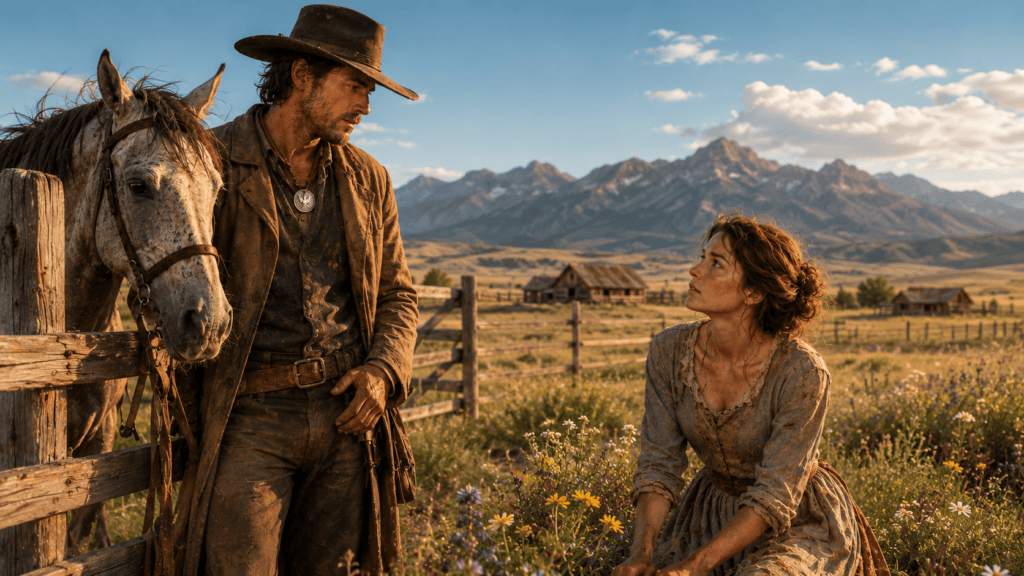
The first frost of the season had silvered the grass along the Judith River when Iris Calloway knelt in the dirt behind the smokehouse, working a splinter of stove wood loose from beneath her thumbnail with her teeth. Her breath fogged in the October air. Somewhere behind her, through the thin log wall, she could hear her aunt’s voice rising and falling like a saw blade catching wood.
“You’ll ruin the good tablecloth if you let her near it, Odessa. Mark me.”
“She won’t touch the tablecloth, Mother. She knows better.”
That was Prudence, the elder of her two cousins, her voice honeyed with the particular cruelty of someone who had never once had to earn a kindness. Iris pulled the splinter free at last, sucked the bead of blood from her thumb, and went back to scrubbing the cast-iron pot she’d carried out to the yard. The water in the basin had long since gone cold, and her knuckles had turned the color of raw meat, but she did not stop. Stopping only ever invited questions, and questions from Odessa Calloway were never kind.
She had been six years old when the fire took her parents’ cabin outside Fort Benton, and six when her father’s older brother, Thaddeus Calloway, rode two days to collect her, more out of duty than love, she understood now, fifteen years later. Thaddeus was not a cruel man, only a tired one, worn down by a wife who counted every mouthful of food that passed Iris’s lips and measured it against what her own daughters ate. Prudence and her younger sister, Delphine, had never once called Iris “cousin.” She was, in Odessa’s careful phrasing, “the girl we took in,” as though charity were a debt Iris owed and would spend her whole life repaying.
The Calloway homestead sat at the edge of the high plains, where the grass rolled gold and endless toward a horizon broken only by the blue teeth of the Rockies, far off and indifferent. It was, by any honest measure, a beautiful place — but Iris had learned long ago that beauty and kindness did not always share the same house.
She was still scrubbing when the dust came up on the road.
Two hundred miles to the west, in a valley the Blackfeet had once called the place where the river remembers, Caleb Ashwood had spent the better part of a week deciding he could no longer stand the sound of his own house.
It was not that Windrider Ranch was silent. Far from it — sixty horses in the north pasture alone, a bunkhouse full of hands who sang off-key after supper, the constant clatter of Grandmother Sakima’s kitchen. But there was a particular silence that lived inside Caleb himself, and no amount of noise from without had ever reached it.
His wife, Marguerite, had been dead three years that November. Consumption had taken her slowly, over eleven months, and Caleb had sat beside her bed every night until the end, memorizing the sound of her breathing because he knew he would need it later, when there was nothing left but memory. Still he woke some mornings reaching for her before he remembered.
His father had built Windrider from nothing — two hundred acres of scrub grass and a dream half the territory had called foolish, a Blackfoot man daring to run cattle and breed horses on land the government had not yet decided whether to let him keep. Now it was eleven thousand acres, the finest horseflesh between the Milk River and the Missouri, and cattle buyers who traveled from as far as Cheyenne to do business under the red-tailed hawk that gave the ranch its name. Caleb Ashwood, at thirty-four, was one of the wealthiest men in Montana Territory, and he had never felt so thoroughly and permanently alone.
It was Ben Ordway, his foreman, who had said the thing that finally cracked something loose in him.
“You’ve had four proposals of marriage brought to this house since the funeral,” Ben said one evening, boots up on the porch rail, whittling a stick down to nothing in particular. “Each one from a family that never sent so much as a casserole when Marguerite was dying. Strange thing, grief. Brings out the vultures same as it brings out the mourners.”
Caleb said nothing for a long while. Then: “I want to find someone before they know who I am.”
Ben only nodded, as if he’d been waiting for Caleb to arrive at that thought on his own.
So began the strange practice that had, over eighteen months, taken Caleb Ashwood across four counties under the name Silas Crane — a drifting horse trainer, saddle-worn and unremarkable, who hired on for meals and a bunk and left before anyone learned better. He told himself it was reconnaissance. In truth, it had become something closer to a pilgrimage — proof that kindness could still exist unpurchased. Twice he had found families who treated him decently as Silas Crane and turned oily and grasping the moment they learned his true name. He had ridden away from all of them with the same hollow feeling in his chest.
The Calloway place, he’d heard, had a marriageable daughter and a mountain of debt. It was, by the account of the cattle buyer who’d mentioned it to him in Fort Benton, exactly the kind of household eager to marry well. Caleb had almost decided not to bother.
He went anyway. He told himself later it was curiosity. He came to believe it was something closer to fate.
He arrived at the Calloway homestead an hour past noon, riding a rangy gray gelding chosen precisely because it looked unremarkable, wearing a coat gone soft and colorless from years of trail dust, his hat brim pulled low. He heard the shouting before he saw the house — Odessa Calloway’s voice, sharp as a slammed door, carrying clear across the yard.
“Look what you’ve done — you’ve tracked mud clean across the porch boards I just had Thaddeus scrub.”
Caleb reined in behind a stand of chokecherry brush and looked down into the yard.
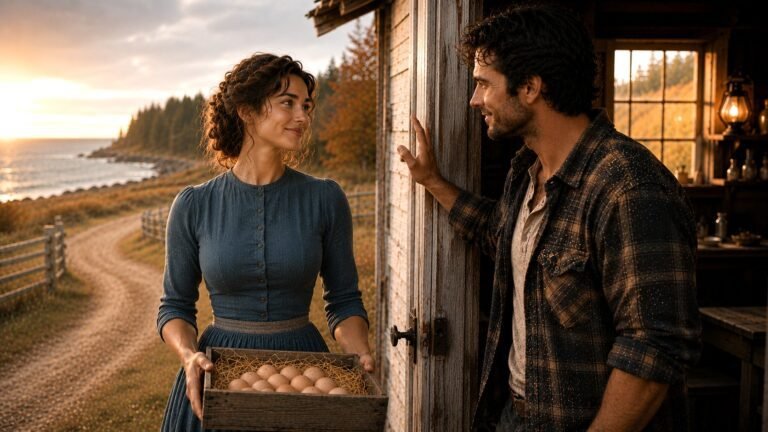
A young woman knelt on the porch steps, scrubbing at a smear of mud with a rag, her sleeves rolled to her elbows despite the cold, her hands raw and reddened. She wore a dress mended so many times the original pattern was barely visible beneath the patchwork, and her dark hair had come loose from its braid in wisps around a face that was, Caleb thought, quietly, startlingly lovely — not in the practiced way of women who knew it, but in the unconsidered way of someone who had never once been told so.
“I’m sorry, Aunt Odessa,” the young woman said. “I’ll have it clean directly.”
“See that you do. Your cousins are dressing for the harvest social, and I won’t have Judge Voss arrive at a house that looks like a pig yard.”
The young woman’s hands did not slow, but Caleb saw something pass behind her eyes — not quite fear, not quite resignation, but some tired cousin of both.
He waited until Odessa Calloway had swept back inside before he nudged the gelding forward and dismounted at the gate.
The young woman looked up at the sound of hooves, and for a moment — just a moment — her whole face changed, opened, the way a door opens onto a lit room. Then she seemed to remember herself, and the openness folded back into something more careful.
“Can I help you, mister?”
“Name’s Silas Crane, ma’am.” He pulled his hat off, held it against his chest the way he’d learned made him look smaller than he was. “I’ve been riding since Choteau, looking for honest work. A man at the mercantile said the Calloway place might need an extra hand before winter.”
“We’re not hiring.” The answer came too fast, rehearsed, the way a person speaks when they’ve had to say it a hundred times before and mean it less each time.
“I don’t need wages,” Caleb said. “Just a place in the barn and enough food to earn it. I’m good with horses. Better than most.”
Something shifted in her face at that — a flicker of real interest, quickly suppressed. “You’d have to ask my uncle. He’s the one who decides.” She hesitated, glancing toward the house, and then added, low, as though it cost her something to offer even this much kindness to a stranger: “Our gelding, Ranger — he’s gone lame in the off fore, and none of the hands can puzzle out why. If you know horses the way you say—”
“Iris.” Odessa’s voice cracked across the yard like a rifle shot. “Who is that man?”
“Looking for work, Aunt Odessa.” Iris — Caleb turned the name over in his mind, liked the plainness of it, the way it suited her better than anything ornamental could have. “Says he knows horses.”
Odessa Calloway appeared on the porch in a blue dress far too fine for a homestead kitchen, her eyes moving over Caleb the way a buyer’s eyes move over cattle — quick, assessing, already calculating cost against usefulness.
“We can’t pay a hand,” she said flatly.
“I don’t need paying, ma’am. Board and meals will do.”
Odessa’s mouth twitched, some private arithmetic resolving itself behind her eyes. Free labor, her expression said, plain as print. “Thaddeus!” she called back into the house. “Come see to this.”
Thaddeus Calloway emerged a moment later, a heavyset man with tired eyes and the stooped shoulders of someone who had spent thirty years absorbing his wife’s disappointments without ever once setting any of them down. He looked Caleb over with more weariness than suspicion.
“You know horses?”
“All my life, sir.”
“Cattle?”
“Some.”
Thaddeus glanced toward the barn, toward whatever unspoken trouble lived out there, and something like hope crossed his tired face. “Ranger’s gone lame and the vet in Choteau wants four dollars just to look at him. You fix that horse, you’ve got a bunk till first snow.”
“I’ll fix him.”
“Iris will show you where things are kept.” Thaddeus turned back toward the house without another word, already retreating into whatever private weather governed his days.
Iris led Caleb toward the barn in silence, her stride shorter than he’d expected, and slightly uneven — favoring one hip, he noticed, the way a person walks when they’ve spent years carrying burdens too heavy for their frame.
“You’ll want to know,” she said finally, not looking at him, “that this isn’t an easy house to work in. My aunt will find fault with whatever you do, however well you do it. It isn’t personal. It’s simply how she is.” A pause. “I only tell you so you won’t take it to heart.”
Caleb studied her face — the careful, guarded kindness of someone who had learned to offer warnings instead of comfort, because warnings were the only gift she had ever been permitted to give.
“That’s a generous thing to tell a stranger,” he said quietly.
Iris’s cheeks colored, faint as a sunset. “My grandmother used to say a soul reveals itself fastest in how it treats those who can do it no good.” She pushed the barn door open, and the smell of hay and horse and old leather rolled out to meet them. “I try to remember that.”
Inside, Ranger stood in the last stall, a rangy sorrel gelding favoring his right foreleg, ribs showing faintly beneath a dull coat. Caleb ran his hands down the horse’s leg with the sure, unhurried touch of a man who had spent his life reading horses the way other men read newspapers, and found the trouble within minutes — a stone bruise gone half-septic beneath the frog of the hoof, easily missed by anyone who didn’t know to look.
“He’ll mend,” Caleb said. “Needs the hoof packed and kept dry a week, maybe less.”
Iris exhaled — relief, plain and unguarded, the first wholly unguarded thing he’d seen from her. “He was my grandmother’s horse, before. He’s the only thing left of her that I have.”
“Then I’ll see he’s well looked after.”
She looked at him then, really looked, and something passed between them that had no name yet, only weight — the particular gravity of two people recognizing, without being able to say why, that they had each been more alone than they let anyone see.
The harvest social was held that Saturday in the grange hall outside Big Sandy, and Caleb — still Silas Crane in the eyes of the household — was set to work hauling firewood while Prudence and Delphine dressed upstairs in borrowed silk and Odessa fussed over ribbons.
Iris was given no such attention. She was handed a basket of pies to carry and told, in the same breath, not to embarrass the family by lingering near the dance.
Caleb watched her from across the yard as she loaded the wagon, her plain wool dress a gray shadow beside her cousins’ bright silks, and felt something in his chest twist tight with a feeling he did not immediately recognize as anger, because he had so rarely had occasion to feel it on someone else’s behalf.
“You’re staring, Mr. Crane,” Iris said without looking up.
“Apologies.”
“Don’t apologize. Just don’t stare. It draws attention I’d rather not have.” She hoisted the last basket into the wagon bed, and for a moment her composure slipped. “I used to like the harvest socials. When my grandmother was alive, she’d let me dance every set, didn’t care what anyone thought.” She smoothed her skirt with hands gone rough from years of laundry water. “Now I mostly just carry the pies.”
“You could dance tonight.”
“With who?” A short, humorless laugh. “The hired men don’t dare, for fear of my aunt. And the eligible sons of the county have all been informed that Prudence and Delphine are the Calloway daughters worth courting.” She climbed up onto the wagon seat beside her uncle, and the wagon rolled off down the frost-hardened road, leaving him standing in the yard with a strange new ache lodged beneath his ribs.
He arrived at the grange hall an hour later on foot, and stood at the edge of the lantern light where the hired hands gathered, watching Iris work the refreshment table alone while her cousins spun in the arms of eager young men beneath paper lanterns strung from the rafters. The fiddle music was bright and quick, and the smell of cider and woodsmoke and crushed prairie grass hung thick in the cold night air, and Caleb Ashwood — who had danced with senators’ daughters in Helena and turned down a supper invitation from the territorial governor’s own niece — found himself wanting, more than he had wanted anything in three long years, to walk across that hall and ask a poor relation in a mended dress for the next set.
He was still working up the courage when Judge Abner Voss arrived.
The room’s temperature seemed to drop the moment Voss stepped through the door — a broad, florid man of nearly sixty, silver-haired, in a black frock coat that had never seen honest dirt, a gold watch chain across his belly, a heavy silver-topped cane in one gloved hand. His pale, assessing eyes swept the room and landed, with unmistakable purpose, on Iris.
“Miss Calloway,” he said, crossing to the refreshment table with the unhurried confidence of a man accustomed to getting what he wanted. “You look lovely this evening.”
Iris’s expression did not change, but Caleb, watching closely, saw her hands go very still around the cider ladle. “Thank you, Judge Voss.”
“I trust your aunt informed you I’d be paying a call on your family soon.”
“She mentioned it.”
“Good. Good.” Voss’s pale eyes traveled over her with the same appraising slowness Odessa had used the day Caleb arrived, and something in Caleb’s chest went cold and sharp as river ice. “I do enjoy a woman who knows how to hold her tongue. My second wife talked entirely too much. God rest her.”
Iris said nothing. Voss smiled, satisfied, and moved off toward the dance floor to pay his respects to Odessa, leaving Iris standing at the table with her jaw tight and her eyes fixed somewhere far beyond the paper lanterns.
Caleb crossed the room before he’d fully decided to.
“You’re pale,” he said quietly, coming to stand beside the table.
“I’m fine, Mr. Crane.” But her voice shook, just slightly, on the last word.
“You don’t have to be fine in front of me.”
She looked at him then, and something in her composure finally, briefly cracked — not tears, not yet, but the raw edge just beneath them. “He’s asked my uncle for permission to court me,” she said, so quietly he had to lean close to hear it over the fiddle music. “Twice now. My aunt says I ought to be grateful a man of his standing would even look my direction.” A short, bitter breath. “I would rather scrub floors till my hands bled than spend one evening in that man’s company, let alone a lifetime.”
“Then don’t.”
“You say that as though I have a choice.” Her eyes met his, dark and fierce and frightened all at once. “I have no money, Mr. Crane, no family who’d take me if the Calloways cast me out, no way to earn a living that wouldn’t see me starve within a season. Choice is a luxury for people who have somewhere else to go.”
Caleb wanted, more than he had wanted anything in a long time, to tell her the truth — to say, I have somewhere else for you to go, I have eleven thousand acres and a name that would close Abner Voss’s mouth in an instant. But he held it, because some old, hard-won instinct told him the moment was not yet right, that trust built too fast collapsed as easily as it rose.
“Then I hope,” he said instead, “that you find one.”
She studied his face for a long moment, as though trying to read something written there in a language she didn’t quite speak, and then, unexpectedly, she smiled — small, tired, but real. “You’re a strange sort of hired hand, Mr. Crane.”
“So I’ve been told.”
The frost thickened over the following weeks into the first true cold of winter, and Caleb settled into the rhythm of Calloway life with a patience that surprised even him. He mended fence, broke a pair of green colts Thaddeus had been too discouraged to attempt, and each evening found some small excuse to be near the barn when Iris came to check on Ranger, whose lameness had cleared exactly as promised.
They talked, in those evenings, in the unhurried way of two people who have run out of reasons to hide from each other but have not yet found the courage to say so outright. She told him about her grandmother — a Métis woman named Colette who had married into the Calloway family and died when Iris was twelve, the last relative who had ever made the house feel like more than a place to survive. He told her, in careful half-truths, about a ranch out west, about horses he loved better than most people, about a wife he’d lost to consumption — that much, at least, was true, and he watched something in Iris’s face soften with a grief that recognized its own reflection.
“I’m sorry,” she said, the first time he mentioned Marguerite. “That kind of loss — it doesn’t heal so much as it teaches you to carry it differently.”
“That’s exactly it,” he said, startled that she’d found the words he’d spent three years failing to find himself.
“My mother used to say grief is just love with nowhere left to go.” Iris ran her hand along Ranger’s neck, and the old horse leaned into her touch, eyes half-closed. “I think about that a great deal.”
It was on one such evening, the sky gone the deep indigo of early November dusk, that Caleb found her sitting alone on an overturned feed bucket outside the barn, hugging her knees against the cold, tears standing unshed in her eyes.
“What’s happened?”
“Nothing.” She wiped at her face with the back of one raw hand. “Everything. It doesn’t matter.”
“It matters to me.”
She looked up at him, surprised by the plainness of it, and something in her seemed to give way. “My aunt has set a date,” she said. “For Judge Voss. Three weeks from Sunday. She informed me at supper, as though telling me what to wear to church.” Her voice cracked. “Nobody asked me. Nobody has ever once asked me what I wanted, in fifteen years in that house, and I don’t suppose anybody ever will.”
Caleb sat down on the ground beside the bucket, close enough that their shoulders nearly touched, and for a long while he said nothing at all, only let her cry, quiet and exhausted, into the cold evening air.
“I have wanted, my whole life,” she said finally, “only to be somewhere I was chosen. Not needed — anyone can be needed, a good milk cow is needed. Chosen. Wanted for no better reason than being myself.” She laughed, short and humorless. “It’s a foolish thing to want.”
“It isn’t foolish.” Caleb’s voice was low, rough with something he hadn’t let himself feel in three years. “It’s the only thing worth wanting.”
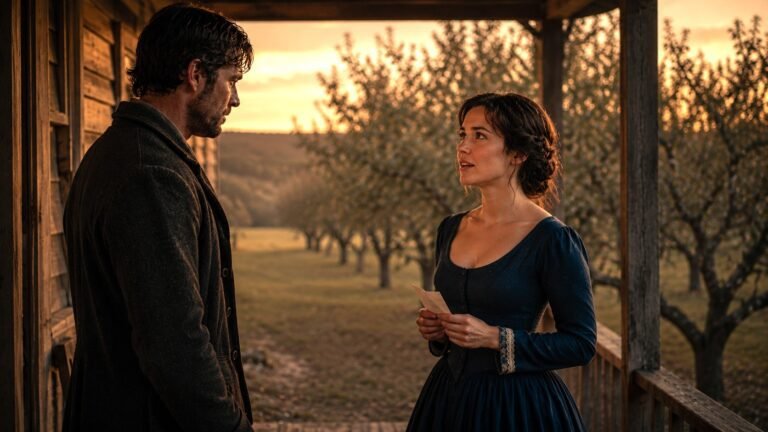
She looked at him for a long moment in the fading light, and he understood, with sudden clarity, that the moment he had been circling for weeks had finally arrived — that if he did not tell her the truth now, in this quiet, unguarded dusk, he would lose forever the chance to be known by her honestly.
He reached beneath his collar and drew out a leather cord, at the end of which hung a small silver medallion worked with the image of a red-tailed hawk in flight.
“My name isn’t Silas Crane,” he said.
Iris went very still.
“It’s Caleb Ashwood. I own Windrider Ranch, two hundred miles west of here, near the Two Medicine River. Eleven thousand acres, more horses than I can rightly count, and more money than any one man ought to have.” He turned the medallion slowly in his fingers, watching the last light catch its edges. “I came here under a false name because I wanted to know if a person could still love me for something other than what I own. I’ve been asking that question for eighteen months, in four different counties, and you are the first person who has ever made me believe the answer might be yes.”
For a long, terrible moment, Iris said nothing at all. Then, quietly: “You lied to me.”
“I did.” He did not look away from her. “I’m sorry for it. But I am not sorry for what I learned.”
“You let me tell you — everything. My grandmother. My mother. Things I have never said aloud to another living soul.” Her voice trembled, caught somewhere between anger and something rawer. “And all the while you were—”
“Testing nothing about you,” he said quickly. “I was testing myself. Whether I could still tell the difference between a kindness given and a kindness bought. You never once knew there was money at stake. That’s the whole of it, Iris. That’s the only thing I was ever measuring.”
She stood abruptly, putting distance between them, her arms wrapped tight around herself. “I don’t know what to do with this.”
“You don’t have to do anything with it tonight.”
“Judge Voss will be my husband in three weeks.” The words came out flat, exhausted. “That is what I have to do something with.”
“Not if you don’t choose it.”
“You keep saying that as though choosing were simple.” She turned back to face him, and in the last gray light he could see hope and fear locked in a struggle neither seemed likely to win. “What are you asking of me, Mr. Ashwood?”
The formality of his true name in her mouth landed strangely, like a coat that didn’t yet fit.
“I’m asking you to come see the ranch,” he said. “Not as my wife. Not as anything but my guest, for as long as you need, until you know your own mind. I’m asking you to have somewhere else to go, so that whatever you decide about Judge Voss, you decide it as a free woman and not a cornered one.”
Iris was quiet for a long moment, the wind moving through the cottonwoods overhead, carrying with it the first hard bite of the coming winter.
“I need time,” she said finally.
“You’ll have it.”
She did not have as much as either of them had hoped.
Three days later, Odessa Calloway discovered the truth — not from Iris, but from a traveling cattle buyer who mentioned, in passing conversation with Thaddeus, that he’d heard Caleb Ashwood of Windrider Ranch was somewhere in the county, traveling incognito, looking for a bride.
Iris was in the kitchen kneading bread when her aunt appeared in the doorway, her face white with something between fury and fear.
“Is it true?” Odessa demanded. “The hired man — is he truly the Ashwood rancher?”
Iris’s hands went still in the dough. She had not yet decided how to answer such a question, had not expected to have to answer it at all before she’d had time to settle her own heart. “Yes,” she said finally. “It’s true.”
Odessa’s expression cycled through shock, calculation, and something that might have passed, in a kinder woman, for delight. “Then the wedding to Judge Voss is off,” she said briskly, already turning toward the door. “I’ll write to him myself this evening. A rancher of Ashwood’s standing is worth ten of that pompous old judge—”
“Aunt Odessa.” Iris’s voice, quiet as it was, stopped her aunt at the threshold. “Nothing has been decided. Mr. Ashwood has asked nothing of me beyond a visit to his ranch, as his guest.”
“Don’t be a fool, girl. A man like that doesn’t offer a poor relation a place under his roof without meaning something by it.” Odessa’s eyes had taken on the same bright, hungry look Iris had seen in Judge Voss’s face at the harvest social, and something cold settled in her stomach at the recognition. “You’ll go, of course. And you’ll conduct yourself in a manner that reflects well on this family, is that understood? No more scrubbing floors like a hired girl. We’ll need to see about a proper dress—”
“I said nothing has been decided.”
But Odessa was already gone, already calling for Prudence and Delphine, already reweaving the family’s fortunes around a windfall she had done nothing to earn, and Iris stood alone in the kitchen with flour on her hands and a hollow, familiar ache spreading through her chest — the bitter recognition that her worth in this house had just been recalculated in an instant, not because of who she was, but because of what she might now be worth to someone else.
She found Caleb in the barn an hour later, currying Ranger with slow, absent strokes, his brow furrowed with some private trouble of his own.
“They know,” she said.
“I heard the cattle buyer talking in the yard. I’m sorry, Iris. I’d hoped to tell them myself, when the time was right.”
“It doesn’t matter how they learned. What matters is what happened after.” Her voice was tight with an anger that had been building for fifteen years and had finally found, in this moment, somewhere honest to go. “My aunt is already planning which dress I’ll wear to your ranch. As though I’ve become valuable overnight. As though I wasn’t the same woman yesterday who wasn’t worth a kind word at her own supper table.”
Caleb set down the curry comb and turned to face her fully. “You were always worth more than that house ever gave you.”
“Then why does it only matter now?” Her eyes were bright with unshed tears, fierce and furious. “I have spent fifteen years being told, in a hundred small ways, that I was a burden, a charity case, a girl who ought to be grateful for scraps. And in one afternoon, because of your name, I have become precious.” She laughed, a raw, broken sound. “Do you understand what that does to a person? To learn that your worth was never about you at all — that it was always, only, about what you might be traded for?”
“I understand it better than you might think.” Caleb’s voice was quiet, but there was iron beneath it. “I have spent three years since Marguerite died watching families press their daughters toward me like merchandise at auction. I know exactly what it is to feel that no one sees past what you own.” He stepped closer, close enough that she could see the genuine anguish in his face. “That is why I came here as Silas Crane. That is why I never once let your aunt or your uncle know who I was. Because I wanted — I needed — to find one person in this territory who would treat me the same whether I was a wealthy rancher or a penniless drifter. And I found her, Iris. I found her scrubbing porch steps in a mended dress, offering warnings to a stranger she owed nothing at all.”
Iris was crying now, openly, the tears cutting clean tracks through the flour still dusted on her cheeks. “I don’t know how to trust it,” she whispered. “I don’t know how to trust that any of this is real and not simply another version of being traded.”
“Then don’t trust it yet.” Caleb reached out slowly, giving her every chance to step away, and when she didn’t, he took her hand in both of his, rough palm against rough palm. “Come to Windrider not as anything but yourself. No promises, no expectations. If, after a season, you find it’s nothing you want, I’ll see you safely wherever you wish to go, and never trouble you again. But I would rather you choose it with your whole heart, someplace far from everyone here who has ever measured your worth in dollars.”
For a long moment, Iris said nothing, only stood in the lantern light with her hand in his, the old mare’s warm breath fogging the cold barn air, the whole of her future balanced on the single fragile fact of whether she believed him.
“All right,” she said finally. “I’ll come.”
The wedding to Judge Voss was to have taken place on a Sunday in late November, and it was on the Thursday before that Voss himself arrived at the Calloway homestead unannounced, having heard, as everyone in three counties now seemed to have heard, that the Ashwood rancher had laid some claim to the girl he considered already his.
He arrived at dusk in a black carriage with two hired men riding behind, his face flushed with drink and fury, and Iris, who was in the barn helping Caleb load the last of her belongings into a wagon bound for Windrider, heard the shouting before she saw him.
“Where is she?” Voss’s voice carried across the yard, thick with rage. “I made an arrangement with this family, and I intend to see it honored.”
Caleb’s hand found Iris’s shoulder, steady and sure. “Stay here.”
“No.” She met his eyes, and something in her had changed in the three days since she’d agreed to leave — some old fear had burned away, leaving behind a hard, clean resolve. “I won’t hide from him. Not anymore.”
They walked out into the yard together, and Iris felt, for the first time in her life, the strange new weight of standing beside someone rather than behind them.
Judge Voss’s pale eyes moved from Iris to Caleb and narrowed with recognition and contempt. “So it’s true. The hired man and the Ashwood rancher are one and the same.” He struck the ground once with his cane. “Clever trick, sir. But it changes nothing. This family owes me a debt, and the girl was pledged in payment of it.”
“I owe you no debt,” Iris said, her voice steadier than she’d believed it could be. “Whatever arrangement my aunt and uncle made, they made it without my consent, and no promise made over my head binds the person whose head it was made over.”
Voss’s face darkened. “You’re a foolish girl if you think—”
“She is not a girl,” Caleb said, stepping forward, his voice carrying the quiet, unhurried authority of a man who had spent his whole life being underestimated and had long ago stopped minding it. “She is a grown woman, and she has told you plainly that she does not consent to this arrangement. I’d advise you to hear her.”
“And who are you to advise me anything? A half-breed rancher playing dress-up as a drifter—”
“A half-breed rancher,” Caleb said evenly, “who could buy every acre you own three times over and never notice the expense. But that isn’t why you’ll leave here tonight without her, Judge. You’ll leave because the law you claim to represent has never once given you the right to purchase a person, whatever debts her family owes you. I’d think a judge, of all men, might know that.”
For a long moment, Voss stood in the yard, his face working through fury and calculation, the two hired men behind him shifting uneasily, unwilling to press a confrontation with a man of Ashwood’s evident standing.
“This isn’t finished,” Voss said, his voice tight with humiliation.
“It is,” Caleb said. “It was finished the moment she said no.”
Voss turned without another word, climbed back into his carriage, and rode off into the deepening dusk, and Odessa Calloway, who had stood frozen on the porch through the entire exchange, watched him go with an expression that seemed to Iris, for the first time in fifteen years, almost like grief — though whether for the lost arrangement or for a niece she had never once troubled to know, Iris could not say, and found, standing there in the cold yard with Caleb’s hand steady in hers, that she no longer much cared to guess.
Windrider Ranch, when Iris first saw it rising out of the November dusk two days later, took her breath away in a manner she did not entirely know how to name.
It was not the size of the place, though it was vast — corrals stretching toward a horizon gone rose-gold with sunset, sixty horses grazing in loose herds, smoke curling from a dozen chimneys. It was the ease of it. Ranch hands — Blackfeet and Métis and white settlers alike — moved through their evening chores with the familiarity of people who trusted one another, who had no cause to measure their worth against a neighbor’s. No one here seemed to be waiting for someone else to fail.
An elderly woman with silver-streaked braids and eyes that missed nothing came out to meet the wagon before it had fully stopped, wrapping Iris in a wool blanket before she had even climbed down.
“So this is the one,” the woman said, studying Iris with a warmth that made her throat tighten unexpectedly. “I’m Sakima. I’ve kept this house since before Caleb could walk. Come — you’re half frozen, and there’s stew on the stove that won’t eat itself.”
“Thank you,” Iris managed, startled by the plainness of the kindness, the complete absence of any calculation behind it.
“Don’t thank me yet, child. Wait till you’ve tasted my biscuits. Then you’ll have something worth thanking me for.”
Inside, the house was warm and unhurried in a way the Calloway homestead had never once been — a fire crackling in a wide stone hearth, bread cooling on the sill, laughter drifting from some back room where two ranch hands argued good-naturedly over a game of cards. It was not grand. It was, Iris realized with an ache that caught her entirely by surprise, simply a home, the first she had known since her grandmother died.
She slept that night in a room with a real feather bed and a window that looked out over the dark shapes of the corrals, and for the first time in longer than she could remember, she slept the whole night through without waking once to some remembered slight or half-formed fear.
The weeks that followed unspooled slowly, the way healing does — not in a single dramatic turn but in a hundred small, accumulating moments. Iris learned the names of every horse in the north pasture. She helped Sakima in the kitchen not because she was made to, but because she wanted to. She laughed — really laughed, unguarded and often — for the first time in years, and each time she caught herself doing it, she felt a small, private wonder at the sound of her own joy.
Caleb gave her, true to his word, nothing but time. He did not press her, did not court her in any of the ways she had half-braced herself for. He simply was there — steady, present in the particular way of a man who had already decided he would rather have her freely chosen affection in ten years than her uncertain gratitude tomorrow.
It was Sakima, in the end, who said the thing that finally settled something loose in Iris’s chest.
“You keep waiting for the trick,” the old woman said one evening, the two of them shelling dried beans by lamplight while Caleb worked late in the barn. “I’ve watched you do it for a month now. Waiting for someone to reveal the price of all this kindness.”
“I’ve learned to look for the price,” Iris said quietly. “It’s kept me safe more than once.”
“I don’t doubt it.” Sakima’s weathered hands did not slow. “But safety and living aren’t the same thing, child. A person can spend her whole life guarding against being hurt that she never once lets herself be happy.” She glanced up, her dark eyes kind but unflinching. “That boy loved his wife something fierce, and when she died I watched him fold in on himself like a flower closing against frost. I have not seen him unfold again until you came into this house. Whatever you decide, decide it because it’s true for you.”
Iris sat with that a long while after Sakima had gone to bed, the fire burning low, and found, when she finally examined her own heart honestly, that the fear she had been carrying was not a fear of being hurt by Caleb Ashwood. It was a fear of discovering that she was, after everything, allowed to be happy — that there might be no hidden cost, no debt quietly accruing behind the kindness, only the plain and dizzying truth that she had, at last, found somewhere she was wanted for nothing more complicated than herself.
She found him in the barn an hour later, working by lantern light on a bridle that did not, she suspected, actually need mending.
“I’ve been afraid,” she said, without preamble, “of believing this was real.”
Caleb set down the bridle and turned to face her, giving her, as he always did, the space to say what she needed without hurrying her toward it.
“And now?” he asked.
“Now I think I’ve spent so long guarding myself against being used that I nearly missed the chance to be loved.” Her voice caught, but she pressed on. “I don’t want to guard myself against you anymore, Caleb. I’m tired of measuring kindness for hidden costs. I would like, for the first time in my life, simply to trust that I am wanted.”
“You are,” he said, closing the distance between them slowly, watching her face for any sign of hesitation and finding none. “You have been since the first morning I saw you on those porch steps, scrubbing mud from boards that weren’t even yours, offering a stranger a warning kindness he’d done nothing to deserve.” He reached into his coat and drew out a small silver ring, unadorned, nothing like the jewels Judge Voss might have offered. “I don’t want you to marry me because I gave you somewhere else to go. I want you to marry me only if this is the life you’d choose, freely, with nothing owed and nothing measured.”
Iris looked at the ring, and then at him, and felt, for the first time in her life, the extraordinary lightness of a choice made entirely for her own sake.
“I choose it,” she said. “I choose you. Not because you rescued me — but because you’re the first person who ever waited long enough to let me choose at all.”
They were married the following spring beneath the same cottonwoods where Iris had first watched the horses graze, the whole ranch gathered in golden afternoon light — no borrowed silks, no calculated guest lists, only wildflowers gathered that morning, a fiddle played slightly out of tune, and people who had come because they wanted to, not because anyone’s fortune demanded it.
Odessa Calloway sent a letter that spring, stiff with apology poorly disguised as congratulation, and Iris read it once, folded it carefully, and set it aside without bitterness, having found, to her own quiet surprise, that she no longer needed her aunt’s regret to feel whole.
Years later, when their daughter was old enough to ask how her parents had met, Iris would tell her, with a smile that never entirely lost its wonder, about a drifting horse trainer who had ridden into a hard winter asking for nothing but a bunk and a meal — and how she had very nearly turned him away.
“And I almost rode past that homestead without stopping at all,” Caleb would add, as though the memory still astonished him as much as the day it happened.
“But you didn’t,” Iris would say.
“No,” he’d answer, taking her hand the way he had that first cold night beside the barn, rough palm to rough palm, two people who had each spent too many years believing themselves unchosen. “And I have thanked whatever kindness governs this world every day since.”
Because in the end, that was the whole of what either of them had ever wanted — not wealth, not rescue, not even love exactly, though they had found that too. Only to be seen, plainly and without calculation, by one person willing to wait long enough to look.