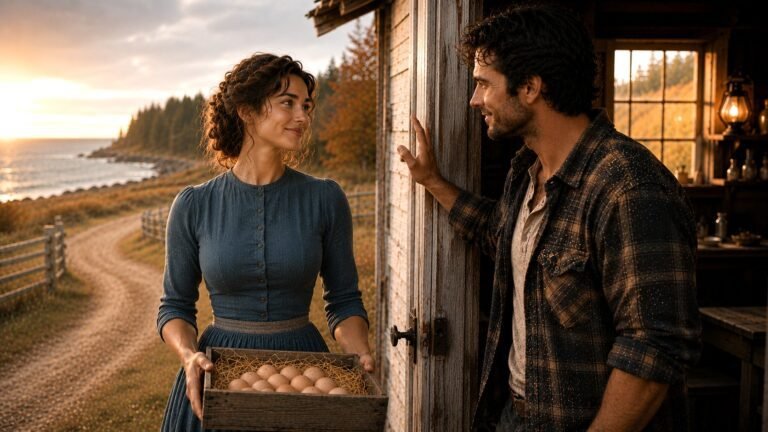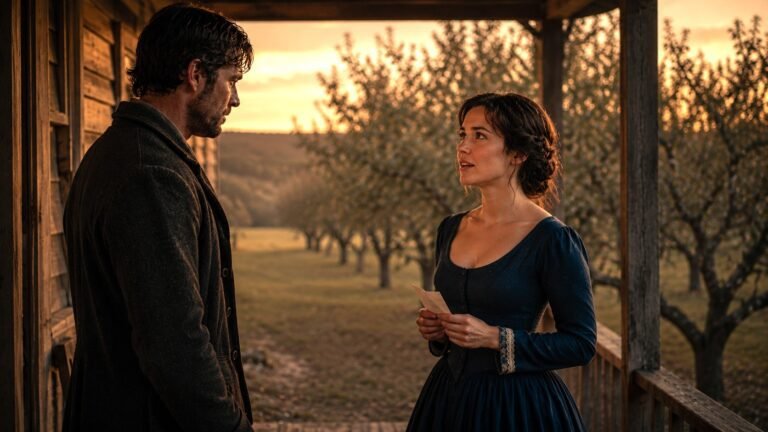

The fjord did not simply hold its silence. It kept it, the way a held breath is kept—tight in the chest, waiting for a reason to let go. In the winter of 1921, three years after the guns in Europe had finally stopped and the influenza had finished what the guns began, the villages along Norway’s northern coast learned to live inside that held breath. Ingrid Solberg stood on the wooden pier at Kirkevik with a single leather case at her feet and understood, with the particular clarity that only complete ruin can provide, that she had already lost everything a person could lose without dying of it.
Her father’s boat, the Solveig, had gone down in October with two other men and every debt the family had ever owed still unpaid. The bank in Tromsø had taken the house before the ice had fully formed on the fjord. The schoolroom where she had taught nineteen children their letters for six years had been given, without apology, to the new pastor’s unmarried sister, because a parish would not pay a woman with no father and no husband to shape the minds of its children. There was a logic to this that Ingrid had turned over in her mind for weeks and had never once found the seam in. She only knew that it had left her standing on a pier in December with her whole life inside one case, watching the steamer that had brought her north pull back out into the gray water, its wake closing over itself like a wound healing shut.
“You’ll want Voss,” the harbormaster said, not unkindly, following her gaze to the far end of the dock. “If you’ve nowhere.”
She turned. A man stood apart from the fishermen and the wool-wrapped wives, the way a stone stands apart from a riverbed—not because it wants to, but because the current has simply never managed to move it. He wore sealskin over layers of wool gone soft and gray with age and use, and a coat that had been patched so many times the original cloth was only a memory beneath the mending. His beard was black going to iron at the jaw, and even at this distance, across thirty feet of frozen planking, Ingrid could see that his eyes did not move the way other men’s eyes moved—darting, assessing, retreating. They simply rested on her, steady as a held lantern.
“They call him the Hollow Man,” the harbormaster went on, lowering his voice as though the wind might carry the words up the fjord to him. “Comes down from the high country twice a year, trades furs and dried fish for salt and lamp oil, never says more than the trade requires. Folk say he lives in a hole dug into the mountain like a bear. Say he’s touched—not right, since the war, though he never went to it. Say a lot of things.” He shrugged, a gesture that carried the particular weight of a man passing on a burden he does not fully believe but cannot afford to dismiss. “But he’s never once cheated a soul, and he’s the only man in this parish with no wife to answer to and no family to object. Pastor Krogh has already spoken to him. He’ll take you, if you’re willing.”
If you’re willing. As though willingness were still a country Ingrid had a passport to enter.
She looked down at her boots, thin-soled things bought for a schoolteacher’s salary and a schoolteacher’s sidewalks, entirely unsuited to snow. Then she looked up at the black wall of mountains rising behind the village, disappearing into a sky the color of a fresh bruise, and she understood that whatever waited up there, it could not be worse than what waited if she stayed. The parish poorhouse. The slow erosion of a woman with no protector, ground down by a hundred small refusals until there was nothing left to refuse.
She walked the length of the pier toward him. Up close, the cold coming off him was different from the cold of the wind—it was the stillness of a man who had made peace with cold as a permanent condition rather than a season to be endured. His eyes, she saw now, were a deep gray-green, the color of the fjord water in the half-light before dawn, and they held no cruelty in them at all. Only a kind of exhausted watchfulness, like a sentry who has stood his post so long he has forgotten what he is guarding against.
“Anders Voss,” he said, and his voice surprised her—low, unhurried, with none of the roughness she had braced for. “The pastor says you’ve need of a husband and I’ve need of hands that can keep a ledger straighter than mine. It isn’t much of a bargain to offer a woman.”
“I’ve had worse offered to me this month,” Ingrid said, “by men who meant far less honestly.”
Something moved behind his eyes then—not quite a smile, but its ancestor. “The climb is hard,” he said. “Harder than anything you’ve walked. But you’ll be fed, and you’ll be safe, and no one up where I live will tell you what a woman is or isn’t permitted to do with her hands or her mind.”
She thought of the schoolroom, of nineteen children’s faces, of the pastor’s sister sitting now in her chair. She thought of her father’s boat, unrecoverable, somewhere under gray water. “Then I accept,” she said, and was faintly astonished at how steady her own voice came out.
The ceremony took four minutes in the pastor’s cold front room, witnessed by a clerk and the pastor’s wife, who cried a little for reasons Ingrid did not ask after. There was no ring to speak of—Anders produced a thin band of hammered iron that fit her finger only because her hands had gone numb enough to shrink inside her gloves—and no supper afterward, only the practical matter of Anders lifting her case onto his own shoulder as though it weighed nothing at all, and turning not toward the cluster of lamplit houses that made up the village proper, but toward the black treeline at the mountain’s foot.
“The path’s narrow past the tree line,” he said. “Walk in my tracks. Don’t look back at the village lights—it only makes the leaving harder.”
Ingrid looked back once anyway, because she was human and not made of the stone the villagers seemed to think he was carved from, and she watched the last window-glow of Kirkevik shrink and vanish behind a shoulder of rock, and something in her chest folded closed like a hand making a fist.
The forest that swallowed them was unlike any wood she had known in the lowlands. The pines here grew ancient and close, their lower branches long since starved of light and gone to gray skeleton wood, so that walking beneath them felt like walking through the ribs of something enormous and long dead. The air smelled of resin and cold stone and, beneath that, something mineral and clean that she would later learn to recognize as the breath of the high snowfields. For a long while the only sound in the world was the crunch of Anders’s boots breaking trail and the smaller, more uncertain sound of her own following after.
He stopped often—not from tiredness, she came to understand, but to listen. He would go still in the middle of a stride, head tilted a few degrees, and hold that stillness for the space of ten or fifteen heartbeats before moving on, as though the mountain spoke to him in a register too low for her ears and he was simply waiting his turn to answer.
“What are you listening for?” she finally asked, when her curiosity outgrew her caution.
“Everything,” he said. “Wind changing means snow. Silence where there should be birds means something’s moved through that shouldn’t have. A mountain that goes quiet all at once is a mountain about to do something.” He glanced back at her, and there was no condescension in it, only the plain offering of information one traveler gives another. “The men who die up here are the ones who stopped listening because they were certain they already knew what the mountain would do.”
Near dusk he knelt beside a thread of half-frozen water, broke the skin of ice with the heel of his hand, and filled a small tin cup he produced from inside his coat. “Drink,” he said, holding it out to her. “The high air steals more from a body than a person feels stealing. You’ll be parched and not know it till you’re weak.”
The water was so cold it ached going down, and beneath the cold there was a taste of stone and moss that she found, unexpectedly, almost sweet. As she drank, her fingers brushed his—his skin rough and scarred and startlingly warm despite the temperature, the hands of a man who had spent years asking his body to do more than most bodies were asked to do. She watched him over the rim of the cup, watched the way his eyes lifted to the darkening ridgeline with something that was not fear and was not quite reverence either, but held elements of both.
He isn’t struggling here, she thought, with the particular shock of an assumption dying quietly. He belongs to this place the way I have never belonged to any place in my life.
They did not reach shelter before the storm found them. It came the way mountain storms come—not gradually, but as a decision the sky made all at once, wind wheeling around a shoulder of rock and driving snow sideways so hard it felt less like weather and more like an assault. Ingrid’s world narrowed to the gray blur three feet in front of her face and the sound of her own blood in her ears.
She did not see the drop until her boot found nothing beneath it.
The world tipped. Then a hand closed around her wrist with a grip like an iron fitting, and she was hauled back and sideways into the lee of an outcropping, close enough against Anders’s chest that she could feel his heart going hard and fast beneath the sealskin—the first evidence she’d had that anything in him moved faster than deliberate.
“I have you,” he said, close to her ear, the words nearly lost in the wind. “I have you. Breathe.”
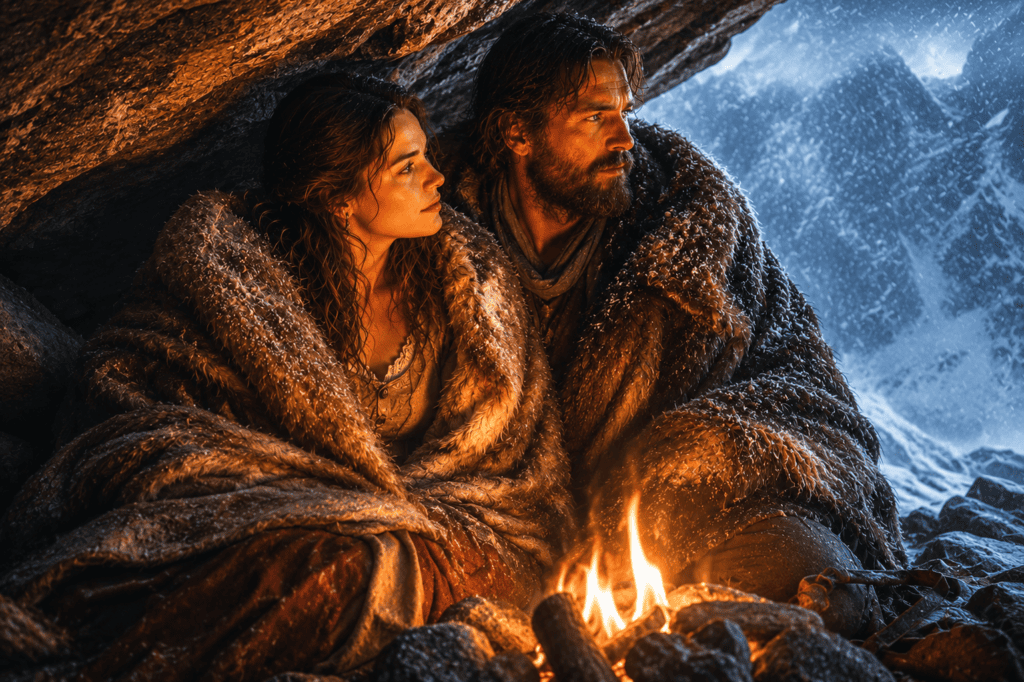
He worked quickly after that, wedging them both into a shallow hollow beneath an overhang of black rock, unwinding a heavy buffalo-hide wrap from beneath his pack and pulling it around both their shoulders. “Body heat,” he said, matter-of-fact, as though explaining a point of arithmetic. “That’s what keeps us through the night. There’s no shame in it and no meaning beyond what it is.”
She wanted to believe that was entirely true. She was not certain, hours later, huddled against the solid warmth of him with the storm screaming past a foot from her face, that it entirely was.
In the dark, to keep her mind from the cold, he talked—not about himself, at first, but about the sky. He named stars she couldn’t see through the cloud, described the shape they’d take when the weather broke, spoke of directions and distances with an ease and precision that did not belong to a man who had, by every account in the village, only ever been a trapper. His voice carried the cadence of education, of rooms with books in them, of a mind that had once been trained to precision and had never entirely forgotten the training.
“You weren’t always this,” Ingrid said quietly, into the dark, into the animal warmth of the hide. It wasn’t quite a question.
For a long moment he said nothing, and she thought perhaps she’d overstepped, reached for a door he had no intention of opening to a stranger he’d known for the length of a single terrible day. Then: “No,” he said. “I wasn’t.”
He didn’t elaborate, and she didn’t push. But something had cracked open a hair’s width, and she felt it, the way one feels a draft from beneath a door long believed sealed.
When the wind finally eased toward dawn, exhaustion pulled her down into a shallow, shivering sleep, and in shifting against him, something slid loose from an inner pocket of his coat and came to rest against her palm.
It was gold, and it was cold, and even in the gray predawn light she could see the fine hinge-work of it. A locket. She should not have opened it—she knew that, even half-asleep, even frozen through—but her fingers moved before her judgment caught them, and the small clasp gave, and inside: a miniature portrait, painted with real skill, of a woman in a high-collared dress of a cut that belonged to a city, not a mountain. And on the facing panel, not a portrait at all, but an etched architectural drawing—the elevation of a building, tall and precise, with columns and glass and a level of draftsman’s exactness that spoke of years of formal training.
Anders’s hand closed over hers before she’d fully absorbed what she was looking at, gentle but final, folding the locket shut inside both their palms.
“That life is finished,” he said, and his voice had gone rough in a way it had not been before.
“You’re not what they say of you in Kirkevik,” Ingrid said. It was not an accusation. It was closer, she realized as she said it, to an apology.
He didn’t answer that. But he didn’t take his hand away either, and they sat like that, her palm and his closed around the small gold weight of whatever he had lost, until the storm finally spent itself and gray light began to climb the eastern peaks.
The world it revealed was white and merciless and beautiful, and Anders led her up through it for another two hours before he stopped at what looked, to Ingrid’s exhausted eyes, like nothing more than another indifferent cliff face.
“Here,” he said, and began pulling aside a screen of frost-heavy dwarf birch she would never have suspected concealed anything at all. Beneath it: steps. Cut into the living rock, worn smooth in their centers by years—by decades, she would later learn—of a single man’s boots.
“Come,” he said, and for the first time since the pier at Kirkevik, there was something in his voice that might have been called eagerness. “It’s time you understood why I brought you up instead of leaving you to freeze at the tree line, which would have been considerably less trouble for both of us.”
The steps climbed through a fissure in the rock so narrow her shoulders brushed both walls, and then, abruptly, opened.
Ingrid stopped walking. She simply stopped, because her legs had, for a moment, forgotten their purpose.
Below her lay a valley that should not have existed—could not, by any law of the world she knew, exist—cupped inside a ring of peaks that blocked the wind entirely, so that the air here hung still and astonishingly mild. Steam rose in slow white columns from pools of water so clear she could see the stones at their bottom from where she stood. Moss grew green and thick along the banks. Somewhere below, water moved with a sound like conversation.
“The rock bends the wind around instead of through,” Anders said, coming to stand beside her, his voice quiet now, almost reverent in a way she had not heard from him. “There are hot springs beneath—the whole floor of this valley sits over them. They warm the ground, warm the pools, warm the air enough that frost can’t take hold except at the very edges. My father’s father found it, hunting. It’s been in no man’s mouth but mine since he died.”
And there, rising from the valley floor near the largest of the steaming pools, stood a house.
It was not a cabin. Ingrid’s mind tried, for a moment, to fit it into that word, because cabin was the word the village had used, and cabin was what a poor man’s home should be, and the failure of the word to apply was itself a kind of vertigo. What stood before her was built of dark timber and pale quarried stone, with tall panels of glass—true glass, carried up a mountain by hand, she would learn, pane by careful pane—catching the thin morning light and throwing it back gold. Wide eaves swept out from the roofline to shed snow before it could gather. The whole structure sat against the rock as though it had grown there by agreement rather than been imposed upon it.
“You built this,” she said. It was not a question either, but it needed saying aloud, needed to be given the weight of spoken language before she could let herself fully believe it.
“One stone, one pane, one winter at a time,” Anders said. “Over eleven years.”
He opened the heavy door, and warm air rolled out to meet them—not the acrid warmth of a badly vented hearth, but something clean, steady, drawn up, he explained, through channels cut beneath the floor from the spring heat itself. Inside: slate floors polished smooth by years of bare feet and wool socks. Cedar shelving climbing to a ceiling higher than any room she’d stood in since Christiania, the shelves themselves crowded with books—not ledgers, not almanacs, but real books, worn-spined volumes on botany, on astronomy, on structural engineering, on languages she didn’t recognize. A long table dominated one end of the room, buried beneath rolled drafting paper and drawing instruments and a half-finished elevation drawing not unlike the one she’d glimpsed inside the locket.
“This is where I work,” Anders said, “when the storms trap me here, or when the noise of what I used to be gets too loud to carry quietly.”
Ingrid moved through the room slowly, fingers trailing the spines of the books, feeling every inch the intruder in someone else’s carefully guarded dream. They ate that first evening on dried fish and roots and water drawn warm and running from a stone basin fed, Anders explained, by gravity alone from a spring higher on the slope. That night she slept in an actual bed, beneath actual wool blankets, in a room of her own with a window that looked out over steam rising silver in moonlight, and for the first time since the telegram about her father’s boat had arrived, she slept the whole night through without waking once into fear.
Winter closed over the Wind-shadowed valley—for that was what Anders called it, in the old tongue, a word Ingrid learned to say correctly only after several attempts that made him laugh, once, a rusty, unpracticed sound that seemed to surprise him as much as it surprised her. Storm after storm sealed the high passes. Below, in Kirkevik and the scattered farms along the fjord, she knew—because Anders told her, grimly, on one of his rare trips down for salt and lamp oil—that hunger was setting into the poorer houses the way it always did by February. Up here, the valley breathed on, warm and undisturbed, as though the mountain itself had drawn a curtain around them.
Ingrid found her place inside that breathing slowly, the way a hand finds the exact shape of a tool it has never held before but was somehow always meant to hold. She learned to read the water channels that fed the glasshouse beds Anders had built into the southern slope of the valley, where he grew winter greens in soil kept unfrozen by piped spring heat—an idea, he admitted, he’d first sketched on paper in Christiania for a client who’d thought it too strange to build. She learned which of the valley’s plants eased a headache and which would stop a heart, information he delivered with the same unhurried precision he gave to everything, watching her repeat each identification back to him until she had it exactly right.
In turn, she brought her schoolteacher’s discipline to his chaos of papers—sorting eleven years of drawings and journals into some order, transcribing his notes in her clean, careful hand where his own scrawl had grown illegible with cold-stiffened fingers. He watched her do this work in the evenings with an expression she came to recognize, over the slow accumulation of weeks, as something closer to wonder than gratitude.
It was on one such evening, snow stacking silent and thick against the tall windows, firelight moving across the rows of books, that she finally asked the question that had been sitting, patient and unspoken, between them since the storm on the mountain.
“Who were you,” she said, “before you were the Hollow Man of Kirkevik?”
He was quiet long enough that she thought he might simply let the fire answer for him. Then he rose, crossed to a drawer in the long table, and set the gold locket on the wood between them, its clasp still closed.
“My name is still Anders Voss,” he said. “That much was never a lie. I was an engineer in Christiania—houses, bridges, once a concert hall that was still standing, last I heard, though I couldn’t say if it still is. I had money. I had standing. I had a wife, Marte, who used to say I loved iron beams more than I loved people, and she wasn’t entirely wrong, until the influenza came through the city in the autumn of ‘eighteen and took her in eleven days, and took our daughter four days after that, and left me standing in a house full of drawings for buildings that no longer meant a single thing to me.”
Ingrid did not reach for the locket. She reached, instead, for his hand, and found it cold despite the fire, and held it.
“I came north because I could not stay in a city where every street corner remembered her,” Anders said. “I meant to disappear for a season. It became eleven years. The mountain doesn’t let a man forget what he’s carrying—it only teaches him how to carry it without it breaking him in half. I built this place with my hands because my hands were the only part of me still willing to believe in anything.” He looked at her then, and the guardedness that had sat behind his eyes since the pier at Kirkevik had, for this one unshielded moment, entirely gone. “I did not bring you here to replace what I lost, Ingrid. I want you to know that plainly. I don’t know yet what I brought you here for. Only that leaving you at that tree line to freeze felt like a thing I would not have survived myself.”
“You didn’t run from your grief,” Ingrid said quietly. “You built somewhere for it to live that wasn’t inside you every waking hour. That isn’t cowardice. Half the men I ever knew back east only knew how to drink theirs away or shout it onto whoever stood nearest.”
“You’re the first person in eleven years I’ve said any of this to.”
“Then I’ll try to be worth the saying,” she said, and meant it more fully than she had meant almost anything in her life.
Spring, when it finally climbed the mountain, arrived the way spring arrives to places that have earned it slowly—not in a single thaw but in a hundred small permissions. Snowmelt sang down the rock in threads that thickened daily into streams. Green pushed up through soil that had been white for so long its color felt like a rumor. The valley, already warmer than the world beyond its rim, filled with a riot of new growth that made Ingrid, walking its paths in the thin gold light, think of resurrection in the plainest possible sense.
She and Anders began work that season on a new wing of the house—her idea first, sketched crudely on the back of a ledger page one evening, refined under his patient correction until it became something structurally sound. Tall windows facing east, to catch first light. A room meant for nothing but books and the reading of them. He built it as he built everything, with a craftsman’s unhurried exactness, and she watched something in him straighten and lighten with every course of stone they raised together, as though the labor itself were a kind of forgiveness he was finally permitting himself to receive.
Word climbed the mountain, as word does, in fragments and rumor. Hunters spoke of steam rising from impossible heights above the tree line. A trapper swore he’d glimpsed green where no green belonged in a Wyoming—no, a Norwegian—winter, and been laughed out of the tavern for the telling. No one ever found the path. The mountain, as it had for eleven years, kept its own counsel.
One clear morning in June, Ingrid climbed alone to the ridge above the house and stood looking out over a country of endless white peaks running to the horizon in every direction, and thought of the woman who had stood on the Kirkevik pier with one case and no future, believing herself bound in marriage to the poorest, strangest man in the parish. She found, standing there, that she wanted to laugh—not unkindly, but with the particular tenderness one feels for a version of oneself who could not yet see what was coming.
Anders found her there a while later, his boots quiet on the stone, and slid his hand into hers without a word, the gesture by now as natural between them as breathing.
“They still think we vanished,” Ingrid said. “Down in Kirkevik. The Hollow Man and the schoolteacher who married a ghost.”
“Let them think it,” Anders said. “We didn’t vanish. We simply stopped needing the world that couldn’t see us.”
Years afterward—when the war that had shaped their generation’s grief had receded into memory and their own valley had seen a decade more of winters folded gently into springs—the house still stood, warm-lit against the dark peaks, its glasshouse beds still green through every frost, its shelves grown fuller with drawings and journals and, eventually, a child’s small handprints pressed in wet clay beside her father’s careful blueprints. It stood as a plain testament to a truth neither Ingrid nor Anders had set out looking for on that gray December pier: that the rarest treasure a person could find in the coldest country was not gold, and was not shelter alone, but another soul willing to be fully seen—ragged coat, hollow name, and all—and to stay.