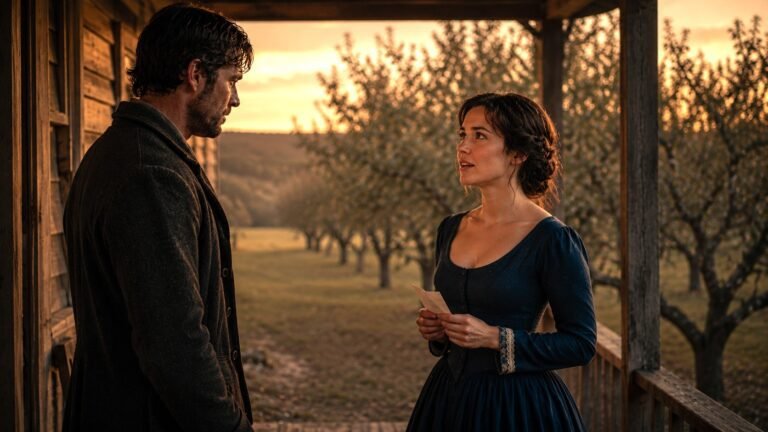

The coffee maker on the counter had a crack in its handle that Wyatt Emory had been meaning to replace since spring, and every morning his thumb found the crack anyway, out of habit, the way a tongue finds a broken tooth. He drank his coffee standing at the kitchen window, looking out at a yard gone to seed at the edges, and at the north side of the house where the siding still waited under blue tarp for a hand that had not come back to finish it.
The house had been half a marriage once. Now it was half a house — studs bare on that north wall, insulation showing pink through gaps like something under a bandage that had slipped. He stepped over the third porch step every morning without looking down, a give in the board he’d noticed in March and never fixed, because fixing his own step had never once made its way to the top of a list that always had somebody else’s name at the top instead.
The list lived on the refrigerator, held by a magnet shaped like a trout. Loretta Combs, garbage disposal. The Petrenko boy, bike chain. Retired judge two streets over, storm door hinge. Names accumulated there the way other men’s lives accumulated golf scores or grandchildren, and Wyatt kept the list not because he needed reminding — he never forgot a job, not once, not in eleven years of contracting before the company folded and took his good name down with it — but because the list was proof of something he did not examine too closely: that he was still, on any given Tuesday, worth walking across a yard for.
He had built houses once, whole ones, start to close-out, and had been good at it in the particular way a man is good at something he loves without being able to say why he loves it. He liked the moment a frame stood up bare against the sky, ribs of a thing not yet a home. He liked walking a finished house at the end and running a level along a sill and finding it true. He had built the house he lived in now with his own two hands, on weekends, over four years, meaning it to be the last house he ever built, the one that did not have somebody else’s name on the contract.
Then the company that carried his crew went under on a bad loan that had nothing to do with him and everything to do with him, the way these things worked, and the north wall of his own house had gone up in April and stalled there, tarp flapping, and Renata had watched it flap for one whole summer before she said, in a voice that was not cruel, only tired past the point where kindness could hold a marriage up by itself, that she could not live inside a thing that never got finished. She had not been talking only about the house. He had understood that even then, standing in the kitchen with a level in his hand and nothing level left to check.
She left in September. He had kept fixing things ever since — other people’s things, mostly, because a man who fixed things was a man who had a reason to be somewhere, a man whose knock at a door got answered with relief instead of the particular blankness that comes when nobody is quite sure why you’ve come. He had learned, without deciding to learn it, that being needed was a kind of currency, the only one he seemed to have left that spent reliably, and he had learned also, in the two years since, never to let a job run long enough that somebody stopped needing him before he was ready to be finished.
His own step stayed broken. He noticed this the way a man notices an old scar, not with pain exactly, just a low familiar accounting each time his boot found the give in the board and steadied itself before it fell. Fixing it would have taken twenty minutes and a length of two-by-six he already owned, cut and stacked in the garage for a job that never seemed to be the one he got to.
The house next door had stood empty eight months before the moving truck came in March, a woman alone directing two movers with a clipboard and a voice pitched for exactness, not warmth. Wyatt had watched from his kitchen window without meaning to watch, the way a man watches weather move in over a field he has some stake in. She had three deadbolts installed within the first week — he knew because he’d seen the locksmith’s van, watched the man work the door from the porch with his own coffee going cold in hand, and had thought, not unkindly, that a woman did not put three deadbolts on a door for burglars in a town where nobody locked up much at all.
She kept to herself in a way that read less like shyness than like architecture, a wall built with the same care Wyatt had once put into framing, load-bearing, meant to hold something up. She did not wave first. She waved back, eventually, if he waved first, a small economical motion, hand barely lifting off the strap of her bag, and then she’d be gone up her own walk and inside her own door, and Wyatt would hear, faint across the yard, the particular sound of a deadbolt turning three separate times.
He told himself he did not think about her more than he thought about any of the names on his refrigerator list. He told himself this on a Thursday in October, coffee gone cold in his hand, watching a wind come up out of the west that smelled like rain not yet arrived, and stepped over the broken porch board on his way out to the truck without looking down, the way he always did, the way that had stopped, some time back, feeling like a thing he was choosing.
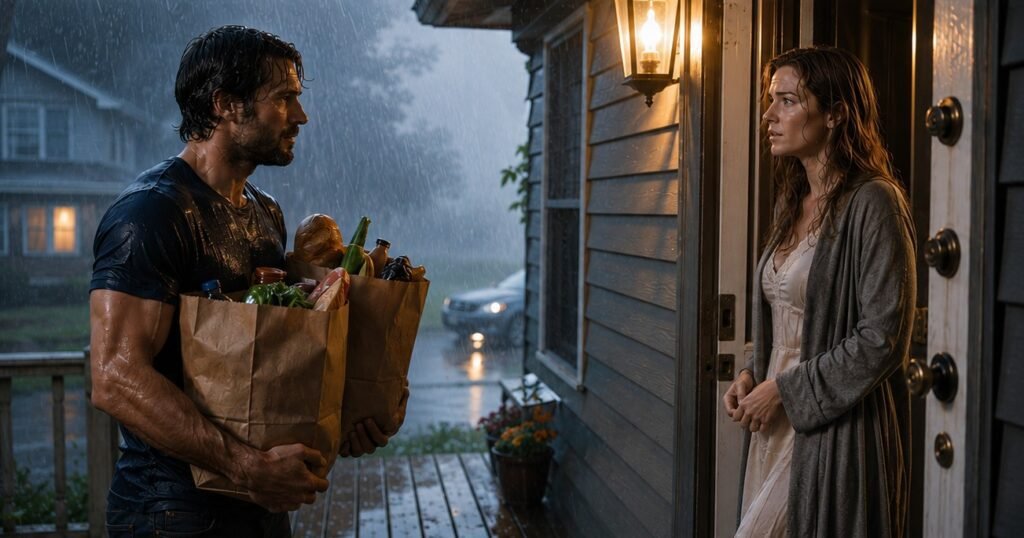
The rain came in sideways just after five, the kind of autumn storm that arrived without much warning and meant business once it got there, and Wyatt was coming back from the hardware store with lumber strapped in the truck bed when he saw her car in the driveway next door, trunk open, and her standing in it with four grocery bags already gathered against her chest and a fifth she was trying to hook with two fingers, rain flattening her hair to her forehead, a bag of oranges starting to give at the bottom seam.
He was out of the truck before he’d decided to be. “Let me get that.”
“Don’t need it.” She said it fast, reflexive, the words out before his hand had even reached the trunk, and he stopped where he was, rain running cold down the back of his collar, and watched her shift the weight in her arms to keep the failing bag from splitting entirely.
“Bag’s about to go,” he said. “Not offering to carry your groceries because you look like you can’t. Offering because standing here watching a stranger drop oranges in the rain seems like a poor way to spend an evening.”
Something in that — the plainness of it, maybe, or the absence of anything she’d need to be grateful for beyond the next ninety seconds — loosened her enough that she nodded, once, and let him take the two heaviest bags off the top of the stack without further argument. They went up her walk together in the downpour, her a half step ahead, him watching where he put his boots on ground he did not know, and reached the porch just as the bottom of the orange bag surrendered entirely and sent three oranges rolling for the steps.
He caught one out of the air without thinking about it, an old catcher’s reflex from some Little League decade back, and the absurdity of it — a grown man diving sideways on a stranger’s porch to save produce — startled a laugh out of her before she seemed to have decided to allow it, quick and unguarded, gone almost as fast as it came, but real enough that he heard it land somewhere in his chest and stay there.
“Good hands,” she said, and there was something almost embarrassed in how she said it, like the laugh had cost her more than she meant to spend.
“Eleven years of drywall,” he said. “Learn to catch things before they hit the floor, or you spend a lot of time on your knees with a putty knife.” That got another sound out of her, not quite a laugh this time, something smaller, but it changed the shape of her face for a second, softened the line of her mouth, and he set the bags down on the porch boards and straightened, rain still coming, and did not reach for the door.
That was the part he would think about later — that he had not reached for the door, had not assumed the small errand entitled him to the next ten feet of her life, and he saw her notice the not-reaching, saw something in her shoulders come down half an inch, though she did not say anything about it, only bent to gather the loose oranges herself rather than let him carry them across whatever line the porch marked.
“Thank you,” she said, standing again, rain-soaked, arms full. “For the hands. And the not asking to use the bathroom or borrow a phone charger or any of the things men do once they’ve been useful.”
“Wasn’t going to ask,” he said. “Wouldn’t know what to do with an invitation in there anyhow. Man in my position tends to overstay.”
He did not know, saying it, why he’d said that last part, some truth surfacing sideways the way it does when a person is standing in the rain with nothing left to lose by honesty, and she looked at him a beat longer than the moment required, water running off the porch eave between them, and said only, “Wyatt, isn’t it? From the trout mailbox.”
“Guilty.”
“Nora.” She did not offer a hand — both of hers were full of a grocery bag and a small orange — but she said the name like it cost her something small and deliberate to hand it over, and then she went inside, and he heard, before the door had fully closed, the particular sound of three deadbolts turning, one after another, unhurried, thorough, a woman closing a house the way another person might close a ledger.
He stood on the porch a moment in the rain before he remembered to move, and walked back across the wet grass to his own yard, and that night, stepping up onto his porch, his boot found the broken third step out of habit and steadied against the give of it, and for the first time in longer than he could easily place, the accounting that came with that small failure of balance did not feel neutral. It felt like a thing he had chosen to leave broken, and he did not, that night, understand yet why the difference mattered, only that it did.
The trash cans went out on the same morning, his and hers, and that became a kind of clock the two of them kept without discussing it, six-forty on Tuesdays, both driveways at once, a nod across the low hedge that grew a little less formal each week. She started leaving her porch light on past dark, which he noticed the way he noticed most things about her yard, sideways, without letting himself call it noticing. He started parking his truck a little further up his own driveway so the bed didn’t block her sightline to the street, and neither of them ever mentioned either adjustment, and both of them made note of the other’s.
She caught him on a Saturday, boots in her flower bed, resetting a fence post that had gone crooked over the summer, and stood on her side of the hedge with her arms crossed against the cold, watching him tamp gravel around the base with a sureness that came from a decade of hands doing exactly this kind of work.
“Didn’t ask you to fix that.”
“Didn’t wait to be asked,” he said, not looking up. “Post was going to take the whole section down by spring. Seemed easier to catch it now.”
“That’s a habit of yours. Fixing things nobody’s asked you to fix.”
He straightened, wiped his palms on his jeans, and considered the fence post like it might have an answer in it. “Guess it is.”
“Why.”
The question came out plainer than he expected, no softness dressing it up, and he looked at her across the hedge for a second before he answered, choosing the words the way a man chooses a board from a stack, testing for warp. “Man likes to know he’s good for something. Easier to prove it with a fence post than most other ways.”
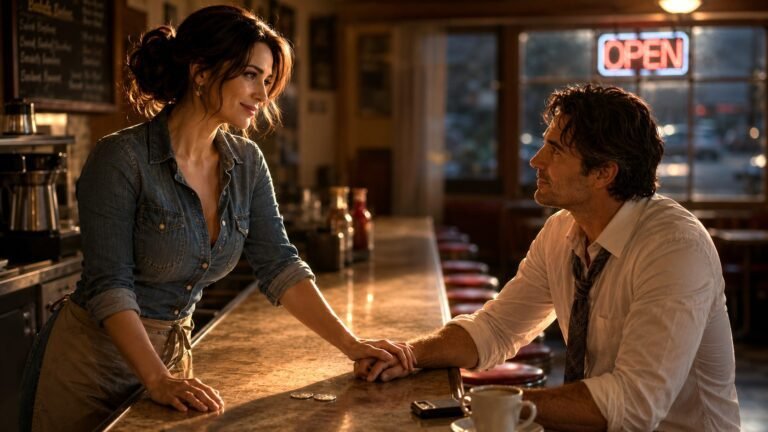
She did not say anything to that, only looked at him with an attention that felt, for a moment, like being measured for something, and then she uncrossed her arms and said his coffee was probably as bad as his fence post was good, and did he want to find out standing up, because she wasn’t putting a chair on the porch for it.
They stood at her porch rail with two mugs while the coffee went from too hot to just right, and she told him, without much preamble, that she’d been married eleven years to a man who called himself helpful the way some men call themselves generous right before they hand you a bill. He had fixed her car without asking, rearranged her kitchen without asking, walked into rooms she’d have preferred he knocked before entering, and had called all of it love for so long that she’d been thirty-four years old before she understood it had another name.
“He never hit me,” she said, like that fact needed defending on its own, the way people say it when they expect to be doubted otherwise. “Just never once let a door stay closed if he decided he had business behind it. Took some years to understand a closed door could mean something besides an invitation.”
“That why the deadbolts,” he said.
“That’s why the deadbolts.”
He thought of the fence post he hadn’t been asked to fix, and did not say anything for a while, and the not-saying sat between them comfortably enough that neither one hurried to fill it, the coffee cooling in their hands, a jay working the hedge for something small and specific.
“You could’ve let that post fall,” she said finally. “Would’ve been easier. Wouldn’t have had to explain yourself to a woman with three locks on her door.”
“Would’ve bothered me more, watching it lean all winter, than explaining myself bothers me now.” He looked at her, and something in his face must have carried more than the words did, because she looked away first, out at the yard, at the hedge, at anywhere that was not quite him.
“I don’t let people help without asking,” she said. “Not anymore. Learned it the expensive way.”
“I noticed.”
“Then why the fence post.”
He turned the mug once in his hands, the way another man might turn a coin over a knuckle, thinking. “Figured a fence post wasn’t the same as a door. Figured a man could fix a thing in a yard without it meaning he expected to get let inside for it.”
She looked at him a long moment, weighing that the way she seemed to weigh most things, careful, unhurried, and then she said, quiet, not quite meeting his eyes, “That’s the first time anybody’s drawn that line without me having to teach it to them first.”
Something in Wyatt wanted, badly, to say the thing sitting under that — that he understood the line because he’d built his whole life since Renata around a version of the same wall, that being useful without being underfoot was the only shape of nearness he trusted himself with anymore, that he recognized in her locked door something close kin to his own unfixed step, both of them keeping a threshold guarded for reasons that had stopped, somewhere along the way, being about the people who’d first made the guarding necessary. He did not say any of it. He drank the coffee instead, and let the jay finish its business in the hedge, and the silence between them filled up with everything neither of them had decided yet was safe to hand over.
Through November they built a rhythm out of small things. He fixed her mailbox flag without being asked and left it fixed without knocking to announce it. She started leaving a second mug out on cold mornings, not an invitation exactly, just a mug, sitting there on the porch rail like a fact she wasn’t prepared to explain. He noticed she’d stopped double-checking the deadbolts when he was still standing in the yard, only after he’d gone, and he never mentioned it, filed it instead alongside the trash can clock and the porch light and the dozen other unspoken accommodations they were making without either of them calling it by its name.
One evening, raking leaves that had drifted across the property line into her yard, he caught her watching him from the kitchen window the way he’d once watched her without meaning to, and when their eyes met neither of them looked away first this time, and something passed between the two panes of glass and the cooling air that felt less like a held breath and more like the moment right before one, and then she smiled, small and involuntary, and went back to whatever she’d been doing at the sink, and he went back to the leaves with his chest doing something he had no ready word for and did not go looking for one.
She left for four days in early December to see a sister in Spokane, and told him the trip only in passing, over the hedge, keys already in hand. She did not ask him to watch the house. He decided to anyway, the way he decided most things lately, without quite consulting the part of himself that used to think first and act second.
The second night, a wind came through hard enough to strip half the yard of its remaining leaves and take a section of her back fence down with it, the same fence he’d reset a section of weeks before, a different post giving way this time under a gust that had nothing personal in it. He saw it from his kitchen window at first light, boards flat in the grass, and told himself the same thing he’d told himself about the first post — that a fence left down through a week of December weather would only cost more to fix later, that catching it now was simple sense, not overreach.
He let himself into her yard through the gap the fallen fence had made rather than walk around to a gate that would have required him to cross her porch, and told himself this made a difference. It took him an hour to reset the post, another to true the rail, and somewhere in the middle of it, needing a level he didn’t have, he went to her garage — unlocked, she’d mentioned once that the garage door stuck and she never bothered latching it — and stood a moment in the gray light among boxes still taped from her move, looking for a tool that turned out not to be there, and left again without touching anything he hadn’t gone in for.
He did not think much of it. He finished the fence, cleaned up the mess, and went back to his own house satisfied in the particular quiet way a completed job had always satisfied him, proof laid down that he’d been good for something while she was three states away and hadn’t had to ask.
She came home on the fourth evening to a fixed fence and a garage door that did not sit quite the way she’d left it — she would tell him later that she always left it three inches short of closed, a small private measurement nobody else could have known to notice or correct — and stood in her driveway a long moment looking at both, the tidy corrected fence and the garage door pushed to, and felt something close over in her chest that had nothing reasonable in it and everything old in it, a door that used to be hers alone to open now closed by a hand she hadn’t given permission to.
She did not call him that night. She did not call him the next morning either, though he saw her car in the driveway and knew she was home, and by the second day the silence had gone on long enough that he crossed the hedge himself, some old dread rising in him that he recognized without wanting to, the particular dread of a man who has fixed something and is waiting to learn whether the fixing was wanted.
She met him on her own porch, arms crossed, and did not invite him past the top step.
“You were in my garage.”
“Fence needed a level. Didn’t have one at the house.” He heard how thin it sounded even as he said it, heard it the way a man hears a board crack under weight he’d sworn would hold.
“I didn’t ask you to fix the fence.”
“No,” he said. “You didn’t.”
“That’s the whole of it, Wyatt. I didn’t ask.” Her voice was not raised. It was worse than raised — level, controlled, a voice doing the work of holding something much larger in place. “You don’t get to decide what needs fixing around here just because you’re good at fixing things. That was the whole deal with the last one. Every door in that house got opened whether I wanted it opened, and every time I said something, it turned into me being ungrateful for a man who was only trying to help.”
“That’s not what this was.”
“I know that’s not what you meant it to be,” she said, and something in the distinction — meant to be versus was — landed on him harder than any accusation would have. “Doesn’t change what it cost me to come home and find my own garage rearranged by somebody I never handed a key to.”
He stood on the second step, his boot finding, out of old habit, the give in a board that was not his own, and felt something drop through him that had the shape and weight of every summer he’d watched a tarp flap on an unfinished wall, the specific cold certainty that he had once again fixed a thing so thoroughly it had cost him the person it was meant to be fixed for.
He went home without arguing further, because arguing had never once, in his experience, made a closed door open faster, and that night he did not sleep, lying in a house half-framed on one side, listening to wind work at a tarp that had gone brittle with two years of weather, and in the morning he did not cross the hedge, and the trash cans went out that Tuesday an hour apart instead of together, and neither one of them looked up when the truck went past.
Three days into the quiet, Wyatt stood in his garage looking at the length of two-by-six he’d had cut and stacked since spring, meant for a job that had never once made it to the top of a list with somebody else’s name on it, and understood, with a clarity that felt less like insight than like something finally landing after a long fall, that he had spent two years walking past his own broken step in order to go fix things that belonged to other people, because a stranger’s gratitude had always been easier to earn than the harder, slower work of tending something that was only his.
He carried the board out to the porch that afternoon and did not go near the hedge first, did not check whether she was watching from the kitchen window, only knelt at the third step and pried the split board loose and set the new one in its place, measuring twice out of a habit that predated everything that had gone wrong in his life and would likely outlast whatever came next. It took him forty minutes. When it was done he stood on it, weight rocking heel to toe, and it held steady under him the way a thing holds when it has finally been done right, no give left in it at all.
He was still standing there, admiring a job that had cost him nothing but his own idle afternoon and had been, until that day, easier to leave undone than to finish, when he heard her come across the wet grass behind him, no hedge between them now, no fence line, just open yard.
“You fixed it,” she said.
“Two years late.” He did not turn around right away, some old reluctance in him wanting to keep his back to whatever she’d come to say, and then he made himself turn, because a man who’d spent his whole life fixing thresholds for other people owed it to himself, at least once, to face one of his own without a tool in his hand to hide behind. “I didn’t come into your garage to prove anything. I told myself that at the time and it was true enough. But I came in anyway, without asking, because some part of me still thinks the only way anybody keeps me around is by needing something fixed, and that part of me doesn’t much care what door it has to open to prove it. Doesn’t excuse what it cost you. Just explains where it came from.”
She stood at the bottom of the step, hands in her coat pockets, and did not answer right away, the wind moving through the bare hedge between their two yards, and when she spoke her voice had lost the level control it had carried on the porch three days before, something rougher underneath it now, closer to the surface.
“I’ve spent two years making sure nobody gets close enough to open a door I haven’t handed them a key to first,” she said. “Didn’t leave much room to tell the difference between a man taking something and a man just trying, badly, to be useful to somebody he cared about. That’s on me as much as it’s on you.”
“Doesn’t have to be on anybody,” he said. “Could just be two people who learned the wrong lesson too well.”
She looked past him at the step, newly boarded, pale wood still raw against the weathered gray of the rest of the porch, and something in her face came loose the way ice lets go of a gutter in the first real thaw, all at once and without warning.
“Test it,” he said, and stepped aside, and held out his hand, not to pull her up, just open, an offer she could take or leave standing where she was.
She came up the two lower steps and set her foot on the new board and rocked her weight onto it, testing it the careful way she seemed to test most things, and it held, solid, no give in it anywhere, and she looked up at him with something unguarded moving across her face that he had not seen there before, not on the porch in the rain, not over coffee at her rail, something that looked, for the first time since the moving truck had pulled into the driveway next door, like a door standing open on purpose.
She took his hand, not to be helped up, just to be holding it, and stood with him a while on the new board, the two of them steady on wood that had no give left in it anywhere, and then she said, still holding on, that she wasn’t ready to walk into a house half-framed, not yet, not tonight, but she wasn’t ready either to let go of his hand and cross back over the hedge to a locked door and a quiet kitchen and call that safety.
So they went to her porch instead, her hand still in his, and she stood at her own door a long moment before she reached for the first deadbolt, and turned it, and then the second, unhurried, no ceremony in it, just a woman doing a small ordinary thing that had stopped, for two years, being small or ordinary at all, and the third bolt gave under her hand with a sound he felt more than heard, and she pushed the door open onto a warm kitchen with one mug already out on the counter and a second one, he noticed, set beside it, as though she’d put it there some morning without letting herself examine why.
“You’re the only man I let inside,” she said, not turning around, her hand still on the open door, “since I learned there was a difference between being let in and being let in because I chose it.” She looked back at him then, and stepped through first, the way a person steps into a room they have decided, finally, to trust holding them, and he followed her over the threshold and pulled the door to behind them, and across the darkening yard, past the low hedge, his own porch light burned steady over a step he had, at last, after two years of other men’s fences and other men’s mailboxes, gotten around to fixing for no one but himself, new wood pale in the last of the light, holding nothing’s weight but the evening settling quietly onto it.
One Response
kakahp