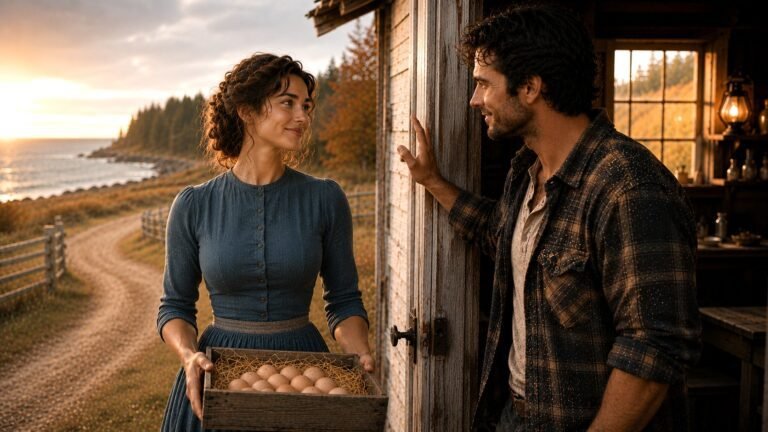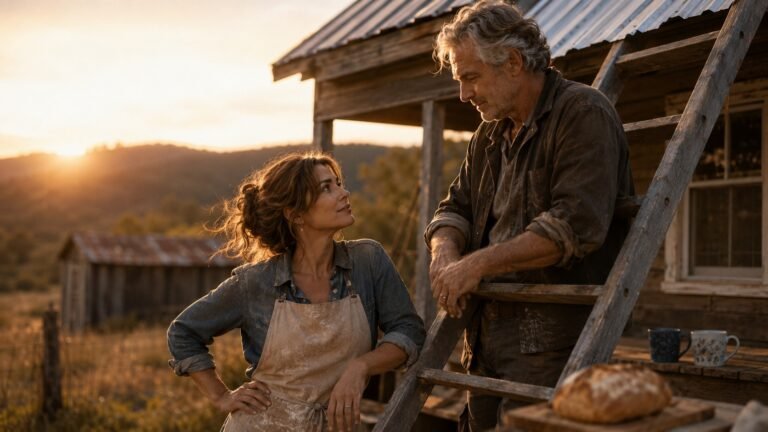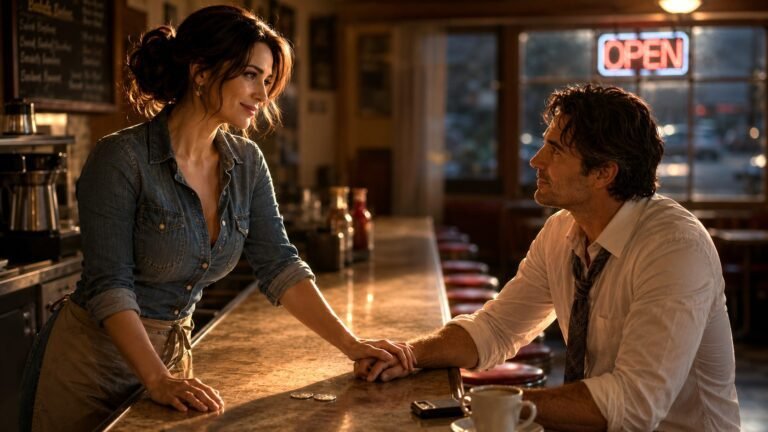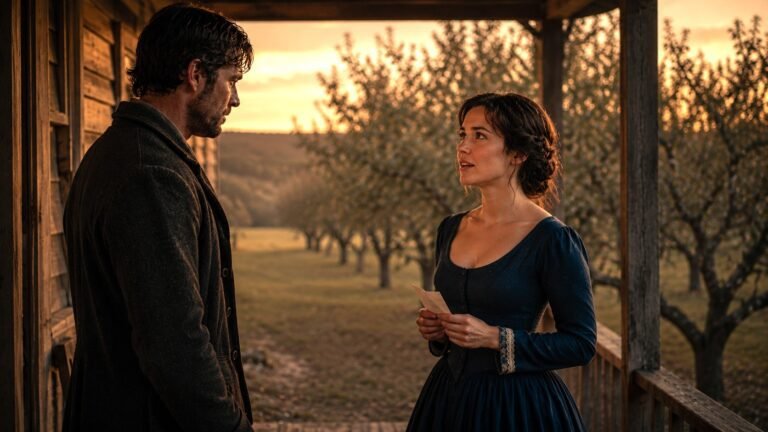

The post office in Ferro opened at eight, and Della Boyce was always there at seven-forty, standing under the eave with the same tin key ring, waiting for the frost to loosen its grip on the lock. Behind her the town did what it always did at that hour: nothing. A dog crossed the road without hurrying. The diner sign buzzed once and went quiet. Above the post office roof, bolted to a pole that had outlived two roofs, a weathervane shaped like a running horse turned in fits, caught on a hinge that had gone stiff sometime around the Bush administration and never been oiled, so that the horse seemed to be fighting the wind instead of riding it.
Inside, the light came up pale through glass block windows, and Della moved through the sorting room in the particular order she always moved through it, touching the same three switches, checking the same thermostat, running her thumb along the edge of the counter as if to make sure it hadn’t changed overnight. It never had. That was, more or less, the point.
She sorted the outgoing mail into stacks of ten. Always ten — not twelve, not a loose double handful — because ten was countable at a glance, and a glance was all a person got most mornings before the line started. She wrapped each stack in a length of butcher’s twine, tied it with a clove hitch her father had taught her on the dock in Sheridan Bay thirty years before he stopped being someone she thought about on purpose, and when the twine came off later, at the sorting table, she didn’t throw it away. She cut it clean with the crescent-bladed paring knife that lived in the top drawer for that single purpose, and coiled it into a mason jar on the shelf behind her, where eleven years of string had gathered into something that was no longer a habit so much as a form of ballast.
If a customer asked about the jar — and one or two did, every year, usually a child — she told them she was saving it for something. She had never once, in eleven years, been asked what.
The undeliverables were the part of the job nobody else wanted, the returned and misaddressed and torn, and Della had taken to keeping that stack for herself instead of passing it along to the district office the way the manual technically required, because she had found, over time, that she could often fix what the manual could not. A transposed digit. A rural route renamed after some county commissioner’s aunt. A hand that wrote its sevens the old European way, crossed through the stem, easy to misread as ones. She liked the work of it. She liked believing, in the small closed chapel of her own mind, that a letter which wanted badly enough to arrive somewhere could be helped along, if a person paid attention.
She had not always believed this. There had been a year, after Frank, when she believed the opposite — that the mail, like everything else, simply went where it wanted and told you nothing in advance, and you found out where you stood only when it was already too late to stand anywhere else. The letter that ended a nine-year marriage had come on a Tuesday, in a plain window envelope, postmarked Reno, and she had recognized his handwriting on her own address before she’d registered that it was addressed to her at all, because in nine years he had never once written her a letter — there had been no need, they lived in the same nine hundred square feet — and the sight of his hand forming her own name on an envelope had told her, before she’d broken the seal, more or less everything the letter went on to confirm in four flat sentences. He was not coming back. He was sorry. He hoped she’d understand, in time, that it wasn’t about her. He had signed it Frank, not love, Frank, and she had noticed that, too, in the particular way a person notices the exact shape of the wound at the moment it opens, memorizing it without meaning to, the way you’d memorize a face.
She still buttoned her cardigan to the throat, even indoors, even in August. She had stopped noticing she did it.
What she had not stopped noticing, could not stop noticing, was the fourth Tuesday of the month, when a letter came addressed in a blunt, careful, uphill hand to W. Calder, Spar Creek Ranch Rd, Ferro WY, a route that did not, strictly, exist anymore, not since the spring flood had taken out the low bridge and the county had rerouted the mail truck around by the highway, leaving Spar Creek unserved for the better part of two years until Della — new to the returned-mail stack then, hungry for the shape of a problem she could actually solve — had traced the name through an old grazing-lease filing and started walking his letters up to the general delivery box herself, on her own time, with a note clipped to the first one explaining what she’d done and why.
He had written back. Not to complain. To thank her, in nine lines that took up most of a page because his sentences ran out of room and turned corners, and at the bottom, almost as an afterthought, he had asked whether the county intended to fix the bridge before the ranch’s owner had gone gray waiting.
She had written back that she doubted it. He had written back that he’d suspected as much.
It had gone on from there in the unhurried way that things go on when neither party is in any rush to name what they’re doing, and if you had told Della, that first autumn, that she would come to organize the shape of her month — the shape, some weeks, of her whole interior weather — around a single envelope from a man she had never seen, whose voice she had never heard, she would have said that sounded like exactly the kind of thing that had already once nearly finished her, and she wasn’t in the market for a repeat.
And yet: the fourth Tuesday came, most months, with its blunt uphill hand, and she opened those letters with the same paring knife she used on the twine, at the counter, alone, after the sign was turned to CLOSED, and read them twice before she let herself go home.
She had never told him about Frank. She had never told him her own front door had a chain lock she used even in daylight, or that she still could not walk past the Reno exit sign on the interstate without something closing quietly in her chest like a fist finding a rhythm. She told him about the weathervane instead, and the twine jar, and once, in a letter she almost didn’t send, about her father’s dock knot. He told her about calving season and a horse named Pilot that hated men in hats and loved men bareheaded, for no reason he had ever worked out, and about the particular blue the mountains went an hour before real dark, which he said he had never found the right word for and had quit trying.
He did not write about why he lived forty miles up a dirt road with no landline and a radio that caught two stations on a good day. She did not ask. It seemed, between them, a fair trade of silences — the kind two careful people make without ever discussing the terms, each one certain the other’s quiet held a different shape of hurt, and each one, in this, not exactly wrong.
That particular October Tuesday, the fourth of the month, no letter came. She checked the sack twice. She told herself the bridge, or the road, or the truck. She went home at six and did not eat much, and stood a long time at the kitchen window watching the light do the thing it did over the foothills, that blue he had given up trying to name, and did not let herself think the word again, though it stood just behind her, patient, the way it always had.
She was still standing there when headlights came up the county road doing something no vehicle on that road had done in the two years she’d lived at the end of it, which was slow down.
It was not headlights for her house. It was headlights for the post office, a mile back the way she’d come, and she knew this the way a person knows the weather has changed before any rain has fallen, some pressure dropping in the middle of the chest, and she was in the truck before she’d decided to be, driving back into town in the dark with the heater ticking and not working yet, her breath fogging the windshield in a way she had to keep wiping clear with the flat of her hand.
The lights were still on when she got there. Not the post office lights — hers, in the truck, throwing a long yellow wedge across the gravel lot, where a vehicle she didn’t recognize sat nose-in to the loading dock with its hood up and steam, or maybe just cold breath off a hot radiator, rising into the porch light in a thin white column. A man stood beside it with his hands loose at his sides in the particular stillness of someone who has run out of things to do about a problem and is waiting for it to solve itself or for someone to arrive who can.
She parked. She got out. The cold came in through her collar and she buttoned the top button, an old motion, automatic, and crossed the lot with her keys already sorted to the one that opened the front door, because whatever else was happening, a man with a dead truck forty miles from anywhere was going to want the telephone, and she had one, and that much, at least, she knew how to give a stranger.
“Evening,” she said, from a still-safe distance, the way you’d address a horse you didn’t know the temper of.
He turned, and the porch light came full onto his face, and something in her went very quiet, the particular quiet of a room after a door has been shut against wind.
He was tall in the unhurried way of men who have spent a life ducking through doorways built for someone shorter, hat pushed back, a canvas coat gone the color of a paper sack from years of weather, and a jaw that worked once, twice, before anything came out of it, the muscle there doing the labor that words weren’t yet willing to do. His eyes were the exact gray-blue of the mountains at the hour he’d once tried and failed to name in a letter, and she knew this because she had spent the better part of a year imagining that color and had gotten it wrong every time, had pictured something bluer, cleaner, and the real thing was rougher and better and it undid her a little, standing there.
“R-radiator,” he finally said, and stopped, and looked like a man bracing for the sentence to be taken from him and finished by somebody with more patience for it than he had faith in himself. “Blew a — a hose. Back by the — ” He stopped again. His hand made a shape in the air, a loose coil, and let it drop.
“The switchback past the Delaney turn,” Della said. “Where the guardrail’s out.”
He looked at her the way a man looks at a locked door that has just, unexpectedly, swung open on its own.
“That’s the one,” he said, and something in his shoulders came down an inch, the bracing gone out of them, and it was in that exact moment — the guardrail, the switchback, the small unremarkable fact of the road he traveled but she had never once seen, offered up and caught without either of them having to work for it — that Della understood, with the flat certainty of a stone dropped down a well and heard to land, that she was standing in front of W. Calder of Spar Creek Ranch, and that he did not yet know it.
“You’re a long way to be walking to a phone,” she said, instead of any of the things crowding up behind that.
“Didn’t figure on walking,” he said. “Figured on the truck.” A pause, the jaw working again. “Didn’t account for the — ” His hand made the coil shape once more, gave up on it, and he looked down at his own boots as if they’d betrayed him too.
“Hose,” she said, gently, not finishing it for him so much as setting the word down next to him where he could pick it back up if he wanted it.
“Hose,” he agreed, and something that wasn’t quite a smile happened at one corner of his mouth, there and gone, like a fish turning under water.
She let him use the phone in the sorting room, standing near enough to hand him the county road-service card taped inside the cabinet, not so near as to watch him form his sentences to the dispatcher, who from the sound of the one-sided conversation was going to be the better part of two hours getting a truck out that way after dark. While he talked, haltingly, Della found herself looking at the counter, at the drop slot where undeliverable mail collected overnight, and did not let herself look at him again until he’d hung up.
“Two hours,” he said, unnecessary, since she’d gathered as much, and stood in the doorway of the sorting room not quite committing to either staying or going, a big man made suddenly careful of his size in a small room.
“There’s coffee,” Della said. “Old. But hot.” And then, because the silence that followed felt like it wanted filling and she had never in her life been good at leaving a silence unfilled around a stranger, “There aren’t usually visitors back here.”
“Didn’t figure there were,” he said, and this time the almost-smile held a beat longer before it went under again. “Didn’t figure on being one.”
She poured two cups from the pot that lived on the hot plate behind the counter, black and stewed nearly to tar, and set one in front of him on the sorting table without asking how he took it, because something about him did not strike her as a man who fussed over coffee. He wrapped both hands around the mug the way men do who have spent a great many hours cold, and looked around the little room — the cubbyholes, the scale, the mason jar of twine on its shelf — with the slow, cataloguing attention of someone memorizing a place he suspected he’d want to remember later.
“Run this whole outfit alone?” he asked.
“Whole outfit,” she said. “Population of Ferro doesn’t require much more than one.”
He nodded at that, turned the mug a quarter turn in his hands, and said, not quite looking at her, “Ever get letters up here for a fella can’t be reached by phone? Out past where the county quit fixing the bridge?”
The room did something. Della felt it in her sternum before she understood it in her mind, a small structural give, like ice deciding, all at once, to be water.
“Time to time,” she said, careful, testing the ground of it. “Spar Creek, was it?”
His whole face changed. Not surprise, exactly — something under surprise, older and more unguarded, the look of a man who has walked a long way toward a specific door and found it not just unlocked but standing open, lit from within.
“You’re — ” he started, and the word he wanted came apart on him entirely this time, no coil of the hand to rescue it, and he set the coffee down like it had suddenly gotten too heavy to hold and be honest at the same time.
“Della,” she said, giving it to him the way she’d given him hose, plain, unhurried, no charge on it either way, though her pulse said otherwise. “Boyce.”
“Wyatt,” he said, and put his hand out across the sorting table, past the scale, past a season’s worth of stray twine, and when she took it his grip was exactly what a year of his handwriting had promised it would be — sure, unshowy, a little rough at the pads of the fingers from rope — and neither one of them let go quite as fast as the handshake required, and neither one of them remarked on that, either, and outside the window the horse on the weathervane caught a gust and spun once, hard, all the way around, before it settled facing north.
The tow truck came at half past nine, and Wyatt rode back up the mountain in its cab with his own dead truck on the hook behind, and Della stood in the lot a long while after the taillights had gone small and then gone altogether, not cold exactly, though the night had turned hard enough to frost the windshield glass in the twenty minutes she’d been standing there.
The letters kept coming after that, but they were not the same letters. Something had gotten into the blunt uphill hand that hadn’t been there before — a looseness, an eagerness the earlier pages hadn’t allowed themselves — and Della found she was answering the same day they arrived instead of waiting out her old two-day interval of consideration, a discipline she had once believed necessary and now simply forgot to keep.
He came to town more than the truck or the ranch strictly required. He came for parts he could have ordered by catalog. He came, twice, for nothing he named at all, standing in the lot with his hat in his hands like a boy called to the principal’s office, until Della came out onto the loading dock and the not-naming of it became, itself, a kind of understanding between them.
The third time, he brought a jar.
“Chokecherry,” he said, holding it out before she’d even gotten the door shut behind her. “Mother’s recipe. Wrote you once you’d never tried it.” A pause, the old coil of the hand, though it came easier now, less like bracing and more like punctuation. “Didn’t seem right, letting a fella tell you about a thing and never handing it over.”
The syrup was dark as a bruise and tasted, when she finally opened it that night alone in her kitchen and put a spoonful straight to her tongue because she hadn’t the patience to wait for pancakes, of something tart and old and faintly of woodsmoke, and she stood at the counter with the spoon still in her mouth and laughed out loud at nothing, at the plain absurd fact of a grown man driving forty miles with a mason jar of preserves in the footwell of his truck because a stranger, a year ago, had mentioned in a letter that she’d never tried them.
They took to sitting on the tailgate of his truck in the post office lot after closing, when the light went that blue he still hadn’t named, passing a thermos back and forth, and it was there, on a Thursday in November with the first real snow not yet down but close enough to smell, that she asked him straight out why a man wrote letters instead of using a phone.
He was quiet long enough that she thought she’d overstepped, and started to say so, and he cut her off — gently, but he cut her off — with a small shake of the head.
“Stutter,” he said. Just the word, set down plain, the way she’d once set down hose for him. “Bad as a boy. Better now. Not gone.” His thumb worked a groove in the truck bed’s rubber mat, back and forth. “Phone’s — worse. Can’t see a person’s face on a phone. Waiting on you.” A breath. “Word won’t come, and you’re just — waiting. On a phone that’s worse.”
“And a letter,” Della said, “doesn’t make you wait on anybody.”
“Letter, a fella gets to — ” He stopped, started over. “Gets to say the thing he means. Not just the thing that’ll come out first try.”
She thought of Frank’s four flat sentences, the plain window envelope, a letter that had said exactly and only the thing its writer meant and had gutted her all the same, and did not say so. Instead she said, “I like knowing what I’m getting into before I open something,” which was true, and which was also, she understood even as she said it, the nearest she had ever come to telling anyone what the string jar was actually for.
Wyatt looked at her a moment with those mountain-colored eyes, patient in a way that made her wonder how much a man could read in a person without ever once demanding the words for it, and said only, “Most folks don’t.”
They didn’t touch the subject again that night. But two weeks later, walking her from the truck to her own front step after driving her home from the Grange supper neither of them had planned to attend together and had somehow ended up leaving together, he stopped at the bottom of the porch stairs, not following her up, respecting some boundary he seemed to have set for himself without her ever having asked him to, and said, “There was a woman. Before.” The words came slower than usual, more effort in them. “Laughed at the — at how I talked. In front of folks. At a — dance.” He looked past her at the dark house. “Quit dances after that. Quit most rooms with more than four, five people in ’em.”
“I’m not much for rooms like that either,” Della said, which was also true, and did not say why, and he did not ask, and the not-asking sat between them on the cold porch step like something they had both agreed, without conference, to set down gently and leave for later.
He reached instead into his coat pocket and drew out a length of braided horsehair, black and silver-gray, no longer than a bracelet, the ends whipped off clean with waxed thread.
“Make these nights I can’t sleep,” he said, holding it out on his open palm like a man offering water to something wild he hoped wouldn’t spook. “Off Pilot’s mane, mostly. Never had cause to give one away before.”
She took it. The hair was cool and slick and stronger than it looked, twisted into a pattern her fingers wanted to keep tracing even after she’d slipped it over her wrist, and she thought, looking at it against her skin in the porch light, of the mason jar of twine on the shelf behind the counter, all that saved string with nowhere yet to go, and understood, standing there, that she had just been handed the first knot in eleven years she had any interest in tying toward something instead of simply preserving.
“I don’t have anything to give you back,” she said.
“Didn’t bring it looking for a trade,” Wyatt said, and the almost-smile came and held, this time, a good deal longer than a beat, and he touched two fingers to his hat brim and walked back to the truck without another word, and Della stood on the step a long time after his taillights had gone, turning the bracelet once around her wrist, feeling, for the first time she could clearly remember since a Tuesday in a plain window envelope, something in her chest that was not bracing for a blow.
He asked her up to Spar Creek for the first time in early December, for the tail end of a gather he’d been putting off calling a party, though that was plainly what it had turned into by the time she arrived — a dozen trucks nosed into the yard, a bonfire built up bigger than any single practical purpose required, three or four ranch families down from the higher country with casserole dishes and a fiddle somebody had thought to bring. The mountains stood up dark and close behind the barn in a way they never did from the flat window of the post office, close enough that Della felt, getting out of her truck, the particular hush that big country presses down over a small gathering of people, everyone pitched a little louder than they meant to be, trying to fill it.
Wyatt met her at the gate looking like a man wearing his own skin uneasily, and she understood, watching him work the crowd of neighbors he’d clearly known his whole life, that a dozen familiar faces cost him something a stranger’s single face at a sorting counter never had. He kept finding his way back to her side between greetings, not for rescue exactly, but the way a man checks a fence line he’s worried about — needing, every so often, to confirm the thing was still holding.
It held, for a while. Then old Purdy Anschell, three drinks into the evening and meaning no more harm than most men that far into a bottle mean, clapped Wyatt on the shoulder in front of the fire and said, loud enough to carry, “Tell her about the bull that got into the Delaney’s silage, go on, tell it the way you told it to me,” and the whole knot of people nearest the fire turned, waiting, good-natured, no malice in a single face among them, and Wyatt opened his mouth to tell it and the word simply would not come.
It caught. It caught again. His jaw worked the way it had the first night in the lot, but there was no quiet room to retreat into this time, no counter between himself and an audience, only firelight and a dozen faces he’d grown up under, patient at first and then — not unkind, never unkind, but present, watching, waiting in a way that filled the held silence with something Della watched land on him like weight — and somebody, meaning to help, started the story for him, and somebody else laughed at the right place, and the story got told, fine, it got told well even, but not by him, and Wyatt stood at the edge of his own fire with his hands gone still and heavy at his sides and did not say another word for the better part of an hour.
Della watched this happen from six feet away and could not close the distance. She told herself later it was because she hadn’t wanted to make a scene of it, hadn’t wanted to be the woman who rushed to a grown man’s side in front of his whole community and confirmed, publicly, that he needed rushing to — but the truth, underneath that reasonable-sounding truth, was that something old and cold had risen up in her own chest at the sight of him going silent, some fist finding its rhythm, and she had stood there working her own jaw uselessly, and by the time she’d found her feet the moment had already closed over like water.
He drove her home himself, late, the fire long since banked, and said almost nothing the whole way down the mountain, and at her porch step he did not get out of the truck at all, just idled at the curb with his hands at ten and two, and said, “Didn’t mean for that.”
“I know,” Della said.
“Wasn’t fair to you. Standing there like that.”
“You didn’t do anything to me,” she said, which was true and also not the whole of it, and she heard the gap between the two and did not know, standing on the cold curb with her breath fogging, how to close it before he drove off.
He didn’t call — couldn’t, not really, not in any way that felt to him like calling — and he didn’t write, not that week, not the next. Della checked the sack on the fourth Tuesday out of eleven years of habit before she remembered what month’s silence she was actually standing inside of, and there was nothing, and the nothing had a very specific weight to it, the exact remembered weight of a plain window envelope, and she went home that night and buttoned her cardigan to the throat and sat a long while at the kitchen window not eating, watching the mountains go that blue he had never found the word for, feeling something close over in her chest with the patient, familiar thoroughness of a door she had thought, foolishly, she’d stopped needing to guard.
Two weeks became three. She did not drive up. He did not drive down. Both of them, forty miles and one bad night apart, carried the same silence in their separate bodies — his gone quiet with the old shame of a fire circle he could not master, hers gone quiet with the old certainty that silence, once it started, only ever widened — and neither one of them, in all that carrying, once stopped to notice they were bracing against the exact same wind.
On the twenty-third day Della did something she had not done in eleven years of tending other people’s mail: she wrote a letter and did not put it in the sack.
She wrote it standing up at the sorting counter after close, the way she’d always read his, and it came out uneven, crossed-through in two places, nothing like the careful two-day-considered replies she’d once prided herself on. She did not explain herself in it, not the way Frank had explained himself in four flat sentences that had taken him, she guessed now, about four minutes to compose. She wrote instead about the fire circle, about watching from six feet off and not closing the distance, about the particular cowardice of a woman who had spent eleven years believing that anyone who went quiet on her was already gone, and had gone quiet herself the one time it might have mattered to prove that belief wrong.
Then she did not mail it. She folded it once, put it in her coat pocket, took down the mason jar of eleven years’ saved twine from its shelf, and drove the forty miles up the mountain in the dark with her headlights carving a single narrow tunnel through country she had only ever seen once, at night, from the passenger seat of somebody else’s truck.
The ranch house showed one window lit when she came up the last grade, low and yellow against all that dark, and she sat in the cab a full minute with the engine ticking before she made herself get out.
He opened the door before she’d reached the porch, like he’d been standing near enough to see the lights climb the ridge, and for a moment neither of them said anything at all — which was, Della understood, standing there with her breath going white in the cold and the jar of twine held against her chest like something that might otherwise get away from her, exactly the problem, and exactly, this once, not a problem she meant to let stand.
“Didn’t come to make you talk,” she said, before he could try and fail and go still the way he had at the fire. “Came to say a thing myself, and then came to sit on your porch as long as it takes you to say one back, if you’ve got one, and if you don’t, came to sit anyway.”
Something moved through his face that wasn’t quite relief and wasn’t quite grief and was mostly, she thought, the particular unclenching of a man who has spent three weeks certain he’d already lost a thing and has just watched it drive forty miles of bad road in the dark to prove him wrong.
She held out the letter first. He took it, but didn’t open it, just held it the way he’d once held out the horsehair bracelet, careful, uncertain of his own hands.
Then she held out the jar.
“Eleven years of string,” she said. “Off every stack of mail that ever came apart clean in my hands. Never had a use for it. Kept it anyway.” She worked the lid loose, cold-stiff, and it gave with a small crack in the porch quiet. “Figured it was time it went to tying something instead of just getting saved.”
She took out a single length, worn soft from handling, and held it out to him — not the whole jar, just the one piece — and waited.
It took him a while. His jaw worked, once, twice, the old bracing, and Della made herself stand still through it this time, made herself hold the distance closed instead of watching from six feet off, and when the word finally came it came slow and whole and entirely his own, nobody finishing it for him, nobody needing to.
“Stay,” he said. Just that. And then, steadier, the second time easier than the first the way it so often was with him, “Stay a while.”
She did. She sat with him on the porch step in the cold with the one window’s light spilling yellow across both of them, and he took the length of twine from her fingers and, without a word this time, tied it — slow, careful, a knot she didn’t recognize, something with a working man’s practical elegance to it, nothing at all like her father’s clove hitch — around her wrist, snug over the horsehair bracelet already there, two knots holding the same skin now, and did not let go of her hand once the tying was done, and up on the ridgepole of the barn behind them, catching the very first grey edge of a wind coming down off the peaks before dawn, a weathervane older than either of them turned once, slow, and settled, and held steady, facing into it.