
Jonah Calder had not spoken a full sentence out loud in three days, and the silence had begun to feel less like an absence and more like a second skin.
He stood now at the edge of what the county plat map called Hollow Creek — one hundred and sixty acres of Montana scrubland, bought sight unseen with the last of his Army discharge pay and every dollar he’d scraped together breaking horses in Ohio after the war ended. The deed sat folded in his breast pocket, soft at the creases from being touched too many times on the three-week ride west. He touched it again now, out of habit more than doubt.
It was the spring of 1920, and the land in front of him looked like something that had been abandoned by God as well as by its previous owner. The creek that gave the place its name was a thread of brown water threading through a gully choked with deadfall. What had once been a cabin was four leaning walls and a roof that had surrendered to a decade of Montana winters. The grass, what there was of it, grew in sparse gray-green tufts, more suited to jackrabbits than cattle.
Jonah’s horse, a rawboned dun gelding named Ezra, shifted beneath him and blew out a long breath, as if even the animal understood the scope of the foolishness they had just committed to.
But Jonah had learned, in a trench outside a French village whose name he still could not say without his jaw tightening, that ruin and possibility often wore the same face. He had seen fields cratered black and lifeless, and he had seen, eighteen months later in the letters his sister sent, photographs of green wheat growing in those same fields. Things came back. He believed that with the same quiet, stubborn certainty with which other men believed in God or gold.
He swung down from Ezra’s back, his left leg buckling slightly as it took his weight — an old wound, a French winter, a piece of shrapnel the Army surgeons had judged not worth the risk of removing. He did not curse it. He simply waited for the leg to remember its job, the way he waited out most things now, and then he walked toward the gully to see how deep the water ran.
He was thirty-one years old, broad through the shoulders from four years of manual labor and two years of war before that, and he moved through the world now with the economy of a man who had learned that wasted motion could cost you your life. He did not know yet that this particular plot of ruined earth was about to cost him something far more valuable than motion. He only knew that the creek, when he knelt and put his hand into it, ran cold and clean over a bed of good dark stone, and that felt, for the first time in a long time, like a reason to hope.
He was still crouched at the water’s edge when he heard hoofbeats — quick, light, confident — and turned to see a rider crest the low rise above the gully.
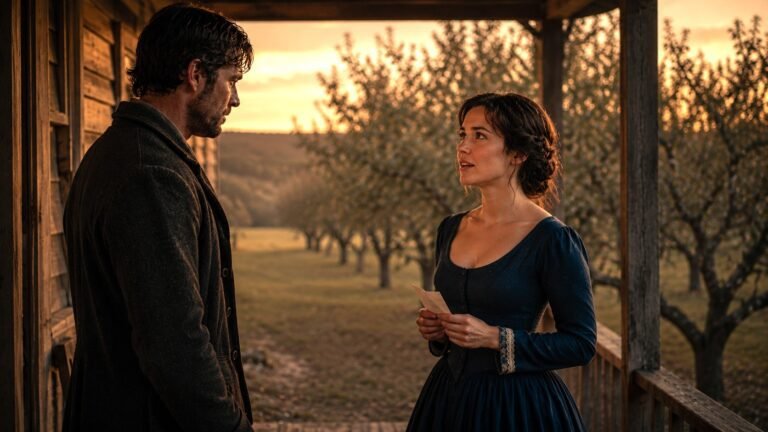
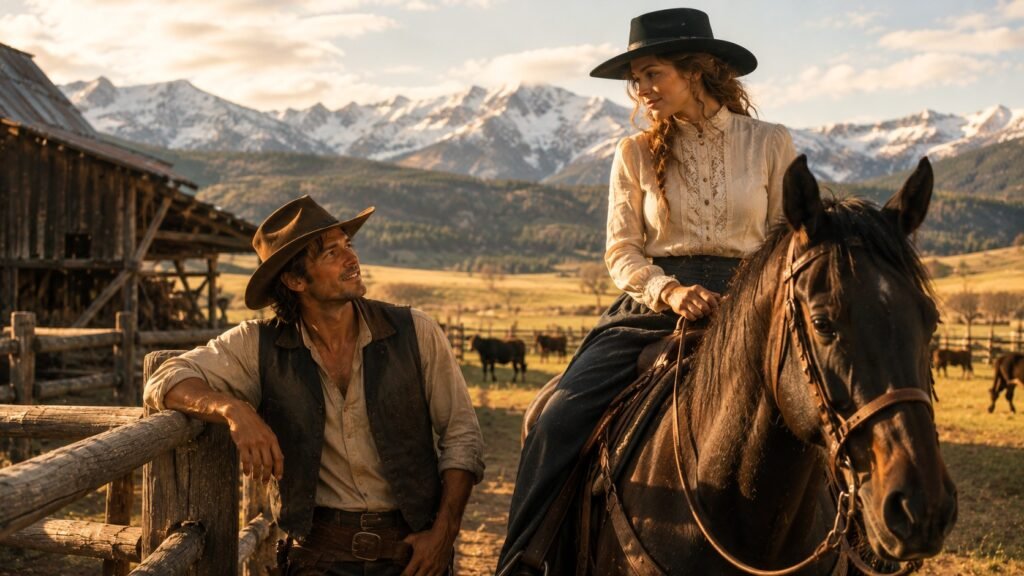
She sat a chestnut mare the way some women sat a parlor chair, as though the animal beneath her were simply an extension of her own will. Her jacket was a deep hunter green, cut close and clearly tailored rather than bought off a rack in Ashford’s one dry goods store, and not a fleck of the trail’s red dust had found purchase on it. Her hair, the color of good strong tea, was pinned beneath a hat too fine for ranch work. But it was her eyes that Jonah noticed first and remembered longest — a pale, startling blue, and fixed on him now with an expression that was not quite scorn and not quite pity, but some careful, amused cousin of both.
“You’re the one,” she said. Not a question. “The one who bought Hollow Creek.”
“I am,” Jonah said. His voice came out rough. He cleared his throat and tried again. “Jonah Calder.”
“Margaret Whitfield.” She did not offer a gloved hand to shake, only inclined her head a fraction, the way royalty might acknowledge a subject. “Though most people call me Meg, except my father, who insists Margaret carries more dignity.” A small, private smile touched her mouth, gone as quickly as it came. “You really bought this? All of it?”
“All hundred and sixty acres,” he said, and something in him — pride, maybe, or simple stubbornness — kept his voice even and his shoulders square, though he was suddenly and acutely aware of the state of his boots, of the three days’ beard on his jaw, of the ruin at his back.
She looked past him at the collapsed cabin, at the choked gully, at the gray fields, with the frank, assessing gaze of someone pricing cattle at auction. “My father will want to know why. The Whitfield range borders this land on the north side. He’s had his eye on absorbing it for two years — ever since old Pruitt gave up and moved to Spokane.” She reached into the leather satchel behind her saddle and produced an envelope, thick with the unmistakable heft of money. “He sent me to make you an offer. Four hundred dollars, cash, to sign the deed over. That’s more than double what the county says you paid.”
Jonah looked at the envelope. Four hundred dollars was more money than he had seen in one place in his entire life. It would buy him a fresh start somewhere with topsoil that didn’t need convincing, a place where the word drought wasn’t carved into the land like a scar.
It would also mean admitting that the only thing he had chosen for himself since 1917 — the only decision in three years that had been entirely, uncompromisingly his — had been a mistake.
“No, thank you,” he said.
Something flickered across her face — surprise, quickly smoothed over. “You haven’t even opened it.”
“Don’t need to. It’s not for sale.” He held her gaze, steady. “I spent a long time getting here, Miss Whitfield. I mean to stay.”
She studied him a moment longer, and he had the uncomfortable sense of being read the way he might read a horse’s ears and stance before deciding whether it would bolt or settle. Then she slid the envelope back into her satchel without another word about it, and her gaze moved instead to the low ridge east of his gully, and something in her posture changed — sharpened, the way a person’s does when they move from one kind of attention to another.
“You’ll want to fence the north boundary first,” she said. “Along the road, where it’s flat. Most men do.”
“That was the plan,” Jonah admitted.
“It’s the wrong plan.” She pointed with a gloved finger, tracing an invisible line across the terrain. “This whole flat drains south off that ridge behind you. Come July, if we get any rain worth having, it’ll come down fast and hard, and it’ll run right along your north fence line and undercut every post you set. You’ll be redigging holes in September that you dug in May.” She looked back at him, and there was no unkindness in it, only a plain and slightly startling competence. “Start on the ridge. Deep-set posts, cedar if you can get it. Let that be your anchor line and work down from there.”
Jonah said nothing for a moment. He had broken horses and mended fences on other men’s land for the better part of a decade before the war, and in that moment he understood, with the particular sting of a man realizing his own blind spot, that she was entirely correct.
“You know a great deal about drainage for a rancher’s daughter,” he said finally.
“My father taught me to read water before he taught me to read a book,” she said. “He says any man who doesn’t understand where the water goes isn’t a rancher — he’s just a farmer waiting to fail.” She gathered her reins. “I’ll tell him you declined the offer. He won’t be pleased.”
“I don’t imagine he will be.”
A ghost of that same private smile returned. “You should build on the ridge, too, if you ever get to building. The view’s better, and the wind clears the mosquitoes off the flat come August.” Then she turned her mare and rode off at an easy canter, back straight, unhurried, and Jonah stood at the edge of his ruined creek and watched her go until she was only a dark shape against the enormous Montana sky.
He did not move the fence line that day. It took him two more days of watching the water cut small braided trails across the flat before pride gave way to sense, and on the third morning he loaded his post-hole digger and his coils of new wire onto the wagon and hauled them up to the ridge instead.
He did not see her again for the better part of two weeks, though he told himself he was not counting the days, and he told himself that lie every single morning.
The work consumed him in the way that hard, repetitive labor always had — a mercy, in its way, because it left little room in his skull for the sounds that sometimes came back to him in the smaller hours of the night. The clang of iron against rock. The distant lowing of Whitfield cattle on the far side of the new fence. These were sounds he could hold onto, ordinary and clean, and he used them the way another man might use rosary beads, turning them over and over until his hands stopped their old, familiar shaking.
He slept in the collapsed cabin, having cleared enough of the wreckage to make one dry corner beneath a patched section of roof. He ate what he could shoot or trap and what little he could afford to freight in from Ashford, and by the time Meg Whitfield reappeared on the ridge line, he had gone four days on jerky, hard biscuit, and a single scrawny prairie hen.
She rode up along the outside of his half-finished fence — cedar posts now marching in a straight, deep-set line along the high ground, exactly as she’d told him — and sat watching him work for a long moment before she spoke.
“It’s a good line,” she said.
He did not stop tamping the post he was setting, though something in his chest loosened at the words. “Held through that hard rain last Tuesday. Ground didn’t move an inch.”
“I know. I watched it from the house.” She said this simply, without embarrassment, as though watching a stranger’s fence line during a storm were the most natural pastime in the world, and something about her bluntness made him want, unaccountably, to smile.
She unstrapped a small bundle from behind her saddle and leaned down to pass it across the top wire. He hesitated before taking it — his pride had teeth, even when his stomach didn’t — but she only raised an eyebrow at him, a silent dare, and he took it.
Inside was a loaf of brown bread still faintly warm from the oven, a wedge of hard cheese, and a jar of buttermilk with a cloth tied over its mouth.
“You don’t need to be doing this,” he said.
“I know I don’t.” She settled back in her saddle. “My mother would tell you it’s an offense against God to let a man work himself to a shadow within sight of a full larder. I find myself inclined to agree with her, on this particular point if no other.” Her pale eyes moved over him, over the hollows that had begun to show beneath his cheekbones, and something in her expression softened, just slightly, into something that was not quite pity but was close enough to concern that he felt it land somewhere beneath his ribs. “Eat, Mr. Calder. The fence isn’t going anywhere.”
He ate, sitting in the thin shade of a cedar post while she remained on her horse a little way off, and it was, without exaggeration, the finest meal he had eaten since before the war.
Her visits became, without either of them naming it as such, a kind of ritual. Every few days she would appear along the fence line, sometimes with food, sometimes only with conversation, and they spoke of things that mattered and things that didn’t — the price of beef in Bozeman, the particular stubbornness of Montana winters, the way the light changed on the ridge in the last hour before sundown. She never asked him about the war, and for that alone he found himself grateful past the point of words. He learned that she had been meant, once, for two years of schooling in Helena, a proper education for a rancher’s only daughter, before her mother’s failing health had called her home again; he heard the small, careful grief in the way she mentioned it, quickly folded away, and did not press. He, in turn, told her almost nothing directly — but she watched the fence rise, straight and unbroken, post by patient post, and she watched him clear the gully of deadfall with his bare hands, and she watched him begin the slow work of raising new walls where the cabin had fallen, and it seemed, somehow, that she understood him anyway, the way a person reads weather instead of a forecast.
It was on one of these afternoons, with the fence nearly finished and the cabin’s new frame rising pale and raw against the sky, that her father came instead of her.
Silas Whitfield rode a black gelding as broad and imposing as its owner, and he did not dismount when he reached the fence line. He simply sat there, a big man gone gray and weathered at the temples, with pale blue eyes that were unmistakably his daughter’s, though nothing in them was soft.
Two of his hands waited a respectful distance behind him.
“Calder.” Whitfield’s voice was a low rumble, like distant weather.
“Mr. Whitfield.” Jonah set down the hammer he’d been using and straightened, his bad leg protesting the sudden shift.
“Fence is good work.” Whitfield’s gaze swept the line with something that might, on another man’s face, have been grudging respect. “Straight and true. I’ll grant you that.” He paused. “My daughter’s taken an interest in your little project out here, Calder. She’s got a soft spot for lost causes — always has, since she was a girl bottle-feeding runt calves the rest of us would’ve culled.” His jaw tightened. “I’ll be plain with you, since you strike me as a plain-spoken man. Margaret is meant for a life a long way from a leaning cabin and a hundred and sixty acres of dust. There’s a young man in Bozeman — Harlan Pierce, his father runs the bank there — who’s asked after her, and asked after her properly, with his family’s blessing and the means to back it up. Whatever notions you might be forming out here, I’d advise you to set them aside. This is a small county, Mr. Calder. A man’s name follows him a long way in a place like this. You wouldn’t want to be known as a man who reached for more than his hands could hold.”
It was not quite a threat. It was worse — it was a fact, laid out plainly, the way Whitfield might describe the boundary of his own range.
Jonah thought of the sound of Meg’s laugh, sudden and unguarded, cutting across the empty flat. He thought of buttermilk and brown bread and a woman who could read water better than any man he’d ever known. He thought, too, of four years spent following other men’s orders in places that had taken pieces of him he would never get back, and of the particular, hard-won freedom of finally being able to say no to a rich man’s offer and mean it.
“I’m just building my fence, Mr. Whitfield,” he said. “And minding what’s mine.”
Whitfield studied him for a long moment, searching, Jonah suspected, for some flicker of fear or shame to confirm what he already believed about drifters and soldiers and men who bought ruined land with their last dollar. He found none. He gave a short, hard nod, wheeled his horse, and rode back toward his own green pastures without another word.
Jonah stood at the fence line long after the dust of Whitfield’s departure had settled, his heart beating slow and heavy, and understood, with a clarity that frightened him more than any German shell ever had, that he had already begun to hope for something he had no right to want.
Meg did not come for nine days.
The work went on without her — it had to — but the silence she left behind was a different animal than the silence he’d carried west from Ohio. That silence had been empty. This one was full of her absence, which was its own kind of ache, sharp and specific in a way general loneliness had never managed to be.
When she finally returned, there was a new carefulness between them, an invisible fence strung up alongside the real one. They spoke less. She did not mention her father, and neither did he, but it sat there anyway, unspoken, in every pause that ran a beat too long.
It was three weeks later, in the deep blue hour just after midnight, that Jonah woke to a strange orange glow staining the northern sky.
He was up and moving before the sleep had fully cleared from his head — old instinct, the kind the Army had carved into him and that had never fully worn off. He saddled Ezra by feel more than sight and rode hard toward the Whitfield homestead, toward a light too fierce and too wrong to be anything but disaster.
The big horse barn was already an inferno by the time he arrived, flame roaring up through the hayloft and licking along the roofline, throwing a hellish orange light across a yard full of shouting men and a bucket line that was, plainly, losing.
Silas Whitfield stood near the front of the chaos, his face slack with a horror Jonah had never expected to see on it.
“How many inside?” Jonah shouted over the roar.
“Three!” Whitfield’s voice cracked. “The stud — Ironclad — and the brood mare with her foal, not two weeks old. Main doors are already gone, we can’t get near them—”
Jonah’s eyes found the smaller side door, the one used for tack and feed, smoking but not yet burning.
“I’m going in.”
“Don’t be a damned fool, son, that roof—”
Jonah was already moving. He tore his neckerchief loose, soaked it in a water bucket, tied it over his mouth and nose, and went through the side door into a wall of heat that hit him like a physical blow, thick with smoke and the high, terrified screaming of trapped horses — a sound that reached down into some old buried place in him and found, without mercy, every memory he’d spent three years trying to bury.
He did not let it stop him. He found the stallion first, wild-eyed and slamming against the walls of his stall, and got the latch open with fingers already blistering from the heat, speaking low and steady the whole time — the voice he’d learned gentling shell-shocked cavalry horses behind the lines in France, the one voice the war had left him that still worked exactly the way it was supposed to. He led Ironclad, fighting and stumbling, back out into the cool dark and shoved the reins into a stunned ranch hand’s hands.
Then he went back in.
The smoke was worse now, black and choking, and somewhere above him he heard the low groaning complaint of a main beam giving way to the fire. He found the mare by sound — a low, frightened nickering, and beneath it, the thin, high cry of the foal pressed into the corner behind her. The mare wouldn’t leave without her baby; he’d known she wouldn’t, the moment Whitfield said foal.
“Easy, girl,” he rasped, throat raw. “Easy now. Bring your baby, come on.”
He got the stall open and herded them both toward the door, the mare nosing the foal along ahead of her, and they had nearly reached the opening when the beam gave way with a crack like cannon fire, and a sheet of burning debris crashed down onto the exact patch of straw they’d stood on three seconds before.
Jonah shoved the mare and foal through the door and stumbled after them, falling to his knees in the cool night air, lungs heaving, vision swimming with smoke and sparks.
When he looked up, two faces swam into focus through the haze. Meg, her hands pressed hard against her mouth, her eyes enormous with terror and relief. And beside her, Silas Whitfield, staring at Jonah with an expression that had nothing left in it of the man who’d warned him off three weeks before — only raw, stripped-down astonishment.
Whitfield crossed the yard slowly, stopped in front of him, and for a long moment said nothing at all. Then he put one broad hand on Jonah’s shoulder, steadying, and said, in a voice gone hoarse with something that was not entirely smoke, “You have my thanks, Calder. My family’s thanks.”
It was not the voice of a rich man dismissing a hired hand. It was the voice of one man recognizing another.
Later, long after the fire had burned itself down to smoldering ruin and the horses had been settled in a neighbor’s borrowed stalls, Meg found Jonah at the well, sluicing water over his blistered hands and soot-blackened arms.
“That was the bravest and most foolish thing I have ever witnessed,” she said, her voice unsteady in a way he had never heard from her before.
“They were trapped,” Jonah said, as though that were sufficient explanation for walking twice into a burning building.
She reached out and touched the raw burn along his forearm, so lightly he barely felt it and felt it entirely at the same time. “You could have died in there.”
“I didn’t.”
He looked at her then, really looked — her hair come loose from its pins, her face streaked with soot and tears she hadn’t bothered to wipe away, and in the dying orange light of the ruined barn she was, without question, the most beautiful thing he had ever seen in a life that had shown him a great deal of ugliness.
Something in him — some final wall he’d carried home from France and rebuilt brick by brick every day since — came down all at once.
“Meg,” he said, and his voice shook in a way it hadn’t shaken since before the war, “when the cabin’s rebuilt and the fence is finished proper, I mean to build a house. A real one.” He swallowed hard, searching for words he had never once in his life needed before. “I was hoping — I was hoping you might help me decide where to put the windows.”
Her breath caught. A slow smile broke across her face, brilliant even through the tears cutting clean tracks through the soot on her cheeks.
“I was hoping you’d ask,” she whispered. Then, with the same brisk practicality that had drawn him to her from the very first afternoon: “But the kitchen window faces east. I want to watch the sun come up over your ridge every morning for the rest of my life.”
Their courtship, once begun, was as steady and unhurried as everything else about them. There were no flowers pressed into her hands, no poetry recited beneath her window — only shared work, which suited them both far better. She was there when he raised the new house frame, handing up nails, arguing good-naturedly with him over whether the porch should wrap the south side or the west. Silas Whitfield began riding over under the thin pretense of checking on his daughter’s virtue, and stayed for hours discussing cattle prices and irrigation with a man he had, three months prior, told to keep his distance — the old animosity worn down to something that looked, more and more each week, like genuine respect.
Harlan Pierce came once, in a hired motorcar that struggled badly on the rutted county road, and left again within the hour, having discovered that Meg Whitfield’s affections were not, in fact, for sale at any price a banker’s son could name. Jonah heard about it secondhand, from Meg herself, delivered with such dry amusement that he laughed — a real, unguarded laugh, the kind the war had nearly cost him permanently — for the first time in longer than he could remember.
They were married that October, in the small clapboard church in Ashford, with half the county in attendance and Silas Whitfield standing straighter and prouder than any man Jonah had ever seen. Meg wore a simple ivory dress and carried, instead of hothouse roses, a hand-gathered bundle of goldenrod and wild aster she’d picked herself from the high ridge on Hollow Creek. When she came down the aisle toward him, Jonah felt something settle deep in his chest that four years of war and three years of wandering had never once let him feel — a sense, plain and profound, of having finally arrived somewhere he was meant to be.
Their life, once begun, was built the same way the fence had been — post by patient post, true line by true line.
The rains came, eventually, the way they always did in that country, and the buffalo grass and blue grama Meg had chosen with her own careful hand began, slowly, to take hold on the flat that had once been nothing but dust and disappointment. They started with a dozen head of cattle, a wedding gift from Silas that neither of them had asked for and both of them accepted with grateful, unspoken understanding of what it meant. The barn rose true and solid where the old one had fallen. The house rose beside it, with a wide porch and a kitchen window that faced due east, exactly as promised.
Six years passed the way years do when a life is finally, fully lived — quickly, and yet each day distinct enough to be its own small treasure.
Jonah sat on the porch swing he had, at long last, gotten around to building, a cup of coffee cooling in his scarred hands, watching the sun go down over land that no longer resembled the ruin he’d bought sight unseen in the spring of 1920. The pastures rolled green and full below the ridge. The creek that gave the place its name ran clear and steady year-round now, deep enough in places for their children to swim. His bad leg still ached before a storm, and some nights the old sounds still found him in his sleep — but Meg’s hand on his shoulder in the dark had become, over the years, a steadier remedy than anything the Army doctors had ever prescribed.
Meg came out and settled beside him, leaning her head against his shoulder, mending a small tear in their son’s shirt with the same unhurried competence she brought to everything. Their boy, Silas — named for his grandfather, with his grandfather’s stubborn chin and his father’s quiet, watchful eyes — was out in the yard chasing fireflies with a jam jar. Their daughter, Ellen, a small whirlwind of tea-colored hair and her mother’s sharp intelligence, was attempting, with limited success, to teach the ranch dog to fetch.
“You were slow getting around to that swing,” Meg said, a familiar, fond note of teasing in her voice.
“Got it built, didn’t I.”
“You always do.” She was quiet a moment, watching their children in the deepening blue light. “Eventually.”
Jonah looked out at the eastern ridge, where his very first fence line still stood — weathered gray now, but straight and true as the day he’d set the last post. He thought of a proud, clear-eyed young woman on a chestnut mare, telling a stranger, without an ounce of apology, that he was doing it all wrong. He thought of buttermilk and brown bread, of a burning barn and the particular, terrible clarity of walking back into it a second time. He thought of every slow, patient thing he had built since — a fence, a house, a marriage, a life — and understood, watching his children play on land that had once held nothing but dust and the ghost of a drought, that she had been right about him from that very first afternoon.
He had been slow. Slow to see it, slower still to say it out loud.
But some things were never meant to be rushed. The best things, he had come to believe, were built exactly the way this land had been — piece by patient piece, post by cedar post, until they were strong enough to stand against any drought, any storm, any fire that came looking for them.
He put his arm around his wife, and together they sat in the gathering twilight, watching their children chase the last of the light across the land that love, and stubbornness, and a great deal of quiet work had reclaimed from ruin.
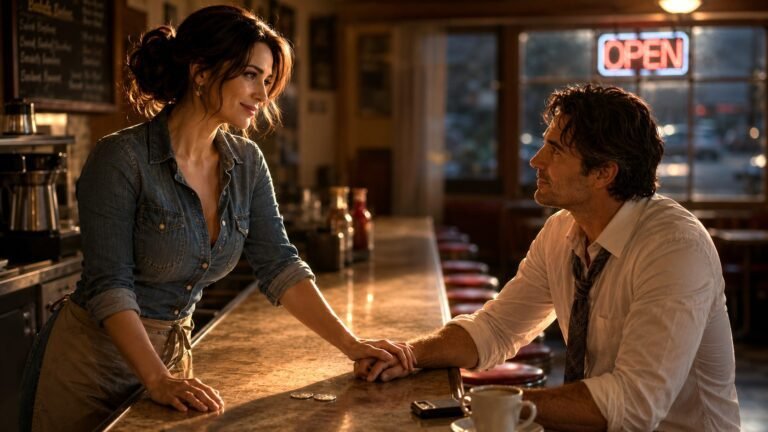
Heartfelt characters sharing love, emotions, and romantic journeys filled with hope, trust, and unforgettable bonds