
Spot Twelve and the Art of Small Victories
Nora Kessler had claimed spot twelve in the Brannigan Court parking lot the day she moved in, three years back, and she guarded it now with a devotion that embarrassed her a little if she thought about it too directly, so mostly she didn’t.
It wasn’t reserved. Nothing in the lot was reserved, a fact the building manager repeated with weary patience every time somebody complained, but Nora had gotten there first that first week, nose-in, close enough to the stairwell that she could carry groceries without her arms giving out halfway, and something in her had decided that this made it hers. She left for her nursing shifts at six-forty every morning and came home at seven-ten every night, and both times, without fail, she eased the car into spot twelve like a key finding its lock, and something in her chest settled half a degree the moment the engine cut.
She had a lot of small rituals like that. She noticed this about herself only in the noticing, never in the doing. The exact fold of her scrub top before she hung it, sleeves in, collar out. The two minutes she spent every morning not moving, coffee mug warming both hands, before she let the day actually start. The parking spot. The specific route she walked from the hospital garage to the ER doors, always the same corner, always the same crosswalk, as though a different path might introduce a variable she wasn’t prepared to meet. All of it small, all of it hers, all of it built, if she was honest, in the eighteen months since Adam had packed a duffel bag and said, in the gentlest voice he owned, that he didn’t think either of them were happy and hadn’t been for a while, and Nora had stood in the kitchen doorway and realized she couldn’t remember the last time she’d asked herself that question either.
She hadn’t cried about it in months. That was supposed to be a good sign, everyone told her so, her sister especially, who used the word “healing” the way other people used the word “Tuesday” — casually, often, without checking whether it was actually true. Nora didn’t feel healed. She felt organized. She had built a life with very clean edges, a life where nothing surprised her because she’d made sure nothing could, and if that wasn’t the same thing as happiness, it was at least the same shape, close enough that most days she didn’t examine the difference.
There was a particular kind of quiet that had moved into the apartment after Adam left, one that had nothing to do with the absence of sound and everything to do with the absence of expectation. She had stopped waiting to be surprised by anything — a phone call, a knock at the door, a schedule change — and had come, instead, to prize the exact opposite. Predictability had become a kind of medicine. She took it in small, regular doses: the same grocery order, the same three shows rotated on nights she couldn’t sleep, the same fifteen minutes on the balcony with tea before bed, weather permitting. She told herself this was contentment, dressed plainly. Some nights, staring at the ceiling long after the tea had gone cold on the nightstand, she suspected it was something closer to hiding, but she didn’t examine that suspicion too closely either. Examining things had a way of unmaking them.
The building was small, six units around a courtyard nobody used, and Nora knew her neighbors the way city people know neighbors — by car, by trash night, by the particular creak of somebody’s floorboards through the ceiling. The man in 4B she knew almost entirely by the back of a gray truck and a general impression of scowling, glimpsed twice a week hauling a toolbox to a job site before dawn, never once nodding when she held the stairwell door. She had decided, without much evidence, that he was the kind of man who considered friendliness an inconvenience, and she had filed him accordingly, in the same mental drawer where she kept other things not worth the energy of reconsidering.
She’d heard his name — Caleb something — from the mail carrier, who complained about the volume of contractor mail he apparently generated, catalogs for cabinet hardware and letters from lumber suppliers, and had filed that away too, without particular interest, the way she filed away most things that weren’t hers to keep.
Her sister called most Sundays, always at the same hour, always with the same gentle probing disguised as small talk. Are you seeing anyone. Are you getting out. Nora had answers rehearsed for both, smooth enough that the conversation never had to linger, and she delivered them the way she delivered discharge instructions to patients too tired to really hear them — clearly, kindly, with no expectation that anything would change as a result. She told herself this was patience. Grief had its own timeline, everyone said so, and she had decided, somewhere in the unmarked months after Adam left, that her particular timeline simply ran long, and that running long was its own kind of virtue, provided nobody looked too closely at what she was actually waiting for.
Which was why, on a Tuesday in early spring, coming home late from a double shift with her feet aching in a way that had become the entire vocabulary of her exhaustion, Nora rounded the corner into the lot and found a gray truck parked, nose-in, unmistakably, infuriatingly, in spot twelve.
She sat in her own car a full minute, engine idling, staring at the truck like it might apologize and move itself. It did not. She circled the lot twice — spot seven was open, spot three, spot nine, all perfectly fine spots, none of them hers — before finally parking in spot nine with the specific, wounded fury of a person who knows the anger is disproportionate and cannot, for the life of her, locate the brakes.
She stood in the courtyard afterward, grocery bags cutting into both forearms, and looked up at the dark windows of 4B, and felt something in her chest that she recognized, uneasily, as the first sharp thing she’d felt in months. It should have alarmed her more than it did. Instead it felt almost like relief — a crack of weather in a sky that had gone flat and gray for so long she’d forgotten skies did anything else.
She didn’t sleep well that night. She lay in the dark turning the shape of her own irritation over like a stone in her palm, surprised by how much room it took up, how loudly it insisted on itself after months of feelings that arrived quiet and left quicker. In the morning she left a note under his windshield wiper — polite, she told herself, though the second draft was considerably less polite than the first, and she’d torn that one up before writing the final version, three lines, no exclamation points, a small miracle of restraint. That’s actually my spot. Not reserved, I know. Just — that’s my spot. She signed nothing, added no name, and told herself this was about principle and not about the strange electricity of picturing a stranger reading words she’d chosen with more care than the situation strictly required.
She didn’t expect an answer. Getting one, the next evening, tucked under her own wiper in handwriting so blunt it looked carved rather than written, was the first surprise. Didn’t see your name on it. — 4B.
Nora stood in the lot holding the scrap of paper, and felt, against every ounce of her considerable good sense, the corner of her mouth lift.
Two Cars, One Spot, and an Apology That Wasn’t
The truck was back in spot twelve the following Tuesday, and the Tuesday after that, an established pattern now, a small territorial war neither of them had agreed to but both seemed, increasingly, unwilling to surrender. Nora started leaving notes as a matter of course — dry, deadpan, escalating in a way that made her laugh out loud once in her own kitchen, alone, at something she’d written about the truck’s parking technique. The notes she got back were shorter, blunter, and somehow, despite themselves, funny in a way that felt entirely unintentional, which made them funnier. She began looking forward to Tuesdays in a way she hadn’t looked forward to anything specific in a very long time, and told herself, unconvincingly, that this was simply the satisfaction of winning an argument.
She met him properly on a Thursday, at the mailboxes, both of them reaching for the same stuck door at the same moment, hands nearly colliding on the little brass handle.
“You’re the note person,” he said. Not a question. Up close he was taller than the back of a truck had suggested, dark hair going gray at one temple only, like a smudge of chalk, and an expression that seemed built, by long practice, to discourage further conversation.
“You’re the spot thief,” Nora said.
Something moved behind his face — brief, almost startled, like he hadn’t expected the accusation delivered so evenly. “Wasn’t your name on the deed last time I checked.”
“Wasn’t your name on the parking lot either.” She got the mailbox open on her second try, more force than the lock required. “Caleb, right? The mail carrier complains about you.”
“Everybody complains about me.” He said it without complaint of his own, a flat statement of fact, the kind of sentence a person says so often it’s stopped costing him anything. “You’re a nurse. Scrubs give it away.”
“ER. Nights, mostly.” She found herself still standing there, mail forgotten in her hand, in no particular hurry to end a conversation she’d started as a joke and now found she didn’t want over. “You do — what, exactly? The mail carrier called it contractor mail like it was a diagnosis.”
“Cabinetry. Custom stuff, mostly. Old houses.” He said it the way some men say embarrassing things, quick, wanting it past him, and Nora understood without being told that this was a man uncomfortable being asked about anything he cared about.
They stood a moment in the small tiled foyer, the kind of silence that should have been awkward and instead sat between them almost companionably, until a fire alarm two floors up went off — false alarm, as it turned out, some tenant’s burnt toast — and sent both of them out into the courtyard with the rest of the building, blinking in the sudden daylight, herded together by an accident of bad cooking.
It was there, standing on the pavement in a loose cluster of irritated neighbors in bathrobes and untied sneakers, that Caleb said something under his breath about the smoke detector policy that made Nora laugh — really laugh, unguarded, a sound that surprised her coming out of her own mouth — and he looked at her sideways with an expression that suggested he hadn’t expected to land a joke, hadn’t perhaps tried to land one in some time, and didn’t quite know what to do with the fact that he had. An older woman from 2A shot them both a look, as if their laughter were somehow the wrong tone for a fire alarm, and that only made it funnier, made Nora press the back of her wrist to her mouth to keep from laughing again.
“You can have the spot back tomorrow,” he said, once the all-clear sounded and people started drifting inside, shuffling in slippers back toward their doors. “Wasn’t trying to start a war over parking.”
“I know,” Nora said. “I think I liked the war a little.”
She hadn’t meant to say it. It came out truer than she’d planned, and she watched it land on him, watched something behind the flat, guarded set of his face shift half a degree, the way a door shifts when the wind finds it, not open yet, but no longer perfectly latched either.
“Spot twelve’s yours,” he said, backing toward the stairwell, something almost like a smile fighting its way into a face clearly unpracticed at hosting one. “I’ll find somewhere else to be a problem.”
He didn’t leave right away, though. He lingered a beat too long at the base of the stairs, one hand on the railing, like a man who’d rehearsed an exit and then found himself unwilling to use it. “For what it’s worth,” he said, “the note you left had better grammar than most contracts I sign.”
“I proofread my hate mail,” Nora said. “Standards matter.”
That surprised a real laugh out of him this time, short and rusty, like a door hinge that hadn’t been used in a while, and he shook his head at himself on the way up the stairs, as if he couldn’t quite account for what had just happened to his own face.
Nora went upstairs that night and stood at her window looking down at the lot, at spot twelve sitting empty in the streetlight, and felt, for the first time in longer than she wanted to admit, the particular unsettled hum of wanting something before she’d decided whether wanting it was safe. She noticed, with some private amusement, that she hadn’t actually parked in spot twelve that evening either. She’d left it open, the way you leave a door unlocked without quite admitting to yourself that you’re hoping someone will try the handle.
The Spot That Neither of Them Uses
Neither of them took the spot back, in the end. That became its own quiet joke, unspoken, both cars parking elsewhere out of what Nora privately thought of as a kind of superstition — as if reclaiming spot twelve, either of them, would break whatever had started at the mailboxes that Thursday.
They fell into proximity by accident, at first, and then by something that stopped pretending to be accidental. The grocery store on Fifth, where Nora shopped after night shifts and found Caleb, more than once, standing in the same aisle at the same absurd hour, buying coffee filters or dish soap with the focused seriousness of a man who did everything, even small things, like it mattered. The coffee shop on the corner, where he apparently worked some mornings with a laptop and a stack of blueprints, and where Nora started arriving twenty minutes before her actual errands required, telling herself this was about the coffee and not about the specific, quiet way he looked up from his work when the bell over the door rang, as though some part of him had been listening for it.
They didn’t call it anything. That was, Nora came to understand, entirely the point — that naming it would have required one of them to admit what it was, and both of them, for their own separate reasons, had gotten very good at not admitting things.
“You ever going to tell me why you moved into a building with no reserved parking and decided a spot was yours anyway,” Caleb asked one evening, both of them out in the courtyard on a bench neither of them had planned on sharing, the streetlight buzzing on above them right on schedule.
“You ever going to tell me why a man who fixes hundred-year-old houses for a living can’t manage a smile without looking like it costs him something?”
He huffed, not quite a laugh, and turned his coffee cup a slow half-circle in his hands, a habit she’d started noticing, the way a person notices weather. “Went through something. Few years back. Not going to make it a whole conversation.”
“Same,” Nora said, and left it there, and found, to her surprise, that leaving it there felt like enough — that the not-saying between them carried more than most of her conversations with people who said everything.
There were evenings after that when they didn’t talk at all, just sat, her feet up on the bench between them after a long shift, his sleeves pushed to the elbow with sawdust still ghosted into the creases of his hands, and the silence did work that speaking never quite managed. She caught herself, some nights, deliberately parking a row over from spot twelve even when it sat empty, just to walk past his truck on the way in, just to see if the porch light in 4B was on. She never examined why the porch light mattered. It simply became, without her permission, a small fact she checked, the way she’d once checked a parking spot, the way a person checks anything they’ve quietly decided to depend on.
“You could just take the spot,” he said once, watching her walk the long way around. “Nobody’s stopping you.”
“I know,” Nora said, and didn’t explain further, because explaining would have meant admitting that some doors were more interesting left half-open than either claimed or shut.
He told her, in pieces, about a marriage that had ended in a way that left him distrustful of rooms that felt too comfortable too fast — a wife who’d wanted a version of him that didn’t include sawdust or long silences or the particular economy of a man who said little because he’d learned that little he said seemed to land right anyway. He told her about the year after, the way he’d taken every job that would send him out of town for a stretch, not because the money was better but because a truck loaded up and pointed somewhere else was easier than an empty apartment that still smelled, faintly, of someone who wasn’t coming back. Nora told him, in pieces of her own, about Adam, about the specific quiet of a kitchen doorway, about how she’d built a life since then with very clean edges because clean edges didn’t surprise you, and being surprised, it turned out, was the thing she’d stopped believing she could survive twice.
“That why you guard a parking spot like it’s Fort Knox,” Caleb said, gentle enough that it didn’t land as mockery.
“That why you park in strangers’ spots and don’t apologize,” Nora said back, and watched him almost smile again, more practiced now, less like it cost him.
There was a Sunday, weeks into whatever this had become, when a storm rolled through hard enough to knock a tree branch onto the courtyard fence, and Caleb was out there in the rain before Nora had even gotten her boots on, dragging the branch clear with his bare hands, soaked through, laughing at something the wind had done to his own hair when she finally made it outside to help. She remembered, afterward, the particular ease of standing beside him in the wet dark, both of them ruined by weather neither had planned for, and how little it had frightened her, how the absence of fear had frightened her more than the storm itself.
Another night, later that month, he showed up at her door with a toolbox instead of a coffee cup, saying only that her kitchen cabinet had been hanging crooked every time he’d glimpsed it through her half-open blind, and did she want it fixed or did she like living with a door that didn’t close right. She let him in without much protest, sat on the counter while he worked, and found herself narrating, unprompted, an entire shift’s worth of ER stories — a boy who’d swallowed a marble, a man who’d insisted for twenty minutes that his broken arm was simply “stiff” — and Caleb listened with the particular stillness of a man who didn’t often get talked to so freely and had decided, somewhere in the last twenty minutes, that he didn’t want it to stop. When he finished, the cabinet door swung shut with a soft, satisfying click, no gap at all, and he ran his thumb along the seam like he was checking his own work against some private standard nobody had asked him to meet.
“You don’t have to fix things to have a reason to come up here,” Nora said, watching him gather his tools.
“Don’t know any other way in,” he admitted, not quite meeting her eyes, and something about the plainness of it — the confession offered sideways, without ceremony — settled into her chest and stayed there long after he’d gone back downstairs.
Neither one said the word that both of them were circling — not love, not yet, something more fragile and less named than that, the specific ache of being known by someone you hadn’t planned on letting see that far in. Some nights Nora lay awake after, replaying the exact angle of his head when he listened, and understood, with a clarity that frightened her more than it should have, that she’d stopped protecting the one thing she’d been most careful with since Adam left — the space where wanting somebody lived, cordoned off, guarded the way she guarded a parking spot, closely, out of habit, out of fear dressed up as routine.
The Night the Spot Sat Empty
The break came on an ordinary Tuesday, the way most human failures do — not from cruelty, not from any single wrong word, but from the exact wound Nora had been carrying since a kitchen doorway eighteen months back, finally finding a shape to attach itself to.
Caleb mentioned, offhand, packing a bag for a job three states over — six weeks, maybe eight, a renovation contract too good to turn down, the kind of work that had made his name in the first place. He said it lightly, the way a man says a fact he hasn’t yet connected to its weight, standing in the courtyard with his duffel already half-packed by the door of 4B, a coil of extension cord looped over one shoulder like it was any other Tuesday.
Nora heard “packing a bag” and heard nothing else. The words did something to her that had nothing to do with logic and everything to do with a doorway she’d never fully walked out of, a specific gentle voice saying he didn’t think either of them were happy, and her body went cold and still in a way she recognized from that night and had promised herself, quietly, she’d never let happen again. Her hands, she noticed distantly, had gone tight around the strap of her bag, knuckles pale, an old reflex surfacing before she’d decided to let it.
“That’s — good,” she said, in a voice gone flat and careful, the voice she used at work delivering news she didn’t want to deliver. “Good for you. The work, I mean.”
“Nora.” He heard something shift in her and reached for it, uncertain, one hand half-lifted like he wasn’t sure yet what to do with it. “It’s six weeks. Not — “
“You don’t have to explain your own life to me.” She was already moving toward the stairwell, faster than the conversation required, her chest tight in a way that had nothing to do with the actual facts on the table and everything to do with facts eighteen months old. “I’ve got an early shift.”
She didn’t have an early shift. She lay awake instead, replaying the sound of a duffel bag zipper, hearing in Caleb’s ordinary, harmless sentence the exact echo of another man packing to leave, and by the time she understood what she’d actually done — punished a good man for the sin of a different man’s leaving — the porch light in 4B had already gone dark, and his truck was gone from the lot by six the next morning, off to the job three states over without a note left on any windshield at all.
For five weeks the lot sat with spot twelve empty and neither car in it, and Nora found herself, every evening coming home, glancing at the bare stretch of pavement with an ache that had stopped pretending to be about parking. She’d catch herself starting texts and deleting them, unsure how to say I mistook you for someone else’s leaving in words that didn’t sound as raw as they felt. She went back, without meaning to, to some of her old rituals — the exact fold of the scrub top, the two motionless minutes with coffee — and found, for the first time, that they didn’t settle anything at all. The clean edges she’d built her life around had started to feel less like protection and more like the walls of a room she’d locked herself inside.
Caleb, three states over, found his own hands going still some evenings over blueprints that should have held his full attention, turning over the memory of a coffee cup and an empty bench, understanding too late that a woman guarding a parking spot had been guarding something else entirely, and that his ordinary sentence about packing a bag had landed on ground already scorched by someone else’s exit. He caught himself, more than once, reaching for his phone with a message half-composed and putting it down again, unsure whether returning to that ground uninvited would only prove her worst instinct right — that men who packed bags always, eventually, kept walking.
What the Empty Spot Was Waiting For
He came back on a Tuesday, fittingly, six weeks and two days after the duffel bag zipper had undone something neither of them had known how to name in time.
Nora heard the truck before she saw it — that particular low engine sound she’d catalogued without meaning to, months of Tuesdays teaching her ears a vocabulary she hadn’t asked for — and came out onto the small balcony off her kitchen just as the gray truck eased, slow and deliberate, into the lot below.
It didn’t pull into spot twelve.
She watched Caleb circle once, unhurried, and park instead in spot nine — her spot, the one she’d taken that first furious night, the one that had nothing to do with either of them and everything to do with a war that had turned, somewhere along the way, into something neither of them had a word for yet.
He got out slow, looked up, found her on the balcony like he’d known exactly where to look.
“Left you the good spot,” he called up, nodding toward spot twelve, empty, waiting, exactly where it had always been. “Figured you’d earned it back. Never should’ve been fighting you for it in the first place.”
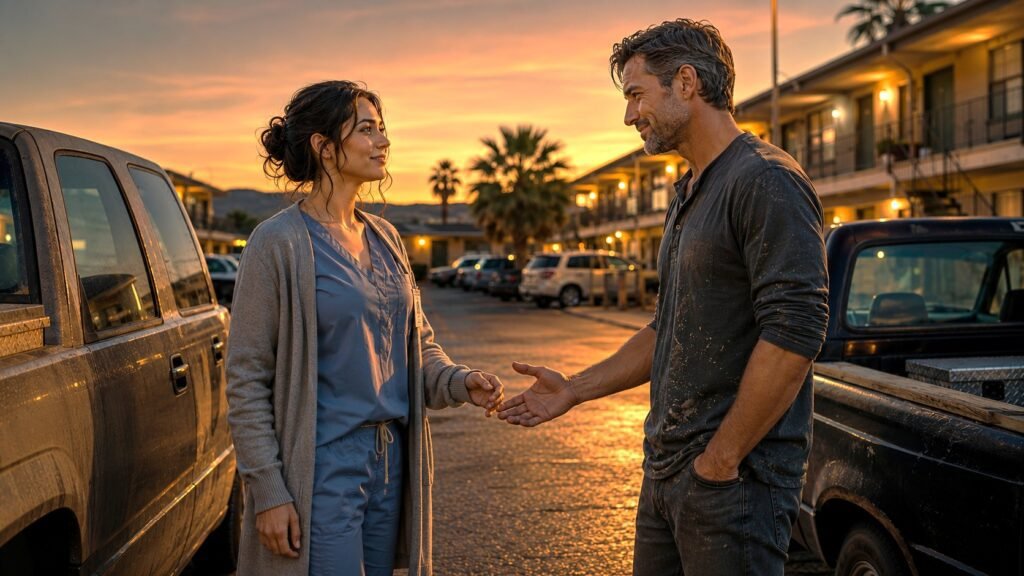
Nora came down the stairwell two at a time, her feet bare on the cold concrete, not stopping for shoes, not stopping for anything, and found him standing beside the truck with his hands loose at his sides, no duffel bag in sight, sawdust still ghosted into the creases of his palms like he’d come straight from work to here, unwilling to waste the drive on anything but arriving.
“I wasn’t punishing you,” she said, before he could speak, because she’d rehearsed this on the stairs and was afraid of losing it. “For leaving. I know that’s what it looked like. I was punishing you for somebody else’s duffel bag. That’s not fair, and I’m sorry, and I understand if six weeks was long enough to decide the parking war wasn’t worth this.”
“Wasn’t the parking war I came back for,” Caleb said, and closed the distance between them with the same unhurried certainty he brought to everything, no rush in it, no doubt either. “Spent six weeks in another state finally understanding I hadn’t been fighting you for a parking spot in months. Was looking for reasons to keep ending up wherever you were.”
“I kept checking for your porch light,” Nora said, half a laugh caught somewhere under the words. “Every night. Like it was going to tell me something the empty spot couldn’t.”
“House three states over didn’t have a porch worth checking,” Caleb said. “Didn’t stop me thinking about this one anyway.”
He reached into the truck bed and lifted out, of all things, a small crooked birdhouse, unfinished, one side still raw and unsanded. “Started this the second week I was gone. Didn’t have a plan for it. Just needed my hands doing something while the rest of me sorted out what to say when I got back.” He turned it over once, self-conscious in a way she hadn’t seen on him before, not even that first Thursday at the mailboxes. “Figured your balcony could use something on it besides an empty coffee mug.”
Nora took it from him, felt the rough grain still catching against her palm, unsanded and unfinished and entirely, deliberately his. “It’s crooked,” she said.
“Built it in a motel parking lot with a borrowed circular saw. Wasn’t exactly optimal conditions.”
“I like it crooked,” she said, and meant it more than the sentence let on.
Nora felt something in her chest come fully unlatched — the last guarded door, the one she’d kept locked since a kitchen doorway eighteen months back, swinging open now not with violence but with the quiet, total permission of a person finally choosing, wide awake, to let someone all the way in.
“The spot’s yours,” she said. “Was always going to be yours. I think I just needed a stranger to fight me for it before I figured out why I wanted him to keep showing up.”
Caleb reached out and took her hand, sawdust-rough, certain, in the exact spot in the lot that had started this — not spot twelve, not spot nine, just the open pavement between two parked trucks where neither of them had planned on standing and both of them, now, had no interest in leaving.
Above them, the streetlight buzzed on early the way it always did, throwing long gold light across the empty stretch of spot twelve, and Nora looked at it once — the space they’d fought over, guarded, finally stopped needing to guard at all — and let Caleb’s hand close fully around hers, warm, present, and entirely, uncomplicatedly there.
Later, on the balcony, she set the crooked birdhouse on the railing where the streetlight caught its raw, unsanded edge, and left it exactly as unfinished as he’d made it, because some things, she was learning, didn’t need smoothing over to be worth keeping.