
A Friday Ritual and a Held Note
Grading papers on a Friday night had become its own kind of ritual for Claire Whitfield, one she performed with a discipline that would have looked, to anyone watching, like devotion, and felt, from the inside, like something closer to armor.
She sat at the kitchen table with a stack of eighth-grade essays on “A Person Who Changed My Life,” red pen capped and recapped between paragraphs, a single glass of wine going warm beside her because she poured it more out of habit than thirst. The apartment was small, clean, arranged with the kind of care that comes from a person who has learned to find comfort in control. Every book on the shelf faced the same direction. Every mug hung from its hook by the same ear. She had built this life, room by room, in the four years since her divorce, and she had built it specifically so that nothing in it could surprise her.
Outside, late October pressed itself against the windows, the kind of gray, wet cold that made the whole town feel like it was holding its breath before winter. Claire liked October for exactly that reason. It matched the weather she carried around most days without naming it — not sadness exactly, more like a held note, low and constant, that she’d gotten so used to she sometimes forgot to notice it was there.
She had a habit, one she’d never confessed to anyone, of keeping a folder in her desk drawer labeled simply “students,” where she filed away the handful of essays each year that undid her a little — the ones about grandmothers who’d passed, about fathers who worked two jobs, about the particular loneliness of being twelve and different in a small town. She told herself the folder was professional development. It was, if she was honest with herself in the specific quiet of a Friday night, the closest thing she had to a diary, a way of feeling something large through the safety of someone else’s story.
Her ex-husband, Michael, had left three years into their marriage with the kind of tired, apologetic finality that made it impossible to even properly hate him for it — he hadn’t done anything dramatic, hadn’t cheated, hadn’t lied, had simply woken up one morning and admitted, gently, that he’d married the wrong life, and Claire had spent the following years understanding that sentence in increasingly uncomfortable ways. She had built herself, since then, into someone entirely reliable. She showed up. She graded the essays. She watered the plants on schedule and never let a library book go overdue. She had decided, without ever fully admitting it, that being unremarkable was safer than being loved and then unchosen, and she had gotten so good at unremarkable that some days it felt indistinguishable from peace.
Her mother called every Sunday at four, and every Sunday the conversation drifted, with the reliability of tide, toward the subject of Claire’s aloneness — gentle at first, framed as concern, and then, as the months accumulated into years, less gentle, more insistent, dressed up as love but landing, more often than not, like an accusation. You’re thirty-four, Claire. You used to have so much light in you. Claire had learned to receive these calls the way she received everything hard: politely, at a slight remove, letting the words pass through her without quite letting them land.
She had, over the years, perfected a particular kind of listening that allowed her to agree with almost anything without actually absorbing it — a nod here, a soft “I know, Mom” there, the verbal equivalent of holding a door open just wide enough to seem welcoming while making sure nothing could actually get through. It had worked, mostly. Her mother eventually moved on to some other worry — the state of the church roof fund, a cousin’s questionable new boyfriend — and Claire would hang up the phone feeling the specific, hollow relief of a person who has successfully avoided a conversation she suspected, somewhere underneath the relief, she actually needed to have.
It was during one of these calls, in the second week of October, that her mother mentioned — too casually, the casualness itself a tell — that she’d run into an old family friend at the pharmacy, a woman named Diane Bennett, whose son had just moved back to town after years away, divorced himself now, doing well, “so handsome still,” and wouldn’t it be nice, her mother said, wouldn’t it just be nice, if Claire let herself be set up on one blind date, just one, just to remember what it felt like to get dressed up for something.
Claire had said no. She had said no with the specific firmness she reserved for arguments she’d already lost the moment they started, because her mother, once she’d decided a thing was good for Claire, had a way of making the decision anyway and simply waiting for Claire to catch up to it.
Which was how, two weeks later, standing in front of her closet on a Thursday evening with a text from her mother reading table for two, 7pm, Rosalie’s, please just try, Claire found herself doing the thing she’d sworn she wouldn’t — pulling out the green dress she hadn’t worn since before the divorce, the one that still, somehow, fit the woman she used to be more than the woman she’d become.
She told herself this was about her mother’s peace of mind and not her own curiosity. She told herself a lot of things, driving to Rosalie’s in the gray dark, gripping the wheel with both hands the way she gripped most things now, carefully, at a manageable distance, prepared for disappointment before disappointment had even had the chance to introduce itself.
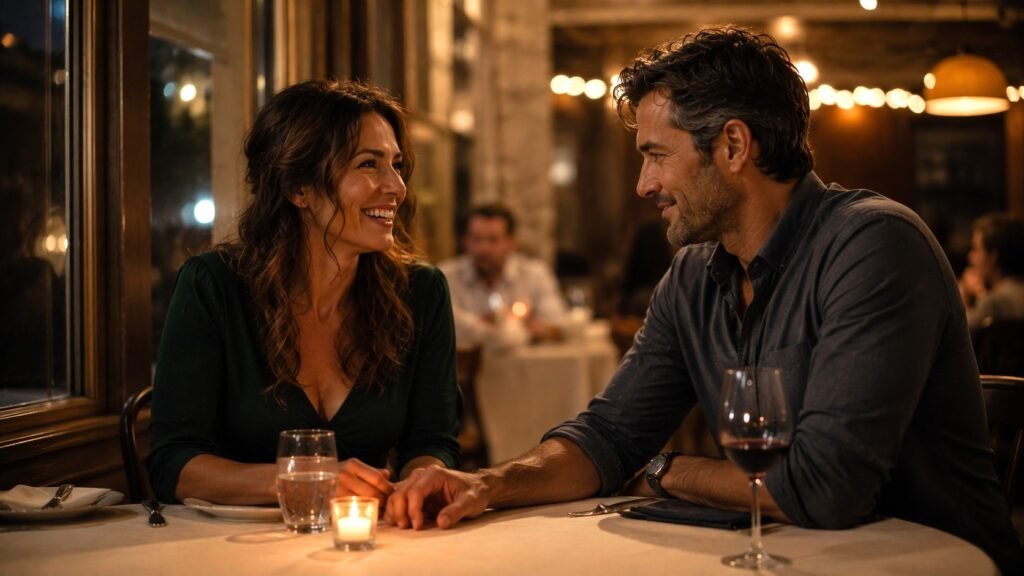
The restaurant was warm and dim inside, candlelight throwing soft gold across white tablecloths, the low murmur of a Thursday dinner crowd settling into its evening rhythm. The hostess, a girl who couldn’t have been older than nineteen, checked a list and smiled the professionally pleasant smile of someone paid to be pleasant.
“Reservation for Whitfield?”
“That’s me.” Claire’s voice came out steadier than she felt.
“Right this way — your date’s already seated.”
Claire followed her through the dining room, past couples leaning close over candlelight, past a table of women laughing at something one of them had said, her heels sounding too loud on the old wood floor, her heart doing something complicated and unhelpful in her chest. The hostess stopped at a table near the back window, gestured with a small flourish, and stepped away.
Claire looked at the man rising from his chair, and the floor of the restaurant seemed, briefly, to tilt.
It was Daniel Reyes. Seventeen years old in her memory, forever standing at her locker with that particular half-smile, forever the boy who’d driven her to the county fair in a truck with a broken radio and sung every song wrong on purpose just to make her laugh. Thirty-four now, standing in front of her in a restaurant her mother had booked, dark hair threaded with the first honest gray at the temples, the same eyes, older now, careful in a way they hadn’t been at seventeen, watching her with an expression that suggested he was every bit as ambushed as she was.
The Table by the Window
“Claire,” he said, and the sound of her name in his voice did something to the whole architecture of the evening that she hadn’t prepared for at all.
“Daniel.” She heard herself say it, watched her own hand accept the chair he’d pulled out for her, some autopilot version of herself managing the mechanics of sitting down while the rest of her tried to catch up to the fact of him. “My mother didn’t mention a name.”
“Mine either.” He sat back down slowly, still watching her like she might turn out to be a trick of the candlelight. “Diane just said ‘a lovely woman from town,’ like I was being set up with a stranger and not — ” He gestured, helpless, between them. “This.”
“Seventeen years of a stranger, maybe.”
“Seventeen years.” He said it like he was testing the weight of the number. “You look — ” He stopped himself, visibly reconsidering, and something in the reconsideration made Claire’s chest go warm despite every instinct telling her to stay guarded. “You look like you. That’s all. Just — you, older. Good older.”
“That’s a low bar to clear and you still almost didn’t.”
That surprised a laugh out of him, real and unguarded, the kind of laugh she remembered from a truck with a broken radio, and for a moment the seventeen years folded up small enough to fit in the space between two water glasses.
A waiter appeared, recited specials neither of them absorbed, and left them alone with menus neither of them opened right away. Claire studied Daniel across the candlelight — the same jaw, sharper now with age, the same habit of tapping two fingers against the table when he was thinking, a habit she hadn’t remembered until she saw it and then couldn’t stop noticing.
“Your mother tell you anything about me,” Daniel asked, “before she sent you in here blind?”
“Only that some family friend’s son moved back to town, divorced, doing well. She left out the part where the son was my high school boyfriend.”
“To be fair to her, that might’ve been the whole selling point and she just forgot to close the deal.”
“You think my mother orchestrated this on purpose.”
“I think your mother,” Daniel said, “has apparently been talking to mine, and I think two women who’ve known each other forty years don’t accidentally sit their kids across from each other at Rosalie’s.”
Claire looked at him for a long moment, something uneasy and warm braiding together in her chest. “That’s either the most romantic or the most humiliating thing I’ve heard all week.”
“Can’t it be both?”
The waiter returned, and they ordered without much thought, and somewhere between the appetizer and the first real lull in conversation, Claire found the evening doing something she hadn’t expected it to do at all — it started, cautiously, to feel easy. Daniel asked about her students, and actually listened to the answer, laughing in the right places at the story about the boy who’d written his entire essay about a goldfish named after a Supreme Court justice. She asked about the years she’d missed — a marriage that had ended two years back, no children, a stint in Denver doing something with structural engineering that he described with the specific modesty of a man who was good at his job and uncomfortable admitting it.
“You always did that,” Claire said. “Undersell yourself. You were valedictorian and told everyone it was a scheduling fluke.”
“It mostly was.”
“It was not. I sat behind you in three AP classes. You worked for it.”
Something shifted in his face at that — surprised, maybe, that she’d kept the memory this long, filed away the way she filed away her students’ best essays, the ones that undid her a little.
There was a moment, midway through the meal, when the restaurant’s ancient heating system kicked on with a loud, undignified clank, startling half the dining room and sending one waiter’s tray perilously close to disaster, and Daniel caught Claire’s eye across the table with an expression of such pure, silent commentary on the absurdity of it that she laughed before she could stop herself, laughed the way she hadn’t laughed in a restaurant in longer than she wanted to calculate, unguarded, real, gone before she’d decided to let it happen.
“There she is,” Daniel said, quiet, almost to himself, and Claire felt the sentence land somewhere she hadn’t given anyone access to in years.
“There who is?”
“The girl who laughed at everything in that truck with the broken radio. Wasn’t sure she made it to thirty-four.”
Claire didn’t have an answer for that, not one she trusted herself to say out loud, so she picked up her water glass instead and let the silence do something speech couldn’t have managed.
By the time the check came, neither of them reached for it fast, both a little slower than the moment required, both aware, without saying so, that the evening had become something neither of them had walked in expecting. Outside, the October cold hit them both at once, and Daniel walked her to her car with his hands in his pockets, the particular careful distance of a man not wanting to presume.
“For what it’s worth,” he said, at her car door, “if our mothers hadn’t ambushed us, I probably would’ve spent another few years too much of a coward to look you up.”
“For what it’s worth,” Claire said, “I’m glad they did.”
She drove home with the heater running and her chest doing something unfamiliar and terrifying, something she recognized, distantly, as the first real want she’d let herself feel in four careful years, and understood, with a clarity that unsettled her more than it should have, that whatever this was, it had already changed the shape of the following morning before it had even arrived.
What Neither Says Out Loud
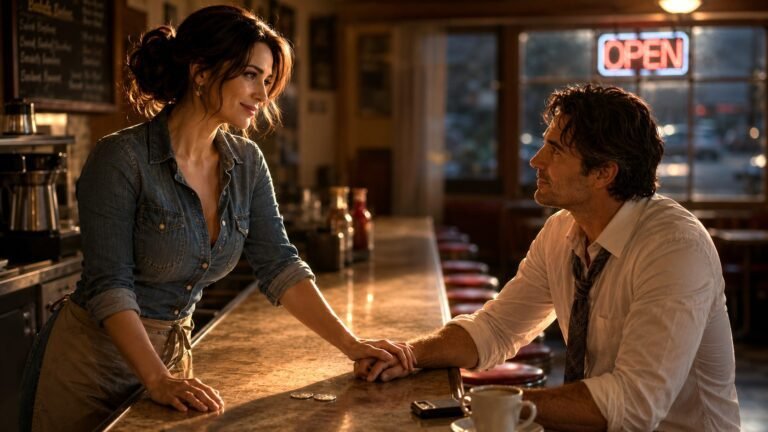
The second date happened without either of them formally calling it one. Daniel texted three days later — no preamble, just a photograph of a goldfish in a pet store tank with the caption thinking of your student’s essay — and Claire found herself typing back before she’d decided whether responding was wise. What began as an exchange of small, low-stakes messages became, over the following weeks, a rhythm neither of them named. Coffee after her Thursday parent-teacher conferences, because his office happened to be three blocks from the school and he happened, always, to be free right around four-thirty. A walk along the river path on a Sunday when her mother’s call ran short and left her restless. A shared basket of onion rings at the diner on Main, eaten mostly in comfortable silence while a football game neither of them cared about played on the television above the counter.
Claire noticed, with the same wary attention she gave everything now, the small ways Daniel had and hadn’t changed. He still tapped two fingers on any flat surface when he was thinking something through. He still undersold every accomplishment, mentioning almost as an afterthought that the bridge retrofit he’d led in Denver had won some regional award, the kind of detail most people would have led with. He had grown, though, into a stillness he hadn’t had at seventeen — a way of listening that didn’t rush to fill silence, that let a sentence sit exactly as long as it needed to.
“You do this thing,” he said one evening, both of them on a bench by the river, watching the last of the light go gold and then gray over the water, “where you apologize for talking too much and then keep talking anyway. Like you’re negotiating permission with yourself in real time.”
Claire felt something in her go still, caught. “Do I?”
“You’ve done it four times tonight. I counted.”
“That’s either very attentive or slightly unsettling.”
“Can’t it be both?” He echoed his own line from Rosalie’s, and she felt the callback land somewhere warm, evidence that he’d been keeping track of her too, cataloguing her the way she’d been cataloguing him.
She didn’t tell him, not that night, about the folder in her desk drawer, about the specific loneliness she’d built her whole adult life around managing rather than solving. But she found herself, over the following weeks, saying truer things than she’d planned to say — admitting, once, over the onion rings, that Michael’s leaving hadn’t broken her so much as confirmed something she’d already suspected about herself, that she was the kind of woman people left gently, without malice, simply because staying had stopped feeling necessary.
Daniel had gone very quiet at that, turning his glass a slow half-circle on the table, and said, finally, “That’s not a fact about you. That’s a story you decided about yourself because it hurt less than not having an explanation.”
“That’s very generous.”
“It’s not generous. It’s just true.” He looked at her steadily, the same careful eyes from the restaurant, older now, more deliberate. “I left this town at twenty-two because I was terrified of becoming my father — a man who stayed exactly where he was planted and called it contentment. Took me until my thirties in Denver, alone in an apartment I never bothered to decorate, to understand I hadn’t run from staying still. I’d run from being known. There’s a difference, and it took me a long time and a divorce of my own to see it.”
Claire sat with that, aware of the particular danger of a sentence like his — the way it invited a matching honesty she wasn’t sure she had ready.
There were nights after that when neither of them said much of anything, just walked, her arm occasionally brushing his, both of them acutely aware of the brushing and neither of them acknowledging it, the unspoken humming between them louder, some evenings, than anything either could have said aloud. He walked her to her car every time and never once presumed more than her hand, held a beat too long at the door, released before either of them had to decide what holding on longer would mean.
One Saturday, driving back from an errand neither of them had really needed to run together, they passed the old county fairgrounds, dark and shuttered for the season, and Daniel slowed the truck without being asked, some old instinct pulling him toward the entrance the way a hand returns to a scar. They sat there a moment in the idling quiet, looking at the empty midway through the windshield.
“Broken radio’s long gone, I imagine,” Claire said.
“Truck’s long gone too. Traded it in Denver for something practical.” He said the word practical like it tasted faintly of regret. “Some nights I missed that radio more than I missed the truck. At least the silence in that thing was honest about being broken.”
Claire looked at him, something loosening further in her chest. “Is that a metaphor, or are you just telling me about a truck?”
“Depends how much you want it to be a metaphor.”
“I want it to be a metaphor.”
“Then it’s a metaphor,” Daniel said, and put the truck back in gear, and neither of them said anything else about it, because some things, once named even glancingly, didn’t need to be named again to keep doing their work.
“You ever think about what our mothers actually wanted,” Claire asked one night, “when they set this up? Whether they knew, or just hoped?”
“I think they knew,” Daniel said. “I think two women who’ve watched their kids go quiet for years finally got tired of waiting for us to fix it ourselves.”
“That’s either very romantic or a little bit terrifying.”
“By now you know my answer to that.”
They stood at her car a long moment, close enough that Claire could feel the specific warmth radiating off him in the cold, close enough that some current in her chest kept insisting this was the moment, the exact hinge point where the evening might tip into something neither of them could take back. Daniel’s hand came up, slow, and brushed a strand of hair from her face with a carefulness that undid her more than urgency would have, and for a suspended second neither of them breathed.
“Claire,” he said, low, and it was the same way he’d said her name at Rosalie’s, except this time it carried three weeks of accumulated weight behind it. “I keep almost saying something and then deciding it’s too soon.”
“Say it anyway.”
“I don’t want to be one more person who wants you and then decides, six months in, that wanting you was too much work.” His thumb traced, once, the line of her jaw, and Claire felt the words land somewhere she hadn’t protected in years. “I need you to know I’m not going anywhere before I let myself actually be here.”
Claire’s whole chest had gone tight, unguarded in a way that frightened her precisely because it felt so much like relief. “I don’t know how to believe that yet.”
“Then don’t believe it,” Daniel said. “Just let me keep showing up until you do.”
He didn’t kiss her that night. He simply held her hand a beat longer than the goodbye required, and drove away, and Claire stood in the cold long after his taillights had disappeared, feeling the exact shape of a fear she hadn’t looked at directly in four years finally beginning, reluctantly, to loosen its grip.
When Two Weeks Became the Wound
The fracture came ten days later, and it came, as these things do, from exactly the wound that had built her life around avoiding it in the first place.
Daniel mentioned, over a phone call that started ordinary and stayed ordinary right up until it wasn’t, that Denver had called again — not the old job, but a colleague, offering him a two-week consulting stint on a bridge project too specialized to easily decline. He said it the way a man says a scheduling fact, already halfway to assuming she’d understand, already assuming the two weeks would matter to neither of them the way it was about to matter enormously to her.
“Two weeks,” Claire repeated, and felt the floor of the conversation tilt the same way the restaurant floor had tilted the night she first saw him at that table.
“It’s just consulting. In and out.” He must have heard something change in her voice, because he backtracked slightly, gentler. “I wasn’t going to take it without talking to you first, but I figured — “
“You figured right. Take it.” The words came out clipped, professional, the voice she used with difficult parents at conferences. “You don’t need my permission to take a job, Daniel.”
“That’s not what I meant.”
“I know what you meant.” She was already standing, already moving toward the window the way she used to move toward doorways, putting distance between herself and a conversation that had stopped feeling safe. “I’m just saying you don’t need to explain yourself to me like this is a big decision. It’s two weeks. People go on trips.”
But it wasn’t the two weeks. It was the word Denver, the word consulting, the specific echo of a man who’d once told her, gently, that he’d married the wrong life and simply left to go find the right one — and underneath the echo, older and quieter, the specific fear she’d built her whole four careful years around managing: that wanting someone fully was the surest way to discover, eventually, that staying had stopped feeling necessary to them too.
“Claire, this isn’t Michael. I’m not leaving.”
“I didn’t say you were.”
“You didn’t have to. I can hear it in how fast you’re trying to get off this call.”
She didn’t correct him, because he wasn’t wrong, and the not-correcting sat in the silence between them like something neither of them knew how to lift. “I’ve got papers to grade,” she said finally, and heard how thin it sounded even as she said it. “I’ll talk to you before you leave.”
She didn’t talk to him before he left. For six days she let his texts go answered in single words, let his calls ring twice and then stop ringing at all, told herself this was self-protection and not the same old cowardice dressed in a new outfit. She sat some nights at her kitchen table with the ungraded essays stacked in front of her, red pen capped, unable to focus on a single sentence, aware of the specific, familiar ache of having built a wall exactly where a door had finally started to open.
Daniel, three states away, found his own hands going still over blueprints more than once, replaying the tilt in her voice, the fast retreat toward the window, understanding — slower than he wanted to admit, but understanding all the same — that a woman who filed her students’ saddest essays into a private folder had likely filed his ordinary business trip into some older, rawer category entirely, one that had nothing to do with him and everything to do with a marriage that had ended with no warning at all. He typed messages and deleted them, unsure whether pushing further would only prove her fear correct — that a man who left, even briefly, was a man rehearsing how to leave for good.
Back to the Table That Started It
The bridge project finished in eleven days, not two weeks, and Daniel drove home the moment it did, six hours through the night, without calling ahead, because some conversations, he’d decided somewhere around hour four, were better arrived at than announced.
He didn’t go to her apartment. He went, instead, to Rosalie’s, and asked the same nineteen-year-old hostess, gray with fatigue after a night shift she clearly hadn’t planned on, whether he could take the same table by the back window, the one from six weeks ago, and whether she’d mind delivering a note to a woman named Claire Whitfield if he called the school in the morning and asked her to come.
Claire got the message from the school’s front office secretary during her lunch period — a folded note, no explanation, just an address she recognized instantly and a time, seven o’clock, and her own name written in handwriting she’d have known anywhere, blunt and careful at once, a man’s version of trying too hard not to try too hard.
She almost didn’t go. She stood in her kitchen at six-thirty with her coat half-on, the old fear rehearsing its familiar argument — that showing up meant risking the exact unchosen feeling she’d spent four years building a life to avoid, that staying home was safer, that safer had, after all, gotten her this far. But she thought of the folder in her desk drawer, of every essay in it about grandmothers and fathers and the particular loneliness of being different, of how she’d spent years finding herself in other people’s bravest, saddest stories instead of writing one of her own, and she put her coat all the way on.
The restaurant was quieter this time, a Tuesday instead of a Thursday, candlelight throwing the same soft gold across the same white tablecloths. Daniel stood the moment he saw her, the same rising motion from six weeks ago, except now his face held none of the careful ambush from that first night — just a plain, unguarded hope that he didn’t try to hide.
“You came,” he said.
“I almost didn’t.” Claire stood at the edge of the table, not sitting yet, needing to say the next part standing up. “I spent six days making you into someone you never asked to be. Michael left because staying stopped feeling necessary. You left for eleven days to consult on a bridge, and I made it the same story, because the same story was easier to survive than a new one where I might actually lose someone I let myself want.”
“I should have called you before I said yes to the trip. Not after.”
“You don’t owe me permission for your own life, Daniel. That’s not what I need from you.” She finally sat, hands flat on the table, the same table where seventeen years had first folded up small enough to fit between two water glasses. “What I need is to stop deciding, in advance, that everyone eventually leaves. And I can’t blame you for a decision I made on my own, in my own kitchen, with the phone in my hand and every excuse not to answer it.”
Daniel reached across the table, slow, the same careful economy of movement he’d used to brush the hair from her face three weeks earlier, and covered her hand with his. “I drove six hours straight because I kept thinking about what you said, the first night, about our mothers finally getting tired of waiting for us to fix this ourselves. I don’t want to be one more thing you have to fix on your own, Claire. I want to be the thing you stop bracing yourself against.”
“That’s a big thing to want.”
“I’ve had eleven days on a bridge site with nothing to do but want it.”
Claire felt something in her chest that had been clenched since the night of his phone call finally, slowly, begin to release, the way a fist unclenches once it understands the danger has actually passed. “I kept the folder,” she said, and watched his face go carefully curious. “In my desk. I never told you about it. It’s full of my students’ essays — the ones that get to me. About grandmothers, about fathers, about kids figuring out how to be different in a town that doesn’t always make room for different. I used to think it was the safest way to feel something big. Through somebody else’s story instead of my own.”
“And now?”
“Now I think I’d rather write one of my own for a while. Even the scary parts.” She turned her hand over under his, palm to palm, an answer more honest than anything she’d said aloud in years. “Even the part where I panic because someone I want turns out to actually want me back.”
Daniel’s thumb moved once, slow, across her knuckles, an echo of the jawline he’d traced three weeks before, except this time neither of them pulled back to reconsider. “Then let’s write the version where nobody drives six hours home to an empty apartment because they were too scared to knock on the right door.”
“You didn’t knock on my door. You went to a restaurant and sent a note through the school office like a teenager.”
“I panicked a little too,” Daniel admitted, and the honesty of it, offered without defense, undid something in Claire that six days of silence hadn’t managed to protect.
The nineteen-year-old hostess passed their table twice without either of them noticing, and somewhere near the back of the restaurant the ancient heater clanked on with the same undignified shudder as six weeks before, and this time Claire didn’t just laugh — she reached across the table with her free hand and covered both of theirs together, sealing the small, absurd, perfectly ordinary sound into something neither of them would ever hear again without remembering exactly this moment.
“For what it’s worth,” Daniel said, echoing himself for the second time that night, “I think our mothers might actually be geniuses.”
“Don’t tell them that. They’ll never let either of us live it down.”
“Worth it,” Daniel said, and lifted her hand to press, once, unhurried, against his mouth — not a grand gesture, nothing choreographed or rehearsed, just a man finally allowed to do the small, ordinary thing he’d been holding back since a table by a window six weeks before.
Claire watched the candlelight catch in his eyes, watched seventeen years and six weeks and eleven days and six lonely hours all collapse down into the exact warm pressure of his lips against her knuckles, and understood, with a certainty that finally felt less like risk and more like arrival, that she had stopped bracing for the moment he’d decide to leave, because some part of her, at last, believed he wouldn’t.
Outside, the October cold waited exactly where it had waited before, but this time, walking out into it together, Daniel’s hand found hers without hesitation, without the careful, held-back distance of six weeks earlier, fingers lacing through fingers the way two people lace their lives together one small, deliberate choice at a time — and Claire, stepping into the dark toward two cars parked side by side under a streetlight just beginning to flicker on, let herself be led, for once, instead of bracing for the door to close behind her.
Suggested category: Slow Burn Romance
Suggested tags: second chance romance, reunion story, small town love story, blind date romance,

Heartfelt characters sharing love, emotions, and romantic journeys filled with hope, trust, and unforgettable bonds