
Alone Among the Wilting Orchids
The bell above the door of Wildroot Flowers hadn’t rung all afternoon, and Elena Marsh had stopped expecting it to. Outside, the maples along Cedar Street had gone the color of rust and old blood, and a wind that smelled like the first frost pushed dead leaves against the shop’s window in slow, scraping circles. She liked the sound. It matched something in her chest that had been scraping for two years now, quiet and persistent, never quite loud enough to notice unless the shop went silent like this.
She moved through her closing routine the way she always did, in the exact order, because order was the only thing that still made sense to her. Water the orchids first — not the roses, not the ranunculus, the orchids, because they punished neglect the fastest. Then sweep the trimmings from the worktable into the compost bin. Then count the till twice, even though it never varied by more than a dollar. Then, last of all, the part of the ritual she never told anyone about: she would take down the white porcelain vase from the highest shelf, the one that had never once held flowers, and she would dust it, and she would set it back exactly where it had been.
The vase had been a wedding gift. Not for her wedding — there hadn’t been one — but for the wedding that was supposed to happen, back when she still let herself believe that a date on a calendar meant something fixed and permanent, back before Daniel had stood outside this very shop eleven months before their ceremony and told her, gently, like he was doing her a favor, that he’d met someone else at a conference in Denver and that he was sorry, that he hadn’t meant for it to happen, that these things just happen sometimes.
These things just happen sometimes. She had turned that sentence over in her mind so many times it had worn smooth, like a stone in a riverbed. It had been the last time anyone called her his fiancée. The word had a shine to it once — she remembered trying it out loud in the mirror before she’d even told her mother, feeling the strange new weight of it on her tongue — and now it sat in a drawer somewhere in the back of her mind like a ring nobody wore anymore, taken off and never quite thrown away.
She dusted the vase. She always dusted the vase.
The orchids on the counter were struggling again — moth orchids, finicky things, prone to dropping their blooms if she so much as changed the angle of the sun on them — and she misted their roots with more attention than the task required, the way she gave attention to anything that refused to die but also refused to fully live. There was one particular plant, a pale lavender phalaenopsis that a customer had abandoned two winters ago, unclaimed and unpaid for, that she had never been able to throw away. It hadn’t bloomed since. She kept watering it anyway. Some habits didn’t need to make sense to be kept.
Outside, the wind picked up, and a shutter across the street banged twice against its frame before someone came out to fix it. Elena watched through the window with the particular loneliness of a person who has arranged her life so precisely around being alone that the arranging itself has become a kind of company. She had the shop. She had her sister’s monthly phone calls, always ending in the same gentle interrogation about whether she was seeing anyone, was she getting out, was she happy. She had the ache in her lower back from twelve years of standing at a worktable, and she had this hour, every evening, when the town went the color of a held breath and she let herself feel, just slightly, how much smaller her life had become since the wedding that never happened.
She did not think of herself as bitter. Bitterness required a kind of active grievance, a fist held up against the world, and Elena had none of that left in her. What she had instead was a quieter thing — a conviction, settled so deep it no longer felt like a belief at all but simply like weather, that permanence was a story people told each other before the story changed. Rings got returned. Vows got broken. The word forever was something florists put on greeting cards, not something that lived anywhere real.
She locked the register. She turned off the front lights, leaving only the small lamp above the worktable burning, because she wasn’t quite ready yet to walk out into the empty apartment above the shop, where the second half of her bed had stayed smooth and undisturbed for two years, a monument nobody else could see.
That was when the bell above the door rang — sharp, urgent, wrong for the hour — and a man she had never seen before stumbled in out of the wind, soaked at the shoulders from a rain that had apparently just started, holding a phone to his ear and saying, in a voice tight with something close to panic, “I don’t care what it costs, I need it fixed by seven, my grandmother is not missing this dinner—”
He looked up. He saw Elena standing very still behind the counter, a watering can in one hand and the whole quiet architecture of her evening about to come down around her ears.
A Storm-Soaked Collision at the Flower Shop
He was, Elena would think much later, the least composed man she had ever seen wearing a two-thousand-dollar coat.
“You’re open,” he said, as though she might dispute it, water dripping steadily off his dark hair onto the reclaimed-wood floor she’d swept twenty minutes before.
“Barely,” Elena said. “We close in five minutes.”
“Then I need five minutes’ worth of miracle.” He ended his call without saying goodbye to whoever was on the other end and crossed to the counter in three long strides, and up close she could see that his composure was a thing he was actively constructing, plank by plank, over something close to desperation. “I need a bouquet. A specific bouquet. White peonies, if you have them, or garden roses, something that reads — ” he made a gesture with his hand, searching for the word “— established. Not trendy. Not first-date flowers.”
“It’s October,” Elena said. “I don’t have peonies in October.”
“Then whatever the closest thing is.”
“To what, exactly?”
He stopped. For the first time since he’d come through the door, he actually looked at her — not through her, not past her toward the emergency he was trying to solve, but at her, and something in his face shifted, embarrassed and a little wry, like he’d just realized how he must sound. “Sorry,” he said. “It’s been a day. My name is Marcus Reyes, and in roughly ninety minutes I am supposed to walk into my grandmother’s house with a fiancée on my arm, and the woman who was supposed to be playing that role just called to say she’s stuck in Hartford with a flat tire and no spare, and there is no version of tonight that goes well if I show up alone.”
Elena set the watering can down very slowly. “You need flowers for a fiancée who isn’t coming.”
“I need flowers for a dinner that is about to fall apart,” he said, dragging a hand down his face, and for a moment the expensive coat and the clipped, efficient voice fell away entirely and what was left was just a tired man standing in a flower shop in the rain. “My grandmother is eighty-six. She has maybe six good months left, the doctors think, and her one condition for signing over the inn to me instead of selling it to a hotel chain that will gut it and put a spa where the dining room is, is that she gets to see me settled before she goes. Engaged. Not married, she’s not unreasonable, just — engaged. Committed to something. And I let her believe that had already happened, because I panicked, months ago, in a moment I would very much like to go back and un-live, and now there is a woman my grandmother has been planning a menu around for three weeks, and she isn’t real, and in ninety minutes I am supposed to produce her.”
There was a silence, and then, absurdly, he laughed — a short, disbelieving huff of a laugh at his own catastrophe — and Elena felt her mouth twitch despite herself, because there was something almost admirable about a disaster constructed this thoroughly.
“So you came in for flowers,” she said, “to bring to a dinner, for a fiancée who doesn’t exist, to convince a dying woman that you’re happy.”
“When you say it like that it sounds worse.”
“It sounds exactly as bad as it is.”
He looked at her for a long moment, rain still beading at his collar, and something calculating moved behind his eyes — not unkind, but sharp, the look of a man doing fast math on a narrowing set of options. “What’s your name?”
“Elena.”
“Elena.” He said it like he was trying it for weight. “Elena, I understand this is an enormous thing to ask of a stranger, and I will pay you generously for your evening, and it is one dinner, ninety minutes, maybe two hours if my uncle starts in on politics — but I need someone to walk in on my arm tonight and let my grandmother believe, for one dinner, that I am not the disappointment she has always half suspected I might become. I need someone to pretend to be engaged to me. Just for tonight.”
The old Elena — the one who still believed in things — would have laughed him out of the shop. The Elena standing there now, who hadn’t been anyone’s anything in two years, who watered a dead man’s orchid every evening out of a loyalty she couldn’t explain, felt something colder and more practical move through her instead. Her sister’s wedding was in the spring. The shop’s lease was up for renewal in January, and the new rate the landlord had quoted her would eat what was left of her savings within four months.
“How generous,” she said, “is generous?”
Something shifted in his face — relief, and beneath the relief, surprise, as though he hadn’t expected her to actually consider it, and beneath that, something warmer that he seemed to catch himself having and quickly smooth away. “Enough to keep the lights on in here through winter,” he said. “I did notice the sign in the window.”
“That sign’s been up for a month. I was starting to think nobody read it.”
“I read everything,” he said. “It’s a professional hazard.” And then, unexpectedly, he smiled — really smiled, not the tight social approximation of one he’d been wearing since he walked in — and it changed his whole face, took ten years and several pounds of worry off it at once, and Elena felt the shape of that smile land somewhere in her chest she hadn’t given anyone access to in a long time. “For what it’s worth,” he added, glancing at the shop around them, the buckets of late dahlias, the wall of dried lavender, “you’re better at negotiating than most of my board.”
“I’ve had less practice being polite about it.”
“That’s obvious. It’s working, though.” He held out his hand, water still dripping from his sleeve onto the floor between them. “One dinner. That’s all I’m asking.”
Elena looked at his hand for a long moment — an ordinary hand, a little cold from the rain, nothing about it should have mattered — and then she shook it, and the deal was made, and neither of them, in that instant, understood that they had just agreed to something neither of them would be able to walk back from.
The Dinner, and Everything Left Unsaid
The drive to the inn took eleven minutes, and Elena spent every one of them memorizing the details he fed her in a low, urgent voice — how they’d met (a charity gala, eighteen months ago, she’d been arranging the centerpieces), how long they’d been engaged (four months, the ring was being resized, that was why she wasn’t wearing it, a lie so tidy it made her almost admire him), what his grandmother’s name was (Rosa), what not to bring up (his father, under any circumstances). By the time the car turned up the long gravel drive toward a rambling white farmhouse strung with lights, Elena had absorbed an entire fictional relationship the way she once absorbed real ones, carefully, like something she meant to keep.
Rosa Reyes turned out to be a small, sharp-eyed woman in a cardigan the color of the dahlias in Elena’s shop, and she took Elena’s face in both hands the moment they were introduced, studying her the way Elena studied a bloom for signs of what it would become. “You’re prettier than the pictures he showed me,” Rosa said, which meant, Elena understood with a private jolt, that there had been pictures — that Marcus had gone to lengths she hadn’t been told about to make this fiancée real before she ever existed. She caught his eye across the room and found him already watching her, faintly apologetic, faintly something else.
Dinner unfolded around a table crowded with cousins and an uncle who did, in fact, start in on politics, and Elena found herself falling into the rhythm of the evening with an ease that unsettled her a little — laughing at the right moments, resting her hand once, briefly, on Marcus’s forearm when Rosa asked how he’d proposed, watching him invent an answer on the spot about a hike and a sunset that was so specific, so unnecessarily tender in its details, that for a moment Elena forgot it wasn’t true. Under the table, his knee found hers, not quite by accident, and stayed there, warm, throughout the rest of the meal, a small anchor neither of them acknowledged.
It was near the end of dinner, when Rosa excused herself and the table’s attention scattered, that Marcus leaned close and murmured, close enough that his breath moved the loose strand of hair at Elena’s temple, “You’re better at this than I am.”
“I’ve had less to lose,” Elena said, which was truer than she meant it to sound.
He studied her for a moment, something quiet and searching in his face, and didn’t ask what she meant. That, she would think later, was the moment the dinner stopped being only a performance — the moment he let a silence sit between them instead of filling it, and let her keep what she hadn’t offered.
They didn’t touch again after the coffee was cleared, not really, but something had shifted, some line crossed without either of them naming it, and when he drove her home the conversation between them had none of the brittle efficiency of the ride out. He asked about the shop — really asked, wanting the answer — and she told him about her grandmother, who had taught her to arrange flowers on the kitchen table of a house in Vermont, and about the way she’d built Wildroot out of nothing after the wedding that hadn’t happened, though she didn’t say that part, only that the shop had come from something that broke.
“One dinner,” he said again, when he walked her to her door, and there was something rueful in it now, an admission that the phrase had already stopped being quite true. “I owe you an actual thank-you. Not a performance of one.”
“You’re welcome,” Elena said, and meant it, and found she wasn’t in any hurry for him to leave.
He didn’t, not right away. He stood on the sidewalk in the last of the rain’s drizzle, hands in his coat pockets, and looked at her the way he’d looked at the flowers he’d wanted, searching for a word that read as something more than convenient. “Rosa wants to have you both to dinner again,” he said finally. “Properly. Not an engagement she was told about secondhand — a real evening, once a month, while she’s — ” he stopped, and something crossed his face that had nothing to do with strategy. “While there’s still time for her to have that.”
Elena should have said no. The deal had been one dinner, and one dinner had been generous and simple and finite, a transaction with an ending built in, and every rational instinct she owned told her to end it there, cleanly, before it turned into something with edges that could cut her.
“Okay,” she said instead, and watched something in him loosen with relief he didn’t bother hiding, and understood, standing there in the wet October dark, that she had just agreed to keep pretending — and that some small, unguarded part of her no longer minded that the word fiancée had started to feel less like a costume and more like a shape she was quietly growing into.
What the Silence Between Them Cost
The months that followed rearranged themselves around a rhythm Elena hadn’t chosen but couldn’t quite regret — Sunday dinners at the inn, Rosa’s sharp eyes softening a little more each visit, and in between, small collisions that had nothing to do with the arrangement at all. Marcus dropping by the shop with coffee on ordinary Tuesdays. A hand at the small of her back that lingered a half-second longer than any pretense required. A night in November when a burst pipe flooded half his office and he showed up at her door at eleven, and they sat on her floor sorting soaked paperwork and laughing until it wasn’t about the papers anymore, and he looked at her in a way that made the empty half of her bed feel, for the first time in two years, like an oversight rather than a fact.
Neither of them said the word real. That was the shape the silence took between them — not absence, but a held breath, a thing too large to name because naming it meant admitting the whole arrangement had outgrown its reason for existing. He would reach for her hand crossing a street and then release it a block later, as though remembering the rules of a game they’d both quietly stopped playing by. She caught herself, one evening, watering the abandoned orchid on her counter and noticing, astonished, the faint green nub of a new bloom spike pushing up from a stem she’d assumed was permanently barren.
She didn’t tell him what that meant to her. She wasn’t sure she could have explained it even to herself — that a plant she’d nursed for two years out of some private, unexamined loyalty to the idea that even hopeless things deserved tending had chosen, of all seasons, this one to prove her wrong.
The fracture came on a Sunday in December, at Rosa’s table, over nothing at all.
Rosa had asked, lightly, delighted, when they were finally setting a date — and Marcus, caught off guard, had laughed the question off with a little too much ease, saying they were in no rush, that there was time, plenty of time, and had reached for the wine instead of for Elena’s hand. It was a reasonable thing to say. It was, Elena understood later, exactly the kind of thing a man says when he is trying to protect a dying woman from feeling she’d been managed. In the moment, though, sitting there with the word fiancée stitched into every sentence at that table and meaning, suddenly, nothing at all, Elena felt the floor of the last four months give way beneath her.
These things just happen sometimes. Daniel’s voice, unbidden, rising up out of the place she’d buried it. A man laughing off a future because the future was never the point — because women like her were useful until the inconvenient day they weren’t. She excused herself before dessert. She drove home too fast down the same gravel road that had once felt, absurdly, like arriving somewhere.
Marcus called that night. She didn’t answer. He called the next morning, and the one after that, and by the third day the calls thinned into a single text — Whatever I did, tell me, and let me fix it — that she read four times and did not reply to, because some part of her had already decided, with the flat, protective certainty of someone who has survived one kind of ending and refuses to let herself walk willingly into another, that this was simply the shape the story always took. That she had let herself believe, for four months, in something with a shine to it, and the shine, as always, had been temporary.
She stopped watering the new bloom spike for exactly three days before her hands, out of pure old habit, went back to doing it anyway. In his office, twenty minutes away, Marcus sat through two board meetings without hearing a word of either, and told his assistant to cancel the third, and stood at his window looking down at a street that no longer had any reason to be interesting, understanding — too late, the way understanding so often arrives — that somewhere between the flower shop and Rosa’s table, the woman he’d hired to play a part had become the only real thing in an arrangement built entirely on pretending.
The Blooming Orchid, and the Choosing That Followed
Rosa called Elena on a Thursday, her voice thinner than Elena remembered, and asked, without preamble, if she would come by the inn — not for Marcus, she said, for herself, for an old woman who missed the company. Elena couldn’t say no to that, whatever else was broken. She drove up the gravel road with her chest tight and her hands too careful on the wheel, telling herself this was only a visit, only kindness, nothing that had to mean anything more.
Marcus was in the garden behind the inn when she arrived, on his knees in the cold December dirt, and it took her a moment to understand what she was looking at: a wooden frame, half-built, clearly meant for something — a greenhouse, small and imperfect, its joints slightly uneven in a way that told her he’d built it himself, without help, probably without sleep.
“Rosa mentioned you missed the light in your shop in winter,” he said, not looking up, his voice rough with something that wasn’t quite an apology yet but was reaching toward one. “That the orchids don’t get enough of it this time of year. I thought — ” He stopped, sat back on his heels, finally looked at her, and whatever composure he’d built for that dinner four months ago was entirely gone now, no strategy left in his face at all, only the plain, unguarded want of a man who has spent weeks learning what silence costs. “I thought if there was ever a version of this where you’d let me try again, it shouldn’t come with a speech. It should come with something built, something that stays, so you’d know it wasn’t only words this time.”
Elena stood very still at the edge of the half-frozen garden, the abandoned orchid’s new bloom spike suddenly vivid in her mind — the stubborn, unglamorous work of something choosing, against all evidence, to open anyway.
“You laughed off the date,” she said, and her voice shook only slightly. “At the table. Like it was nothing.”
“Because I panicked,” he said, “the same way I panicked the night I lied to my grandmother in the first place — because naming the real thing, out loud, in front of everyone, made it something I could lose, and I have already watched this family lose enough. I should have told you that instead of reaching for the wine. I have had four months to learn the difference between protecting someone and abandoning them at the exact moment they need proof, and I got it wrong, and I am not interested in getting it wrong again.”
The wind moved through the bare apple trees behind him, and somewhere past the tree line the light was going that particular gold it went before winter dusk, and Elena thought of the porcelain vase on the highest shelf of her shop, dusted every evening for two years, waiting for nothing. She thought of how easy it would be to walk back to her car now, to let this be one more true thing that had almost happened.
Instead she crossed the frozen grass and knelt beside him at the half-built frame, and put her hand flat against the cold wood, feeling the careful, uneven joints where he’d clearly measured twice and still gotten it slightly wrong, and found that she didn’t mind the wrongness at all.
“The orchid bloomed,” she said. “The one nobody claimed. Two years, and it just — decided to.”
He looked at her, understanding arriving slowly and then all at once, and something in his face broke open in a way that had nothing to do with performance, nothing left to prove to anyone watching, because no one was watching now, only the two of them and the coming dark and a greenhouse frame that wasn’t finished yet.
“Bring it here,” he said. “Let it get the light it needs. Stay while it does.”
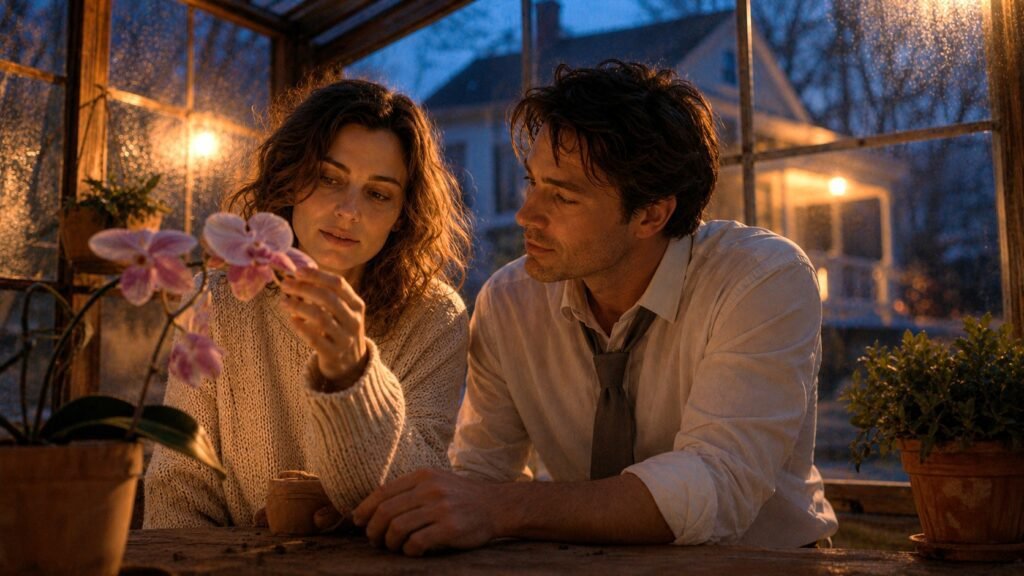
Later, when the frame was glassed in and the first hard frost had silvered the garden outside it, Elena set the pale lavender orchid on a shelf inside the little greenhouse Marcus had built with his own uneven hands, its new bloom fully open now, delicate and improbable in the last of the daylight, and she did not think of it as something rescued. She thought of it, watching Marcus latch the door against the cold behind them, as something that had simply been waiting — the way she had been waiting, without quite admitting it — for a light worth opening toward.
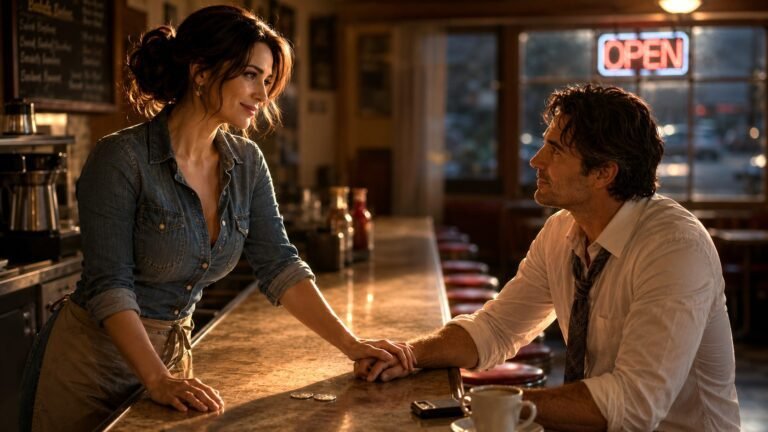
Heartfelt characters sharing love, emotions, and romantic journeys filled with hope, trust, and unforgettable bonds