
The mail boat came twice a month, when the sea allowed it, and on the last Tuesday of September it brought four crates of lamp oil, a sack of cornmeal, and a woman nobody in Crake Harbor had asked for.
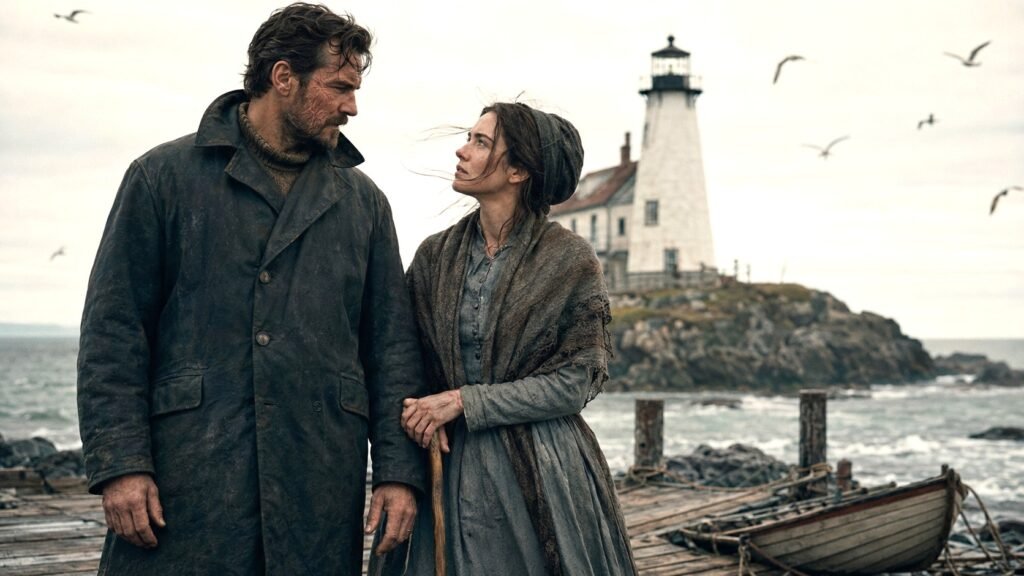
Elias Thorne stood at the end of the pier with his collar turned up against the wind, watching the boat fight its way through the chop. He had not come down from Widow’s Point in eleven weeks. He would not have come now, except that the mail agency’s letter had said arriving Tuesday, non-negotiable, balance owed on delivery, and Elias Thorne did not leave debts unpaid, not to agencies, not to anyone.
The lighthouse stood two miles out along the spit, a white column rising out of black rock, and for six years it had been the only thing in his life that asked nothing of him beyond precision. Wind the mechanism. Trim the wick. Log the weather. Watch the light turn, hour after hour, sweeping its slow gold arm across water that had already taken everything he’d ever loved and would gladly take more, given the chance.
He did not need a wife. He had written that plainly enough in his one and only letter to the agency in Portland, three months back, in a fit of some feeling he still could not name — loneliness dressed up as practicality. Not seeking companionship. Seeking a housekeeper who will not scream at the sight of me and will not mind the isolation. He had expected no response at all, or a polite refusal. Instead a woman’s name had come back by return post — Naomi Vance, twenty-nine, widowed, previously employed as a seamstress — along with a note from the agency matron that read, with what he now understood to be a kind of embarrassed honesty: She has a lame hip from a childhood fever and cannot bear children. Most households will not have her. If your circumstances permit —
His circumstances permitted. His circumstances, God knew, permitted almost nothing else.
The boat knocked against the pilings. A deckhand tossed a line. And there she was — small, upright, gripping the rail with a hand gone white at the knuckle, waiting her turn while two barrels of salt fish were swung ashore ahead of her, because a woman traveling alone came last in the order of cargo.
Elias watched her come down the gangplank. She did not have a proper trunk. She carried a single carpet bag, worn soft at the corners, and she moved with a rolling, uneven gait, her right hip dropping low with every second step, like a boat riding a swell that never quite settled. She did not use a cane. He would learn later that she had refused one for years, out of a stubbornness that had cost her more pain than pride was worth, and that changing that had taken him the better part of a winter.
She reached the pier. She looked up and found him — six foot three of him, wrapped in an oilskin coat, his left side turned slightly away out of an old habit he no longer noticed he had — and her eyes went, unhurried, to the ruin of his face.
The fire had taken him nine years ago, aboard a fishing trawler off Sable Bank, when a kerosene stove had gone up in a squall and the sea had been too rough to launch a boat fast enough. He had pulled two men clear before the flames found him. His face — the left temple, the cheek, the jaw — had melted and healed into something the town children called, when they thought he couldn’t hear, the drowned man’s face, though he had never drowned at all. The scar tissue pulled his left eyelid into a permanent half-close, so that he seemed always to be squinting at some far horizon only he could see.
He braced for what always came next.
It did not come. Naomi Vance looked at his face the way a person looks at weather — not with horror, not with pity, but with the plain attention of someone assessing what she would need to work around. Then her gaze dropped, briefly, to his hands, and back up.
“Mr. Thorne,” she said. Her voice carried the flat vowels of somewhere inland, somewhere without salt in the air. “I hope I find you well.”
“Miss Vance.” His own voice came out rough, unused. He had spoken perhaps forty words in the last week, all of them to the lighthouse cat. “Boat’s this way.”
He did not offer his arm. He had learned, from the agency matron’s letter and from some private instinct he trusted more than he should have, that she would not welcome the offer, that pity dressed as help was its own small cruelty. He simply matched his pace to hers, which meant walking slower than he had walked in a decade, and did not comment when the boards of the pier caught the toe of her boot and she stumbled, catching herself hard against a piling.
“I’m all right,” she said, before he’d said anything at all.
“Didn’t say you weren’t.”
She glanced sideways at that — surprised, he thought, though her face didn’t show much. It was a plain face, sun-weathered at the cheekbones, with pale brown eyes and a mouth that looked as though it had not smiled in some time but had not forgotten how, either. Not a face the agency catalogue would have called beautiful. He found himself, walking beside her toward the rowboat that would carry them out to the Point, unable to look away from it.
The crossing took forty minutes, the water choppy and gray-green under a sky the color of an old bruise. Naomi sat in the stern with her carpet bag held against her chest, and Elias rowed, and neither of them spoke, and the lighthouse grew larger and whiter against the clouds until it seemed to fill the whole sky.
“You keep it alone,” she said at last. Not a question.
“Six years.”
“Before that?”
He did not answer for three strokes of the oars. “Had a keeper’s assistant. Left.”
What he did not say was that the assistant had been his wife, Rebecca, and that she had not left so much as died, in the second winter, of a fever that the mainland doctor arrived four days too late to treat, because the sea had been unrowable and there had been no way to send for him sooner. He did not say that he had buried her himself, in the thin soil behind the keeper’s cottage, in a grave he had dug with his own two hands while the light kept turning above him, indifferent, because the light did not stop for grief. He did not say that he had written to the agency three months ago in a moment of weakness he still did not fully forgive himself for, telling himself it was practical, telling himself a housekeeper was not a betrayal of a dead woman’s memory, and had spent every day since half-hoping the letter would go unanswered.
Naomi did not press him. She watched the lighthouse instead, her pale eyes narrowed against the spray, and said only, “It’s larger than I pictured.”
“Has to be. Light’s got to carry twenty miles on a clear night.”
“And on a night that isn’t clear?”
“Then men die who oughtn’t,” he said, “if I’ve done my job wrong.”
She looked at him properly then, and something in her expression shifted — not softened, exactly, but sharpened, as though she’d just understood the shape of the man she was rowing out to live with. “You take that hard.”
“Somebody ought to.”
The boat scraped bottom on the rocks below the Point, and he shipped the oars, and stepped out into the shallows to haul the bow up onto the stones, and when he turned to help her out she had already gathered her skirts and was climbing over the gunwale on her own, refusing his offered hand with a small shake of her head that was not unkind, only certain.
She went down hard on the wet rock, her bad hip buckling under her, and caught herself on both palms before he could reach her.
“Miss Vance —”
“I said I’m all right.” She pushed herself upright, wiping her stinging palms on her skirt, her jaw tight with a pain she was clearly determined not to show him. “I have managed stairs and rocks and worse for twenty years, Mr. Thorne. I don’t require rescuing every time I stumble.”
Something in the flatness of that — not anger, just weary fact — made him understand, all at once, the whole shape of the life she must have led. A childhood fever. A ruined hip. A world that had spent twenty-nine years telling her, in a thousand small ways, that she was a burden to be managed rather than a woman to be seen. He said nothing further. He picked up her carpet bag, and let her climb the path to the cottage at her own pace, and did not offer his arm again, though every instinct in him wanted to.
The cottage crouched low against the wind, a squat stone building beside the tower, with a single chimney and windows shuttered against salt spray. Inside, it smelled of kerosene, damp wool, and six years of a man’s solitary cooking — burnt oats, mostly, and coffee boiled too long.
Naomi stood in the doorway and looked at it the way she had looked at his face: taking inventory, not flinching.
“There’s rot in that windowsill,” she said, nodding at the kitchen window. “And that chimney wants sweeping before winter, or you’ll smoke yourselves out the first hard blow.”
“Chimney draws fine.”
“It draws fine now. It won’t in December.” She set her carpet bag down on the single wooden chair, unpinned her hat, and looked around at the rest of it — the narrow cot in the corner, the trunk of tools, the shelf of logbooks. “Where am I to sleep?”
He had thought about this for three weeks and had no good answer. “I’ll build a partition. There’s lumber in the shed. Until then —” He gestured, awkward as a boy, at the cot. “You take the bed. I’ll manage.”
“You’ll manage on the floor of a lighthouse cottage in October.”
“I’ve managed worse.”
She studied him a moment longer, and something that might have been the ghost of amusement crossed her mouth before vanishing again. “I don’t doubt it,” she said. “But I won’t have it on my account. We’ll hang a blanket across the corner tonight and you’ll build your partition tomorrow, and neither of us will freeze on principle. Agreed?”
It was, he would come to understand, entirely characteristic of her — the refusal of pity paired with a fierce, practical insistence on fairness, as though she had decided long ago that if the world would not be kind to her, she would at least make sure it was even.
“Agreed,” he said.
She did not cry that first night, nor the second, nor any night he was aware of, though he heard her some weeks later through the thin new partition wall, her breathing gone ragged and controlled in a way that told him she was weeping as quietly as a person could manage. He lay awake and did not go to her, because he understood, without being told, that she would not have wanted him to see it, and that the kindness lay in leaving her the privacy of her grief.
By the second week she had scrubbed the cottage floor to bare pale wood, boiled his moth-eaten blankets clean, and reorganized his logbooks by year with a corrective little huff that suggested his previous system had personally offended her. By the third week the smell of burnt oats was gone, replaced by bread — real bread, with a crust that cracked properly under the knife — and a chowder thick with potatoes and the cod he caught off the rocks in the evenings.
They spoke, in those early weeks, mostly of practical things. The mechanism of the lamp, which she learned to help him wind so that his arm — sprained badly the second week from hauling a coil of chain up the tower stairs — could rest. The weather, which she began to read with an accuracy that startled him, watching the color of the horizon the way other women watched a clock. The supply schedule, the mending, the goat he kept for milk and that she named Persimmon within a day of arriving, over his flat objection that livestock did not require names.
“Everything requires a name,” she said, “that’s asked to live alongside you.”
He thought about that longer than he let on.
What she did not speak of, not for many weeks, was the childhood fever, or the husband the agency’s letter had mentioned only in passing — widowed — or why a woman who could sew fine enough to earn her keep in any city dressmaker’s shop had ended up answering an advertisement from a scarred lighthouse keeper on a spit of rock two miles from the nearest human voice. He did not ask. He had learned, from his own silences, that some things could only be given, never taken, and that a person who had spent a lifetime being managed by others deserved, if nothing else, the dignity of choosing her own moment.
There was an evening in late October, though, that stayed with him longer than he expected. He had gone up the tower at dusk to trim the wick and found her already there, sitting on the top step below the lamp room with her bad leg stretched out in front of her, watching the light begin its slow first turn against a sky gone the color of a healing bruise.
“You’ll take a chill, sitting on stone,” he said.
“I like it up here.” She didn’t move to make room, exactly, but she didn’t ask him to leave either, so he lowered himself down beside her, his knees cracking, the two of them wedged into a space built for one man and his tools. “Down below, the sea sounds like something trying to get in. Up here it sounds like something keeping watch. I’ve never lived anywhere that felt like it was keeping watch over me before.”
“Felt that way myself, first winter alone,” he admitted. “Before it started feeling like a cell instead.”
“And now?”
He considered the question longer than it probably warranted. Below them the lamp’s brass gears ticked over, patient and exact, and somewhere out past the reef a bell buoy tolled once, twice, carried faint on the wind. “Now I don’t rightly know what it feels like,” he said. “Something’s shifted since September. Can’t put a name to it yet.”
Naomi didn’t press him for the name, though something crossed her face that suggested she had her own private guess. She only drew her shawl tighter and said, after a while, “My hip locks worst in cold weather. I wanted you to know that before winter proper sets in, so you’re not startled some morning to find me unable to rise from a chair without help. I don’t ask for help easily. I want you to understand that’s pride talking, not refusal of you.”
“Wasn’t going to think it refusal.”
“Most men do. My husband did. Called it stubbornness, like I chose the pain of it for spite.” Her jaw tightened, briefly, at the memory. “I’d rather you simply knew the shape of the trouble ahead of time, so neither of us has to pretend surprise when it comes.”
“Appreciate the warning,” he said, and meant it, and something in the plainness of his answer seemed to ease her more than any softer reassurance would have. They sat a while longer in the cold, watching the light sweep its long gold arm out over water going black with evening, and when they finally climbed down the tower stairs together, her hand found the crook of his elbow on the third step — not asked for, not offered, simply taken, the smallest of surrenders — and he did not remark on it, only slowed his pace to match, and let her keep it the rest of the way down.
The moment came properly in November, during the first real storm of the season, when the wind came screaming out of the northeast and drove rain sideways against the shutters hard enough to sound like gravel.
They sat by the fire, Elias mending a net, Naomi turning the heel of a sock, and the lamp above them turning its long slow beam out over black water where, somewhere, ships were fighting to keep off the rocks. She had grown used to the rhythm of it — the tower’s mechanism ticking above the cottage like a great patient heart — and no longer flinched at the groan of the gears each time the light came round.
“My husband,” she said, without preamble, into the crackle of the fire, “did not marry me for love, Mr. Thorne. I should tell you that, since you’ve been decent enough not to ask.”
Elias set down the net. He said nothing, which he had learned was usually the correct response to her.
“He married me because my father owned a mill and I came with a dowry large enough to overlook a bad hip. He told me as much, the week after the wedding, when he’d had enough wine to be honest. I was seventeen. I thought perhaps affection would grow, the way people say it does.” Her needle moved steadily, her eyes on the sock, not on him. “It did not grow. He was not cruel, precisely. He simply looked past me, every day, for six years, as though I were a piece of furniture that had come with the house. When the fever took him, I felt — ” She paused, and for the first time since her arrival, her hands stilled. “I felt relief before I felt grief. And I have never forgiven myself for the order of it.”
The fire popped. Outside, the wind found some gap in the shutters and keened through it, a thin high note under the storm’s roar.
“There is no shame in relief,” Elias said finally. “A person can only carry so much invisibility before it becomes a kind of drowning.”
She looked up at that — sharply, as though he’d said something she had not expected a man like him to understand. “You speak like someone who knows.”
“I had a wife,” he said. It was the first time he had said the words aloud in six years, and they came out of him like something long buried working itself finally to the surface. “Rebecca. She kept this light with me, two winters. Then a fever took her too — different fever, same indifference — and there was no boat could reach the mainland doctor in time, on account of the sea. I dug her grave myself. Behind the cottage. You’ll have walked past it, likely, without knowing.”
Naomi’s face changed — not to pity, which he would have hated, but to something quieter and more exact, a recognition passing between two people who had each, in their own way, learned the particular loneliness of being loved too late or not enough. “I didn’t know,” she said. “I’m sorry.”
“Wasn’t asking for sorry.” He picked the net back up, though his hands weren’t really working it. “Just answering honest with honest. Seemed only fair, you telling me what you told me.”
They sat a long while after that in a silence that had changed shape — no longer the silence of two strangers keeping their distance, but something warmer, worn smooth between them like a stone handled often. When Naomi finally rose to bank the fire for the night, she paused behind his chair, and her hand — rough now from weeks of scrubbing and hauling water, the softness of a seamstress’s fingers long gone — rested for a moment on his shoulder.
“For what it’s worth, Mr. Thorne,” she said, “I don’t look past you.”
He did not trust his voice to answer. He only reached up and covered her hand with his own, briefly, before she drew it back and went to her side of the partition, and he sat a long while by the dying fire listening to the light turn above him, feeling something in his chest that he had thought the sea had put out for good nine years ago.
It was in December that the Constance Marie went down.
Elias saw the flares first — three of them, low against the black horizon, far too close to Widow’s Point Reef for any captain’s comfort. He was down the tower stairs and into his oilskins before Naomi had finished asking what was wrong, and by the time she reached the door he was already dragging the dory down toward the water, the wind tearing the words out of his mouth as he shouted back at her to keep the light steady, to watch the mechanism, to bank the fire and wait.
“Elias —” It was the first time she had used his given name. It stopped him, one hand on the boat, for half a second, no more. “The sea’s too rough.”
“Men are dying out there.”
“You’ll die out there.”
“Then I’ll die doing something worth the dying.” He shoved the dory into the surf and threw himself over the gunwale, and the last thing he saw of her, looking back through sheeting rain, was her standing at the waterline with her bad hip locked and her fists clenched at her sides, not weeping, not calling him back again, because she had understood, in the space of a single sentence, that this was a thing he could not be talked out of and that begging would only cost him the seconds he needed.
What happened on the water that night he would only ever describe to her in fragments, over months, in the flat unadorned way men speak of things too large for ordinary language. The Constance Marie had struck the reef and was breaking apart within the hour. He pulled four men from the water — two clinging to a shattered spar, two more nearly gone beneath the waves — and rowed them, one exhausting trip at a time, back through swells that stood taller than the cottage roof, until his arms had gone past pain into a kind of numb mechanical repetition that was the only thing that kept him rowing at all.
On the last trip, hauling the ship’s cook aboard, a wave took the dory broadside and threw Elias into the black water.
He did not remember much of what followed — the cold closing over him like a fist, the strange calm that cold brings before it kills, the moment he stopped being able to feel his own hands on the oar he somehow, through some animal instinct, had not let go of. He remembered, faintly, the light. Widow’s Point’s light, turning steady above the chaos, the one fixed thing in a world gone entirely to water and wind, and he remembered aiming for it the way a drowning man aims for the one syllable of a prayer he hasn’t forgotten.
He did not remember reaching shore. He would only ever know, from Naomi’s own halting account, that she had seen the dory capsize from the tower window, had left the light — left the light, which she had never once done, which every instinct the agency and the sea and six years of watching Elias had drilled into her told her never to do — and had gone down to the rocks in the storm on a ruined hip with a lantern in one hand, and had found him half-drowned in the shallows, and had somehow, through some strength she would later say she did not know she possessed, dragged two hundred and thirty pounds of unconscious man clear of the tide line.
He woke three days later to firelight and the smell of tallow and the particular ache of a body that has been very close to dying and has changed its mind. His chest felt scraped raw from the inside. His left hand, he would learn, had lost two fingers to the frost before she’d gotten the blood moving back into it. And Naomi Vance was asleep in the chair beside his cot, her head fallen sideways against the wooden frame, one hand resting flat against his chest, over his heart, as though she had been counting its beats to make sure they continued.
He lay very still, not wanting to wake her, watching the firelight move across her tired face — the lines at the corners of her eyes, the gray already threading through her brown hair though she was not yet thirty, the raw chapped skin of her hands, scalded, he would later learn, from hours of boiling water and packing hot cloths against his chest through the worst of the fever that had followed the cold.
He lifted his good hand, slowly, and laid it over hers.
She woke at the touch, disoriented for a moment, and then her eyes found his face and something in her whole body seemed to unclench at once, a held breath finally released.
“You went out to the light,” he said. His voice came out in barely more than a rasp. “You left the light unattended.”
“I put the mechanism on manual wind and left it turning,” she said, a little defensively, as though she expected to be scolded. “I was gone eleven minutes. I timed it.”
“You could have drowned dragging me.”
“I could have.” Her chin came up, that same flat stubbornness he had loved — the word arrived in his mind before he could stop it, loved, and he did not take it back — from the very first day. “I decided the risk was worth it. You don’t get to argue with a decision that’s already been made, Mr. Thorne.”
“Elias,” he said.
Something in her face softened at that, the formality falling away between them like ice off a roof in a thaw. “Elias,” she repeated, testing the shape of it. “You frightened me badly.”
“Didn’t mean to.”
“I know you didn’t.” She turned her hand beneath his, so that their palms met properly, fingers lacing together with the same careful attention she’d once given to reading a coming storm. “I have spent my whole life being told I was too much trouble to keep, Elias Thorne. Too broken to be worth the bother. And then I found myself dragging a half-drowned giant of a man up a rock face in a gale, and do you know what I thought, the whole while I was doing it?”
He shook his head, barely, against the pillow.
“I thought: he is worth the bother. And so, evidently, am I — because I did not stop to consider whether I ought to try, only whether I could.” Her voice cracked, just slightly, on the last words, the first crack he had ever heard in it. “Nobody has ever been worth that kind of trouble to me before. And nobody has ever been fool enough to think I was worth it either, before you.”
He did not have words equal to what moved in him then. He drew her hand up instead and pressed it, scarred palm and all, against the ruined side of his face — the side he had spent nine years turning away from mirrors, from lamplight, from his own reflection in the black glass of the tower windows — and he held it there, and did not flinch, and neither did she.
Spring came late to Widow’s Point that year, the ice breaking up in the cove in a series of long groaning cracks that Naomi said sounded like the whole sea clearing its throat. Elias’s hand had healed as well as it was going to, three fingers instead of five on the left, enough to still work the mechanism, enough to still hold a hammer, and in April, with the days lengthening and the wind finally losing its winter teeth, he spent three evenings in the tool shed with the door shut, working at something he would not let her see.
He brought it out to her on a Sunday, on the flat rock above the cove where they had taken to sitting in the evenings once the weather allowed it, watching the light begin its long swing against a sky still pale with the last of the sunset.
It was a cane — but not the plain ash stick the agency matron had once mentioned in passing, the kind Naomi had refused for twenty years out of a pride that cost her more pain than it was worth. This was driftwood, silvered and dense from years in salt water, sanded until it held a soft grey sheen like the underside of a wave. He had fitted the handle to the exact curve of her palm, carving late by lamplight with the two remaining fingers of his ruined hand doing work that would have taxed a whole steady set. And set into the wood, in a slow spiral from grip to tip, he had inlaid a dozen pieces of sea glass — the ones she’d been collecting all winter from the tide line, green and amber and one rare piece of blue, each one worn smooth by exactly the kind of violence that made a thing beautiful instead of breaking it.
“I know you’ve managed without one,” he said, holding it out, his voice gone rough in the particular way it only did now around her. “Twenty years without, and pride enough for twice that. I’m not asking you to need it. I’m only asking you to let something ease you, for once, that was made for no purpose but your ease.”
Naomi looked at the cane for a long moment, her throat working, and then reached out and took it from his hands. She turned it slowly in the fading light, watching the sea glass catch what was left of the sun, and when she finally looked up at him her pale eyes were bright with unshed tears she made no effort to hide, for the first time since the pier at Crake Harbor.
“You watched how I walk,” she said. “You watched, all winter, closely enough to build a bridge for exactly where I break.”
“Wasn’t hard to watch you close,” he said. “Been doing it since the day you wouldn’t take my hand off that boat.”
She laughed — a real laugh, low and startled out of her, the first he had heard since her arrival, and it changed her whole face into something he thought, privately, was more beautiful than any catalogue photograph the agency had ever printed. She set the old plain cane down on the rock between them and rose, leaning her weight onto the driftwood one, testing it, and found it fit her stride the way water fits a riverbed — as though it had always belonged there and was only now, finally, allowed to.
She crossed the small distance between them and pressed her free hand flat against his scarred cheek, the way she had once pressed it against his heart while he lay dying.
“I came here because no one else wanted a broken woman who couldn’t bear children and couldn’t run from a fire,” she said quietly. “I did not come here to be loved. I had given that up as a foolishness for other women, women without my particular arithmetic of what a person was worth. And you have gone and proven that arithmetic wrong, Elias Thorne, in every quiet, stubborn way a man can prove a thing to a woman who does not want to believe it.”
“I love you,” he said. It came out plain, unpolished, the way everything true came out of him. “Been true a good while before I found the nerve to say it. Didn’t want to say it while you might’ve felt obliged to stay for saying it back.”
“I am not obliged,” Naomi said, “to anything I do not choose freely. I have spent my whole life being managed, Elias. I know the difference now, better than most, between staying because I must and staying because I want nothing else in this world.” She leaned into him, her forehead against his chest, the new cane steady beneath her hand, the light sweeping its long gold arm above them both. “I choose this. I choose you. I have never in twenty-nine years chosen anything so completely.”
He wrapped his arms around her then, careful of her hip, careful of nothing at all, and held her while the light turned and the tide came in below the rocks and the whole cold indifferent sea, which had taken so much from each of them, gave something back at last, small and stubborn and entirely their own.
They were married in May, in the front room of the cottage, with the lighthouse keeper from the next station rowed over to serve as witness and Persimmon the goat bleating her objections from the yard. Naomi wore no white dress, only her good gray wool with a sprig of beach rose pinned at the collar, and carried, instead of flowers, the driftwood cane with its spiral of sea glass catching the morning sun.
And on winter nights afterward, when the wind screamed out of the northeast and the light swept its long patient beam across black water, the sound that filled the keeper’s cottage was no longer the silence of a man keeping his grief at bay alone. It was two voices by the fire, low and easy, and the steady tap of a cane against the floorboards that no longer meant a woman managing her pain in solitude, but a woman walking, at last, exactly where she meant to go.

Heartfelt characters sharing love, emotions, and romantic journeys filled with hope, trust, and unforgettable bonds