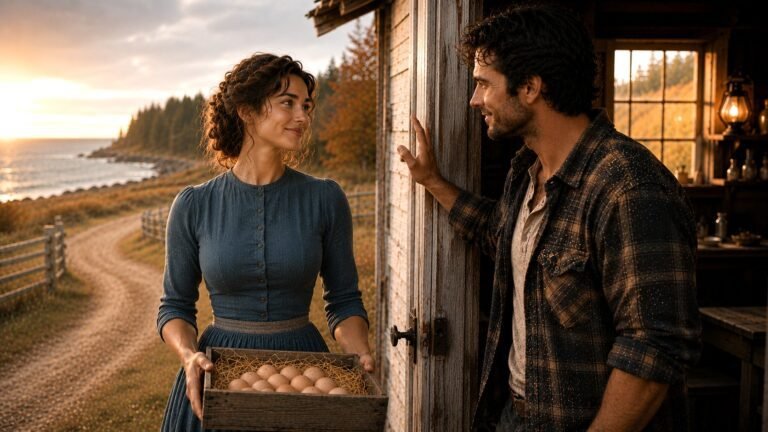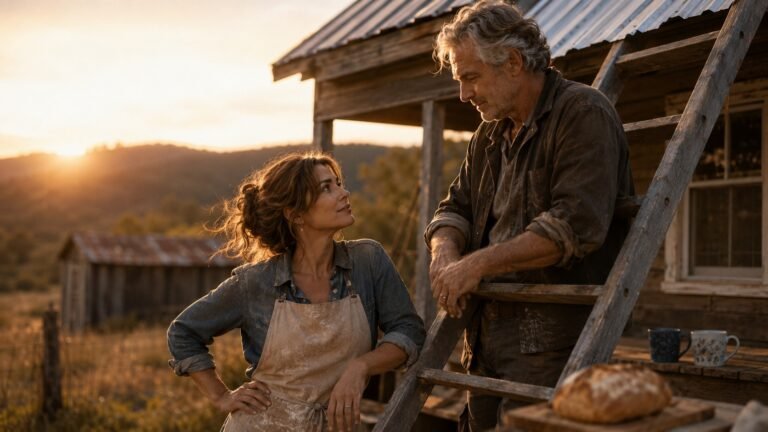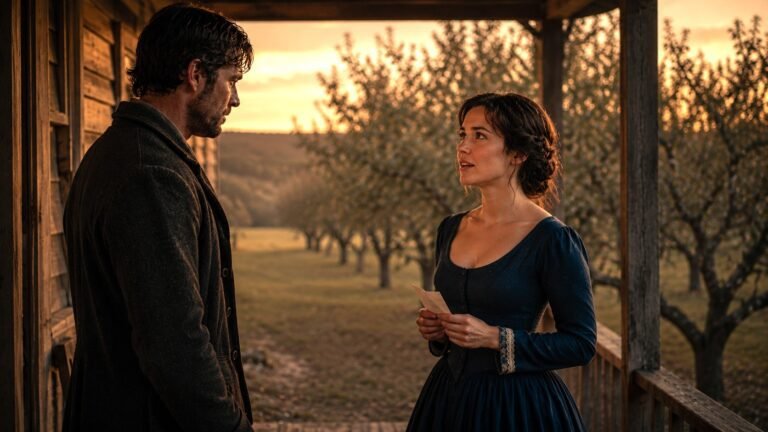

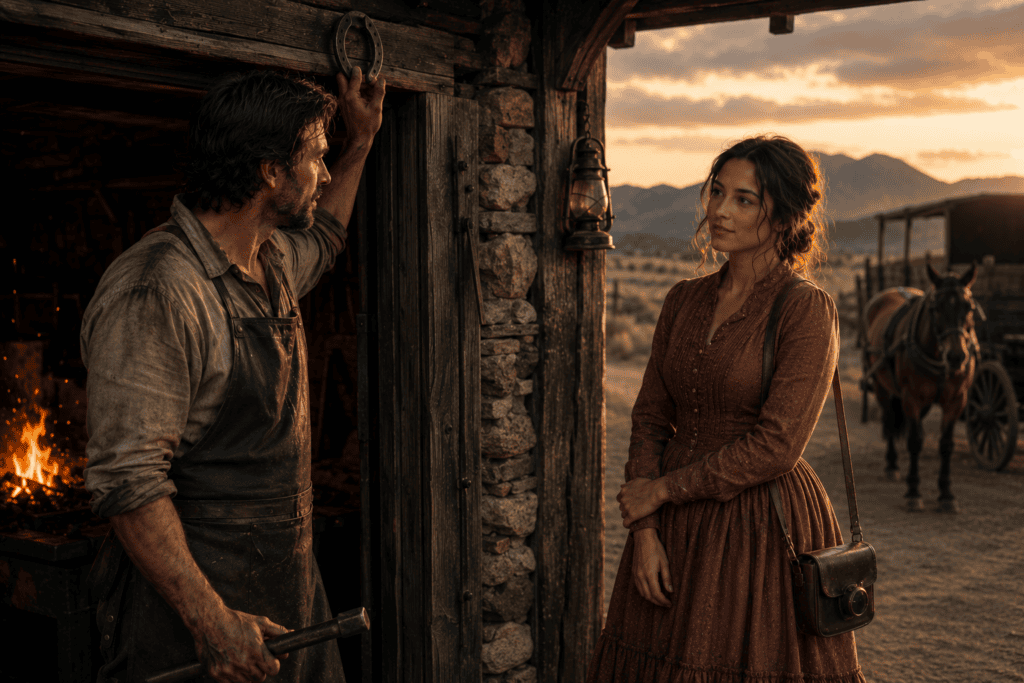
The forge at Blue Creek burned low most mornings before the sun came all the way up over the Bighorns, and Jacob Coe liked it that way — liked the hour when the coals were more memory than fire, red going to gray going to the color of a healed-over wound. He was thirty-four years old and had outlived a wife, a daughter who never drew breath long enough to be given a name past the one whispered to her in the last hour, and most of what he used to believe about the shape of a life. The mountains did not care about any of that. They stood the way they had stood before him and would stand after, blue-shouldered and indifferent, snow sitting in their creases like salt in the folds of an old coat, and some mornings Jacob thought that was the only honest thing left in the territory — a mountain did not promise a man anything it did not intend to keep.
He worked the bellows slow, the leather sighing, and watched the coals wake up orange at the edges. The shop smelled the way it always smelled: coal smoke and hot iron and the particular sweetish rot of the tanning shed two lots over, and under that, faint, the cold mineral smell of the creek that gave the town its name. He had built the forge himself, stone by stone, the summer he married Sarah, and there were still places in the mortar where her hand had smoothed a joint before it set, small crescent moons where her fingers had dragged through wet lime. He never told anyone about those. He was not sure, most days, that he still remembered which ones they were, only that some deep animal part of him touched certain stones more than others when he passed, the way a tongue finds a broken tooth without meaning to.
He shod horses and mended plow blades and made hinges and nails, because a town needed those things more than it needed anything a man might call art, but the true work — the work he did for himself, that nobody paid for and nobody asked after — was the testing. Every shoe he made, before it went out the door strapped to some rancher’s saddle or nailed under some cutting horse’s hoof, got struck once against the anvil horn and held to his ear. A good piece of iron rang clean, a single true note that traveled up through the bones of the hand and did not waver. A piece with a hidden flaw — a fold in the metal, a bubble of air trapped from careless hammering — sang wrong. It sounded almost the same to anyone else. To Jacob it sounded like a lie told smoothly enough that only the liar could hear the seam in it. He had learned, since Sarah, to hear seams in everything. He kept a bucket by the anvil for the flawed ones, and could not have said, if pressed, what he intended to do with them, only that he would not let a single one leave his shop to fail some stranger forty miles out on a trail where failing meant a broken leg, a caught foot, a body a long way from any doctor. He had not caught the flaw in the thing that mattered most. He caught every other flaw now instead, obsessively, the way another man might have taken to drink.
The one horseshoe he never tested and never sold sat in the bottom drawer of the workbench, wrapped in a square of chamois gone stiff with age. His father had forged it the night before the wedding, working by lantern light in a shop three hundred miles east, and had pressed it into Jacob’s palm still faintly warm and said, Hang this over your door, son, open end up, so the luck doesn’t run out of it. Jacob had meant to. There had always been a reason not to yet — the door needed rehanging, the header beam needed replacing, and then there was no door that mattered anymore, no threshold anyone was walking through together, and the shoe went into the drawer instead, and Jacob had discovered that a man could build an entire structure of daily habit around not looking at one small object, the way water finds its way around a stone without ever touching it.
Coffee first, black, drunk standing at the open door watching the light come up the flank of the ridge. Then the fire. Then the day’s work, laid out the night before on a slate so there would be no room in the morning for thinking past the next task. He ate the noon meal at the same hour each day at Ruth Verner’s boardinghouse, two doors down, and Ruth had long since stopped trying to seat him near the window where the light was better, because Jacob always moved his chair, without comment, to the darker corner where he could see the door and nobody could see him first. He did not examine why. It had simply become the shape of the chair he sat in, the way the shape of a shoe becomes the shape of a foot that has worn it long enough.
At night he banked the coals, checked the latch on the forge door twice — not once, twice, his hand returning to the iron ring a second time even when he could feel with certainty it had already caught — and walked the quarter mile to the room he rented above the mercantile, where he owned almost nothing that could not fit in a single trunk, because he had learned, in the particular arithmetic grief teaches a man, that the fewer things a life was nailed to, the less there was to come loose when it fell.
That was the whole of him, that spring: a man who tested iron for flaws he could not find in himself, who kept a wedding gift in a drawer like a bone kept from a beloved dog long dead, who checked locks twice against a danger that had already, once, gotten in anyway. The town thought him solid. The town was not entirely wrong. Solid was simply what a thing became after it had been struck hard enough, cooled too fast, and never reheated to be worked soft again.
He did not know, that particular gray Tuesday morning with the bellows sighing and the coals just waking, that a wagon with a canvas top gone the color of weak tea was coming up the north road with a cracked iron fitting rattling loose beneath it, or that the woman driving it had spent six years teaching herself never to stay anywhere long enough to need to be missed. He only knew the fire wanted feeding, and fed it, and struck the first shoe of the day, and held it to his ear, and heard, for once, nothing wrong with it at all — a small and ordinary mercy he did not think to notice, because he had not yet learned that some mornings announce themselves quietly, in the register of things that ring true.
The wagon came in loud, which was the first thing Jacob registered before he ever saw the woman driving it — a metallic complaint, iron on iron, unrhythmic, the sound of something that had been failing by degrees for perhaps sixty miles and had finally decided the town of Blue Creek was as good a place as any to fail all the way. He straightened from the anvil with the tongs still in hand and watched it come down the rutted street past the mercantile, canvas bowed with dust, a mule and a rangy bay pulling in a harness that had clearly been jury-rigged more than once, and a woman on the bench holding the reins with the kind of grip that said she had been holding them a long time and did not entirely trust anyone else to.
She pulled up outside his open door without being told it was a smithy, which meant she had an eye for what a building was for even under a coat of road dust, and climbed down before the wheels had fully stopped rolling, moving around to the rear axle with the particular briskness of someone assessing damage they already suspected. Jacob set down the tongs and came out into the light.
“Rear fitting,” she said, without introduction, crouching to touch the cracked iron bracket that held the leaf spring to the axle. “Started singing about forty miles back and got worse. I’d have stopped sooner but there wasn’t a sooner to stop at.” She looked up at him then, and he had the strange sensation of being read the way he read iron — quickly, expertly, for flaws, though her face gave away nothing about what she found.
“Stage doesn’t run through here till Thursday,” he said, which was not an answer to anything she’d asked, only the first thing that arranged itself into words.
“I’m not waiting on the stage. I’ve got my own wheels, when they’re not busy telling everyone in three counties they’re about to fall off.” She stood, brushing her palms on a canvas apron that had clearly been sewn for exactly this kind of work, dyed and stained and patched at one knee. Up close she was younger than her voice, sun-browned across the nose, with pale eyes the color of creek water over gravel, and a way of standing that put her weight forward on the balls of her feet, as if she expected, at any moment, to need to move fast in some direction.
“Adelaide Whitfield,” she said, and then, before he could offer his own name back, “everyone past the Mississippi calls me Dell, on account of Adelaide takes too long to say and I’m generally in a hurry.” She said this like a fact about weather, not a confession, though something in the quickness of it made Jacob suspect she had explained herself this exact way in a great many towns before this one, a small worn groove of a sentence.
“Jacob Coe.” He crouched where she had crouched, examined the bracket. The crack ran clean through the casting, an old flaw finally given enough road to open all the way. “This won’t hold another mile, let alone sixty.”
“I know what it won’t do. I came here for what you can do about it.”
He could have told her a day, maybe a day and a half, given the queue of work already chalked on his slate. Instead he found himself saying, “Get the wheel off. I’ll look at what’s under the canvas while I’m at it, if there’s a reason it’s riding this heavy.” He did not examine, later, why he offered that — only that something in the brisk, unbothered way she’d said there wasn’t a sooner to stop at had struck him the way a good piece of iron struck, one clean note, no hidden seam in it that he could hear.
She peeled back a corner of the canvas to show him crates packed in straw, and inside the crates, wrapped in flannel, brass and mahogany devices he did not have a name for until she told him — a camera, several of them, various sizes, and behind those, stacked plates of glass in slotted boxes, and coils of chemical-smelling paper. “I take photographs,” she said. “Of what’s disappearing. Towns like this one, buildings like that one” — she nodded at the boardinghouse — “before the railroad comes through and flattens the need for a place like Blue Creek to exist at all. I’ve been three years at it. Man in Cheyenne buys the plates off me and sells them east, to people who want to feel sorry about a country they’ve never set foot in.”
“Must be lonesome work,” Jacob said, and regretted it instantly, the word too naked for a man who’d only just learned her name, but Dell only shrugged, unoffended, already reaching past him to lift a crate she had no business lifting alone.
“Lonesome’s a place you can leave, same as any other,” she said. “I just don’t stay in it long enough to unpack.”
He took the crate from her before she could argue, and in the small tug-of-war over its weight their hands crossed on the wooden edge, her knuckles rough with rope-burn and sun, and for half a second neither of them let go, both of them absorbed in the ordinary business of not dropping something breakable, and Dell laughed — a short, surprised bark of a sound, as if the laugh had gotten loose before she’d decided whether to permit it.
“You’ve got soot on your face like a chimney sweep in a children’s story,” she said.
“You’ve got a wheel that’s about to leave you stranded in a town with one smithy,” he said back, “so I wouldn’t laugh at the soot.”
That got a real laugh out of her, wider, and something in Jacob’s chest did an unfamiliar thing, a small unlocking, like a hinge given oil after years of rust. He set the crate down harder than he meant to and one of the flannel-wrapped shapes shifted, and Dell caught it against her hip without looking, an old reflex, and in the catching she looked at him again, longer this time, in the frank appraising way she’d looked at the cracked bracket, except he understood, somewhere below thought, that this time she was not looking for a flaw. She was looking at the whole of him, the way she might look through one of her lenses, deciding what was worth keeping still long enough to see clearly.
He fixed the bracket by midafternoon, and it was good work, clean work, no seam in it a smith worth his trade could not have caught if he’d gone looking — except that near the weld, where the new iron met the old casting, there was a hairline shadow that would show if you struck it and held it close to the ear, a flaw so small it would never fail under any weight this wagon carried, and Jacob, tongs in hand, ear bent toward the ring of it, heard the flaw and, for the first time in three years, did not put the piece in the bucket. He set it on the wheel instead, and fitted it, and told himself it was because the flaw was harmless. He did not examine, that day, what it meant that he had let something imperfect leave his hands and ride off into the world anyway.
Dell paid him in coin and in one of her photographs, a print she pulled from a case without being asked — an image of a burned-out homestead somewhere in the Powder River country, chimney standing alone in a field gone to weed, and something about the starkness of it, the plain unflinching fact of a thing still standing after everything around it had gone, sat wrong and right in Jacob’s chest at the same time. He did not tell her that. He thanked her, and she climbed back onto the bench, and the mule and the bay leaned into a harness that no longer sang wrong beneath the wagon, and Jacob watched the tea-colored canvas go north up the road until the dust settled behind it, and only then noticed that he had been standing in his own doorway for longer than a repair job justified, watching an empty road the way a man watches something he has already, somewhere below the reach of language, decided he does not want to see disappear.
She did not leave in a day, or a week. The railroad survey crew came through and needed photographing for a report some office back east required, and Dell took the work because, she told Ruth Verner over supper, a woman had to eat regardless of principles about progress, and Blue Creek had a boardinghouse room going empty and a smithy that kept odd, early hours she found she did not mind keeping company with.
She came by most evenings, after the light went too flat and gold for good exposures, and sat on the upturned barrel just inside the forge door where the heat did not quite reach but the glow of the coals still reddened one side of her face, and watched Jacob work the way another person might watch a river — not for any purpose, just for the old animal pleasure of watching something move the way it was built to move. He found he did not mind being watched. He found, in fact, that he had begun, without deciding to, shaping the visible part of the day’s work — the pretty joints, the fine finish work — for the hour she would be sitting there, the way a man might plant flowers along a path he knew someone else would walk.
They did not talk much, some evenings, and the not-talking had a texture to it he had forgotten silence could have — not the flat gray silence of the room above the mercantile, but a silence with give in it, like a hand resting open instead of a fist.
“You test every one,” she said one evening, watching him strike a shoe and hold it to his ear before setting it aside. “Every single piece.”
“Bad shoe fails a horse forty miles from anyone who can help it,” he said.
“That why, or is that just the reason that fits in a sentence.” She said it lightly, not quite a question, watching the fire instead of him, and Jacob felt the old instinct rise in him to close the shop of himself the way he closed the forge door, latch checked twice — and felt, alongside it, something newer and more stubborn that did not want to.
“There’s a shoe in that drawer,” he said instead, nodding at the workbench, surprising himself, “my father made it. For the door. Never hung it.”
“Why not.”
“Never got around to it,” he said, which was a lie small enough to pass, and Dell looked at him with those creek-water eyes and did not push, though he understood, from the particular quality of her not-pushing, that she had heard the seam in it the way he heard seams in iron, and had chosen, for reasons of her own, to let the flawed piece stand a while longer rather than strike it again.
Other nights she talked more than he did, about towns she’d photographed and left, about a father who had gone west when she was nine and never sent for the rest of them, about a mother who had waited two years with a bag half-packed by the door before she stopped waiting and married a dry-goods clerk in Ohio who never once raised his voice and never once, Dell said, made her mother’s face do the thing it used to do when her father came into a room. “I used to think that was the saddest thing I’d ever seen,” she said, “a woman’s face just — going quiet like that, like a lamp turned low. Took me a long while to understand she wasn’t sad. She’d just stopped hoping for a particular kind of light and made her peace with the ordinary kind.” She turned the crank on a small mechanism she was cleaning, not looking up. “I told myself I’d rather go dark than go quiet like that. Rather keep moving than end up waiting on a road nobody’s coming down.”
“That why you don’t stay,” Jacob said.
“That’s why I don’t stay,” she agreed, easy as anything, though her hands had gone still on the little brass gears. “Man asks a woman to marry him, first thing he’s asking, whether he knows it or not, is will you be here when I turn around. I’ve watched what happens to women who say yes to that and then spend the next twenty years finding out the answer was supposed to be theirs to give and instead it got given to a house, a stove, four children and a fence line. I’d rather nobody ever get the chance to leave me standing at a window. I do the leaving first. It’s not noble. It’s just — arithmetic.”
Jacob turned that word over, arithmetic, and found it fit something in him too well for comfort, the same cold ledger-keeping he did with locks checked twice and shoes tested and rung, the same fear wearing a different coat. He did not say so. He set down the hammer instead and came to sit on the edge of the workbench near her, close enough that the heat of the fire and the warmth coming off her arm blurred into one general warmth he could not have separated if asked.
“I had a wife,” he said, into the quiet, the words coming out rough with disuse, like a gate that hadn’t swung in years. “Sarah. And a girl, after her, though the girl never — ” He stopped. Dell did not fill the silence, did not reach for him, only sat very still, the way a person sits still around something wild that might bolt if startled, and something in that stillness let him keep going. “Three winters back. Fever, the both of them, inside four days of each other. I built half this shop with her hands in the mortar.” He looked at the wall behind the anvil, at nothing in particular. “I don’t test the iron for the horses’ sake. Not only. I test it because once, the thing that mattered most had a flaw in it I never heard ringing, and I’ve been listening awful hard ever since, for everything else.”
Dell reached over, finally, and put her hand flat against the back of his, not gripping, just resting, the calloused warmth of her palm against the calloused warmth of his, two hands that had both done real work in the world, and neither of them said anything further, because there was nothing further that needed saying that a held hand did not already say better. The fire popped. Somewhere down the street a dog barked twice and quit. Jacob turned his hand over under hers, palm up, so that her fingers settled into the lines of it, and thought, distinctly, that he had not let anyone this close to an open flame in three years, and that some part of him was waiting, the way he always waited, for the moment it would prove to have been a mistake.
The stage was due through on a Thursday, and on the Tuesday before it Dell told him, in the flat brisk voice she used for facts about weather, that she’d finished the survey work and the light in Blue Creek had gone thin the way light did once she’d photographed a place long enough to have used it up, and that there was a mining camp two hundred miles west that a man in Cheyenne wanted documented before the company tore the old buildings down. She said it standing in the doorway of the forge with the morning behind her, not sitting on the barrel the way she usually sat, and Jacob understood, from the way she stood — weight forward, ready to move — that she had come to say this and only this, and that everything else about the visit was armor around the saying of it.
“There’s room on the wagon bench for someone who isn’t afraid of dust,” she said, and her voice, for just a moment, lost its briskness, went thin and careful, like a person setting down something they were not sure would be caught.
Jacob heard the offer. He also heard, underneath it, the arithmetic she’d told him about weeks before — I do the leaving first, it’s not noble, it’s just arithmetic — and some cold, quick part of him, the part that checked latches twice, decided in half a second that this was not an offer at all but a test, a woman giving a man the chance to fail her early and cheaply before she had to watch him fail her the slow way, the way Sarah had failed him, without meaning to, simply by being made of the same breakable stuff as everyone else. He thought: if I say yes, I am nailing myself to a wheel that never stops turning, and it will roll on one day without me on it, the way everything does eventually, and I will have chosen it, walked into it with my eyes open. He thought of the shoe in the drawer, the one that had never been hung because hanging it had once meant believing luck could be trusted to stay where you put it.
“I’ve got a forge here,” he said. “Customers. A slate full of work.” True things, all of them, arranged like stones across a gap he did not have the courage to name.
Dell’s face did not change much — she had, he understood later, spent a lifetime practicing the not-changing — but something went out of her eyes, some light drawing back the way a hand draws back from a stove it has learned, once, badly, to distrust. “Course,” she said. “Wouldn’t ask a man to leave a life he’s built.”
“That’s not — ” Jacob started, and did not know how to finish it, because it was not that, and it was exactly that, both at once, and he had no tool in his whole shop built for a joint that complicated.
“Some things are made to be used once and put away safe,” he said instead, hearing himself say it, hating the sound of it even as it left him, thinking of the shoe, thinking that he meant it as some crooked kind of tenderness — I will not risk you the way I risk iron I’m not sure of — and watching, in real time, the sentence land on Dell like exactly the opposite of what he’d intended, watching her hear in it a comparison to a tool set aside, a thing handled once and shelved.
“Right,” she said, and the word came out very level, very final, the voice of a woman closing a case and latching it. “Well. I know how to read a shoeing job that’s finished, Jacob. Obliged for the work.”
She was gone by the following afternoon, two days before she’d said she’d go, the wagon pulling out north in gray early light with no fanfare, no lingering, the mule’s harness silent this time, nothing left in it to sing.
Jacob burned the heel of his hand two days running, distracted at the forge in a way he had not been distracted since the winter Sarah died, holding stock too long in the fire, letting the color go past what the eye should trust. He wrapped the burns in a strip of clean cloth and did not go to the doctor, and at night he found himself standing at the workbench with the drawer open, the chamois-wrapped shoe sitting in his palm, its shape gone soft and cold, and could not, that week, make himself put it away, and could not, either, make himself hang it, so it sat out on the bench in plain sight, a wound with the bandage half off, and every time he passed it his hand ached in the place the burn had not quite reached.