
Frost had come late that year, later than any Emmett Voss could recall his father marking on the barn calendar in thirty years of Aprils, and it had come hard, dropping the thermometer on the equipment shed to twenty-six degrees on a night the bloom was already a third open across the north block. He had been out with the smudge pots since two in the morning, moving between rows in a canvas coat gone stiff with cold, lighting what needed lighting, watching what needed watching, the orchard around him lit in low orange pools that made the blossoms look, for a few hours, like something out of a stained-glass window rather than a crop a man’s whole year depended on.
The valley held the cold the way a bowl holds water, low ground first, then working its way up the slope rows by degrees, and Emmett had learned as a boy exactly which rows sat lowest and therefore died first, and he worked those hardest, moving pot to pot with a lighter that had quit twice already and a temper that had not quite quit but was getting there. Above him the sky stayed hard and clear, no cloud cover to hold the day’s warmth down where the trees could use it, stars thick and indifferent in a way that made a man feel smaller than the work already made him feel.
He was forty-four years old and had run the Voss orchard alone for going on four years, since his father’s heart had finally done what a lifetime of frost nights and hail years had been threatening to do all along, and since Lucia, eighteen months after that, had stopped being someone he came in from the cold to. He did not think the word for what had taken her most days anymore. He thought instead, when he thought of her at all in the working hours, of the particular way she used to stand in the kitchen doorway at three in the morning during frost watch, not saying anything, just holding a thermos out until he came and took it, and how the coffee in it was always slightly too strong, over-brewed on purpose, because she said a man out fighting frost at three a.m. had no use for a delicate cup of coffee.
Nobody held a thermos out to him now. He kept one in the truck instead, filled before he ever left the house, and told himself the arrangement was more efficient regardless.
The house itself had settled, these four years, into the particular economy of a man living alone in rooms built for more than one — a table with four chairs where he used only the one nearest the stove, a linen closet that still held towels folded by hands other than his own, arranged in a pattern he had never once disturbed enough to require refolding. He kept the kitchen radio tuned to the agricultural report each morning less for the frost warnings, which he could read as well as any broadcaster, than for the plain fact of a voice in the room while he ate, and turned it off the moment he stepped out the door, as though a voice indoors were a kind of company a man was allowed and a voice following him into the yard were not.
The barn calendar his father had kept for thirty years still hung by the equipment shed door, and Emmett had gone on marking it the same way, frost dates in blue, spray dates in red, though he had stopped, sometime in the second year, writing anything in the small margin at the bottom of each month where his father had always noted weather oddities and where Lucia, for the six years she’d had the chance, had taken to writing small private jokes meant only for whichever of them found them later — a margin gone blank now, month after month, the way a mouth goes quiet when it has run out of things it trusts itself to say without the words coming apart partway through.
The north block came through the freeze better than he’d feared, the smudge pots and four hours of a man’s sleep sacrificed holding the worst of it off, but the east block — the young block, forty trees he had bench-grafted himself six years back, Golden Delicious scion onto dwarfing rootstock, the whole planting meant to be the orchard’s future once the older trees aged out — the east block did not come through at all. He found it at first light, walking the rows with his breath smoking and his hands too cold inside his gloves to feel much of anything, and the blossoms there hung black and collapsed on the branch, killed clean through in a single night, the whole six years of careful work reduced to forty trees of dead flower that would set no fruit that season or, as it turned out over the following weeks, any season after, because a freeze that hard at that stage of bloom did more than kill a crop. It killed the wood underneath, slow and invisible at first, cambium blackening beneath bark that still looked, for a month or more, like it might recover.
He did not clear the block. He told himself, that first spring, that a man didn’t rush a diagnosis on a tree any more than on a person, that some of them might yet leaf out thin and come back over a season or two, and by the time it was plain past arguing that none of them would, clearing it had become a different kind of task than pruning ever was — not maintenance now but subtraction, the removal of forty trees whose grafting he remembered doing one at a time, whip-and-tongue cuts made with his father’s old folding knife on a cold March afternoon while Lucia carried the labeled scion wood up from the cold cellar and called out varieties like she was reading him a grocery list, laughing at how serious he got about the angle of each cut.
The east block stood behind its own separate fence now, deadwood gray among the living green of the rest of the orchard, weeds grown up through what had once been clean-mowed rows, and Emmett walked past it most mornings on his way to check the pots or the drip lines without looking at it directly, the way a man learns not to look directly at a light too bright to be comfortable, though he could have described every dead tree in that block from memory, could have told you which variety stood in which row, could have told you, if anyone had asked, exactly which four trees Lucia had insisted on grafting herself despite never once having held the knife before that afternoon, and how badly, and how happily, she had botched every one of them.
Nobody asked. In four years, nobody had stood in that block long enough to ask him anything at all.
He carried his father’s grafting knife in his coat pocket that morning the way he carried it every March, bone-handled, the blade honed thin as a man could get it and still trust it not to fold under a firm cut, and though the young-block grafting season had come and gone six years back and there was no living use for the knife that particular week beyond the general maintenance grafts he did most springs on older trees gone weak in a limb, he kept it on him anyway, the way certain tools ride in a pocket long past the specific task that first put them there.
The frost alarm on his phone had gone quiet an hour before dawn, temperatures finally climbing back above the danger line, and Emmett sat on the tailgate of his truck at the top of the orchard road with the last of the too-strong coffee gone lukewarm in the thermos cup, watching the sun come up hard and orange over the ridge the way it did most spring mornings in the valley, indifferent to whichever rows below it had lived and which had not, and thought, in the flat unnarrated way a tired man thinks at the end of a long night, that the bloom on the surviving blocks was thinner than he needed it to be, and that without more bees than his own two hives could offer, thin bloom would set thin fruit, and thin fruit, this particular year, was a number the bank in town had made plain it would not be patient about a second season running.
A truck came up the county road below him that he did not recognize, hauling a long low trailer stacked with white wooden boxes under tarps gone silver with age, moving slow and careful the way a driver moves when the cargo behind them is worth more than the truck pulling it, and Emmett watched it come without much curiosity at first, until it slowed at his gate, and idled there, and a woman leaned out the window studying his mailbox number against something written on a clipboard propped against the wheel. — “You’re not who I’m supposed to be meeting,” she said, when he’d walked down to the gate to find out what she wanted. She had the clipboard still in one hand, sleeves pushed to the elbow though the morning air still carried the night’s cold in it, dark hair pulled back under a ball cap gone soft with wear, and behind her, through the trailer’s slatted sides, came a low steady hum that took Emmett a second to place as the sound of several hundred thousand bees objecting, mildly, to a morning of highway travel.
“Depends who you’re supposed to be meeting.”
“Voss orchard. Pollination contract, forty hives, coordinated through the co-op two months back.” She checked the clipboard again, frowning at it the particular way of someone whose morning had already gone sideways twice before this stop. “Except the address on this points me to a gate with a chain and padlock on it that doesn’t match anything the co-op sent me, and the number on your mailbox matches a name I don’t have written down anywhere.”
“Co-op books contracts through my neighbor most years. Kessler place, half mile on.” Emmett looked at the trailer, at the hum coming steady through the slats, doing arithmetic he hadn’t expected to be doing at seven in the morning after a night with no sleep in it. “Kessler didn’t plant this spring. Sold his water rights to the district in the fall and let the whole block go fallow.”
The woman’s face did something complicated then, weariness and calculation both moving through it at once. “Nobody told the co-op that.”
“Co-op doesn’t always know what it thinks it knows.”
“No,” she said, with the particular flatness of someone who had learned that fact the hard way more than once, “it generally does not.” She looked past him at the orchard rising up the slope behind the gate, blossom thick and white on most of the rows, thinner and stranger-looking on a few, and something in her posture shifted, the practical recalculation of a woman whose whole livelihood depended on being able to read a landscape fast and adjust to it faster. “You got bloom needing bees on this place, or am I about to waste another hour finding that out.”
“Bloom needing bees is most of why I was standing at my own gate at seven in the morning looking like I hadn’t slept.”
“You look like you hadn’t slept regardless of the bloom.”
“Frost night.” He said it without elaborating, the way he said most things about the orchard to strangers, and something about her nod in response — quick, unsurprised, the nod of someone who had spent a working life around growers who kept frost-night hours — told him she needed no further explanation of what a frost night cost a man.
She introduced herself over the tailgate of her truck a few minutes later while they worked out, in the practical unhurried language of two people used to solving logistics rather than discussing feelings about them, whether forty hives on a two-week rental could be squeezed into a budget that had, until that morning, made no room for bees at all. Ada Ryerson, she said, hand out for shaking, palm rough in a way that matched his own, and when he asked, mostly to be saying something, how long she’d been hauling bees around the West for a living, she said, “Since I was old enough to lift a super without dropping it,” and did not elaborate further, though something in the flatness of the answer told him there was a longer story riding behind it, filed away the way certain stories get filed by people who have told them too many times to strangers who didn’t actually want to hear them.
They settled on a rate lower than the co-op contract by a margin that made Ada wince slightly signing it, and a placement — the open ground between the north block and the dead east block, level enough for the forklift, close enough to both live rows that the bees wouldn’t have to work too hard for their pollen — and by midmorning the hives stood staged in their new rows, entrances facing the sun, a low golden static of bees already beginning to orient themselves to blossom they had not, an hour before, known existed.
She walked the staging ground once before they’d finished the paperwork, boots sure and unhurried across ground she’d clearly assessed a hundred times before at a hundred other orchards, checking the slope for drainage, the treeline for windbreak, the distance to standing water a colony might need on a hot afternoon, and Emmett found himself watching the assessment the way he might watch anyone competent do careful work, a kind of attention that had nothing yet to do with the woman doing it and everything to do with the plain pleasure of watching a thing done right. She caught him at it once, glanced back over one shoulder mid-stride, and neither of them commented on it, though something in the corner of her mouth suggested the noticing had not gone unnoticed in return.
Ada stood at the edge of the staging ground afterward, watching the first scouts come and go, and asked, nodding at the fenced-off deadwood beyond the hives, “What happened there.”
“Frost killed it. Different year, worse night than last night.” Emmett did not elaborate further either, and for a moment the two of them stood in a silence that held, without either one remarking on it, the particular ease of people who had each just recognized in the other someone equally practiced at not elaborating.
“Forty hives isn’t going to do much for that block,” she said. “Nothing left in it to pollinate.”
“No,” he said. “It isn’t.”
She looked at him a moment longer than the conversation strictly required, filing the fact of the fenced deadwood away the same unhurried way she’d filed her own history a few minutes before, and did not ask further, and something in the not-asking — the plain, uncomplicated space she left around a thing she had clearly noticed and chosen not to press — landed on Emmett with more weight than a direct question would have.
“Coffee’s on in the house,” he said, “if two weeks of hauling bees has left a person wanting anything stronger than what’s in your truck thermos.”
“It has,” Ada said, “for about the last four hundred miles,” and followed him up toward the house without further discussion, the low hum of settling bees rising steady behind them across the staging ground, forty boxes finding, by slow degrees, their new temporary place in the world. — The two weeks stretched into three when a second cold snap threatened the tail end of bloom and Ada, watching her own weather app more closely than the growers’ forecast Emmett trusted, argued the hives should stay through it rather than risk a move mid-cold, and Emmett, who had spent four years making every decision about the orchard alone and had grown unaccustomed to anyone arguing a point with him at his own kitchen table, found he did not mind the argument nearly as much as he might have expected to.
She fell into the rhythm of the place without seeming to try — up before him some mornings, working the hives in the gray light with a headlamp and a smoker that filled the staging ground with a low sweet haze, gone quiet and diplomatic around the bees in a way that struck Emmett, watching from the porch with his coffee, as the same kind of care he brought to a grafting cut, patient, exact, entirely unhurried by anything but the work’s own requirements. She ate supper at his table most nights by the second week, not quite invited and not quite uninvited either, the arrangement arriving by the same slow unspoken accumulation that had settled the hives into their rows, and they talked, across those suppers, around the things that mattered the way two careful people talk around things that matter, testing the ground before trusting weight to it.
She told him, one evening, in fragments offered without much apparent difficulty, about the family apiary in eastern Oregon, four generations of Ryersons running bees across three counties, and the autumn — she was nineteen — that half the operation’s hives collapsed inside a single season, boxes found silent and empty of everything but a queen and a scatter of brood nobody could explain even now, the science still arguing about causes a decade on. She did not say devastating. She said, turning her fork slowly through food she wasn’t eating much of, “Lost sixty percent of the operation in four months. Dad never really built it back. I left for seasonal contract work not long after, and never much stopped.” Emmett heard, underneath the plain accounting of numbers, the particular weight of someone who had learned young that a thing built slow could be lost fast, and did not push further, understanding exactly the shape of a fence a person puts up around ground they have already grieved once and do not intend to grieve twice.
He, in turn, told her about the grafting knife, how his father had carried it thirty years before him, how the bone handle had gone smooth and dark with three decades of hands, and how he still used it most springs though the young-block grafting it had done its heaviest work for stood dead behind its own fence not two hundred feet from where they sat. He did not tell her about Lucia, or the four trees she had grafted badly and happily in a single cold afternoon, though once, watching him turn the knife over on the table between them, Ada said, mild as weather, “Man doesn’t keep a knife that sharp for maintenance pruning alone,” and let the observation sit there in the room without further comment, a stone dropped into water she seemed entirely willing to let ripple out on its own schedule.
The motif deepened without either of them naming it as such. On a warm evening in the second week she asked him to show her the whip-and-tongue cut properly, having only ever watched growers do it from a professional distance, and Emmett walked her through it on a length of dormant scion wood left over from other years, the angle of the first cut, the small reverse notch that let two pieces of living wood lock into each other and hold while the cambium found its way toward union, and Ada’s hands, steady around bee boxes all day, went careful and uncertain around the small folding knife in a way that struck him, watching, as its own kind of trust, a woman letting a task expose exactly how new she was at something rather than performing competence she didn’t yet have.
She cut a dozen practice unions that evening before she managed one Emmett judged fit to actually bind and wax, and threw the failures into a growing pile at her feet without complaint, each one examined a moment for what had gone wrong before it was discarded, a cut too shallow, a notch that didn’t seat, wood held at an angle that would never have healed true even given a season of patience. Emmett watched her work through the failures with a steadiness that struck him as its own kind of instruction, a woman who had clearly spent a working life failing at things in front of an audience and had long since stopped letting the failing show on her face as anything other than information to be used on the next attempt.
“It’s not so different from what the bees are doing out there,” she said, once the pile of failed cuts had grown tall enough to satisfy her, holding the two pieces of a finally successful graft together, testing the fit the way he’d shown her, tongue and notch locking with a small definite click. “Bringing two separate things close enough, long enough, that they stop being separate.”
There were mornings, too, when Emmett rode out with her to check the hives before the day’s heat set the bees working too hard to be handled easily, and stood at a careful distance while she worked frame by frame in her veil and gloves, calling out counts of brood and capped honey in a voice gone entirely different from her kitchen-table voice, brisker, more certain, the voice of a woman standing fully inside the one skill she had never doubted herself in even during the years everything else about her life had come apart. He asked her once, watching her lift a frame heavy with new comb into the light, how a person learned to read a hive the way she read one, and she said, without looking up from the frame, “Same way you learned to read a graft union. You kill enough of them not knowing what you’re looking at, until one day you do,” and something in the plainness of that answer settled between them the way most of their truest exchanges did, unremarked upon, filed away by both of them for later use.
“Graft doesn’t always take,” Emmett said, before he’d quite decided to say it. “Cut it wrong, or the wood’s not compatible, or a hard freeze gets in before the union’s set — looks fine a month, looks fine two, and then one day it just doesn’t leaf out, and there’s nothing left to do but admit it and cut it back out.”
Ada turned the two joined pieces of wood over once in her hand, studying the thin green line where bark met bark. “Some grafts take, though.”
“Some do.” He did not look at the fenced block when he said it, though both of them, in the small silence that followed, understood exactly which direction the sentence had not quite pointed.
There was an evening, near the end of the third week, when a swarm broke from one of the strongest hives at dusk, the air over the staging ground suddenly thick and roaring with a cloud of bees lifting and turning as one animal in the low gold light, and Ada went after it at a dead run with an empty box and a bedsheet, shouting instructions back over her shoulder that Emmett followed without fully understanding them, both of them ending up flat on their backs in the grass beneath an old apple tree at the staging ground’s edge, holding a bedsheet stretched taut between them while ten thousand bees settled, with the slow deliberate patience of a single mind arriving at a decision, onto the branch directly overhead. They lay there a long while afterward, sheet abandoned, laughing in the low startled way of two people who had just survived something together that neither could have managed alone, and when the laughing finally wore itself down into the ordinary quiet of two people lying in wet grass at dusk, Ada’s hand found his in the dark without either of them, afterward, being entirely sure which of them had reached first.
A co-op grower two valleys over called Ada near the end of that third week with a contract offer that would have kept her steady work through October, apple bloom into cherry into late clover, the kind of stitched-together season a hauling beekeeper waited years to be offered rather than had to go chasing for herself, and she took the call standing at the edge of the staging ground with her back to the house, answering in the flat practical voice she used for business, though Emmett, watching from the porch without meaning to eavesdrop, could read in the set of her shoulders that the call was not, this time, entirely business.
She told him about it that evening, plain, the way she told him most things, and something in the plainness this time carried an edge he hadn’t heard from her before, the sound of a decision not yet made being turned over for inspection in front of the one other person it stood to affect. “Steady work through October,” she said. “First time in longer than I want to admit anybody’s offered me a season instead of two weeks at a stretch.”
“Sounds like a good offer.”
“It is a good offer.” She turned her coffee cup slowly on the table, not drinking from it. “Doesn’t mean taking it’s simple.”
Emmett heard, underneath the sentence, an invitation to say the thing that would have made it simple — to ask her to stay the season here instead, to say plainly what three weeks of suppers and one swarm and one hand found in the dark had already made plain enough between them without either of them naming it — and felt the old familiar mechanism engage in his chest, the one that had kept him upright and functioning through four years alone, the one that had learned, the hard way, exactly what it cost a man to ask someone to stay and then fail them when staying mattered most.
“You should take what’s steady,” he said instead. “Man doesn’t get many chances at steady in this line of work. Neither do you.”
Something closed in Ada’s face then, quick and complete, a door shutting on hinges that had clearly been oiled by long practice. “No,” she said. “I don’t suppose I do.” She stood, took her cup to the sink, rinsed it with more care than the cup required. “I’ll call the co-op back in the morning.”
“Ada—”
“You already said your piece.” She did not raise her voice. That was, somehow, worse than if she had. “It was good advice. I’ll take it under advisement, same as I take most good advice.”
She was gone from the staging ground three days later, hives loaded back onto the trailer in the gray hour before dawn while Emmett still slept, no argument left in either of them to have. He woke to an empty rectangle of flattened grass and a note left on the kitchen table in handwriting he had not yet had occasion to learn, four lines thanking him for the placement and the coffee and nothing else, folded once and weighted down under the sugar bowl the way a person leaves something they expect to be found but do not especially want to be caught leaving. He read it twice standing at the counter in his socks before the coffee had finished brewing, and put it in the drawer of the side table rather than the trash, and did not examine that choice any more closely than he examined most choices those days. The co-op contract two valleys over swallowed her up the way steady work always swallowed a person who had spent a career chasing the opposite of steady. Emmett walked the staging ground that first empty morning listening to the particular silence a place makes after several hundred thousand bees have gone out of it, grass flattened in forty rectangular patches where the boxes had stood, and did not let himself examine too closely why the silence sat in his chest the same way the fenced deadwood block always had, a shape where something used to be that he had gotten, over enough repetition, disturbingly practiced at walking past without looking at directly.
He worked the orchard alone through the rest of bloom and into fruit-set in a stretch of weather that turned unseasonably warm and then, without warning, mean again, a late hailstorm rolling down off the ridge on a Thursday evening and stripping a third of the young fruit off the north block in eleven minutes flat, ice piling white and strange in the row middles like a wrong-season snow. He stood in it without a coat, watching leaves shred and fruitlets scatter across the ground he’d spent four years keeping clean-mowed, and did not go inside until the last of the ice had melted into the grass, soaked through and shaking with a cold that had stopped, some while back, being only about the weather.
He caught a fever two days after that, the kind a man gets from standing too long in a hailstorm at forty-four with too little sleep banked up behind him, and spent the better part of a week moving through the orchard in a haze that made the rows blur at the edges, checking drip lines and counting hail damage with hands that shook faintly on the clipboard. He slept those nights on top of the covers rather than under them, unable to settle on whether he was cold or overheated, and twice woke in the dark certain he’d heard a truck engine in the yard, certain enough to get as far as the porch steps before the sound resolved itself into nothing but wind working through the old cottonwoods at the property line, and stood there both times a long while in bare feet on cold boards before going back in, telling himself the fever alone accounted for it.
He understood, somewhere in the worst of that fevered week, exactly what a silence could cost a body once there was no one left in the kitchen doorway to notice it had gone on too long, no thermos held out at three in the morning, no voice at the table plain enough to ask a hard question and patient enough to wait out a bad answer. — She came back in late September, unannounced, hauling an empty trailer that had clearly been emptied on purpose rather than by contract, and parked it at the edge of the staging ground in the same spot the forty hives had once stood, grass grown back in over the flattened rectangles by then, no trace left of where the boxes had been except in the two people who remembered. Emmett was up a ladder in the north block, thinning what hail damage had left him of the crop, when he heard the truck, and he came down slower than the ladder required, giving himself time to decide what his face ought to do before she was close enough to read it.
“Co-op season ran out three weeks early,” Ada said, standing at the base of the ladder with her hands in her jacket pockets, offering the fact plainly, without dressing it up as anything other than what it was. “Grower two valleys over decided he didn’t need bees on contract past Labor Day after all. Left me with a month I hadn’t planned for and a trailer with nothing in it.”
“Steady work,” Emmett said, “same as I told you it’d be.”
“Steady enough.” She did not look away from him, though something in her jaw had gone tight in the manner of someone forcing a harder sentence out from behind an easier one. “I didn’t drive four hours back here about the contract, Emmett. I drove back because I spent a month in a bunkhouse two valleys over doing good work for a stranger and thinking, most nights, about a fenced block of dead trees I never once asked you the whole story of, and about a man who told me to take the steady work instead of asking me to stay for the unsteady kind, and I have spent enough of a life reading that particular silence correctly to know exactly what it was you weren’t saying that evening at your own kitchen table.”
Emmett looked past her at the fence line around the east block, deadwood standing gray and unchanged in the low autumn light, weeds gone to seed head-high between the rows nobody had mowed in four years running.
“I told you to take the steady work,” he said, “because the last time I let something matter enough to ask it to stay, I wasn’t there when staying got hard. Frost got the young block the same year Lucia got sick the first time, and I was out with the smudge pots half that spring instead of at the hospital, telling myself the trees needed saving too, and both of them died anyway, on my watch, while I stood exactly where I was best at standing and worst at being needed.” He said it flat, the way a man says a fact he has rehearsed enough times alone that it no longer costs him anything new to say aloud, though something in his hands, he noticed, had gone still in a way that suggested the cost had not, in fact, gone anywhere at all. “I don’t graft that block back because grafting it back means believing a thing I plant can outlast whatever comes for it. I have not believed that in four years.”
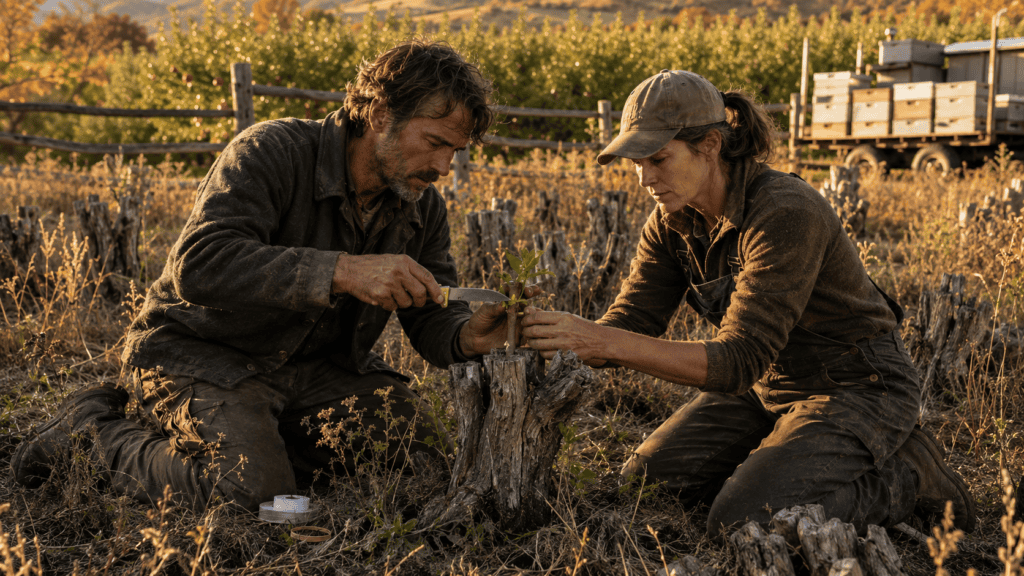
Ada did not answer that with comfort, sensing, correctly, that comfort was not the thing the moment called for. She walked past him instead, through the gap in the old fence where a gate had once hung and never gotten rehung, into the dead block itself, boots moving through weeds gone to seed, and stopped at the nearest stump, one of the forty, cut back two winters ago to root level in a halfhearted attempt at clearing that had never gotten finished. She crouched, brushed weed growth back from the base of it, and found, low on the stump’s shaded side, a single thin shoot of green pushing up from wood everyone including Emmett had long since written off as entirely dead.
“Root’s still alive under this one,” she said. “Whole top died. Root didn’t.”
Emmett came and crouched beside her, looking at the small green shoot the way a man looks at evidence he has spent four years arranging his life around not finding.
“Rootstock’s a different variety than what was grafted onto it,” he said, after a while. “That shoot won’t be Golden Delicious. It’ll be whatever the rootstock was underneath, come up wild.”
“Doesn’t have to stay wild.” Ada reached into her jacket pocket and drew out a short length of dormant wood wrapped in damp paper toweling and a rubber band, cut, he understood without asking, from somewhere on her drive back through the valley, scion wood carried four hours in a truck cab on the chance a conversation might go somewhere worth having it for. “Cut from an old tree behind the bunkhouse two valleys over. Grower said it was planted by his grandfather. I didn’t ask the variety. Didn’t much matter to me what it was called. Mattered more that it was old, and it was still alive, and I thought, driving back, that a man who taught me a whip-and-tongue cut on a warm evening in April might know what to do with it better than I would.”
Emmett took the folding knife from his coat pocket, bone handle worn dark and smooth under his thumb, and opened the blade the way he’d opened it a thousand times before, and knelt at the base of the stump beside her, the two of them working in a silence that had, for the first time in four years, nothing guarded left in it. He made the first cut on the rootstock shoot the way his father had taught him, clean and angled, and Ada held the scion wood steady while he matched the cut on it, the small reverse notch locking the two pieces together with a soft definite click, cambium against cambium, old wood and new wood brought close enough, long enough, to stop being separate.
“Might not take,” he said, wrapping the union in grafting tape with hands that had gone, for once, entirely steady. “Told you that already. Some don’t.”
“Some do.” Ada’s hand rested a moment on the tape beside his, not moving to let go of it just yet, the two of them crouched together at the base of a stump that had, an hour before, been nothing more than a dead thing standing in a fenced-off corner of a man’s grief. “Worth the cutting regardless.”
They worked the rest of that afternoon clearing the block by degrees, not all forty stumps and not all at once, but enough, cutting scion wood from three more surviving shoots and grafting each one with the same unhurried care, and by evening the low autumn light came slanting long and gold across a section of orchard that had stood silent and untouched for four years, four small grafts wrapped and waiting now among the standing deadwood, green shoots no bigger than a finger promising nothing certain and everything possible in the same small gesture.
Ada’s trailer stayed parked at the edge of the staging ground that night, and the night after, and on the third morning Emmett came out to find her already in the dead block before full light, marking two more shoots she’d found with strips of surveyor’s tape, working alone in the gray hour the way he’d once worked alone with the smudge pots, except this time, hearing his boots on the grass behind her, she turned, and waited, and did not go on without him.
By the following spring the co-op books would carry a new arrangement alongside the old pollination contracts, Ada Ryerson listed not as a two-week rental anymore but as a partner in a small experimental block of grafted trees nobody in the valley had a name for yet, and the bees, when bloom came around again, would find, among the old rows and the new, four young grafts leafed out fully into a variety that belonged, at last, to no one’s grief and to both of their hands equally, cambium long since healed into a single unbroken line of living wood, green against the gray weathered bark of stumps that had waited four winters to be worth cutting back to.