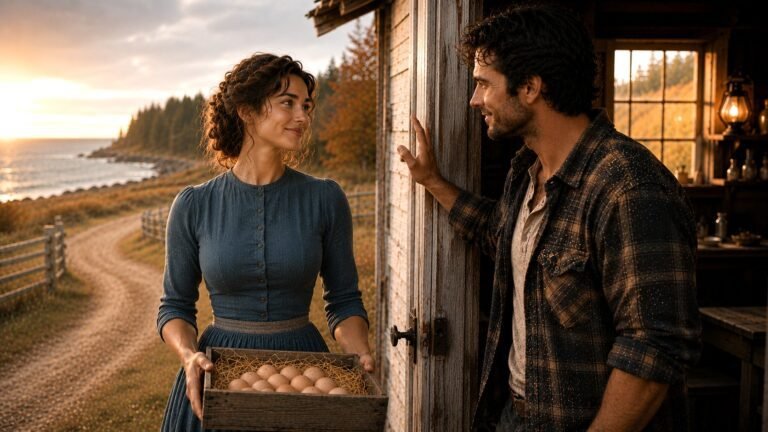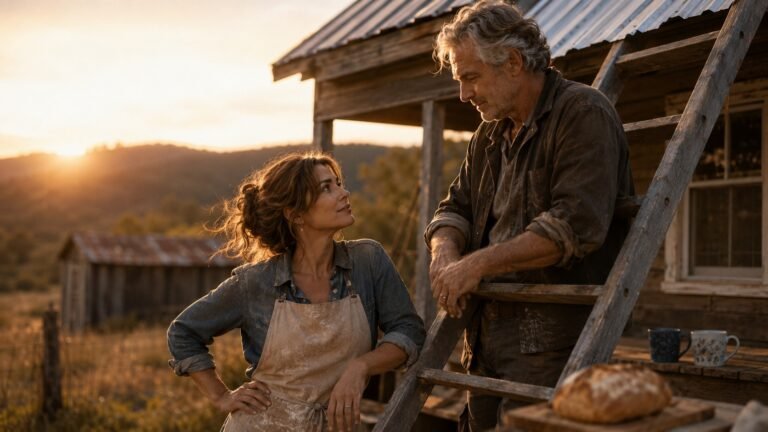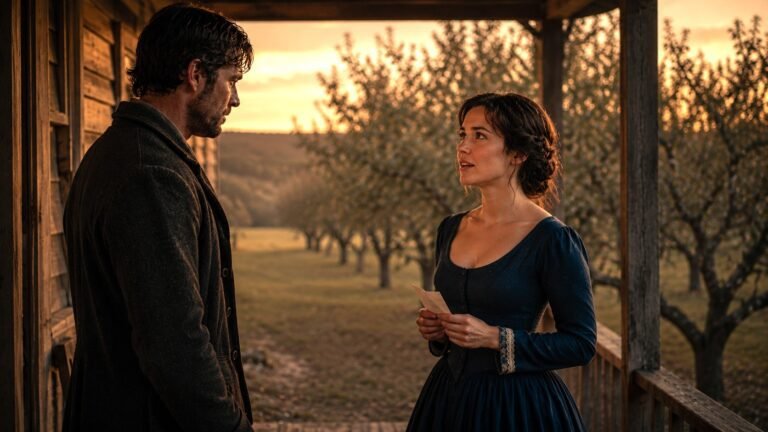

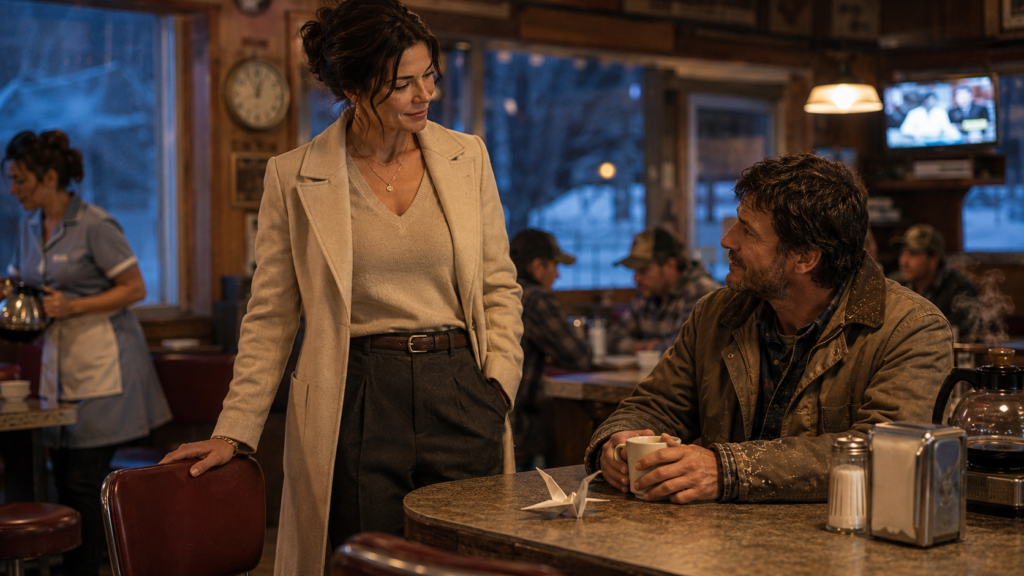
The Bitterroot Valley in late October turned the color of a bruise healing — plum shadow in the draws, a yellow going brown along the cottonwoods, the mountains holding their first snow like something they weren’t ready to give up. Wyatt Cole drove the same half mile of gravel he’d driven for eleven years, past the leaning fence post he kept meaning to reset, past the mailbox with the dent shaped like a fist, and parked the truck outside the Blue Spruce Diner at six-forty, same as always, engine ticking in the cold the way it always did, like something counting down.
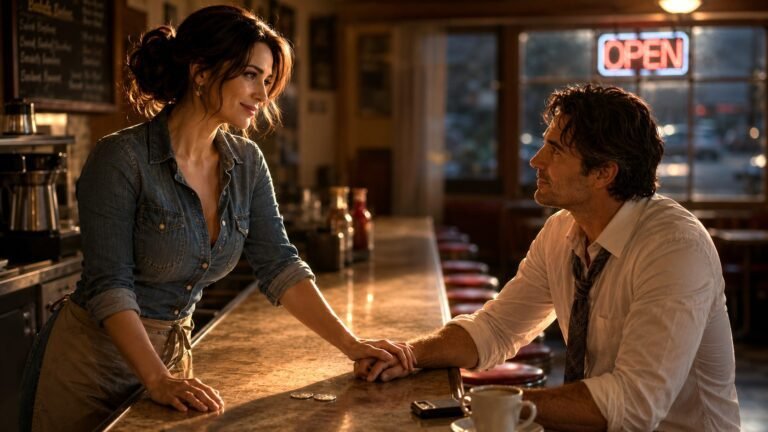
Inside, the diner smelled of scorched coffee and bacon grease and the particular mildew of an HVAC system older than the county road department. Doris had his stool wiped down before the bell over the door finished ringing. Third stool from the register. Not the first — too close to the door, too easy for anyone leaving to clap a hand on his shoulder and ask how he was holding up. Not further down, either, where the ranch hands sat in a row like crows on a wire, trading weather and gossip in equal measure. Third stool. Close enough to be counted present. Far enough that no one expected conversation.
He ordered the same thing he ordered every morning — two eggs over medium, wheat toast, coffee black — and while Doris called it back to the kitchen, his hands found the napkin dispenser without being told to. He didn’t look down at what they were doing. That was the strange part, if anyone had ever pointed it out, which no one had, because no one watched him closely enough anymore to notice. His fingers pulled a napkin free, creased it in half, in half again, folded the corners in with a precision that looked practiced because it was — thousands of afternoons of practice, a decade of practice — until a bird sat on the counter in front of him. A crane, wings notched, neck bent at the particular angle that had once made a six-year-old shriek with delight in a hospital room that smelled like rubbing alcohol and the too-sweet apple juice they gave to kids who couldn’t keep anything else down.
He didn’t remember learning to fold them. He remembered Sarah’s hands doing it first, quick and sure, while a chemo drip clicked through its slow arithmetic beside her, and Lily, three years old then, reaching for the bird before the last fold was even set. After the funeral, the folding had stayed. It came up through his fingers on its own now, the way some men’s legs jiggled or some men’s jaws worked when they were thinking too hard about a thing they wouldn’t say. He folded and set the bird aside and never looked at what his hands had made. That was its own kind of tell. A man who couldn’t look at the thing he’d built.
Doris set the coffee down and started to top it off twenty minutes later, out of habit, and he covered the cup with his palm.
“Still got someplace to be,” he said, which wasn’t true. The store didn’t open till eight. But a second cup meant sitting long enough for someone to slide onto the next stool and ask a real question, and he had gotten very good, in two years, at not being asked real questions.
The store was called Cole’s Hardware & Orchard Supply, a low building with a tin roof that complained all winter and a bell above the door that had rung for his grandfather and would probably outlast him too. He unlocked it at seven-fifty, same as always, and stood for a moment in the dark before he hit the lights, in the smell of cut lumber and fertilizer and the orchard beyond the back lot where two hundred Honeycrisp trees stood bare-limbed, waiting on him to finish the winter pruning he was already behind on. He checked his phone. No missed calls. He checked it again ten minutes later, though nothing had rung. It wasn’t Lily he was checking for — she was safe at school, he’d walked her to the bus himself, watched it pull away with its stop sign folded out like a flag — it was an old reflex, worn smooth as a creek stone, from two years of a phone that might ring with a number from Missoula and change the shape of everything.
The clinic in town — Bitterroot Family Health, two exam rooms and a nurse practitioner named Carol who’d delivered half the county — had almost closed the year Sarah got sick. There’d been a fundraiser, then a grant nobody could quite explain the source of, and the clinic had stayed open, small and underfunded but open, and it had been the only reason Lily’s asthma got caught early instead of late, the only reason a nebulizer sat in the hall closet instead of an oxygen tank in a hospital room. Wyatt didn’t know who’d funded it. He’d stopped wondering, mostly, the way a man stops wondering about weather he can’t change. What he knew was that help, when it came, came with strings nobody told you about until you were already caught, and so he’d built the last two years the way he built everything else — load-bearing walls first, nothing borrowed, nothing owed.
He was good at fixing things that stayed fixed. He was less good, if he let himself think about it, which he didn’t, at anything that required staying loose enough to be helped.
At nine, Marla from the co-op came in for fence wire and asked, the way she always did, gentle as she could manage, if he’d thought any more about the church potluck, about maybe bringing Lily, about maybe letting somebody set him up with her cousin who taught third grade in Hamilton. He said he’d think about it. He would not think about it. He rang up the wire and counted her change twice, though he never miscounted, and watched her drive off before he let his shoulders come back down from around his ears.
Lily’s laugh came home with her at three-fifteen, along with a picture of a horse she’d drawn with six legs, and for an hour the store smelled like crayons and the orchard smelled like woodsmoke from somebody burning brush three farms over, and the ache that lived somewhere under his sternum went quiet the way it always did around her, because she was the one thing he had never once doubted he could hold onto.
That night, after she was asleep, he sat at the kitchen table with a beer he didn’t finish and looked at the crane still folded in his shirt pocket from that morning, forgotten there, wings a little crushed from the day’s work. He set it on the table. He did not throw it away. He never did. He just never looked at it for long, either, the way a man will keep a photograph in a drawer he doesn’t open, not because he’s forgotten what’s in it, but because he knows exactly what’s in it, down to the grain of the paper, and some knowledge is better carried closed.
Fifty-one miles west, in a glass-walled office eleven floors above a city he owned more of than he’d meant to, a woman named Eleanor Voss was doing the same thing she did most nights — reading a stack of grant applications her assistant had already approved, because if she stopped reading them herself, she’d stop knowing what her name was actually paying for. Bitterroot Family Health, Ravalli County. Renewal request, page four of nineteen. She read the line about pediatric asthma cases caught in early screening and put a check mark beside it, the way she’d put a check mark beside it every year for six years, and did not let herself wonder, because she never let herself wonder, whose child.
Site visits were the only part of the work Eleanor still did herself, unannounced and unattributed, in a rented Subaru with Idaho plates and a barn coat that had cost more than most people’s rent but looked, from ten feet, like any other barn coat. Her security team hated it. Her board hated it more. But there was something in her that needed, every so often, to stand in the actual gravel lot of the actual clinic and watch the actual door swing open for someone whose name she’d never know, some proof that the money had gone somewhere real and not just evaporated into the machinery of good intentions. She’d driven out that Tuesday to do exactly that — an hour outside the clinic’s open sign, a look at the parking lot, nothing more — and a front tire had picked up a nail on the state highway outside a town whose name she hadn’t bothered to learn, and the only diner with lit windows at six that evening had a hand-painted sign shaped like a tree.
The Blue Spruce was full in the particular way small-town diners get full on cattle-sale Tuesdays, every booth taken, a line of hats at the counter, Doris moving through the noise like a woman conducting an orchestra she’d stopped needing a score for. Eleanor stood in the doorway a beat too long, coat dusted with highway grit, and felt the whole room’s attention pass over her and away, the specific relief of being looked at and not recognized, a feeling she got maybe four times a year and had learned to treasure the way other people treasured vacations.
There was one open stool. Third from the register. Beside a man in a canvas jacket with sawdust still caught in the weave of his cuff, eating eggs alone, a paper napkin folded into the shape of a bird sitting untouched by his coffee cup.
“Can I sit with you?” she asked, because it was the only seat, and because something about the folded bird made her not want to sit anywhere else in the room.
Wyatt looked up. She had flour-pale hands and a coat that didn’t fit her the way it should have, cuffs too clean for the sleeves, boots that had clearly never met a corral, and an expression like she was waiting to be told no. He’d have bet money she was somebody’s lost tourist, though what a tourist was doing in Darby in late October he couldn’t have said.
“Free country,” he said, and went back to his eggs, which was as close to hospitality as he generally offered a stranger.
She sat. She ordered, after a long look at a laminated menu, the chicken fried steak, and when it came — a slab the size of a dinner plate, gravy in a separate boat because Doris knew better than to drown it before serving — she stared at it with such open bewilderment that Wyatt, without quite meaning to, said, “It’s not going to hurt you.”
“What is it, exactly,” she said. “In terms of — animal.”
“Cow. Batter. More cow-adjacent than you’d think.”
“It looks like a hubcap.”
“That’s generous. Some days it looks worse.”
Something in her laughed — not the polished laugh she used in boardrooms, the one that ended exactly on cue, but something shorter and more surprised, like it had gotten loose before she’d approved it. She cut into the steak with the wrong fork and didn’t correct herself, and Wyatt found himself watching the process with an attention he hadn’t spent on a stranger in longer than he could easily place.
“You’re not from here,” he said. Not a question.
“No.”
“Passing through.”
“Something like that.” She glanced at the bird by his coffee cup. “Did you make that?”
He looked down at it like it had appeared there on its own, which, in a sense, it had. “Habit,” he said, which was true and also told her nothing, which was also true.
“Show me,” she said, and it wasn’t a request so much as a fact she was stating about the next several minutes, and something in her own directness seemed to catch her off guard — a small flicker crossing her face, like she’d surprised herself by wanting something out loud.
He didn’t know why he did it. He hadn’t shown anyone the folds since Lily was small enough to need showing. But he pulled a fresh napkin from the dispenser and walked her through it anyway — the first fold that made the square into a triangle, the second that made the triangle into something with a spine, his big hands slow and careful in a way that looked nothing like the speed with which he usually did it, alone, without watching. She ruined her first three attempts. The fourth came out lopsided, one wing longer than the other, its neck bent at an angle that suggested more injury than grace, and she held it up like she’d built a cathedral.
“It’s terrible,” she said, delighted.
“It’s got character.”
“That’s what people say about ugly dogs.”
“It’s what people say about a lot of things they’ve decided to keep anyway.”
She looked at him a second too long after that, like the sentence had landed somewhere she hadn’t braced for, and he felt his own ears go warm and looked back at his coffee, and for the length of that silence — a silence with the whole loud diner going on around it, hats and gravy and a football game arguing with itself on the mounted television — neither of them reached for anything to fill it.
A tow truck driver came in near seven-thirty to tell the woman in the barn coat her tire was patched and the car was out front, and she paid for both plates before Wyatt could stop her, which annoyed him for exactly as long as it took her to say, sliding off the stool, “Thank you for the lesson,” holding up the lopsided crane like a diploma.
“Keep practicing,” he said. “You’ll ruin fewer napkins.”
“I don’t think that’s the point of it,” she said, and was gone before he could ask what she meant, the bell over the door ringing once, gone.
He sat a while after, finishing coffee that had gone cold, and realized somewhere in the last hour he hadn’t checked his phone once — not for Lily, not for the clinic, not for anything — the first time in two years the reflex had simply failed to fire, and he didn’t examine that too closely because examining it felt like it might undo it.
Eleanor drove the rest of the way to Missoula with the crooked paper bird sitting on the passenger seat, seatbelt looped absurdly across it like it might otherwise fly, and thought, for the first time in longer than she could easily place, about a version of her evening that hadn’t involved anyone wanting anything from her at all — not her name, not her signature, not her money, not even, particularly, her opinion — just an hour on a stool beside a stranger who’d corrected her fork grip and let her ruin four napkins in peace. She did not know his name. She realized this somewhere past the county line and felt the not-knowing sit in her chest like an unfinished sentence she wanted, badly, to go back and finish.
She came back the following Tuesday. She told herself it was the site visit, unfinished business, the clinic parking lot still owed a proper look. She wore the same coat. She parked, this time, deliberately in front of the Blue Spruce, and found the third stool empty and felt something in her chest drop half an inch before Doris told her, without being asked, that Wyatt generally came in earlier on delivery days and might she want to try the store instead, everybody knew where the store was.
She learned his name from the sign over the door — Cole’s Hardware & Orchard Supply, gold letters flaking at the edges — and stood outside it a full minute working out what possible reason a woman in a Subaru with Idaho plates could have for needing fence staples in a town she had no fence in.
“Back again,” Wyatt said, when the bell rang and he looked up from a shipment of pruning shears he was pricing by hand, because the scanner had died sometime around the Clinton administration and he’d never seen the point in replacing it.
“I need — ” she looked around the shelves, buying time, and her eyes landed on a bin of grafting tape. “This. I need this.”
“You garden?”
“Extensively,” she said, in a tone that made it obvious she had never once put a hand in dirt on purpose, and he laughed, actually laughed, a short surprised sound that seemed to catch him as off guard as it caught her.
“Grafting tape’s for trees. You got trees?”
“I’m considering acquiring some.”
“That’s not usually how it works.”
“Most things I want, I find a way to make work,” she said, and there was something under it — not quite a joke, not quite not one — that made him look at her a second longer than the sentence required.
He didn’t sell her the tape. He walked her out back instead, past the register, past a NO he nearly said and swallowed, into the two hundred bare-limbed Honeycrisps waiting on their winter pruning, and showed her, without her asking twice, how a graft took — cambium to cambium, the wound of one tree matched exact to the wound of another, wrapped tight until the two decided, on their own schedule, to become one thing instead of two. She listened with a focus that unsettled him a little, the way people who ran things for a living tended to listen, filing everything away like it might matter later.
“You could kill it wrong,” he said. “Cut too deep, don’t match the layers right, whole graft just dies. Looks fine for a season. Falls apart the next.”
“How do you know it’s matched right?”
“You don’t, not for sure. Not till spring.”
“That seems like a lot to plant on faith.”
“Most things worth growing are,” he said, and didn’t know where it had come from, and neither, from the look on her face, did she.
She came back the Tuesday after that, and the one after, under a rotating cast of reasons that got thinner each time — a follow-up on the tape, a question about deer fencing, a need, apparently, for a level, though she owned, by her own admission, no walls to hang anything on. He stopped pretending not to expect her. He started, without deciding to, saving her the good apples from the cull bin, the ones with one blemished cheek and a sweet side that would keep. She started bringing coffee from the good place in Missoula, two cups, setting one on the counter without asking if he wanted it, which he did, though he’d have died before saying so.
Lily met her on the third visit, home from school early with a half-day, cartwheeling through the orchard rows in a coat two sizes too big, and stopped dead at the sight of a stranger crouched at graft height beside her father, and demanded, with the total lack of diplomacy native to seven-year-olds, “Who’s that.”
“Somebody buying grafting tape,” Wyatt said.
“Nobody buys that much grafting tape.”
“Kid’s got a point,” Nora said, and Lily’s face did something complicated — suspicion collapsing, slowly, into interest — and by the end of the afternoon she’d taught the stranger to fold a napkin bird with the specific bossy patience of a child who has recently mastered a skill and cannot wait to lord it over an adult, and Wyatt stood in the doorway watching the two of them hunch over the kitchen table, his daughter’s small hands guiding a billionaire’s manicured ones through folds worn smooth by his wife’s ghost, and something in his chest did a slow turn he didn’t have a name ready for.
They didn’t talk about the things that mattered. That was the shape of it, the whole autumn through — orbit without collision, closeness measured in apple crates and coffee and a level she genuinely never used. She asked him once, on a cold evening with Lily asleep upstairs and two beers going warm on the porch rail, what happened to Lily’s mother, and he told her the bones of it — sickness, then not sickness, then gone — in the flattened voice of a man reciting a fact he’d worn smooth from handling, and she didn’t reach for him, didn’t say the things people usually said, just sat with it a while in the dark, and then said, “That’s a lot of ground to cover twice a day, alone,” and he understood she meant the orchard and also did not mean the orchard at all, and something in him unclenched half a degree that had been clenched two years solid.
He asked her, in turn, what she did — work, family, the shape of a life he could tell, from the careful way she answered, had been curated for public consumption for a long time.
“Foundation work,” she said. “Grants, mostly. Boring, if you get me talking about it.”
“Try me.”
“Health clinics. Schools. Small places nobody else is looking at.” She turned her beer bottle a quarter turn, watching the label. “You spend money the way most people spend money they’re afraid of,” she said, and it sounded, for a second, like the start of a confession she then visibly decided not to finish, redirecting instead toward the mountains going navy at the ridgeline. “It’s a strange kind of lonely, having more of a thing than you know what to do with.”
“Can’t say I’ve had that problem.”
“No,” she said. “I don’t imagine you have.” And there was something in the way she said it — not pity, nothing so simple as pity, something closer to envy — that he filed away and didn’t understand until much later, until it was too late to ask.
They never touched, that autumn, beyond the accidental brush of hands passing coffee cups, apple crates, a folded bird across a kitchen table. But there were nights he lay awake cataloguing the sound of her laugh like a man memorizing directions he’d need later, and there were drives back to Missoula where she caught herself smiling at nothing, at the memory of a joke about hubcaps, and neither one of them said the word that would have made it real, because saying it meant asking to be known, and both of them, in their separate and mirrored ways, had built entire lives around never quite risking that.
The town council met the second Thursday of November in the back room of the fire station, folding chairs and bad coffee and an agenda that ran, most months, to weather and water rights and whether the Christmas lights budget could stretch to cover the flagpole this year. Wyatt went because he always went, because his grandfather had gone, because it was one more habit that held the shape of a life he could stand inside without thinking too hard about it. Item six was the clinic — a renewal, a thank-you resolution, a motion to send a formal letter of gratitude to the funding body that had kept Bitterroot Family Health’s doors open six years running.
The clerk read the name off the letterhead before anyone thought to soften it for him. The Voss Family Foundation. Eleanor R. Voss, director.
Wyatt sat very still in his folding chair while the room moved on to item seven, and something in him went the particular quiet of a man doing arithmetic he doesn’t want to finish. Voss. Nora. The same woman who bought coffee from the good place in Missoula and lost every time at cards with a seven-year-old and had, six weeks running, driven fifty-one miles on a Tuesday to buy grafting tape she would never use — had been, this whole time, the hand behind the check that caught Lily’s asthma before it caught her for good, the same money, likely, that had quietly absorbed the worst of Sarah’s hospital bills two years back, back when a grant nobody could explain had shown up and made the impossible merely unbearable instead.
He didn’t say anything in the meeting. He drove home with both hands tight on the wheel and sat a long time in the dark cab before he went inside, running the autumn back through his head with new eyes, and every kindness that had felt, at the time, like something offered freely between two people now looked, from this new angle, like a woman checking in on an investment. The apples. The evenings on the porch. The question about Sarah, asked so gently, filed away, he understood now, the way she filed everything, for later use, for the file marked bitterroot family health, beneficiaries, follow-up.
He knew, somewhere underneath the flat cold spreading through his chest, that this wasn’t fair to her, that a woman who gave money in the dark and never once mentioned it wasn’t running a con. He knew it and didn’t feel it, the way a man can know a fall won’t kill him and still brace every muscle against the ground.
She called Friday. He let it ring through. She called Saturday, twice, and he sat at the kitchen table with the phone face-down beside a beer he wasn’t drinking and Lily asked why he wasn’t answering and he told her it was work, which was the first time in two years he had lied to his daughter about anything that mattered, and the lie sat in him like a swallowed stone.
She drove out Sunday, unannounced, tires loud on the gravel, and stood on the porch in the barn coat with the cuffs still too clean, and he opened the door only as far as his own body would fill, Lily’s cartoon voices spilling faint from the television behind him.
“You could have told me,” he said, before she’d gotten a word out, and his voice came flatter than he meant it to, flat the way ice is flat right before it goes.
“Told you what,” she said, though her face had already answered for her, already gone the particular still of someone watching a door close from the wrong side of it.
“That every good thing that’s happened to my family the last six years, you had your name on the check for. That the clinic that caught my daughter’s lungs before they went bad — that was you. That whatever this was” — his hand moved between them, helpless, indicting the porch, the apples, the whole soft unspooled autumn — “you were already paying for before we ever met.”
“It isn’t like that.”
“Isn’t it.”
“I didn’t come here for the clinic,” she said, and her voice had gone thin in a way he’d never heard it, the boardroom polish gone clean off it. “I came back for the same reason I keep coming back. Because for one hour on a stool in a diner, you didn’t want a single thing from me. Do you understand how rare that is? Do you have any idea what it’s like to never once, in a whole life, be sure whether anyone would still be standing there if the money went away?”
“I wouldn’t know,” he said, and it landed harder than he intended, a door instead of an answer. “I’ve spent two years making sure nobody could take anything from me again. And now I find out the ground I’ve been standing on this whole fall — I didn’t even own it. You did.”
She didn’t argue further. She stood on the step a moment more, coat pulled tight, watching him the way a person watches weather they can’t outrun, and then she went, gravel loud and then quiet, taillights shrinking down the dark road, and he stood in the doorway a long time after they were gone, the cold coming in around him, Lily calling from the couch to ask if he was going to shut the door, and he did, finally, though it took him longer than it should have, his hand steady on the knob and everything else in him not steady at all.
Three weeks passed the way a bad winter passes — slow, then all at once. Wyatt went back to the third stool, coffee black, no refill, and Doris noticed, the way Doris noticed everything, that the napkins by his elbow stayed flat and unfolded, a small blank stack he let the busboy clear at the end of the counter same as trash. He lost four pounds he hadn’t had to lose. He caught himself twice standing in the orchard rows with pruning shears open and idle in his hand, staring at nothing, the grafts from October healed clean under their wrapping and no memory in him of having checked them. Lily asked, on a Tuesday, why the coffee lady stopped coming, and he said she got busy, and Lily, who was seven and not stupid, looked at him a long moment and said nothing else, which was somehow worse than a follow-up question would have been.
In Missoula, Eleanor sat through board meetings with her hands folded on a legal pad she didn’t write on, and turned down, for the first time in memory, an invitation to a gala with her own foundation’s name on the step-and-repeat, and her assistant, alarmed, asked if something was wrong, and she said no, only tired, which was a lie small enough to pass and large enough to sit in her chest like a stone all the same. She kept the crooked paper crane on the corner of her desk, wings a little more crushed each week from her thumb passing over it without her noticing she was doing it, until one afternoon she looked down and found herself refolding it, badly, from memory, the way he’d shown her, and had to put both hands flat on the desk and breathe through something she would not, in that glass office eleven floors up, allow herself to name.
She thought about the ground he’d said he didn’t own. She thought about it from every angle a sleepless week could offer, and what she kept arriving at, underneath the hurt, was this: that a man who had built his whole life on owing no one anything had let her into the orchard anyway, had saved her the good apples, had shown her, unasked, how two wounded things get bound together long enough to become one — and that she had let the money stand between them the way she let it stand between herself and everyone, always, without ever once testing whether it needed to.
She drove out on a Sunday near the middle of December, snow coming down thin and serious over the valley, and did not go to the house. She went to the diner, because the diner was where it had started, and there was a rightness to that she couldn’t have explained to her board if she’d tried. She took the third stool. Doris, without a word, without needing one, poured her a coffee and left the pot within reach.
Wyatt came in at six-forty, same as always, cold coming off his coat, and stopped two steps past the door.
She didn’t turn around. She’d heard the bell. Her shoulders had gone tight at the sound of it, waiting, and she made herself sit still, made herself not turn and check his face for the answer before he’d had a chance to give it.
He crossed the diner in the kind of quiet that makes a room’s other conversations lower without deciding to, hats turning, Doris going still by the register with the coffee pot forgotten in her hand. He stopped beside the stool she was on — his stool — and for a moment neither of them said anything, the whole Blue Spruce watching in the unhurried, unhidden way of small towns that have decided something is worth watching.
He pulled a napkin from the dispenser. His hands were not steady the way they usually were, the fold coming out crooked on the first pass, and he didn’t hide it, didn’t smooth it over, let the wing sit a little lower than it should have, the neck bent at an angle more honest than graceful. He set it on the counter beside her cup.
“Can I sit with you?” he said, and the words came out rough, used, like he’d practiced them the whole drive over and lost the polish anyway, and it didn’t matter, because it was the truest thing he’d said out loud in longer than he could count — not a question about a stool, not really, but about all the ground between them, the money and the fear and the two years he’d spent making sure nothing could be taken from him again, offered up now, on purpose, to a woman who might take it and might not, and he was choosing to find out anyway.
She looked at him then. Something in her face came loose that had been held a long time, and she moved her coat off the stool beside her, though nothing had been on it, a gesture with no function except the plain fact of making room.
“Yes,” she said.
He sat. Doris came by and refilled his cup without being asked, and this time he let her, no hand over the mug, no reason left to stop it, and the diner’s noise came back up slow around them — hats, gravy, a football game arguing with itself on the mounted television — while between the two coffee cups the crooked paper bird sat with its one low wing and its bent honest neck, catching, for just a second, the diner’s flickering fluorescent light along one folded crease, like something that had finally decided, after all that folding and unfolding, to stay exactly the shape it was.