
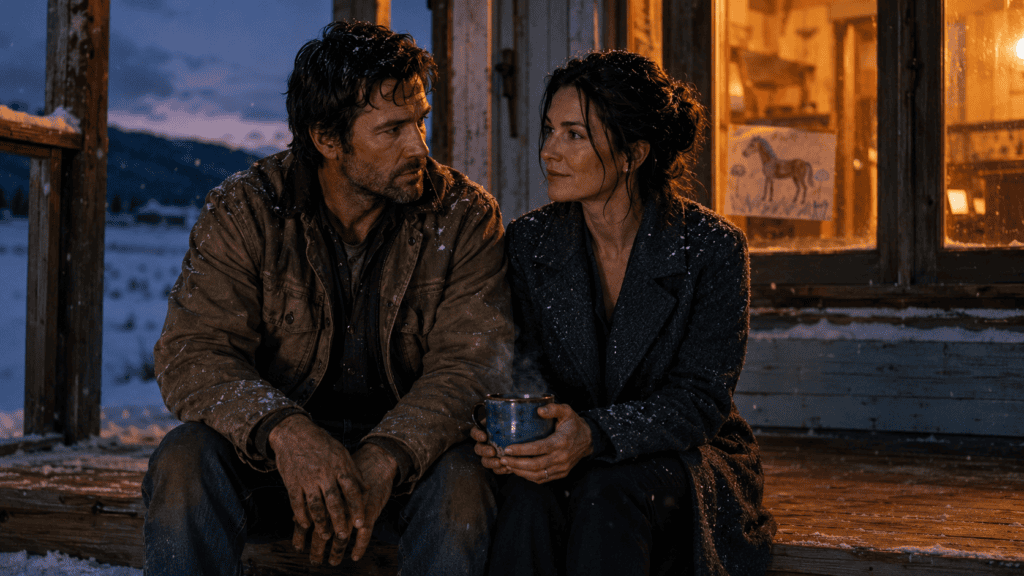
The frost came early that October, laying itself over Sable Creek like a hand pressed flat against a window, and Wyatt Hale woke before it did, the way he always woke — four-forty, no alarm needed anymore, his body having long ago replaced the clock with something colder and more reliable. He lay still a moment in the dark and listened to the house settle, the particular creak of the second stair that Etta always skipped without being told, the furnace ticking on somewhere below the floorboards. Then he got up.
The kitchen held its cold like a held breath. He crossed it in sock feet, past the coat hooks by the door where a woman’s canvas barn jacket still hung, sleeves gone stiff with three winters of dust, and he did not look at it, the way a person does not look at a scar they have stopped believing will fade and stopped hoping will disappear. He filled the percolator. He took down two mugs from the cupboard — this was the part of the morning that never varied, the part his hands did without asking permission of the rest of him — one a plain white diner mug with a chip on the handle he’d bought at the Sinclair station in Miles City, and one that was blue, hand-thrown, glazed unevenly near the rim where Callie had rushed the kiln because she wanted it finished before Etta was born. He set the blue mug on the counter beside the stove, out of the way of the coffee’s steam, and he poured the black coffee into the white one only, and drank it standing at the window while the pot finished dripping, and when it was done he took the blue mug, still empty, still waiting, and rinsed it out under the tap as if it had been used, and set it in the drying rack. He had done this nine hundred some mornings. He could not have said, if asked, what the ritual was for. He would have said only that some things a man does because stopping doing them announces something he isn’t ready to announce, even to an empty kitchen.
Outside, the light came up gray over the stubble fields, over the shop with its two bay doors and the tractor half-gutted in the second bay, over the fence line that needed mending before the snow made mending impossible. Sable Creek sat in a fold of land between two low ridges, a town of four hundred people and one stoplight that blinked amber all night, a co-op grain elevator, a diner, a church with a white steeple visible for eleven miles in any direction if the air was clear. It was a place built for people who had decided, consciously or not, that they preferred distances they could measure. Wyatt had grown up thinking he’d leave it. Instead he’d inherited his father’s machine shop, married a girl from two ranches over, and watched the horizon become something he trusted more than most people.
He heard the second stair complain and did not turn around. “You’re up early,” he said.
“Couldn’t sleep.” Etta came into the kitchen in one of his old flannel shirts belted with a jump rope, hair a wreckage of static and pillow. She was seven, all elbows, missing the same tooth for two months now. She climbed onto a chair at the table and regarded him with the particular seriousness of a child who has learned, too young, to read a room before speaking in it.
“Bad dream?”
“No. Just awake.” She picked at the placemat’s frayed edge. “Can you do my hair before I go? Miss Ardell said we’re doing pictures today.”
He set the spatula down and came around and stood behind her chair, and his hands, which could rebuild a diesel engine blind, went stiff and careful the way they always did with this, working the brush through the tangles with a patience that had cost him, in the beginning, actual effort to fake and now came without thinking, though it had never once come easy. He parted her hair down the center — Callie’s method, the only one he knew — and plaited each side too tight, always too tight, and Etta never complained, and he suspected she had simply decided, somewhere along the way, that a father’s too-tight braid was a kind of love and had made her peace with the difference.
“There,” he said, when it was done, both braids identical, secured with the same green elastics she wore every single school day because he’d bought a hundred-pack once and never needed reason to buy another color.
“Thanks, Dad.”
“Eat your eggs.”
He turned back to the stove and did not look at the blue mug drying upside down in the rack, its handle catching the gray light, and he did not think about the fact that a man who tells himself he has stopped grieving does not need two mugs every morning of his life. He thought instead about the transfer case waiting in the shop, a job with a deadline and a customer who’d pay cash, a problem with an answer he could find with his hands. This was the shape his days had taken since the accident on the county road three winters back, the black ice no one saw coming, the particular arithmetic of a life divided cleanly into before and after: work that could be finished, a daughter who could be fed and braided and delivered to school on time, and nothing — not one thing — left open to chance that he could help. He had built the fence of his life close and low around the two of them, and he told himself this was simply what caution looked like, and did not examine too closely why caution, in his case, had come to resemble a man standing guard against a door nobody was trying to open.
By six-fifteen Etta was dressed and fed and delivered to the end of the driveway where the bus groaned to a stop in a cloud of its own exhaust, and Wyatt stood with one hand raised until the bus was a yellow smear past the Larsen place, and then he went to the shop and opened both bay doors to let the cold scour it clean, and he did not think about the coffee cup, or the coat on the hook, or anything at all beyond the ordinary miracle of an engine that could be taken apart and, if a man was patient enough, put back together exactly as it had been. He was under the transfer case by nine, headlamp throwing a small circle of light against grease and rust, when he heard the truck.
It came up the county road too fast for the frost, tires finding no purchase where the gravel had glazed overnight, and Wyatt rolled out from under the transfer case in time to see it — a black rental Suburban, plates from the airport in Billings — slide sideways at the culvert by his mailbox and drop its front wheel into the borrow ditch with a sound like the earth clearing its throat. He was already walking toward it, wiping his hands on a rag that did nothing but rearrange the grease, when the driver’s door opened and a woman got out into six inches of half-frozen mud wearing a coat that cost more than his truck and shoes that were, by any reasonable measure, an act of open warfare against the state of Montana in October.
“That road,” she said, by way of greeting, looking down at herself, “was not on the map as a hazard.”
“Most of them aren’t,” Wyatt said. “Till they are.”
She looked up at him then — dark hair pulled back hard enough to read as armor, eyes doing the fast, assessing sweep he recognized from men who bought equipment for a living, sizing up the shop, the house, him, in under two seconds and filing it all somewhere useful. “Eleanor Voss,” she said, and put out a hand that was cold and precise in his grip. “I don’t suppose you tow.”
“I don’t suppose you have a choice.”
Something moved behind her face — not quite a smile, more the ghost of one passing through, gone before it could commit to anything. “Fair.”
He walked the ditch line, assessing the angle, the depth, whether the frame had caught. Behind him she was trying to scrape mud from a heel against the truck’s running board with the grim concentration of a person defusing something. “You’re a long way from a paved road, Ms. Voss.”
“I’m here for the co-op.” She said it the way people say things they’ve said many times that day already, worn smooth from repetition. “Norwood Systems. We’re piloting an autonomous tillage system with three operations in the valley, and someone at corporate decided a site visit before the snow would be prudent.” She looked around her — at the shop, the two-story house behind it with its sagging porch and its lit kitchen window, the dog that had wandered out to investigate and was now leaning its full weight against Wyatt’s leg — with an expression he couldn’t place, something between appraisal and hunger, quickly closed off. “It has been, so far, extremely prudent.”
He laughed before he decided to, a short surprised bark of a thing, and she looked startled that she’d caused it, and something eased in her shoulders that he doubted she was aware had been raised at all.
The tow took forty minutes, most of it spent with her standing just outside the reach of the winch cable in her ruined shoes, arms crossed against the cold, asking him precise, useful questions about the chain’s rating and the truck’s drivetrain that told him she was not a woman used to standing by while other people worked. When the Suburban was back on solid ground she looked at its front bumper, cracked and hanging by one clip, and then at the twelve miles of gravel still between her and the co-op office, and something in her posture — some careful architecture she’d been maintaining since the door opened — showed a hairline crack.
“There a part I can get in town?” she asked.
“Not before Thursday.” He wiped his hands again, out of habit more than hope. “Come inside. I’ll get the fascia clipped back on enough to get you where you’re going, but it’ll take an hour, and it’s cold enough out here to crack a battery.”
She hesitated on the threshold of his shop the way a person hesitates at the edge of water they don’t know the depth of, and then she came in, and stood near the woodstove with her arms still crossed, watching him work with an attention that made the back of his neck warm in a way the stove had nothing to do with. At some point she picked up a socket wrench from the bench and turned it over in her hands like an artifact from a culture she was trying to place, and he said, without looking up, “You’re holding it backwards,” and she said, without any apology in her voice at all, “I run a company that makes machines. I don’t have to know how they work,” and he laughed again, that same startled bark, and this time she smiled back at him — a real one, quick and unguarded, gone almost before it landed, but he’d seen it, and something in his chest turned over slow, like an engine on a cold morning deciding, against its better judgment, to catch.
When the fascia was clipped and the coffee he’d offered was gone cold in the mug he’d handed her — the white one, the everyday one, though his hand had hovered a half-second over the blue before some old caution steered it away — she stood in the doorway with her coat buttoned and looked past him into the kitchen window, where a child’s drawing of a horse was taped crooked to the glass in orange marker.
“Yours?” she asked.
“Etta. She’s seven. Horses this month. Dinosaurs before that.”
“She’s talented.” Eleanor said it plainly, no performance in it, and then, as if surprised at herself for lingering on the subject, added, “I should go before the light does anything worse to that road.”
He walked her to the Suburban. The dog followed as far as the mailbox and sat there like a sentry. “Thank you,” she said, and meant it in a way that seemed to cost her something, as if gratitude were a currency she spent carefully. “I imagine most people out here would’ve let me sit in that ditch till Thursday.”
“Most people out here would’ve told the whole town by lunch,” Wyatt said. “I’m just slower with a phone.”
She laughed — actually laughed, head tipping back an inch, and it changed her face entirely, took ten years and every ounce of boardroom off it — and then she caught herself doing it and reeled it back in, though not all the way, and got into the truck, and pulled out onto the frosted gravel more carefully this time, and was gone.
Wyatt stood at the end of his driveway a long moment after the sound of her engine had faded into the general hush of the valley, and became aware, with a kind of distant surprise, that he was still holding the rag he’d been wiping his hands with, and that his hands, for the first time in longer than he could easily account for, did not feel like they belonged to a man standing guard over anything. The Norwood pilot kept Eleanor in the valley longer than three days turned into three weeks turned, by the time the first real snow came, into most of a season, and the road past Wyatt’s shop turned out to be the only reliable route between the co-op’s north pivot fields and the motel in town, which meant her rental — a sturdier one now, with all-terrain tires he’d recommended over the phone before she’d even landed the second time — came past his mailbox most days whether it needed to or not.
At first it was practical. The truck picked up a rattle in the transfer case housing his tow had loosened, and she brought it in, and stood in the doorway of the shop in a coat too thin for the cold with her laptop bag still over one shoulder, taking calls in the fifteen minutes it took him to diagnose it, her voice dropping into a register he recognized — clipped, exact, unbothered — that had nothing in common with the voice she used when she hung up and asked him, watching his hands work, what a torque wrench actually measured, and listened to the answer like it mattered.
Then it was less practical. She came by with a thermos of coffee from the motel because, she said, the diner’s was an affront, and stayed to watch him weld a hitch back together, sparks throwing blue light across the concrete floor, her face lit by it, unreadable, watchful. Etta, dropped off by the bus one afternoon while Eleanor’s truck idled in the yard waiting on a part, wandered into the shop in her backpack and regarded the stranger with the same frank appraisal her father used on faulty carburetors, and asked, without preamble, “Do you know how tractors drive themselves?”
“A little,” Eleanor said, crouching to Etta’s height without seeming to think about it, an unconscious economy of motion that made something in Wyatt’s chest tighten. “Want to know the secret?”
“Yes.”
“They don’t actually think. They just measure everything constantly and make very small corrections, over and over, faster than a person could.” She glanced up at Wyatt, briefly, as if checking whether this was permitted, and he found he had nothing in him that wanted to stop it. “Like your dad does with an engine. He’s not guessing. He’s just noticing things faster than you can see him do it.”
Etta considered this with the gravity she brought to all new information. “That’s not magic, then.”
“No,” Eleanor said. “It’s paying attention. Which is better than magic, because you can learn it.”
Wyatt, wrench in hand, found he’d stopped working, and had to remind his hands what they’d been doing.
The weeks accumulated the way snow does, not as an event but as a slow reshaping of the ground beneath things. She started staying for supper some evenings when the light gave out before the day’s business did — nothing declared, nothing that either of them named, just an extra plate that became less of a question each time he set it out. She was clumsy in ways her competence elsewhere made almost endearing; she did not know how to season anything, admitted she had not cooked a meal for herself in years that wasn’t assembled from a delivery bag, and watched Etta teach her how to crack an egg one-handed with the focus she otherwise reserved for boardrooms, failing twice, laughing at herself both times in that same startled, uncaged way, before getting it right on the third and looking, briefly, absurdly proud.
There were silences, too, that did more work than the talking. One evening in November, the two of them on the porch steps after Etta had been sent up to bed, the cold sharp enough to see their breath, neither of them reaching for a coat though both should have, Eleanor turned the mug she was holding — the white one, always the white one, though he’d noticed, once, her eye catch on the blue one in the rack and move past it, some instinct telling her not to ask — slowly between her palms and said, “I forgot what this was like.”
“What’s that.”
“This. Sitting somewhere with nowhere to be after.” She looked out at the dark shape of the ridge against a sky gone the deep bruised blue of a winter evening. “There was a version of a life I thought I was going to have. Before the company took up all the room.” She stopped there, the sentence left standing open like a door she’d decided, at the last second, not to walk through, and Wyatt, watching the side of her face, understood that whatever stood on the other side of that door was hers to open or not, and did not push.
“You don’t talk about before,” he said instead. “The other life.”
“Neither do you,” she said, and it wasn’t an accusation, just a fact laid gently between them, and he felt it land somewhere under his ribs.
He thought, then, of the blue mug, of Callie’s hands shaping it too fast because she wanted to see her daughter born into a house with a matched set, of the three years he’d spent rinsing an unused cup each morning like a man tending a small flame he was afraid to either feed or let die. He almost told her. The shape of the words rose up in him — Callie, the ice, the two mugs, the fence he’d built around what was left of his life — and he opened his mouth around the start of it, and what came out instead was, “Cold enough for you?”
Eleanor looked at him a beat too long, long enough that he understood she’d heard the door open and close as clearly as he had, and did not resent him for it, and said, “I should let you get some sleep,” and did not move for another ten minutes, and neither did he.
It was on a Sunday in early December, snow finally down in earnest and settled thick and blue-shadowed over the fields, that the dinner happened that neither of them would afterward be able to speak about lightly. Eleanor had brought a pie from the diner because Etta had mentioned, weeks before, that her mother used to make one at Christmas and nobody had since, and the gesture sat on the table between them all evening like something too large for the room. Halfway through the meal, Eleanor set down her fork and looked around the kitchen — the drawings on the fridge, Etta’s mismatched socks under the table, Wyatt’s hand resting, unthinking, on the back of his daughter’s chair — and said, quiet, almost to herself, “Wish I had a happy family like yours.”
The kitchen went very still. Wyatt felt the words land somewhere he had no ready defense for, and reached, the way he always reached when a thing threatened to go too deep too fast, for the easy exit, the joke that could turn a held breath back into a laugh. “Well,” he said, “you’re welcome to it. Kid needs a mom.”
He heard it leave his mouth and understood, half a second too late, that it hadn’t come out as a joke at all — that it had come out true, unguarded, the truest thing he’d said aloud in three years — and across the table Eleanor’s face did something quick and unshielded before the composure came back down over it like a blind drawn against light, and Etta, who had been silent through all of it, looked between the two adults with the unnerving clarity children sometimes have, and said, simply, “I know.”
Nobody spoke for a long moment. Outside, snow ticked against the window glass, and the coffee pot clicked off, and Wyatt sat with his hand still resting on the back of his daughter’s chair and understood that the fence he’d built around his life had a gap in it now, whether or not he’d meant to leave one, and that a woman in a coat that cost more than his truck was standing in it, looking back at him, waiting to see what he’d do. The fear did not arrive as an event. It arrived the way the old fear always had — as a small, reasonable-sounding voice in the quiet hours, the kind that had kept him alive through three winters by convincing him that nothing was safe unless he controlled every part of it. Norwood’s regional office announced, that same week, that the pilot program would need a site director if it moved to full deployment, and Eleanor, telling him this on the porch with snow melting in her hair, said it plainly, without drama — that the job would mean staying, that she’d have to decide by January, that she had told corporate she needed time to think about whether Sable Creek could be somewhere she actually lived rather than somewhere she visited.
He heard decide and think about it and something in him, old and well-worn as a path through a field, began building the fence back up before he’d consciously chosen to. He thought of Etta at the table saying I know, of how a seven-year-old’s whole face could rearrange itself around a hope she hadn’t been given permission to have yet, and he thought — not cruelly, never cruelly, but with the flat, protective logic of a man who had buried one certainty and built his life on never trusting another — that a company could reassign a director as easily as it had created the position, that women who ran things answered to boards and quarters and decisions made in cities he’d never see, and that the surest way to keep his daughter from learning the particular architecture of loss he knew from the inside was to make certain she never leaned her whole weight on a door that might, in the end, only be open temporarily.
So when Eleanor mentioned, two days later, that Norwood wanted her in Denver for the board’s final vote and asked, carefully, whether Etta’s school pageant that Friday — the one Etta had spent a week rehearsing a single line for, the one Eleanor had promised, unprompted, to attend — might be moved up on his calendar so she could plan around it, he said, before he’d let himself examine the sentence, “Don’t make her a promise you can’t keep depending on what Denver says.”
It landed exactly as badly as it sounded. He watched it land — watched something close behind Eleanor’s eyes, fast and total, the shutter of a woman recalibrating a risk she’d let herself misjudge. “I wasn’t planning on breaking it,” she said, quiet.
“I know. I’m not saying—” He stopped. He did not know how to finish the sentence without saying the true thing underneath it, which was I can’t watch her learn this twice, and the true thing under that, which was I can’t survive it either, and so he said nothing further, and the silence did the damage the words hadn’t finished.
She left that evening earlier than usual, and did not come by the shop the next day, or the one after. The rattle in her transfer case, long since fixed, gave her no more excuses, and neither of them manufactured a new one. Wyatt told himself this was what he’d wanted — a return to the fence line, the manageable weather of a life with no more risk in it than an engine could hold — and found instead that his hands, alone in the shop, kept stopping mid-task, holding a wrench without turning it, staring at nothing. He slept badly. He caught himself, twice, taking down two mugs before catching his own hand and putting the blue one back.
Etta felt it the way children feel a barometric drop before the storm arrives. She stopped asking when Eleanor was coming by. She rehearsed her one line for the pageant — and a star shall guide them home — to the bathroom mirror instead of to the kitchen, where she’d been rehearsing it all week to an audience of two, and Wyatt heard her through the door one night, saying it over and over in a voice gone thin and careful, and understood that she had already, quietly, at seven years old, begun building her own fence, learning the lesson he’d never meant to teach her: that people worth loving are people you learn, early, not to expect.
He drove to town Thursday for parts and saw Eleanor’s rental outside the motel, packed, a suitcase visible through the back window, and did not stop. He told himself there was nothing to say that wouldn’t make it worse. He told himself this with the same flat certainty he’d used to justify the two mugs, the tight braids, the twelve miles of gravel he’d let stand, for three years, as the entire known border of his life — and driving home past the culvert where her truck had first gone into the ditch, he felt, for the first time since the accident, something in his chest that was not the old grief but a new one arriving to stand beside it, and could not, for a long time, tell the two apart. The pageant was Friday evening in the gymnasium, folding chairs and construction-paper stars taped crooked to a paper moon, and Wyatt sat in the second row with his hands between his knees and watched his daughter stand in a line of six-year-olds and seven-year-olds in bedsheet robes, watched her scan the crowd once, fast, the way a person checks a horizon for weather, watched her find him and no one else, and watched something in her small shoulders settle for it, the way a person settles for less because more was never promised.
He did not hear the line when she said it. He was watching the door.
Afterward, in the gym’s fluorescent hum, parents folding chairs and children running loops around the punch table, Etta found him and did not ask why the door had stayed empty, and that was somehow worse than if she had, and he crouched down to her height the way he’d seen someone else do once, unthinking, natural, and found he did not have the same gift for it, that his knees ached and his throat had gone tight and all he could manage was, “You did good up there, El.”
“I know,” she said, which was what she’d said in the kitchen weeks before, and he understood, looking at her, that she had learned it from somewhere else entirely — not bravado, but the flat armor of a child deciding not to need what wasn’t reliably given — and something in him broke open that no amount of engine work had ever been able to fix.
He drove home with the radio off and the heater ticking and Etta asleep against the window by the time they hit the county road, and pulled up at the shop to find his own porch light burning yellow against the snow and, parked crooked at the end of the drive where a black Suburban had first gone into the ditch two months before, a car he did not recognize — a rental, newer, the plates still from the Billings airport.
He carried Etta in asleep, laid her down without waking her, and came back downstairs to find Eleanor sitting on the porch steps in the cold in a coat that had never once, in two months, looked like it belonged to this valley, a thermos beside her that she hadn’t opened, her breath showing white in the porch light.
“Board vote’s in three hours,” she said, before he could speak. “I told them I needed one more day.”
He stood in the doorway with the cold coming past him into the house and did not know, for a long moment, how to begin. “I missed the pageant.”
“I know. I was there.” She looked up at him. “I stood in the back so she wouldn’t feel like she had to perform for me too. She found you first anyway. I watched her face do it.” Something moved through her voice, careful and unshielded at once. “I’ve spent a career learning to read a room in four seconds. I have never in my life been as afraid of a decision as I am of this one, and it isn’t the board’s.”
He came down the steps and sat beside her, close enough that their shoulders nearly touched, not quite. “I said a thing I shouldn’t have,” he said. “About Denver. About promises.”
“You did.”
“I built a life where nothing gets to depend on anything that can leave,” he said, and heard, saying it, how long he’d known this about himself and how long he’d refused to say it in a room with another living person in it. “I’ve been rinsing a coffee cup every morning for three years that nobody’s used since Callie died, because putting it away felt like deciding she wasn’t coming back, and taking it out every morning felt like—” He stopped. Started again. “I don’t know how to let something matter without being ready to lose it. I thought if I kept the fence low enough, close enough, nothing new could get far enough in to be worth grieving if it left.”
Eleanor was quiet a long moment, the kind of quiet that in the old days would have felt like a door closing, and instead, slowly, she reached over and put her cold hand over his cold hand on the porch step between them, and said, “I turned down a partnership once because it would’ve meant staying somewhere longer than eighteen months, and telling myself it was ambition was easier than telling myself I didn’t trust anything to still be there if I looked back.” She turned her hand so their fingers laced, plain and unhurried. “I’m not the board’s decision either. I already told them I want the post. I wanted to tell you first, and then you told me not to make promises, and I understood, finally, what you’d been guarding since before the ditch.”
He looked at her — really looked, the porch light doing nothing kind for either of their faces and neither of them minding — and felt something in his chest that had been held rigid for three years let go by one degree, small and specific as a bolt finally breaking loose after years of rust.
“Come inside,” he said. “It’s cold enough to crack a battery.”
She laughed, quiet, real, and followed him in.
In the kitchen he took down two mugs from the cupboard without hesitating over which was which. He filled the percolator and while it worked he reached up and, for the first time in three years, took the blue mug down not to rinse it empty but to fill it, and set it on the counter, and when the coffee was ready he poured it full and carried it to the table and set it down in front of Eleanor Voss instead of himself, and took the white chipped one for his own hand, and sat down across from her at the table where Etta’s crooked horse drawing still hung on the fridge behind them both.
Eleanor looked at the mug a moment — the uneven glaze near the rim, the small history visibly folded into it, the fact of being handed something that plainly, wordlessly, had never before this night been given to anyone — and did not ask what it meant, understanding, the way a person understands weather, that some things are read in the offering and not in the explaining. She wrapped both hands around it the way a person does when a thing is precious and warm and has been a long time coming, and lifted it, and drank, and outside the window the snow kept falling steady and unhurried over the ridge, and upstairs, in a house that had finally stopped counting the ways it might yet be broken, a child slept on, undisturbed, her two green elastics resting on the nightstand where her father would, in the morning, braid her hair a little less tightly than before.