
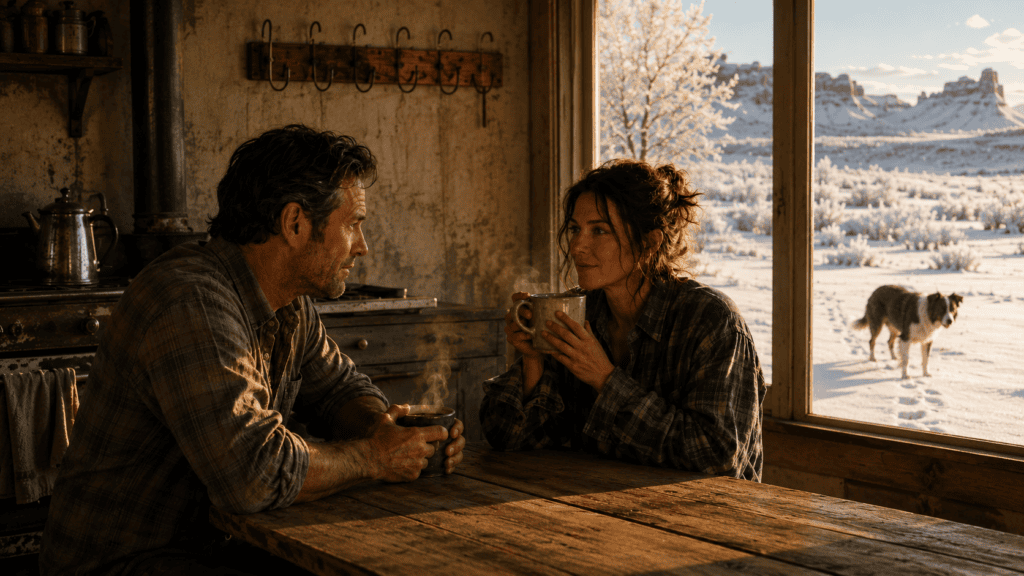
The coffee maker on the counter in Hollis Bragg’s kitchen was older than his marriage had been, a percolator with a dented lid that ticked and sighed on the burner like something with lungs. Every morning at five-forty he took down two cups from the row of hooks above the sink, filled both, and carried them to the table where the good light came slanting low and orange through the east window. He drank his own black, sitting in the chair that faced the door. The second cup sat across from him, untouched, going from steam to stillness to a skin of cold film, until the chores called him outside and he poured it into the dirt beside the porch step, where over three years a faint gray stain had worked itself into the ground, a shadow that never quite washed out even in hard rain.
He did not think of this as anything. It was not, in his accounting of himself, a form of grief. It was simply the order of a morning, the way a man’s hand might still reach for a rung of the ladder that used to be there, the way a tongue finds the place where a tooth is gone and returns to it, testing, before the day has properly begun. Carol had liked her coffee with too much sugar and had complained, every single morning of the eleven years they’d shared this table, that the percolator made it bitter, and every single morning he had made it anyway, and now he went on making it anyway, for no one, out of a loyalty that had outlived its object and did not know how to stop.
The ranch sat in a fold of high plain outside a town small enough that its name did not appear on the state road atlas, only on the county map tacked behind the counter of the feed store. Eleven thousand acres of short grass and sage and rimrock, cut through by a creek that ran high in April and showed its stones by August, fenced and cross-fenced by three generations of Braggs before him, though the men in the photographs on the stairwell wall had a squint to them that made them look already halfway to being ghosts even in their youth. Hollis ran cattle on it alone now, with a hired man named Dutch who came three days a week and a border collie named Vessel who slept against the woodstove and dreamed with her legs twitching. He was forty-four years old. He had the kind of quiet that people in town mistook for peace.
What he had stopped believing in, though he would not have used the word believing, was the plain fact of staying. He had watched his father’s heart give out at the branding chute one May morning, watched his mother go two winters later of nothing anyone could name but the absence of him, and he had watched Carol, healthy as a horse her whole life, drop in the yard between the barn and the house on an ordinary Tuesday in October with a blood vessel gone wrong in her skull, and after that he had come to understand staying as a kind of arrogance, a thing the land itself did not permit. The rimrock stayed. Everything that loved you did not.
So he had built, without meaning to build it, a life organized around the brief and the temporary. He fed anything that turned up hungry — barn cats, coyote pups too young to know better, the occasional stranded traveler on the county road who’d blown a tire or run out of gas in a stretch where the nearest gas station was forty miles and the nearest tow truck was an act of God — but he did not keep them. There was a cot in the mudroom, made up always with clean sheets and a wool blanket folded square at the foot, ready on a day’s notice for whoever the highway sent him. It had been Carol’s habit first, this taking-in of strangers; she’d had a gift for it, a way of setting a plate down in front of a person that made them feel they’d been expected their whole lives. He kept the cot made because it felt like keeping something of her going. But he had a rule, unspoken even to himself until he noticed himself following it: one night. Breakfast. A full tank if they needed it, cash from the coffee can in the pantry if that was the trouble. Then the road again. He had never once asked anyone to stay a second night, and he had never once let himself wonder why the rule existed, because to wonder was to come close to a shape he did not want to look at directly, the shape of himself standing at a gate watching something recede, over and over, for the rest of his life, unless he simply refused to let anything come close enough to leave.
That October, the aspens up in the draws had gone the color of the inside of a struck match, and the wind had a threat of snow riding under it two weeks early, and Hollis Bragg was out mending a stretch of fence along the county road at dusk when he saw, half a mile off through the sage, a car pulled crooked onto the shoulder with its flashers going weak against the failing light, like something signaling for help it had already stopped believing would come.
Delia Renner had been driving for six days with a bag zipped shut on the passenger seat and the certain, comfortable knowledge that nothing in it needed unpacking, because nothing about where she was going was permanent enough to warrant it. She had left Ohio in a hurry that had disguised itself, for the first three states, as purpose. She was going to her sister’s outside Spokane. She had a plan, of sorts, the way a leaf drifting downstream has a plan, which is to say she was moving and calling the movement a direction. Twelve years of marriage had ended nine days earlier in a kitchen not unlike the one Hollis Bragg poured his second cup of coffee into the dirt beside, when she’d found, with the flat unsurprise of someone confirming a suspicion she’d carried so long it had gone numb, the messages on her husband’s phone that told her what she’d already known in her body for the better part of a year. She had not cried. She had packed a bag that night, one bag, the same one she’d carried out of her mother’s house at nineteen and out of a college dormitory and out of two apartments and, now, out of a marriage, because Delia Renner had learned early — her father had gone for cigarettes on a Sunday in 1994 and simply not come back — that the leaving was less like a wound if you were the one who did it first. She had gotten so good at going that she had stopped noticing she was always the one who went.
Her habit, the one that would have told a careful observer everything about the shape of her, was this: in every motel room on the six-day drive, she had unpacked nothing but a toothbrush. Not a shirt hung in a closet. Not a book left open on a nightstand. She showered, she slept on top of the made bed some nights rather than disturb it, she left each room by seven the next morning looking exactly as it had looked when she’d arrived, as if she had never been there at all, as if departure were a species of politeness. The bag stayed zipped on the passenger seat, riding shotgun like a second person who never spoke and never stayed either.
The car had begun making a sound outside of a town whose name she’d forgotten before she was ten miles past it, a grinding cough under the hood that grew worse with the grade of the road, until the engine simply quit on a stretch of two-lane with sage running gray-green to the horizon on both sides and not a light showing anywhere, and dusk coming down fast and cold, the first snow-smell she’d caught all trip riding under the wind through the vents even with the engine dead.
She had her phone in her hand, watching the single bar of signal flicker and fail, when the truck came along the fence line — not on the road but inside it, a man walking the wire with a pair of fencing pliers hooked to his belt, a dog trotting a length behind him — and stopped at the corner post nearest the road and looked at her the way a man looks at weather rolling in, assessing rather than staring, before he came the rest of the way to the fence and called across it, not raising his voice more than the distance required.
“Radiator, sounds like,” he said, when she’d rolled the window down enough to hear him and be heard. “Or a belt. Won’t know till somebody looks.”
“I don’t suppose there’s a garage close,” she said, and heard in her own voice the flatness of a person delivering a line she already knew the answer to.
“Forty minutes, and closed by now besides.” He looked at the sky, which had gone the color of a healing bruise low in the west. “Going to snow tonight. Early for it, but it’s coming.”
She had nothing to say to that. She had, if she was honest with the part of herself she rarely consulted, nothing much to say to anything just then; the six days of driving had worn a kind of silence into her that felt less like grief than like static, a radio tuned between stations. The man studied her through the windshield a moment, not unkindly, the dog sitting now at his heel with its ears up, and then he said the thing that would arrive, later, folded into memory with a weight far past its size, a plain question asked the way a person asks whether you take cream:
“Have you got anywhere to sleep?”
It was such an ordinary sentence that its kindness took a moment to land, the way cold water takes a moment to register as cold. She looked at him — a man perhaps ten years older than herself, weathered in the particular way of people who spend their lives outdoors, not handsome so much as made, put together out of necessary things, no waste in his face — and felt something in her chest do a small, unauthorized thing, a loosening she hadn’t given permission for.
“No,” she said. “I don’t.”
“Well,” Hollis said, already turning to whistle the dog up into the truck bed, already reaching for the tow chain coiled behind the seat, as if the matter had been settled before either of them had finished speaking it, “I expect you do now.”
The chain rattled against the tailgate, bright and businesslike in the failing light, and overhead the first flakes came down not falling so much as simply arriving, weightless, uncommitted, the way she had arrived at everything for six days, and would not, though neither of them knew it yet, arrive at leaving this place so easily again.
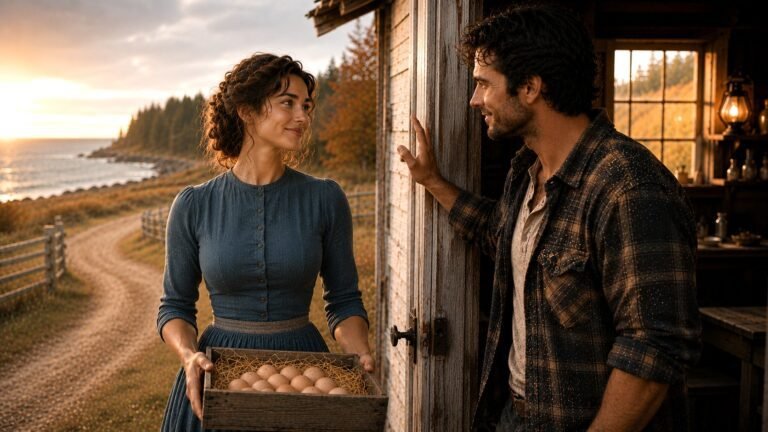
The house sat back from the road at the end of a gravel lane lined with cottonwoods gone bare-branched and silvery in the dusk, and by the time Hollis had the car chained and towed the quarter mile into the yard, actual snow had begun, fine and dry, ticking against the windshield like sand. He showed her the mudroom off the kitchen — the cot made up square, a lamp with a cracked amber shade, a hook for a coat — with the unceremonious efficiency of a man who has done this before and does not intend to make an occasion of it, and then he cooked, because it was suppertime and there was no reasonable universe in which a person under his roof went unfed. He fried potatoes and a piece of venison from the freezer and set the plate in front of her without asking whether she was hungry, the way Carol used to do, though he would not have named the resemblance even to himself.
She ate more than she meant to. The kitchen was warm in a way that had nothing to do with the woodstove ticking in the corner — warm the way rooms are when someone has cooked in them steadily for years, grease and woodsmoke and something like bread gone into the walls themselves — and she found herself, halfway through the meal, laughing, a short unpracticed sound that surprised her more than it surprised him, when the dog, Vessel, put her chin on Delia’s knee with an expression of such theatrical hope that even the man across the table smiled down at his plate.
“She’s shameless,” Hollis said. “Don’t feed her or she’ll never leave you be the whole night.”
“Too late,” Delia said, already breaking off a corner of venison, and Vessel took it from her fingers with a delicacy that seemed almost apologetic, and Hollis Bragg, watching this small transaction, felt the floor of something in him shift half an inch, imperceptibly, the way a fence post shifts in a hard freeze, not falling, not yet, but no longer standing quite where it had stood an hour before.
They did not talk about why she was on that road, or why he lived alone on eleven thousand acres with a dog and a dead wife’s coffee habit, because neither of them was in the business, that first night, of handing over the contents of a life to a stranger across a supper table. But something passed between them anyway, wordless, in the way he refilled her water glass without being asked, in the way she noticed — and did not say she noticed — the second cup he set out from habit the next morning before catching himself, staring at it a long moment before pouring it, unusually, not into the dirt but down the kitchen sink, as though something about its presence embarrassed him now in a way it hadn’t in three years. She left that morning with a new belt on the car, tightened by Hollis’s own hands in the cold barn light, and cash refused twice and then accepted once, folded into her coat pocket “for the road,” and a strange, unfamiliar reluctance dragging at her like a hand on her sleeve as she pulled back out onto the county road, watching the house go small in the rearview mirror the way she had watched a hundred other places go small behind her, except that this time some part of her, watching, did not want it to.
She did not make it to Spokane that week. The car, it turned out, needed more than a belt — the radiator, too, exactly as he’d guessed, and a garage forty minutes off with a two-week wait on the part — and so what began as an accident of geography stretched itself, day by day, into something neither of them examined too closely, because to examine it was to name it, and naming it felt, to both of them, like handling something too new to survive the handling.
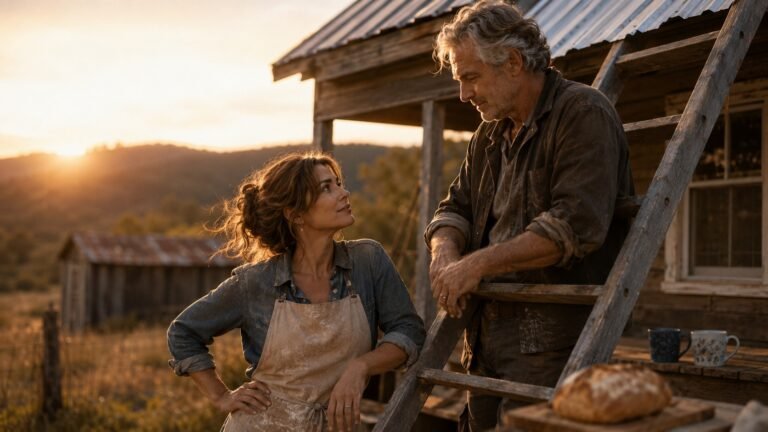
She took a room in town, above the hardware store, cheap and cold-cornered, and she came out to the ranch most days anyway, first with the thin excuse of checking on the car’s progress, then with no excuse at all, because Hollis had begun, without deciding to, teaching her the small competent language of the place — how to read weather coming three hours out by the way the light changed over the Bull Mountains, how to sit a horse without gripping it like a drowning woman, how to tell from twenty yards which cows were closest to calving though it was the wrong season and there was nothing, really, to teach her about it except the shape of his own attention, which he gave freely to the land and, increasingly, without entirely meaning to, to her.
They fell into a rhythm that had the shape of courtship without any of its declared intentions. Afternoons mending fence, her holding the wire while he stretched and stapled it, the two of them not talking for whole stretches at a time, the silence between them doing something that conversation, she found, had rarely managed in twelve years of marriage — it did not feel like absence. It felt occupied, the way a held breath is occupied, waiting for its own release.
“You always make two cups,” she said once, in November, watching him at the counter, the second one steaming untouched across from her at the table, and something crossed his face too quick to name, gone before she could read it.
“Habit,” he said.
“Whose?”
He didn’t answer that directly. “Carol used to say this pot made everything bitter.” He poured his own, black, and did not sit down right away. “She was probably right.”
“Was,” Delia repeated, soft, not a question, and he looked at her a moment with something unguarded moving behind his eyes, and then looked away, out the window, at the gray light lying over the pasture.
“Three years in March,” he said, and that was all, and she did not press further, because she recognized, in the careful economy of his sentence, a grief handled the way her own losses were handled — folded small, put away, taken out only by accident, in the wrong light.
She, in turn, told him almost nothing directly about the husband, the phone, the kitchen in Ohio. What she told him instead was smaller and truer: that she had never, not once in her adult life, hung a picture on a wall she didn’t already know she’d be taking down. That she’d left her toothbrush in a paper cup in every bathroom of every place she’d lived, because a toothbrush standing upright in a cup felt, to her, like a commitment she wasn’t ready to make.
“That’s a strange thing to be careful about,” Hollis said, and there was no mockery in it, only the plain curiosity of a man turning over an unfamiliar stone.
“Everything’s a strange thing to be careful about, if you look at it long enough,” she said, and he laughed — a short, real sound, rusty with disuse — and something in her chest turned over at having caused it.
There were evenings that November when the work was done and neither of them found a reason to say goodnight. She’d sit on the porch step in a coat too thin for the cold, watching her breath go up pale against the dark, and he’d come out with two mugs — coffee, plain, both of them drunk down to the dregs now, no cup going cold and wasted in the dirt — and hand her one without a word, and they’d sit shoulder to shoulder not touching, close enough that the cold made an argument for closing the distance and neither of them closed it, because closing it meant something neither of them had yet found the nerve, or perhaps the right, to mean.
“You could stay the winter,” he said once, watching the sky, not looking at her, the sentence coming out sideways the way the true ones always did with him. “Car’s not going anywhere till spring anyhow, way that part’s backordered.”
“I know,” she said, meaning she’d heard the part about the car, and also meaning something else, something neither of them said, and the silence that followed had a held quality to it, taut as new fence wire, singing faintly if you put your ear close enough, though neither of them put their ear close enough, not that night.
What Delia did not say was that she had begun, for the first time in six weeks, to unpack — not fully, not everything, but a sweater hung now in the closet of the room above the hardware store, a second toothbrush, standing upright, unashamed, in the cup by the sink at the ranch, left there after a day of helping move cattle down from the high pasture, left there because she’d forgotten to take it back to town, and then left there again the next week, on purpose, a small flag planted in soil she had not yet admitted she wanted to keep.
What Hollis did not say was that he had stopped, some week in early December he couldn’t have named exactly, making the second cup out of habit and started making it on purpose, and that the difference between those two things sat in his chest some mornings like a held match, warm and dangerous, a thing that could either light something or burn it down, and that he did not yet trust himself to know which.
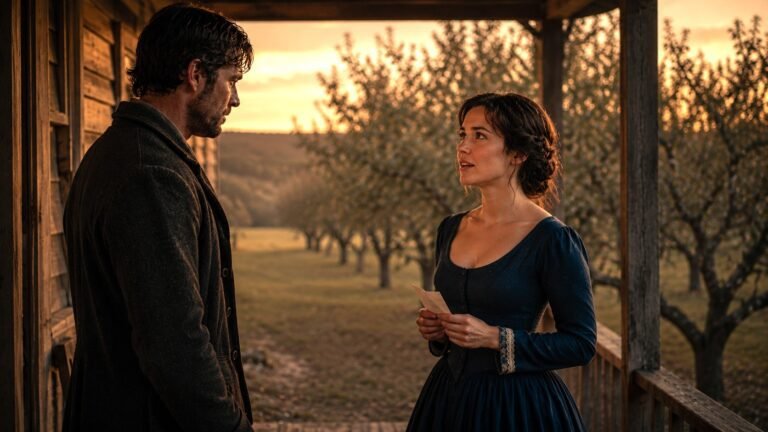
Delia’s room above the hardware store had a window that looked down Main Street toward the depot, and on a Tuesday in mid-December, with the part for her car finally in and the mechanic’s estimate promising the work done by Friday, she stood at that window a long while, watching the four-fifteen bus idle at the curb below, its exhaust rising white into the cold, and she felt the old habit stir in her like a hand closing around something it recognized — the pull toward the door before the door could close on her first.
It had started three days earlier, small and wordless, the way the fracture in a fence post starts below the frost line where no one can see it until the post goes over in a spring wind. Hollis had driven her back into town after a long day working calves in a cold that cut through three layers, and at the curb outside the hardware store, engine idling, he had not said what she’d caught herself, in some unguarded corner of her chest, hoping he would say. He’d said instead, looking straight ahead through the windshield at the falling dark, “Car’ll be ready Friday. Ferguson says he can get the part in a day early if I run into the county seat for it myself, save you the wait.”
It was, on its plain face, a kindness — the same kindness that had chained her car and towed it home the first night, that had made two eggs instead of one every morning she stayed, that had taught her to sit a horse and read a sky. But something in the offering, coming just then, in that particular flatness of voice, landed on her like the closing of a door rather than the opening of one. It sounded, to the part of her that had spent a lifetime listening for exactly this sound, like a man arranging her exit. Like a man who had done, without cruelty, without a single word of it spoken aloud, the thing every man in her life had eventually done: made the practical case for her leaving before either of them had to survive the harder conversation of her staying.
She did not ask him what he meant by it. That was the failure, if a failure it was — not his offer, but her long, well-worn refusal to test a fear against the evidence, to say do you want me to go and wait, unguarded, for the answer. Instead she did what she had always done, what the leaving-first in her did better than any other single thing: she thanked him, went inside, and by Thursday morning had a seat booked on the four-fifteen bus west, told herself it was only sense, only the plan she’d started with, Spokane, her sister, a life that did not depend on a man’s silence being interpreted correctly across a cold truck cab.
What she could not have known — because he did not know it clearly himself until the truck was empty beside him in the dark and the porch light burned uselessly over the mudroom cot that had gone, for the first time in three years, unmade — was that Hollis had spent that same drive rehearsing a different sentence entirely, one about staying, about spring, about a name added someday to something more permanent than a hook by the sink, and had lost his nerve for it a half-mile before the hardware store, had reached instead for the ordinary, safe, temporary language of car parts and errands because the other sentence, the true one, felt too much like building something that the world, in his experience, reliably came and took away. He had made the second cup that whole week on purpose. He had not once managed to say why.
Friday morning he drove into the county seat for the part as promised, and Friday afternoon he drove back to a house gone quiet in a new way, the mudroom cot still made from the last night she hadn’t slept in it, her second toothbrush still standing in the cup by the sink, and it was Dutch, of all people, who mentioned, three days later and entirely without malice, that he’d seen a woman fitting her description buying a one-way ticket at the depot counter Thursday evening, headed west, and Hollis had stood in the cold barn aisle with a currycomb in his hand and felt something in his chest go the flat gray color of a sky before real snow, the particular stillness of a man watching, again, a thing recede, except this time he had built the road it left on with his own two careful, cowardly hands.
He did not sleep that night, or told himself later he hadn’t, though he must have, in pieces, because he remembered waking at four with the lamp still on and the whole house around him making the small settling sounds it always made, sounds that had never once, in three years, sounded to him like absence until now. He went to the kitchen in the dark and stood a long while at the counter before he took down two cups from the hooks above the sink and then, for the first time since the second morning of her staying, put one of them back.
Delia sat in a bus depot in a town two hundred miles west with a coffee gone cold in a paper cup and her one bag zipped on the bench beside her, and felt, for the first time in a lifetime of leavings, that the leaving had cost her something on the way out rather than saved her something on the way in. Outside, snow was coming down in earnest now, the real snow that had only threatened back in October, and the bus board above the ticket counter had begun flashing DELAYED beside every westbound route, the storm closing the passes faster than the highway department could keep pace, and Delia sat with her hands wrapped around a cup she wasn’t drinking and thought, with a clarity that felt almost violent in its suddenness, of a hook above a sink and a coat on a peg in a mudroom that had never once, in the whole of her adult life, felt like a door closing rather than one held open.
She did not decide, exactly, to stand up. Her body seemed to arrive at it before the rest of her caught up, the way a hand knows to pull back from a stove before the mind has finished registering heat. She was three steps toward the depot’s glass doors, toward the pay phone bolted to the wall beside them, toward some version of a sentence she had never once in her life practiced saying first — have you got anywhere to sleep, because I think I do now, and I think it’s yours — when the doors themselves opened inward on a gust of snow and cold, and Hollis Bragg stood in them, hatless, his coat still dusted white across the shoulders from the two-hundred-mile drive through a storm the radio had been calling a fool’s errand since noon, holding two paper cups of gas-station coffee because some habit in him, some habit older than fear, had made him stop and buy two without letting himself examine why.
Neither of them said anything grand. That was, later, the thing she would remember most clearly, turning it over the way a person turns over a stone worn smooth — that there was no speech, no scene, nothing a stranger in the depot would have paused to watch. He simply crossed the tiled floor and held one of the cups out to her, and she took it, and their fingers found the brief accidental contact of the exchange and did not hurry away from it, and he said, in a voice gone rough with two hundred miles of silence and cold, the only sentence he seemed to have carried the whole way, plain as the first one, changed only by everything that had happened since:
“Roads are bad. You’d be safer waiting it out someplace warm.”
“I don’t have anywhere,” she said, and heard her own voice catch on the word, and did not look away from him to hide it, “unless you’re still offering.”
“I never stopped,” he said, and it was the truest sentence either of them had managed in eight weeks, delivered without drama in a bus depot that smelled of wet wool and burnt coffee, and it undid something in her chest more completely than any grander word could have.
They drove back out to the ranch through a storm that would, by morning, close the county road behind them for three days, snow drifting waist-deep against the cottonwoods, the whole white world gone still and sealed and private, and neither of them minded the closing of that road at all.
In the morning — the first true morning, the light coming up pale gold over a yard buried in new snow, Vessel’s tracks already crossing it in busy loops toward the barn — Delia woke in the room that had, without either of them naming the shift, stopped being spoken of as the mudroom cot and become simply the other side of the bed, and she came out to the kitchen before he was up, moving through the cold house in one of his flannel shirts, and she did the smallest, most courageous thing either of them had done in the whole slow unfolding of that autumn: she took down not one cup but two from the hooks above the sink, filled the percolator, and set both cups out on the table, across from each other, on purpose, before he’d even come down the stairs to see it done.
When he came into the kitchen in his socks, rubbing sleep from his face, and saw the two cups steaming there, waiting, claimed, he stopped a moment in the doorway the way a man stops at a gate he has closed and locked himself for three years, finding it, unaccountably, standing open. He did not say anything about it. He crossed the room, sat down across from her in the chair that faced the door, the good light coming low and gold through the east window exactly as it always had, and picked up the cup that was his, and she picked up the one that was hers, and outside the snow lay clean and unbroken over eleven thousand acres of ground that had, for three years, kept only one set of prints crossing it at dawn, and now, plainly, in the new white morning, kept two.