
The Foreman Who Stopped Listening
Caleb Ross had learned, over the years, to build things that did not need him to trust anyone.
That was the quiet arithmetic of the job — steel don’t lie, concrete don’t leave, a level either reads true or it doesn’t, and there was a peace in that kind of certainty that people never quite managed to offer him. At forty-one he ran a crew of nine on the renovation of the old Larchmont Mill on the edge of Miller’s Bend, turning a hundred-year-old husk of red brick and broken glass into what the developers were calling luxury loft apartments, and he had come to prefer the company of rebar to the company of most anyone with a pulse.
He arrived before the others, always. Before the sun cleared the water tower, before the first truck rattled over the gravel lot, Caleb walked the perimeter of the mill alone, running a bare hand along the brick the way another man might run a hand along the flank of a horse he trusted. He checked the scaffolding joints twice. He checked the crane cable even when he’d checked it the night before. It wasn’t caution, not exactly. It was closer to a kind of prayer — the only kind he still practiced — the belief that if a man looked closely enough, often enough, nothing important would be allowed to slip past him unnoticed again.
He had not always been a man who checked things twice.
Twenty years back he’d been the kind of boy who left his truck unlocked in the school lot and his heart wide open besides, and both of those habits had cost him, in their own separate ways. The truck had been stolen exactly once, by a kid three grades below him looking for a joyride, and Caleb had gotten it back within a week, mildly dented, easily forgiven. The heart had not come back so easy.
Her name had been Reyna Hale, and for two years of high school she had been the whole shape of his future as far as he could see it — homecoming and graduation and some version of forever that two eighteen-year-olds in a town like Miller’s Bend had no earthly business promising each other, and had promised anyway, lying in the bed of his truck out past the mill on summer nights when the whole plant was still running and the windows glowed amber clear till midnight.
Then, in the space of nine days in August, her father’s company had folded, and the Hales had packed a U-Haul and driven out of Miller’s Bend without so much as a note nailed to his door. Caleb had gone by her house on a Tuesday to find the porch light off and the curtains gone and a realtor’s sign already staked crooked in the yard. No goodbye. No explanation that ever reached him, not that summer, not the one after. He had spent a long while believing he’d done something to deserve the silence, before he’d finally worn that particular grief down into something duller and more manageable — the simple, settled conviction that people left, that explanations were a courtesy nobody actually owed you, and that the safest thing a man could do was build his life so sturdy that no single person’s leaving could take the roof off it.
He still, twenty years on, had a habit he’d never quite managed to break. Most mornings, driving the two miles from his place to the mill, he’d flip the truck radio through three or four stations before settling, and every single time, without deciding to, his thumb paused half a second too long on 91.5 — the frequency the old classic rock station had broadcast on, back when it still existed, back before it got bought out and folded into something else entirely. He never lingered there anymore. There was nothing on it now but static and the ghost of a signal from two towns over. But his hand still went there first, every morning, an old reflex the rest of him had stopped believing in a long time ago.
This particular Monday in September, Caleb parked the truck at half past six, checked the crane cable, checked it again out of a habit he’d have called useless if anyone but him had noticed it, and was halfway up the scaffold when Danny Okafor, his second, hollered up from the gravel lot that corporate had finally sent down word on the new site manager — the one meant to babysit the back half of the Larchmont job through winter, since the last one had bailed for a bigger contract in Columbus without much notice at all.
“Landing today,” Danny called. “Some transfer outta the regional office. They’re saying she used to live around here, way back.”
Caleb didn’t think much of it. People used to live around a lot of places. He climbed the rest of the scaffold, checked the joist bracing, and did not think, even once, that the morning had anything unusual waiting inside it. That was, he would later understand, the last ordinary hour of a life he had spent two decades building to be unbreakable.
A Voice Before Her Face
The site trailer’s radio crackled to life around nine-fifteen, patched through from the gate intercom where a car had pulled up without a badge scanned, and Caleb was thirty feet up on the north scaffold with a level in one hand when the voice came through the little speaker clipped to his belt.
“Morning — looking for whoever’s running this site. I’ve got paperwork says I’m supposed to be expected.”
It was not the words that stopped him cold on the scaffold, both boots planted, level forgotten in his grip. It was the particular rasp underneath them — a scratch worn into the low register of her voice that Caleb had once, half-joking, told her sounded like a porch swing that needed oiling, and she’d laughed so hard at the comparison that the sound of the laugh had gotten tangled up permanently with the sound of the voice itself, so that hearing one without the other, twenty years on, felt like hearing half a sentence.
He recognized her voice before he ever saw her face. That was the plain, unglamorous truth of it — no slow-motion, no soundtrack, just a man three stories up a scaffold going still as poured concrete while a radio clipped to his hip said six ordinary words in a voice he’d have known blind, deaf, and half-dead.
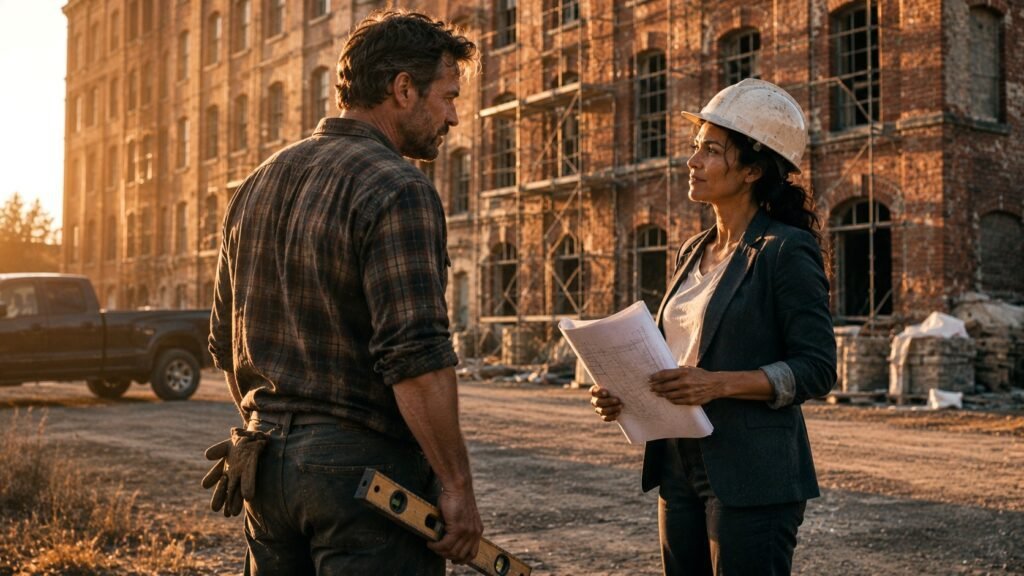
By the time Caleb got down the scaffold ladder, his hands not quite steady on the rails, she was standing in the gravel lot in a hard hat two sizes too big and a blazer clearly not built for a construction site, looking up at the mill’s brick face with an expression he recognized even faster than he’d recognized her voice — the particular tilt of the head she’d always given anything she was trying to decide whether to love.
“Reyna,” he said, and the name came out rougher than he meant it, like something dragged up from underneath a floor he’d nailed shut a long time ago.
She turned. For one full second — Caleb counted it later, lying awake, the way a man counts the seconds between lightning and thunder to measure how close a storm has actually come — her face did nothing at all, caught between the stranger’s polite blankness and something underneath it fighting hard to surface. Then it broke open into recognition so plain it looked almost like pain.
“Caleb Ross.” She said his name like she was testing whether the floor beneath it would hold her weight. “They didn’t put your name on any of the transfer paperwork.”
“Wouldn’t figure they would. I’m just the foreman.” He heard how flat that came out and didn’t try to soften it. Twenty years hadn’t erased the girl who used to sit on his tailgate with her boots swinging, but it had built a wall around the boy who used to let her, brick by careful brick, and the wall didn’t come down just because the voice on the other side of it turned out to be exactly as he remembered.
“Just the foreman,” Reyna repeated, and something wry moved at the corner of her mouth — the same corner, Caleb noted with an ache he hadn’t budgeted for, that used to tuck up first whenever she was fighting not to laugh at him. “And I’m just your new boss, apparently. Regional sent me down to close out the interior schedule before the snow gets serious. Nobody mentioned Miller’s Bend still had you in it.”
“Didn’t much go anywhere to be mentioned.”
It should have landed harder than it did. Instead, something in the plain honesty of it seemed to catch her off guard into a laugh — small, surprised out of her, the porch-swing rasp underneath it exactly unchanged — and for one unguarded second the twenty years folded up small enough to fit in a shirt pocket, and Caleb felt the ground shift under his boots the way it hadn’t shifted in longer than he wanted to count.
“Well,” Reyna said, recovering, straightening the hard hat that was sliding toward her eyebrows, “guess you’d better show your new boss around the site, then, Mr. Ross.”
“Guess I’d better,” Caleb said, and picked up his level, and did not trust his voice for anything further than that.
They walked the mill floor together for the better part of an hour, Caleb pointing out load-bearing walls and Reyna nodding along with a competence that surprised him — she’d learned the industry properly somewhere in the twenty years he hadn’t been there to watch it happen — and neither one of them said a single word about U-Hauls or dark porches or nine unexplained days in August. But by the time she climbed back into her rental car at noon, Caleb Ross stood in the gravel lot a changed man, and he suspected, watching her taillights swing out onto the county road, that whatever she’d driven back into Miller’s Bend carrying, it had changed her too.
Falling for the New Boss
By the second week, Caleb had learned the shape of Reyna’s new habits the same careful way he’d once learned the old ones — not by asking, but by watching, the way a man reads a building before he trusts it to hold his weight.
She took her coffee black now, no cream, where she used to drown it in enough sugar to embarrass a dentist. She still chewed the cap of her pen down to ruin when she was working through a schedule that wouldn’t balance. She still, without seeming to notice she did it, hummed three low notes under her breath when she was thinking hard — the same three notes, Caleb realized on the fourth or fifth time he caught it, that used to be their whistle. A stupid, private signal from a stupid, private summer, two short notes and a long one, the sound he used to make from the sidewalk under her window when her father’s porch light was off and it wasn’t safe to knock, and she’d slip out the back with her shoes in one hand.
He did not tell her he still remembered it. He wasn’t sure yet what he’d do with an answer either way.
They fell, without either one naming it, into a rhythm that had nothing to do with the site schedule and everything to do with the particular electricity of two people relearning each other in small, careful increments. She started staying past five most days, ostensibly to walk the punch list with him before the light went, though the punch list rarely took the whole hour they spent on it. He started parking the truck a little closer to her rental than the gravel lot strictly required. Neither of them commented on any of it. The not-commenting became its own kind of language, dense with things that both of them understood and neither one said aloud.
“You still whistle when you’re thinking,” he told her one evening, finally, the two of them leaning on the tailgate of his truck while the crew’s trucks pulled out one by one down the gravel drive, dust hanging gold in the last of the light. “Same three notes.”
Reyna went still, the pen cap frozen between her teeth. “You remember that.”
“Remember a lot of things I never much tried to forget,” Caleb said, and immediately wished the words back, because something crossed her face that looked less like pleasure and more like a wound reopening from underneath a scar she’d thought had closed clean.
“Caleb.” She set the pen down on the tailgate, careful, like it might go off. “There’s things about that August you don’t know. Things I never got the chance to —”
“Don’t gotta explain nothing to me,” he said quickly, the old wall going up brick-fast, reflex faster than thought. “Long time ago.”
“It wasn’t, though. Not to me.” Her voice had gone quiet, the rasp underneath it thinner than usual, worn down by something that had nothing to do with twenty years of talking over machinery. “My father’s company didn’t just fold, Caleb. He’d been — there’d been trouble. Money trouble, the kind a man doesn’t tell his kids about till the sheriff’s at the door. We were gone inside two days because we had to be gone inside two days, and I begged him to let me at least call you, and he said a phone call wasn’t safe, not with what was chasing us, and by the time it was safe again, months had gone, and I didn’t know what there’d be left to say that wouldn’t sound like an excuse dressed up as an explanation.”
Caleb stood very still, the way he’d stood on the scaffold the morning her voice first came through the radio, feeling twenty years of a story he’d built for himself — she left because leaving was easier, because he hadn’t been worth a note nailed to a door — come apart in his hands like drywall gone soft with water damage.
“You could’ve told me that fifteen years ago,” he said, and it came out rougher than he meant, not accusation exactly, closer to grief finding a door it hadn’t known was open.
“I know it.” Reyna looked at him full on, no flinch in it, the same unflinching honesty he remembered from a girl on a tailgate a lifetime back. “I’m telling you now.”
Neither one of them closed the distance between them that evening. But something in the air between the truck and the last of the sunset had shifted permanent, the way a foundation settles once and doesn’t move again, and Caleb drove home that night with the radio on 91.5 the whole way, static and all, and did not once reach to change the station.
When Old Wounds Reopen
It should have been a small thing. It was, in the end, the exact wrong small thing at the exact wrong moment, the way a hairline crack in a foundation only ever picks the worst possible week to finally give.
Caleb came around the corner of the site trailer on a Thursday afternoon, meaning to ask Reyna about a change order on the second-floor plumbing, and stopped short at the sound of her voice through the half-open door, low and urgent on a phone call he hadn’t meant to overhear.
“I know it’s fast,” she was saying, “but if regional wants to close this out early, I need to know now, because I’m not interested in dragging my feet on a decision I’ve already made. I’d rather it happen clean. Better for everybody if I’m just — gone before anybody gets used to the idea of me being here.”
The words landed in Caleb’s chest exactly where twenty years of scar tissue had been keeping the old wound quiet, and every careful brick he’d laid back up around himself in three weeks of watching her hum three notes and drink her coffee black came crashing down into the same shape it had always been. Gone before anybody gets used to the idea. No note nailed to a door. No nine days’ warning this time — hardly even nine minutes.
He did not knock. He did not ask her what she’d meant, or who she’d been talking to, or what “close this out early” was even in reference to. He turned around in the gravel and walked back to the scaffold and spent the rest of the afternoon checking joist bracing that didn’t need checking, the old reflex taking over completely, the level in his hand doing the only kind of talking he still fully trusted.
Over the following days, Caleb went quiet in a way the whole crew noticed even if none of them said so out loud. He stopped walking the punch list with Reyna past five. He stopped parking close. When she asked him, carefully, if something was wrong, he said “nothing, just behind on schedule,” in a voice flat enough that she didn’t ask twice, though something in her eyes each time told him she knew exactly what a wall going back up looked like, having watched him build the same one once before.
Reyna, for her part, grew quieter too, though her version of it wore differently — she worked later, alone, the trailer light burning long after the crew trucks pulled out, and Caleb, driving past on the county road on his way home, would see that single lit window and feel something in his chest pull toward it like a tide he’d trained himself for two decades not to trust, and would drive on past anyway, both hands tight on the wheel, telling himself he was only protecting the one thing a man could actually count on — the choice to never again be the one standing on an empty porch waiting for an explanation that wasn’t coming.
He did not sleep well that week. Neither, if the hollows deepening under her eyes were anything to judge by, did she. Two people who had once known exactly how to read each other now sat forty feet apart on the same job site building the exact same silence twice, brick by separate brick, each one certain the other had already decided to leave.
Choosing His High School Sweetheart Again
It was Danny Okafor, of all people, who finally said the thing out loud.
“She’s not leaving early, boss,” Danny said Friday evening, catching Caleb alone at the truck, dust still on both their boots. “Heard her on the phone with regional myself, hollering to make this her permanent post. Said something about wanting to close out the transfer paperwork early — the temporary kind — so she could put in for the job full-time before somebody else got wind it was open. Whole thing’s got nothing to do with Columbus.”
Caleb stood in the gravel lot a long moment with that sentence rearranging everything he’d spent a week deciding he already knew, feeling twenty years of careful bricklaying come apart a second time in half as many minutes, except this time what it revealed underneath wasn’t a wound — it was a door he’d slammed shut on a woman who’d never once been walking toward it.
He drove to the site trailer instead of home. The single window was still lit, same as every night that week, Reyna’s shape bent over a schedule she hadn’t managed to balance in days. Caleb stood in the gravel outside for a moment, the old fear arguing hard against the new information, and then he did the only thing that had ever once meant something between the two of them that words hadn’t managed to say cleaner.
He whistled it. Two short notes and a long one, into the cooling dark, the same signal he used to send up from a sidewalk under a porch light that wasn’t safe to knock beneath.
The trailer door opened so fast he understood she must have crossed the room the second the second note landed.
Reyna stood in the doorway with the schedule still in one hand, and for a moment neither of them said anything at all, twenty years and one very bad week hanging in the gap between the gravel and the step.
“You weren’t leaving,” Caleb said finally. Not a question. An apology dressed as one, because that was as close as a man like him had ever learned to get.
“I was fighting to stay,” Reyna said. “Same as I fought once before, if anybody’d ever let me finish the sentence.”
“I heard you on the phone. Heard close it out early and gone before anybody’s used to me and went straight back to nineteen years old standing on your daddy’s dark porch.” He said it plain, no defense built into it, because he’d decided somewhere on the drive over that the only way through this particular wall was to stop building it. “Wasn’t fair to you. Was old ground I never finished walking off.”
Reyna came down the trailer steps, close enough now that Caleb could hear the particular unsteady catch in her breath that had nothing to do with the September cold. “I’m not nineteen anymore either. Neither of us are standing on a porch that’s about to go dark.” She reached out, slow, and closed her hand over his — work-rough, both of them, twenty years of separate callus meeting in the middle. “I put in for the permanent post this afternoon, Caleb. Told regional Miller’s Bend was where I meant to stay. Didn’t get the chance to tell you first, because you’d already stopped walking close enough to hear it.”
“I’m walking close now,” Caleb said, and meant it as more than the gravel between them.
He didn’t kiss her that night, not right away. Instead he did something smaller, and truer, and entirely his own — he reached into his jacket pocket and pulled out the level he’d carried in there half of that terrible week, the same one he’d been white-knuckling on the scaffold the morning her voice first came through the radio, and set it flat on her open palm.
“Never once read false on me,” he said. “Figured it was about time I trusted something else the same way.”
Reyna laughed — the real laugh, porch-swing rasp and all, the sound that had gotten him three stories up a scaffold before he’d even seen her face — and closed her fingers around the level like it was the only proof of anything she’d ever actually needed.
Somewhere down the county road, past the mill, past the gravel lot gone quiet and dark, a radio in a parked truck sat tuned to 91.5, static hissing soft into the empty cab, waiting the way it had waited every morning for twenty years — except this time, when Caleb finally climbed back behind the wheel with Reyna’s hand still warm in his, he reached over and turned the dial clean past it, toward something with an actual signal, and did not look back.
Suggested category: Slow Burn Romance
Suggested tags: unexpected reunion romance, second chance romance, small town love story, slow burn romance story
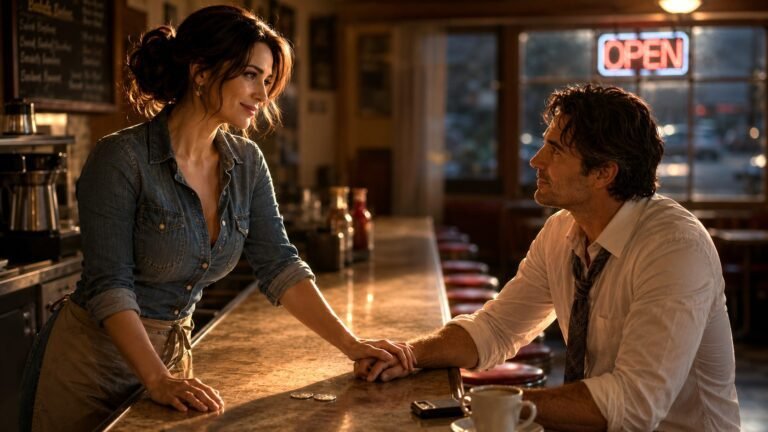
Heartfelt characters sharing love, emotions, and romantic journeys filled with hope, trust, and unforgettable bonds