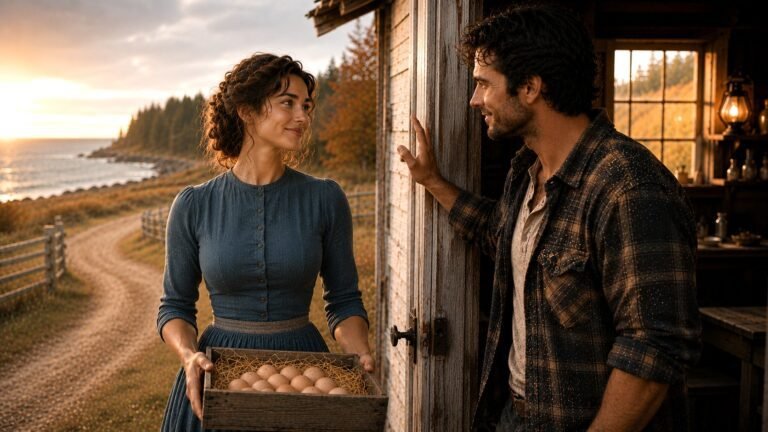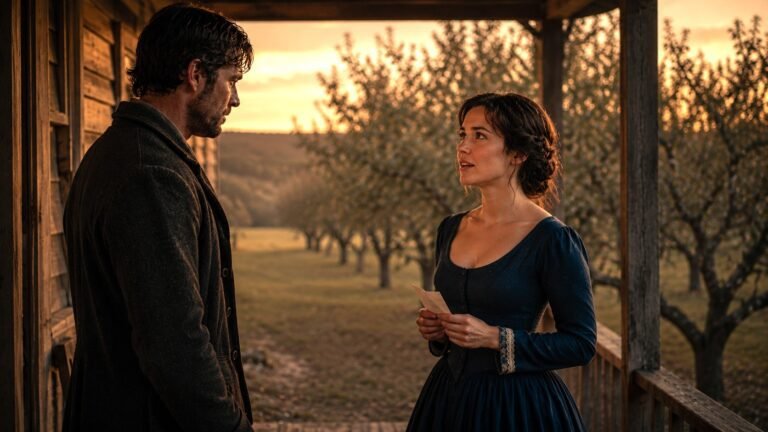

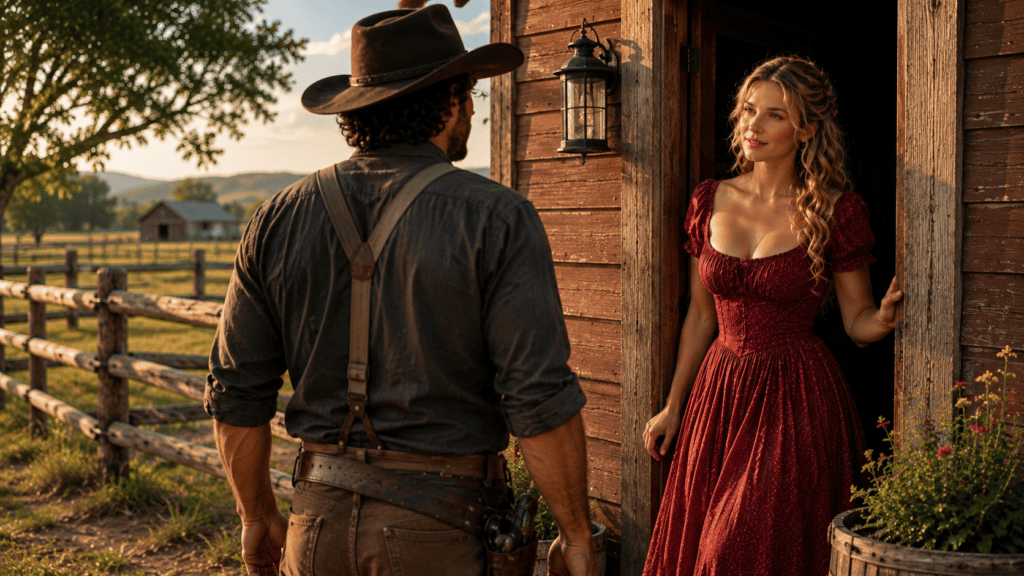
Wyoming Territory, 1897
Thomas Calder had walked into more towns than he could name, and he had learned that the ones worth staying in never looked like much from the road. Larkspur Hollow was a scatter of buildings pressed into a fold of the foothills, the kind of place a man could pass through in the time it took to water a horse. He had come up from Cheyenne on foot the last eleven miles, his boots gone thin at the heel, his coat gone thin everywhere, following a rumor that a widow out past Willow Creek was hiring on for the lambing season.
The rumor had not mentioned that the widow’s land sat at the mouth of the only reliable water in twenty miles of drought-cracked range, or that a man named Silas Crane had been trying to buy her out of it since before her husband was cold in the ground.
Thomas didn’t know any of that yet. He only knew that his stomach had forgotten what supper tasted like and that a man could not keep walking forever without something to walk toward.
The house came up out of the heat shimmer like something imagined — a low log home with a good stone chimney, a barn behind it weathered silver but square-shouldered and sound, and beyond that a scrubbed green stripe of willow and cottonwood that told him exactly where the creek ran, because nothing else for miles was that particular shade of alive.
He stood at the gate a moment, working the dust from his throat, and told himself the same thing he told himself at every gate. Ask plain. Take what’s offered. Move on if there’s nothing.
He’d been telling himself that since he was seventeen. He was twenty-nine now. It had never once occurred to him that a gate might be the last one.
He knocked. The door opened before his hand had fully dropped, as if she’d been watching him come up the road and had simply waited for the knock to be polite about it.
She was younger than he expected and older in the eyes than her years should have allowed. Dark hair pulled back hard enough to mean business, a man’s canvas coat over a gray dress, sleeves shoved to the elbow like she’d been elbow-deep in something when he interrupted. She held a tally book against her hip the way another woman might hold a child, and she looked at him the way a buyer looks at a horse whose teeth she intends to check personally, no matter what the seller claims.
“You’ll be looking for work,” she said. Not a question.
“Yes, ma’am. Heard you might need a hand for lambing.”
“I don’t.” She said it evenly, without cruelty, the way a person states the balance in a ledger. “I need a husband. A hand I could hire and lose in a season. A husband stays signed to the papers whether the wool sells or not.”
Thomas had been turned away from doors with a shotgun raised and doors with nothing but silence, and he had thought he knew the whole catalogue of ways a door could close on him. He had never once imagined a door opening onto that.
“Ma’am?”
“Come in,” she said, already turning back into the dim of the house, “before the heat gets in with you. I’ll explain, and you can decide if you’d rather be hungry and free or fed and married. Most men take longer to choose than the coffee stays hot.”
He stood on the step a moment longer than was decent. Then, because a man does not often get handed a door twice, he went in.
Her name was Ruth Vance. Her husband Elias had been dead seven months, thrown from a wagon on the steep grade above the creek crossing when a wheel found a rut in April rain, his neck broken before he hit the ground. She told Thomas this at the kitchen table with her hands flat on either side of the open ledger, her voice steady in the particular way of a woman who has already cried every tear she intends to spend on a fact and has moved on to what the fact requires of her now.
The Vance homestead held two hundred and forty acres and, more valuable than the acreage, the senior water right on Willow Creek — filed in 1881, six years before Silas Crane’s much larger spread downstream had filed its own, junior claim. In a dry country, seniority on water was worth more than gold, and everyone within thirty miles knew it.
Elias had borrowed against the place the autumn before he died — three hundred and fifty dollars from the Larkspur Trust, to drill a second well and drought-proof the flock against a bad year that all the signs said was coming. The well had come in dry. The bad year had come anyway. And now the note was due in October, ninety days off, and the bank’s man, Otis Merrick, had made it plain in a letter written in a clerk’s careful hand that a widow’s estate in probate was not the sort of collateral he could recommend extending.
“He wouldn’t say it so plain to my face,” Ruth said. “He’s not an unkind man. He’s a careful one. There’s a difference, and the difference doesn’t help me any.”
She had gone through the arithmetic of every alternative the way Thomas imagined she went through everything — thoroughly, without flinching, arriving each time at the same closed door. Sell down the flock to cover the note, and she’d have nothing to build back with come spring. Sell the water right itself — and there was exactly one buyer for that, and she would rather burn the deed than hand Silas Crane the creek her husband had died defending. Fight the bank in court — the lawyer in Cedar Fork had told her plainly that a widow’s word carried little weight against a note with Elias’s signature on it, and hers carried none at all, not while the estate sat in probate limbo.
“The law only wants one thing from me,” she said. “A husband’s name beside mine on the refinancing papers. That’s all it takes to turn a widow back into somebody the bank will talk to. I’ve thought about the unfairness of that until I wore the thought smooth, and I’ve decided there’s no profit in being angry about a wall. Better to find the one door in it.”
Thomas turned his hat over in his hands. “You’re offering me a wage to marry you.”
“I’m offering you a home, a share in the operation once it’s solvent, and forty dollars a month starting the day the note’s refinanced. In return I need your signature, and I need you to actually work this land like it matters, because it does. To me.” She closed the ledger with a small, final sound. “I won’t pretend it’s a courtship. I’ve had one of those. I buried it in April. This is a business, Mr. Calder, and I intend to run it honestly, which is more than I can say for the last man I asked.”
“There were others?”
“Two. One laughed in my face and rode off telling half the county before he’d cleared the gate. The other didn’t laugh — he named terms I wasn’t willing to meet.” Something moved behind her eyes and was gone before he could name it. “You haven’t laughed. You took your hat off before I finished a sentence. That’s not nothing, where I’m sitting.”
He looked at the ledger under her folded hands, at the tally marks and the careful sums, at a woman who had built herself a wall of numbers because numbers, unlike neighbors, did not lie to her out of pity or greed.
“I’ll want to see the books before I decide,” he said. “All of them. Not because I don’t trust you. Because I won’t sign my name to a debt I haven’t looked in the eye.”
For the first time since he’d walked in, something like surprise crossed her face, quickly governed. “That’s fair,” she said, and pushed the ledger the rest of the way across the table. “Start there. There’s stew on the stove if you’re hungry enough to think straight. You’ve got until morning.”
He slept that night in the barn, on a bed of hay that smelled of clean animal and cut grass, and he lay a long while listening to the flock settle and thinking that a neglected place declares itself first in its animals, and these animals were calm, fed, unafraid. Whatever else was true of Ruth Vance, she had not let the place go to ruin around her grief. She had held it up with her own two hands for seven months, alone, and that fact sat in his chest like a coal he couldn’t quite stop turning over.
He had spent his whole life useful and unrooted — a hired hand on other men’s spreads, sleeping in other men’s barns, driving other men’s fence posts, always moving because nothing had ever given him a reason strong enough to stop. He had told himself, the way a man tells himself things to make peace with a hard life, that he liked it. The road. The not-belonging. He was beginning to suspect, lying in a stranger’s hay with a stranger’s ledger memorized behind his eyes, that he had simply never been offered anything worth staying for.
Across the pasture, in the last blue light before full dark, a rider sat motionless on the ridge above the creek, watching the house the way a man watches something he intends to have. Thomas marked him and said nothing, because he did not yet know if it was his place to say anything at all. The rider turned east and was gone before the stars were fully out.
He came to the kitchen at first light. Ruth was already up, coffee made, the ledger open again as if it never closed.
“Yes,” he said, before she could ask.
She looked at him for a long moment. Something in her shoulders eased — not relief, exactly. The particular loosening of a woman who has carried a weight alone so long she’d forgotten what it felt like to feel it shared.
“Sit,” she said. “Eat. We’ll ride to Cedar Fork this afternoon. I’d rather not give the county more days to talk than it needs.”
They were married in eleven minutes by a circuit preacher passing through Cedar Fork, with the storekeeper and his wife standing witness because there was no one else convenient to ask. Ruth wore her gray dress brushed clean. Thomas wore the one clean shirt he owned. Walking back to the wagon, she said, “Thank you,” and he said, “I’d like to go over the flock records tonight, before the week’s further along,” and something crossed her face that was almost, not quite, a smile.
What he also saw, on the ride back through town, was Silas Crane standing in the shade of the mercantile awning, watching their wagon pass with the stillness of a man recalculating a sum he’d thought was already settled. Thomas kept his eyes on the road. He had mended enough broken fences to recognize the particular quiet that comes before a man decides to do something about a thing he doesn’t like.
The first weeks ran on pure practicality. Thomas rose before the sun and worked past dark — fence, flock, the barn’s north wall gone soft with rot, the irrigation ditch that fed the home pasture and needed clearing of a spring’s worth of silt. He asked questions the way a man asks who means to understand a system rather than impress its owner, and Ruth answered with the clipped efficiency of someone who had explained this land to herself, alone, every day for seven months just to keep walking forward.
He had worked other men’s ground his whole life and the labor had always felt borrowed, like sweat spent on somebody else’s future. The first morning he drove a post into new ground on the Vance place — his place, now, whatever else the marriage was or wasn’t — he stopped with the maul still raised and listened to the sound of it. It rang different. He couldn’t have said how. He went back to work before he had to explain it to himself.
The meeting with Otis Merrick at the Larkspur Trust went better than either of them had dared plan for. Merrick, a small, precise man who considered himself reasonable and mostly was, asked Thomas three questions about the flock’s condition and the state of the second well without once glancing at Ruth for confirmation. Thomas answered every one from memory.
Walking out onto the boardwalk, Ruth said, “He looked at you like you’d done something remarkable.”
“I read the ledger front to back before I ever signed anything,” Thomas said. “I know what we’ve got and what we owe.”
She stopped walking. “You read the whole thing. Before you decided.”
“I wasn’t going to put my name to a debt I hadn’t looked at plain.”
She started walking again, but slower, and something in the set of her shoulders had changed, though he couldn’t yet name what. “The ditch records are in the second drawer of the desk,” she said. “I’ll walk you along the water line after supper. You’ll want to know exactly where our right starts and Crane’s begins, since he’s the sort of man who forgets on purpose.”
What Thomas did not tell her yet, because it was not the right moment and he did not want to hand her a fear before he understood its shape, was what he’d found folded into the back pages of the ledger while reading it that first night — a scrap of paper in Elias’s hand, dated the February before he died: Crane offering again on the water right. Survey of ’81 filing has a discrepancy in the creek’s old channel marker. Ought to have it checked before he does.
Elias had never checked. Thomas folded the knowledge away and kept walking beside his wife toward a home he had known for four days.
Larkspur Hollow had opinions, as small places always do. The storekeeper’s wife reported that Ruth Vance had married a drifter she’d known scarcely a week, that the drifter knew stock, and that the whole arrangement was either the smartest thing a widow had ever done or a slow disaster no one had the nerve to interrupt yet. She had not decided which, and said so to anyone who’d stand still.
Silas Crane owned the eleven-hundred-acre spread downstream and had been circling the Vance water right since before Elias was buried — two offers made, two refused, and a third suggestion, delivered with studied gentleness the previous winter, that a widow alone might find the burden of ownership easier to set down than to carry. When Ruth remarried, Crane had gone quiet in the particular way of a man who has not abandoned a goal, only changed his method of reaching it.
He rode up to the fence line on a Tuesday and found Thomas resetting a post that had rotted at the base.
“You’ll be the new husband,” Crane said, not dismounting.
“Thomas Calder.”
“Heard Ruth finally found someone willing to sign.” Crane’s tone was easy, almost friendly, the kind of friendly a man wears like a good coat over bad intentions. “That old water right’s caused her nothing but grief since Elias passed. County records on the ’81 filing are a mess — everybody knows it. Might do you both a favor to sell out the right and the trouble along with it, before somebody forces the question in court.”
“The question’s already answered,” Thomas said, driving the post home with three clean strikes. “It’s been answered since 1881.”
“Records can surprise a man.” Crane looked past him, down the green line of willow that marked the creek, with the frank hunger of someone measuring a thing he intends to own. “Old channel marker’s shifted some since then. Might be worth checking, before you build too much on ground that isn’t as settled as you think.”
He rode off without waiting on an answer. Thomas set his maul down and looked a long while at the creek, at the water running low and brown with the summer’s dryness, at the exact spot upstream where, if a man moved a marker in the dark, he could argue the senior right had never covered as much frontage as everyone had always assumed.
That evening he wrote a letter to a land surveyor in Cedar Fork, a careful man named Abel Foss whom he’d heard mentioned twice as somebody honest.
I want to pause here a moment, because I think it matters — what Ruth was actually standing against. A woman in that country, in those years, could lose everything not because she’d done anything wrong, but simply because the law had never imagined she’d be the one left holding the reins. She found the one door left open to her, and she knocked on it herself, twice refused, and knocked again. That takes a particular kind of courage nobody writes songs about. If this story has found you tonight, wherever you’re watching from — stay a while longer. There’s more of Ruth and Thomas ahead, and it’s worth the road.
October brought the complication that hadn’t been written into any of their four practical terms.
Thomas had spent his whole life moving on before anything could ask more of him than his labor. He had told himself that was freedom. He was beginning to suspect it had only ever been fear wearing a more respectable name.
He was in the barn one evening, working a stiff harness strap with a hot iron, when Ruth came out with a supper plate — not part of any agreement, just something that had quietly started happening over the past weeks, the way habits do before anyone notices they’ve become one.
She set the plate on the bench beside him and watched the work in silence a moment. “Elias kept meaning to replace that trace. Never got to it.”
“Leather’s still sound. Just the stitching’s gone.”
She sat on the edge of the bench, tally book absent for once, her hands empty in her lap in a way that seemed to cost her something. “He was a good man,” she said. “Careless with money. Careless with the land office filings, it turns out.” A pause, careful, testing the ground. “You found the note in the ledger. About the survey.”
Thomas set the iron down. “I did. In August.”
“You’ve known since August and said nothing.”
“I didn’t want to hand you fear without a plan folded up inside it. I’ve been writing to a surveyor in Cedar Fork. If there’s truly a discrepancy in the marker, we get it corrected and filed before Crane can make use of it.”
She was quiet long enough that the fire in the forge popped twice. When she spoke, her voice had a different weight to it. “You’ve been carrying that alone since August, working it out before you’d let me see the shape of it.”
“Seemed the kinder way.”
“It’s not the way I’m used to being handled,” she said, and something in her face shifted — not offense, but the specific, unguarded surprise of a woman who has managed everything alone for so long that being managed for, even once, lands like a struck bell. She picked up her plate and set it beside his on the bench, and they ate supper in the barn without another word, and it was, Thomas thought, the easiest silence either of them had shared since August.
Abel Foss came out from Cedar Fork in the second week of November and spent two days along the creek with his transit and chain, Thomas working beside him — not directing, only present, learning the method of the thing, the way a man learns what he intends to understand rather than simply trust.
The finding, when it came, was plain and damning in Crane’s favor for exactly nothing: the original 1881 channel marker had been set correctly, but a survivor stake driven in a drought year some seasons back — likely by Crane’s own hired man, though nothing could be proven — had shifted the apparent line nearly sixty feet east, enough to throw real doubt on a casual reading of the county record, though not on the deed itself. Foss filed the corrected survey with the land office on a Thursday, restoring the marker to its true and original ground, and closing, on paper at least, the whole question Crane had been counting on to stay open.
On Friday night, someone opened the head gate on the irrigation ditch and left it running wide into the dry range beyond the fence line, draining three days of stored water into ground that would swallow it and give nothing back, and cut the wire on the north pasture besides, so that by the time Thomas found it at five the next morning, forty head of the flock had wandered out into open country in the cold hour before dawn, scattering toward the boundary where Crane’s land began and the legal ground turned murky enough, for a night or two, to make recovery a fight instead of a formality.
He rode back to the house at a hard gallop and had one boot in the stirrup to leave again before he thought to wake her. He stood in the door a moment, breath fogging, weighing thirty seconds he didn’t have to spare.
Then he went and woke her anyway.
“North fence is cut. Water’s running out the head gate. We’ve lost near forty head into open ground.”
She was up and dressed before he’d finished the sentence, rifle down from above the door, boots laced with the economy of a woman who had done this before and expected to again. “I’m coming.”
“You don’t need to—”
“They’re my sheep,” she said, already moving past him into the dark, “same as this is my land, and I’ve stopped waiting on permission to defend either.” She swung up onto her mare without another word.
They rode out together into a black, star-hard November morning, and Thomas thought, watching her lean into the wind ahead of him, this is what it looks like when someone refuses to let a thing fall. He had never in his life seen anything like it, and he understood, with the sudden clean certainty of a man arriving somewhere after a long walk, that he did not intend to spend the rest of his life anywhere he couldn’t keep seeing it.
They found the flock scattered across a mile of frost-hard ground, moving in the deliberate drift of animals that had been pushed, not merely loosed — tracks of two riders working the herd steadily toward Crane’s fence, where a night’s confusion of ownership might cost the better part of a week to untangle in a land office that moved slower than any dispute could afford to wait.
The temperature was falling fast; a wind out of the north carried the particular bite that meant the first hard cold of the season was arriving early and arriving mean. Ruth cut west without being told, working the strays back from the low draw before they reached open range. Thomas pushed east and found, at the far edge of the scattered flock, two riders sitting easy on their horses, watching sheep drift toward a fence line, waiting rather than working.
He rode straight at them, no rifle raised, nothing but a man on a horse coming on steady in the rising wind at five in the morning with the particular calm of someone who has already decided exactly how far he means to go and has made his peace with the distance.
“This ain’t your ground, friend,” one of them said.
“It is, as of Thursday’s filing. You’re welcome to ride to Cedar Fork and check it yourselves.” He held the man’s eye through the dark. “I’m taking my flock home now. You can help move them or you can carry a message back to Mr. Crane — the survey’s corrected, the wire will be mended by noon, and the next hand that cuts my fence in the dark had best not plan on riding away from it alone.”
A long silence, wind picking up, ice starting fine in the air. The second rider murmured something low. Then both turned east and were gone.
By the time the flock was pushed back through the mended gap and the fence braced enough to hold till full daylight, snow had begun, and the temperature had dropped another fifteen degrees in the space of an hour. Ruth looked at the sky the way a woman reads a page she’s read too many times before.
“Bad blow coming,” she said.
“I know it.”
“Then we’ve work to do,” she said, already turning her mare toward the barn, and Thomas followed her into it.
The blizzard that hit the high plains that winter would be spoken of for thirty years after as the hardest anyone in that county could remember — the kind of storm that closed the open range for good in places, that broke outfits twice the size of the Vance place, that killed stock by the thousands across three territories before it finally wore itself out.
At Willow Creek the temperature fell to twenty-six below by the second week of January. The creek froze solid to the gravel. The pump on the home well seized twice and had to be freed by hand in cold that burned exposed skin white in under two minutes. Thomas and Ruth worked as though rest were a luxury reserved for people with less to lose.
They lost nine head the first week — animals already weak going into the season, losses no amount of care could have prevented. They saved fourteen more that would surely have died, hauling them into the barn and, when the barn itself grew too cold to trust, into the kitchen itself, three lambs wrapped in horse blankets beside the stove for two days straight while Ruth and Thomas took turns through the night keeping the fire fed and the small bodies warm. The kitchen smelled of wet wool and woodsmoke and coffee that never once went cold on the stove.
There was no time, in those weeks, to speak of terms or arrangements or anything beyond the next chore and the one waiting behind it. On the worst night, with the wind driving sideways hard enough that the barn door needed both of them leaning into it to force shut, Thomas came in past midnight with frost already whitening three fingers of his left hand, and Ruth sat him at the table and worked the feeling back into them for twenty minutes, saying nothing but the plainest instructions, her hands steady, her face wearing the particular stillness of a woman managing something serious and refusing herself the luxury of showing how serious it was.
When the color had come back and the worst of the danger passed, he looked at her bent over his hand in the low lamp light and thought, with a clarity that startled him more than the cold had, I have spent my whole life looking for the thing that would make me stop moving. I never once pictured it would look like this. A woman with flour dust never quite out of the creases of her hands, a rifle over the kitchen door, a ledger she carried like other women carried grief.
“Ruth,” he said.
She looked up.
“Thank you,” he said, and it meant more than the fingers.
She held his gaze a moment with those dark, careful eyes. “They’re your hands now too,” she said simply. “This is your land now too.” And she went back to working warmth into his fingers, and he understood, sitting in that lamplit kitchen with three lambs breathing softly by the stove, that the echo he’d spent twenty-eight years listening for had been here all along, waiting on him to stop long enough to hear it.
Crane rode out in late February, once the worst of the thaw had broken enough to travel, and found Thomas resetting the last of the north fence — the same fence cut in November, rebuilt now with posts driven deeper and wire strung tighter than before.
“Lost near thirty head in the storm,” Crane said, not dismounting.
“We lost eleven.” Thomas kept working. “Heard you fared worse.”
Crane’s jaw worked once. He looked past Thomas at the new survey stakes, frozen white and permanent along the true line. “The filing stands, then.”
“It does.”
“There’s nothing further to be said about the water.”
Thomas set down the fence tool and looked at him straight on. “One thing,” he said. “Ruth Vance has held this ground her whole married life. She buried her husband on it. She kept it through a bank that wanted it settled, a storm that near took it outright, and neighbors who thought a widow alone was an opportunity worth pressing.” He picked the tool back up. “She isn’t alone now, and I’d like the two of us to be clear on what that means, going forward.”
Crane held his eyes a long moment — the look of a man taking another man’s full measure and finding, whether he liked it or not, that there was something there worth respecting. Then he nodded, once, and turned his horse east without another word — the nod of a man choosing to become a neighbor rather than remain a problem, because he had finally been given a reason worth the choosing.
Thomas watched him go, then bent back to the fence. Three more hours of work waited in it. He found, turning that thought over, that he was glad of the three hours. Glad to still be here to spend them.
By March the debt sat solidly ahead of schedule, a fact Ruth discovered in the accounts one evening and had not yet found the moment to raise. Thomas had been drawing his forty dollars a month faithfully since the refinancing — and quietly returning every dollar of it back into the operation, a fact he had not mentioned either, mostly because it had never once occurred to him to mention it.
She found the entries on a March evening with the fire built high against the last cold snap and the accounts finally, blessedly caught up. She pushed the ledger across the table to him without a word.
He looked at the column she’d marked. Forty dollars, five months running, two hundred dollars total — and beside each entry, in her careful hand: returned to operation.
He looked up. She was watching him, not the book.
“You’ve been paying your own wage back in,” she said.
“The operation needed it more than I did.”
“So did I,” she said, and something in her voice had gone unguarded in a way he hadn’t heard from her before. “You could have left after the fence was cut. After the storm, certain, you had every reason a man could want.”
He looked down at the numbers — the careful accounting of everything they had built together and everything it had cost them both to build it. “No,” he said. “I didn’t.”
She held his eyes a long moment across the table. Then she closed the ledger — set it aside, for once, rather than reaching for the next column — and reached across the space between them instead, and took his hand, the same one she’d warmed back to feeling on the worst night of the storm, and did not let it go.
Outside, the last of the winter’s ice was breaking loose along Willow Creek, and the water, when it finally ran free again, ran clean and full and entirely, unambiguously theirs.
The letter Thomas wrote to his father that April was the first he’d sent in four years, and the first four years he hadn’t known what there was worth saying. This time he knew exactly.
I found a place. I’m staying.
Ruth found it on the table before he sealed it. Read it, he was certain, though she never once mentioned it aloud — which was, he’d come to understand, her particular way of saying everything that mattered most.
The flock rebuilt through the spring, forty-nine head grown to fifty-eight with the new lambs, the operation turning a modest, honest profit — not the ambitious expansion Elias had once borrowed and hoped and finally died half-preparing for, but something sounder: ground that had been tested past its limit and had, in the end, held.
Otis Merrick stopped Thomas on the boardwalk outside the Trust in May and remarked, with the mild surprise of a careful man revising a low expectation upward, that the Vance-Calder note was the most current account in his entire portfolio.
On a warm morning not long after, Ruth sat at the kitchen table with the ledger — always the ledger, some things a marriage didn’t change — and Thomas came in from mending the last stretch of the east line and sat across from her. She turned the book toward him without a word and tapped one column with a finger gone permanently ink-stained.
Two hundred dollars, returned. Beside it, in her hand, a line she hadn’t shown him before: and everything else, besides.
He looked up. She was not looking at the ledger anymore.
“You could have kept walking any morning these past eight months,” she said. “God knows you’d earned the right, after Crane, after the storm.”
He reached across and closed the book gently under her hand, the way he’d have closed a gate behind him for good.
“I know,” he said. “I didn’t want to.”
She held his eyes a long moment, the same steady, assessing look she’d given him across a threshold in August, though it carried an entirely different weight now. Then she rose, crossed the small distance the kitchen table put between them, and kissed him — not carefully, not as the closing clause of a business arrangement, but with the full, unhurried conviction of a woman who made her decisions slowly and kept every one of them completely, once made.
He kissed her back with the certainty of a man who had spent twenty-nine years driving nails into other people’s barns and had finally, at long last, driven one into something that was entirely, permanently his own.
Outside, the Wyoming spring came on strong across land they had chosen, together, to keep — the fence standing, the flock growing, the water running clean and senior and unmistakably theirs down through the green stripe of willow that had first told him, all those months ago, exactly where to find something worth staying for.
Ruth Vance opened a door in August with a ledger against her hip and told a stranger, plainly, that she needed a husband more than a hand. She had been refused twice already. She asked a third time anyway, because the alternative was watching everything her husband had built slip through a gap the law had never meant to leave her.
Thomas Calder had spent his whole life on other men’s ground, listening for an echo that always sounded exactly the same — hollow, borrowed, temporary. Then he followed a woman he’d known one day into a kitchen in the Wyoming foothills and said yes to the strangest offer he’d ever been handed.
He drove a fence post into new ground that first week and stopped to listen to the sound of it. It rang different than any he’d driven before. He didn’t yet understand why. By March, he did.
That’s the whole of it. A woman who asked for what she needed, knowing full well she might be refused a third time. A man who’d spent a decade looking for a reason to stop moving and found one before he’d even finished reading the terms. Two people who wrote four practical lines on a page in August and were still at the same kitchen table in March — not because of what the page said, but because of everything that had grown up quietly around it while a hard winter did its level best to break them, and failed.
The water ran on, senior and unbothered, exactly as it always had. It was, by every measure that mattered to either of them, precisely right.