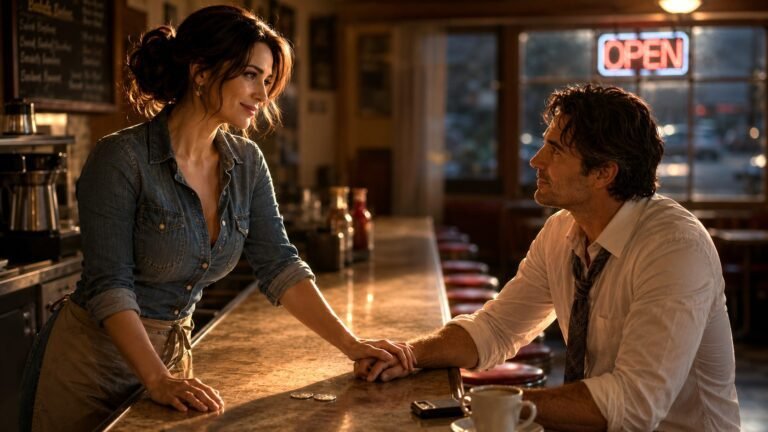

A Rainy Night, the Wrong Apartment
The city had been gray for eleven days straight, and Mara had stopped counting the puddles that gathered outside her building because counting them felt like admitting the rain had won. She lived on the fourth floor of a walk-up that smelled of wet plaster and other people’s dinners, and every evening she performed the same small ritual: keys in the left pocket, phone in the right, headphones in until the elevator that didn’t exist would have arrived, if it existed, which it didn’t. The stairwell light on the third landing had been flickering for three months. She’d stopped reporting it to the building manager. Some things, she’d decided, simply stayed broken, and there was a certain peace in expecting nothing else from them.
She hadn’t always been a woman who catalogued disappointments like this, filing them the way another person might file receipts. Two years ago she had believed — actually believed, with the kind of conviction that felt like bone rather than opinion — that if she gave enough of herself to someone, they would stay. She had learned otherwise on a Tuesday, in this same stairwell, holding a box of the life she and Daniel had built, watching him carry the last of his belongings past her without quite meeting her eyes. He hadn’t been cruel about it. That was almost the worst part. He had simply, quietly, gone to the wrong apartment — the wrong life, the wrong woman — and corrected his mistake, leaving her to live in the address he’d abandoned.
Since then, Mara had built her days into something narrow and dependable. She worked long hours restoring furniture in a shop two blocks from her building, sanding down the varnish on other people’s inheritances, coaxing grain and shine out of wood that had been neglected for decades. There was comfort in things that could be fixed with enough patience and the right tools. People were not like that. People walked out mid-repair and left the piece half-finished, exposed, raw at the seams.
Tonight the rain had followed her home in sheets, the kind that turned umbrellas into useless, flapping things, and by the time she reached her building her jeans were soaked through to the knee and her hands had gone stiff with cold. The stairwell light was out again — not flickering this time, simply gone — and she climbed by the glow of her phone screen, counting doors instead of puddles. Fourth floor. Third door on the left. Her hands were so numb she fumbled the key twice before it slid home and the door gave beneath her palm.
The apartment felt different immediately, and she was too exhausted, too wrung out by the cold and the long week and the particular loneliness of Friday nights alone, to register why. The scent was wrong — cedar and coffee instead of the lavender candle she always forgot to blow out. The couch was the wrong shape, deeper, with a soft gray throw folded over one arm instead of her own faded blue one. But her body had already made the decision her mind was too tired to question: she peeled off her wet jacket, dropped her bag by a door she didn’t recognize, and sank into the cushions like a woman finally allowed to stop holding herself together.
She told herself she would rest for five minutes. She told herself this was still, somehow, her apartment, that the mind played tricks after a long week, that nothing about tonight needed to be examined too closely. The rain kept its rhythm against a window she couldn’t see from where she lay, and that sound, at least, was familiar enough to trust. Her eyes closed before she gave herself permission.
She did not hear the front door open forty minutes later. She did not hear the pause — long, startled, uncertain — of a man standing in his own doorway, keys still in hand, looking at a stranger asleep on his couch as though the universe had rearranged itself without consulting him.
Owen Hale had lived in apartment 4C for three years, ever since a different kind of ending had sent him looking for a place with thick walls and no memory of anyone but himself. He worked nights sometimes, days sometimes, whatever the restaurant needed, and he had grown so used to solitude that he’d started speaking to it like company — narrating his evenings out loud to no one, a habit he’d never admit to a single living soul. He stood now in his own entryway, rain still dripping from his jacket onto the floor, and did the only thing that made sense to a mind trying to catch up with its eyes: he checked the number on his own door.
4C. His door. His key had turned in his own lock.
And yet here was a woman he had never met, dark hair damp against gray cushions, one hand curled loosely near her jaw, breathing in the unbothered rhythm of someone who trusted, however briefly, that she was safe. He almost laughed. He almost said something sharp and startled into the quiet — you have the wrong apartment — the kind of sentence that would have been reasonable, expected, entirely justified. Instead he stood there a long moment with the words caught behind his teeth, struck by something he couldn’t yet name: how strange it was, how oddly tender, to come home to a stranger who had mistaken his life for her own and fallen asleep inside the mistake.
He set his keys down without a sound. Whatever this was, it could wait until morning — or at least until she woke on her own, rather than startled by a man she’d never seen standing over her in the dark. He draped his jacket over a chair, dimmed the hallway light instead of switching it off completely, and settled into the armchair across the room to wait, watching the rain streak the window and the wrong woman sleep soundly in the right kind of stillness he hadn’t felt in his own apartment for a very long time.
The Collision of Two Strangers
She woke to lamplight and the smell of coffee, and for one disoriented second, still tangled in sleep, she thought she was home. Then her eyes adjusted to unfamiliar shelves — books stacked by height rather than color, a chipped blue mug on the side table, a jacket that wasn’t hers slung over a chair — and her whole body went rigid with the particular horror of waking somewhere she didn’t belong.
“Okay,” said a voice, low and careful, from across the room. “Before you scream — and you’re well within your rights to scream — I just want to say that you’ve had the wrong apartment for about two hours, and you looked so peaceful I didn’t have the heart to correct the record.”
Mara sat up so fast the room tilted. A man was folded into an armchair with a paperback open on his knee, dark hair pushed back like he’d run a hand through it more than once, watching her with an expression that was trying very hard to be reassuring and only partly succeeding. “I — this isn’t—” She looked at the door, at the number screwed into its center. 4C. Her own door was 4C too, one floor down, or one floor over, she genuinely couldn’t remember which, because right now every fact she’d ever known about her own life had evacuated her brain simultaneously.
“You’re one floor up,” he said gently, as if reading the exact shape of her panic. “Building’s got the same layout on three, four, and five. Genuinely diabolical design. I’ve done it myself, actually — walked into 3C once, scared the life out of a very nice retired dentist.”
“I fell asleep on your couch.”
“You did. Very thoroughly. I made coffee at one point and you didn’t even flinch.”
Mara pressed both hands to her face, mortification rising so fast it was almost funny, would be funny eventually, was already threatening to be funny despite her best efforts to remain appropriately horrified. “I am so sorry. I’m — my building’s identical, I wasn’t even thinking, I was just cold and tired and the door opened and I —” She stopped herself before she could apologize a fourth time and looked at him properly for the first time, really looked, and found something in his face that made the panic loosen its grip: he wasn’t annoyed. He looked, if anything, faintly delighted, like she’d handed him the best story he’d have all month.
“Owen,” he said, setting the book aside and standing to retrieve the coffee, which he handed to her without asking whether she wanted it, which she found she didn’t mind at all. “And you let yourself into a strange man’s apartment and immediately fell into the most peaceful sleep I’ve ever witnessed a human being have, so I feel like we’ve skipped past several introductory steps most people take before this level of trust.”
“Mara,” she managed, wrapping both hands around the mug because it was warm and because it gave her something to do besides stare. “I promise I’m not usually — this is not a thing I do.”
“Breaking and entering by accident, specifically to nap?”
“Specifically that, yes.”
“Shame. I was hoping I’d found a very committed serial napper. I’d have cleared a shelf for you.” He said it so easily, so without agenda, that she laughed before she could stop herself — a short, surprised sound that seemed to startle them both. It had been a long time since something had gotten past her guard that fast, without her noticing the door had been left open at all.
They stood there a moment in the strange, easy quiet that follows an absurd beginning, rain still ticking against the glass, the whole ordinary apartment rearranged into something faintly unreal by the fact of her being in it at all. She should have left already. She knew this the way she knew most sensible things — distantly, as a fact rather than an instinct she felt any urgency to obey.
“I should go,” she said, not moving.
“You should,” he agreed, not moving either. “Your apartment’s presumably very cold and very correct, one floor down, patiently waiting for you to remember it exists.”
“Right.” She set the mug down. Picked her jacket up off the floor where she’d dropped it, still damp, and pulled it on. At the door she turned back, because it felt unfinished somehow, this collision of a night, like a sentence that hadn’t found its period yet. “Thank you. For the coffee. And for not being a person who screams at strangers on his couch.”
“In my defense, I considered it,” he said. “But you looked like someone who needed the sleep more than I needed the outrage.” He held the door for her, and for one suspended second, neither of them said anything else, the whole hallway between their two apartments — the right one and the wrong one — feeling smaller than it should have. “Try 4B next time,” he added as she stepped past him. “Nice couple. Big dog. Very forgiving of mistaken identity.”
She laughed again, softer this time, and went down to her own apartment, her own door, her own life — and lay awake far longer than the coffee could explain, replaying an evening that had started as an accident and ended as something she didn’t have a name for yet, something that had gotten in through a door she hadn’t meant to open, and hadn’t quite managed to close.
Every Wrong Turn Leads Back
It became a habit neither of them named. Mara told herself, the first few times, that the timing was coincidental — that she happened to leave the shop at six, and he happened to be coming off his shift around then too, and the stairwell light, still broken, still uncorrected by any building manager, happened to make the third landing the kind of place two people paused rather than passed through.
“You know,” Owen said one evening, leaning against the wall while she dug for her phone light, “I could just fix that bulb. I have a ladder. I have opinions about municipal negligence.”
“If you fix it, we lose our excuse to stand here in the dark,” Mara said, and immediately wished she could take back how much that had revealed.
He didn’t tease her for it, which she noticed, and filed away, the way she filed away the small things that kept accumulating between them like sediment: that he took his coffee the way she did, too strong, apologizing for nothing; that he’d started leaving his door slightly ajar on nights he knew she’d be climbing past, not an invitation exactly, just a possibility left open; that he never once, in all the evenings that followed the first, made her feel foolish for the mistake that had started this — the wrong apartment, the wrong door, the wrong key turning by accident into something that felt, more and more, like the only right thing that had happened to her in two years.
They didn’t call it anything. That was its own kind of comfort. There were dinners that weren’t dates, made from whatever was in his fridge, eaten standing at the counter because sitting felt like admitting the evening mattered more than either of them was willing to say aloud. There were nights she came up not because she’d lost her way but because she wanted to, and he never asked her to explain the difference, just opened the door wider and let her in without commentary, the way you let in something you’ve been quietly hoping would return.
“Do you ever think,” she asked one night, curled into the corner of his couch — the same couch, always the same corner, as if her body had claimed it that first accidental evening and never relinquished the claim — “that some mistakes turn out to be the only correct thing you’ve done in months?”
Owen considered this with the particular seriousness he brought to questions that mattered more than they sounded like they did. “I think,” he said slowly, “that I walked into my own apartment three years ago and never once thought of it as anything but a place to sleep between shifts. And now I check the stairwell for a woman who took a wrong turn once and apparently decided my couch met some kind of standard.”
“It’s a good couch.”
“It’s a mediocre couch. You’ve slept on it four times since. I’ve started to suspect you like the couch more than you like me.”
“The couch has never once made me talk about my feelings,” she said, and he laughed, and something in the sound of it — unguarded, warm, entirely without performance — made her chest ache in a way she didn’t examine too closely, because examining it meant admitting how far past the boundary of not a thing I do she had already wandered.
There were silences too, longer ones, the kind that in the past she would have rushed to fill because silence with Daniel had always meant something was souring underneath it. But silence with Owen felt like weather, something to sit inside rather than flee — his knee an inch from hers on the couch, the rain outside doing its steady work against the glass, neither of them reaching to close the distance and neither of them needing to, because the not-reaching was its own kind of conversation. She would catch him watching her sometimes when he thought she was absorbed in something else — a book, the window, the chipped rim of the mug he’d apparently bought specifically because she’d complimented it once — and there would be a question in his face he didn’t ask, and she understood it without translation, because she was asking herself the same one.
What is this, and what happens if I let myself want it.
She didn’t answer it. Not out loud. Instead she kept returning to the third landing, kept letting the broken bulb become an alibi they both maintained by unspoken agreement, kept sitting in that same corner of his couch until the shape of her had worn itself into the cushion the way water wears itself into stone — slow, patient, permanent in a way neither of them had signed up for but neither of them stopped either.
“I keep thinking I should go home earlier,” she admitted once, near midnight, her voice pitched low the way people speak when they’re saying something true for the first time.
“Why don’t you?”
“Because home doesn’t feel like a place I chose. It feels like a place I ended up.” She traced the rim of the mug with one finger, not looking at him. “This feels like something I keep choosing. Even when it’s a mistake. Especially when it’s a mistake.”
Owen was quiet a moment, and when he spoke his voice had lost its usual ease, gone careful instead, like he was handling something he was afraid of dropping. “For what it’s worth,” he said, “I’ve stopped thinking of you as the wrong apartment a while ago.” He didn’t finish the thought. Neither of them needed him to. The rain kept its rhythm, the bulb on the landing stayed broken, and something between them stayed unspoken, hanging in the warm dark like a held breath — closer than confession, further than certainty, exactly the kind of unnamed thing that could either become everything or come apart at the first careless touch.
What Silence Costs Two Hearts
The night it broke, nothing dramatic happened, which was, in its own way, the most dramatic thing about it.
Owen had been offered a promotion — head chef at a second location, six months in another city, a chance he’d wanted for years without quite admitting how much. He told Mara about it on the landing, still in his coat, the words tumbling out with more excitement than caution, and somewhere in the telling he said, “I keep picturing you there too, actually, which is a strange thing to picture about someone whose apartment I still haven’t technically invited you into on purpose,” and laughed like it was the kind of thing you could say lightly.
Mara heard six months, another city and felt the floor of her chest give out beneath her the way it had once before, in this exact stairwell, holding a box of a life someone else had already decided to leave. She heard I keep picturing you there and her mind, faster and crueler than her heart, translated it instantly into the shape of every door that had ever closed on her without warning: this is the part where he tells me gently, the part where the leaving starts sounding like an invitation so it hurts less when it isn’t one.
“That’s really great,” she said, and her voice came out wrong, flattened, already halfway to the version of herself that knew how to survive an exit. “You should take it.”
“Mara—”
“No, I mean it. You’d be incredible at it.” She was already stepping back, already reaching for the railing, already performing the particular arithmetic of a woman deciding to leave before she could be left. “I have an early morning. I should go.”
She didn’t go up that night, or the next, or the one after that. She told herself this was sensible, was self-protective, was the intelligent response to watching a good thing prepare its own departure. She didn’t return his texts with anything but clipped, cheerful nothing, didn’t mention the ache that had set up permanent residence beneath her ribs, didn’t examine why her hands had started shaking every time she passed the third-floor landing where the bulb, still broken after everyone, watched her hurry past in the dark she’d once found romantic and now found only isolating.
Owen, for his part, read her silence the only way a person can read silence — as an answer, even when it isn’t one. He told himself she’d never really wanted more than the accident had given them, that he’d mistaken comfort for something deeper, that a woman who vanished the moment a future was mentioned had never planned on sharing one. He stopped leaving his door ajar. He fixed the bulb himself, finally, on a Tuesday, standing on a borrowed ladder in the very spot where two strangers used to linger, and told himself the bright, steady light was an improvement, though it did nothing to warm the apartment that had gone quiet in a way three years of solitude before her had never quite managed.
Neither of them called. Both of them, in their separate rooms one floor apart, sat with the particular exhaustion of a body holding itself rigid against a wanting it refused to name — sleep going thin and unreliable, meals abandoned half-eaten, the ordinary business of living continuing on the surface while underneath it something essential simply stopped. Mara sanded a table at the shop for four hours longer than it needed and still couldn’t get the grain to sit right, her hands unsteady in a way they’d never been with wood. Owen burned a sauce he’d made a hundred times without looking, standing at the stove with his mind one floor down, composing sentences he didn’t send.
The wound Mara had carried since Daniel had a very specific shape, and Owen’s mention of leaving had slid into it perfectly, precisely, the way a key fits a lock it was cut for — not because Owen had done anything wrong, but because she’d spent two years bracing for exactly this, and the bracing had become so practiced it mistook a possibility for a certainty and acted accordingly. She hadn’t asked him what he meant. She hadn’t given him the chance to say the rest of the sentence. She had simply, quietly, done what she always did when the ground seemed likely to disappear: she’d left first, so it couldn’t be done to her again.
The Right Door, Chosen on Purpose
It was the sound of hammering that finally undid her — faint, rhythmic, coming through her ceiling on a Thursday night nine days after the landing, nine days of a silence that had started to feel less like protection and more like the exact thing she’d been trying to avoid all along, self-inflicted this time, which somehow made it worse. She lay on her own couch, the wrong shape, the wrong color throw, listening to the sound of someone building something one floor above her, and thought, with sudden clarity, of every door she had ever let close without asking what was on the other side of it.
She thought of Owen saying I’ve stopped thinking of you as the wrong apartment, and how she had let fear finish that sentence for him instead of letting him finish it himself. She thought of the bulb, fixed now, steady light where uncertainty used to live, and understood — too late, she was sure, but understood nonetheless — that some doors don’t close on their own. Someone has to choose, deliberately, stupidly, bravely, to walk back through them.
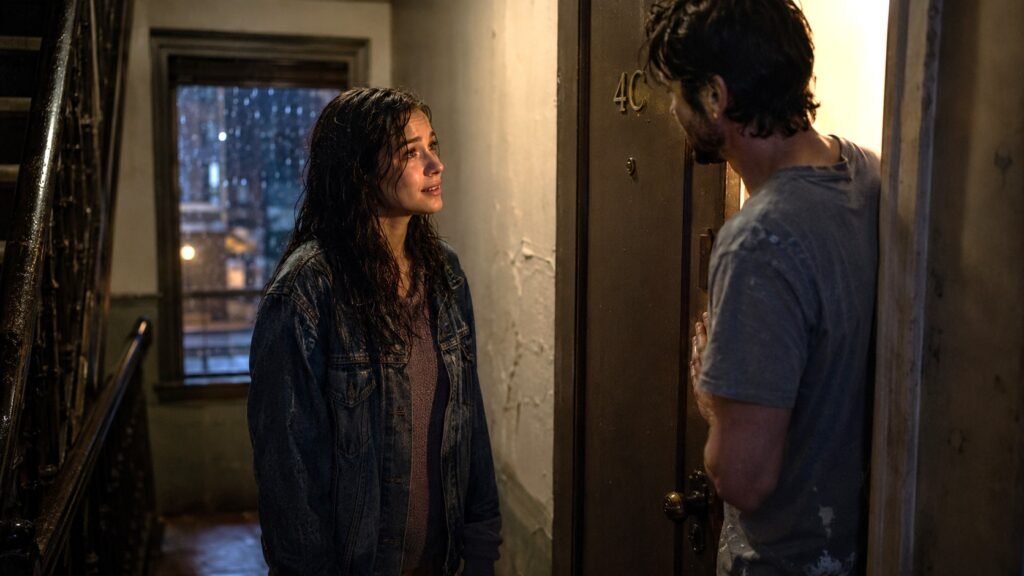
She didn’t let herself think past the stairwell. She climbed in yesterday’s clothes, barefoot, hair still damp from a shower she’d abandoned halfway through, and stood in front of 4C with her heart going so hard she could feel it in her teeth. The hammering stopped. Footsteps. The door opened before she could decide whether she’d actually knocked or only imagined knocking, and Owen stood there in old paint-flecked jeans, a picture frame in one hand, looking at her the way a man looks at something he’s stopped letting himself hope for.
“I’m not lost,” she said, before he could speak, before her nerve could fail her the way it had on the landing nine days ago. “I know exactly which door this is. I’ve known since the first night. I just got scared that knowing wasn’t enough to keep it.”
Owen set the frame down slowly, like it required more concentration than it did, buying himself a second he clearly needed. “The promotion,” he said. “I turned it down. Three days ago. Wasn’t going to tell you unless you asked, because I didn’t want it to sound like a bribe for you to stay.”
“I don’t need you to turn anything down for me.”
“I didn’t do it for you,” he said, and something in his voice cracked open, honest in a way that undid her completely. “I did it because the version of my life where I go to another city and don’t get to find out what this is — what you are, to me — stopped making any sense the second you stopped coming up here. I’ve had nine days to sit in an apartment with a working light and figure out that it was never the bulb that made this place feel like somewhere worth coming home to.”
Mara felt something loosen in her chest that had been clenched for two years, maybe longer, maybe her whole careful, guarded life. “I keep expecting people to leave,” she said, quiet, the truest sentence she’d given anyone in longer than she could remember. “I heard another city and all I could hear underneath it was every door that’s ever shut on me. I didn’t stay to find out if you meant something different by it. I’m sorry. I should have stayed.”
“You’re staying now,” he said. Not a question.
“I’m staying now,” she agreed, and stepped forward into the doorway that had once been a mistake and had become, through nine nights of aching silence and one act of deliberate courage, the only address she wanted to answer to.
He didn’t say anything else. He didn’t need to. He reached out and drew her in the rest of the way — not through an accident this time, not through a wrong turn on a rain-soaked night, but through a door held open on purpose, by two people who had finally stopped waiting for the other to knock first. The frame he’d been hanging sat forgotten on the floor beside them, a photograph inside it that she’d notice later, much later: the two of them, taken by someone else on some ordinary evening neither had realized was being kept.
Outside, the rain had finally stopped. The stairwell bulb, newly fixed, threw its clean, steady light across the landing where two strangers had once lingered in the dark, and up in 4C, the right apartment now and always, the kettle Owen had left on began, softly, insistently, to sing.
Suggested Category: Slow Burn Romance
Suggested Tags: wrong apartment romance, accidental meet-cute, slow burn love story, neighbors to lovers