
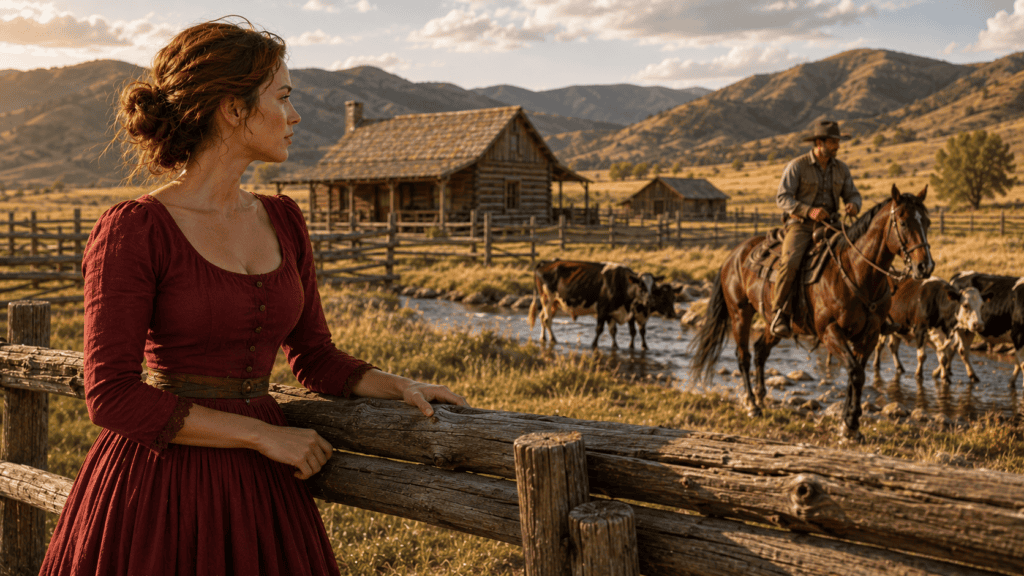
The letter had been sitting on the kitchen table for three days before Adelaide Whitfield worked up the nerve to read it twice, and both times it said the same thing: she would marry Silas Vance on the first Sunday of October, or her uncle’s ranch, along with what remained of her father’s name, would belong to the bank.
She folded the paper along its worn crease and set it back exactly where her uncle had left it, because Ezra Whitfield did not like his things disturbed, and because there was a particular kind of danger in a man who counted his debts more carefully than he counted his kindnesses. Addie had learned that lesson the hard way, in the two years since her father’s wagon went over in the spring flood and left her with nothing but his name, his debts, and an uncle who saw her as a means of settling both.
She was twenty-two years old and had not been asked her opinion about anything of consequence since.
The morning was already hot when she carried the wash basket out past the henhouse, the wet linens heavy over her forearm, the rope line sagging under last week’s mending. Dust hung thin and gold in the early light, and somewhere past the fence a meadowlark was singing like the world hadn’t gone and arranged itself around her without so much as a by-your-leave. She pinned a shirt to the line, then another, and did not let herself cry, because crying solved nothing out here, and her uncle would only ask what she had to cry about, being fed and housed and soon to be wed to a man of property.
That Silas Vance was fifty-one years old, thick through the middle, and known to strike his horses when they didn’t move fast enough — these were not, in her uncle’s accounting, matters that concerned her.
She was reaching for the last of the wash when she heard the wagon.
It came up the north road slow, drawn by a pair of dust-colored mules, and behind it walked a man leading a saddle horse, his hat pulled low against the sun. Addie did not stop her work. Strangers came through the Whitfield place often enough — drovers looking for a season’s wages, peddlers, men running from something back east. She had learned not to look at any of them too closely, because looking invited talk, and talk was the one thing she could not afford three weeks before her wedding.
But she looked up anyway when the wagon slowed by the gate, because the mules stopped without being told, the way a well-worked team will do when their driver has spent years teaching them patience instead of the whip. That was the first thing she noticed about Jesse Cole, though she did not yet know his name: that his animals were calm.
He touched the brim of his hat to her — not a bow, not a flourish, just an acknowledgment, the kind a man might give another man he had reason to respect — and then he looked toward the house, where her uncle had come out onto the porch already talking with his hands the way he did when he meant to strike a hard bargain.
Addie went back to her wash. She told herself she had not marked the line of his shoulders, or the quiet way he’d sat the wagon seat, like a man accustomed to long distances and short comforts. She told herself this several times, which was itself a kind of admission, though she would not have called it that.
Ezra Whitfield hired him to help bring in the last of the hay and mend fence before the first frost, paying him little and working him hard, which was Ezra’s way with every man who owed him nothing and had nowhere better to be. Jesse Cole did not complain. He rose before the house did, and Addie, who was always up first herself to start the stove, began to find the woodbox already filled when she came down, the kindling split fine and stacked the way her father used to stack it, back when there had been a father to do such things.
She did not ask him to do it. He did not mention that he had.
On the third morning she found him at the pump before dawn, working the handle with the unhurried patience of a man who had done the same chore in a hundred different yards, and when she came out with the milk pails he took them from her without a word and filled them himself, then handed them back full, water sloshing cool over her knuckles.
“I can carry my own water, Mr. Cole,” she said, more from habit than complaint.
“Didn’t say you couldn’t,” he answered, and that was all, and he walked off toward the barn with his own bucket, and Addie stood there a moment in the gray light before she remembered herself and went in to the stove.
He was a man of few words, she came to understand, but not an unkind one, and there was a difference between the two that most people in her life had never troubled to learn. Silas Vance talked a great deal and said almost nothing that wasn’t calculated to remind a person of what they owed him. Jesse Cole said next to nothing and somehow left a person feeling as though they had been listened to.
She watched him at supper sometimes, when her uncle allowed the hired men to eat at the long table instead of out at the bunkhouse, which he did only when it saved him the trouble of sending food out. Jesse ate without hurry, thanked her plainly for the cornbread, and did not look at her the way some of the drovers looked at her — sideways, assessing, as though she were another piece of livestock on the property. He looked at her the way a man looks at weather he respects: watchful, careful, but not unkind about it.
There was a morning, not long after he’d come, when a storm blew through in the night and left the yard a churn of mud, and Addie went out at first light to find the chicken coop roof had torn loose at one corner, half the shingles scattered across the yard like fallen leaves. She stood surveying the damage with her arms crossed, calculating how much of the morning it would cost her and whether her uncle would notice or care, when she heard the ladder scrape against the wall behind her.
Jesse was already up on the roof before she’d finished counting shingles, hammer in hand, nails held loose between his teeth the way men did when they meant business and didn’t care to waste a trip down for more. He did not ask whether she wanted help. He simply set to it, and by the time the sun had cleared the far ridge the roof was whole again, tighter than it had been before the storm took it, and he came down the ladder wiping his palms on his trousers as though he had done nothing more remarkable than water the horses.
“You didn’t have to do that,” Addie said. “That’s not fence work. My uncle didn’t hire you for the coop.”
“Didn’t hire me to like seeing things broke, either,” Jesse said, and picked up his hat from where he’d set it on the fence post, and that was the whole of his explanation, and somehow it was explanation enough.
She began, after that, to notice the small accumulating evidence of him — the gate hinge that stopped creaking, the porch step that no longer wobbled underfoot, the axe left freshly sharpened by the chopping block on mornings when her arms ached worst from wash day, though she had never once complained of the ache where he could hear it. He did these things quietly, without comment, the way another man might have made a show of them, and it took Addie longer than she cared to admit to understand that the quiet was the point — that he was not doing them to be thanked, but because the doing itself was, for him, a kind of speech.
She tried, once, to return the favor in kind, mending a tear in his work shirt she’d noticed at the shoulder seam without asking whether he wanted it mended, leaving it folded on the bunkhouse step the way he left his kindnesses for her to find. He said nothing about it at supper that evening, but the shirt appeared on his back the next morning, the mend small and neat and worn without comment, and Addie found she understood, at last, the particular language the two of them had begun, without meaning to, to speak.
“You’re not from around here,” she said to him one evening, when her uncle had gone into town and the two of them were the only ones left at the table, the lamp burning low between them, moths ticking against the glass chimney.
“No, ma’am.”
“Where from, then?”
He was quiet long enough that she thought he might not answer at all. “Missouri, first. Then a good deal of nowhere in particular.” He turned his coffee cup a quarter turn on its saucer, a small precise gesture, as though he were setting something right that only he could see was wrong. “Had a place of my own once. Didn’t keep it.”
“I’m sorry.”
“No need. It was mine to lose.” He said it without bitterness, the way a man states a fact about the weather, and Addie understood then that whatever had happened to him had happened long enough ago that the pain of it had worn down to something smoother, harder, like a stone shaped by a river. She recognized that particular smoothness, because she was working on shaping one of her own.
“You’ll be married soon, I hear,” he said, and it was the first time he had mentioned it, though surely he had heard the talk in town, the way everyone in the county seemed to have heard it.
“October,” she said, and was surprised at how flat her own voice sounded.
He looked at her then — really looked, the way he hadn’t quite let himself before — and something moved behind his eyes that she could not name, gone again before she could study it further. “That so,” he said, and nothing more, and reached for the coffee pot to fill her cup before his own, which nobody had ever troubled to do before, and it was such a small thing that she nearly missed it entirely.
She did not miss it. She only pretended to, because there was nothing to be done about a feeling that had no business existing.
The days settled into a rhythm that Addie would later remember as the last easy weeks of her life, though she did not know it at the time. Jesse mended the north fence and then the south, brought in the hay before the weather turned, and in the evenings, when the chores allowed it, sat with her on the porch steps while the sky went copper and then violet over the far hills. They did not always talk. Sometimes she mended by lamplight and he oiled a bit of harness leather, and the quiet between them was not the strained, watchful quiet she kept with her uncle, but something that felt, strangely, like rest.
“You’ve a fine hand with a needle,” he said once, nodding at the shirt she was patching.
“My mother taught me before she died. Said a woman ought to be able to mend what’s broken, since so much of life hands it to her broken already.”
“Smart woman.”
“She was.” Addie bit off the thread and smoothed the seam flat against her knee. “I don’t remember her voice anymore. Just things she said.”
Jesse was quiet a moment, working a stiff patch of leather between his thumbs. “My mother used to sing when she baked bread. Don’t remember the tune. Just that she did it.” He set the harness down. “Funny what stays and what don’t.”
“Funny,” Addie agreed, though there was nothing funny in it at all, only a kind of shared ache that neither of them named, and that was, she thought later, the moment the two of them had first truly seen each other — not as employer’s niece and hired hand, not as a woman promised to another man and a drifter passing through, but as two people who had each buried something and gone on carrying the shovel.
It was around the fire one evening, weeks into his stay, when he finally asked her outright.
“You want to marry him?” Jesse said. He was crouched by the low fire they’d built to burn off brush from the fence line, the last light draining out of the sky behind him, and he did not look up when he asked it, as though giving her room not to answer if she chose.
Addie watched the flames a long moment. “It isn’t a matter of want,” she said finally. “My father owed Mr. Vance money before he died. A good deal of money. My uncle says marrying settles the debt clean, and if I don’t, the ranch goes to the bank and my uncle with it, most like.”
“Your uncle tell you that himself?”
“He did.”
“You ever see the note? The paper your father signed?”
Addie looked at him then, surprised by the question, because it had not occurred to her — not once, in two years of being told what she owed and to whom — to ask to see the proof of it. “No,” she admitted slowly. “I never have.”
Jesse only nodded, the way a man nods at a fact he intends to turn over later, and said nothing further on the matter that night. But Addie carried the question home with her like a coal wrapped in cloth, warm and dangerous, and found she could not put it down.
She looked for the note that same week, going through the tin box where her uncle kept his papers while he was away buying seed, her hands unsteady with the particular fear of a woman who has been taught her whole life that curiosity is a fault. She did not find her father’s signature on anything. She found instead a ledger, and in it, entries in her uncle’s own hand that troubled her in ways she could not yet name — figures that did not match what she’d been told, dates that did not sit right against her memory of her father’s final months. She was no bookkeeper, but she was not a fool either, and something in the columns felt wrong the way a fence feels wrong before you can say which post has rotted through.
She put the ledger back exactly as she’d found it and said nothing, not even to Jesse, because a thing half-understood was a dangerous thing to speak aloud, and because some frightened part of her was not yet ready to know what she suspected.
She thought, more than once, of confronting her uncle outright with what she’d half-glimpsed in the ledger, but caution held her back — a lifetime of watching what happened to women who accused men of things they couldn’t yet prove had taught her the value of patience, however bitterly she resented needing it. Instead she did what she could on her own account. She began keeping a small tin of her own, hidden beneath a loose floorboard beneath her bed, and into it she put whatever coin she could spare from the egg money her uncle allowed her to keep for herself — a nickel here, a dime there, small enough sums that their absence would never be noticed, but steady enough that by the time October neared she had saved nearly six dollars, more money than she had ever in her life held that belonged to no one but herself.
It was not much. It would not have carried her far, had matters come to the worst and she’d needed to run. But the having of it changed something in her all the same — some old, worn place in her chest that had gone slack with two years of believing herself entirely at the mercy of other people’s decisions. She had a plan now, however small, however desperate a last resort it might prove to be. She was no longer only waiting to see what would be done to her. She had begun, in her own quiet way, to see to herself.
She did not have long to wait before the matter came to a head regardless.
Silas Vance began coming around more often as the wedding neared, and where before he had merely been unpleasant, he grew possessive in a manner that made the skin at the back of Addie’s neck prickle. He commented on the hired man loitering about the place. He commented on how much wood had been split, how well-mended the fence looked, how a woman soon to be his wife ought not spend her evenings sitting up with drifters on the porch steps.
“He’s hired help, Mr. Vance,” Addie said, keeping her voice even, though her hands had gone white-knuckled in her apron. “Nothing more.”
“See that it stays that way,” Vance said, and smiled in a way that did not reach his eyes, and rode off leaving the taste of something sour in the back of Addie’s throat.
She told Jesse about it that night, sitting on the porch steps with her knees drawn up beneath her skirts, the first cool wind of the coming autumn moving through the grass with a sound like a held breath let slowly out.
“He’s not a man used to being told no,” Jesse said.
“Neither is my uncle.”
“You’ve had a hard road of it.” He said it plainly, without pity, which was somehow worse than pity and better than it both. “Longer than three weeks.”
“Since my father died, if I’m honest.”
Jesse looked out at the dark line of the hills a long moment. “I know something of hard roads,” he said. “Man loses a place he built with his own hands, loses it to a bank that never once asked whether he’d fed his family right in order to keep current on the note — that road teaches a man to keep quiet and keep moving. I did both those things a long while. Didn’t much see the sense in stopping anywhere, since stopping only gave a place time to be taken from me again.” He glanced at her, and in the lamplight spilling weak through the window behind them, Addie saw something in his face she had not seen there before — not the careful stillness he wore like a second coat, but something rawer beneath it. “I stopped here longer than I meant to.”
“Why?” Addie asked, though some part of her already knew the answer and was afraid of it.
Jesse did not look away from her this time. “You know why,” he said quietly, and it was not a boast or a declaration, only a fact laid plain between them the way he laid every fact plain, and Addie’s heart moved in her chest like something that had been asleep a long while and had only just remembered how to beat.
She did not answer him in words. She only sat with him a while longer as the wind moved through the grass, and let herself, for the first time in two years, feel something that was not merely endurance.
The turn came at the county social, held in the schoolhouse the week before the wedding, with lanterns strung along the rafters and a fiddle player from the next valley over sawing out reels while the floor thudded with boots. Addie had not wanted to go. Her uncle insisted, saying it would look ill for the bride to be absent, and so she stood at the edge of the room in her one good dress, watching other women dance with men who had chosen them freely, and tried not to let the ache of that show on her face.
Jesse came, though he was not obliged to. He stood near the door most of the evening, not dancing, watching the room the way he watched weather — carefully, from a distance, as though gauging when it might turn. When Silas Vance arrived late, flushed with drink already, and made straight for Addie, Jesse’s gaze sharpened, though he did not move from his post.
“My bride,” Vance said loudly, loud enough that heads turned, and took Addie’s arm without asking, his grip too tight through her sleeve. “Come. Dance with your husband-to-be, before he changes his mind about the whole arrangement.”
“Mr. Vance, you’re hurting my arm.”
“Nonsense.” He pulled her toward the floor, and Addie’s stomach dropped with a familiar, sickening fear, the fear of a woman who has learned that resistance only sharpens a certain kind of man’s appetite.
It was Jesse who crossed the room. He did not shout. He did not so much as raise his voice. He simply stepped between them with the quiet, immovable presence of a fence post sunk deep in rock, and said, “She asked you to let go.”
Vance’s face went red. “This is none of your concern, hired man.”
“Making it my concern,” Jesse said, and something in his voice — flat, even, entirely without heat — carried more weight than shouting would have. The fiddle music faltered. The room had gone very still, the way a room does when it senses a thing about to break open.
Vance released Addie’s arm, but his eyes had gone ugly and calculating, sweeping over the two of them with a sudden, cold clarity. “I see how it is,” he said, low enough now that only those nearby could hear, though his voice carried the particular venom of a man rehearsing his cruelty for later use. “The Whitfield girl and her father’s hired mongrel. Does your uncle know you’ve been carrying on with the help, Adelaide?”
“There’s been no carrying on,” Addie said, her voice shaking despite her effort to steady it. “Only decency, which is more than I’ve had from you.”
“Decency.” Vance laughed, an ugly sound. “You’ll marry me all the same, girl, decency or no. Your uncle’s debt doesn’t care who you’ve been sweet on.” He straightened his coat, glancing around at the gathered faces with the satisfaction of a man who believed he had already won. “First Sunday of October. See that you’re not late to your own wedding.”
He left the schoolhouse in a temper, and the fiddle player, after an uncertain pause, struck up again, and the room resumed its dancing with the particular determined cheer of people pretending not to have witnessed something shameful. But Addie stood frozen at the edge of the floor, humiliation burning hot across her face, and Jesse’s hand came to rest — lightly, only for a moment — at the small of her back, steady as a fence post, saying without words that he had not gone anywhere, and did not intend to.
“I need air,” Addie said, and went out into the cold dark, and Jesse followed a few steps behind, giving her room, the way he always did.
She stood beneath the schoolhouse eaves, the autumn stars hard and bright overhead, her breath coming in unsteady clouds, and let the tears come at last, because there was no one left to see her cry except the one man who had never once made her feel ashamed for it.
“I looked in my uncle’s ledger,” she said, the words coming out before she had decided to say them. “There’s no note for my father’s debt in it — not the way my uncle’s told it. There’s figures that don’t square, Jesse. I don’t understand bookkeeping well enough to say for certain, but something in it is wrong. I think—” Her voice caught. “I think my uncle owes Vance money of his own, and I think this marriage is meant to settle that debt, not my father’s. I think I’ve been sold to cover someone else’s mistake.”
Jesse was quiet a long moment, and when he spoke his voice was very level, the way it always was when he was thinking hard about something. “Then we find the truth of it before Sunday.”
“How? My uncle keeps that box locked when he’s home, and Vance surely won’t hand over whatever paper he’s got just because I ask polite.”
“Vance keeps his business papers at the land office in town, same as every rancher with debts on the books. Clerk there’s an honest man — knew my father’s people, some years back, before I ever came west. If there’s a recorded note against your father’s estate, it’ll show in the county filings.” Jesse looked at her steadily. “I can ride in tomorrow, ask to see it. Might be nothing comes of it. Might be everything does.”
“And if my uncle finds out you’ve gone digging into his affairs?”
“Then he finds out,” Jesse said simply. “I’ve been run off worse places than this for less good reason.”
Addie looked at him a long moment in the starlight, this quiet, plainspoken man who had asked for nothing from her in all the weeks he’d been at the ranch and had given, without asking, more steadiness than she had known in years. “Why would you do this for me?” she asked. “You’ve no stake in it. You could ride on tomorrow and never think of the Whitfield place again.”
“I could,” Jesse agreed. He did not elaborate further, not in words, but he reached out, slow and careful, the way he did everything, and tucked a loose strand of hair back from her face, his rough fingers barely grazing her cheek, and in that small, unhurried touch Addie understood everything he had not said. Her breath caught. For a moment neither of them moved, the lantern light from the schoolhouse window falling warm and gold across them both, close enough now that she could see the fine lines at the corners of his eyes, the careful, searching look on his face, as though he were asking permission for something neither of them had yet named.
“I don’t aim to ride on,” he said quietly. “Not unless you ask me to.”
“I won’t ask that,” Addie whispered, and it was the truest thing she had said in two years.
He rode to town before dawn the next morning, and Addie spent the day in a state of tightly held quiet, going about her chores with her hands busy and her mind entirely elsewhere, watching the road for a rider who did not come back until the light was going long and gold across the fields.
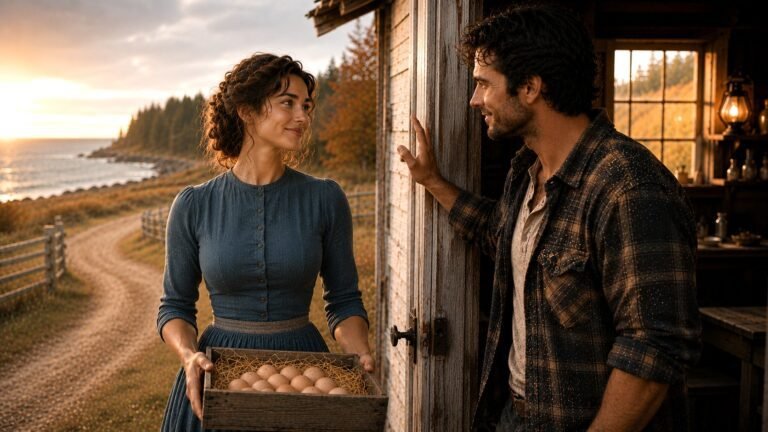
He found her at the henhouse, gathering eggs into her apron, and she knew from his face before he said a word that he had found something.
“There’s no debt,” Jesse said. “Not from your father. I looked at the county filings myself, and the clerk pulled the original record for me besides, since he remembered your father fair well and thought something smelled poorly about the whole business the moment I asked. Your father’s estate was clear when he died, Addie. No note, no lien, nothing owing to Silas Vance or any man.” He held up a folded paper. “What there is, is a debt against your uncle’s own name — near two thousand dollars, borrowed from Vance three years back against the ranch itself, and due in full this fall. Your uncle’s been telling you a lie built on top of a truth, hoping you’d never think to look past it.”
Addie’s hands had gone still over the eggs. “He was going to marry me off to cover his own debt,” she said slowly, “and let me believe all this while it was my father’s shame to answer for.”
“Looks that way.”
“That son of a—” She caught herself, though the anger in her was hot and clean and, for the first time in two years, entirely without shame attached to it. “I want to see him. Tonight. Before the wedding, before anything else — I want him and my uncle both to answer for it, in front of whoever will listen.”
Jesse looked at her a long moment, and something like pride moved across his quiet face. “Then I’ll stand beside you while you do it,” he said. “But it’s your fight to lead, Addie. You’ve carried enough of other folks’ burdens without asking. This one, you get to settle yourself.”
She found her uncle in the parlor that evening, going over his accounts by lamplight, and she did not wait to be invited to speak.
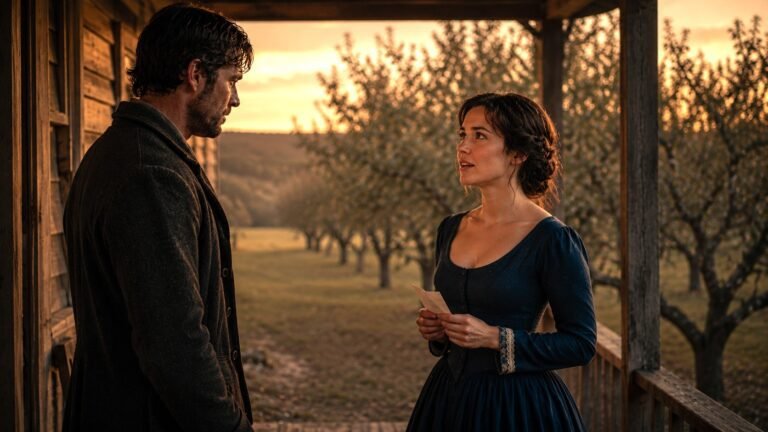
“I know about the debt,” she said, setting the county filing down on the table before him, the paper crisp and damning in the lamp’s yellow light. “The real one. Yours, not my father’s. I know you owe Silas Vance near two thousand dollars against this ranch, and I know you’ve been trading me to settle it while telling me it was Papa’s shame to answer for.”
Her uncle’s face went through several colors in quick succession — surprise, then anger, then something that might, in a better man, have been shame. “You’ve no business going through—”
“I’ve every business,” Addie said, and her voice did not shake now, not even a little. “It was my life you were spending, Uncle Ezra, same as if you’d taken it to the bank and cashed it for coin. I won’t be married to settle a debt that was never mine to carry.”
“You’ll do as you’re told, girl, or this ranch—”
“Then let the bank have it,” Addie said. “I’d rather see it sold at auction honest than see myself sold dishonest to save it. And when Mr. Vance comes calling to collect what you truly owe him, you can explain to the whole county why you tried to pay a gambling debt with your own brother’s daughter.”
“You don’t understand what a man’s driven to,” Ezra said, his voice gone thin now, stripped of its earlier bluster. “Vance held that note over me for three years. Three years, watching him circle this place like a buzzard, knowing one bad season would see it taken from under me entire. When he took a fancy to you, I saw a way clear of it — and I told myself it wasn’t so different from any other match, that plenty of women marry for less romantic reasons than love and count themselves lucky besides.”
“Then you ought to have asked me,” Addie said, “instead of deciding for me and dressing the deciding up as duty. You let me believe I owed a dead man’s debt so I wouldn’t ask too many questions about a living one. That’s not desperation, Uncle. That’s cowardice wearing desperation’s coat.”
He had no answer for that. He sat with his hands flat on the table, looking older in that moment than Addie had ever seen him, and something in her that had spent two years braced against him softened just slightly, not into forgiveness, but into something like pity, which she found she could afford to feel now that she was no longer afraid of him.
“I won’t ruin you out of spite,” she said finally. “I won’t go running to the whole county with the particulars, though the county will likely learn them regardless once Mr. Vance comes looking for his money and finds no bride waiting to cover it. But I’ll not be sold again, Uncle Ezra. Not by you, not by anyone. Whatever comes of this ranch, I mean to have a say in the shape of my own life from here on, and if that costs you the roof over your head, then I expect you’ll manage, same as I’ve had to.”
The silence that followed was thick enough to choke on. Her uncle opened his mouth, closed it again, and in that silence Addie understood that she had won — not because he had softened, but because she had, at last, made the cost of his lie greater than the comfort of it.
Word traveled fast in a county that small, and faster still once the land office clerk, no friend to secrets and less friend to Silas Vance, mentioned to the right people over supper what he’d shown the quiet cowhand from the Whitfield place. By the time Sunday came — the very Sunday that had once been fixed for a wedding — it was Silas Vance’s debt, and Ezra Whitfield’s lie, that were the talk of the county instead, and neither man showed his face at church that morning, which suited Addie fine, since she had not gone to be married that day after all, but only to sit in the sun on the schoolhouse steps afterward with Jesse Cole beside her, both of them saying very little, and needing to say very little more.
Vance left the territory before the month was out, his debts called in from other quarters once his name had soured, and Ezra Whitfield, humbled and diminished, sold off half his acreage to satisfy what remained, and troubled his niece very little after that, having lost, in the space of a single confrontation, whatever authority he had once presumed to hold over her.
It was several weeks later, with the first hard frost silvering the grass and the cottonwoods gone bare along the creek, that Jesse found Addie at the pump one morning, same as he had that first gray dawn so many weeks before, and took the buckets from her hands to fill them himself, same as always.
But this time, when he handed them back, he did not let go at once.
“I’ve been thinking on something,” he said, and there was a careful, unhurried quality to his voice that told her he had chosen his words the way he chose everything, with great deliberation. “I’ve no ranch of my own left to offer you, Addie. No fine house, no easy years ahead, most like — just a man who’s learned the hard way what a place is worth, and who don’t aim to lose another one, if he’s given the keeping of it.” He reached into his coat and drew out a small ring, plain and unadorned, worn smooth with age. “This was my mother’s. Not much to look at. But it’s mine to give, same as I mean to give you the rest of what I’ve got, which isn’t riches, but is steady, and is honest, and is yours if you’ll have it.”
Addie set the buckets down slow, the water catching the pale morning light, and looked at him — this quiet man who had noticed her when the whole world had looked away, who had filled her woodbox without being asked and her cup before his own, who had stood between her and every cruelty life had arranged for her and asked nothing in return but the chance to keep standing there. She thought of the first morning she’d seen him, dust-colored and unhurried on the wagon seat, and how she had told herself she hadn’t marked the line of his shoulders.
She had marked them. She had marked everything about him, from that very first look, though it had taken the whole slow turning of a season for her to admit it even to herself.
“I’ll have it,” she said, her voice unsteady with something that was, for the first time in two years, entirely happiness. “And you, besides — steady and honest and unglamorous as you please. I’ve had enough of glamour, Jesse Cole. I’ll take steady, and gladly.”
He slid the ring onto her finger with the same careful attention he brought to everything, his rough hands gentle around hers, and when he kissed her it was unhurried too, the way the best and truest things in his life had always been — not a thing seized in a moment, but a thing built slow, out of woodboxes filled at dawn and coffee poured before his own and a hundred small, unspoken kindnesses that had, without either of them quite noticing when, become something neither of them could do without.
They married in the spring, in the same schoolhouse where the truth had first come open, with the windows thrown wide to let in the smell of new grass and turned earth, and Addie wore her mother’s old blue dress, let out at the seams and pressed smooth, and did not once think of Silas Vance, whose name had already begun to fade from the county’s memory the way a bad smell fades once the source of it has been carted off.
They took a small parcel of land at the western edge of the valley, poor in comparison to the Whitfield acreage but rich in the ways that mattered — good water, a stand of cottonwoods for shade, a view west toward the mountains that turned violet and gold at evening in a manner Addie never tired of watching. Jesse built the house himself, plank by plank, through that first summer, and Addie split the difference of her days between helping him raise it and putting in a garden along the south wall, and in the evenings, when the work was done, they sat together on the porch he’d built with his own two hands, in two chairs he’d made to match, and watched the light go long and gold across land that belonged, at last, to no one but themselves.
Years came and went the way years do — hard ones and easy ones both, a drought one summer that tested them, two children born in the years that followed who filled the little house with a noise Addie had once thought she would never have the right to hope for. Jesse remained a man of few words all his life, but Addie had long since learned to read the ones he didn’t say — in the woodbox always filled before she rose, in the coffee poured for her before his own, in the quiet, steady presence of him beside her through every ordinary evening that followed the extraordinary one where he had first noticed her, when the whole rest of the world had already looked away.
She was an old woman, gray-haired and satisfied, when she sat on that same porch one autumn evening — the boards worn smooth now under decades of feet, the chairs weathered gray, the cottonwoods grown tall and gold-leafed along the creek — and watched her husband, stooped now but still steady, still unhurried, cross the yard toward her with two cups of coffee in his rough, careful hands, one for her and one for himself, same as he had done every evening for near on fifty years.
He set her cup down first, same as always, and settled into the chair beside hers with a small, contented sigh, and out past the porch rail the last light of day was going long and gold across land that was, and had always been, entirely their own.
“Fine evening,” he said, which was, for Jesse Cole, very nearly a speech.
“It is,” Addie agreed, and reached over to take his hand, rough and familiar and steady as it had ever been, and thought, as she often did in these quiet hours, of a gray dawn so many years before, when a stranger’s mules had stopped of their own accord at her uncle’s gate, and she had looked up from her washing and found, without quite meaning to, everything her life had been missing.
The wind moved soft through the grass. Somewhere down by the creek a meadowlark was singing, the same simple, unhurried song it always sang, and Addie Cole sat on her porch in the last gold light of an ordinary evening, her husband’s hand steady in her own, and wanted for nothing else in all the world.