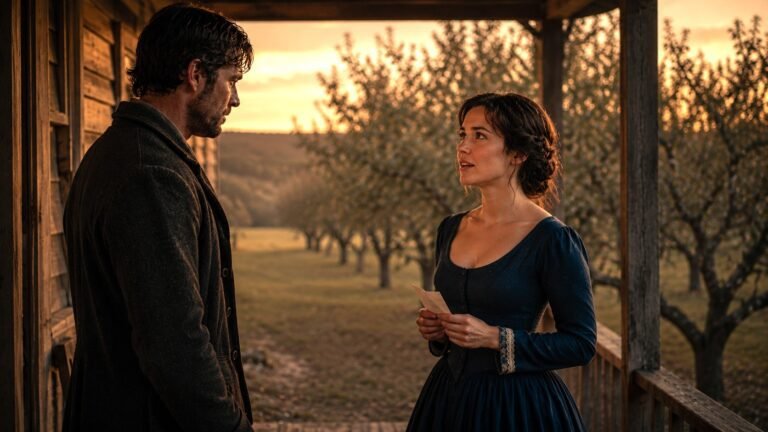

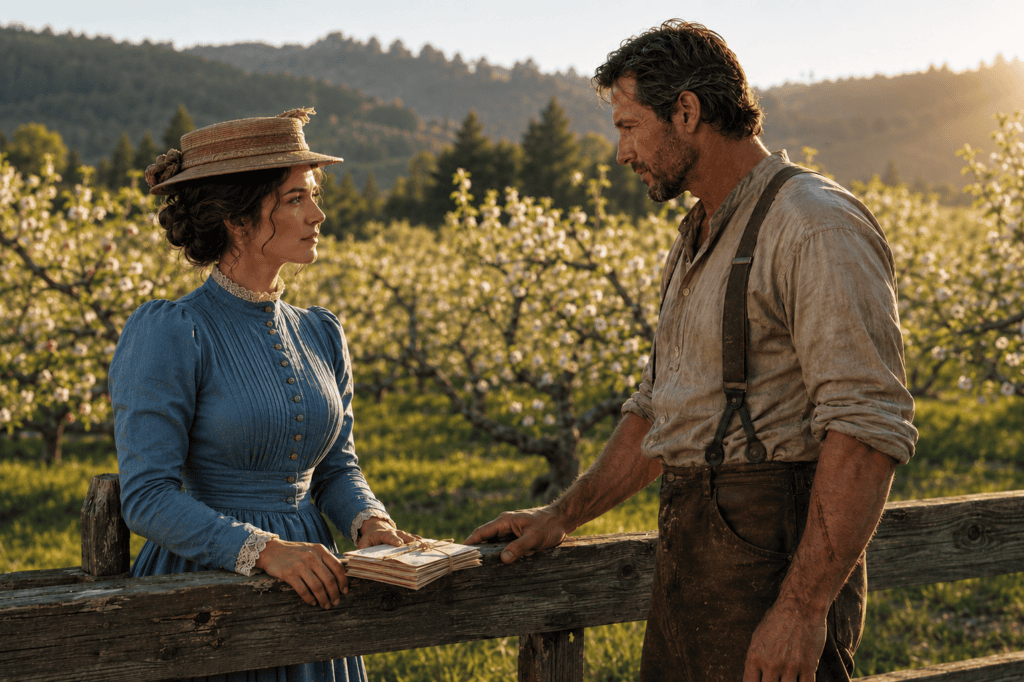
The advertisement was three inches of type wedged between a notice for a lost mule and an announcement of the Grange’s spring social, and Selah Vance almost turned the page before her eye caught on it.
Widower, 40, sound orchard and dairy holding near Hollow Creek, Yamhill County. Seeking a woman of sense and stamina for correspondence and, God willing, marriage. No time for flattery. Write if you are willing to be told the truth about the work.
It was signed T. Calloway.
She read it standing at the counter of her millinery shop on Commercial Street in Astoria, the bell over the door still faintly ringing from the last customer’s exit, the smell of glue and felt and the river’s brine drifting in through the propped window. Outside, a fish-packing whistle sounded somewhere down toward the docks, the sound that had once meant Elias was coming home and now meant nothing at all except that the day was ending.
She was thirty-four years old. She had been a widow for four years, ever since a gillnetter named the Bethany had gone down in a squall off Peacock Spit with her husband and two other men aboard, and none of the three had ever been found, not so much as a boot washed up to bury. She had a boy of seven with his father’s quiet stubbornness and a small shop that kept them fed most months and thin the rest.
She read the notice four times. Then she set it down, because the bell over the door rang again, and a woman named Mrs. Pruitt wanted a black straw re-trimmed for a funeral, and there was no more time that day for imagining another life.
She spent the afternoon steaming crepe and pinning veiling with her fingers doing the work while her mind kept drifting back to those three inches of newsprint, the way a tongue keeps finding a sore tooth. She had read a great many notices like it over the years — a woman in her position could not help but notice them, the way someone who has gone hungry cannot help but notice a bakery window — and most of them promised things no honest man could deliver: a life of ease, a gentle temperament, prosperity assured. This one had promised nothing but work and honesty in roughly equal measure, and something in its plainness had lodged itself under her ribs and stayed there through the fitting, through the walk home along the wet planked sidewalk with the gulls wheeling and complaining over the cannery scraps, through supper, through the hour of mending she did every evening by the stove while Micah read aloud to her from a boy’s adventure story he was only half old enough to follow.
She had not thought of remarrying in any serious way in four years. She had thought of it the way a person thinks of a country she will likely never visit — pleasantly, at a distance, without expectation of arrival. But there was something in the particular honesty of that notice, its refusal to dress itself up, that made the country feel nearer than it had any right to.
She wrote back that night, after Micah was asleep.
He slept in the loft above the shop’s back room, in a narrow bed under the eave, and before he’d gone up he had shown her, as he did most evenings, the day’s find — a jay’s feather, blue-black and iridescent at the edge, which he set with great ceremony into the cigar box he kept beneath his bed. The box held perhaps sixty feathers by then, each one labeled in his careful, unpracticed hand with the bird he believed it had come from and the date he’d found it. He could tell a Steller’s jay from a scrub jay by call alone, could pick out a varied thrush’s strange electronic whistle from the ordinary chatter of the waterfront, and Selah had long since stopped trying to explain where the habit had come from. Elias hadn’t been especially fond of birds. It was simply Micah’s, the way some children loved horses or arithmetic.
She sat at the kitchen table with a single candle and a sheet of good paper — she used the good paper for important things, the same instinct that made her save the whole cloth for a client’s wedding dress rather than piecing it — and she wrote her name, her age, her trade. She wrote about the shop and the four years since the Bethany, and about the coast weather, which she understood a farmer inland might want to know she was accustomed to hardship.
She did not write about Micah.
She told herself, setting down the pen, that it was an omission and not a lie, and that there was a difference, though even as she thought it she recognized the thought for what it was — the kind of sentence a person constructs specifically because they do not quite believe it. She told herself she would mention the boy in the second letter, once Mr. T. Calloway had some sense of her as a woman before he had to reckon with her as a mother of a fatherless child that was not, strictly, his concern to take on.
She sealed the letter before she could reread it, the way a person walks fast past a pit they know is there, and set it on the sill to post in the morning.
Thaddeus Calloway read the reply on a Tuesday in April, standing at the kitchen window of the farmhouse he had built with his own hands eleven years before, watching the light come up gray-gold over rows of apple trees just beginning to leaf.
He had placed the notice at his sister’s insistence. Beatrice had come from Salem for a week in March, taken one look at the state of his kitchen and the state of his temper, and told him plainly that a man alone on sixty acres of orchard and eighteen head of dairy cattle was making a hard life harder than it needed to be, and that three years of grieving Ruth was a respectable interval and going on four was beginning to look like stubbornness dressed up as loyalty.
He had not argued with her, because she was not wrong.
Ruth had died in the winter of 1897, in a barn fire that took four cows and very nearly took Thaddeus as well — he still had the scar along his left forearm where a falling beam had caught him as he’d gone in after her, too late, because she had gone in first after a calf that had gotten itself trapped, and the smoke had done its work before the flame reached her. He did not talk about it. He had built a new barn eighty yards farther from the house and had never once, in three years, said aloud what he had seen when they pulled her out.
He received eleven replies to the notice over the following month, and he read them all at the kitchen table on a wet Sunday, laying them out in a row like a man taking inventory. Most were pleasant enough and told him almost nothing — a schoolteacher from Portland who wrote about the weather and her fondness for hymns, a widow from The Dalles who mentioned three times in one page that she was an excellent cook.
Selah Vance’s letter told him more than she likely intended. Not in its content, which was careful and spare, but in its precision. She did not say she had struggled since her husband’s death; she said she had kept the shop solvent through four winters on her own, which he understood to mean the same thing stated as a fact rather than a complaint. She described the millinery trade in exact terms — the felt, the wire frame, the particular vanity of women who wanted to look bereaved and elegant at once — and he found himself smiling at the kitchen table, alone, over a description of a customer’s hat.
He wrote back the same evening.
Over the following two months they exchanged nine letters, and Selah began keeping his in a cigar box of her own — not Micah’s, a second one, empty until then, that she’d been saving for no reason she could name — because the button tin on her worktable was too shallow and too often opened by careless fingers, and she found she wanted his letters somewhere with a proper lid.
Micah found the first one anyway, examined the unfamiliar hand with great seriousness, and asked whether it was from a man. She said yes. He considered this with the same gravity he gave a new feather, decided it required no further comment, and returned to sorting his collection by size.
Thaddeus wrote about the orchard in specific terms — the north block that had come in late two years running, the trouble with the well in August, the two hired hands, Osgood and a boy named Pruitt who was not much older than a boy himself and ate like a bear coming out of winter. He did not make the work sound easier than it was, and Selah noted this and was grateful for it; she had spent four years being told by well-meaning people that things would surely improve, and she had come to distrust anyone who promised her ease.
She wrote about her customers, about the particular intimacy of fitting a hat to a woman’s face, the way you came to know things about people — their vanities, their griefs, the shape of what they wanted to be seen as — that they would never have volunteered outright. She wrote about the smell of wet wool on a rainy day, the sound of the foghorn at the river mouth that she’d stopped hearing after the first year and heard again, freshly, every time she thought of Elias.
In his sixth letter, Thaddeus wrote that he had found himself thinking, while walking the rows one evening, about something she’d said regarding a hat coming together “the way a difficult sentence finally says what you meant it to.” He said that was very near how he felt about the orchard in a good year, and that this was not the kind of observation he had expected to find in a reply to a newspaper notice, and he meant it as a compliment.
Selah read that paragraph three times, standing by the window with the last of the daylight going gray over the river.
That night, after Micah was asleep with his feathers arranged by species on the windowsill, she sat at the table with a fresh sheet of paper and tried to write about the spring weather and a bonnet she’d finished that week for the pastor’s wife. She wrote one line. Then she stopped.
She thought about what it would mean to keep on as she had been going. She thought about arriving in Hollow Creek with a boy no one had been told existed, and watching a man’s face change as he understood what she had done. She thought about eight letters, now nine, that had been honest in every particular but the one that mattered most.
She did not write the truth that night. She told herself, again, that there would be a right moment, and that a letter was too thin a thing to carry news of this weight — that it wanted to be said in person, where he could see her face and know she meant it. She was aware, even as she constructed this reasoning, that it was more armor than argument. She put the pen down anyway.
They agreed, in his eighth letter and her answering ninth, that she would come to see the place before either of them spoke further of marriage — a sensible arrangement, he said, since a woman ought to see what she was agreeing to before she agreed to it. She wrote back that she would come the second week of June, and that she would be traveling with a companion, which was true in every particular except that she allowed him to assume, by saying no more, that the companion was an adult.
She spent the two weeks before the journey in a state she did not examine too closely. She told Micah they were going to visit a man’s farm in the valley, a friend of hers, and that he must be on his very best behavior, and Micah — who at seven had already absorbed enough about widowhood and shortage to understand that some visits mattered more than others — nodded seriously and asked whether there would be birds he didn’t know yet. She said she expected there would be.
She did not tell him, because she had not fully told herself, what she intended to say when they arrived. The closest she came to a plan was this: she would introduce him, in the first instance, as her sister’s boy, come along for the visit because there was no one in Astoria to keep him — a lie built entirely out of the shape of a lie she’d told herself already, that there would be a right moment later, a private moment, in which the truth could be set down gently instead of thrown.
She was not proud of the plan. She built it anyway, the way you build a bridge you know is unsound because the alternative is not crossing at all.
The train took them as far as McMinnville, and from there a farmer named Otis Reams, hired for the purpose, drove them the last eleven miles by wagon through country that unmade every picture Selah had carried of it. The coast was fog and spruce and the gray weight of the ocean always somewhere at the edge of hearing; this was different — open, green-gold in the June light, orchard rows running up gentle hills in ranks so even they looked drawn with a rule, the air smelling of cut hay and apple blossom just past its peak and, underneath it, warm earth in a way the coast never quite managed. Micah sat forward on the wagon seat the whole way, head turning at every call from the hedgerows, and by the time they reached the turn for the Calloway place he had already identified, correctly, a western meadowlark, a flicker, and something he was fairly sure was a lazuli bunting, though he admitted this last with less certainty than usual.
Selah watched him lean into the wind of their passing, his cap pushed back, his whole small body alight with the particular happiness of a boy who has found, unexpectedly, a country full of the thing he loves best, and she felt the lie she was carrying settle a little heavier in her chest with every mile. It was one thing to deceive a stranger by letter. It was another to watch her son grow so plainly, unguardedly glad of a place, while she carried inside her the knowledge that his welcome there had been built on a sentence that was not true.
She had rehearsed, in the days before they left Astoria, a dozen different ways of telling Thaddeus the truth once they arrived — in the first hour, on the first evening, before supper, after — and had discarded every one of them for some reason that had seemed, at the time, sound. Now, with the orchard rising up green around her and the farmhouse coming into view at the top of the lane, white-boarded and modest with smoke already curling from its chimney, she understood that she had used up the last of her rehearsing and arrived instead with nothing decided at all, only the old plan, the sister’s-boy plan, sitting in her mouth like a stone she had not yet chosen to swallow or spit out.
Thaddeus was waiting at the top of the lane when the wagon came into view, and Selah’s first thought, absurd and immediate, was that he looked exactly like his letters — tall, still in the particular way of a man who has learned to conserve motion rather than waste it, weathered in a manner that made his age hard to guess within five years in either direction. His second look, after the handshake he gave her that was direct without being demonstrative, went to the boy on the wagon seat, and Selah felt her whole chest go tight and cold.
“This is Micah,” she said, and the next words came out of her before she had decided to say them, arriving instead from the plan she had built and not yet unbuilt. “My sister’s boy. She’s poorly this season and I offered to bring him along.”
She watched the lie leave her mouth and land, and she watched Thaddeus receive it without any sign that it had cost him anything, because of course it hadn’t — not yet, not to him.
“Well,” he said, looking at Micah with the same unhurried directness he’d given Selah, “we’ve got more birds out here than we know what to do with, if that interests you.”
Micah, who had been watching him with the concentrated evaluation of a boy deciding whether to trust a stranger, said, “Do you have kestrels?”
“I believe we do,” Thaddeus said. “Though I couldn’t have told you the name for them before this minute.”
Micah appeared to regard this as an acceptable beginning, and climbed down from the wagon without further comment, and Selah, watching the two of them, understood with a lurch that the lie she had told was not going to be a small, containable thing. It was going to have to survive three days.
It survived one.
Not because anyone caught her out directly, but because a boy of seven does not carry a fiction the way an adult does, folded neat and out of sight. Micah followed Selah everywhere on the first afternoon in the unthinking way he always had, close at her elbow, and twice caught himself starting to say Mama before something in his own instinct — some dim seven-year-old sense that the word was, on this visit, wrong — made him swallow it and say nothing at all, which was in its way more conspicuous than the word would have been, because a boy staying that close to his aunt was one thing, and a boy going suddenly careful around his own tongue was another.
Osgood, the hired hand, a broad silent man of perhaps fifty who ate his meals at the kitchen table with the family as though he had done so for years, watched the boy with the flat unbothered attention of a man who has raised his own children and recognizes what he’s looking at, and said nothing to Selah, though she caught him once, at supper, watching Micah reach without asking for the salt the way he did at home, and watching her hand come up automatically to steady his cup before he could knock it, the way a mother’s hand does and an aunt’s, usually, does not.
That night, lying awake in the small guest room down the hall from where Micah slept on a cot near the kitchen stove, she understood she had perhaps two more days before the lie fell apart on its own, without her needing to confess anything, simply from the weight of maintaining it — and that this would be worse than confessing, because it would mean Thaddeus learning the truth by catching her in it rather than being given it.
She did not sleep well.
It came apart on the second evening, over supper, and it was Micah who broke it, though not through any fault she could hold against a child of seven.
Thaddeus had asked him, kindly, whether he missed his own mother while she was poorly, and Micah — tired, full of a long day of orchard rows and bird names, and perhaps simply unable any longer to hold a fiction that made no sense to him in the first place — looked confused for a moment and then said, plainly, “She’s not poorly. She’s right here.”
The table went quiet in the particular way a room goes quiet when something true has been said that everyone present had agreed, tacitly, not to say.
Selah felt the blood leave her face. Osgood studied his plate with great interest. Thaddeus looked at Micah, and then at Selah, and his expression did not change in any way she could read, which frightened her more than anger would have.
“Micah,” she said, “go on and see to your feathers before it gets dark,” and her voice came out steadier than she felt, and the boy, sensing without understanding that something had shifted, went, casting one uncertain look back at her from the doorway.
She sat at the table with her hands in her lap and did not look up.
“He’s mine,” she said. “He’s my son. Not my sister’s. I have no sister in this story — I have a sister in Ohio I write to twice a year, and she has no children, and none of it was ever true.” She made herself continue, because stopping now would be worse than the whole confession together. “I left him out of my letters from the start. I told myself I’d tell you before it mattered, and then I told myself I’d tell you when I arrived, and then I built a lie instead, because I was afraid of exactly this — of watching your face while you understood what I’d done, and deciding I wasn’t worth the trouble a boy brings with him.”
Thaddeus did not say anything for a long moment. Osgood rose quietly and took his plate to the wash basin, giving them the room without being asked to.
“You told me you had a sister,” Thaddeus said finally, and his voice was even, not raised, which was somehow worse than shouting would have been. “You told me a specific lie, not just an absence. I could have understood the absence. I don’t know what to do with the lie.”
“I know,” Selah said. “I don’t have a defense for it. I built it out of fear and I kept building on it because the first stone was already laid, and I am not going to sit here and tell you it was anything other than cowardice, because it was.”
She stood, because sitting there under his gaze had become unbearable. “I’ll go tell Otis we’ll want the wagon in the morning. I won’t ask you to decide anything tonight.”
She was nearly to the door when he spoke again.
“Sit down, Selah.”
She stopped. She had not, she realized, heard him use her given name before — in the letters he had always written Mrs. Vance, formal, careful, a man minding a distance he thought proper until matters were settled between them. She turned back and sat, because there was nothing else in her to do but what he asked.
“I’m not angry that you have a boy,” he said. “I want that said plainly before anything else. Ruth and I never had children, and I’ve spent three years in a house too quiet for one man, and if you’d written me in the first letter and said I have a son and he comes with me, I’d have written back the same day and told you a boy would be welcome.” He paused, and something in his jaw worked, the closest thing to visible frustration he’d shown. “What I can’t get past so easy is that you decided, on your own, that I wasn’t a man who could be trusted with the truth of you before I’d had the chance to prove I was or wasn’t. You made that judgment without giving me the opportunity to earn it or fail it.”
“I know,” she said again, and it came out smaller this time. “I’ve known it since the third day I was writing to you. I kept thinking there’d be a better letter to say it in, and there never was, because there’s no good letter for admitting you’ve been afraid the whole time you were writing.”
He was quiet for a while. Outside, through the open window, she could hear Micah’s voice, low and absorbed, talking to himself the way he did when he was sorting feathers, and under it, fainter, the call of some bird settling for the evening that she couldn’t have named and her son almost certainly could.
“I had a wife who never lied to me a day in her life,” Thaddeus said finally, “and I lost her anyway, in about four minutes, to a fire she didn’t have to walk into. I’ve spent three years turning that over, and the only thing I’ve settled on is that I’d rather have the truth late than the comfort of never testing whether a person could give it to me at all.” He looked at her, and for the first time that evening something in his face eased, just slightly, the way a held breath finally lets go. “You told me. Nobody made you. You could have gone on hiding him the whole visit and put him on the train home and I’d likely never have known the difference.”
“I couldn’t,” she said. “I tried to build a version of this trip where I could, and it fell apart the first evening, because he’s not a secret I know how to keep from myself, let alone from you.”
“Then I’d say,” Thaddeus said, “that the lie cost you more than it cost me, and that ought to count for something.”
She did not sleep at all that night, turning it over — his voice, his stillness, the way he had said sit down without cruelty in it — and near dawn she rose and went out to the porch rather than lie there further, and found him already there, coffee in hand, watching the light come up gray-gold over the orchard the way she imagined he watched it most mornings, alone, before this week had happened at all.
“I owe you the rest of it,” she said, “if you’ll let me give it plainly instead of piecemeal.”
He gestured to the other chair, and she sat, and told him — Elias, the Bethany, the four years of hats and thin winters, and Micah’s feathers, and the particular loneliness of raising a boy who noticed everything and needed, more than most children, someone steady to notice him back. She told it without asking for pity and he took it without offering any, which she found she preferred.
When she’d finished, he was quiet a moment, turning his cup in his hands.
“I’ve got a boy of seven walking my fence lines like he owns them,” he said, “asking Osgood the names of birds Osgood’s lived here forty years and never once wondered about. I don’t think that’s a boy who’s going to be trouble to have around.”
“You don’t have to decide anything about him today,” Selah said. “I only wanted you to know I meant to.”
“I know you did,” he said. “That’s rather the point of it, isn’t it. You could’ve kept meaning to indefinitely. You didn’t.”
They sat in the quiet a while longer, the coffee going cold in his hand, the orchard waking up around them in birdsong Selah still couldn’t sort but was, she noted, beginning to want to learn.
“There’s a thing I keep turning over,” she said finally, “and I’d rather say it while we’re being plain with each other than let it sit unsaid and grow teeth later. I’m afraid, some, that you’ll look at me differently now. Not unkindly — I don’t think that’s your way — but differently. That I’ll always be, a little, the woman who lied to you before I was the woman who told you the truth.”
Thaddeus considered this with the same unhurried care he gave a question about the orchard, turning it over before he answered rather than reaching for the first comfortable thing to say.
“I expect there’ll be moments I remember it,” he said at last. “I won’t lie to you and say otherwise, seeing as we’ve just spent an evening on the trouble lying causes. But I’ve found, in my own life, that the things which cost a person the most to say are usually the ones I end up trusting furthest down. Ruth never once had cause to tell me a hard truth in eleven years of marriage, and I loved her for it, and I’ll grieve her the rest of my days. But I never got to see what she was made of in the way I saw it in you last night, sitting at that table with your hands in your lap, waiting to hear whether I’d send you home.” He set the cold coffee down on the porch rail. “I don’t say that to speak ill of her memory. I say it because I think you’re asking whether the lie will always stand between us, and what I’m telling you is that I believe, in time, it’ll be the confession that stands there instead. That’s the part I expect to remember.”
Selah found she had nothing to say to that for a long moment, and was glad of the excuse the valley gave her, brightening now in earnest, birdsong thickening in the hedgerows, to simply sit and let the words settle into her the way water settles into dry ground — slowly, and all the way down.
The wagon did not go back to McMinnville that morning, nor the next. Selah stayed the full three days as planned, and on the last evening, after Micah had gone to bed exhausted and happy with a kestrel feather he was fairly sure was genuine tucked into his shirt pocket, Thaddeus walked her out to the porch rail and did not make a long speech, because that was not his way, and she had come, in the space of three days, to be glad of it.
“I’ve read nine letters from you and watched you tell me a hard truth face to face when it would’ve been easier not to,” he said. “I’ve got a clear enough view of the woman you are to ask the question worth asking. The orchard’s better with two people in the house than one, and I expect it’d be better still with three.” He looked toward the dark window where Micah slept. “I’ve formed a view of the boy too. He’s got a careful eye. In eight or nine years he’ll make a hand worth having, and I’m prepared to wait that long.”
Selah looked at him for a long moment in the failing light. “I should have told you the truth from the first letter,” she said. “I want that said, so it isn’t sitting unsaid between us.”
“You told me when you found you couldn’t keep from telling me,” he said. “I’ve decided that’s what matters, in the end. Not the letter it came in.”
“Yes,” she said.
They were married on the last Sunday of July, 1901, in the small church at Hollow Creek, with Osgood and Otis Reams as witnesses and Beatrice come down from Salem to weep with unembarrassed enthusiasm through the whole ceremony from the front pew. Micah stood beside his mother in a new shirt Selah had made him for the occasion, his hair combed flat with water and already springing loose at the crown, and watched the proceedings with the careful reserve of a boy withholding final judgment until the evidence was in.
Selah learned the orchard the way she had once learned a bolt of unfamiliar cloth — from the outside in, feeling for the grain before she cut anything. By the first frost she knew the difference between the north block’s late-ripening Winesaps and the early Gravensteins by the smell of the crates alone. By the following spring she had found an error in the household accounts, a mistaken column that had been costing the farm eleven dollars a season for three years running without anyone catching it, and she showed Thaddeus the corrected ledger without comment and let him find the mistake himself in the figures.
He studied it a long while at the kitchen table. “You’ve a better eye for numbers than I do,” he said finally.
“I spent twelve years fitting garments on women who believed themselves a different size than they were,” she said. “You learn to trust the measurement over the impression. It’s a habit I never found a way to set down.”
“It’s likely the most useful habit a person could bring to a farm,” he said, and she agreed that it probably was.
Their first real disagreement came the second autumn, over whether to dig a drainage channel through the low corner of the south block that flooded every wet winter. She raised it once, plainly, and let it be. He argued against the labor it would cost in a busy season, and she did not press it further. That winter the corner flooded exactly as she’d said it would, drowning a dozen young trees, and the following spring he dug the channel she’d described without either of them mentioning the earlier conversation at all. She found she preferred this to being agreed with outright — the slow, unspoken way he arrived at a thing in his own time, once it had proven itself true rather than merely been argued.
Micah grew into the farm the way a fence post settles into ground — gradually, without ceremony, until one day it is simply there and the fence cannot be imagined without it. By ten he could read the orchard’s moods, a coming frost, a tree favoring blight, almost as well as Selah could read a bolt of wool for flaw. By fourteen, Thaddeus had begun asking his opinion on the spring pruning, not because it was required of him, but because the opinion, more often than not, was worth hearing. Thaddeus never called him son outright — that was not a word that came easily to him for anyone — but he called him by name with a particular steadiness that carried the same weight, and Micah had understood this for years before either of them found cause to put it into plainer words.
There was a night in the spring of 1908 when a late freeze threatened the whole blossom crop, and Thaddeus and Micah worked the smudge pots together through the cold hours until dawn, moving row to row in the bitter dark, and something settled between them in that long, silent, freezing work that neither of them ever needed to say aloud afterward.
Selah watched them from the kitchen window that night, two lanterns bobbing low between the trees, and thought of the boy who had once asked, on his first evening at the farm, whether there were kestrels, and of the man who had answered honestly that he didn’t know but was willing to find out. She thought that this, more than the ceremony in the church or the ring he’d given her or any of the words either of them had said since, was the truest proof she had that she had not been wrong to tell him the truth when she finally had. A man who would spend a freezing night saving a boy’s inheritance alongside him, without ever once being asked to think of it that way, was not a man who had taken her son on out of obligation. He had simply, somewhere in the slow accumulation of years, stopped drawing the line at all.
There were harder seasons too, of course — a summer in 1911 when the codling moth took nearly a third of the crop and Thaddeus did not speak more than was necessary for the better part of a month, moving through his own silence the way he moved through everything, without complaint and without asking to be managed out of it; a winter when Micah, fifteen and newly certain of his own opinions, argued with his stepfather over the wisdom of grafting a new variety onto the old Gravenstein rootstock and left the supper table before the meal was finished, only to appear at the barn before dawn the next morning to help with the grafting anyway, because the argument had been about pride and not about the work. Selah learned, across those years, that a family built the way theirs had been built did not stay stitched by any single act of honesty, hers or anyone’s, but had to be resewn continually, at the seams, wherever the ordinary wear of living threatened to open them.
The cigar box on Selah’s dresser grew heavier with the years — not feathers now, those still lived in Micah’s own box, long since moved with him when he married and took over the north forty himself in 1915 — but pressed apple blossoms, one taken each spring from the first bloom of the north block, dated in her careful hand, thirty-some years of them layered flat and fragile as moth wings by the time she was an old woman. She kept Thaddeus’s nine courting letters folded beneath the flowers, at the very bottom, where they had first been laid.
She had told him the whole truth, eventually, at whatever cost it carried, and that, she thought often in the quiet evenings when the farm had settled into the particular stillness it wore after supper, Thaddeus reading by the lamp and grandchildren asleep in the room where Micah himself had once slept as a boy — that was worth more than never having had to.
Thaddeus died in February of 1922, at sixty-one, of a heart that simply stopped one evening while he sat reading, in the house he had built with his own hands and known the way a man knows a thing he has maintained by hand for thirty years. Micah was there. Selah was there. Osgood, seventy-two by then and having never once left Hollow Creek in the whole of his working life, sat in the kitchen afterward and said nothing at all, which was exactly where he was needed.
Selah stayed on at the farm nine years more, in the east-facing room where the morning light reached first, the room she had chosen the very week she’d arrived and had never once found reason to leave. She died in the autumn of 1931, seventy-nine years old, in that same room, with the orchard turning gold outside the window the way it did every year at that season, dependable as breath.
When Micah, fifty-nine himself by then, with his own children grown and his own grandchildren underfoot, came to settle her few things, he opened the cigar box on her dresser and found what he half expected — the pressed blossoms layered thirty years deep, oldest at the bottom, brittle as paper. Beneath them, folded many times soft at every crease, was a single sheet in his mother’s hand that was not one of his father’s letters at all, but her own — the third letter, the one that had never been sent, written the night before she left for Hollow Creek and kept instead of posted, because by the time she’d finished writing it she had already decided to say the words in person or not say them at all.
I have one son, it read. I did not put him in the first letter. I am telling you now, before you can write back and ask, because I find I would rather lose your good opinion honestly than keep it on a lie.
He carried it out to the porch and sat a long while in the morning light coming in low over the valley, exactly as it had for thirty years, exactly as his mother must have sat a hundred mornings in her own life turning something similar over in her mind. He was fifty-nine years old, and he had a boy of his own grown now with a bird book instead of a cigar box, and he thought about a woman who had been afraid and had told the truth anyway — not at the first opportunity, because she was human and fear is a real thing and not a failing to be ashamed of outright, but before it was too late to matter, which was, he understood now in a way he could not have as a boy, the only kind of courage that had ever counted for anything.
He thought it was good she had taught him that with her life, long before either of them had needed the words for it at all.
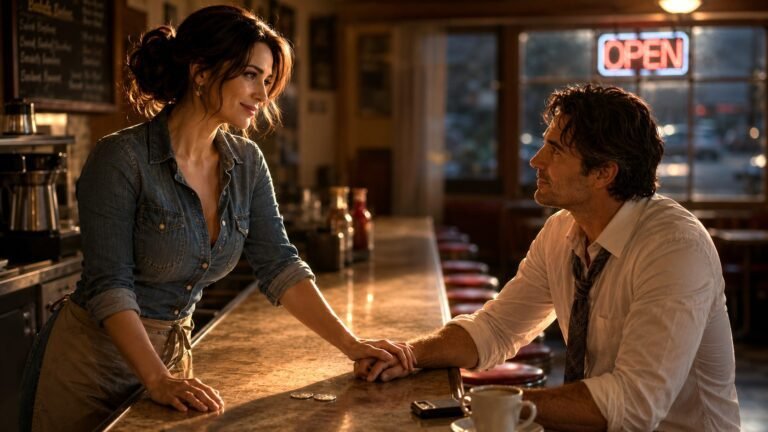
Heartfelt characters sharing love, emotions, and romantic journeys filled with hope, trust, and unforgettable bonds