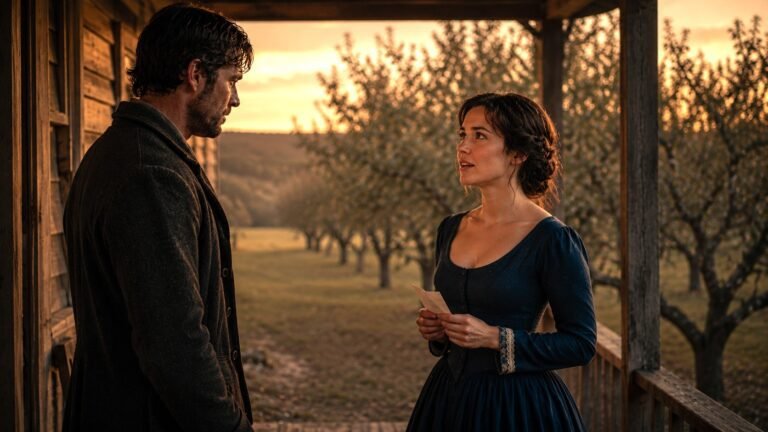

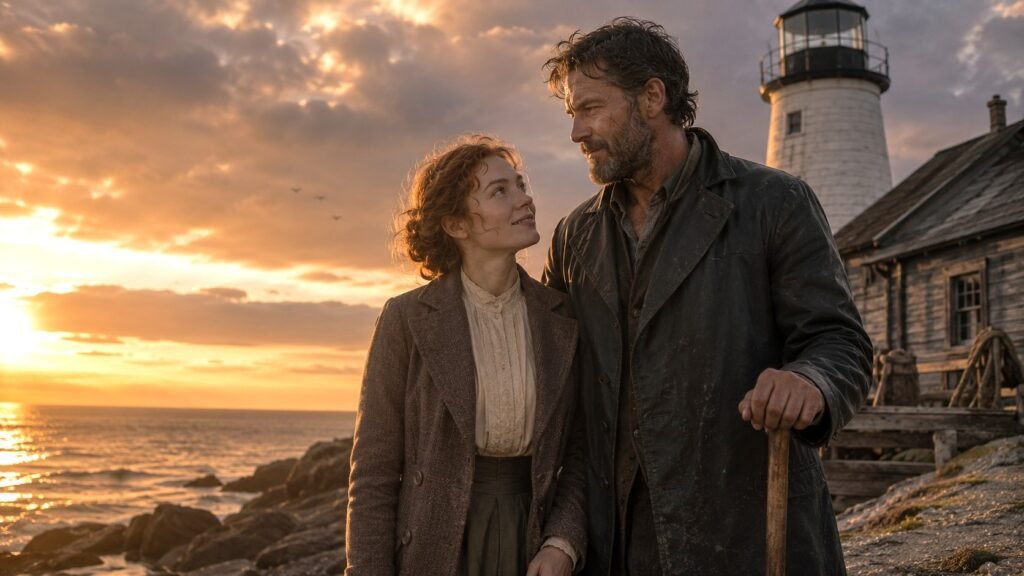
Mara Voss had wept twice in her life that she could remember — once when her father’s boat came back without him, and once, seventeen years old and half-drowned with grief, when they lowered him into the churchyard dirt at Thistle Cove. She did not weep the November morning they walked her down to the fish market square and put her up, in front of God and the herring boats and everyone who had ever known her name, to settle a debt.
The bell at St. Aldous’s had just finished its eight strokes. The square smelled of low tide and diesel and the cold iron tang that came off the water when a storm was building somewhere out past the shoals, and Mara stood on the worn granite steps of the customhouse with her sister’s hand gripped so hard in hers that she could feel Lenna’s pulse hammering against her palm.
“Lenna. Look at me.”
But Lenna wouldn’t. The girl stood half a step behind their stepmother’s good wool coat, fourteen years old and small for it, staring at the cobbles like she could will herself through them.
Odile Voss turned with the unhurried calm of a woman rearranging cutlery. “Stop your fussing, Mara. You’ll shame us in front of the whole quay.”
“Shame us.” Mara’s laugh came out cracked, more air than sound. “Which us is that, ma’am? The family that raised me, or the family that’s selling me?”
“Nobody is selling anybody.” Odile’s mouth went thin as a filleting knife. “You are being placed in respectable service. There’s a difference, and a girl your age ought to know it.”
A crowd had gathered the way crowds gathered in any harbor town too small to have better entertainment on a Tuesday — net-menders and cannery girls and old salts down from the ice house, all of them lining the steps with their arms crossed and their faces carefully, deliberately blank. Mara knew half of them by name. Mrs. Pruitt, who’d sold her mother thread before the influenza took her. Old Cyrus Bell, who used to slip her peppermint humbugs from behind the chandlery counter when she was small enough to reach only his knee. None of them met her eyes now. It was easier, she supposed, to watch a thing happen than to be the one who’d have to answer for stopping it.
“Where,” Mara said, “am I being placed?”
Odile didn’t answer. She didn’t have to, because that was the moment the dory came around the breakwater, one oar dipping wrong, a big grey-bearded man at the tiller squinting against the glare — and the crowd went still the way a room goes still when something wild wanders in through an open door.
“Lord have mercy,” someone breathed. “They actually got him to row in.”
“Didn’t think that man came off the Point for anything short of a wreck.”
“He don’t. That’s how you know what she’s paid him for.”
The dory scraped up onto the shingle below the seawall, and a man climbed out of it. He came up wrong — favoring one leg badly, hauling himself hand over hand up the iron ladder set into the granite, and when at last he stood on the flat of the quay and straightened, the whole square seemed to lean back a half-inch, the way it does from a snake sunning on a warm rock.
He was tall, wide through the shoulders in a way his oilskin coat couldn’t disguise, his face weathered the deep brown of tanned hide, and a scar ran pale and puckered from his left temple down under his jaw, disappearing into a week’s growth of grey-black beard. When he lifted his eyes and looked across the square, half the crowd took a step back.
“That’s him,” a woman whispered near Mara’s shoulder. “That’s Kane. The one they say brought the wreckers’ fire down on his own men. Been out on the Point alone ever since, and don’t you go near that light after dark, you hear, or he’ll—”
“Hush now.”
Mara had heard the stories her whole life, the way every child in Thistle Cove heard them — the ghost of Gull Point, the keeper with the ruined leg and the temper like a lit fuse, the man who’d come back from the wreck of the Aurelia ten years past with three graves behind him and a silence around him that nobody had ever managed to crack. Folks decided, the way folks decide, that a man that quiet and that scarred must have something buried he didn’t want dug up.
And this was the man her stepmother had sold her to.
Mara’s knees went, just for a second. She caught herself on the iron rail. You will not fall down in front of these people. You promised yourself that on the walk over. You will not fall down and you will not beg and you will not give them the satisfaction.
Thaddeus Kane stopped ten feet off, and his eyes went first to Odile, then to the girl half-hidden behind her, and last — and longest — to Mara. Something moved behind his gaze that she couldn’t read.
“Mrs. Voss.” His voice was low, salt-rusted, a man who didn’t spend it often. “You sent word to the customhouse. Said you had a girl needed placing before winter set the crossing to the Point too rough for regular boats. Said she was capable and willing.”
“I did.” Odile’s smile came back up bright and false as a shop window. “And here she is. Twenty years old, strong hands, keeps a house better than any girl on this coast. You’ll not find better for the wages we discussed, Mr. Kane.”
“The wages.” Something in Mara’s chest dropped away like a stone down a well shaft.
Kane’s jaw worked once. “The wages.”
“The arrangement.” Odile drew from her coat pocket a small cloth purse and held it up so the whole square could see it — so no one could later say she’d done a thing in shadow. “You sent forty dollars ahead, generous of you. My late husband left debts, Mr. Kane, and a widow alone in this world has to be practical.” She held the purse out, palm up, offering him a kindness. “She’s yours. Take her up to the light. We’ll speak no more of it.”
The crowd leaned in. You could feel it lean, all of them waiting to see the ghost of Gull Point take the girl down to his dory and row her out to that lonely tower, waiting for the story they’d carry home to their suppers for a month.
Mara stood with her hands fisted in her coat and her whole body shaking, and she thought: this is how a life comes apart. Not with a scream. With a woman holding out a purse in the cold and calling it practical.
Kane looked at the purse a long moment. Then he stepped forward — that uneven, swinging stride — and closed Odile’s fingers back over the coins with one broad, scarred hand.
“I don’t buy people, ma’am.”
The square went dead silent.
“I beg your pardon?”
“You heard me.” He never raised his voice; that was somehow worse than if he had. “I sent forty dollars because word came there was a soul in this town about to be turned out with nowhere to go before the ice locked the harbor. I sent it because I’ve a light to tend and work enough for two hands and I don’t hold with folks freezing. I did not send it to buy a girl off her own kin like a crate of cod.” He drew his hand back. “Keep your money. And take your grip off that child.”
Because Odile’s fingers, Mara realized distantly, had closed around her wrist sometime in the last minute, hard enough to leave a mark.
“Mr. Kane.” Odile’s voice had gone tight. “I don’t think you understand the situation. She’s got nowhere else. There’s my own daughter to consider — her prospects, her name in this town. And this girl—” her lip curled, just slightly, pitched loud enough for the whole square to catch it, because it was easier to send a girl away if everyone had already agreed she deserved it — “this girl has always been difficult. Willful. Not the marrying kind, Mr. Kane. You’d be doing us all a Christian mercy.”
Somewhere in the crowd, someone laughed.
Mara felt it go through her like harbor water in January. She had braced for a great many things that morning. She had not braced for the laughing.
Kane turned his head, slow, and looked out over the crowd. He didn’t say a word — just looked, moving from face to face the way a man counts a herd — and one by one the laughter died and people found urgent reasons to study their own boots. When the square was silent again, he turned back to Odile.
“A Christian mercy,” he repeated, and let it sit a moment. “I’ve been called worse than a ghost by this town, Mrs. Voss. Heard most of it through the chandlery walls when folks thought I couldn’t. But I’ll tell you this — not one soul in this square has done a crueler thing in front of me than what you just did to that girl. And you did it in your Sunday coat.”
He rowed her out himself. Lenna’s hand had slipped from hers somewhere in the confusion, and the last Mara saw of her sister was a small pale face turned back over their stepmother’s shoulder, one hand half-lifted in a wave Odile hadn’t managed to catch in time.
The oars dipped and pulled, dipped and pulled, and the town fell away behind them into grey and distance, and Mara sat in the bow of the dory with her hands knotted in her lap and finally, where no one from Thistle Cove could see her do it, let herself cry.
He let her. That was the thing she would remember after — long after the salt spray and the cold had blurred everything else. He didn’t tell her to stop. He didn’t tell her it would be all right, which would have been a lie. He just rowed, both hands steady on the oars, eyes fixed somewhere past her shoulder on the white tower rising out of the fog ahead, and gave her the whole crossing to come apart, and the whole crossing after that to put herself back together.
“Name’s Mara,” she said at last, when she’d scrubbed her face dry with the heel of her hand.
“Kane. Thaddeus, if you’d rather. Mr. Kane if you’d rather that instead. Your choice — I’ll answer to whichever you tell me.”
She looked at him sideways. It was such a small thing, being asked what she wanted to be called. She could not remember the last time anyone had thought to ask.
“Thaddeus is fine.”
“All right, then.” He nodded once, and that was settled, the way he seemed to settle most things — plainly, without fuss.
They rode in silence a while, gulls wheeling and crying overhead, the tower growing taller against the pewter sky.
“Can I ask you something?”
“Ask.”
“Why’d you send the money? You’d never met me. Never met any of us. You could’ve hired a strong-backed man from the docks. Why send forty dollars sight unseen on the word of a woman you’d never spoken to?”
Thaddeus was quiet long enough that she thought he might not answer at all. “The letter said there was a soul about to be put out with nowhere to go before winter.” His hands tightened on the oars, then eased. “I know what that is. I’ve buried men who had nowhere to go — pulled them off the rocks after, when it was already too late to matter. So when word comes there’s a body about to become one of them, I don’t much care if it’s a man or a woman or how strong the back is. I care they’ve got a roof and a stove come January. That’s the whole of it.”
“They told me you were a monster,” Mara said quietly. “Told me you brought the wreckers down on your own crew.”
Something closed over his face — not anger, something older. “That so.”
“Is it true?”
He was a long time answering, and when he did, his voice had gone flat and even, a man reciting a thing he’d made peace with never being believed. “There’s a version they tell in Thistle Cove,” he said, “and there’s what happened, and the two ain’t the same story. I’ll not sit here and tell you my hands are clean, because no man’s hands stay clean who’s lived the life I’ve lived on this coast. But I’ll tell you this much, and believe it or don’t, as you see fit — I never once raised a hand against a soul that wasn’t raising one first against somebody weaker. And I never will. You’ll be alone with me out on that Point a good long while, and I’d be a coward not to say that plain so you can sleep nights. You’re safer under my roof than you were in that square this morning. Low bar, God knows. But it’s true, and it’ll stay true, and the day I give you the smallest reason to doubt it, you take the dory and you row yourself back to town, and I won’t so much as call after you.”
Mara sat with that a long moment, turning it over the way she’d turned over every kind word anyone had ever said to her, listening for the crueler thing hidden underneath. She had gotten very good, in two years under Odile’s roof, at hearing the second meaning under the first.
There was no second meaning here. Just the words, plain as stones laid in a row.
She didn’t know what to do with that. So she looked out at the water and said nothing at all, and let the tower rise up to meet them.
The lighthouse became, in its slow way, the first safe thing Mara had known since her father drowned. She learned that a coast does not care whether you are grieving; she learned it the second morning, before dawn, when Thaddeus knocked twice on her door — not hard, just enough — and told her through the wood that the lamp oil wanted trimming and she was welcome to sleep, but the coffee would be gone by the time she rose. She was up and dressed in four minutes flat, because two years in Odile’s house had taught her that a girl who slept while others worked did not stay welcome.
“Didn’t mean you had to jump,” Thaddeus said, surprised, when she came down the spiral stair. “That was an invitation, not a bell.”
“I don’t lie abed while there’s work,” Mara said. “Wasn’t raised to it.”
“No.” Something crossed his weathered face. “No, I don’t reckon you were.”
He handed her a tin cup of coffee, black and scalding, and she noticed — the way she noticed everything now, watching for the trap under the kindness — that he turned the handle carefully toward her and did not let his fingers brush hers. He’d thought about that, she understood slowly. Thought about how to hand a frightened girl a cup of coffee without frightening her further. She didn’t know what to do with a man who thought that far ahead on her behalf. In her experience, men who planned that carefully were the ones you watched closest.
By the sixth day she caught herself humming while she scrubbed the lens housing, and stopped, ashamed, the way you’re ashamed of laughing at a funeral. Her father was still in the ground. Lenna was still down in that house. She had no business humming.
The coast didn’t care about that either.
The trouble came on the ninth day, the way trouble does on a coast — fast, and from a direction nobody’s watching. Mara was down at the boathouse mending net when she heard oars, three sets, coming around the point at a pace too deliberate to be fishermen, and something in the rhythm of it put her on her feet before she’d finished thinking why.
Thaddeus came out of the tower wiping lamp-black off his hands, and she watched his whole body change — not squaring up, not reaching for anything, just going still in a way that was somehow louder than shouting.
“Go on inside, Mara.”
“Who is it?”
“Slocum’s men. Go on.”
She didn’t go. She came and stood a few feet behind him, close enough to be with him, far enough not to crowd his bad leg, and watched three boats scrape up onto the shingle. Two men she didn’t know, hard-faced, coats too fine for fishing weather. The third she did — Emory Slocum’s foreman, a lean, smiling man named Garrett Voss — no relation to her, though the coincidence had always made her skin crawl — who’d once had a widow’s furniture set out in the rain and called it business.
“Kane.” Garrett touched his hat brim, mockery riding just under the courtesy. “Fine morning for a call. Fine little arrangement you’ve got up here, too — you and the castoff. Half the Cove’s talking about it.”
Mara felt her face go hot.
“State your business,” Thaddeus said, “and then get back in your boats.”
“Mr. Slocum’s had a thought.” Garrett leaned against the boathouse wall, unhurried. “Legal thought. Turns out there’s some question down at the customhouse whether a young unmarried woman ought to be living alone out here with a man of your — reputation. Questions of decency. Mr. Slocum being a deacon and all, he’d hate to see a scandal touch the parish. Thought it might be cleanest all around if the girl came back to town. Protective custody, you understand. Till things get settled proper.”
Protective custody. Mara felt the ground tilt under her. She understood in one sick instant exactly what they meant to do — take the one decent thing that had happened to her in two years and make it filth, drag her back down the coast in the name of her own virtue and hand her straight back to the woman who’d sold her.
“No,” she said, before she’d decided to say anything at all.
Garrett blinked. “Beg pardon, miss.”
“I said no. I’m twenty years old, of full age, and I’m here of my own free will earning honest wages. There’s nothing in the law of God or Maine that says I owe you an inch of explanation. Tell Mr. Slocum I decline his protection. And tell him I know exactly what it’s worth.”
For a moment nobody spoke. Then Thaddeus said, quietly, not taking his eyes off Garrett, “She said it. Ain’t much I could add.”
That night, by the stove, with the wind starting to work itself up outside the shutters, Thaddeus told her the rest of it — the part the town’s stories never got right. Ten years back, before the leg, he’d been a merchant captain running coastal freight, and there had been men working this shoreline — wreckers, they called them, who lit false lamps on stormy nights to lure ships onto the reef and loot the wreckage after. One black November, he’d come upon three of them doing exactly that to a fishing family’s boat, a father and two boys aboard, the false light already burning on the point where the real light should have stood.
“I put myself between the fire and the reef,” he said, staring into the stove, “and there was a fight, and two of my own crew died getting that family off the rocks, and I put a knife into the man holding the lantern before he could put a gun into the father. Third one went off the cliff in the scramble — whether I pushed him or he fell, I couldn’t tell you true, even now. The leg came after. Rock came down on it in the slide.”
“That’s not what they say in town.”
“No. Town says I brought the fire down on my own men. Easier story. A man who wants to be left alone learns to let people believe the worst of him, because it keeps them at a distance.” He looked at her, firelight catching the scar along his jaw. “But I find I don’t much want you believing the worst. So there it is. All of it.”
Mara sat with that, close beside him now, closer than she’d ever sat. “My father,” she said softly, “would have called you a good man who paid too high a price for doing right. And he was the finest judge of character I ever knew.”
Something moved in Thaddeus’s face that she’d never seen there before.
Two nights later, a knock came at the tower door well past midnight — soft, frantic. Mara pulled back the bolt to find Lenna on the step, soaked through from the crossing, a bruise purpling one cheek, a small carpet bag clutched to her chest.
“Lenna! How did you—”
“I rowed.” Her sister’s teeth chattered. “Josie — Mara — I heard them. Mama and Mr. Slocum, in the parlor. They didn’t know I was on the stairs. He said he’s not waiting on any inquiry. Said he’s coming out to the Point tomorrow with men, going to burn the boathouse with Mr. Kane in it and bring you back and make it look as though he did something to you, so nobody asks questions after. And Mama—” her voice broke apart entirely— “Mama said fine. She said you were always going to come to a bad end regardless.”
The tower was silent but for the wind and the far, patient groan of the lamp turning overhead.
“How many men,” Thaddeus said. His voice had gone flat and cold, and this time Mara found she wasn’t frightened by it at all. This time she loved it.
They did not wait to be attacked. Before first light, they crossed to town by the back channel Thaddeus knew and no revenue boat ever bothered to watch, and they came into the square from behind the customhouse, ahead of Slocum, ahead of his story.
Mara stood on the customhouse steps with Lenna beside her and old Cyrus Bell — who’d once given her humbugs, who’d since told her, quietly, one evening at the chandlery, that Slocum had forged his own late brother’s signature to seize the family’s fish weirs three years past — leaning on her arm, his wrist bandaged where Garrett’s men had struck him two days prior trying to silence him.
“Most of you know me,” Mara called out, and her voice shook at first, and then it didn’t. “You watched my stepmother sell me in this square nine days ago. Some of you laughed. I remember which of you laughed.” She let that land, watched a few faces drop. “And you know Cyrus Bell, standing here with a broken wrist because two nights back Slocum’s men came to keep him from talking about a forged deed to his brother’s weirs. I’ve got the names of nine more families on this coast that Emory Slocum robbed the very same way — the Trewitts, the Okonkwos out past Widow’s Ledge, old Ansel Marsh who can’t read his own name. Forged signatures, every one, filed three counties off before anyone thought to fight it. And you all wondered, I’d wager, why a cannery man was so eager to lend money to folks who couldn’t pay it back.”
The truth of it — the thing the old surveyor had told Thaddeus in confidence four years past, that a vein of fine-grained slate ran under the whole shoreline shelf from Widow’s Ledge clean out to Gull Point, worth a fortune to the roofing trade once the rail spur reached the coast — came out into the cold morning air, and the square went dead quiet to hear it.
That was when Slocum came up the street with Garrett and eight men behind him, exactly as Lenna had warned, and rode straight into a square already turned against him, a hundred faces waiting.
He tried the old story anyway — the girl’s mind has been turned, poor thing, living alone with a known killer — and Thaddeus came around the corner of the customhouse with both hands open and empty and walked straight into the middle of Slocum’s men, and told the whole truth of the Aurelia to the square in his low, unhurried voice, the way he’d never once told it before that morning, and let the town decide for itself, finally, which of the two men standing before them had ever actually been the monster.
It was the survey man’s return — four years gone, back now with the very inquiry letter Thaddeus had once, in a moment of pure desperation at the boathouse door, invented out of nothing — that tipped it past argument. A state revenue agent had been riding the coast a full week already on the strength of that real letter, and he stepped out from behind the ice house with two deputies and a flat, unhurried voice of his own, and told Emory Slocum to take his hand off his pistol, slowly, before he gave anyone reason to help him do otherwise.
Slocum ran. The square did not part for him. Cyrus Bell caught the bridle of his horse with his one good hand, and Mrs. Pruitt, who had sold Mara’s mother thread and said nothing in this same square nine days past, picked up a length of net-line and did not let it go until the deputies had him down.
They hanged Emory Slocum the following autumn, not for the forgeries alone but for a homesteader gone missing two winters back, found at last beneath his own collapsed seawall when the agent went looking. Mara did not attend. Thaddeus asked her once, gently, giving her the choice as he gave her every choice now, and she thought about it honestly and said no.
“I spent two years being taught I was worth less than other people,” she told him. “I don’t need to watch a man die to know I’m not. I already know it.”
He married her that spring, in St. Aldous’s, in front of the whole town that had once watched her sold on its steps and now came, most of them, to weep instead. The slate money — and it came, in time, exactly as the survey man had promised, enough to make Thaddeus Kane one of the wealthiest men on that coast — went back out to the town almost as fast as it arrived: deeds returned free and clear to every family Slocum had robbed, a proper doctor’s house built above the harbor, a new roof — slate, of course, cut from their own shelf — on the schoolhouse.
“You’re giving it all away,” Mara said once, watching him sign another draft at the kitchen table, the lamp turning its slow patient circle out over the water above them.
“Not all.” He didn’t look up. “Keeping the Point. Keeping enough to see us old, and enough that our children never learn what it is to have nowhere to go before the ice sets in.” He set down the pen. “The rest was only ever sitting under the ground waiting on somebody to do right by it. I’m not giving it away, Mara. I’m giving it back.”
Lenna stayed with them — that had been Mara’s one condition, asked outright the night after the trial, braced the whole while for a no she’d been trained her whole life to expect. She did not get one. Odile came out once, that summer, in a hired boat and her good coat, to reclaim her daughter, and stood in the boathouse doorway and found a sixteen-year-old girl who looked at her a long moment and said, simply, that the woman who’d said fine to burning a man alive did not get to call herself anyone’s mother anymore, and that Mara was the only one who’d ever truly been one. Odile went back down the coast alone, and none of them watched the boat out of sight.
They had a daughter the second winter, born in a gale with the foghorn sounding low and steady through the walls, and Mara held her by the stove with Thaddeus’s arm around them both and thought about the letter that had started it all — nowhere to go before winter — words that had moved a lonely, grieving man on a lighthouse point to send forty dollars to a stranger, because he knew exactly what a coast like this one did to a soul with nowhere left to stand.
“Sometimes,” she said quietly, so as not to wake the child, “I think about how close it came to never happening at all.”
Thaddeus was a long while answering, turning it over the way he turned everything over, slow and thorough, before he let it go. “I don’t see it that way anymore,” he said at last. “Used to think the whole world was just bad luck circling, waiting to fall on you. Lived that way ten years — wanting nothing, so nothing could be taken. But I’ve come to believe it wasn’t luck, any of it. Somebody chose brave at every one of those turns. You. Me. That girl asleep up in the loft who rowed a channel in the dark rather than let us burn. Even the whole sorry town, when it finally came down to it, chose to grab a bridle instead of look away.” He drew her closer against the cold coming off the glass. “That’s not luck, Mara. That’s people choosing the harder right thing, over and over, until it stops looking like a close call and starts looking like the way things were always going to go.”
Outside, the light kept its slow turning over black water, faithful the way it had been faithful every night for ten lonely years before she came, and would be faithful every night after — sweeping out across the dark to tell any soul still lost out there exactly what Thaddeus Kane had once, without knowing it, promised a frightened girl on a fish-market step: there is a place for you here, and no one is ever going to take it from you again.
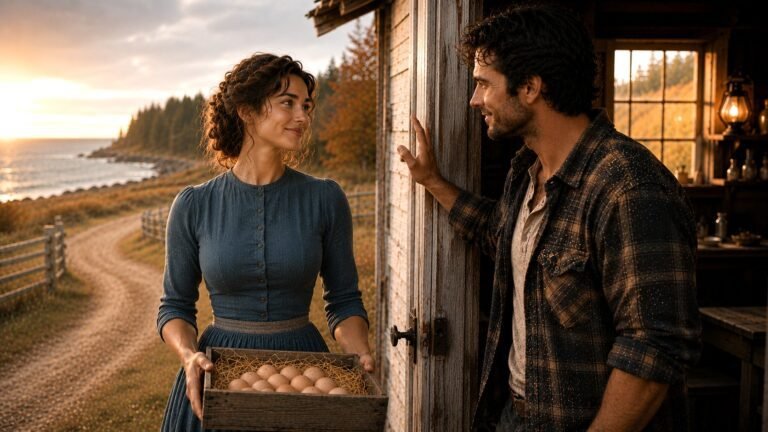
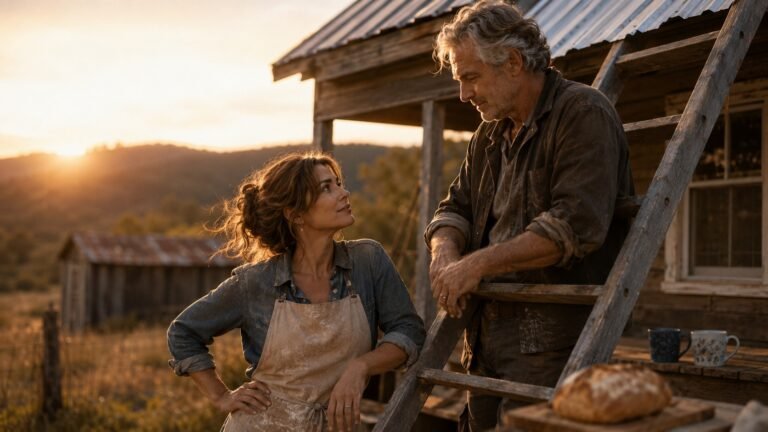
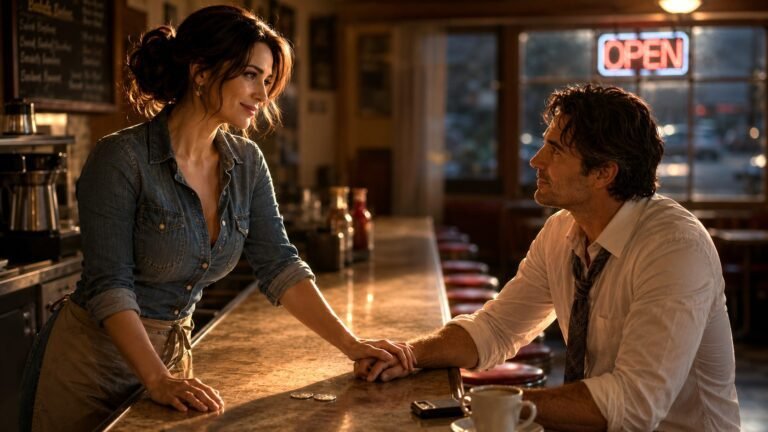
Heartfelt characters sharing love, emotions, and romantic journeys filled with hope, trust, and unforgettable bonds