
The bell hung from a length of baling wire on the north gate, and Wyatt Sallis touched it every morning before he touched anything else — before coffee, before the dog, before the sky told him what kind of day it meant to be. He’d cup the small brass dome in his palm and give it half a turn, just enough to hear the clapper answer, a single dull note swallowed almost at once by all that country. Then he’d let it go and walk on to the barn like a man crossing something off a list.
The ranch sat forty miles from Alpine in country that didn’t apologize for itself — creosote and ocotillo, a rind of mountains blue and jagged at the edge of everything, and grass that came in thin as a rumor most years and had come in thinner every year since the rains stopped meaning anything you could plan around. He ran what cattle the land would carry, which was fewer every season, and he told himself this was simply arithmetic, nothing more. Rain, grass, cows. A man could live a long time inside numbers like that and never once be asked to feel anything about them.
He was forty-four years old and had not slept through a night without waking at least once to listen for something in three years.
The habit had started small. A hook by the back door where he began hanging his keys so he’d hear them jingle if anyone lifted them off in the dark. A creak he left unfixed on the third porch step on purpose, because a fixed step was a step that let you come and go without saying so. The bell on the gate had come last, the winter after Dorothy, when he noticed he’d started waking at four in the morning from dreams where he was running toward a sound he couldn’t place, and he understood finally that what he wanted, plainly and simply, was never again to be in a house with someone and not know the moment they left it.
She had not left in any way a man could rightly resent. She had gone quietly, in her sleep, her heart just declining to continue its long correspondence with the rest of her, and he had woken at six as he always did and reached for her the way he always did and found her already cool. There had been no gate to swing, no door to slam, no truck engine turning over in the dark to warn him. She had simply, silently, without asking his opinion on the matter, stopped being there. He had spent three years since trying to build a house that would not let that happen to him twice, not understanding, or not letting himself understand, that no bell in the world rings for the kind of leaving that comes from inside a person’s own chest.
He fed the horses by feel, mostly, the sun not yet up over the Del Nortes, breath showing pale in the cold that always came before a Big Bend dawn no matter what the day would turn into by noon. The barn smelled the way it had always smelled — sweet feed, old leather, the ammonia bite of the stalls he hadn’t mucked yesterday because his knee had been bad — and there was a comfort in that, in a smell that didn’t change even when everything under it did. He ran his hand along the rump of the gray mare, an old habit of his father’s, a way of saying I’m here, don’t kick without using words that might mean more than they needed to.
The dog, a blue heeler named for no particular reason Scout, fell in at his heel and did not leave it, not once, not for the whole circuit of feeding and checking water and glancing over the fence line where it sagged along the arroyo. Wyatt had come to depend on the dog’s nearness the way another man might depend on a radio playing in the next room — not for anything it said, but for the fact of it being there, uninterrupted, a small continuous proof that the world had not yet gone silent on him.
At the house he made coffee in a pot that had been his mother’s, the enamel chipped down to gray tin at the handle, and he drank it standing at the window over the sink because he had never once, since Dorothy, sat down to a table that had two chairs pulled out from it and only used the one. He left post office in Alpine, twice a month, grocery in town, twice a month, and otherwise the ranch was the whole of his conversation. He talked to the cattle sometimes, low, the way you’d talk to something you didn’t want startled. He did not talk to himself. He was careful about that particular line.
The land that summer had gone the color of an old bruise, tan going to purple in the far hills, and the stock tank was down two feet from where it ought to have stood in a decent year. He’d been watching the sky for three weeks the way another man might watch a woman across a room, waiting for some sign it intended to come toward him, and getting nothing but a high hard blue that never once broke into cloud. He knew, the way ranchers always know these things without wanting to say them aloud, that if it didn’t rain by August he’d be selling cows he couldn’t afford to sell and buying feed he couldn’t afford to buy, and that the arithmetic he’d built his whole quiet life around was about to ask more of him than he had.
He didn’t pray, exactly, standing at that window. But he looked at the sky the way a man looks at something he has stopped expecting anything from, and some old unkillable part of him kept looking anyway.
He went out to check the truck’s oil before he drove the fence line, and that was when he heard, from somewhere down the county road, an engine working too hard for the grade it was climbing, and a sound under it that had no business being under any engine at all — a knock, deep and arrhythmic, the sound of something about to quit for good.
He didn’t think much of it. Trucks broke down on that road with some regularity, ranch hands and oil men and the occasional lost tourist who’d taken a wrong turn off the highway believing their phone knew this country better than the country knew itself. He finished with the oil, wiped his hands on the rag that lived permanently in his back pocket, and told himself, the way he told himself most mornings, that whatever needed him today would find him without his going looking for it.
He did not know yet that something already had.
The truck came into view around the bend below his mailbox trailing a thin gray ribbon of smoke and dying by degrees, the way an animal dies when it’s decided the fight isn’t worth the trouble anymore, and it rolled the last thirty yards on nothing but its own stubborn momentum before it gave up entirely in the gravel turnout at the base of his drive.
Wyatt watched from the porch, one boot up on the rail, Scout gone stiff-legged and alert beside him.
The door of the truck creaked open on a hinge that wanted oil worse than the engine did, and out stepped a woman in a hat that had seen better decades, a shirt gone soft and colorless from washing, and boots that had been resoled at least once by somebody who knew what they were doing. She stood a moment with her hands on her hips, looking at the smoke coming up from under the hood the way a person looks at a horse that’s just told them, in no uncertain terms, exactly how the rest of the day was going to go.
“Well,” she said, to nobody, to the truck, to the whole indifferent sky, “that’s that, then.”
She popped the hood without much hope in her shoulders and stood back from the steam that came up off the radiator, and Wyatt found himself already walking down the drive before he’d made any decision to do so, Scout trotting ahead of him like the dog had decided this on both their behalfs.
“That’ll be your water pump,” he said, when he was close enough not to have to shout it. “Or your radiator hose. Sounds like both, way it was knocking.”
She turned, and up close she was younger than her clothes had suggested from the porch, maybe thirty, with a sunburn across the bridge of her nose that said she didn’t spend much time thinking about shade, and eyes the pale, weathered gray-green of creosote after rain. She looked at him the particular way a person looks at someone they’ve decided, on no evidence at all, they can afford to be a little bit honest with.
“Sounds like my truck’s about to become somebody’s parts truck,” she said, “is what it sounds like.”
“You headed anywhere in particular?”
“Headed generally north,” she said, which was not an answer and both of them seemed to understand that it wasn’t. “There any work around here? Fence work, cattle work, don’t much matter. I’m decent with a come-along and I’ve never met a heifer that didn’t eventually see things my way.”
He looked at her a moment longer than the question required. There was a hollowness to her that had nothing to do with hunger exactly, though he’d have bet money she was hungry too — a hollowness more like a house that’s been lived in hard and left standing anyway, walls that had learned to hold weight they were never built for. He recognized something in it, though he couldn’t have said what, only that it made him less inclined to send her on toward whatever generally north was supposed to mean.
“I’ve got fence needs mending,” he said. “Whole stretch of it along the arroyo. Pay’s not much but there’s a bunkhouse, and it’s got a roof that doesn’t leak, which is more than some can say.”
“I don’t need charity,” she said, quick, before he’d even finished the offer, the words coming out with an edge that told him this was a line she’d drawn a long time ago and drawn deep.
“Wasn’t offering any,” Wyatt said. “I’m offering wages for fence work, same as I’d offer any hand. Whether you take it’s your business.”
Something in her face eased at that, just barely, the way a fence wire eases when you finally get the stretcher off it right.
“Name’s Etta,” she said, and put out a hand that had calluses in all the right places, a hand that told its own history without needing help from her mouth.
“Wyatt.” He shook it. Her grip was sure, unhesitating, and warm despite the cool of the morning, and he felt that warmth travel up his arm and settle somewhere behind his sternum in a way he immediately distrusted.
They stood a moment not saying anything, the smoke thinning out from under her hood, the dog sniffing hopefully at the hem of her jeans until she reached down without looking and scratched behind his ears in exactly the spot that made his back leg thump, and Wyatt watched that unthinking kindness pass between the woman and the dog and felt something in his chest shift a half a degree off whatever course it had been running for three straight years.
“Your dog’s got opinions,” Etta said.
“Everybody’s got opinions about you inside of ten seconds,” Wyatt said. “Never met a soul that dog didn’t have a verdict on.”
“And what’s his verdict?”
“Jury’s still out. He generally takes his time.”
She looked down at Scout, who had, in point of fact, already flopped over onto his back in the gravel and offered his belly up to her like a wager already settled, and a laugh came out of her before she seemed to have decided to let it, short and surprised, like something that had gotten loose before she could stop it.
“Don’t look like it’s still out to me,” she said.
“No,” Wyatt admitted, and felt his own mouth do something it hadn’t done in longer than he wanted to reckon with. “Don’t look like it is.”
He told her he’d have somebody come tow the truck into Alpine, that the bunkhouse had two cots and clean linens if she wanted to choose the one nearer the window, that supper was at six and she was welcome to it whether she’d earned it yet or not. She thanked him with a formality that didn’t match the dust on her boots, a carefulness, like gratitude was a debt she intended to pay back in full and didn’t like owing even for an afternoon.
He walked back up the drive with the dog trotting between them, and didn’t look back, though he could feel, the whole way up, the specific and unfamiliar sensation of being watched by someone who had not yet decided what she thought of him — and the stranger sensation, underneath that one, of finding that he minded, more than he’d have guessed that morning, what her verdict turned out to be.
She stayed a week that turned into two turned into a month without either of them naming the accumulation as anything other than fence work and fair wages, though both of them understood, in the private accounting each of them kept and showed to no one, that it had become something with a great deal more architecture to it than that.
She was good with the wire, better than good, and she worked in a silence that matched his own so exactly it was almost eerie, the two of them moving along the arroyo fence some mornings and getting a quarter mile done between them without either one offering more than hand me that stretcher or watch that post, it’s rotted at the base. He found he didn’t mind the quiet the way he minded it alone. Hers had a different weight to it. Alone, his silence was a room with the furniture taken out. Beside her, it felt more like a held breath — full, waiting, going somewhere.
She ate supper with him most nights at the table that had two chairs, and for the first time in three years both of them got used.
“You always eat standing up before I got here?” she asked once, watching him settle into the chair across from hers with the particular stiffness of a man relearning a motion his body had unlearned on purpose.
“Didn’t see much point in sitting,” he said, “eating alone.”
She didn’t press it, and he was grateful for that more than he let on, because there were things under that sentence he wasn’t ready to hand her yet, and she seemed, without his ever having to ask, to know exactly how far into a man’s silence she was welcome and where the fence line of it stood.
She talked, when she talked, in a roundabout way that circled its own center without ever quite landing on it — a mother who hadn’t stayed, a string of ranches from Uvalde to Odessa where she’d worked a season and moved on before anybody could get too used to the shape of her in a doorway, a way of describing a place she’d left that never once mentioned why she’d left it. Wyatt noticed the shape of what she wasn’t saying the way he noticed a fence post leaning wrong — not the post itself, but the tension it was failing to carry.
“You ever think about staying somewhere?” he asked her one evening, both of them out on the porch step after supper, the sky doing the long slow purple thing it did out there when the heat finally let the day go.
“Staying’s a good way to find out how long somebody’s patience runs,” she said, looking off at the mountains instead of at him. “Better to move on before you find out.”
“That’s a lonesome way to run a life.”
“Lonesome’s got a roof that don’t leak on it, though,” she said, and there was something almost like a joke in the way she said it, except it wasn’t, not really, and he understood that too, the way you understand weather coming before the sky’s committed to anything.
He thought about the bell on the gate and did not tell her about it, though she’d asked once, early on, nodding toward it while they walked the horses in.
“What’s that for?”
“Habit,” he’d said, which was true and also nothing, and she hadn’t pushed, only looked at it a moment longer than the answer required, filing it away the way he suspected she filed away most things — carefully, and for later, and never mentioned again until it mattered.
There was an evening in the second month when a storm finally broke over the Del Nortes, real rain, the kind that came sideways and smelled like creosote and hot dust turning to mud all at once, and the two of them stood under the barn overhang watching it come down in sheets across the pasture, close enough that her shoulder brushed his and neither of them moved away from the touch of it.
“Been waiting on this a long while,” Wyatt said.
“I know it,” Etta said, and something in the way she said it made him understand she wasn’t only talking about rain, and something in him, standing there with the water coming down loud enough to cover whatever either of them might have said next, decided not to ask her to clarify, because he wasn’t sure, if she answered honestly, that he was ready yet to answer honestly back.
She reached out at one point and caught a stream of water coming off the eave in her cupped palm, held it there a second like she was weighing it, then let it go, and Wyatt watched her do it and felt something in his chest that he recognized, with something close to dread, as wanting — plain, unhidden, the kind of wanting he’d spent three careful years making sure he’d never have to feel the loss of again.
“You’re staring,” she said, not looking at him, a small smile pulling at one corner of her mouth.
“Didn’t say I wasn’t.”
She laughed then, that same startled sound from the first day, and reached over without a word and took his hand, just held it, out there under the overhang with the rain coming down loud enough to drown out anything either of them might have felt obliged to say about it, and Wyatt let her, and did not let go first, and understood, standing there, that some fence he’d built a long time ago had just come down a wire at a time without his ever quite noticing the stretcher loosen.
Neither of them said the word that belonged to what was happening. It sat between them at supper, in the quiet on the porch step, in the particular way she’d started leaving her boots by his door instead of the bunkhouse’s, unnamed and enormous, the way weather is enormous before it’s given a season to belong to.
“You ever gonna tell me about that bell?” she asked him one night, weeks into it, both of them lying in the dark with the window open to the sound of the cattle settling.
He was quiet long enough that she must have thought he wasn’t going to answer.
“Lost somebody,” he said finally, “who left without my hearing it. Been making sure ever since that I would.”
She didn’t say anything to that for a while, and he thought maybe he’d said too much, handed her more of himself than the moment had asked for. Then he felt her hand find his in the dark, the same sureness in it as that first handshake, and she said, quiet, “I don’t leave loud, Wyatt. Never had cause to. Nobody ever asked me to stay long enough for it to matter how I went.”
He turned that over a long while after she’d fallen asleep, the particular architecture of a fear that looked, from the outside, so unlike his own, and was, underneath, built from the exact same lumber — two people who had each decided, separately, in different country, under different skies, that the safest thing a person could do with their heart was to keep it moving before anybody got the chance to leave it standing alone in a room.
It was a Tuesday, unremarkable by every measure except the one that mattered, when Wyatt came in from checking the tank levels and heard her voice through the screen door before he saw her, low and urgent on the bunkhouse phone, words carrying across the yard in fragments the way words do when the wind’s decided to be unhelpful about it — can’t stay past the season and never do, you know that and don’t get attached to a place, that’s the whole trouble with attached.
He stood at the edge of the porch with the water bucket still in his hand and felt something in him go very still and very cold, the specific stillness of a man who has just heard, with his own ears, the exact sentence he’d spent three years building bells to warn him against.
He didn’t wait to hear the rest of it. He didn’t ask her, that night at supper, who she’d been talking to, or what season she meant, or whether don’t get attached had been advice given or received. He told himself, walking back to the house, that he already had his answer, that he’d been a fool to let the wire down as far as he had, that a man his age ought to know better than to mistake a good month for a permanent weather pattern.
What he didn’t let himself hear — because to hear it would have meant admitting the bell had failed him after all, that the very warning system he’d built his whole guarded life around was still, in the end, no match for the ordinary human habit of assuming the worst of a voice overheard in fragments — was that Etta had been on the phone with a woman two ranches over who’d offered her steady work come fall, and that Etta had turned it down flat, and that the sentence about attachment had been the reason she’d given for turning it down, not a warning aimed at him but a wall she’d been quietly, privately, dismantling on his behalf without telling him, because she hadn’t yet found the nerve to say the larger thing underneath it.
He went quiet at supper that night, quieter than his ordinary quiet, a quality to it she felt the way you feel a front coming in before the sky’s shown you a single cloud.
“Something wrong?” she asked.
“Nothing wrong,” he said, which was the first outright lie he’d told her, and it sat in his mouth like a stone.
He pulled back after that, not all at once — he wasn’t cruel, and cruelty wasn’t in him even here, even scared — but by degrees, the way a man pulls a hand back from a stove before he’s fully certain it’s hot, testing the withdrawal, unable to stop it once it had begun. He found reasons to ride fence alone that he’d have asked her along for a week before. He let the silences between them go from full to empty again, the furniture going back out of the room one piece at a time. He did not touch the bell any less often — if anything he touched it more, mornings, a longer pause at the gate, his palm staying against the brass a beat past what the habit required, as though he could squeeze some earlier warning out of it now, retroactively, for a leaving that hadn’t happened yet and that he’d already, somewhere in the locked room of himself, decided was coming.
Etta felt the door of him closing and did what the whole architecture of her life had trained her to do when a door began to close — she stepped back from it first, gently, before it could shut on her outright. It was not cowardice, though it felt like something close to it, days later, alone. It was the oldest reflex she owned: better to be the one already walking than the one found, again, standing in a doorway that somebody else had quietly decided to stop holding open.
She finished the fence line that week, every wire she’d been hired to mend, tight and true and better work than the job had strictly required, and on Friday morning she left an envelope of cash on the kitchen table — wages she hadn’t earned yet, paid back in full, the debt she would not carry — and drove off in a truck that had been fixed and returned to her a month before, and Wyatt heard the engine on the county road from the porch and did not go out to the gate to listen for the bell, because there was no bell out there, only the ordinary sound of a truck getting smaller, and smaller, and gone.
He stood in the kitchen a long time afterward looking at the two chairs pulled out from the table, and did not sit in either one.
The month that followed sat on the ranch like weather that wouldn’t break. Wyatt went back to the habits he’d built to survive Dorothy — the bell each morning, the keys on the hook, the porch step left creaking — but they’d gone hollow on him in a way he hadn’t expected, rituals performed by a body that no longer believed in what they were meant to prevent, because he understood now, with a clarity that cost him sleep, that the leaving he’d spent three years guarding against had never been the kind that made a sound. It was the kind a man made himself, quietly, by stepping back first.
He caught himself standing at the sink some mornings, coffee gone cold in his mother’s chipped pot, looking out at a stretch of fence that didn’t need checking, and understanding, in the plain unglamorous language a working man uses on himself when there’s no one else to overhear it, that he had done to Etta the exact thing that had been done to him — he had let a silence stand in for a truth, and called the silence safety, and it hadn’t been safety at all. It had been the same cowardice wearing a rancher’s hat.
Scout took to lying by the bunkhouse door some evenings, ears up at nothing, and Wyatt would find himself standing in the yard watching the dog do it and feel the particular ache of a body keeping vigil for something it had no evidence would ever return.
He drove the fence line the day after she left and found, near the last stretch by the arroyo, a section of wire mended so well it looked like it had never been broken at all, and he stood there a long while with his hand on the post, feeling the tightness of the wire under his palm, and understood that he was not looking at fence. He was looking at the last honest thing a person had left him, built with her own hands, asking nothing back.
He thought about the phone call he’d overheard, turned it over enough times in the weeks that followed that the fragments finally rearranged themselves into something closer to what they’d probably meant, and felt something in his chest that was not quite hope and not quite regret but occupied the same country as both.
Three weeks after she’d gone, he drove into Alpine on ordinary business — feed, mail, a part for the tractor — and heard, from the girl behind the counter at the feed store, that there was a woman doing fence work out at the Kessler place, quiet sort, good with a come-along, didn’t talk much about herself.
He stood in the parking lot afterward with the truck door open and the key in his hand a long while before he got in.
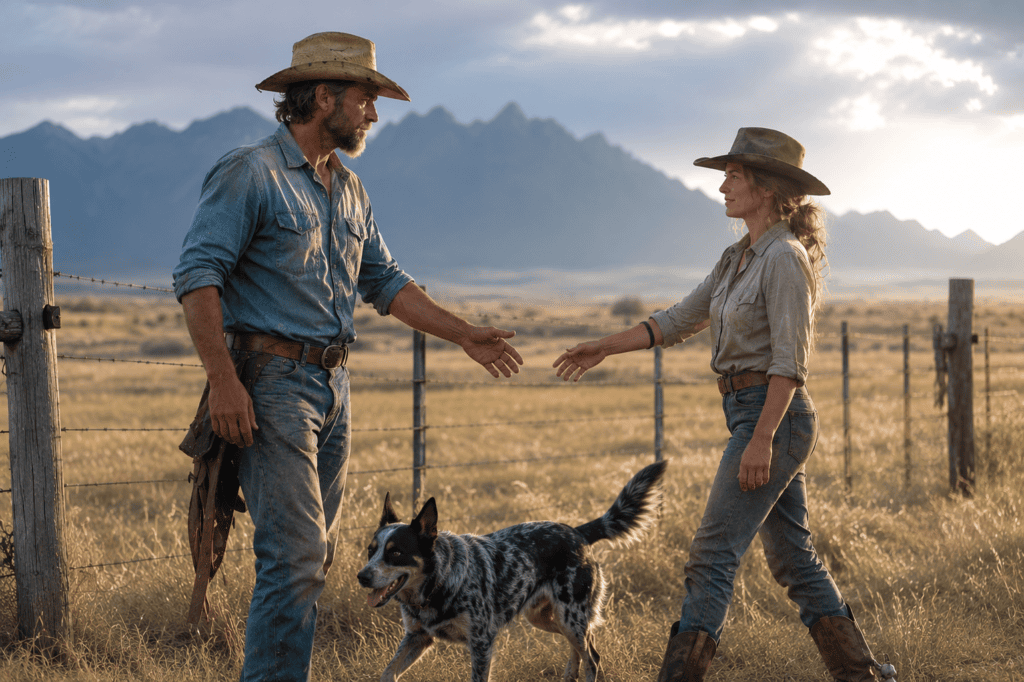
He drove out to the Kessler place at an hour that gave him no good excuse for being there other than the true one, and found her exactly where the girl had said, out along a stretch of fence in the flat gold light of late afternoon, hat pulled low, moving down the wire with the same economical patience he remembered, like she’d never once left off the habit of it.
He got out of the truck and stood by the gate, and Scout, who he had not planned on bringing and had brought anyway, went straight past the gate and across the pasture toward her at a dead run, and Etta looked up from her work and went very still, the stretcher hanging loose in her hand.
She let the dog reach her, let him circle and whine and flop over in the dirt in front of her exactly as he had the first day, and only then did she look past him, up the fence line, to where Wyatt stood at the gate not coming any closer, waiting to see whether he’d be let to.
Neither of them said anything for a long moment, the wind moving the grass between them, the sun going long and orange over the Del Nortes the way it did on evenings that had decided, finally, to be kind about something.
“You drive all this way to check my fence work?” she said finally, and there was an edge in it, but not a hard one — more like a hand held out to see if it would be taken.
“Drove all this way,” Wyatt said, “because I heard a rumor there was a good hand working the Kessler place, and I got to thinking I’d been a damn fool about the last one I had.”
She set the stretcher down slow, deliberate, the way you set down a tool when your hands have decided to be honest before your mouth has caught up.
“I don’t have much to say for myself,” she said. “Never did. Leaving quiet’s the only kind of leaving I ever learned how to do.”
“I know it,” Wyatt said. “Same as I never learned but the one kind of listening — for the leaving, not the staying. Spent three years building a whole life around hearing the door before it shut. Didn’t once think to build anything for hearing somebody stay.”
She looked at him a long moment, something moving behind her eyes that he couldn’t yet name and didn’t try to.
“I have nothing to offer you,” she said, and her voice caught a little on it, plain and unguarded in a way he hadn’t heard from her before, not even in the dark with her hand in his. “Truck’s held together with baling wire same as everything else I own. Never had a place long enough to call it mine. Don’t know how to stay somewhere without waiting for the day I have to leave it.”
“You have the kindest heart in Texas,” Wyatt said, and it came out of him plain, unrehearsed, the truest sentence he’d built in three years, “and that’s worth more to me than every acre I’ve got. I’m not asking you to have something to offer. I’m asking you to stay long enough to find out you already do.”
She didn’t answer that right away. She reached into the pocket of her work shirt instead, and Wyatt watched her fingers close around something small, and she crossed the last of the distance between them and held it out on her open palm — the brass bell from his north gate, the one he hadn’t noticed missing until this exact moment, its baling-wire hanger still looped through the eye of it.
“Took it the morning I left,” she said. “Didn’t rightly know why at the time. Thought maybe I just wanted something of yours to carry. Now I think maybe I took it so you’d finally have to build something else to listen for.”
Wyatt took the bell from her hand, the metal warm from her pocket, and turned it once between his fingers, and then, instead of pocketing it, he knelt and looped the wire through the buckle of her boot, low near the ankle, working the twist tight and sure the way he tied off any wire that needed to last.
“There,” he said, standing, dusting his knee off against his palm. “Now you can’t so much as cross a room without me hearing you come.”
Etta looked down at the small brass shape sitting against the leather of her boot, catching the last low gold of the sun, and when she took her next step toward him, deliberate, unhurried, the bell gave a small clear note into the wide quiet evening — not a warning this time, not a thing rung to guard against a leaving, but a sound made simply because she had chosen, of her own will and her own weight, to walk toward him instead of away, and Wyatt Sallis stood in the gold light with the dog circling their ankles and listened to that single note travel out over the grass and thought that it was, without any argument left in him, the finest sound he had heard in three long years.