
The salt marsh town of Egret’s Landing smelled of brine and diesel and something sweeter underneath — bruised figs falling from the trees behind the fish market, rotting slow and gold in the September heat. Eleanor Whitfield Cross had never smelled anything like it. Boston smelled of coal smoke and wet stone. This smelled like a wound that was somehow also a blessing.
She stood at the edge of the public dock in a traveling suit the color of unripe plums, watching a heron pick its way through the shallows with the unhurried confidence of something that had never once had to answer to anyone. She envied it thoroughly.
It was 1949, and she was thirty-one years old, and she was, by any measure that mattered to the people she had left behind in Massachusetts, a catastrophic success. Her late husband’s shipping interests had made her one of the wealthiest widows on the Eastern Seaboard. She had a house with a ballroom she had entered perhaps four times. She had a staff who called her Mrs. Cross with the particular gentleness people use with the very rich or the very sick, and she had begun, in the eighteen months since Walter’s funeral, to suspect she might be both.
She had come to Egret’s Landing because a lawyer in Savannah had mentioned it in passing — some old family land, a parcel her father had owned before the crash and never sold, tucked along the tidal creek at the edge of town. She had told her household she was going to see about the deed. In truth she did not care about the deed. She had simply wanted, for the first time in a decade, to go somewhere no one knew her name.
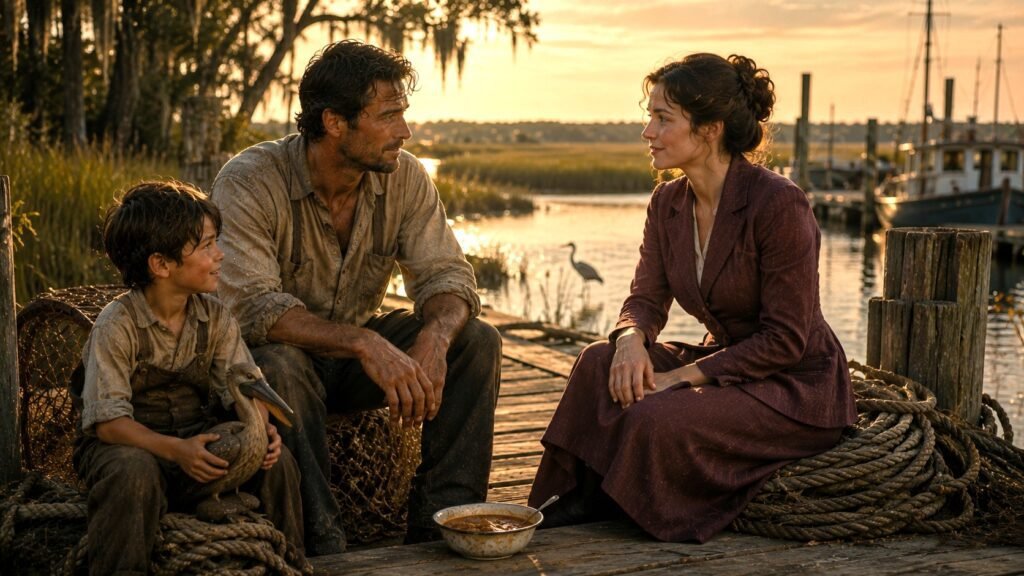
That was how she came to be standing on a splintered dock at dusk, watching a man share a single bowl of gumbo with his son.
He was crouched on an overturned crab basket, and the boy sat across from him on a coil of net line, and between them was one chipped enamel bowl and one spoon, passed back and forth with a rhythm so practiced it had the quality of liturgy. The man would dip the spoon, taste barely enough to know the food existed, and hand it across. The boy would eat properly — a real mouthful, rice and broth and a curl of shrimp — before passing it back.
The man was broad through the shoulders in the particular way of men who worked with their hands against resistant things — wood, rope, iron. His forearms were latticed with old scars, pale seams against sun-brown skin, the kind of marks that told a story about fishhooks and rope burn and knife-work done too fast in bad light. He wore a canvas shirt gone soft and colorless from a thousand washings. The boy, seven or eight, had his father’s same dark, watchful eyes and a gap where a tooth had recently gone missing.
Eleanor had not meant to stop. She told herself that later, and it was even partly true. But something about the unhurried tenderness of it — a man giving away the better half of almost nothing — reached backward through fifteen years of dinner parties and boardrooms and closed over her like water.
It reminded her of her father. Before the mills failed. Before the money came back different — colder, with strings she hadn’t chosen attached to it. She remembered being six years old on the porch of a house that no longer existed, splitting a peach with her father because there had only been one, and neither of them minding.
The boy saw her first.
“Daddy,” he said, tugging his father’s sleeve, eyes wide on her plum-colored suit. “Is she a movie star?”
The man looked up. His eyes were a deep, unreadable brown, steady in a way that made her feel, absurdly, as though he already knew several things about her that she had not said aloud. He did not stand. He did not perform surprise or deference the way men in her circle did when they registered what her clothes were worth.
“She’s just a lady standing on a dock, Micah,” he said. Then, to her, with no particular warmth and no particular coldness either: “Evening, ma’am.”
“Good evening,” Eleanor said. Her voice came out smaller than she intended. “I’m sorry — I didn’t mean to stare.”
“Most folks who dress like you don’t stare at folks who dress like us.” There was no bitterness in it. Just an observation, offered plainly, the way he might have noted the tide was going out.
“Most folks who dress like me,” Eleanor said, surprising herself, “have forgotten how to look at anything worth looking at.”
Something shifted in his face — not quite a smile, but its foundation. “Caleb Reyes,” he said. “This is my boy, Micah.”
“Eleanor.” She did not give her surname. She was not ready, yet, for the weight of Cross to land on this dock and change the way he looked at her.
Micah scooted over on the net coil, making room with the unthinking generosity of a child who has not yet learned that space, like everything else, can be a transaction. “You can sit,” he said. “We don’t got another bowl, but you can have some of mine.”
Caleb’s jaw tightened, almost imperceptibly — the look of a proud man watching his son offer away the little they had. But he didn’t correct the boy. He only said, quiet: “It’s a public dock, ma’am. You’re welcome to the company, even if the supper’s thin.”
Eleanor sat down on a coil of net that smelled of tar and salt, in her plum-colored suit, and understood that something in her life had just quietly, irreversibly begun.
She did not tell him, that first evening, about the fire that had taken her father’s cotton warehouses in 1929, six months before the crash finished the job the fire started. She did not tell him about the man who had come from nowhere — an anonymous buyer, some agent had said, who purchased the family’s last unmortgaged acreage for twice its worth when even vultures wouldn’t touch it, and vanished before her father could learn his name or offer his thanks. She did not tell him that her father had spent the rest of his life a changed man — humbled, grateful, and forever unsettled by a debt he could never repay — and that when he died, he left Eleanor not just his rebuilt fortune but a strange, aching restlessness, an inherited need to understand a kindness she hadn’t witnessed.
She only told Caleb, as the light went copper and then violet over the marsh grass, that she had lost her husband, and that Boston had become a house full of furniture she didn’t recognize.
He told her, in turn, almost nothing. That he mended nets and repaired shrimp boat hulls for half the fleet in Egret’s Landing. That his wife, Naomi, had been gone three years now — a fever that took hold during a wet, miserable spring and never let go. That he and Micah made do.
“Made do,” Eleanor repeated. “That’s a very small phrase for a very large thing.”
Caleb looked at her for a long moment, the kind of look that seemed to weigh whether she deserved the truth or only the performance of it.
“Some things don’t get bigger words,” he said. “Making do is the whole art of it. You learn to want less than you need, and you thank God for the difference.”
Micah, half-asleep against his father’s arm by then, mumbled something about the wooden pelican he was carving, and how he’d give it to Eleanor when it was finished because pelicans were good luck and she looked like she could use some.
Eleanor laughed — a real laugh, unrehearsed, the first one in longer than she could accurately say — and did not go back to her hotel until the mosquitoes drove her off the dock past ten o’clock.
She stayed in Egret’s Landing. She told herself it was the deed, the land, unfinished business with the lawyer in Savannah. The lawyer, when she finally called him, sounded faintly bewildered that the matter required a second visit.
What it actually required was watching Caleb Reyes work.
She began coming to the dock most evenings, sometimes with a basket from the general store — good bread, a wedge of cheese, a jar of preserved peaches — set down without ceremony, as though it had simply appeared. She learned not to make a show of giving. She learned that a woman with Eleanor’s kind of money could do real damage with careless generosity, the way a bull does damage in a shop it never meant to enter. Caleb would eye the basket sometimes with the particular suspicion of a man who had been condescended to by wealthier people before. But he never turned the food away, not with Micah watching, and slowly, over weeks, the suspicion softened into something like trust.
She learned the rhythm of his hands at work — the way he sewed a torn net with a wooden needle called a shuttle, fingers moving faster than she could follow, the pale twine passing in and out until a hole the size of her fist disappeared into a lattice as tight as lace. She learned that he hummed low in his throat when he was concentrating, something tuneless and private, and that he stopped the moment he noticed her listening.
She learned that Micah collected shark teeth from the tide line and kept them in a cigar box, that he was teaching himself to read from a stack of dog-eared adventure novels a schoolteacher had given him, that he asked Eleanor questions about Boston with an appetite that made her ashamed of how little she’d appreciated having it.
And she learned that Caleb Reyes watched her with the same unhurried attention he gave a hull he was assessing for rot — patient, thorough, unwilling to be rushed into a verdict.
“You’re not from around any water I know,” he said to her one evening, watching her attempt, badly, to coil a length of line the way he’d shown her. “Not the way you hold yourself. Careful. Like you’re expecting the ground to give out.”
“I suppose I am,” Eleanor admitted. “Where I come from, the ground has a way of giving out. Usually right when you’ve stopped watching for it.”
“And here?”
She considered the marsh grass turning gold in the last light, the tide sliding in over the mudflats with a sound like a long, patient sigh. “Here I keep waiting for it. It hasn’t happened yet.”
Caleb’s hands went still on the net. “Maybe you’re standing on better ground than you’re used to,” he said, and did not look at her when he said it, and she understood, with a small internal lurch, that this was as close as he was likely to come to telling her something true about how he felt.
The trouble, when it came, arrived in a car too clean for the dirt roads of Egret’s Landing, and it wore the shape of a man named Reginald Voss.
Eleanor knew him from Boston — a man who had made a second fortune buying up drowning businesses at the exact moment they went under, and who had, on more than one occasion, made his interest in Eleanor’s late husband’s shipping lanes plain in ways she found faintly nauseating. He arrived at the dock on a bright Thursday afternoon in a linen suit, trailing the smell of bay rum, and found her sitting cross-legged on an overturned crate, laughing at something Micah had said, with fish scales on the hem of her skirt.
“Eleanor.” His voice carried the particular horror reserved for finding something precious in an unsuitable location, like a diamond found in a gutter. “My God. What is this?”
Caleb straightened slowly from his workbench, wiping his hands on a rag, saying nothing.
“Reginald,” Eleanor said, and felt the old Boston coldness settle over her voice like a coat she hadn’t wanted to put back on. “What brings you to Georgia?”
“Business, obviously, though I begin to think I ought to have come sooner, given the company you’re keeping.” His eyes moved over Caleb with the flat, cataloguing contempt of a man assessing livestock. “You there — Reyes, is it? — do you have any notion who you’ve been entertaining on your little dock? This woman could purchase your entire shrimp fleet, this town, and the mud it’s sitting on, and not notice the expense at dinner.”
“I know who she is,” Caleb said. His voice was even, but Micah had gone very still beside him, and Eleanor saw Caleb’s hand settle, light and instinctive, on his son’s shoulder. “She’s a woman who sat down at my table when she didn’t have to. I don’t need to know the size of her bank account to know that much.”
“How touching.” Voss’s mouth curled. “She’s a philanthropist, then, in her spare time. Slumming for her soul’s sake.” He turned to Eleanor. “Darling, I understand grief does strange things, but this is beginning to embarrass people who care about you.”
Something in Eleanor went very quiet and very hard, the way still water goes hard just before it freezes.
“The people who care about me,” she said, “have never once required an audience with my accountant to prove it, Reginald. This man fed his son before himself for a month of evenings I witnessed personally, and never once asked me for a dime. You flew four hundred miles to insult him in front of his child. I would ask you to consider which of you has embarrassed me today.”
Voss’s smile thinned into something uglier. He turned it, finally, fully on Caleb. “Careful, fisherman. Women like her collect strays for a season and then remember who they are. You’ll be a very entertaining anecdote at her next dinner party.”
Caleb didn’t raise his voice. He didn’t need to. “I’ve been called worse by better men than you, standing over worse fires than this one,” he said. “You can go on back to wherever it is men like you come from. My son’s had enough of your talking.”
Voss looked, for just a moment, uncertain — the particular uncertainty of a bully who has met a wall instead of a flinch. He recovered it into a sneer, tipped his hat with exaggerated courtesy toward Eleanor, and walked back to his too-clean car, and did not return to Egret’s Landing again.
But something had cracked open in the silence he left behind. Micah, badly shaken, pressed his face into his father’s side. Caleb held him, and over the boy’s head, his eyes met Eleanor’s with an exhaustion that went deeper than the afternoon.
“Men like that will use you to get at anyone standing beside you,” he said quietly, once Micah had calmed. “I can carry his contempt. I’ve carried worse. But I won’t have my boy learning he deserves it.”
“He doesn’t,” Eleanor said. “Neither do you.”
Caleb studied her for a long moment, the last of the day’s light catching gray in hair that hadn’t been gray a year ago, grief and work having aged him faster than his years. “Thank you for what you said to him,” he said finally. “But maybe you ought to think on whether this is a life you want dragged into yours. It’ll cost you people like him. It already has.”
“Reginald Voss,” Eleanor said, “was never people I wanted.”
It was three days later, sorting through her hotel room for a handkerchief before a walk along the tideline, that Eleanor’s hand closed on something she had carried for eleven years and had, in the strange gravity of Egret’s Landing, almost managed to forget.
It was a receipt, brittle and gone the color of weak tea, folded so many times the creases had worn soft as cloth. She had found it among her father’s papers after his death, tucked into a Bible he rarely opened — a bill of sale for the last of the Hargrove land, dated the autumn after the warehouse fire, paid in full by a buyer whose signature was two initials and nothing more: C.R. Beneath the initials, drawn in the same brown ink, was a small, careful mark — the outline of a fish hook, curved and precise, like a man’s private seal.
She had traced those letters a thousand times over the years, hiring investigators who found nothing, writing to banks long since dissolved, chasing a ghost through two states and three decades. She had never once considered that the ghost might mend nets for a living forty feet from where she’d been sitting every evening for a month.
C.R.
Caleb Reyes.
Her hands were shaking so badly she nearly tore the paper reaching for her coat.
She found him at the forge behind the boatyard — not a blacksmith’s forge exactly, but the small fire and anvil he kept for shaping hardware, fixing fittings, doing the iron work no one else in Egret’s Landing knew how to do. The evening air smelled of coal smoke and hot metal. Micah sat nearby on a stack of burlap sacks, absorbed in his adventure novel, a shark tooth serving as a bookmark.
“Daddy, the movie star’s here,” he said without looking up, which made Eleanor laugh despite the tremor still working through her chest.
Caleb turned from the anvil, hammer loose in his hand, and something in her face made him set it down entirely.
“Eleanor. What’s happened?”
She held out the receipt. Her hand was not steady. “I need you to look at this,” she said. “I need you to tell me I’m wrong.”
He wiped his palms on his apron and took the paper with the careful reverence of a man who understood, instinctively, that it mattered before he’d read a word of it. His eyes moved down the page. She watched his face change — watched thirty years drop away from it and then settle back, heavier.
“Where did you get this,” he said. It wasn’t quite a question.
“It was my father’s. Elias Hargrove. He owned cotton warehouses outside Savannah, before the crash. There was a fire in ’29. It took nearly everything. The land should have gone to speculators for pennies — everyone said as much — but a buyer paid double what it was worth, and vanished, and my father spent the rest of his life trying to find out who.” Her voice had gone thin, stretched over something enormous. “I’ve spent eleven years looking, Caleb. I have his initials memorized. I have that mark memorized. I didn’t understand it was a fish hook until I watched you carve one into Micah’s pelican last week.”
Caleb sat down slowly on the edge of the anvil, the receipt still in his hand, looking at it as though it might dissolve. “I was twenty-two,” he said finally. “I’d been three years working salvage — diving wrecks off the Keys for a outfit that paid better than it should have, because most of the men who took the job didn’t live to spend the money. I came up from one wreck with a haul of silver dollars that should’ve drowned me twice over getting them to the surface, and more money than I’d ever seen in my life, and no family left to spend it on, and no idea what a man does with a fortune he never expected to survive long enough to hold.”
He looked up at her. “When I was a boy in Savannah — nine years old, my mother two years dead, my father gone to drink and worse — I stole a loaf of bread off a cart outside a dry goods store. Baker caught me by the collar. I thought they’d send me to a work farm, the way they did boys like me back then.” His voice had gone low, worn smooth by years of not telling this story. “A man stepped in. Paid for the bread. Bought me three more loaves besides, and a length of good rope for my shoes, which had about given out. Gave me a silver dollar and told me — I’ve never forgotten the words — don’t let a hard world talk you into thinking it’s the only kind there is.“
Eleanor’s breath caught somewhere behind her ribs.
“That was your father,” Caleb said. “I didn’t know his name then. I found it out years later, after the diving money came in, when I heard through a cousin still living in Savannah that Elias Hargrove had lost his warehouses to fire and was about to lose the family land besides, to men who smelled blood in the water. I couldn’t let it happen to the one man who’d ever looked at a hungry thief and seen something worth feeding.” He shook his head slowly. “I didn’t want him to know it was me. It wasn’t a debt I was looking to be thanked for. I just needed it paid.”
Eleanor sat down hard on an overturned crate, her knees no longer entirely reliable. “What happened to the rest of it,” she said. “The silver money. You should have been a wealthy man.”
“Most went into this—” he gestured at the forge, the boatyard, the modest tools of a modest trade “—and into a few other families same as yours, when the crash came for them too. I never needed much. Then I met Naomi, and we built a little house on the creek, and I thought that was going to be the whole of my fortune and it was more than enough.” His jaw tightened. “When she got sick, what was left went to doctors who couldn’t save her anyway. Whatever remained after that, I put in the Egret’s Landing bank, thinking I was being careful for Micah’s sake. The bank folded in ’38 same as half the banks in Georgia did. Took every dollar down with it.” He turned the receipt over in his hands, gentle as though it were made of ash. “All I had left was this forge, these tools, and my boy. And it turned out that was plenty, most days. Just not the kind of plenty a man can buy anything with.”
“You never regretted it,” Eleanor said. “Even down to one bowl of stew, one man’s supper split between the two of you — you never once regretted paying my father’s debt with money you could have kept.”
“Not once,” Caleb said, and for the first time since she’d known him, his voice cracked open completely, undefended. “Losing money’s just losing money, Eleanor. It hurts, but it heals over, same as a burn does. Losing the man I decided to be the day that baker grabbed my collar — that’s a wound that doesn’t close. Kindness is the only currency I know that doesn’t rust in the damp. Everything else in this town rusts. That doesn’t.”
Eleanor found she was crying, quietly, without the shame she would once have attached to it. “I spent my whole life thinking my father’s survival was luck,” she said. “An accident of fate. I never once imagined it was a nine-year-old boy’s stolen loaf of bread, repaid twenty years later by a man too proud to sign his name to it.” She looked at him — at the soot on his forearms, the fire-light catching gray in his hair, the son reading quietly ten feet away, oblivious to the fact that his father had just rewritten the whole shape of her life for the second time without meaning to. “I don’t know how to thank you for something you never wanted thanked.”
“You don’t,” Caleb said simply. “You just keep sitting down at tables you didn’t have to.”
The town noticed, of course. Towns like Egret’s Landing always did. What had begun as a curiosity — the rich widow who lingered too long at the boatyard — hardened, over the following weeks, into something the church ladies discussed in low, satisfied voices over lemonade, as though scandal were a flavor they’d been missing.
Mrs. Delacroix-Pruitt led the delegation, arriving at Eleanor’s hotel one Tuesday afternoon in a hat trimmed with so many feathers it looked prepared to take flight independently of her.
“Eleanor, dear, we simply must speak frankly,” she said, settling into the good chair without being asked. “The whole of Egret’s Landing is talking about your — attachment — to that Reyes man. A woman of your standing, at his dock every evening like a common — well. I shan’t say the word. Think of what Walter would say.”
“Walter,” Eleanor said, “spent the last six years of his marriage to me discussing tariffs at dinner and forgetting my birthday twice. I imagine he’d have very little to say on the subject of who I choose to sit beside now that he’s had four years in the ground to reconsider his priorities.”
Mrs. Delacroix-Pruitt’s feathers trembled with outrage. “Your reputation—”
“Caleb Reyes,” Eleanor said, standing, “gave away the better half of his own supper to his son for a month straight while I watched, and never once asked me for anything in return, including my good opinion. I have sat in your parlor, Mrs. Pruitt, and in a dozen others exactly like it, and I have never once witnessed a kindness in any of them that wasn’t first calculated for its return. If keeping company with a man of real character costs me a reputation built on rooms like this one, then it was never a reputation worth defending, and you may tell the whole of Egret’s Landing I said so.”
She showed the delegation to the door herself, and did not look back to see how the feathers took the news.
The fever came at the end of October, the way it sometimes did along that stretch of coast after a wet hurricane season left standing water in every low place mosquitoes could find. It moved through three households along the creek before it reached Micah, and by the time it did, Eleanor understood with a cold, plummeting certainty that this was a different kind of trouble than Reginald Voss or Mrs. Delacroix-Pruitt had ever posed.
Micah woke burning, his small face flushed dark, too weak to sit upright without help. Caleb, who could bend iron and read a hull’s rot from thirty feet and stare down a man like Voss without blinking, was rendered entirely helpless by an enemy he couldn’t see or strike.
The town doctor was one man for four hundred souls and had run through most of his quinine treating the earlier cases. The pharmacy shelves were bare of anything stronger than aspirin.
Eleanor did not hesitate.
She wired Savannah for the best fever specialist money could produce and paid to have him driven through the night. She moved Micah into the coolest room of her hotel — the only room in Egret’s Landing with an electric fan — and hired the most experienced nurse in three counties to sit with him around the clock. She bought every block of ice the icehouse had and had it packed in towels against the boy’s burning skin.
For three days, she and Caleb slept only in scraps, trading watches over a small, restless body that seemed, at moments, dangerously close to slipping away entirely. Caleb sat in the hotel’s good chairs in his work clothes, soot ground so deep into his hands it had become part of the skin, entirely indifferent to the disapproving glances of the staff. He held his son’s hand through the worst of the nights and did not let go.
“I should have kept better watch on the standing water,” he said, on the second night, his voice hollowed out with exhaustion and fear. “Should’ve had the boy sleeping under netting. I’ve failed him, Eleanor. All that money I gave away so free-handed all those years ago, and I can’t buy the one thing that would keep him breathing.”
Eleanor put her hand over his, over Micah’s small burning fingers. “You gave him a father who fed him before himself for every meal you’ve ever shared,” she said. “That’s not a failure, Caleb. That’s the only foundation a boy needs. Now let me spend the money on the thing it’s actually good for, for once in its miserable life.”
On the fourth morning, the fever broke.
Micah’s sweat turned cool against the sheet before the dawn light had fully cleared the marsh mist outside the window. His eyes opened, first vague and then focusing, first on the unfamiliar ceiling and then on his father’s ravaged face.
“Daddy,” he whispered, his voice a thin thread. “Did we still get the pelican carved?”
Caleb made a sound that was half a laugh and half something that broke entirely, and put his head down against the boy’s small shoulder, and wept without any attempt to hide it. Eleanor turned toward the window, her own tears falling freely onto the sill, and watched the sun climb up over the salt marsh, gold and merciless and completely indifferent to how close they had all just come to losing everything, and thought that she had never in her life seen a more beautiful morning.
Two weeks later, once Micah was strong enough to sit up on the hotel’s small balcony wrapped in a quilt, arguing happily with the nurse about whether he was well enough to go back to collecting shark teeth, Caleb came to find Eleanor where she stood looking out over the waking town.
“I can’t live in your world forever, Eleanor,” he said, without preamble, the words clearly costing him something to say plainly. “I’m a man of the forge and the water. I don’t know how to sit in parlors and discuss interest rates, and I don’t much want to learn. If I tried to be that man, Micah would grow up watching his father pretend to be somebody he isn’t, and I won’t do that to him. Not even for you.”
Eleanor turned to look at him — soot-stained, exhausted, entirely unwilling to become smaller or shinier than he actually was, even for the woman standing in front of him — and felt something in her chest settle, finally, into place.
“Then I’ll come to yours,” she said.
He blinked, clearly not having expected that particular answer. “You’d give up all this? The house, the money, the — the whole life you were born into?”
“I’ll keep enough of it to matter,” Eleanor said. “I want to build a proper schoolhouse here, one with real books and a real teacher who isn’t stretched across four grades at once. I want a clinic on this creek so that no father ever again has to watch his son burn for three days without real medicine within reach. But I don’t need the rest of it. I don’t need the ballroom I’ve entered four times in eighteen months, or the friends who measure kindness by its usefulness to them.” She stepped closer. “I need a seat at your table, Caleb. Even if there’s only ever one bowl between us.”
He reached for her slowly — giving her every chance to step back, the way he’d given her that first evening on the dock — and when she didn’t, he pulled her in, and she came, and found that he smelled of coal smoke and salt water and something that, after everything, could only be called home.
“It’s a hard life,” he warned her, low, against her hair. “Storms take the roof some years. The mosquitoes never really leave. There’s seasons the whole town goes lean together.”
“As long as there’s always room for one more at the table,” Eleanor said, “I don’t need it to be easy. I just need it to be honest.”
They were married under a live oak at the edge of the marsh the following spring, Spanish moss drifting overhead like something out of an old hymn, Micah standing solemnly beside his father with the wooden pelican — finished now, and given pride of place on a ribbon around his neck for the occasion — clutched in one hand.
Reginald Voss did not attend, and neither of them noticed his absence for even a moment. Mrs. Delacroix-Pruitt sent a note expressing her scandalized disapproval, which Eleanor read aloud to Caleb over breakfast and both of them laughed until Micah demanded to know what was so funny about a hat with too many feathers.
They built a life that became, in time, something like local legend in that stretch of Georgia coast. Their house on the creek was never grand, but it had a wide porch and a door that was never locked, and there was always, somehow, enough — enough stew, enough bread, enough room at the table for whoever knocked, hungry or lost or simply lonesome for company.
Eleanor traded her Boston silks for cotton that could stand up to salt air and fish scales, and learned to garden, and helped the town doctor when the fever season came around again, better prepared this time. She became, in the language of a town that had once whispered about her, simply Miss Eleanor, the schoolhouse founder, the woman who kept the clinic stocked.
Caleb kept working the forge and the nets. He was no longer the man who ate his supper in careful silence, giving away the better half without complaint. He became instead a man other people leaned on — the fellow the whole fleet trusted to fix what nobody else could, the father whose porch light was always somehow on when a neighbor’s boy needed a place to sit and be fed without being questioned.
They remembered, both of them, what it was to be the anonymous hand in the dark, and when a family along the creek came close to losing their boat or their land in the lean years that followed, a debt would sometimes vanish without explanation, the way a debt had vanished for a cotton merchant named Elias Hargrove twenty years before either of them had known the other existed. They never spoke of it outside their own walls. It wasn’t a kindness that wanted an audience.
Micah grew into a schoolteacher himself, gentle and patient with children who reminded him, he always said, of a boy who once had nothing but a bowl of thin gumbo and a father who gave away the better half anyway. He kept the wooden pelican on his desk for the whole of his career, a small worn thing with the paint long since faded, and told his students, every autumn, that fortune could burn down in a single bad night, that fever could take what money couldn’t buy back, but that character — real character, the kind built quietly, one shared bowl at a time — was the one thing no fire ever managed to touch.
Years on, Eleanor and Caleb still sat most evenings on that wide porch, watching the marsh turn gold and then violet and then a deep, star-scattered blue, sharing a simple supper the way they always had — one plate, sometimes, when the day had been long, passed back and forth without either of them minding.
Sometimes Eleanor would glance toward the empty chair at the end of the table and remember the exact words she’d used that first evening on the dock, when she’d been nothing to him yet but a stranger in an unsuitable suit.
Can I sit with you?
She had believed, back then, that she was asking for nothing more than a place to rest for one uncomfortable evening among people who wouldn’t recognize her name.
She understood now that she had been asking, all along, for a home — and that she had found one, finally, beside a man who had kept his heart unrusted through every hard season life had handed him, at a table that never once, in all the years since, had room for only one.
The tide came in slow and steady over the mudflats below the porch, the way it always had, the way it always would, indifferent and patient and faithfully returning, exactly like the thing both of them had spent their whole lives, without quite knowing it, trying to find their way back to.
“Ready to go in?” Caleb asked, as the last light dropped below the tree line and the first stars found their places overhead.
Eleanor took his hand — still strong, though the years had begun to soften its grip — and did not look away from the water.
“Yes,” she said. “I’m already home.”
This is a work of fiction. All characters, places, and events are invented.


Heartfelt characters sharing love, emotions, and romantic journeys filled with hope, trust, and unforgettable bonds