
Everett Doyle sat in a rented sedan at the end of a gravel drive in northern Vermont with the engine running and the phone in his lap lit up with a message he had already read twice, and he did not get out of the car.
The message was from the estate lawyer, confirming a two o’clock walk-through of his father’s house, the house he was parked in front of at one-forty, seventeen minutes early, engine idling, because Everett Doyle did not arrive anywhere without confirmation first. It was a small thing, the kind of habit a person could go a whole life without noticing in himself, except that he had noticed it, the way you notice a limp only when someone points out that you’ve been favoring one leg for years. He called ahead. He texted before he knocked. He confirmed appointments he had already confirmed. At restaurants he asked the hostess twice whether the reservation had gone through. It was not, he would have said if pressed, a fear of anything in particular. It was simply thoroughness, a professional habit — he did contract work now, environmental assessments, the kind of job that took him to a different state every eight weeks and required him to show up exactly when he said he would and not one minute before, because showing up early meant walking into a room before it was ready for you, and walking into a room before it was ready for you was, in Everett’s specific and uninspected history, the thing that had preceded every bad night of his childhood.
His father had not knocked. His father had not called ahead. His father had come home at any hour with any face on him, and the not-knowing had lived in Everett’s chest for years the way water lives in a low place after rain, unable to drain, unable to dry, until Everett had built, brick by unconscious brick, a life in which he was never, under any circumstance, the unexpected arrival. He gave people warning. He gave himself warning. He had not set foot in this town in fifteen years, and even now, driving up from Boston to settle the estate of a man three months dead, he had emailed the lawyer his exact arrival time down to the quarter hour, as though punctuality could retroactively undo the years of not knowing what was coming through the door.
The house in front of him had gone the color of a bruise left too long — the white paint grayed and curling off the clapboards, the porch listing a half-degree off true, the lilacs his mother had planted grown wild and woody and reaching halfway across the front windows like something trying to take the place back for the woods. The orchard behind it, six acres his grandfather had planted, stood in ranks of untrimmed, unsprayed trees gone half-feral, the apples small and wormed and dropping ungathered into grass gone to seed. Everett looked at it through the windshield the way a man looks at an X-ray of an old break, and felt nothing he could have named, only a familiar tightness low in his ribs, and checked his phone again for a text that had not changed since the last time he’d checked it.
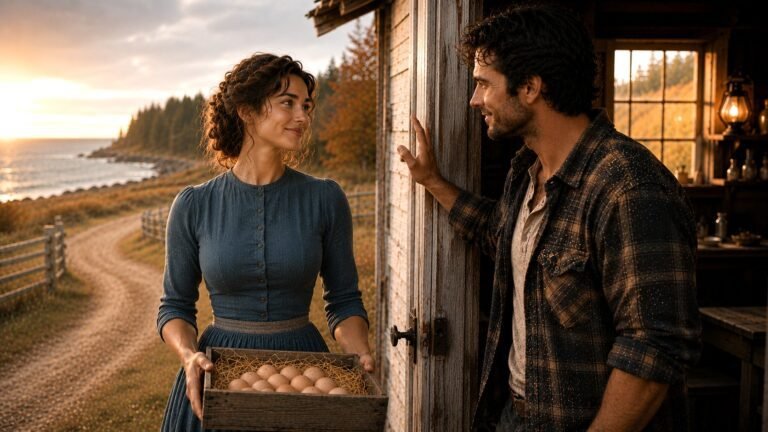
It was the orchard next door that broke the shape of what he’d braced for. Over the stone wall that had divided the two properties since before either family had owned them, the Asher land ran in the opposite direction entirely — rows of apple trees pruned into open, sculptural shapes, heavy now in early September with fruit, the grass beneath them mowed to an even nap, a hand-lettered sign at the end of the lane reading ASHER ORCHARD & FURNITURE, CIDER PRESSING SEPT–OCT, and beyond the trees a long low barn with its doors open to the afternoon, the smell of linseed oil and sawdust and something fermenting drifting faint and sweet across the wall even with the car windows shut.
He had known Nell Asher was still here. His mother had mentioned it, in the years before she went too, in the clipped, careful way she’d mentioned everything about the town he’d left — the Asher girl kept the place, you know, does something with wood now, some kind of business. He had let the information sit in him unexamined, the way he let most things about that town sit unexamined, filed under not relevant to the current version of his life. He had not expected, sitting in a rented car at one-forty in the afternoon with his father three months dead, that the smell of her cider barn drifting over a stone wall would put a fist around something in his chest that fifteen years and four states and one failed engagement had not managed to touch.
He did not get out of the car until his phone buzzed, at exactly two o’clock, with the lawyer’s message that she was running eight minutes behind. Everett read it, set the phone face-down on the passenger seat, and sat a moment longer in the idling car, looking not at his father’s house but past it, at the stone wall, at the orchard beyond it holding its ranks of trees in a discipline his own family’s land had long since forgotten, and something in him — some old, unpracticed muscle — considered, for the length of one held breath, walking over there instead.
He did not, that first day. But the wanting stayed in him the rest of the afternoon like a splinter gone in sideways, too deep to see, impossible to leave alone.
He went the next morning instead, before he’d decided to, the way a body sometimes decides things faster than the mind agrees to them. He had told himself it was about the wall — a section of it had come down between the properties, stones scattered into the grass on the Asher side, and it seemed, in the small, formal part of his brain that ran his life, a neighborly courtesy to mention it before some contractor bulldozed it flat during the estate cleanup. He had rehearsed the sentence the whole walk down the lane. He had not rehearsed anything else, because he had not let himself consider that there might be anything else to say.
The barn doors stood open the same as the day before, and inside, in a wedge of gold morning light thick with drifting sawdust, a woman knelt at a low workbench with a chair turned upside down in front of her, running a rag along one reglued leg with the unhurried attention of someone who did not believe in shortcuts. She had sawdust caught in hair the color of dark honey, pulled back loose and coming undone at the temple, and forearms marked with the kind of small scars that come from years of hand tools, and she did not look up right away, and Everett stood a moment in the doorway with the sentence about the wall dying somewhere behind his teeth, watching her work with an attention he had not given anything in longer than he could easily account for.
It was the dog that gave him away — a stub-tailed mutt asleep in a patch of sun who lifted its head and thumped its tail twice against the floorboards, and Nell Asher looked up following the sound, and went still in a way that had nothing to do with surprise and everything to do with recognition arriving a half-second before the mind could organize itself around it.
“Well,” she said, and set the rag down, and did not stand up right away, looking at him the way a person looks at a photograph they’d stopped expecting to match anything real. “You knocked.”
He hadn’t, not on any door, but he understood what she meant — the old code, two long raps and one short, a pause, one long, the pattern the two of them had used as children tapping messages through the shared stone wall and later, briefly, unforgettably, on her window at sixteen — and he realized, standing there, that his knuckles had in fact found the door frame on the way in without his permission, the pattern coming up out of some drawer in him he’d thought locked fifteen years shut, and the fact of it landing on her ear before it had even registered in his own hand undid something in his chest with the particular violence of a held thing finally let go.
“Didn’t mean to,” he said, which was true and also, he understood even as he said it, not quite the whole truth.
She stood then, wiping her hands on her apron, and crossed the sawdust floor toward him with an unhurried directness that had not been in her at sixteen, some new-built steadiness that he registered before he understood what he was registering, and she stopped a few feet off, studying him the frank, unflinching way she’d studied everything even as a girl, and said the thing that would sit in him for the rest of that visit and long past it, delivered without cruelty, without triumph, simply as a fact laid down between them the way she might lay a plank across a workbench to check it true:
“You grew up.” A beat, her eyes not leaving his face. “I didn’t wait for you to.”
It should have landed like a door closing. Instead — and this was the thing he would turn over for days afterward, unable to fully explain it even to himself — it landed like relief, like a window opened in a room he hadn’t known had gone stale. He had spent fifteen years half-expecting, in the vague and shameful way a person expects things they’ve never examined, that if he ever came back this town would have kept her waiting in some unlived version of herself, preserved like a photograph, available. What stood in front of him instead was someone whole, unbroken by his absence, built out past any shape he’d left her in, and the fact of her wholeness did not diminish anything in him. It astonished him. It was, he understood with a kind of vertigo, the first genuinely unexpected thing to have happened to him in years, and he had not called ahead for it, and the world had not ended.
“Fair,” he said, and something in his own voice surprised him — an unpracticed lightness — and she almost smiled, the corner of her mouth moving before she caught it, and behind her the dog gave up on either of them and went back to sleep, and outside a wasp worked at a dropped apple in a patch of sun, and neither of them moved to end the moment, both of them standing in a doorway thick with the smell of oil and sawdust and old wood made new again, each of them already, though neither would have said so, recalculating everything they’d assumed about the shape of the next several weeks.
“Wall’s down between our places,” he said finally, remembering, absurdly, the sentence he’d actually come to deliver.
“Has been for a year,” she said. “I like it that way.” And this time she did smile, brief and unguarded, before she turned back toward her bench, leaving the sentence to do whatever work it was going to do in him, and Everett Doyle walked back up the lane to his father’s dying house with sawdust on his sleeve and a splinter of something working its way, gently, dangerously, toward the surface of him.
The estate took longer than he’d told the lawyer, longer than he’d told his employer, longer, if he was honest, than any reasonable accounting of the work required. He told himself it was the house — the sorting, the appraising, the slow archaeology of a life he’d fled and his father had continued alone in his absence, drawers of unopened mail and a closet of clothes that still held, faintly, the smell of a man Everett had spent half his life afraid of and the other half missing in a way he’d never once let himself examine. But most afternoons, by four, he found himself down at the stone wall with no task that required him there, and most afternoons Nell was somewhere in the orchard or the barn with a task that could, plausibly, use an extra pair of hands, and neither of them commented on the frequency of the coincidence.
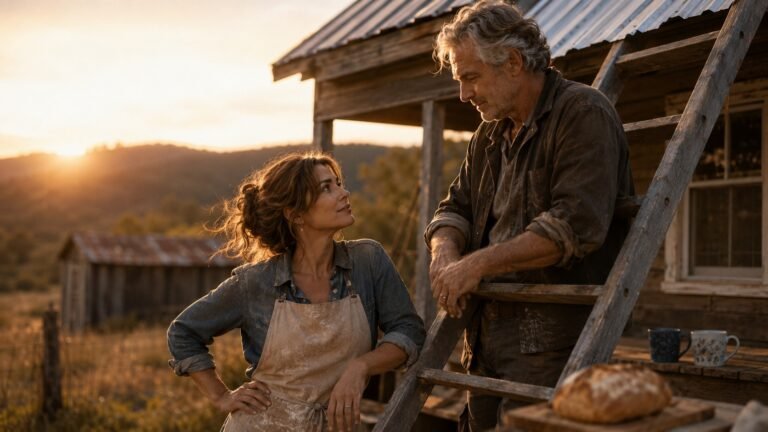
She taught him things with the same unhurried directness she did everything — how to tell a Northern Spy from a Baldwin by the shape of the calyx, how to run the old cider press her grandfather had built without jamming the screw, how to sand a chair rail with the grain instead of against it, a mistake he made twice before she took his hand, without ceremony, and guided the motion herself, her palm rough and warm over his knuckles for three full seconds before she let go, and neither of them mentioned that either, though he carried the shape of it in his hand the rest of that day like a coal banked under ash.
They talked around things the way two people do who have both spent years learning the cost of saying things straight out. He told her about the environmental work, the different states, the apartment in Boston that held nothing on its walls because he’d never stayed anywhere long enough to justify hanging a picture. She told him about the ex-fiancé, three years back, a man who had wanted her to sell the orchard and move to Burlington, and how she’d understood, somewhere in that asking, that he had never once actually seen the place, only the acreage it represented on a listing, and how she’d given the ring back the same week and never once regretted it, though she said this last part looking hard at the chair leg in her hands rather than at him.
“Your mother used to say you built things that lasted,” Everett said once, watching her true up a joint with a plane, the curl of wood coming off in one long unbroken ribbon. “Instead of things that were easy.”
“Your mother,” Nell said, not looking up, “used to say the same thing about you. Before.”
“Before what.”
She was quiet a moment, the plane resting against the wood, not moving. “Before you stopped writing her back,” she said, gently, no accusation in it, only the plain unclosed fact of it, and Everett found he had nothing to say to that at all, and the silence that followed was not, he noticed with some surprise, an uncomfortable one. It sat between them the way the good silences had always sat between them as children, occupied rather than empty, and he understood, watching her go back to the wood without pressing further, that she had left a door open in that silence rather than closed one, had said the hard thing and then declined to make him answer for it immediately, and something in him loosened another degree at being handled with that particular mercy.
There were evenings, as September wore toward the harvest, when he stayed past dark, sitting on an upturned crate in the barn while she worked by lamplight, the smell of pressed cider fermenting sweet and sharp in barrels along the back wall, and they’d talk about nothing consequential — the weather, a chair’s provenance, whether the Wolf River apples would hold past October — while underneath the ordinary words something else moved, unnamed, gathering weight the way water gathers before it finds the crack to go through. He caught himself, more than once, on the edge of the real sentence — I didn’t stop thinking about you, I don’t know how to stay anywhere, tell me if there’s a version of this where I could — and each time some old reflex closed his throat around it, the same reflex that made him confirm a reservation twice, the fear that arriving too plainly, too suddenly, into a thing this size would be its own kind of intrusion, an unannounced knock on a door that might not, this time, be ready for him.
“You could stay past the estate work,” she said once, not looking at him, running her thumb along a seam she’d just glued. “Plenty of houses need fixing up around here. Man good with his hands wouldn’t go hungry.”
“I don’t stay places,” he said, and heard, too late, how it sounded — a door shutting on a hinge he hadn’t oiled in years — and saw something pass quick and unlit behind her eyes before she nodded once and went back to the seam, and neither of them said anything else about it that night, though the unsaid thing rode home with him in the dark, heavier than anything he’d carried down that lane in fifteen years.
By the last week of September the estate paperwork was nearly done, a closing date set for the house, the lawyer’s emails coming daily now with things to sign, and Everett — faced, for the first time in longer than he could account for, with an ending that had no clear next assignment waiting behind it — did the thing his whole adult architecture had built him to do when a room went unpredictable: he took control of the exit.
He texted Nell a specific time. Come by Thursday at 6, before I head out — want to say a proper goodbye, walk the wall one more time. He reread it twice before sending, satisfied with its clarity, its courtesy, the way it gave her, gave both of them, fair warning, an appointment, a container for whatever this had been so that neither of them would have to stand in an unscheduled doorway and improvise something too large to say cleanly. It felt, composing it, like kindness. It felt, he told himself, like the responsible thing.
What he could not see, sending it, was how it would land on the other end — a woman who had spent three weeks watching a man’s face come alive in her barn every afternoon, who had shown him, without fully deciding to, the unguarded architecture of her own rebuilt life, reading a text that scheduled her like a closing appointment, that used the words proper goodbye the way a lawyer might use them, that folded whatever had passed between them into a fifteen-minute slot before he drove back to a life that had never once, in fifteen years, made room for anything unscheduled. It confirmed, with a precision that felt almost surgical, the exact fear she had built her whole quiet, competent life to defend against — that she was, to the people who left, a fixture to be checked on, tended once and departed from again, valued perhaps, but never chosen the way a person chooses something they can’t script the terms of.
She did not go to the wall Thursday at six. She sent nothing, cancelled nothing, simply did not come, and stayed instead in the barn with the doors shut against the evening chill, running a chisel along a dovetail joint with a pressure that split the grain, ruined the piece, and she set it down and did not pick up another.
Everett stood at the stone wall until well past dark, phone lit uselessly in his hand, the cold coming up out of the ground through his boots, and understood, standing there in a silence that had none of the occupied warmth of her barn silences, only the old flat kind, that he had done, with the very care he’d meant as kindness, the exact thing his whole life had been built to prevent him from doing to anyone else. He had knocked, and then, frightened by what answered, retreated behind a schedule. He drove back to his father’s empty house that night and did not sleep, phone on the nightstand, three different texts typed and deleted, none of them brave enough to send, his chest carrying the same low, undrained weight it had carried the day he’d parked outside that house three weeks before, as though nothing in the intervening month had happened at all — except that now the ache had a shape to it, a name he still would not let himself say, and it hurt exactly as much as everything unnamed had ever hurt him.
The closing was two days off. His flight out of Burlington was booked for the morning after. He spent the better part of a day walking through his father’s stripped rooms with the strange, hollow competence of a man finishing a job, signing where the lawyer indicated, boxing what remained for the church donation truck, and told himself, with the flat conviction of a man rehearsing a lie he needs to believe by morning, that this was simply how the visit had always been going to end.
It was the porch that undid the lie. He was carrying the last box out to the truck near dusk when he passed the section of railing his grandfather had built, and his hand, moving without his permission the way it had moved on Nell’s door frame three weeks before, found the old carved letters worn soft into the wood — E.D. + N.A., cut there with a pocketknife the summer he was fifteen, half a joke between them even then, and left uncorrected by either family in twenty years of paint jobs, both houses somehow always finding a reason to paint around it rather than over it. He stood there with the box in his arms and understood, with a clarity that arrived all at once instead of gradually, that he had spent his whole life mistaking control for care, warning for love, and that the woman two hundred yards down that stone wall had shown him, without a single dramatic gesture, exactly what the difference looked like, and that he was about to fly back to Boston having offered her nothing but a scheduled fifteen minutes in return.
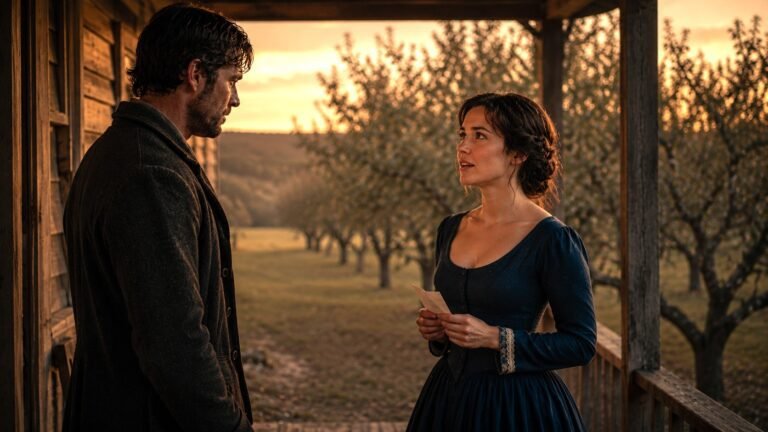
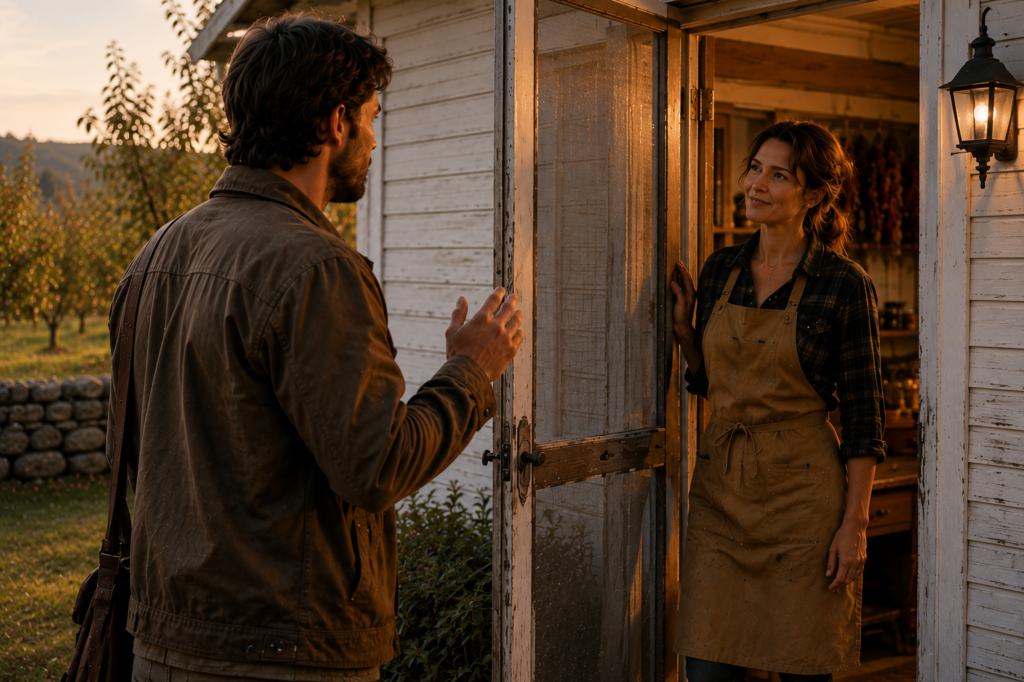
He set the box down on the porch step. He did not call ahead. He did not text. He walked the lane in the failing light with his heart going hard and unfamiliar against his ribs, past the fallen section of wall, into a yard gone blue with dusk, and stood at her door — the actual door, not the barn, the door of the house she’d grown up whole in without him — and raised his hand, and knocked the old code before he had fully decided to, two long, one short, a pause, one long, the same pattern that had once been a secret and was now, he understood as his knuckles struck the wood, something closer to a confession.
The door opened before the sound of the last knock had finished dying in the wood. She stood there in the porch light with sawdust still caught along her hairline, her face doing nothing to hide what it had been doing all evening, and neither of them said anything for a long moment, the dusk settling blue and complete around the two houses and the fallen wall between them, and Everett found that every rehearsed sentence he’d carried down that lane had gone, at the last, entirely unnecessary.
“I’m not calling ahead anymore,” he said, which was not the speech he’d meant to make and was, he understood as soon as it left him, the only sentence that mattered. “Not with you. Not ever again.”
She looked at him a long moment, something moving behind her eyes that had nothing guarded left in it, and she did not ask him to explain, did not make him account for the text, for the fifteen years, for any of it, because she had already read, in the raw unscheduled fact of him standing there past dark with no warning given, everything the explanation would only have gotten in the way of saying.
“Good,” she said, quiet, and stepped back from the door — not to shut it, but to open the way behind her, into the warm lamp-lit kitchen with its smell of woodsmoke and drying apples, and she left the screen door swinging loose on its hinge behind her rather than reaching to close it, an old habit of hers he remembered suddenly from childhood summers, the door left open because a house that meant to keep people out kept its door shut, and she had never once, in fifteen years or twenty, been a person who meant that — and Everett Doyle stepped up onto the porch and followed her in, the screen door tapping once, twice, against the frame behind him in the evening wind, and did not turn back to latch it.