
Elena Voss watered the ferns at six every morning, before the heat came up off the street in visible sheets, before the sprinklers three doors down hissed to life and the paperboy’s bike ticked past on its bent kickstand. She had watered them for eleven years. She watered them still, though the automatic mister Richard had installed the summer they moved in — a birthday present disguised as a home improvement, the kind of gift a man gives when he has stopped listening closely enough to know what a woman actually wants — had broken two winters ago and she had never called anyone to fix it. So she watered by hand now, a chipped tin can with a spout like a heron’s bill, moving down the porch rail fern by fern in the gray predawn light, and she told herself this was practical, this was simply what needed doing, and did not examine too closely why a woman living alone kept eleven ferns thriving on a porch nobody sat on anymore.
The house on Larkspur Street had been chosen, once, for its light — a wide bay window that caught the morning sun straight through the kitchen, a porch deep enough for two rocking chairs that had stood there gathering dust since the day Richard’s had gone empty. She was forty-five years old. She had been a wife for nineteen of those years and had been, for the fourteen months since the divorce was finalized, something she had not yet found a satisfactory word for — not single, which sounded like a fresh start she did not feel; not widowed, though there were mornings the distinction seemed academic. Richard had left in April, for a marketing associate named Brynn who wore her hair the way Elena had worn hers at twenty-six, and the particular cruelty of it was not the leaving but the ordinariness of the reason, the way it made Elena’s whole marriage retroactively resemble a placeholder for something younger that had simply been waiting, all along, in the wings.
She taught eighth-grade English at the middle school two miles east, and she was good at it, the kind of good that came from actually caring whether a roomful of thirteen-year-olds understood why Atticus Finch mattered, and she filled her summers — this one stretching now into its seventh empty week — with grading she’d already finished and a garden she had let, this particular July, get away from her. The grass had grown past her ankles. She noticed it the way she noticed most things about the house now, from a slight remove, as a fact belonging to a life she was still auditing rather than fully occupying — the grass needs cutting filed in the same drawer as the gutter’s coming loose and I should call someone about the mister, all of it waiting on a decisiveness she no longer trusted herself to summon.
She had stopped, somewhere in the last fourteen months, believing that wanting things led anywhere good. That was the plain truth of it, dressed up in no metaphor she cared to reach for. She had wanted, at twenty-six, a husband who’d look at her the same way at sixty as he had at thirty; she had wanted, more recently and more quietly, simply to be looked at at all, to walk into a room and register as something other than furniture, and both wantings had come to nothing, and so she had trained herself, the way you train a dog off a bad habit, to notice desire the moment it lifted its head and set it firmly back down.
That was where the ferns came in, if she was honest with herself, which she tried most days not to be, not about this. Eleven years she and Richard had watered them together some mornings, before the mister, standing companionably at either end of the rail with their own separate cans, not talking much, the marriage humming along in that unremarkable competent way marriages do before you learn, retroactively, that unremarkable was not the same as safe. She kept watering them now for reasons she did not examine, and if a friend had suggested the ferns had become a kind of church, a small stubborn insistence that some things could still be kept alive through sheer daily attention when so much else had not survived it, she would have laughed and changed the subject, because that was, she had also learned, another thing she was very good at.
The grass, though. The grass had gotten embarrassing. Twice now Mrs. Kowalczyk from across the street had made a comment disguised as concern — everything all right over there, hon? — with a glance at the yard that made clear the concern was mostly aesthetic, and Elena had smiled and said everything was fine and gone inside and stood a long while at the bay window looking at the yard the way you look at a symptom you’ve decided not to have diagnosed.
She had seen the flyer at the hardware store the week before, stapled crooked to the community board between a lost cat and a piano lesson ad — Yard Work, Mowing, Odd Jobs, Reasonable Rates, Ask for Wyatt — with a phone number torn into little tabs along the bottom, half of them already gone. She had taken a tab and put it in the pocket of her cardigan and left it there four days, through two washes, until the ink had gone soft and illegible and she’d had to go back for another.
She called on a Tuesday morning, standing at the kitchen counter with her coffee going cold, and a young man’s voice answered on the third ring, unhurried, a little rough with sleep though it was nearly nine. She gave her address. He said he could come Thursday. She said Thursday would be fine, and hung up, and stood a moment in her own kitchen feeling something she recognized, distantly, uneasily, as anticipation, and set the feeling down the way she set most feelings down these days, gently, without ceremony, in the place reserved for things she had decided, a long time ago now, not to trust.
He arrived Thursday at nine sharp, driving a pickup the color of a bruise, primer-gray in patches, with a push mower rattling loose in the bed and a dog — some rangy shepherd mix — riding shotgun with its head out the window the whole way up the block. Elena watched him pull into the drive from behind the kitchen curtain, told herself she was watching to make sure he’d found the right house, and stood there a beat too long doing it.
He was younger than his voice on the phone had suggested — twenty-seven, maybe twenty-eight, with the kind of build that came from actual labor rather than a gym, sun-browned forearms, a faded county fair T-shirt gone soft with washing, a ball cap pushed back off a face that hadn’t yet learned to guard itself much. He got the mower down out of the truck bed with an easy competence that had nothing showy in it, and the dog leapt down after and trotted straight for Elena’s flower bed with the unerring instinct of dogs for exactly the wrong place, and Elena came out onto the porch calling, “Not the peonies, please,” before she’d even said hello, and the young man turned and grinned — an open, unguarded thing, gone as quick as it came — and said, “Copper. Get out of the lady’s peonies,” in a voice that suggested this was a losing battle he’d fought many times before.
“Wyatt,” he said, coming up the walk, wiping his hand on his jeans before he offered it. “Sorry about him. He thinks every yard’s his.”
“Elena.” His hand was warm and rough and the shake was brief, correct, nothing in it. She was aware, in a way that irritated her the moment she noticed it, of noticing his hand at all.
He looked out over the yard with the flat assessing gaze of a man pricing a job, and let out a low whistle. “Been a minute since this got cut.”
“It’s gotten away from me,” she said, which was truer than she meant it to sound, and something flickered in his face — not judgment, she understood after a beat, just simple acknowledgment, the way you’d nod at weather — and he said, “Yards do that. Nothing that can’t be fixed,” and went to get his mower, and Elena stood on the porch a moment, absurdly grateful for a sentence that had nothing to do with her, before she went back inside to the grading she wasn’t really doing.
She watched him work through the kitchen window on and off through the morning, telling herself each time that she was only checking on the peonies. He worked steadily, without the phone-checking laziness she’d half expected, stopping once to drag a fallen branch clear of the mower’s path, once to crouch and examine something in the grass — a toad, it turned out, when she went out later and found the small damp print of his knee in the flattened grass beside a marked-off patch he’d mowed carefully around — and by eleven the yard had begun to look, for the first time in weeks, like a place someone lived rather than a problem someone had.
The heat had climbed by then into the high nineties, the kind of Midwestern July heat that sat on a body like a hand, and she watched him pull his shirt off at the fence line to wring the sweat from it, watched him do it with the complete unselfconsciousness of a young man who had never once had to consider whether his own body was a thing other people might be looking at, and Elena turned from the window with a small, sharp intake of breath she immediately, furiously, filed under ridiculous, and went to fill two glasses with ice.
She brought the lemonade out at noon, not because it seemed forward but because she had made a full pitcher years of habit deep and there was no earthly use for that much lemonade in a house of one. He took the glass with a thank you, ma’am that made her feel, obscurely, both older and unaccountably pleased, and drank half of it in one go, throat working, eyes gone briefly, involuntarily, closed against the pleasure of it.
“Best part of the job,” he said, when he came up for air, tapping the ice with one finger. “Half the people who hire me don’t think to offer water till you’re about to keel over.”
“That seems like poor management,” she said, and he laughed — a real laugh, surprised out of him — and said, “That’s exactly what my mother says,” and something in the easy comparison, mother rather than anything else, should have settled her and instead did something more complicated, something she chose, standing there in the noon glare, not to look at too directly.
“I could bring more ice,” she said. “I’ve got a whole freezer going to waste.”
“Waste’d be a shame,” he said, and there was a beat — brief, unremarkable to anyone watching, and yet Elena felt it land somewhere under her sternum with real weight — where neither of them said anything further, the ice cracking softly in his glass, the mower ticking as it cooled in the grass behind him, a jay somewhere setting up a racket in the oak, and then he said, “I’ll get the back done before it gets much hotter,” and turned, and the moment closed itself the way a held breath finally lets go, and Elena went back inside and stood at the sink a long moment before she remembered what she’d come in to do.
He finished at two, refused a second lemonade with an apologetic got another job across town, and took thirty dollars from her with a directness that had no fuss in it, no negotiation, just a fair price stated once and accepted. At the truck he paused, hand on the door, and looked back at the yard — trim now, edged, the peonies standing clear and undisturbed — with something like satisfaction on his face, an ordinary pride in work done well, and said, “I could come by every couple weeks, keep it from getting away from you again, if you want.”
“I’d like that,” Elena said, and heard, distantly, how plainly she’d said it, and was already turning back toward the house before the sound of her own voice could catch up with her, before she’d have to examine what exactly it was she’d just agreed to want.
Driving away, Wyatt Cole found himself, for reasons he did not examine any more closely than she had, checking the rearview mirror twice for a house that had nothing further in it to see, and Copper, riding shotgun, put his head out the window into the rushing heat and did not notice anything different about his person at all, though something had, in fact, in the space of that one lemonade, quietly and irreversibly shifted.
He came back every second Thursday through the rest of July, and by the third visit the arrangement had acquired a shape neither of them had planned for out loud: he’d arrive at nine, work till noon, and there would be lemonade, and then there would be a chair — he’d started bringing his own folding one from the truck bed, unasked, and setting it in the shade of the oak — and twenty minutes, sometimes forty, of talk that circled without ever quite arriving, the way water circles a drain a long while before committing to go down.
She learned he’d grown up two counties over, the youngest of four boys, that he’d started mowing lawns at fourteen for pocket money and had somehow, at twenty-seven, still not managed to want anything else badly enough to stop, though he said this without self-pity, a plain accounting rather than a complaint. He’d done two years of community college, welding certification, worked construction until a knee injury sidelined him a season, and had built the yard business back up from nothing in the time since, one flyer at a time. “Not much of a story,” he said once, shrugging it off, and Elena, who had spent nineteen years married to a man whose story was told entirely in quarterly earnings and golf handicaps, found she did not agree, though she did not say so plainly, only, “Most honest work isn’t much of a story. That’s usually what makes it honest.”
He asked about her carefully, in the oblique way of someone raised not to pry, and she found herself telling him more than she meant to — not about Richard directly, not at first, but around the edges of it, the shape of an absence rather than its details. “Fourteen months,” she said once, when he asked, without quite asking, why a woman with a yard that size lived in it alone. “Feels longer some days. Shorter, others.”
“Which is today,” he asked, and there was something in the directness of the question, unadorned by the careful sympathy she’d gotten so tired of receiving from friends who meant well, that made her actually consider it rather than deflect.
“Longer,” she said. “Today it’s longer.”
He didn’t offer comfort. He just nodded, like the answer was reasonable, like her days having a texture at all was not a thing that needed managing, and pulled a blade of grass and split it slow between his thumbs, and the silence that followed was not empty, was in fact one of the fuller silences Elena had sat inside in longer than she could easily place, and she found she did not want to fill it.
The ferns came up between them once, near the end of July, when he noticed her out at six one Thursday, watering by hand, and said, mild, not quite teasing, “Mister’s busted, huh,” nodding at the corroded fitting on the porch rail she’d never had fixed.
“For two years now,” she said.
“I could fix that in twenty minutes. Got the part in the truck, probably.”
“I like doing it by hand,” she said, too quickly, and heard how it sounded — heard the whole small architecture of what she wasn’t saying stand up plainly between them for a second — and he looked at her a beat, something working behind his eyes, and did not push it, only said, “Some things are better done by hand, I guess,” in a voice that carried, she understood, more freight than the sentence strictly required, and went back to loading the mower, and neither of them named what had just passed between them, though both of them, driving away or standing at the window, carried it the rest of the day like a stone warmed in a pocket.
It was the second week of August, the cicadas going full-throated in the heat, when the charge between them finally found a moment it couldn’t circle around. He’d finished early, the day cooler than most, and instead of the usual lemonade she’d made a pitcher of sun tea and set out a plate of the lemon bars she baked when she couldn’t sleep, and he ate three of them standing at the porch rail, unselfconscious, and said, “You made all this for just the yard guy?”
“Would you rather I hadn’t?”
“Didn’t say that.” He looked at her sideways, a small smile working at one corner of his mouth. “Just wondering what a woman like you’s doing making lemon bars for somebody who mows her lawn twice a month.”
“A woman like me,” she repeated, and there was an edge under the lightness of it, old and reflexive, the specific brace of a woman who has learned to hear a woman like you as the opening line of an insult even when it plainly isn’t one.
“Didn’t mean anything bad by it,” he said, quick, reading the shift in her face. “Meant — smart. Put together. The kind of woman who doesn’t usually need company on a Thursday afternoon.”
“Maybe I don’t need it,” she said, and heard, again, how it landed wrong, too sharp, and softened it before he could answer. “Maybe I just like it anyway.”
Something eased in his shoulders. “Yeah,” he said. “Me too, if we’re being honest about it.”
Neither of them said anything for a while after that. The cicadas kept on. Copper lay stretched in the shade with his chin on his paws, watching them both with the patient half-attention of a dog that has learned, over many afternoons, exactly how long this particular pause tends to run. Elena found she was watching the condensation slide down her glass rather than look at him directly, and Wyatt found he was looking anywhere — the yard, the dog, the oak’s shifting shade — except at her, and it was in this careful mutual not-looking, more than in anything either of them said, that the whole shape of the thing between them stood revealed, plain as the cut grass, to both of them at once.
“I should get going,” he said finally, though he made no move to. “Got another job.”
“You said that three weeks ago too,” Elena said, and there was a smile in it now, unguarded, the kind she hadn’t heard herself produce in longer than she wanted to think about, and he laughed, caught out, and said, “Guess I keep finding reasons to be slow about it,” and the honesty of that — offered so plainly, without the hedging she’d have expected, without the safety of deniability — sat between them a long moment, warm as the afternoon, before he finally did gather his things and go, and this time, driving off, he did not bother pretending, even to himself, that the checking in the rearview mirror was about anything but her.
The break came, when it came, not from anything Wyatt did but from the particular shape of what Elena had spent fourteen months teaching herself to fear.
It was late August, the light already beginning its early slant toward autumn, when Mrs. Kowalczyk stopped her at the mailbox with a smile that had something else folded inside it. “That young man’s been coming around a lot,” she said, not unkindly, in the tone of a woman simply making conversation, though Elena heard, underneath it, the whole town’s quiet accounting — a lot for lawn work, the sentence didn’t need finishing — and felt something old and well-worn close over her like a hand.
She said nothing to Mrs. Kowalczyk beyond a light, dismissive laugh. But she carried the comment into the house with her, and it sat there the rest of the day, gathering weight, joining itself to older fears it had no trouble finding company among — Richard’s associate with her twenty-six-year-old’s hair, the particular public math of a woman past forty being seen with a man well shy of thirty, the sense, deep and reflexive, that whatever this was would be read by everyone around her not as a thing she’d chosen but as a thing she’d been foolish enough to want.
When Wyatt came the following Thursday, she met him at the door with the money for the job already counted out, before he’d even started the mower, and something in the gesture — its briskness, its finality — registered on his face before she’d said a single word.
“Everything all right?” he asked.
“Fine,” she said. “I just have a lot on today. Errands.” It was not, strictly, a lie; it also was not, in any way that mattered, the truth, and he heard the gap between the two clearly enough.
He mowed in near silence. She did not bring out lemonade. When he finished he stood at the fence a moment, cap in his hands the way he had that very first day, and said, careful, like a man testing ice, “You don’t gotta feel sorry for me, you know. If that’s what any of this’s been. I don’t need looking after.”
She heard it wrong — heard, in her own fear’s translation, not an offering but an accusation, charity, pity, the exact word she’d spent all week bracing against from everyone but him — and something in her closed like a fist before she’d even decided to let it. “I wasn’t aware I was doing anything but hiring someone to mow my lawn,” she said, and watched the words land, watched something shutter behind his eyes that had been, until that sentence, entirely open.
“Right,” he said, after a moment, quiet, and put his cap back on. “My mistake.”
He did not come the following Thursday, or the one after. The grass grew back past her ankles and Elena did not call anyone else to cut it, and did not water the ferns some mornings at all, standing instead at the window with the tin can hanging forgotten from her hand, watching the empty drive the way you watch a door you’ve closed yourself and cannot, for reasons you refuse to examine, bring yourself to open again. Wyatt drove other routes through those two weeks, took on other yards, and found himself twice, without deciding to, turning down Larkspur anyway, slowing at her mailbox, not stopping, Copper whining low in the passenger seat at a silence he didn’t have the words for either.
It was Elena who broke it, in the end, though it took her the better part of three weeks to arrive at the courage the breaking required — not a grand courage, nothing that would have made a scene of itself, but the small, specific kind that is somehow harder to summon: the courage to be plainly, admittedly wrong.
She found the broken mister fitting on a Sunday morning, kneeling on the porch with a wrench she barely knew how to use, trying to fix it herself, and stripped the fitting after twenty frustrated minutes and sat back on her heels in the gray early light with grease on her hands and something loosening in her chest that had been clenched two solid weeks. She thought of him saying I could fix that in twenty minutes, thought of her own answer, I like doing it by hand, and understood, kneeling there, exactly what she’d been protecting and exactly how much smaller it had made her.
She drove to the address on the flyer’s tab — she still had it, softened, half-illegible, kept in the same cardigan pocket for reasons she’d stopped questioning — a small rented house on the edge of town with Copper’s bark going up the moment her car door closed. Wyatt came out onto the step, wary, wiping his hands on a rag, and did not say anything, just waited, the same waiting she remembered from that first Thursday when she’d stood too long behind the curtain.
“I fixed the mister today,” she said, which was not true, and both of them seemed to understand it as the opening of something rather than a lie exactly. “Well. I tried. I stripped the fitting instead.”
Something almost smiled at the corner of his mouth, cautious. “That so.”
“I was wrong,” she said, plainly, no dressing on it. “About what you said. I heard pity where you weren’t offering any. I’ve spent a long time getting good at hearing things that aren’t there, and I did it to you, and it wasn’t fair.” She held the wrench out, absurdly, the only prop she had. “I don’t need looking after either. But I’d like the company. If that’s still something you want to offer.”
He looked at the wrench, and at her, and something in his shoulders came down the way it had that first hot noon over the lemonade. “Twenty minutes,” he said finally. “Told you that from the start.”
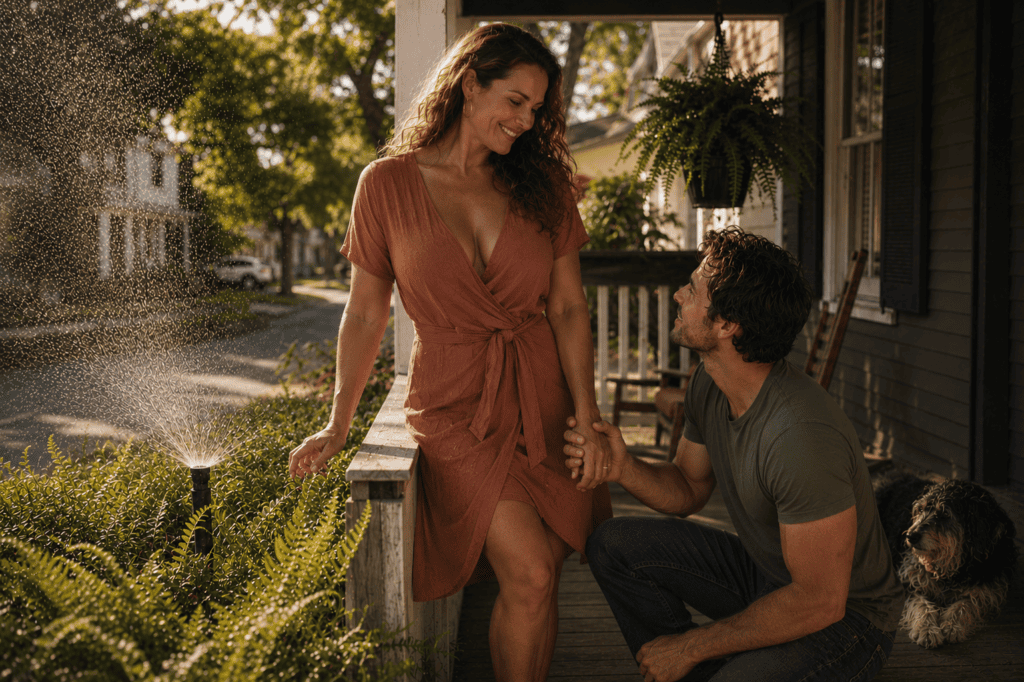
He followed her back to Larkspur Street in his gray truck, Copper’s head out the window the whole way, and he fixed the mister in exactly the time he’d promised, kneeling at the porch rail while she held the flashlight though the morning was bright enough not to need it, both of them finding reasons to stay close in the work that the work itself didn’t strictly require. When he twisted the valve and the fine mist came hissing up over the ferns for the first time in two years, catching the morning light in a hundred small suspended arcs, Elena laughed — that same startled unguarded sound he’d first heard over lemonade — and put her hand flat into the spray without thinking, the water cool and bright across her palm, and Wyatt reached over and did the same, his hand closing loose around hers under the mist, both of them soaked through the shoulders and neither of them minding at all, the ferns drinking greedily after two years of thirst, green and alive and finally, entirely, tended.
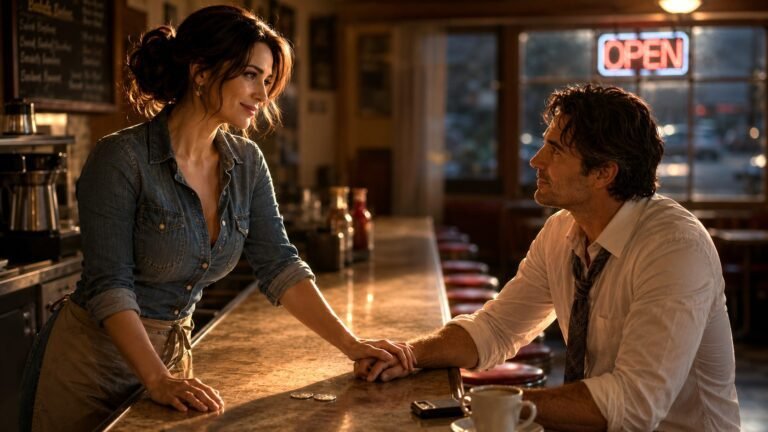
Heartfelt characters sharing love, emotions, and romantic journeys filled with hope, trust, and unforgettable bonds