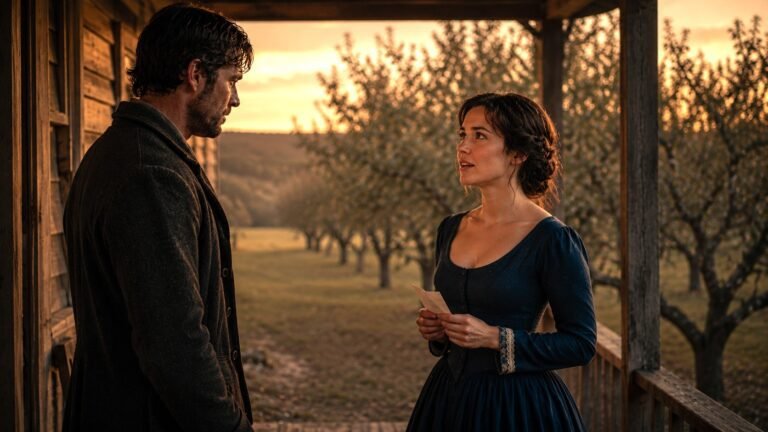

The knock came before sunup, three hard raps that shook the thin door in its frame, and Clara Bennett knew before she opened it that Silas Vane had come to collect what her father had not lived to pay.
“Morning, Miss Bennett.” He stood on the step with his hat already off, which was worse somehow than if he’d kept it on, because it meant he thought himself a gentleman about the whole business. “I trust you’ve had time to consider my offer.”
She had considered it every hour of every night for a month. The offer was this: her father’s debt, three hundred and twelve dollars owed to Vane’s mercantile and freight concern, could be forgiven if she married him. Silas Vane was forty-four years old, twice widowed under circumstances the town of Independence, Missouri, discussed only in whispers, and he collected people the way other men collected land — for what they could be made to yield.
“I have considered it,” Clara said. “My answer hasn’t changed.”
“Then I’ll need the money by the fifteenth. All of it. Or I’ll take the house, and after that I expect the county will find you a place to sleep that isn’t nearly so comfortable as this one.” He set his hat back on his head, slow, like a man setting a lid on a pot he meant to let simmer. “Think on it, Miss Bennett. A woman alone doesn’t have so very many doors open to her.”
She watched him go down the walk toward his buggy, unhurried, a man who had never once in his life needed to hurry, and she shut the door and stood with her back against it for a long moment, the way she had taken to doing lately, as though she could hold the whole crumbling shape of her life together by will alone if she simply pressed hard enough against the wood.
The house had been her father’s, and his father’s before him, and it still smelled faintly of the pipe tobacco he’d smoked on the porch every evening until the year his heart gave out without warning, folding him over his ledger books at the kitchen table where she’d found him the next morning, pen still in his hand. She had been going through those same ledgers for a month now, in the gray hours before dawn when sleep wouldn’t come, trying to make the numbers say something other than what they plainly said. There was no hidden reserve. There was no forgotten kindness from a distant relation. There was only debt, patient and accumulating, and a man in town who had made his intentions toward her plain enough that she no longer bothered pretending she hadn’t understood them.
She had once imagined, as a girl, that her life would follow a gentler shape — a husband chosen for affection, a house of her own furnishing, children who would grow up not knowing what it was to go without. She had believed, for a while, that Nathaniel Cross would be the one to give her that shape, right up until the morning she’d gone to the bank with her small inheritance in hand to open the joint account he’d suggested for their coming marriage, only to learn that a man answering his description had closed just such an account three days prior and boarded a westbound train alone. She did not cry over that loss anymore. She had used up whatever tears she’d once had for Nathaniel Cross, and what remained now was something harder and more useful — a plain, unsentimental will to survive whatever came next, on her own terms if she could manage it, and on someone else’s if she could not.
He was wrong about the doors, though she didn’t tell him so. She had one door left, and it was a door two thousand miles west, in a place called Larkspur Creek, in the Wyoming Territory, and it had been opened to her three weeks earlier by a letter written in a plain, careful hand.
I am not a man of many words, so I will not waste yours. I have a cattle ranch, four hundred head, a house that wants a woman’s care and has for six years. I am thirty-eight, in good health, and I do not drink to excess. If you are willing to come out and see if we suit, I will send the fare and meet your train myself. — Jonas Reeve
She had answered three advertisements that month, out of a desperation she was too proud to name even to herself, and Jonas Reeve’s had been the only one that hadn’t promised her anything. No talk of love everlasting, no flowery claims. Just a fair accounting of what he had and what he wanted, offered plainly, the way a man offers a horse trade.
She packed her mother’s quilt, her sewing basket, and the last of her dignity into a trunk that had crossed the ocean once already with people who were now dead, and she left Independence on a morning so gray it seemed the sky itself was ashamed to watch her go.
The train put her off at a water stop that called itself a town by courtesy alone — a depot, a mercantile, a church with a leaning steeple, and beyond that the enormous, indifferent grass rolling away toward mountains so far off they looked painted on the sky. Clara stood on the platform with her trunk at her feet and her carpetbag in her hand and waited for a man she had never seen.
The wind out here was different from any wind she had known in Missouri — dry and constant, carrying the smell of sage and turned earth instead of woodsmoke and river mud, and it worked at the loose strands of her hair until she gave up trying to keep them pinned. She had spent four days on trains that grew progressively more spare and less certain of themselves the further west they carried her, watching the country change outside the window from green farmland to broken hill country to this — a flat gold ocean of grass that seemed to have no edges at all, and no patience for a woman’s small worries.
An hour passed. Then another. The station agent, a thin fellow with tobacco-stained fingers, watched her with the particular pity reserved for women who have been left standing.
“You waiting on someone, miss?”
“Mr. Jonas Reeve,” she said, and heard how thin her own voice had gone.
“Reeve.” The agent scratched his jaw. “Reeve don’t come to town but once a fortnight, usual. His herd’s calving. Could be he lost track of the day.”
Could be he had thought better of the whole arrangement, was what she heard beneath it, and she sat down on her trunk in the thin October light and folded her hands and told herself she would not cry in front of a stranger, not after everything else she had already survived without tears.
It was near four o’clock, the sun dropping fast and mean toward the western hills, when a wagon came up the road at a pace that suggested its driver had been running the horses harder than he ought. It pulled up short at the platform, and a man climbed down — tall, sun-browned, dressed in clothes that had been mended more than once by a hand that was not skilled at it. He didn’t hurry toward her. He came at a steady walk, the way a man approaches something he means to do right.
“Miss Bennett.” He said it like a question and a fact both. “I’m sorry. Heifer got into trouble calving and I couldn’t leave her.” He looked, for the first time, directly at Clara’s face, and something in his own stilled, as though he’d expected a photograph and found a person instead. “You’ve been sitting here since the noon train.”
“I have.”
“That was wrong of me.” He said it simply, no excuse trailing after it, and bent to take up her trunk before she could protest that she was capable of directing a porter herself. He hefted it onto his shoulder like it weighed nothing, though she knew for a fact it weighed a great deal, because she had packed it herself and staggered under it twice.
He did not offer his arm. He did not comment on her traveling dress, gone gray with dust, or her hair, come half undone from the wind. He simply walked her to the wagon, settled the trunk, and handed her up onto the seat with a hand that was rough and warm and let go the instant she was steady.
They rode the eleven miles to the ranch in near silence, but it was not an uncomfortable one. The grass moved in long silver waves under the last of the light, and somewhere off in the draws a meadowlark was arguing with the coming dark, and Clara found that she did not need to fill the quiet with talk the way she had always felt obliged to do with other men. Jonas Reeve seemed to expect nothing of her but her presence.
“House isn’t much,” he said, as they crested a rise and the ranch came into view below — a low log house, a barn, corrals, all of it hunched against a stand of cottonwoods that had gone gold with the season. “I built it for one man’s needs. Never got around to building it for two.”
“It looks sturdy,” Clara said, because it was true, and because she had learned that true things were easier to say than kind ones that might not hold up.
“It is that.” He glanced at her sideways, the first real look he’d given her since the station. “You’re not what I expected.”
“What did you expect?”
“Didn’t let myself expect anything. Man who expects things gets disappointed.” He said it without bitterness, only as a fact he’d worked out for himself a long time ago, and Clara understood, with a small ache, that she was looking at a man who had trained himself out of hope the way another man might train himself out of a limp.
They were married two days later by the circuit preacher, in the front room of the house, with the ranch hand Ezra Combs and his wife standing as witnesses. It was not a wedding out of any story Clara had read as a girl. There were no flowers, no gathered guests, no tears of joy. Jonas wore a clean shirt and stood very straight and said his vows in a voice that did not waver, and when the preacher pronounced them married, he took her hand — not to kiss it, only to hold it a moment, careful, as though it were something that might break — and said, “I’ll do right by you, Clara. That’s my word.”
She believed him. She did not yet know why she believed him, only that something in the plainness of the promise made it more solid than any of the pretty words Nathaniel Cross had once whispered to her on her father’s porch, before he’d taken her modest savings for a “sure investment” and vanished toward California without so much as a note. She had learned, since then, to trust the men who said less.
That first night, she lay awake a long while in the narrow bed in the room he’d given her — her own room, a fact she had not expected and did not know how to feel about, though relief was somewhere in the tangle of it — listening to the unfamiliar sounds of a house settling around her: the creak of cooling log walls, the low complaint of wind finding the gaps in the eaves, and somewhere below, the slow, even tread of a man who did not seem to be sleeping any better than she was. She heard him pass the door once, twice, and stop each time, as though weighing whether to knock, before the footsteps retreated again toward his own room at the far end of the house. She was grateful, in a way she could not have explained to anyone, that he never did knock. It told her something true about the kind of patience he intended to practice.
The weeks that followed were not romance, not as she had imagined it. They were labor. She scrubbed the house from rafters to floorboards, aired the quilts, put up the last of the season’s vegetables from a garden gone half to weed. Jonas worked from before light until after dark, calving season being what it was, and came in each evening smelling of woodsmoke and cattle and cold air, and ate what she’d cooked with a quiet, thorough appreciation that said more than compliments would have.
He noticed things. That was what she came to understand about him, in those first weeks — Jonas Reeve was a man who noticed. He noticed when the porch step had gone soft with rot and fixed it before she’d said a word about it. He noticed when her hands had gone raw from lye soap and left a jar of tallow salve on the washstand without comment. He noticed, one evening, that she’d gone quiet and still over her mending, staring at nothing, and instead of asking her what troubled her — which she would not have answered — he simply sat down across from her with his own work, a bridle he was mending, and stayed in the room until the stillness passed out of her on its own.
There came a morning, some three weeks into her marriage, when Jonas rode out before dawn to help Ezra Combs pull a wagon free of a mud hole on the county road and did not return by midday as he’d said he would. Clara waited until the sun had climbed past its peak, and then, rather than sit fretting at the window as she might once have done, she saddled the gentlest of the ranch horses herself — a skill she had quietly taught herself over her first days there, watching how Ezra did it and practicing alone in the corral when no one was there to see her fail at it — and rode out along the road to see what had become of him.
She found the wagon mired axle-deep and both men filthy and short-tempered from an hour’s fruitless digging, and rather than wring her hands at the sight of it, she directed them to lay brush and fence rail beneath the wheels the way she’d once seen a freighter do it back in Missouri, and stood at the horses’ heads herself, steady and calm, coaxing them forward while the men heaved. The wagon came free within the quarter hour.
Jonas looked at her afterward, mud to his elbows, something unreadable moving behind his tired eyes. “You didn’t have to ride out.”
“I know I didn’t.” She handed him a rag from her saddlebag, unbothered. “I chose to.”
“Most women I’ve known would’ve sat home and worried.”
“I’ve done enough sitting and worrying to last a lifetime, Mr. Reeve. I find I’d rather be of use.” She swung back up into her saddle, and if she was pleased by the way he watched her do it — easy now, sure of herself in a way she hadn’t been a month before — she didn’t let it show on her face. “Besides. A woman who can’t manage a horse or a wagon out here is a woman who’ll be waiting on rescue her whole life. I’ve had enough of waiting.”
He said nothing more on the ride home, but that evening he brought out a second, better saddle from the barn — his late wife’s, she understood without being told, oiled and cared for all these years though it had gone unused — and set it by the door without comment, which was, she was coming to learn, exactly how Jonas Reeve said the things he could not yet say aloud.
“You don’t ask many questions,” she said to him some days later, as they sat on the porch in the blue hour after supper, the cottonwoods rustling dry and silver above them.
“Don’t reckon it’s my business, most of what you carry.” He was whittling — always whittling, in the evenings, small useless shapes that he seemed to make and unmake out of restlessness more than purpose. “You’ll tell me what you want told, when you want it told. I’ve got no use for prying a woman open like she’s a letter I’ve got a right to read.”
“That’s a strange way to put it.”
“Strange man, some say.” A corner of his mouth moved, not quite a smile. “My wife used to say I thought too much and talked too little for a rancher. Said a cattleman ought to be simple.”
It was the first time he had mentioned a wife. Clara went still, the way a person goes still when a door long shut creaks open a crack.
“You were married before.”
“Six years back. Fever took her and the boy both, same week, same year the well went dry and half my herd with it.” He kept his eyes on the wood curling away under his knife. “House has been empty of a woman’s voice since. I got used to the quiet. Told myself I liked it.” He looked up at her then, and there was nothing performed in his face, only a plain and careful honesty. “I don’t like it as much as I told myself.”
Clara found she could not speak for a moment. She thought of her own losses — her mother gone when she was twelve, her father dead of a bad heart and worse debts, the fiancé who’d proven himself a thief with a handsome face — and understood that she had married, without quite knowing it, a man who had been as thoroughly emptied out by loneliness as she had.
“I had a fiancé once,” she said, the words coming slow, testing the ground before she put her full weight on them. “He took what money I had and left. My father’s debts came after, and there was a man in Independence who wanted to collect them in a way that wasn’t money.” She looked down at her hands, folded tight in her lap. “I didn’t come out here for romance, Mr. Reeve. I came out here because I ran out of other doors.”
“I know it,” Jonas said. “Knew it the day I met you at the station, sitting on your trunk like a woman braced for one more disappointment. Didn’t hold it against you. A person takes the door that’s open. That’s not weakness. That’s sense.”
It was not a declaration. It was not even, quite, a comfort. But something in Clara loosened at the words, some tight, defended place she had carried across two thousand miles, and she understood that this quiet, careful man had just handed her something more valuable than a compliment: he had told her the truth, and let her be exactly what she was, without asking her to be ashamed of it.
Winter came hard that year, the way it does in that country, and the ranch drew in on itself like a fist. Snow piled against the corral fences until only the top rail showed, and the wind came down off the mountains with a voice like something grieving, so that Clara took to sleeping with an extra quilt — her mother’s, the one she’d carried across two thousand miles — folded double at the foot of her bed. Jonas rose before light each morning to break ice on the stock tank and fork hay to cattle too dumb or too stubborn to seek the shelter of the draws, and came in afterward with his mustache crusted white and his hands so cold Clara took to warming a basin of water for him without being asked, the way he had once left tallow salve for her without being asked, each of them learning the other’s needs in that same wordless currency.
There was a closeness in the small house through those months that had nothing to do with romance in the way novels told it, and everything to do with two people learning the shape of each other’s days. Clara learned that Jonas took his coffee black and his silence seriously, that he read the same worn Bible each night not for piety but for the sound of his dead mother’s voice, which he said he still heard when he read her favorite passages aloud. Jonas learned that Clara hummed when she was troubled and went perfectly silent when she was happy, the opposite of what he might have guessed, and that she had a temper banked deep under her manners, one she’d learned to keep controlled the way a woman learns to keep anything controlled that the world has taught her is dangerous to show.
He taught her to shoot, that winter, standing behind her with his hands cool and sure over hers on the rifle stock, correcting her grip without ever once making her feel foolish for not already knowing. There was a particular evening, cold enough that their breath hung visible in the barn’s lantern light, when a coyote had been troubling the calving heifers and Jonas had gone out to see to it, and Clara, without being asked, had followed with the rifle he’d taught her to load, and stood watch at the corral gate while he worked, saying nothing, needing to say nothing, the two of them simply present in the cold together until the danger had passed. He’d looked at her afterward with an expression she hadn’t yet learned to name, something between surprise and a settling certainty, as though he were revising some private accounting of what a wife might be expected to do and finding the new sum better than the old.
She taught him, in turn, to dance a little, humming the tune herself in the lamplit front room, laughing — really laughing, for the first time since she’d come West — when he trod on her hem and apologized so gravely that the apology itself became funny.
“You’ve a nice laugh,” he told her that night, when the dancing lesson had dissolved into simply standing near the stove, close enough that she could feel the warmth coming off him, distinct from the fire’s. “Haven’t heard it much.”
“Haven’t had much cause to use it. Not for a long while.”
“Well.” He looked down at her, and there was something new in his face, something he seemed to be working hard to keep steady. “I’d like to hear more of it. If that’s not too forward a thing to say.”
“It isn’t,” Clara said, and found that her own breath had gone short and strange. “It isn’t forward at all.”
He did not kiss her that night. That was not his way, not yet — Jonas Reeve moved toward a thing the way he moved toward a spooked horse, slow and without sudden claims. But he reached out and tucked a loose strand of her hair back from her face, his thumb grazing her cheekbone, brief as a held breath, and said, low, “Goodnight, Clara,” in a voice that carried more in it than the words themselves could hold.
She lay awake a long while after, listening to the wind work at the eaves, and understood that somewhere in the ordinary labor of that winter — the mended shirts, the shared silences, the small unasked-for kindnesses — she had come to love a man she had married as a last resort. It frightened her a little, how completely it had happened, and how quietly.
The trouble came in April, with the first green breaking through the winter-killed grass, and it came, as trouble so often does, wearing the shape of the past.
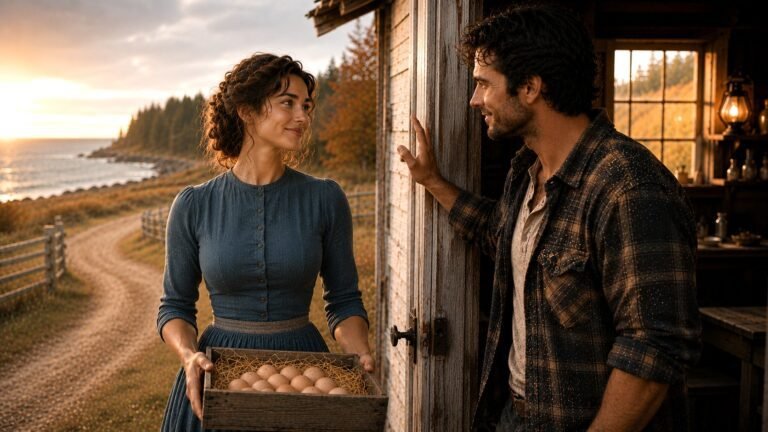
Clara was in town at the mercantile, trading eggs for coffee and thread, when the bell over the door rang and a voice she had prayed never to hear again said her name.
“Well. Clara Bennett. Or is it something else now?”
Silas Vane stood in the doorway, hat in hand, travel-worn but unmistakable, his eyes moving over her with the same appraising coldness she remembered from her father’s porch.
“It’s Reeve now,” she said, and was proud of how steady her voice came out, though her heart had begun to slam against her ribs. “Mrs. Jonas Reeve.”
“Is that so.” He came further into the store, and the storekeeper, sensing something ugly in the air, found sudden business in the back room. “You ran a fair distance, Mrs. Reeve, for a woman who owed me three hundred and twelve dollars and left without a word.”
“I owed my father’s debts, not a promise of marriage. There’s a difference, Mr. Vane, whatever you told yourself.”
“A jury in Missouri might see it different. Fraud, they might call it. A woman fleeing her creditors under a false name.” He smiled, and it did not reach his eyes. “I’ve come a long way to collect what’s owed me. One way or another.”
Word of the confrontation reached Jonas before Clara did — Ezra Combs had been in the mercantile buying nails and rode out ahead of her, grim-faced, to warn him — so that by the time Clara returned to the ranch, pale and shaking though she tried to hide it, Jonas was already standing in the yard, waiting, his face set in a stillness she had not seen on him before.
“He’s here,” Jonas said. Not a question.
“Silas Vane. My father’s creditor.” The whole of it came out of her then, in the yard, in the fading light, everything she had told him in pieces over the winter now laid out whole — the debt, the threat of a forced marriage, the shame of it, the fear that had chased her two thousand miles and had, it seemed, finally caught up. “He means to make trouble, Jonas. He’ll say I married you to run from a lawful debt. He’ll say ugly things about how I came to be your wife at all.”
She braced herself, in that moment, for something she had feared without naming it all winter — that Jonas Reeve, steady and quiet and careful, would look at her differently now that the whole shabby truth of her circumstance stood revealed. That he would think less of her for having been desperate.
He didn’t.
“Let him say it,” Jonas said. “Let him say it to the whole town, if that’s his aim. I’ll stand right beside you while he does.”
“You don’t know what it’ll cost you. A man like that can make life hard for people who cross him.”
“I know what it’d cost me not to stand by you.” He took her hands, both of them, in his — rough, sure, unwavering. “I made you a promise at that wedding, Clara. I’ll do right by you. I didn’t put a clause in it that said only so long as it was easy.”
Vane came to the ranch three days later, not alone — he’d brought the county sheriff with him, a weary man named Dutton who looked as though he’d rather be anywhere else, and a lawyer’s letter besides, full of official-sounding language about fraudulent flight and debts unpaid.
He found Clara on the porch, shelling peas into a bowl in the thin spring sun, and Jonas beside her, mending a hinge, and something about the two of them sitting there so plainly together seemed to catch Vane wrong-footed, though he covered it quick.
“Mrs. Reeve.” He tipped his hat with mock courtesy. “I’ve brought the sheriff, and papers besides. Three hundred twelve dollars, plus interest for the months you’ve evaded payment. I expect the ranch could cover it, if the lady herself can’t.”
“She doesn’t owe you a dollar,” Jonas said, without rising, without raising his voice. “Her father’s debt died with her father, unless she signed a note herself. Did she sign a note, Mr. Vane?”
Vane’s jaw tightened. “The debt was her father’s household. She benefited from the credit as much as he did.”
“That’s not how a note works, and you know it, or you wouldn’t have needed to chase her two thousand miles instead of simply filing a claim in Missouri and letting the courts sort it out proper.” Jonas set down his hammer, unhurried, and stood. He was not a large man in the way some men are large, but there was a settled solidity to him, a man who had never once needed to raise his voice to be believed. “Sheriff Dutton. You’ve read that letter of Mr. Vane’s, I expect. Does it name an actual signed note, or does it name a debt he says is owed on account of a marriage he says was promised him and wasn’t kept?”
The sheriff, looking increasingly uncomfortable, allowed that the letter was thin on the particulars of any signed obligation.
“It’s owed,” Vane snapped. “Whether there’s a paper for it or not. Her father owed my mercantile for two years of goods — flour, cloth, tools. That’s a debt any court would recognize.”
“Then take it to a court,” Jonas said. “A Missouri court, where the debt was made, against the estate it was made to — not against my wife, on my land, in Wyoming, with a sheriff you’ve dragged along to make it look more lawful than it is.” He let that sit a moment. “I’ve got half a mind to ask Sheriff Dutton here whether a man who crosses state lines to intimidate a married woman into paying a debt she’s not legally bound to, backed by a letter with no signed note behind it, isn’t closer to committing a crime himself than she is.”
Something shifted in Vane’s face — the first crack in the confident mask, a flicker of a man who had counted on a frightened woman alone, and had not counted on finding her settled, married, and defended by a man who knew exactly how thin his legal ground actually was.
“I’ll not be lectured on the law by a cattleman,” Vane said, but there was less certainty in it now.
Clara set down her bowl of peas and rose. She had spent a month bracing herself to be small in front of this man, the way she had learned to make herself small in Independence, and she found, standing now on her own porch with her husband beside her, that the smallness simply would not come.
“You came all this way, Mr. Vane, not for three hundred dollars,” she said. “A freight concern the size of yours could absorb that debt without blinking. You came because you couldn’t stand that I found a door you didn’t hold the key to.” She kept her voice even, though her hands, out of his sight, were trembling with the effort of it. “I’m not the frightened girl on my father’s porch anymore. I have a husband who stands with me, and a home, and neighbors who’ll vouch for both. If you want to pursue this, pursue it properly, through the courts, in the state where the debt was made. But I think you know as well as I do what a Missouri judge would say about a man who chased a widow’s daughter across two territories to threaten her in her own yard.”
The silence that followed had a weight to it. Sheriff Dutton, who had clearly begun the day hoping to avoid exactly this kind of confrontation, cleared his throat.
“Mr. Vane, I don’t see cause here for me to act. This looks to me like a civil matter for a Missouri court, not a Wyoming warrant.” He settled his hat. “I’d suggest you take the matter up proper, through the mails, if you mean to pursue it at all.”
Vane looked from the sheriff to Jonas to Clara, and something in the arithmetic of the moment — the law unwilling to bend for him, the woman unbowed, the man beside her plainly ready to fight the thing out to whatever end it required — seemed finally to register. He was, Clara understood in that moment, a man who had built his whole authority on other people’s fear, and fear, once it was gone, left him with nothing at all.
Vane’s eyes cut once more to Jonas, taking his measure the way a man takes the measure of a fence he’s decided not to climb. “You’re a fool, Reeve, marrying a woman who came to you running from her debts.”
“I married a woman who came to me honest about her troubles, which is more than I can say for you, coming here dressed up as the law when you know full well you’ve no lawful claim.” Jonas’s voice had not risen once through the whole exchange, and that steadiness seemed to unsettle Vane more than shouting would have. “I’ve dealt with men like you before, out here. Cattle buyers who try to weigh the scale with their thumb. It works right up until somebody calls it plain, in front of witnesses who can see the thumb for themselves.”
“You’ll regret this,” Vane said, but it came out thin, more habit than threat, and he turned and went back to his horse without waiting for an answer, the sheriff following after with an apologetic backward glance.
They watched him ride off down the road until the dust of him settled and the yard was quiet again, only the wind moving through the new grass and the cottonwoods murmuring overhead.
“He won’t come back,” Jonas said.
“You don’t know that.”
“I know men like him. They spend their whole strength on scaring folks who look like they’ll scare. He’s already found out you won’t.” He looked down at her, something soft moving behind the steadiness of his face. “You didn’t need me to say a word of that, back there. You’d have sent him off on your own.”
“Maybe.” Clara found she was still shaking, now that it was over, some belated tremor working its way loose. “But I’m glad you were beside me all the same.”
“I’ll always be beside you,” Jonas said. “That was the whole of my promise, if you’ll recall. Never had any intention of it being conditional.”
Spring gave way to summer, and the ranch settled back into its rhythms, but something in the house had changed — a lightness that hadn’t been there before, as though a held breath had finally been let go. The garden Clara had planted in careful rows through April came up thick and green by June, and she took a fierce, quiet pride in it that surprised her, this small proof that something she had put her hands to could simply grow, undisturbed by any man’s threats or any ledger’s demands. Neighbors who had kept a polite distance through that first hard winter — uncertain, perhaps, what to make of a mail-order match, or simply waiting to see if it would hold — began stopping by more often now, drawn by the story of how the quiet Reeve place had stood down Silas Vane without so much as raising a voice, and Clara found herself, for the first time since her father’s death, genuinely known and liked by the people around her, rather than merely tolerated or pitied. Clara found she no longer flinched at unexpected knocks on the door. She found, too, that she had stopped measuring her days by what she had lost, and started measuring them instead by small accumulating gains: a garden coming in green and orderly, a colt born easy in the May pasture, evenings on the porch that had gone from careful silence to easy talk, the two of them trading the small news of their days the way people do who have decided, without needing to announce it, that they intend to keep doing this for a very long time.
It was on one such evening, in early June, with the cottonwoods full-leafed and rustling silver-green above the porch, that Jonas set aside the shirt he’d been mending and reached instead for the small wooden box he kept on the shelf by the door — the box where he’d been putting, all these months, the little carved shapes he made in the evenings, the ones Clara had assumed were nothing more than a restless man’s habit.
“I’ve been meaning to give you something,” he said, “and I expect I’ve put it off longer than I ought, on account of not knowing how to say what needs saying alongside it.”
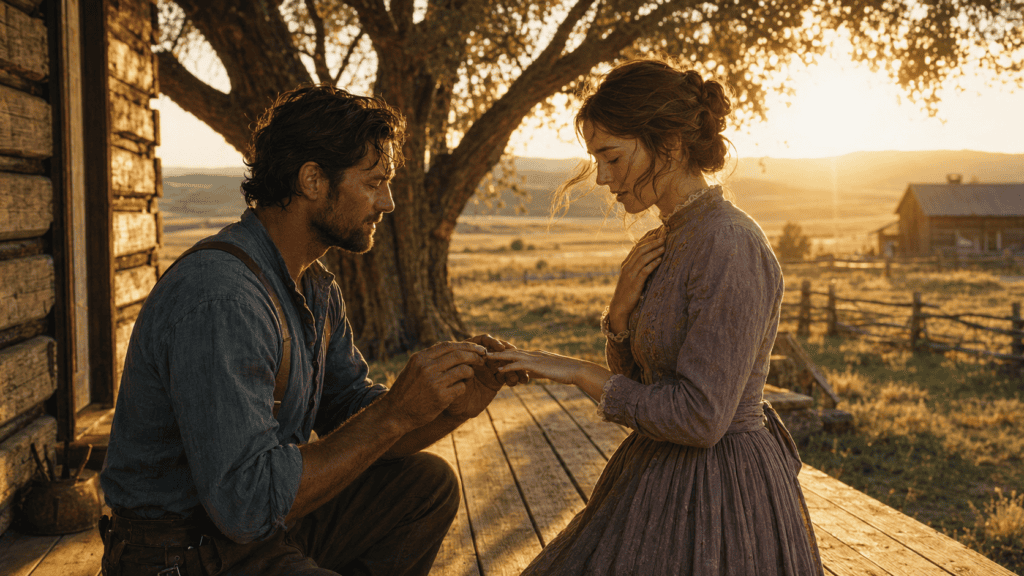
He opened his hand. In his palm sat a ring, carved from a pale, close-grained wood, smoothed and oiled until it had a soft, warm shine to it, simple and without ornament except for a single fine line etched around its band, delicate as a hair.
“It’s cottonwood,” he said. “From the tree yonder — the big one, the one that’s stood over this house since before I built it. I’ve been working at it, evenings, since near about the time you told me about your fiancé and I understood what a ring had come to mean to you — a promise made and then broken.” He turned it slow between his fingers. “I couldn’t afford, when we married, to give you gold. Didn’t seem right, either, giving you a ring bought quick from a catalogue for a marriage that started the same way. Wanted this one to be made, not bought. Wanted you to know exactly how long I’d been thinking on you, every evening I sat here carving it, before I ever worked up the nerve to say what I mean to say now.”
Clara’s throat had gone tight. “Jonas—”
“I love you, Clara.” He said it the way he said everything, plain and without flourish, but his hand was not quite steady as he held the ring out to her, and that unsteadiness said more than any poetry could have. “Didn’t marry you for love. Told myself I wasn’t fool enough anymore to want such a thing, after what I’d lost. But I do love you — the whole stubborn, proud, resourceful shape of you, the way you stood up to a man twice your size in meanness without so much as raising your voice, the way you hum when you’re troubled and go quiet when you’re glad. I love the woman who sat on a trunk at that station four hours past when she should’ve, and didn’t once complain of it to me after.” He held the ring out further, steady now, as though the saying of it had settled something in him. “I’m asking you proper, this time. Not for a marriage of convenience, or a debt paid off, or a door that happened to be open. I’m asking you to stay because you want to, same as I want you to. Will you wear it?”
The last light of evening had gone gold and low across the yard, catching the ring’s soft grain, catching the wet shine in Clara’s eyes that she made no effort now to hide. She held out her hand, and he slid the ring onto her finger, careful, the way he did everything, and it fit as though he had measured it against her hand a hundred times in his mind before ever cutting the wood.
“I love you too,” she said, and heard her own voice break a little around the words, glad and disbelieving both. “I think I have for longer than I let myself know. I was so afraid, all my life, of doors closing on me — my mother’s death, my father’s debts, Nathaniel’s lies, Silas Vane’s threats. I forgot that a door could open onto something good and simply stay open, if the man on the other side of it meant what he said.” She looked up at him, at the face she had come, over one long winter, to know better than her own reflection. “Yes, Jonas. I’ll wear it. I’ll wear it every day for the rest of my life.”
He kissed her then, finally, there on the porch in the gold and fading light, slow and certain, his hand coming up to cradle her jaw the same careful way he’d once steadied a rifle in her grip, as though she were something valuable he intended to handle exactly right. The cottonwoods stirred overhead, dry leaves whispering against each other the way they had every evening since he’d built the house alone, six years a widower, waiting though he hadn’t known he was waiting.
They were married again that autumn — not by law, which had already bound them, but by choice, in a small ceremony on the porch with Ezra and his wife and a handful of neighbors who’d come to think well of the quiet rancher and his resourceful wife over the past year. Clara wore the cottonwood ring beneath a plain gold band Jonas had finally allowed himself to buy, though he’d insisted the wooden one come first in the ceremony, worn on her right hand always after, a reminder of the promise made before either of them had dared call it love.
Winter came again, gentler than the last, and by the following spring there was a cradle in the front room that Jonas had built himself from the same cottonwood, matching its grain to the ring on his wife’s hand without either of them needing to remark on it — some things simply belonged together, once a person found the right pairing.
On the evenings that followed, in all the years that followed, they sat together on that same porch, two chairs worn smooth by long use, and watched the light go gold and then blue over the grass, the cottonwoods rustling their old, familiar song above the house that had once known only silence and now held, every evening, the sound of a full and settled life — a child’s laughter drifting from the yard, a woman’s hum rising unbothered over her mending, a man’s hand finding hers in the dusk the way it always had, steady, certain, and entirely without need of words.
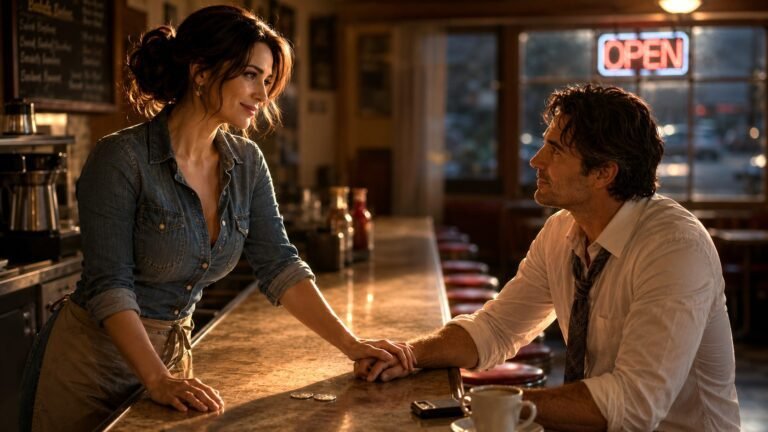
Heartfelt characters sharing love, emotions, and romantic journeys filled with hope, trust, and unforgettable bonds