
The frost came early that year to Absalom, laying itself down over the Bighorn foothills like something that had always intended to stay. Wyatt Cale woke before the alarm, the way he had for three years now, and lay in the gray of the room listening to the house tick and settle around him. Outside, the cottonwoods along the creek had gone the color of old pennies, and beyond them the mountains held their first snow in the high folds where the sun never quite reached.
He got up, made coffee in the same chipped percolator, and drank it standing at the window over the sink, the mug held in both hands though the kitchen wasn’t cold. Some habits didn’t need a reason anymore. They only needed repeating.
On the shelf above the stove sat a silver pocket watch, the case worn smooth at the hinge, the crystal fogged faintly with age. Wyatt took it down the way he took it down every morning, turned the small brass key at its crown three careful clicks, and set it back exactly where it had been, the chain coiled beside it like something sleeping. The watch did not run. Had not run in three years. The hands stood at seventeen past four and had not moved since the morning Renata’s breathing went quiet in the bed down the hall, the hospice nurse’s hand light on his shoulder, the watch on the nightstand where she’d asked him to put it so she could hear it tick beside her. He had wound it that morning too, before he understood there was no longer any reason to. He had gone on winding it every morning since. It was not superstition, not exactly. It was closer to the way a man might keep paying rent on a room he no longer lived in, because the alternative was admitting the room was empty.
Cale’s Repair sat off the county road two miles outside town, a low steel building with a gravel lot and a hand-painted sign that had faded to the color of a bruise. Wyatt fixed what people in that country still needed fixed — balers, well pumps, the odd chainsaw, engines that had outlived the men who’d bought them. He was good at it in the way of someone who had made peace with the fact that most things could be repaired if you were patient enough, and that patience was the one thing he had left in any real supply.
He ate lunch alone at the workbench most days, a sandwich made the night before, wrapped in the same waxed paper he refolded and reused until it split. He did not eat lunch with the men from the co-op when they stopped in, though they asked, still, out of a stubborn kindness that had outlasted his willingness to accept it. He told them he had work. Mostly this was true. The rest of the time it was easier to be alone with a carburetor than to sit across a table and watch people work to keep a conversation level, the way you’d keep a wheelbarrow from tipping.
There had been, in the early months, a great deal of soup left on his porch, casseroles in dishes he was meant to return and mostly didn’t, sympathy delivered in Pyrex. He had eaten it because it seemed rude not to, though hunger, in that season, was a thing that happened to his body without his permission, disconnected from him the way his hands sometimes seemed disconnected when they were deep in an engine, working on instinct while the rest of him stood somewhere off to the side, watching.
What people did not understand, and what he did not explain, was that he had not stopped grieving so much as he had built a structure around the grief, load-bearing, the way you’d frame a barn around a rock too big to move. The watch was one wall of it. The lunch alone was another. The drive home past the turnoff to the cemetery, always at the same speed, never slowing, never quite looking — that was another. He had made, without meaning to, an entire architecture out of not-looking, and he lived inside it the way a man lives inside any house long enough: not noticing the walls until someone else pointed them out.
He did not date. Women had been suggested to him, gently, by well-meaning people who did not understand that suggestion itself was a kind of violence, implying as it did that Renata was a door that could simply be closed. He had told his sister, once, the only time he’d said it aloud, that it wasn’t that he couldn’t love someone else. It was that he no longer trusted the floor. You built a life with someone, you poured the foundation and framed it up and hung the drywall and painted the rooms the colors she picked, and then one morning it was gone, not slowly, not gently, but the way a barn goes down in a windstorm — standing, and then not. He did not think he could survive framing another house only to stand in the wreckage of it twice.
So the days went on, gray and then white with the first real snow, and Wyatt fixed what came through the door and would not let himself want more than that. He was forty-eight years old. He told himself this was simply what forty-eight looked like, for a man in his position, in that country, with that particular hole in him — and he might have believed it, might have gone on believing it for another decade, if it hadn’t been for the sound of a truck coughing and dying in his gravel lot on the second Tuesday of November, and the smaller sound, underneath it, of a child’s voice asking her mother if the nice man’s dog bit. It was the dog, actually, that started it — a blue heeler named Scout who had no manners and less shame, who trotted out from under the workbench the moment the truck door opened and put both front paws up on the running board like he’d been expecting company. The woman behind the wheel had her hands still gripping ten and two, the truck ticking and steaming under the hood, snow starting to come down in the fat, deliberate flakes that meant business. In the passenger seat, half out of her seatbelt already, was a girl of six or seven with a knit cap pulled low over dark hair, staring at the dog with an expression of such total, unguarded delight that Wyatt found himself smiling before he’d said a word to anyone.
“He won’t bite,” Wyatt said, coming around the front of his own truck, wiping his hands on a rag that did more redistributing of grease than removing it. “He’ll talk your ear off, though, if you let him.”
“Good,” the girl said solemnly, already climbing down, “because I have a lot to tell him,” and crouched in the snow to receive Scout’s whole-body greeting like a dignitary accepting a medal.
The woman — dark-haired herself, a scarf wound twice around her throat, a smear of flour still ghosted on one wrist like she’d left the house mid-task — got out more carefully, one hand pressed to the small of her back in the way of someone who’d been driving longer than she wanted to. “It just died,” she said. “No warning. One second it was running, then it made a sound like it was clearing its throat and it just — stopped.” She looked at the hood the way people look at things they don’t expect to understand and don’t especially want to. “I’m sorry to just show up. Your shop was the only sign I saw for twenty miles.”
“That’s most of what I’ve got going for me,” Wyatt said. “Location.” He popped the hood, and the smell that came up — hot metal, a whisper of something burning that shouldn’t be — told him most of what he needed before he’d even leaned in. “You didn’t do anything wrong. Fuel pump, probably. Sounds worse than it is.”
“Everything sounds worse than it is, out here,” the woman said, and there was something dry in it, something that had learned the shape of that sentence recently and was still deciding how she felt about saying it. “I’m Mara. That’s Etta. We’re new. Obviously.”
“Wyatt.” He didn’t offer his hand — it was black to the wrist — and she seemed to understand that without being told, which he noted, the way he noted most things, without remarking on it.
Etta had by now migrated from the dog to the open bay of the shop, peering in at the disassembled mower engine on the bench with the frank curiosity of a creature who had not yet learned that some rooms were not meant for her. “What’s that for?” she said, pointing at a carburetor with a finger that had, at some point, been dipped in something purple.
“Makes the engine breathe,” Wyatt said. “Like a nose, sort of. Gas and air mix in there before it goes and does its business.”
“Does it have boogers?”
“Etta.” Mara’s voice carried the particular weariness of a woman who had answered for this exact question in public before.
“It’s a fair question,” Wyatt said, and found, with some surprise, that he meant it. “Sometimes, yeah. We call it gunk, professionally.”
Etta considered this with the gravity of a judge weighing testimony, and nodded, satisfied, as if a scientific matter had been settled to her precise standards. Mara laughed — a short, unpracticed sound, like something that had gone stiff from disuse — and pressed the back of her hand briefly to her mouth as if she could take it back, though she clearly didn’t want to.
Wyatt got the truck running enough to limp it into the bay, told Mara it’d be a day, maybe two, parts depending, and offered to run them into town himself since the only other option was the two of them walking the two miles back in weather that had gone, in the last ten minutes, from serious snow to something closer to a warning. Mara hesitated — he watched her hesitate, watched the specific arithmetic of a woman deciding whether a stranger’s kindness could be trusted, an arithmetic he recognized because he’d done its opposite version himself, a hundred times, deciding whether to let anyone close enough to be kind to him at all — and then said, “That would help. Thank you,” in a voice that had clearly cost her something to use.
In the cab of his truck, Etta sat between them with Scout’s leash wound twice around her mittened fist, though the dog had elected to ride in the bed, nose to the wind, delighted with the entire arrangement of the day. “Do you live by yourself?” Etta asked Wyatt, apropos of nothing, the way children ask the only questions that matter and adults have long since trained themselves not to.
“Etta.” Mara again, quieter this time, an apology already forming at the corner of her mouth toward Wyatt.
“It’s all right,” Wyatt said, and to the girl: “I do, yeah. Me and the dog.”
“That’s sad,” Etta said, not unkindly — stating it the way she might state that it was Tuesday, or that snow was cold — and then, immediately, moved on to asking whether Scout could ride in the front next time, leaving behind her a small, precise wound that she had no idea she’d made and that Wyatt found, strangely, he did not mind having.
He watched the road, the wipers ticking, the girl’s shoulder warm against his arm at the curves, and understood — the way you understand a change in weather before you can name what’s shifted, some pressure in the ear, some new slant of light — that he had, in the space of forty minutes, stopped being entirely alone in the cab of a truck for the first time in three years, and that something in him had noticed this before he’d given it permission to.
Mara, for her part, watched the man beside her girl — watched him answer questions about engine boogers with the same unhurried patience he’d have given a customer twice his age — and felt something loosen behind her sternum that she had kept deliberately, carefully clenched since Denver, since the apartment with the boxes still half-packed, since she’d promised herself and no one else that the next thing she built would be built slow, and built alone, and built to withstand whatever came. She did not examine the loosening. She filed it away, the way she filed most things now, under later, and watched the snow come down white and endless over the fields, and did not say anything else for the rest of the drive, though the silence, unlike most silences she’d sat inside lately, did not feel like something she had to survive. The truck took four days, not two — a part had to come from Sheridan, and then it snowed the highway shut for a night — and in that time Wyatt drove out to the Kessler place twice, once with the excuse of a part he could’ve mailed and once with no excuse at all, just a bag of split firewood he said he’d had extra of, which was not entirely a lie and not entirely the truth either.
The house Mara had bought sat a half mile off the county road, a squat old homestead place with a barn leaning gently east like it had made peace with the wind’s direction, and everywhere Wyatt looked there was work that needed doing — a porch step gone soft with rot, a pump handle that shrieked, a chimney that smoked wrong. He fixed what he found without being asked, the way he’d have fixed anything left too long in disrepair, and told himself this was simply what he did, that it had nothing to do with the particular way Mara stood in her doorway watching him work with her arms crossed and a look on her face like she was doing sums she couldn’t quite make add up.
“You don’t have to keep doing this,” she said the third time, handing him coffee in a mug that said WORLD’S OKAYEST COOK, watching him crouch by the porch step with a level.
“I like fixing things,” Wyatt said, which was true, and also not the whole truth, and they both seemed to understand this without either of them saying so.
“Everybody in this town likes fixing things, apparently,” Mara said. “I’ve had the man from the feed store offer to look at my furnace three separate times.”
“Cliff Aldous. He’s not wrong about furnaces. He’s wrong about most things that aren’t furnaces.”
“Is that a warning?”
“It’s an observation,” Wyatt said, and something passed between them then, quick and small, the kind of exchange that in a different life might have simply been flirtation and in this one felt like two people testing the weight a bridge could hold before either was willing to walk across it.
Etta, for her part, had appointed herself Wyatt’s apprentice with a speed and totality that neither adult had authorized. She followed him around the yard with a toy wrench that did nothing, narrating his work back to him with startling seriousness — “now he’s fixing the wobble,” she’d say to no one, to the dog, to the cold bright air — and on the coldest of those afternoons she’d sat cross-legged on an overturned bucket in the barn doorway and asked him, without looking up from the stick she was whittling with a butter knife, “Did your wife die?”
Wyatt’s hands went still on the pump handle. Behind him, in the doorway of the house, he heard Mara’s breath catch — not a gasp, just the smallest hitch, the sound of a woman bracing to intervene and not yet moving to do it.
“She did,” Wyatt said, after a moment, and found that the words came out steadier than he expected, steadier than they’d come out in three years of not saying them at all. “Few years back now.”
“My dad didn’t die,” Etta said, still working the stick. “He just left. Mom says that’s different but I don’t know if I believe her.”
“It is different,” Wyatt said carefully. “But I understand why it might not feel that way. Either one, you’re standing in a house that’s got somebody missing from it.”
Etta considered this, the way she considered most things, with her whole small face. “Do you still talk to her? Your wife?”
“Sometimes,” Wyatt admitted, and it was the truest thing he’d said out loud in longer than he could measure. “Mostly I just — keep some things the way she left them. So it still feels like she’s around, some.”
“That’s not sad,” Etta said, revising her earlier verdict with the total confidence of the very young. “That’s nice, actually,” and went back to her whittling as if the matter, like the carburetor’s boogers, had now been thoroughly and finally settled.
Mara didn’t come out onto the porch until Etta had wandered off after Scout, and when she did, she stood beside Wyatt at the pump with her arms wrapped around herself against the cold, not quite looking at him. “She doesn’t usually talk to people like that,” she said. “About her dad. She doesn’t usually talk to anyone about much of anything, these days.”
“Kids know who’s safe,” Wyatt said. “Better than we do, probably.”
“Is that what you are?” Mara asked, and there was something underneath the question, some second question riding along inside the first one, that neither of them was ready yet to pull out into the light.
“I don’t know what I am,” Wyatt said, which was honest, and watched something in Mara’s face soften and tighten at once, the way water does right before it goes to ice.
They did not touch, that afternoon or the several afternoons after it that turned, without either of them quite agreeing to it, into a kind of habit — Sunday dinners that started as a thank-you for the porch step and kept happening long after the porch step was fixed, Etta’s drawings appearing taped to the inside of Wyatt’s shop window, a spare key finding its way, unremarked upon, onto his ring. What passed between the two adults instead was a language made almost entirely of what didn’t get said. Mara would start a sentence — “I keep thinking maybe we should—” — and let it die there, unfinished, and Wyatt would not press her to finish it, because he had sentences of his own that ended in exactly the same kind of silence, the two of them circling something neither was willing to name, the way a man walks the perimeter of a house fire checking for heat before he’ll admit there’s anything worth putting out.
One evening in January, the two of them stood on the porch after Etta had gone to bed, the sky gone that particular hard-diamond black that only comes with deep cold, and Mara said, not looking at him, “You still wear that watch. The one that doesn’t run.”
Wyatt’s hand went, without his permission, to his coat pocket, to the small hard shape of it. “I do.”
“Why don’t you get it fixed?”
He was quiet long enough that she almost took the question back. “Because right now it’s the last thing that still remembers what time it was, that morning,” he said finally. “If I fix it, it just — becomes a regular clock. Telling regular time. I don’t know that I’m ready for that.”
Mara nodded slowly, and did not say anything about how a stopped clock is right twice a day and wrong every other second of it, which he half expected and was grateful she didn’t, and instead said only, “I understand that better than you’d think,” and reached over, briefly, to touch the back of his hand where it rested on the porch rail — not a held hand, not quite, just contact, just a woman confirming a man was solid and warm and there — before she pulled the door shut behind her and left him alone in the cold with his pulse going harder than the temperature explained. It was a small thing that broke it, the way small things always are the ones that do the real damage, working underground, out of sight, until the ground gives.
Mara asked him to come to Etta’s school program in February — a shuffling, off-key winter concert in the gymnasium, folding chairs and construction-paper snowflakes taped to cinderblock — and asked him three days ahead of time, which felt, to both of them, like an invitation to something larger than a concert, an invitation to be seen standing beside her in a room full of people who would draw their own conclusions and not be wrong to draw them.
Wyatt said he’d be there. He meant it when he said it.
But the morning of the program, he woke early, the way he always did, and went through the motions of the coffee and the window and the watch on the shelf, and something in him — some old, load-bearing wall he’d built without ever meaning it to be permanent — refused to move. He stood at the sink a long time. He thought of Etta on a gymnasium stage, scanning the folding chairs for a face, and he thought, with a clarity that frightened him, of what it would mean to become a fixture in that scanning — to be a face a child looked for, a shape whose absence would register as absence and not just as the ordinary vacancy of a stranger who was never owed to be there in the first place. He thought of the barn coming down in the windstorm, standing and then not, and understood, in the particular coward’s logic of a man who has already survived one collapse, that the surest way to never again stand in that wreckage was to never again finish building anything worth losing.
He did not go. He told himself he’d call, and did not call, and by the time he thought to, it was nine at night and the gymnasium lights were long since off and Etta had already asked, twice, from the folding chair beside her mother, where the nice man with the dog was, and Mara had already run out of answers that weren’t a lie.
The days after moved slow and strange, the way days do after a thing has gone wrong that no one will name aloud. Wyatt drove past the turnoff to the Kessler place at the same careful speed he used for the cemetery road, not slowing, not quite looking. He noticed he had started winding the watch twice some mornings, as if once weren’t enough anymore to hold the day together. His hands, deep in an engine, felt more disconnected from the rest of him than they had in a year.
Mara, for her part, did not call either — told herself she wouldn’t chase an explanation out of a man who hadn’t offered one, that she had promised herself precisely this kind of vigilance back in Denver, precisely this refusal to build again on ground that might give — and found that the promise, kept, felt exactly like the thing she’d been trying to avoid feeling in the first place. She caught herself standing at her own window some mornings with a cup going cold in her hands, watching the road for a truck that didn’t come, and hated the watching, and could not seem to stop doing it.
Etta didn’t understand the shape of it, only the fact of it — the absence, the wrongness, the way her mother’s voice went careful and thin whenever his name came up, which was less and less often, deliberately. She asked once, only once, why he didn’t come around anymore, and Mara said, “Sometimes people get scared, baby, and scared people pull back instead of forward,” and Etta had looked at her with an expression far too old for her face and said, “That’s what Dad did too,” and Mara had not had an answer for that, either, only the specific, silent grief of watching a six-year-old file a second man under the same heading as the first.
Wyatt fixed a hay baler for a rancher out past the county line and found his hands remembering, without his consent, the particular economy of Etta’s small fingers pointing at a carburetor, the particular sound of her narrating his work to an audience of no one. He wound the watch each morning and each morning it told him, as it always had, that it was seventeen past four, forever, a single held breath of a moment he had built an entire life around not moving past — and for the first time in three years, standing at the sink with the frost thick on the window and the coffee going cold in his hand, he understood that the watch had stopped protecting anything a long while back. It had simply stopped, the way he had, and he had been calling the stopping a kind of loyalty because the alternative was calling it what it was. It was Etta who broke it open, in the end, the way children do — not through any grand understanding of what had happened, only through the plain, unbearable logic of missing someone and refusing to accept that missing was simply how things were now.
She came to the shop on a Saturday in March, walked the two miles herself along the shoulder of the county road with Scout — who had taken, in the intervening weeks, to showing up at the Kessler place on his own, some four-legged diplomacy Wyatt hadn’t authorized and couldn’t seem to stop — trotting at her heel like an escort. Mara found the note on the kitchen table twenty minutes later, block letters in purple crayon, GONE TO SEE WYATT BE BACK SOON, and was in her truck with her coat half on before she’d finished reading it twice.
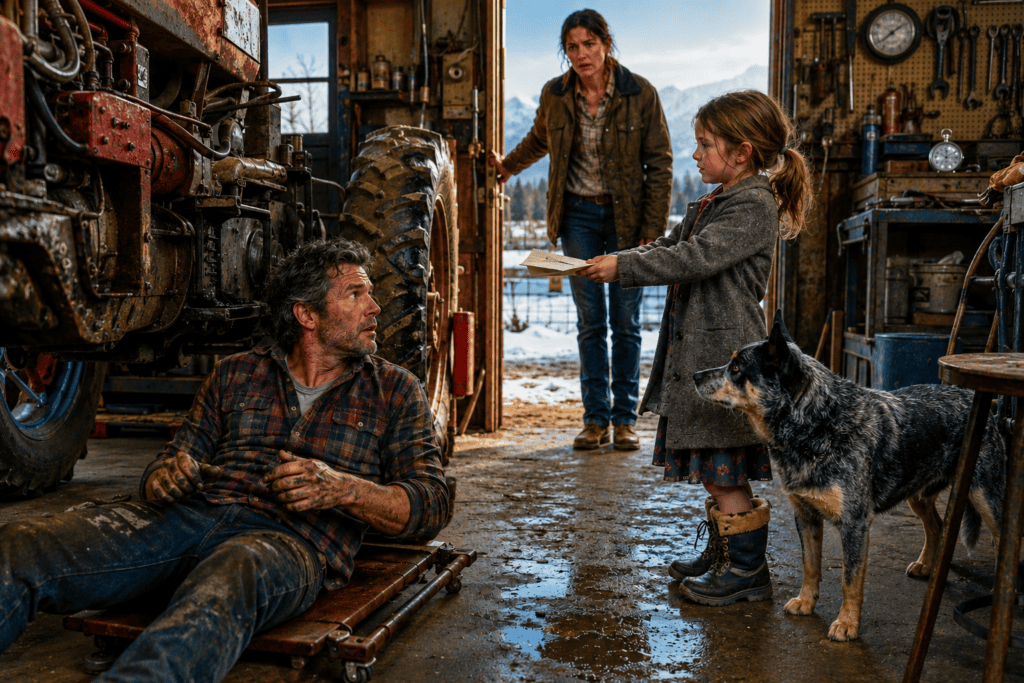
Wyatt was under a tractor when the bell over the door rang, and when he rolled out on the creeper, wiping his hands, it was to find Etta standing in the middle of his shop floor in her snow boots and her unzipped coat, cheeks bright red from the walk, holding out a folded piece of paper with the particular ceremony of a child delivering something she considers to be of the highest possible importance.
“You have to circle one,” she said, before he’d even sat up. “Mommy doesn’t know I’m here. I walked. Scout came too so it was safe.”
Wyatt took the paper. His hands, he noticed, were not entirely steady, and he set down the rag first, deliberately, the way you’d set down anything you didn’t want to risk dropping.
The letters were uneven, some backward, pressed hard enough into the paper that he could feel the ridges of them under his thumb: WILL YOU MARRY MY MOMMY? CIRCLE YES OR NO. Beneath it, two options, drawn in the same purple crayon, a small hopeful box around each word as if the boxes themselves might help.
“Etta.” His voice came out rougher than he meant it to. “Does your mom know you wrote this?”
“No. But I know she likes you. She thinks I don’t notice but I notice everything.” Etta said this with the flat, devastating confidence of the very young, and then, quieter, the ceremony dropping away from her all at once, revealing the thing underneath it: “You stopped coming. I don’t want you to be a dad who leaves. I want you to be the other kind.”
Wyatt heard the shop door open again behind her — Mara, out of breath, framed in the gray March light, her face doing something complicated that hadn’t yet decided whether it was going to be anger or something else entirely — and he understood that he had perhaps four seconds in which everything that came next would be decided, and that the four seconds had, in truth, been building for three years, since a bedroom on a morning in autumn, since a watch he’d kept stopped because moving forward had felt, for a long time, like the one thing he could not survive doing twice.
He looked at the girl. He looked past her at the woman in the doorway, snow melting in her dark hair, her hand still on the door as if she hadn’t yet decided whether to come further in or turn around and take her daughter home. And he thought, with a clarity that arrived all at once, the way clarity sometimes does after a long fog: that the barn that goes down in a windstorm is not proof a man shouldn’t build. It is only proof that the ground was never the thing that failed him — the wind was, and the wind was going to come whether he built or not, and a life spent refusing to frame anything up, for fear of what weather might eventually do to it, was not a life spared from loss. It was only a life that had already surrendered, quietly, years before any storm arrived to make it official.
He took the pencil from behind his ear — the same stub he used to mark torque settings on engine housings, the same hand that had wound a dead watch every morning for three years out of a loyalty he was only now understanding had curdled somewhere along the way into something closer to hiding — and he circled YES, pressing hard enough that the lead nearly tore through the paper, and beneath it, because it did not feel like enough, he wrote, in his own crooked hand: Ask her yourself. I’ll be right behind you.
He walked toward the door. Mara had not moved, had not spoken, was watching him cross the shop floor with an expression that had finally settled into something he recognized, because he’d worn it himself for three years — the particular look of a person deciding, in real time, whether it was safe to let hope back into a chest that had spent a long while keeping the door barred against it.
“I should have come to the program,” Wyatt said, stopping close enough that he could see the exact color her eyes went in the gray light, close enough that Etta, watching from beside the workbench with the folded paper clutched to her chest, had gone entirely still. “I got scared of exactly the thing I wanted. I’ve been getting scared of it for three years, if I’m honest, and I let a six-year-old walk two miles on a county road before I said so out loud, which is its own kind of shame I intend to carry a while.”
“You could have called,” Mara said, and it wasn’t forgiveness, not yet, but it wasn’t a door slamming either — it was a woman naming the wound precisely, which was its own kind of invitation, if he was willing to walk through it.
“I could have,” Wyatt agreed. “I’m calling now. In person, since I’m bad at telephones and worse at waiting.” He held out the paper — YES circled hard enough to nearly tear through, his own handwriting crooked beneath it — not as an answer to a proposal that hadn’t technically been his to make, but as an offering, the plainest one he had. “I don’t have a ring. I’ve got a shop full of parts and a dog who likes your kid better than he likes me and a watch in my pocket that hasn’t told the right time in three years. But I’d like to try. If you’ll let me. Slow, if it needs to be slow. Just — not from a distance anymore.”
Mara looked down at the paper a long moment, her thumb moving once over the crayon letters, and when she looked back up there was water standing in her eyes that she made no effort to blink away, which struck Wyatt as its own kind of answer.
“Ask her again,” Mara said, nodding at Etta, her voice gone thick. “The actual question. Not to a piece of paper.”
So Wyatt crouched down to the girl’s height, there on the concrete floor of the shop with the smell of grease and cold metal all around them, and said, “Etta Kessler, I circled yes. Does that work for you?”
“Obviously,” Etta said, with the particular scorn of a child who considers the outcome to have never been in doubt, and threw both arms around his neck hard enough to nearly take him off his heels, and over her shoulder, Wyatt watched Mara cross the last of the distance between them, and did not step back. The watch came back from the jeweler in Sheridan on a Thursday in April, packaged in a small brown box that Wyatt carried out to the truck like it might spill.
He hadn’t told Mara he was taking it in. He’d driven the forty miles alone one gray morning in March, not long after the shop floor and the crayon letters and the two of them standing close enough in the doorway that Etta had loudly announced she could see them, and had set the watch on the jeweler’s counter and said, simply, “Whatever it needs. I’d like it running again,” and the old man behind the glass had turned it over once in his hands, opened the back with a tool no wider than a matchstick, and said the mainspring had gone brittle with age but the rest of it was sound — these old ones usually were, he said, built to outlast the men who wound them — and that it would take a few weeks to source the part.
The wedding, such as it was, happened on the Kessler porch in early June, the step Wyatt had fixed in November holding steady under a scattering of folding chairs, Cliff Aldous from the feed store present and behaving himself, Scout wearing a bandana Etta had tied on him herself with a ceremony that rivaled anything the officiant managed. It was small, and plain, and exactly the size the two of them could carry without either feeling the weight of it as a threat.
But it was after — after the chairs were folded, after Cliff had gone home, after the last of the June light had gone long and gold across the fields and Etta had finally worn herself out enough to be carried up to bed — that the thing Wyatt had been waiting three months to do finally found its moment.
He found Mara on the porch step, her shoes off, her feet bare in the cooling grass, a glass of something amber going warm in her hand, and he sat down beside her without a word and took the small brown box from his jacket pocket and opened it.
The watch sat inside, the case polished now, the crystal clear, and the hands — Mara noticed it before he said anything, her breath catching the particular way it had caught once before, on a cold porch in January — the hands were moving. Not frozen at seventeen past four. Moving, quietly, the second hand sweeping its slow circle, keeping the actual time of an actual Thursday evening in June, keeping it the way it was built to, the way it had been built to all along before grief taught it to hold still.
“I had it fixed,” Wyatt said, unnecessarily, since she could see that for herself, and then, because the rest of it needed saying and he had learned, finally, the cost of leaving things unsaid: “I kept it stopped because I thought that was how you honor a thing — freezing it exactly where it was, so nothing else could ever come along and be measured against it. Took me three years and a six-year-old walking two miles on a county road to understand honoring somebody and refusing to keep living aren’t the same thing. She’d have liked you. Renata. She’d have liked that girl of yours even more — probably would’ve handed her the crayon herself.”
Mara didn’t say anything right away. She took the watch from the box instead, turned it once in her palm to feel the faint working warmth of the mechanism against her skin, and then reached over, without asking, and slid it into the breast pocket of Wyatt’s shirt, patting it once flat against his chest the way you’d settle something back into the place it belonged.
“Keep winding it,” she said. “Every morning. Just — for a different reason now.”
Wyatt covered her hand with his own where it still rested against his chest, and beneath both their palms, faint but steady, the watch went on keeping time — not the frozen minute of a morning he could never get back, but the plain, unremarkable, ongoing minute of a June evening on a porch step, ticking forward into whatever came next, the way it always should have, the way, he understood now, it always would.
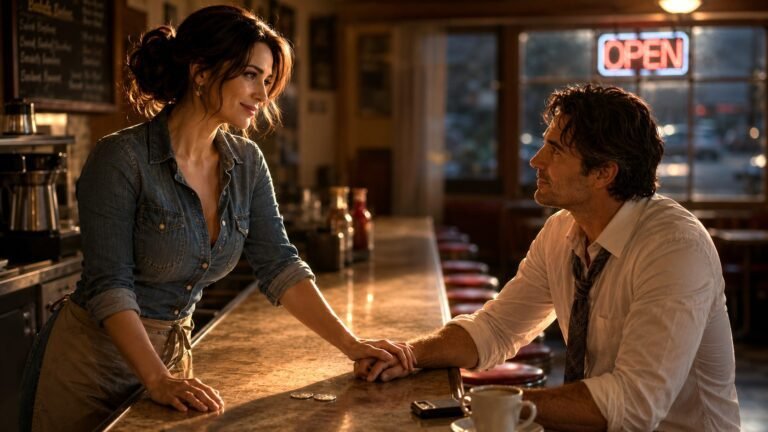
Heartfelt characters sharing love, emotions, and romantic journeys filled with hope, trust, and unforgettable bonds