

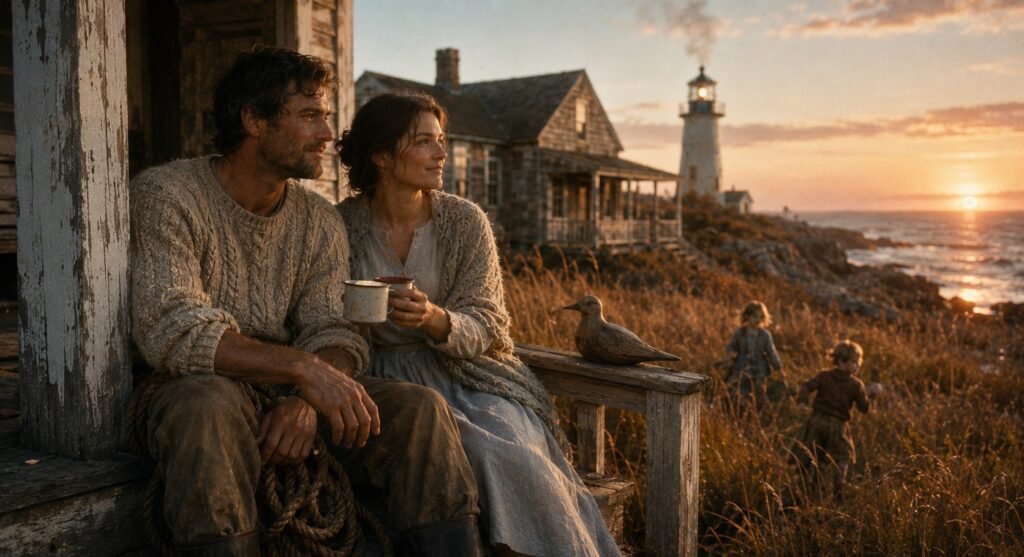
The village of Bittern Cove clung to the Maine coastline the way a barnacle clings to a hull — stubborn, salt-scoured, and unwilling to be shaken loose by weather or time. In the autumn of 1951, it was a place of gray shingled houses and grayer skies, where the fog rolled in most mornings thick enough to swallow the church steeple, and the only sounds before dawn were the groan of docklines and the cry of gulls arguing over the night’s leavings.
Thomas Calder lived at the far edge of that world, in a keeper’s cottage below the Widow’s Point light, though he had not been the official keeper for three years — not since the Coast Guard automated the beacon and left him only the cottage, the boat shed, and the silence. He kept the place anyway, out of habit more than duty, polishing the brass fittings of a lamp that no longer needed a human hand to burn.
He was thirty-four years old, broad through the shoulders from a life spent hauling lobster traps and mending nets, with hands so calloused that a hot coal could sit in his palm a full second before he felt it. His hair had gone prematurely gray at the temples, not from age but, the townsfolk said, from grief — the kind that bleaches a man from the inside out. His eyes were the pale blue-gray of the sea on an overcast day, and they rarely settled on anyone’s face for more than a moment before sliding back toward the horizon, as though he were perpetually watching for a storm that never quite arrived.
Four years earlier, he had buried his wife, Elizabeth, and the daughter she had been carrying, in the small cemetery behind St. Aidan’s, where the wind came hard off the water and bent the grass flat against the stones. Since then, Thomas had built his life into a fortress with exactly two rooms: the boat shed, where he worked, and the cottage, where he did not sleep so much as wait out the dark. He rowed out before first light and rowed back after the last one, and in between he spoke to almost no one except the lobsters he hauled and the gulls that followed his skiff, hoping for scraps.
The cottage held only what was necessary. A single chair at the table. A single tin cup on its hook. And by the window that faced the water, a second chair — a ladder-back rocker Elizabeth had loved, its seat worn smooth by years of her weight and her humming. He had draped a length of muslin over it the week after the funeral, the way a man might cover a mirror in a house of mourning, and he had not lifted that cloth since. He did not sit in the chair. He did not look at it, if he could help it. But he could not bring himself to burn it either, and so it sat there, shrouded, the heaviest object in a house otherwise stripped down to bone.
Clara Whitfield arrived on the mail boat on the second Tuesday of October, with a steamer trunk, a sewing machine wrapped in canvas, and a face that the men on the dock later described — when their wives weren’t listening — as handsome, not pretty, but the kind of handsome that grows on a man. She was twenty-four, raised in Portland by a great-aunt who ran a boarding house with the discipline of a ship’s captain, and she had come to Bittern Cove because a cousin twice removed had left her a narrow storefront on Harbor Street, empty since the cobbler who’d occupied it died without heirs.
She meant to open a bakery. She had learned bread at her great-aunt’s elbow the way other girls learned piano, and she had decided, somewhere around her twenty-third birthday, that a woman with a good oven and a head for numbers did not need to wait for a husband to have a life worth living. If a husband came along afterward, so much the better. If he didn’t, she would not consider herself unfinished.
The town watched her the way small towns watch anything new: carefully, and with more opinions than information. They watched her scrub four years of dust from the storefront windows until they threw back the light like mirrors. They watched her haggle old Mr. Pruitt at the general store down to a fair price on flour and yeast, and they watched her nail up a hand-lettered sign — WHITFIELD’S — that she’d painted herself, the letters a little crooked at the start and perfectly even by the end, as though she’d taught her hand the shape as she went.
What the town did not see, because they were not looking as closely as she was, was the way Clara noticed things. She noticed that the harbormaster’s boy limped worse on rainy days. She noticed that the minister’s wife wore her sleeves long even in August. And on her third day in Bittern Cove, walking the length of the wharf to see what the fishing boats brought in, she noticed Thomas Calder.
He was down at the boat shed, working a length of ash into a new trap frame, and he did not so much stand as occupy the space around him, still and economical, the way a stone occupies a riverbed. She watched him test the give of the wood with his thumb, watched him drive a peg home with three exact strikes of the mallet, no more, no fewer. He did not hum. He did not speak to the boy who brought him a coil of rope, beyond a single word of thanks that seemed to cost him something to say. When he finally looked up and caught her watching, his eyes met hers for exactly as long as it took to register a stranger, and then slid away, back to the wood in his hands, as though she were weather he’d already decided not to worry about.
Clara understood loneliness. She had grown up in its shape, in the too-quiet halls of her great-aunt’s house, in the particular ache of being loved dutifully but never delighted in. She recognized it now in the set of Thomas Calder’s jaw, in the careful three feet of air he kept between himself and every other person on that dock. But where her own loneliness had always been a room she could leave, his looked like a room he had bricked shut from the inside.
She did not try to break the door down. That was not, she had learned long ago, how doors like that opened.
Her first excuse was flimsy and she knew it. She had a wool coat with a torn lining, and instead of taking it to Mrs. Odell, who did such work for half the village, she carried it down to the boat shed, telling herself that a man who worked leather and canvas all day would know a stronger stitch than any seamstress in town.
“Mr. Calder,” she said, and he straightened from his workbench slowly, the way a man surfaces from deep water. He looked at her, then at the coat folded over her arm, and said nothing.
“I was told you’re handy with an awl,” she said. “My lining’s torn clean through. I wondered if you might mend it — I’ll pay, of course.”
“Mrs. Odell does that kind of work,” he said. His voice, when it came, was low and rough, a voice unused to the shape of conversation.
“She does. But I’ve seen the stitching on your trap lines from the dock. Small, even, tight enough to hold in a gale. I’d rather trust that to my coat than to somebody who’s never sewn anything that had to survive real weather.”
Something crossed his face then — not quite surprise, but its shadow. He was not a man accustomed to being complimented on anything but his catch. He looked from the coat to her face and back, a long, assessing look, as though trying to work out what she wanted from him.
“Leave it,” he said finally, and turned back to his bench.
It was not gracious. It was, she understood, the closest thing to a yes he had to offer, and she left the coat folded on a clean corner of the workbench and walked back up the hill without another word, satisfied.
A week later she returned to find it waiting for her, the lining repaired in stitches so fine and so even they might have been laid by machine, though she knew from the slight variation at the corners that they were not. She had brought, this time, a small loaf wrapped in brown paper, still faintly warm from the morning’s baking.
She found him hauling a skiff up onto its trestle, his forearms slick with salt water, and waited until he’d finished before she spoke.
“I came to pay you for the coat.”
“No charge,” he said, not looking at her.
“Well. I brought you something anyway.” She set the parcel on the corner of the trestle. “Just bread. I had extra.”
He went still in a way that had nothing to do with the boat. He stared at the parcel as though it might do something unexpected — catch fire, perhaps, or speak. No one had brought him food, unasked, unpitying, in four years. Not since Elizabeth used to leave a plate warming on the stove for him on the nights the fog kept him out late. The memory rose in him sudden and sharp, a hook catching under a rib.
“Don’t need it,” he said, and the words came out harder than he meant them.
Clara did not flinch, and she did not apologize for the offer, which he found, obscurely, more unsettling than either flinching or apologizing would have been.
“Everybody needs bread,” she said simply, and walked back up the hill, her shawl pulled close against the wind coming off the water.
He stood a long while by the trestle, the gulls wheeling and complaining overhead, before he picked the parcel up. The paper was still warm. He carried it home the long way, along the shore path, turning it over in his hands as though it were something he’d stolen. In the cottage, he unwrapped it at the cold hearth and found a plain loaf, dark-crusted, the smell of it filling the small room with something he had no name for anymore — not grief, not quite comfort, something in between. He tore off a piece and ate it standing up, and it was, he thought bitterly, the best thing he’d tasted in three years, and he hated it a little for that.
It became, without either of them quite naming it, a rhythm. She would find some reason to come down to the shed or the dock — a net needing a knot she couldn’t manage, a question about tarring a hull, a curiosity about the tide charts pinned above his bench — and he would do the work in his clipped, economical way, and she would leave something behind when she went: a jar of beach-plum preserves, a paper twist of peppermints for the harbormaster’s limping boy that she asked Thomas to pass along because she didn’t know the child well enough yet, a folded newspaper from Portland with a story about shipbuilding she thought might interest him. She never lingered for thanks. She never pushed at his silences, only stood inside them a moment, unbothered, and then let herself back out.
But the silence in him was changing, and he resented it even as he could not stop it. He began, without meaning to, watching for the color of her coat on Harbor Street. He found himself taking the longer way into town, past the bakery window, just to see if the lamp was lit, if she was there, moving behind the glass in that unhurried way she had. He would catch himself doing it and feel a cold anger rise — at her, at himself, at the unfairness of a heart that was supposed to be finished with wanting things.
He was betraying Elizabeth. That was the thought that came to him most nights now, sitting at his single chair with his single cup, the shrouded rocker a pale shape in the corner of his eye. He would let the fire burn low and remember his wife’s laugh, the way she used to hum some tuneless thing while she darned socks by the lamp, the exact warmth of her hand in his the last time he’d held it, before the fever took her and the child both in the same terrible night. Those memories were sharp enough to cut him still, and yet they were all he had left of her, and to let something new take root felt like a second burial — like letting her die again, more quietly this time, but no less finally.
And still, when he saw Clara wrestling a crate of canning jars off the mail boat one gray afternoon, her arms shaking with the effort, he found his legs moving toward her before he’d given them permission.
He took the crate without a word. She looked up, startled, and then smiled — not a large smile, just a small, warm curve of her mouth — and something in his chest did something he did not like and could not stop. He carried the crate up to her storefront, set it inside the door, and turned to go.
“Thank you, Thomas,” she said to his back.
It was the first time she had used his given name. He stopped in the doorway, one hand on the frame, and did not turn around. The sound of it in her voice — steady, unhurried, entirely without pity — landed somewhere under his ribs like a stone dropped into still water. He gave a short nod he wasn’t sure she could even see, and walked out into the wind, his pulse going harder than the work had earned.
He tried, after that, to be harder with her. It was the only defense he knew. He answered her in fewer words. He let the silences between them go long and sharp instead of easy. One late afternoon she brought him a shirt of his own that had come loose at the collar — she’d offered, weeks before, to see to any mending he needed, and it was, they both understood by now, a threadbare excuse for a visit — and he did not take it from her hands.
He was down at the rail of the dock, watching the tide turn, his back half to her. “Why do you keep doing this,” he said. It was not quite a question. “Finding reasons to come down here.”
The wind pulled at her shawl. She did not answer right away, and when she did, her voice was as plain and clear as the water below them.
“You looked like you could use some company.”
It was not an accusation. It was not pity, dressed up to look like kindness. It was only the truth, offered flat and unadorned, and for that reason it went into him like a blade. He felt his whole body go rigid, a barely visible flinch, and he knew in that instant that she had seen straight through four years of careful architecture — through the boat shed and the empty cottage and the shrouded chair — to the plain, unbearable fact underneath: he was lonely. Not grieving in some noble, faithful way. Lonely, the way a man is lonely who has locked himself in a room and told himself the lock was love.
“I have all the company I need,” he said, the words coming out colder than he meant, colder than he felt, and he turned and walked up the dock without looking back, leaving her standing there with his shirt still folded over her arm.
That night he made a decision the way a drowning man makes a decision — not out of clarity, but out of panic. The Ellery Brothers were fitting out for the herring run up past the Bay of Fundy, six weeks on cold water, hard work, harder pay. He did not need the money. He needed the distance — needed the sea to be vast and empty and indifferent again, the way it had been before a woman with steady eyes had started making his silence feel less like sanctuary and more like a cell.
He packed before dawn: oilskins, his good knife, a tin of tobacco he rarely smoked but always carried. He was nearly out the door when his eye caught the small carved shape sitting on the windowsill — a little gray seabird, wings half-lifted, that he’d been whittling without quite admitting it to himself through the dark hours of the last three weeks, working the wood the way his hands worked anything they didn’t want to think too hard about. He picked it up. It fit neatly in his palm, and it looked, he realized with something like a jolt, exactly like the herring gull that used to land on Clara’s windowsill every morning, the one she’d taken to calling the mayor because of the officious way it strutted the sill, and had mentioned to him once, laughing, as though it were the most ordinary thing in the world to tell a near-stranger about a bird.
It was foolish. Sentimental. The kind of thing he should have pitched into the cold stove. Instead, on his way down to the harbor in the pre-dawn dark, he made a detour past Harbor Street. Her window was unlit. He stood outside it a long moment, the fight going on inside him same as it had for weeks, and then, quick and quiet, he set the little carved bird on the sill just inside the gap where she left the sash cracked for air.
No note. No explanation. It was an apology and a goodbye both, carved out of driftwood, and then he was gone, down to the boat, out past the breakwater before the sun had fully cleared the horizon, the wake of the herring boat folding shut behind him like a door.
Clara found the bird that morning, sitting in a bar of early light on her sill, small enough to close inside one fist. The carving was spare but sure — every feather line deliberate, the small hooked beak exact. She knew, without needing to be told, whose hands had made it, and what its silent appearance and his silent absence, together, meant.
She heard the news by midday, the way news traveled in Bittern Cove — through Mrs. Odell, through the fishmonger’s wife, through the particular hush that fell over any topic involving Thomas Calder. Gone up with the Ellerys. Six weeks, maybe more, if the run’s good. Some said he’d finally come to his senses and gone back to honest work. Some said, more quietly, that he’d run.
Clara set the little gray bird on the shelf above her cutting table, where the afternoon light caught it best, and did not cry, though she wanted to. A man who meant to disappear entirely did not carve something so careful and leave it behind. A man who wanted to be forgotten did not leave a piece of his own hands on a windowsill. It was not a promise, not exactly. But it was not nothing, either.
So she waited. She opened her shop each morning at six. She kneaded and proofed and sold her bread, and answered the town’s questions about Thomas Calder with a polite, unreadable calm that gave nothing away, and kept, without quite admitting it to herself, half an eye on the mouth of the harbor.
The herring run was, by any fisherman’s measure, a good one — heavy nets, steady weather, fair pay waiting at the end of it. It was also, for Thomas, a kind of penance he had not expected. He worked harder than any two men on the boat, took the worst watches, the coldest hours, hoping the exhaustion would scrub his mind the way saltwater scrubbed a deck. It did not work. The vastness of open water, which had always been his refuge — the one place wide enough to hold a grief as large as his — had turned on him somewhere in the second week. It no longer felt like freedom. It felt only like distance, and distance, he was beginning to understand with a dread that grew heavier each night, was not the same thing as peace.
In the long dark watches, with nothing but the slap of water against the hull and the cold stars wheeling overhead, his thoughts would not stay where he tried to put them. He thought of Elizabeth less than he expected to — her memory had settled, over the weeks, into something quieter, a fixed point rather than an open wound. What rose instead, insistent and sharp, was Clara: her steady gray eyes that never once looked at him with pity. Her voice saying everybody needs bread. The plain, devastating truth of you looked like you could use some company — a sentence he had run six weeks and half a coastline to escape, and which had, infuriatingly, followed him the entire way.
He understood, somewhere around the fourth week, lying in the narrow bunk with the boat pitching gently under him, that he had been using Elizabeth’s memory as a wall to keep the rest of the world out, and calling it devotion. He had told himself he was protecting something sacred. But a man who protects a memory by starving himself of everything else is not honoring the dead. He is only burying himself alongside them, a little at a time, year after year. Clara had seen that — had seen him, not the grieving widower the town had decided he was, but a lonely man wearing grief like armor — and she had never once flinched from it or pitied him for it. She had simply stood there, offering bread, offering company, and waiting to see if he would let himself take it.
He had run from the first person in four years who had looked at him and seen exactly what was there.
He gave notice to the Ellery brothers that same week, took his pay in Lubec, and turned south before he’d fully decided to. He rode the mail boat and then the coastal packet, and when neither moved fast enough for the urgency now burning through him, he walked the last eleven miles along the shore road, his sea bag over one shoulder, his boots raw by the time Bittern Cove’s steeple came into view against the gray autumn sky.
He did not go home first. He went straight to Harbor Street, salt-crusted and wind-burned, six weeks of beard on his jaw and his heart going harder than any storm had ever managed. He stood outside the bakery window a long moment, gathering what nerve the walk hadn’t already spent, and then pushed open the door. The bell above it rang, bright and small in the warm, flour-scented air.
Clara was at her worktable, a length of dough half-shaped beneath her floured hands, and she looked up at the sound of the bell the way she looked up at every customer — and then went still, the way water goes still just before it freezes.
She took him in: the salt stains on his coat, the exhaustion carved into his face, the way his hands, when he pulled his cap off, would not quite stop moving, turning the brim over and over. Her gaze flicked, for the barest second, to the little gray bird on the shelf above her table.
He had rehearsed a dozen speeches on the long walk down the coast, apologies of varying length and varying honesty, and every one of them had dissolved somewhere between Lubec and here. What came out instead, when he finally found his voice, was smaller than any of them.
“I came back,” he said.
She did not ask where he had gone, though she knew. She did not ask why he had left, though she suspected. She looked at him a moment longer, something moving behind her steady eyes — not quite forgiveness, because there had never really been a debt between them to forgive, only a door he’d needed time to walk through on his own.
“I’ll put the kettle on,” she said, and wiped the flour from her hands, and that was, he understood, exactly the answer he had come eleven miles on foot to receive.
They sat at the small table behind her shop counter and drank tea while the light went gold and then gray outside the window, and the silence between them was no longer a wall but something shared — a warmth passed back and forth like the cup between his cold hands. He told her about the run, not the reasons behind it, but the plain facts: the weight of the nets, the color the water turned before dawn, the particular misery of a wet watch in November. She told him about the town — a wedding dress she was piecing together for the schoolteacher, the early frost that had killed half of Mrs. Pruitt’s dahlias, the herring gull that still came to sit on her sill every morning, bold as ever, though it hadn’t yet learned to behave half so well as the wooden one.
When the cups were empty, a different quiet settled over the table, and he understood it was time.
“Clara,” he said, and had to stop and start again. “I was a fool to leave.”
“You had your reasons, I expect,” she said.
“I had my fears,” he said. “That’s not the same thing.” The admission cost him more than the eleven miles had. “I’ve been hiding a long while. Told myself it was for Elizabeth’s sake. Truth is, it was for my own. Being alone felt safe. And then you—” He looked down at his hands, scarred and salt-cracked, and made himself finish it. “And then you made the alone feel lonely again. And that scared me more than any storm ever has.”
He lifted his eyes to hers, and found no triumph in them, no accusation — only that same steady, unhurried understanding that had undone him from the first afternoon on the dock.
“I’d like to stay,” he said. “Not just in the cove. I’d like to court you proper, Clara Whitfield, if you’ll let me.”
She did not answer at once. A small smile came up slowly at the corners of her mouth, warm and a little wry.
“Took you long enough to walk down here and say it,” she said, and reached across the table, and set her hand over his, and that — the plain, unhurried weight of her hand — was answer enough.
Their courtship, when it came, was as quiet and steady as the both of them. There were no grand declarations, no sweeping gestures — only smaller, surer things. It was him walking her home along the shore path after evening service, their hands finding each other somewhere around the second bend without either of them quite deciding to reach. It was her leaving a covered plate warming on the back of his stove on the nights the fog kept the boats out late. It was long evenings on the step outside her shop, talking about tides and thread and the shape a life might take, their conversation threaded through with silences that no longer felt like distance.
One Saturday in early spring, Thomas went home to the keeper’s cottage and stood a long while in front of the shrouded rocker before he finally reached out and drew the muslin away. Dust rose in the slant of afternoon light, turning slowly, and he ran his palm over the worn arm of the chair the way he might have once run it over Elizabeth’s own hand. For three years it had stood as a monument to what he’d lost. He decided, that afternoon, it would become something else instead — not a forgetting, but a keeping, turned toward the living rather than only the dead.
He spent the day sanding it smooth, working linseed oil into the old pine until it glowed warm under his hands again, and carried it down to Harbor Street himself, setting it by the stove in the back room where Clara kept her tea things. He said nothing when he set it down. He didn’t need to. She understood a gift when she saw one, and what it had cost him to give it.
They married that May, when the beach plums along the shore road had gone white with blossom and the fog had, for once, the grace to lift by noon. Clara wore a dress of pale gray-blue she’d sewn herself, and Thomas wore a suit he had not put on since another wedding, long ago, and did not flinch from the memory of it now. Half the cove packed into the little clapboard church, and their presence felt less like an audience than a blessing — the whole stubborn, salt-worn town standing witness to two careful people who had found their way to each other not through any lightning strike, but through the slow, patient accumulation of small true things.
Six years on, the sun was going down behind Widow’s Point in long bands of copper and rose, and the keeper’s cottage below it was no longer small. A second story had gone up two winters back, and a porch now ran the length of the front, looking out over water gone the color of hammered pewter in the fading light. The boat shed had grown into a proper yard, with two skiffs and a small sloop under construction, and beside it, Clara’s ovens sent a plume of woodsmoke curling up into the evening — she baked from home now, three days a week, and the rest of the town still climbed the hill for it gladly.
Thomas sat on the porch step, working a splice into a length of new line, the rope’s smell of tar and hemp as familiar to him now as breathing. The door opened behind him and Clara came out with two mugs of tea, handing him one before she settled beside him, her shoulder finding its old place against his.
A shout of laughter rose from the yard below. Two children were tumbling in the new spring grass — a boy of five with his father’s gray, steady eyes, and a girl of two, sturdy and stubborn-chinned like her mother, chasing him with a fistful of dandelions. The boy clutched something small and gray in one hand as he ran, making it swoop and dive through the air with solemn concentration.
“He won’t be parted from that bird,” Clara said, watching him. “Carries it everywhere.”
Thomas set down the splice and watched his son a moment, a feeling rising in his chest so large and so quiet it was almost more than he could hold. He thought of the man he’d been on this same porch, six years and a lifetime ago — a man locked in a single-room house, keeping a shrouded chair and a single cup, mistaking silence for loyalty.
“You were right,” he said finally.
Clara looked over at him, a question in the tilt of her head.
“That day on the dock,” he said, his gaze going back out to the water, gone violet now at the horizon. “I could have used some company.”
She leaned her head against his shoulder, and he felt her smile more than saw it.
“You still can,” she said.
He put his arm around her, and they sat together on the worn porch step as the light failed gently over Widow’s Point, watching their children chase each other through the darkening grass, the whole wide quiet of the evening folded close around them like something finally, fully kept.
There is a kind of love that arrives like a flood tide — sudden, overwhelming, rearranging the shoreline of a life in a single night. It announces itself. It is loud, and certain, and easy to name.
But there is another kind that comes more like a spring finding its way up through packed earth — slow, patient, working at the cracks a person has spent years hardening shut, until one day the ground gives without anyone quite marking the moment it happened. It is built less from what is said than from what is done: a mended coat, a warm loaf left without asking for thanks, a carved bird set quietly on a windowsill in the dark. It asks nothing but the chance to stay nearby, and it has the grace to wait, unhurried, for a locked door to open from the inside.
It is, in the end, a simple and sacred thing — to see a person’s loneliness plainly, without flinching from it, and to offer, without conditions, the two truest words there are: some company. And then only to wait, kettle warming, for them to finally come home.
— END —



Heartfelt characters sharing love, emotions, and romantic journeys filled with hope, trust, and unforgettable bonds