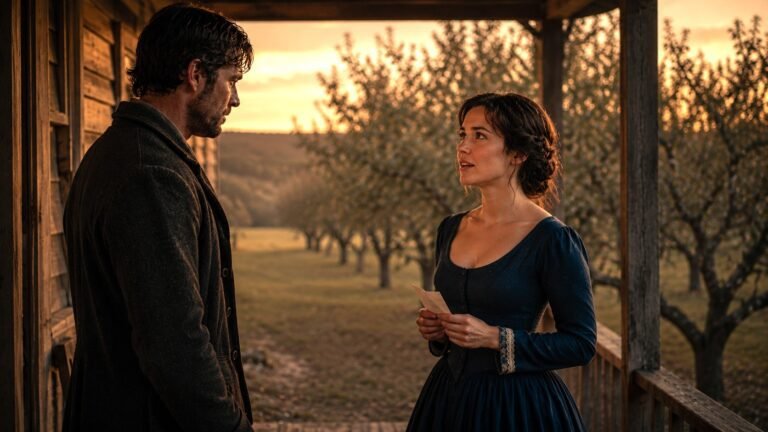

The letter from Silas Pruitt arrived on a Tuesday, and by Thursday Mara Doyle had sold the last of her mother’s silver spoons to buy a train ticket west, because the alternative — printed in Pruitt’s small, careful hand — was that she would come to his office in Springfield and discuss “other arrangements” for her father’s debt.
She had read the letter three times before she understood what he meant by other arrangements, and after the third reading she had walked straight to the depot with her mother’s spoons wrapped in a handkerchief and had not looked back at the boardinghouse room where she’d spent four years mending other women’s dresses for wages that never quite covered the interest.
Her father had died owing four hundred dollars to a man who smiled too much and never raised his voice, and when he smiled that way at Mara across his desk, she had understood that the debt was no longer only about money. So when the newspaper advertisement caught her eye — a rancher in the Montana Territory seeking a wife, honest work, a decent home, references available — she had answered it the same night, before she could talk herself out of the shame of it, and had not told Pruitt where she was going.
The Montana Territory in April was colder than she had imagined, and emptier. The stage let her off at a crossroads that did not deserve to be called a town — a mercantile, a livery, a church with a bell that had cracked somewhere in its casting and rang flat — and a man was waiting there who did not look like a groom.
He looked like a man who had come from work and would go back to it. His coat was patched at the elbow with leather the same brown as his hands, and he stood beside a wagon with his hat pushed back, not smiling, not frowning, simply watching her climb down with her one trunk and her mother’s Bible and nothing else in the world.
“Miss Doyle,” he said. It was not a question.
“Mr. Calder.”
“Thomas,” he said. “I answer better to that.”
He did not offer his arm or say anything about the journey or how tired she must be. He picked up her trunk as if it weighed nothing and set it in the wagon bed, and then he stood by the wheel and offered his hand to help her up, and that was the whole of their courtship for that first hour — his hand, rough and warm, closing around hers just long enough to steady her, then letting go the moment her feet were solid on the wagon floor.
They rode eleven miles without more than a dozen words passing between them, and Mara found she did not mind the silence. She had grown used to silence back east — the particular silence of a room where everyone was calculating what she owed and what she was worth, which were never the same number. Thomas Calder’s silence was different. It did not press on her. It simply sat beside her, the way he sat on the wagon seat, close enough that she could smell woodsmoke and horse and the clean cold of the mountain air on his coat, far enough that she never once felt crowded.
The ranch house, when they reached it, was small and square and honest, with a porch that ran the width of the front and a single rocking chair on it, weathered gray, clearly built for one person to sit alone. Mara looked at that chair longer than she meant to.
“There’ll be a preacher through in three weeks’ time,” Thomas said, setting down her trunk on the porch boards. “Circuit rider. Til then you’ll have the back room, and I’ll bunk in with the hands.” He paused. “Didn’t want you thinking I expected different, you stepping off a stage and all.”
“I didn’t think that,” Mara said, though she had wondered, and was grateful now that she would not have to find out the answer by living it.
“Didn’t figure you did. Wanted it said anyhow.”
That was the whole of it. He showed her the kitchen, the well, the root cellar with its dirt smell of potatoes and old apples, and then he went back out to the barn and left her alone in a house that was not yet hers, with a stove that was not yet lit, and a silence that, for the first time in four years, did not feel like being watched.
She lit the stove herself. She found flour and lard and a crock of buttermilk gone slightly sour, and she made cornbread because it was the only thing she trusted herself to make in a strange kitchen with strange measures, and when Thomas came in at dusk, smelling of hay and cold iron, he stopped in the doorway and looked at the table she had set — two plates, though she had not been sure he’d want to eat with her — and something in his face eased, just slightly, like a fence post settling into ground that had finally frozen solid enough to hold it.
“Didn’t expect supper,” he said.
“I didn’t expect a chair on the porch built for company,” she said, “but there it was.”
He almost smiled. She would learn, over the coming weeks, that this was as far as his face generally went — an almost, a suggestion, a thing you had to be watching for or you would miss it entirely. He sat down across from her and ate her cornbread without comment, which she came to understand, over those same weeks, was itself the comment. Thomas Calder did not praise what didn’t deserve praising. When he ate a second piece without being asked, she knew more from that than she would have from any word.
The weeks that followed took on a shape Mara had not known she was hungry for.
Mornings, she rose before him and had coffee going by the time he came in from the barn, and he took the cup from her hands with a nod that was thanks enough. Evenings, they ate together, and though he rarely spoke first, he answered when she asked — about the ranch, about the cattle, about the mountains that stood blue and serrated along the western edge of everything, about his people, who had come out from Ohio in his father’s time and were mostly gone now, buried on a rise behind the house under a stand of aspen.
“You’re alone out here,” she said one evening, not quite a question.
“Was,” he said, and did not elaborate, and she did not press, because she understood a man who counted his words the way some men counted coins — carefully, and only spending what needed spending.
She found small ways to be useful that did not require asking permission, because she had learned long ago that a woman who waited to be told what to do in someone else’s house was a woman who would wait a long time and be thought lazy for it. She mended the split seam in his good shirt without being asked. She found the kitchen garden gone to weed and turned the soil herself, her hands blistering before they hardened, and planted what seeds she found in a tin in the pantry, not knowing yet what half of them would grow into. She scrubbed the porch boards until the gray wood showed its grain again, and one evening, coming in from the barn, Thomas stopped at the top step and looked down at the clean boards under his boots for a long moment before he looked up at her.
“You didn’t need to do that,” he said.
“I know,” she said. “I wanted a clean place to sit of an evening.”
He looked at the single rocking chair, and then at her, and the next morning, when she woke, there was a second chair on the porch beside the first — plain, unpainted, clearly built in the barn the night before by lamplight, the joints still faintly smelling of fresh-cut pine.
She sat in it that evening without either of them remarking on it, and the silence between them, filled now with the creak of two chairs instead of one, felt like the truest conversation she’d had in years.
It was in the third week that she began to understand what kind of man she had married herself to, sight unseen, out of desperation that she was slowly coming to think might have been luck instead.
A calf had gotten itself tangled in wire down along the creek, and Thomas had gone to fetch it in the gray hour before dawn, and had come back an hour later with his forearm laid open from wrist to elbow where the wire had caught him working the calf free. He said nothing about it. He simply came in, washed his arm at the basin, and reached for the carbolic and bandages himself, one-handed, awkward, blood already soaking through the cloth he’d wrapped it in.
Mara took the bandage out of his hand without asking.
“Sit,” she said.
He sat. She had learned enough from her mother, who had nursed a husband through consumption for six slow years, to clean a wound properly, and she did it now with quick, sure hands while Thomas watched her face rather than his arm, his jaw tight but his voice, when he spoke, even.
“You’ve done this before.”
“My mother was sick a long while. You learn what you have to.” She tied off the bandage and did not let go of his hand right away, turning it over to check her work, and it was the first time she had held his hand for longer than the length of a step down from a wagon. His palm was seamed with old calluses, a burn scar across two knuckles, dirt worked so deep into the creases that no amount of washing would ever lift it all. It was not a soft hand. It was a hand that had done every hard thing asked of it without complaint, for longer than she had been alive, most likely, and she found she did not want to let it go.
“Obliged,” Thomas said quietly.
“You’d have done it yourself.”
“Wouldn’t have done it half so well.” He looked at the bandage, then at her. “You didn’t have to stop your morning for it.”
“I didn’t have anything better to do with my morning than see you didn’t bleed to death on my kitchen floor,” she said, and he made the sound that passed for his laugh — a short breath through the nose, barely there — and something in Mara’s chest loosened that had been clenched tight since the day her father died owing money he never should have borrowed.
That night at supper he told her, without her asking, about his mother, who had died of a fever the second winter they’d been out here, and his father, who had followed her within two years, not from any sickness Thomas could name, just a kind of quiet giving-up that Thomas had watched happen and had never been able to stop. He told her he’d run the ranch alone for six years since, hiring hands for the roundup and letting them go after, coming into the house each evening to a table set for one.
“Why’d you send for a wife, then, after six years of managing?” she asked.
He was quiet a moment, turning his coffee cup slowly on the table.
“Man gets tired of setting one plate,” he said finally. “Gets tired of a porch with one chair on it, too, though I didn’t know that particular part till you scrubbed the boards and I saw how empty it looked with just the one.”
It was the longest speech she had heard him give, and the most naked one, and Mara understood that for a man like Thomas Calder, that admission had cost him something to make, the way it cost her something to admit, in turn, that she had answered his advertisement not for adventure or romance but because a man in Springfield had looked at her like property and she had needed, badly, to be somewhere he could not follow.
She did not tell him about Pruitt that night. She told herself it was because the debt was paid, or nearly so — she had sent what money she could scrape together, month over month, back to Springfield, determined that whatever else happened, she would not carry her father’s shame into this new life owing a cent of it. But some smaller, more honest part of her knew she said nothing because she was afraid that if Thomas Calder learned the whole ugly truth of where she’d come from and why, the easy peace between them might not survive it.
The preacher came through on schedule, a thin circuit rider named Brother Emmet with a Bible worn soft as cloth at the corners, and he married them on the porch in the low gold light of a spring evening, with two of Thomas’s hired hands standing witness and a jackrabbit watching from the edge of the yard as though it, too, had been invited.
Thomas had no ring. He had not thought to send for one, and there had been no time between the wiring of the letters and Mara’s arrival to order one from the catalog, and he stood there in front of the preacher with his jaw working, plainly furious with himself in the quiet way he was furious with anything — no raised voice, just a stillness gone taut as wire.
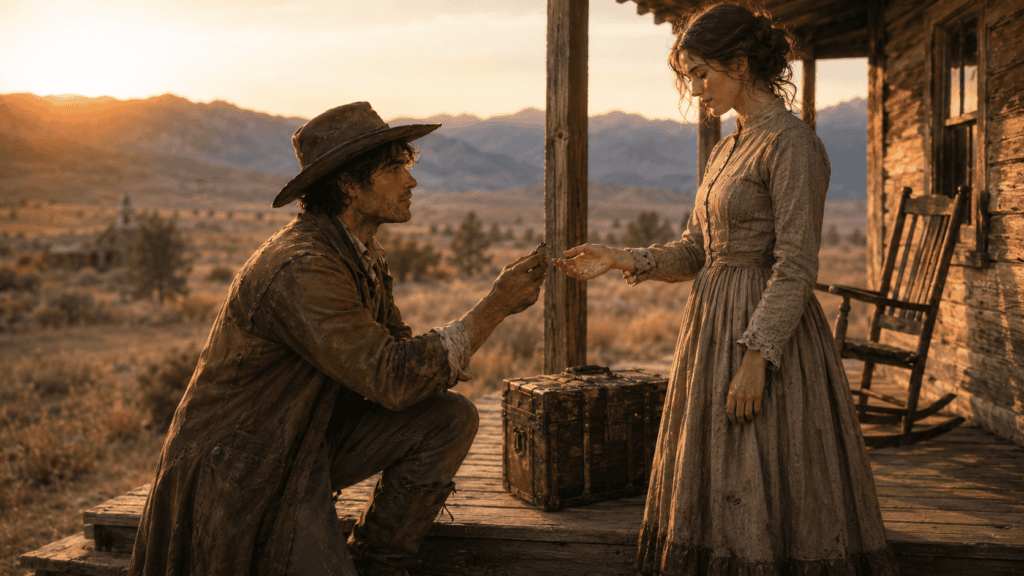
“Give me a moment,” he said, and before the preacher could object, Thomas walked to the fence line at the edge of the yard, drew his knife, and cut a short length from the top rail of a post he had set himself the summer before — a post of ash wood, pale and close-grained, silvered a little by weather but sound clear through. He worked it there in the yard while Mara and the preacher and the hands all stood watching, his hands quick and certain with the blade, shaving the wood down, rounding it, and in perhaps ten minutes’ time he came back up the porch steps holding out a plain wooden ring, still faintly warm from the friction of his own hands shaping it, smelling of fresh-cut wood and the oil he’d rubbed into it from his own skin to smooth the grain.
“It’s not what you ought to have,” he said, low, just for her, though everyone on that porch could hear it plain. “I’ll send for a proper one soon as I’m able. But I didn’t want you standing here with nothing on your hand when the preacher says the words.”
Mara looked at the ring in his palm — rough still in places, a little uneven, cut in ten minutes from a fence post by a man who had never carved anything finer than a hitching post in his life — and she thought of the silver spoons she had sold to get here, of the smiling man in Springfield who had looked at her like a column of figures to be collected, and she held out her hand.
“I’d rather have this,” she said, “than anything from a catalog.”
He slid it onto her finger. It fit close enough, a little tight over the knuckle, and she did not care. The preacher said the words, and the light went gold and long across the yard, and when Thomas kissed her — brief, careful, as though he were afraid of asking more than she’d agreed to give — she felt the rough wood of the ring against her cheek where her hand had come up without her deciding it, and she thought that whatever else happened in this hard, wide country, she had married the right kind of man.
Summer came on, and with it work enough to fill every waking hour — haying, the garden Mara had planted coming in stubborn and green, a new calf crop to brand, the long light evenings when Thomas taught her, patient and wordless mostly, to sit a horse properly instead of sidesaddle like a lady, because a woman on a ranch who couldn’t ride astride was a woman who’d be no use in an emergency, and he said so plainly, without unkindness, the first time he saw her flinch at the idea.
“You’ll thank me for it,” he said, “the first time a fence goes down at the far pasture and there’s no one else to ride for it.”
“I don’t doubt it,” she said. “I only mind looking foolish learning.”
“Nobody out here to see you but me and the cattle,” he said, “and I promise you the cattle won’t say a word about it,” and that was as close as Thomas Calder ever came to teasing her, but it made her laugh out loud in the dusty corral, and he watched her laugh with an expression she was beginning to recognize — something careful and hungry both at once, a man watching a thing he wanted badly and was afraid, still, to reach for too fast.
They did not speak of love. It was not the kind of word that came easily to either of them — Mara because she had learned love was a thing people claimed and then withdrew when it suited them, Thomas because he simply did not trade in words he had not earned the right to say. But she saw it in the way he left the good cut of meat for her plate and took the tougher piece for himself without comment. She saw it in the way he’d taken to leaving his boots by the door instead of tracking mud through her clean-swept floor, and the way he’d started whittling, of an evening, small useless things — a bird, a fish, a comb with crooked teeth — and leaving them on the kitchen table where she’d find them in the morning, never once handing one to her directly, as though the giving itself embarrassed him and he preferred to let the object speak for him.
She kept every one of them in the drawer of her dresser, wrapped in a handkerchief, the way she had once wrapped her mother’s spoons.
By August she loved him. She knew it the night a summer storm came through hard and sudden, lightning cracking blue-white over the western ridge, and Thomas had been out checking the stock and came in soaked through and shaking with cold, and she had stripped his wet shirt off him without a word and wrapped a blanket round his shoulders and sat with him by the stove until the shivering stopped, her hand resting flat against his chest where she could feel his heart going hard and fast beneath her palm, and he had looked at her in the low firelight with an openness she had not seen in him before, unguarded, and said, “I don’t know what I’d have come home to, all these years, if you hadn’t answered that advertisement.”
“You’d have come home to one plate on the table,” she said, “same as always.”
“I know it,” he said. “That’s what I mean.”
She had kissed him then, first, her hand still flat over his heart, and he had kissed her back like a man finally allowing himself something he’d been rationing for years, and that had been the true beginning of their marriage, whatever the preacher’s words on the porch had legally made of it — that storm-lit night, her hand on his chest, the wooden ring on her finger catching the firelight.
The trouble came in September, on a hot dry afternoon when the light lay flat and yellow over the yard and Mara was hanging wash, and a rider came up the road she did not recognize, and something in her stomach went cold before she even saw his face clearly, the way a body sometimes knows danger before the mind has caught up to name it.
It was Silas Pruitt. Older than she remembered, thinner in the face, but unmistakably him, sitting his horse with the same too-easy posture of a man who believed the world generally arranged itself to suit him.
“Miss Doyle,” he said, reining up at the fence, and then, seeing the ring on her hand as she lowered the wet shirt she’d been pinning, “Mrs. Calder, I should say. You’ve done well for yourself, coming all this way to find a husband. Saved me the trouble of writing to ask where you’d got to.”
“Mr. Pruitt.” Her voice came out steadier than she felt. “You’ve come a long way for nothing. The debt’s paid. I sent the last of it in June.”
“The debt on your father’s note, yes.” He smiled the smile she remembered, the one that never reached past his mouth. “That’s paid clear, I’ll grant you. But your father signed more than one paper before he died, Miss Doyle — Mrs. Calder — and there’s a second note, cosigned in your name when you were sixteen years old and hardly knew what you put your hand to. Two hundred dollars more, with six years’ interest compounding, which by my figuring comes to something near four hundred again.” He drew a folded paper from inside his coat and held it out, not quite close enough for her to take without stepping toward him. “I’ve come to collect, one way or another. I’d have preferred you came quiet, back to Springfield, and we settled it there like reasonable people. Since you’ve married yourself into property instead, I expect your husband can settle the account, or I’ll be forced to take the matter to a judge, and a judge is like to look hard at a wife who left the state owing money and never said a word to her new husband about it.”
Mara’s hands had gone cold despite the September heat. She did not remember any second note. She had been sixteen the year her father’s business first began to fail, sixteen and grieving her mother and trusting her father entirely, and it was entirely possible — it was, God help her, entirely plausible — that she had signed something in that terrible year without understanding it, the way children sign what desperate parents put in front of them.
“I don’t recall any such paper,” she said.
“Wouldn’t expect you to. You were young, and your father was pressed, and men do things when they’re pressed that they wouldn’t otherwise.” Pruitt’s eyes went past her to the house, to the barn, to the good fat cattle in the near pasture, cataloging it all the way he had once catalogued her father’s furniture. “I’ll be at the hotel in town three days, Mrs. Calder, to give you time to discuss it with your husband. After that, I go to the judge, and it becomes a matter of public record — the debt, and how you came to leave Springfield in such a hurry without settling it. I imagine your husband would rather avoid that particular embarrassment, married man of standing that he is.”
He touched his hat brim, turned his horse, and rode back the way he’d come, leaving Mara standing in the yard with a basket of half-hung wash and a cold, sick certainty that whatever peace she had built in this house over the summer was about to be tested by the one thing she had never told Thomas — not the debt itself, which was ugly enough, but the shame underneath it, the sixteen-year-old girl who had signed something she didn’t understand and had spent every year since trying to outrun it.
She did not tell Thomas that evening. She told herself it was because she needed to think first, to find some way through it before she burdened him with it, but the truth, when she was honest with herself lying awake beside him in the dark, was that she was afraid — afraid of the look that might come into his face when he learned she’d married him with a debt collector on her trail and had said nothing, afraid that a man who valued plain dealing above all things would see her silence as a kind of lie, even if she had told no actual falsehood.
She rode into town herself the next morning, before Thomas woke, telling the hand who saddled her horse only that she had an errand.
Silas Pruitt received her in the hotel’s small parlor with the same easy smile, and this time she did not let herself go cold in front of him.
“Show me the note,” she said.
He produced it, and she read it carefully, twice, and something in her chest steadied even as her stomach turned, because she recognized, now that she looked at it plainly in daylight instead of catching it in a folded glimpse in the yard, that the signature on the paper was not quite her own. It was close — close enough to have fooled her for one frightened moment in the yard — but she had signed her name ten thousand times since she was a girl, on ledgers and letters and the register at church, and she knew the particular slant of her own D, the way she looped her y, and this signature’s y did not loop the way hers did. It was a forgery, done by someone who had studied her hand but had not quite captured the whole truth of it.
“This isn’t my signature,” she said.
“That’s a serious accusation to make against a note properly witnessed and filed,” Pruitt said, though something flickered behind his easy smile now, some small crack of uncertainty.
“It’s a serious thing to forge a girl’s name to a debt she never owed,” Mara said, and stood, and found that her hands, for the first time since he’d ridden up to the fence, were not shaking at all. “I paid every cent my father honestly owed you, Mr. Pruitt, and I have the receipts to show it, sent and signed by your own hand acknowledging each payment. I’ll be taking this paper to the circuit judge myself when he comes through, and I’ll be taking my receipts along with it, and we’ll let him decide whose signature is whose. In the meantime, you’re not welcome at my husband’s ranch, and if you ride out there again, he’ll have something to say to you that won’t involve any paper at all.”
She left him sitting in the parlor with his mouth slightly open, and she rode home with her back straight and her heart hammering, not from fear now but from something closer to triumph, and it was only when she reached the top of the ridge above the house and saw Thomas standing in the yard, clearly having noticed her horse gone and come looking, that the triumph gave way to a colder feeling — the understanding that she still had to tell him all of it, and that the telling could not wait another day.
She told him that evening on the porch, in the two chairs side by side, the whole of it — her father’s debt, the sixteen-year-old girl who might have signed something she didn’t understand, Pruitt’s smiling threats, the forged note, her own silence these past months out of fear of exactly this moment.
Thomas listened without interrupting, his jaw set, his eyes on the darkening yard rather than on her, and when she finished, the silence that followed was the first silence between them that had ever frightened her.
“You should have told me the day he rode up,” he said finally.
“I know it.”
“Not because I’d think less of you for a debt you didn’t make and a father who left you holding it.” He turned to look at her now, and his face was not angry, she saw, but something more wounded than angry, which was somehow worse. “Because you’re my wife, and a man can’t stand beside you against a thing he doesn’t know is coming. I’d have ridden into town with you today instead of you facing that man alone.”
“I didn’t want you thinking you’d married trouble,” Mara said, and heard how small it sounded even as she said it.
“I married a woman who sold her mother’s spoons and crossed half a country alone rather than let a man like that own her,” Thomas said. “That’s not trouble, Mara. That’s the same grit that turned my kitchen garden from weeds to vegetables and taught herself to sit a horse in a summer and held my arm together with her own two hands when I was too proud to ask for help. I don’t scare off that easy. But I won’t have you carrying a thing like this by yourself again, understand? Whatever comes at this house comes at both of us now.”
He reached over and took her hand, the wooden ring rough under his thumb where he rubbed it, once, like a man checking that a thing he valued was still solidly in place, and Mara felt something in her chest that had been clenched since the day her father died finally, fully let go.
“The judge comes through in eight days,” she said. “I mean to be ready for him.”
“Then we’ll be ready together,” Thomas said, and that was the whole of his forgiveness and his vow both, plain as everything else about him, and worth more to Mara than any speech a more talkative man might have given.
The eight days that followed were not idle ones. Mara wrote to the boardinghouse keeper back in Springfield, a sharp-eyed widow named Mrs. Aldrich who had watched Mara grow from a girl of sixteen into the young woman who left for Montana, and asked her to search her records — for Mrs. Aldrich, ever thrifty, kept every receipt and letter that passed through her house, including, Mara remembered now with a rush of hope, the correspondence Mara’s father had kept in a strongbox that Mrs. Aldrich had held onto after his death, since Mara had had no proper place to store it at the time.
Thomas rode to the county seat himself and spoke to a lawyer he knew slightly from cattle business, a careful, unhurried man named Pratt who examined the forged note under a glass and confirmed what Mara had already seen — the signature did not match Mara’s known hand in several particulars, and moreover, he pointed out, the note was dated for a year in which, by the county’s own land records, Silas Pruitt had not yet been licensed to conduct lending business in the state of Ohio at all, a detail Pruitt had evidently not thought anyone in Montana Territory would trouble to check.
And Mrs. Aldrich, God bless her thrifty heart, wrote back within the week with a bundle of Mara’s father’s papers, among them a ledger in his own hand recording every debt he owed and to whom, and nowhere in it, across four painstaking pages, was there any second note to Silas Pruitt for two hundred dollars. There was only the one debt, the one Mara had paid in full, each payment logged and receipted in Pruitt’s own hand.
“He forged it after your father died,” Thomas said, reading it over at the kitchen table by lamplight, “counting on you being too far off and too frightened to check close. Man like that’s done it before, I’d wager, to some other girl with no one to stand beside her.”
“He’s not counted on you,” Mara said.
“No,” Thomas agreed. “He hasn’t.”
The circuit judge held his court in the back room of the mercantile, as he did twice a year, and the whole small town turned out for it the way they turned out for anything that broke the monotony of the season — farmers and ranch hands and the preacher and the mercantile owner’s wife, all crowded in to watch Silas Pruitt’s face when Thomas Calder laid Mara’s father’s ledger on the table before the judge, followed by the receipts in Pruitt’s own hand, followed by the lawyer Pratt’s sworn statement regarding the licensing dates, followed last of all by Mara herself, standing straight in her one good dress with the wooden ring plain on her hand, describing in a clear, steady voice exactly how Silas Pruitt had ridden up to her husband’s fence and threatened to take her land and her marriage and her good name over a debt that existed nowhere but in his own greedy invention.
Pruitt tried, at first, to bluster it through — a misunderstanding, an honest error in his records, a note perhaps misdated by a careless clerk — but the judge was an old man who had seen every variety of liar cross his makeshift courtroom over thirty years on the circuit, and he had the particular patience of a man who enjoyed, in a quiet way, watching a bully’s story come apart thread by thread.
“Mr. Pruitt,” the judge said finally, laying the forged note down on the table with two fingers, as though it might dirty him, “you’ve traveled a long way to collect a debt on a note you weren’t licensed to write, in a signature that doesn’t match the woman’s own hand, for an amount she never received and never spent. I find that troubling in a man of your profession. I find it a good deal more troubling that you thought to collect it not from the lady herself, who has clearly demonstrated she’s more than capable of managing her own affairs, but by threatening to shame her before her husband, in the evident hope that shame would do your collecting for you.” He folded his hands. “This debt is void. And I’ll be forwarding a note of my own, to the licensing board in Ohio and to the sheriff in this county both, regarding your conduct, so that the next young woman you think to frighten might have an easier time of it than Mrs. Calder was nearly made to have.”
Pruitt’s face, through all of this, went through several colors, ending on something gray and thin, and when the judge dismissed the matter, he left the mercantile without another word to anyone, and rode out of the territory that same afternoon, and was never seen in that country again.
Mara stood in the crowded little room afterward, accepting the nods and murmured congratulations of neighbors she was only beginning to know, and felt Thomas’s hand come to rest at the small of her back, steady and warm, not holding her up — she had not needed holding up, not through any of it — but simply there, the way he was always simply there, a fact as solid and unremarkable as the ground itself.
“You did that,” he said quietly, once they were outside in the afternoon light, the crowd dispersing behind them. “The ledger, the letters, the lawyer — you built the whole case before that man even knew you were building it.”
“I had help,” Mara said.
“You had a husband who rode to town and fetched a lawyer,” Thomas said. “You had the rest of it in you already. I only watched you use it.”
They rode home together in the long gold light of early evening, the same light that had lain over the yard the day they married, and when they came up over the last rise and saw the house below them — small and square and honest, smoke curling thin from the chimney where the banked fire still smoldered, the two porch chairs sitting side by side in the shadow of the eaves — Mara felt something settle in her chest that she understood, now, was simply peace. Not the absence of trouble, for trouble would come again in one form or another, the way it came to every life lived close to the land. But the peace of knowing she would not face it alone, that whatever came up that road toward the house, there would be two of them standing in the yard to meet it, and that was worth more than any sum Silas Pruitt or any man like him could ever have named.
That evening, after supper, Thomas went out to the barn for a while and came back with something wrapped in a piece of cloth, and set it on the table in front of her without ceremony, the way he set down everything that mattered most to him.
Inside the cloth was a ring — a proper one this time, gold, thin and plain, the kind a man might order from a catalog and wait weeks for, and Mara understood, turning it over in the lamplight, that he had sent for it back in the spring, before Pruitt ever rode up to the fence, before any of the trouble had come — that he had been carrying it, waiting for the right evening, this whole while.
“Was going to give it you before all this business started,” he said. “Then it seemed the wrong time, with everything else pressing. Didn’t want you thinking I was trying to buy off worry with a bit of gold.”
“You could give me a ring made of barbed wire and I’d wear it,” Mara said, “so long as it came from you.” But she did not take off the wooden one. She held out her other hand instead, and Thomas slid the gold ring onto that finger, so that she wore both at once — the fence-post ring, rough and plain and cut in ten desperate minutes by a man determined she’d have something to wear before the preacher’s words were even finished, and the gold one beside it, ordered and waited-for and given now in a quieter hour, once the trouble had passed and there was room again for tenderness instead of survival.
“I’ll not take the other one off,” she said. “Not ever. I don’t care that it’s rough. It’s the truest thing anyone’s ever given me.”
Thomas looked at her a long moment in the lamplight, and something moved across his face that was not the almost-smile she’d grown used to but the whole of it, unguarded, the way she’d seen it only once before, the night of the storm.
“Then I reckon we’ll grow old with you wearing both,” he said, “and I won’t argue the matter.”
They did grow old there, in the years that followed, though that particular evening could not have known it yet — grew old through hard winters and good calving seasons and one lean year when the cattle prices fell and they lived thin and careful and never once spoke a cross word to each other over it, grew old through the births of two children who filled the house with noise Thomas had once thought he’d never hear again, grew old through the slow accumulation of a life built plank by plank the way Thomas built everything, without hurry, without waste, with care taken over every joint.
And on quiet evenings, when the children were grown and gone to their own places and the ranch had settled into the easy rhythm of two people who had spent forty years learning each other’s silences, Mara and Thomas Calder still sat on the porch in the two chairs, side by side, facing west toward the mountains that had turned blue and gold in that same particular light every evening of their marriage.
Her hands, spotted now with age, still wore both rings — the gold one worn smooth and thin from decades of wear, and beside it the ring of ash-wood fence post, gone dark and satiny with the oils of fifty years’ handling, the wood so worn now it had taken on almost the softness of cloth, though it had never once cracked, never once failed to hold its shape, the way the man who had carved it in ten frantic minutes on their wedding evening had never once, in all the years since, failed to hold his.
“Still don’t regret it,” Thomas said one such evening, not looking at her, watching the light go down gold behind the ridge the way he always did, “marrying a stranger off a train, sight unseen.”
“I was never a stranger,” Mara said. “I was just waiting for somebody to notice me.”
“I noticed,” Thomas said. He reached over, the way he had reached over ten thousand evenings before this one, and found her hand, the wooden ring rough and familiar under his thumb, and held it there in the last of the light, two chairs on a clean-swept porch, a house behind them full of everything they had built together out of nothing but plain dealing and patience and one small, deliberate kindness offered on a cold spring afternoon to a woman who had stepped off a train expecting nothing at all, and been given, instead, a whole life.
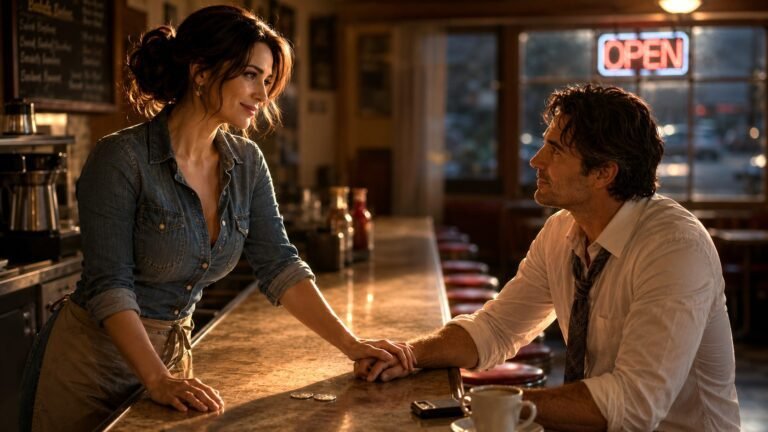
Heartfelt characters sharing love, emotions, and romantic journeys filled with hope, trust, and unforgettable bonds