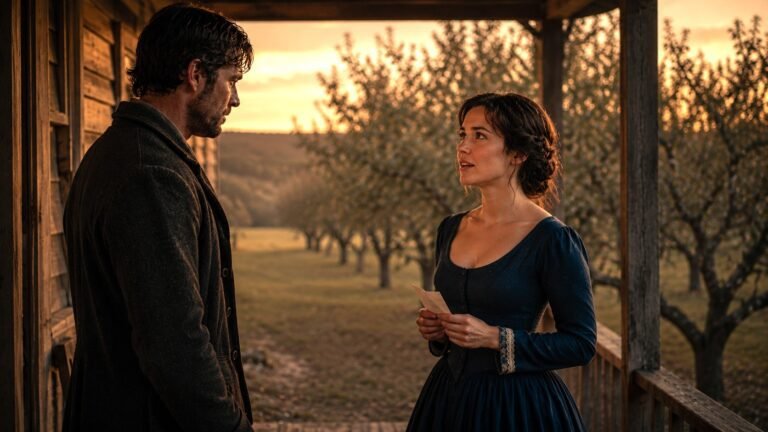

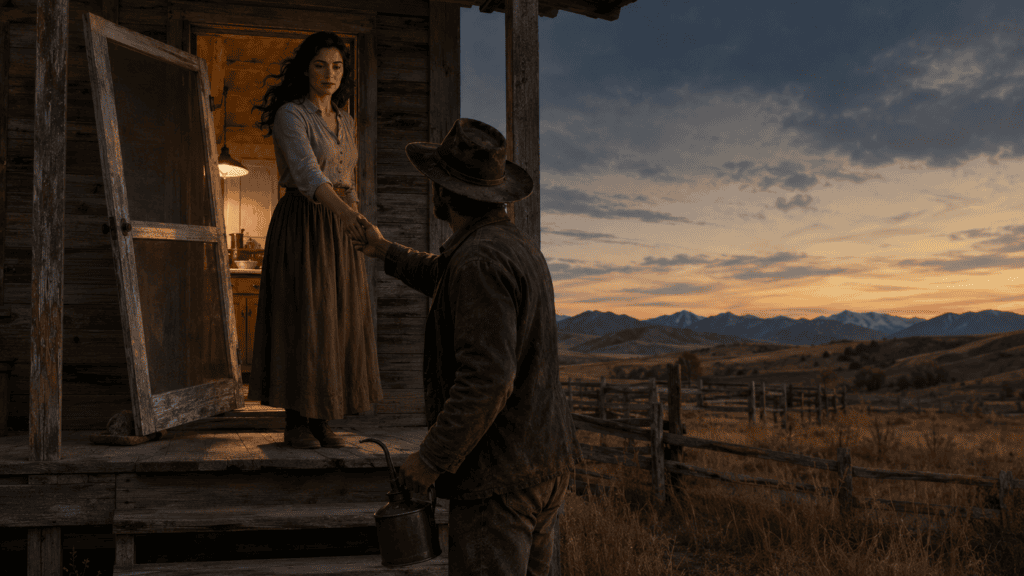
The house sat alone on the bench above Otter Creek, sixty miles from anything a person could call a town, with the Judith Mountains going blue and then black behind it as the light dropped out of the sky. September had burned the grass to the color of an old dog’s coat. The wind came down off the bench most evenings around six and did not let up until well past dark, working at the eaves, worrying the screen door in its frame so that even hooked, even checked twice, it shuddered in its little rectangle of night.
Read more: The Cowboy Wanted a Wife Who Could Ride — But the Woman Who Arrived Left Him SpeechlessEvery night before the lamp went out, Wes Calder crossed the kitchen in his sock feet and hooked the screen door. It was a small brass hook, gone green at the eye, and it caught in its loop with a sound like a tooth clicking shut. He tested it once with two fingers, a light tug, and then again, harder, the way a man checks a cinch he does not quite trust. The door itself hung a half-inch crooked in its frame, had for years, and no amount of planing had ever fixed it. He had stopped trying. He only made sure of the hook.
He had built a life around not listening to that particular sound.
Mornings he was up before the sky had any color to it, moving through the kitchen in the dark by memory alone — three steps to the stove, the coffee can on the second shelf, the enamel pot with the chip in its lip that he always set down chip-side facing the wall. He did this without deciding to. He had done it long enough that the deciding part of it had worn away, the way water wears a channel into rock until the water forgets it is choosing a path at all and simply runs there.
There was a second cup, white with a blue rooster on it, that lived behind the flour tin and had not been taken down in eight years. He was not a man given to shrines. He had told himself this more than once, standing in front of that cupboard with his hand not quite reaching for the rooster cup, and then reaching instead for his own, the plain one, and shutting the cupboard door.
The ranch ran eleven hundred head of cattle across four sections of leased range and two of deeded, and he ran it alone except for a boy named Purcell who came up from the Sanders place three days a week when he wasn’t in school, and old Ott Bruner, who had cowboyed for Wes’s father and now mostly sat on the fence rail and told him things he already knew. Wes did the branding himself in spring with whatever hired hands he could scrape together, did the haying alone on the swather from first light till the dew came back at dusk, mended fence alone, broke ice on the stock tanks alone through the winter with an axe that had a taped handle because he could not bring himself to replace it either.
There had been a woman. Her name did not get said aloud on the place anymore, not by him, not by Ott, who had learned the hard way, early on, that certain words in that kitchen were like striking a match too near a gas can. She had married him at twenty-three and left at thirty, and the manner of her leaving was the kind of thing a man could turn over in his hands for the rest of his life and never wear smooth. She had gone in the night, in April, with the calving only half done, and the last thing he had of her going was the sound of the screen door slapping in the wind at three in the morning, unhooked, banging itself against the frame until he woke and lay there a long moment not getting up, because some part of him already knew, before he ever crossed the kitchen and found the driveway empty of her car, what that sound meant.
He had fixed the hook the next week. He had never again gone to bed without checking it.
It was Ott who suggested the ad, sitting on the corral rail with a matchstick going gray between his teeth, squinting at Wes stringing wire in a wind that made the job take twice as long as it should have. Get somebody up here who can carry a share of the work, Ott said. A wife, not a hand. Somebody who can ride and cook and won’t need explaining twice. There’s women placed ads like that and got good marriages out of it, out past Miles City, out toward Ekalaka. Practical women. Women who know what a ranch costs a person and aren’t looking for the ranch to be something it isn’t.
Wes had said nothing for the better part of a week. Then, on a Tuesday, with the wind down for once and the light coming in low and gold across the stubble, he sat at the kitchen table with a pencil and a torn half-sheet of paper and wrote it out four times before he had something he could stand behind.
Rancher, 41, eastern Montana, seeks capable woman for marriage. Must ride, must work, must not need the truth softened. No romantics.
He mailed it to the paper in Lewistown that carried the classifieds three counties wide, and on the way back from the post office he did not let himself think about what kind of woman answered an advertisement like that, or why the wording of it — must not need the truth softened — had come out of him so fast, ahead of anything he’d meant to say, like a confession slipping out under a door that was supposed to be shut.
That night he hooked the screen and tested it twice, and lay listening to the wind take a run at the house the way it always did, and did not sleep for a long while, and told himself it was only the wind he was listening for.
She came up the county road on the Thursday two weeks later in a truck that was not hers, driven by a mail carrier named Pete Aldous who had picked her up hitching from the bus depot in Roundup because there was nothing else moving that direction and it did not sit right with him to leave a woman standing at a crossroads with one suitcase and no coat suited to the wind. Wes was up on the loading chute working a gate hinge loose with a can of oil and a pair of pliers when the truck came up the two-track, throwing dust, and he straightened and watched it come the way he watched any unfamiliar vehicle, which was to say carefully, with one hand resting near the top rail.
The woman who got out was not what the word ride had built in his head. She was maybe thirty-five, dark-haired, in a wool coat too thin for the country and shoes that had been chosen for pavement, and she stood by the truck a moment taking in the shape of the place — the barn, the windbreak of Russian olives gone silver in the wind, the mountains behind everything like a held breath — with an attention that was not quite fear and not quite wonder but something adjacent to both.
Her name was Della Voss. She said it before he asked, walking toward him across the yard with her hand already out, which caught him off guard enough that he wiped his palm on his jeans before he took it.
“You’re the one placed the ad,” she said. It wasn’t a question. “The one about riding.”
“That’s right.”
“I should tell you now and save you the trouble of finding out. Never been on a horse in my life. Grew up in Billings, in town, in an apartment over a hardware store. My father sold insurance.” She said this evenly, without apology, watching him the way a person watches to see whether a door is about to close. “I can cook. I can keep books — kept them for a feed lot outside Roundup two years, before it folded. I can work harder than I look like I can. But I answered that ad knowing I couldn’t do the one thing you asked for, and I thought you ought to hear it from my mouth before you decided anything else about me.”
Wes stood with the pliers still in his hand and did not say anything for a moment. The wind moved the fine dark hair that had come loose from its pins at her temple. Somewhere behind him a horse blew and stamped in the corral.
“That’s an honest way to start,” he said finally.
“It’s the only way I’ve got the patience for anymore.”
He looked past her at Pete Aldous’s truck idling in the yard, at the one suitcase she’d set down in the dirt, small and cheap-looking and packed, he could tell by the way it sat, with more books than clothes.
“You want coffee,” he said. It came out less a question than the door held open a certain way. “Or you want to stand out here and finish deciding whether I’m worth the walk up to the house.”
Something crossed her face then, quick, and gone before he could name it — not quite a smile, but the shape a smile leaves in a person’s face on its way somewhere else.
“Coffee,” she said, “would be the first sensible thing anybody’s offered me all day.”
In the kitchen he took down the plain cup out of habit, and then, without entirely understanding why his hand did it, reached past it and took down the one with the blue rooster instead, and set it in front of her, and did not explain, and she did not ask, though she looked at it a moment longer than the cup required.
The coffee had gone bitter sitting on the back burner since morning and he apologized for it, and she said bitter coffee had never killed anybody her family hadn’t already lost to something else, which was a strange enough thing to say that he laughed before he could stop himself, a short surprised bark of a sound that seemed to startle them both, him more than her.
“You laugh like a man who doesn’t get much practice at it,” she said.
“I don’t.”
“I’ll try not to hold it against you.”
Outside, a colt Ott had been gentling got loose from its lead in the round pen and came tearing past the kitchen window at a dead run, tail up, ears pinned in pure animal delight at its own freedom, and Della set her cup down and watched it go with an expression so unguarded, so entirely without calculation, that Wes found himself watching her instead of the horse. When it wheeled and bucked twice and shot off toward the far fence, she laughed — not politely, not the laugh of a guest being agreeable, but a real one, surprised out of her, both hands coming up to her mouth.
“He looks,” she said, “like he’s just remembered something wonderful and can’t decide what to do about it.”
“That’s about the size of it,” Wes said, and did not tell her that he had not seen that particular animal run flat out and joyful like that in the three weeks since Ott had started working him, and did not tell her, either, that something in his own chest had just done something similar, some small ungainly buck against a fence it had long since stopped testing.
She stayed the night in the spare room, which had been his mother’s sewing room once and still smelled faintly of cedar and machine oil, and in the morning she was up before he was, standing at the stove in yesterday’s clothes with her hair pinned back properly this time, frying eggs in the black skillet like she’d done it in that kitchen a hundred mornings already.
“I don’t ride,” she said again, not looking up from the skillet, “but I imagine that’s a thing a person could learn, given a reason good enough.”
Wes stood in the doorway a moment, in his sock feet, the screen door behind him still faintly ticking from where the wind had rocked it against its frame in the night, and found that he did not, for once, have anything practical to say back.
October settled over the bench in long gold afternoons that fooled a person into forgetting how close the snow was. Della stayed on. There had been no talk of marriage yet, not directly — the word sat between them the way a gate sits closed but not latched, something either of them could have pushed through at any time and did not. She kept the books. She kept the house in a way it had not been kept since before the leaving, not fussy, but attentive, the way a person tends something they have decided, privately, is worth tending. She learned to gentle bread dough with the heel of her hand the way his mother once had, though nobody taught her that; she simply watched the kitchen for what it wanted and gave it that.
And she asked, most evenings, to be taught to ride.
He started her on Dolly, a sorrel mare gone gray at the muzzle and steady enough to teach children on, walking beside them the first week with a hand loose on the cheek strap though Della never once needed it. She sat a horse the way she did most things, he noticed — not fearless, exactly, but unwilling to let the fear be the one steering. By the second week she could walk and jog a slow circle of the round pen without his hand on the horse at all, and by the third she asked him, flat out, mid-lesson, whether he thought she’d ever be good enough to ride out with him to check the far fence line, the one that ran along Otter Creek two miles east, out past where the land dropped into coulees, out where a person could go a whole afternoon without seeing another soul.
“Good enough’s not really the measure,” he said, adjusting her stirrup though it did not need adjusting, an excuse to stand close a moment, his hand brushing her boot. “It’s more whether you trust the horse under you enough to stop watching your own hands.”
“And if I don’t.”
“Then you watch your hands a while longer. Nothing wrong with that. Man who doesn’t watch his hands long enough is the one gets thrown.”
She was quiet a moment, looking down at him from the saddle, the low sun behind her so he had to squint to find her face in it. “Is that a thing you’re telling me about riding,” she said, “or a thing you’re telling me about something else.”
He did not answer right away. Somewhere off past the barn a meadowlark was working through its evening song, three notes and a trill, over and over, the way it had every evening that week, as if it had not yet gotten the song right and meant to keep trying until dark. “Might be both,” he said finally, and went back to a stirrup that had never needed him.
They took to sitting on the porch after supper those weeks, not talking much, the coffee going cold between them, the dark coming down slow and blue over the mountains. There was a particular kind of quiet that had grown up between them by then, not the flat silence of two people with nothing to say, but something with weight and give to it, like the silence in a barn at night when the animals have settled and a person can hear the whole structure breathing around him. She would sometimes start a sentence and let it go unfinished, and he had learned not to press her to close it, the way she had learned not to press him about the second cup she’d found behind the flour tin the first week and never once mentioned, not directly, though he’d seen her notice it, seen the small recalibration in her face, and watched her choose, deliberately, kindly, to let it lie where it was.
“There was somebody,” she said once, out of nothing, out of a long stretch of porch-quiet, not looking at him but out at the dark shape of the barn. “Before Roundup. Before any of this. It ended the way things end when two people want different sizes of the same life.” She turned her cup in her hands, not drinking from it. “I’m not telling you that to hand you a story you have to do something with. I’m telling you because I think you’d rather know a thing plain than have it come up sideways on you later.”
“Appreciate it,” Wes said, and meant it, and did not ask the questions that were sitting right behind his teeth — what his name was, how long it had lasted, whether she still — because some doors a man learns not to push on even when they are not latched, especially then.
He did not offer his own story back. She did not ask for it. But two nights later, mending a bridle at the kitchen table by lamplight while she read at the other end of it, he found himself talking anyway, low, not quite looking up from the leather in his hands, about a woman who had married him at twenty-three, about an April with the calving half done, about a screen door banging in the wind at three in the morning and the particular quality of a driveway with nothing in it. He did not say left and he did not say why, because he did not, even now, have a satisfying answer to the why of it, only the fact, only the door.
Della did not reach for his hand across the table. She let the story sit in the room a moment, the way a person lets bread sit before cutting it, and then she said, “That’s why the hook. Every night.”
“That’s why.”
“You could’ve told me that the first week,” she said, gently, not an accusation, closer to an offering.
“Could have,” he agreed, and went back to the bridle, and did not say the rest of it, which was that telling her felt like handing over the one tool he had left for keeping a door shut, and some nights lately he had lain awake wondering whether he wanted it shut at all anymore, or whether he had simply forgotten, in eight years of checking that hook, that a door could also be opened on purpose, by a person standing on the inside.
The first snow came in early November, a dry skiff of it that didn’t stick, dusting the stubble fields silver before noon burned it off. They rode out that morning anyway, out along the creek, out toward the coulees, Della sitting Dolly easy now, her hands quiet on the reins the way his had gone quiet years back when he stopped watching them. They stopped at the fence line and did not fix anything, because nothing there was broken, and sat their horses a while in the cold bright air looking at the long fall of land toward the river breaks, blue and endless, and neither of them said much of anything, and it was, Wes thought, without letting himself think it too hard, the fullest kind of quiet he had known in longer than he could easily count.
“I keep waiting,” Della said finally, watching a hawk work the thermals above the coulee, “for you to ask when I’m leaving.”
“I know it.”
“You haven’t.”
“No.”
“Why not.”
He was quiet long enough that she turned in the saddle to look at him. “Because I’m not sure I want the answer,” he said, “and a man learns, after a while, which questions are worth the risk of asking.”
She held his eyes a moment, something moving behind her own that he could not entirely name, and then looked back out at the hawk, and neither of them said anything more about it, and the not-saying sat between them the whole ride home, warmer than it had any right to be, given what it was.
The letter came on a Tuesday with the rest of the mail Pete Aldous dropped at the box down by the county road, and Wes brought it up to the house along with the seed catalog and the light bill without looking twice at the return address, which was a law office in Billings, and set the stack on the kitchen table where Della found it that evening.
He was out at the barn when she opened it, and so he did not see her face change, did not see the particular stillness that came over her reading it, a letter from her sister’s estate lawyer about a house in Billings that had finally cleared probate, a house that was, as of that Tuesday, hers to sell or keep. He came in an hour later to find her on the phone in the front room, her back to the door, her voice pitched low and careful in the way of a person choosing words meant for someone else’s comfort.
“I don’t know yet,” he heard her say. “There’s things here I’d have to think about. I’m not saying no. I’m saying I need time before I decide anything.” A pause. “It isn’t that simple anymore. I know it used to be that simple. It isn’t now.” Another pause, longer. “When I’ve settled it, I’ll come. I’m not asking you to wait on me forever, only long enough to do this right.”
Wes stood in the doorway with a fence stretcher still in his hand and heard exactly enough to build the wrong house out of exactly the right bricks. When I’ve settled it, I’ll come. He did not hear the rest, did not hear her explain to her brother-in-law, two hundred miles away, that the house would be sold and the money split three ways among nieces who needed it more than she did, did not hear her say his own name, once, low, the way a person says a thing they are still deciding whether they have the right to.
He set the stretcher down without a sound and went back out to the barn, and did not come in for supper, told Ott some fence needed looking at that could easily have waited till morning, and worked in the cold dark by lantern light on wire that did not need mending, because the alternative was standing in that kitchen watching for the exact shape of a leaving he had already, eight years ago, learned by heart.
Della found him there past nine, his breath showing in the lantern light, his hands raw from wire he’d been pulling too hard.
“You’ve been out here three hours.”
“Fence needed it.”
“Wes.” She said his name the way a person tests ice, one careful foot. “That fence didn’t need anything.”
He did not look up from the post he was setting. “Heard some of your call,” he said, and the words came out harder than he’d meant them, flat, a door closing rather than a hand extended. “Didn’t mean to. Heard enough.”
Something in her face went very still. “Then you heard the start of it and not the middle, and you’ve already built the ending in your head, haven’t you. I can see it. I can see you doing it right now, standing there.”
“Man doesn’t need much of a story to know how one like that usually finishes.”
“That isn’t fair.”
“Maybe not.” He drove the post deeper than it needed, the mallet ringing off the frozen ground. “Maybe it’s just familiar.”
She stood a long moment in the cold with her arms wrapped against herself, waiting for him to say more, to ask, to open the one door that would have let the truth in, and he did not, because some old machinery in him had already begun doing what it knew how to do, which was to make the leaving his own idea, to get there first, to latch the hook before the wind could get a hand on it. She went back inside without another word, not from anger, he understood later, but because there is only so long a person can stand in the cold holding a door open for someone who will not walk through it.
He did not go in for a long while after that. When he finally did, the lamp in the sewing room was out, the house dark and close around him in a way it had not felt in weeks, and the second cup, the one with the blue rooster, sat washed and upside down in the drying rack, and something in the ordinary sight of it sat wrong in his chest, though he could not, standing there in his sock feet in the dark kitchen, have said exactly why.
He hooked the screen door. Tested it twice. Lay awake a long while listening to the wind take its usual run at the house, and this time it did not sound like weather. It sounded like a question he had already, badly, answered.
She was gone before light two mornings later, not fled in the night the way the last one had gone, but plainly, deliberately, her suitcase by the door and a note on the kitchen table in handwriting gone tight and careful, the handwriting of a person keeping something contained. Pete Aldous’s truck again, the same rattling engine, the same dust rising off the two-track and hanging a long while in the still cold air after it had gone, and Wes stood at the window with the note unread in his hand for the better part of a minute before he could make himself unfold it, and even then the words did not arrange themselves into anything he could hold onto, only the shape of a door, closing, from the outside this time, by his own hand though he had never once touched it.
The note said only that she had gone to see about a house in Billings, that it wasn’t right to leave a thing like that unsettled between them, and that she would write when she knew more of her own mind. It did not say goodbye. He read it eleven times over three days looking for the goodbye in it and did not find one, and the not-finding sat harder in him than a clean ending would have, because a clean ending a man could grieve and be done with, and this was something else, an open gate swinging on an unlatched hinge, and he did not know what to do with a thing left open.
He did the work that November the way he always had, alone, the calving months off yet but the feeding heavy now, hay sledded out to the herd in the gray early light, ice broken on the tanks with the taped-handled axe, and none of it filled the particular silence that had moved into the house behind Della’s leaving, a silence with a different weight than the one he’d carried for eight years before her, because this one had a shape to it now, the shape of a rooster cup drying in a rack, of a bridle mended by lamplight, of a hawk working thermals over a coulee while two horses stood quiet in the cold.
Ott found him on a Sunday sitting on the corral rail doing nothing at all, which was not a thing Ott had ever known him to do, and stood beside him a while chewing his matchstick before he spoke.
“You heard from her.”
“No.”
“You written to her.”
Wes did not answer that, which was answer enough, and Ott spat off to the side and said, in the mild voice of a man who had watched this particular kind of foolishness before, more than once, in more than one generation of Calder men, “Your daddy did the same fool thing. Built a wall the size of Montana around himself and then wondered, every day for the rest of his life, why nobody could get in to keep him company.” He pushed off the rail. “That woman told you a true thing about a house and a phone call, plain as she knew how, and you built her a whole different story out of eight-year-old lumber because the lumber was already cut and lying around and it was easier than waiting on the truth to finish arriving.”
He left it at that and walked back toward the barn, and Wes sat a long while on the rail with the wind working at his collar, turning that over, and found that he could not, for once, argue himself out of it.
He wrote to her that night — not a long letter, he was not a man built for long letters, but an honest one, plain as he knew how to make it, saying what he had heard on the phone and what he had built out of it, saying that the building had been his own doing and not anything she owed an apology for, saying that the door in him had been shut so long he had forgotten it came with a hinge as well as a hook, that a hinge meant a thing could open as easy as it closed, if a man let it. He did not ask her to come back. He only told her, as plainly as the words would go, that the latch was hers, now, whenever she wanted it, and that he would understand, and go on understanding, whatever she chose to do with that.
She came up the county road herself this time, a week before Christmas, driving a truck she’d bought outright in Billings with money that had been her sister’s, and Wes was out at the loading chute again, oiling the same hinge, when he heard the engine and did not let himself turn too fast, the way a man does not turn too fast toward a thing he has wanted badly enough to be afraid of wanting it.
She came across the yard the same way she had that first Thursday, hand out before she’d quite reached him, except this time she did not put it out for a handshake. She stopped a few feet off and simply stood there, the mountains blue behind her, the wind moving her hair the way it had that first day, and said, “The house sold. The money’s split three ways among my sister’s girls, the way it should be. There wasn’t anything left in Billings that needed me the way I thought it might.”
“Wasn’t asking,” Wes said.
“I know it. That’s part of why I came back to tell you anyway.” She looked at him a long moment, steady, the way she’d looked at him from the saddle that day at the fence line. “I got your letter.”
“Figured.”
“You said the latch was mine.”
“Said it and meant it.”
She did not answer that in words. She walked past him, across the yard, up the porch steps, and stood a moment in front of the screen door with its half-inch crooked hang, its small brass hook gone green at the eye, and she reached up and unhooked it herself, slow, deliberate, the little click of metal loud in the cold quiet air, and then she pushed the door wide and propped it there, open, against the frame, with a stone she picked up off the step for the purpose, so the wind could not swing it shut again on its own.
“I’m not walking through a latched door tonight,” she said, “and I don’t much want to spend what’s left of winter listening for the sound of you checking it twice.”
Wes stood at the bottom of the steps with the oil can still in one hand, and something in his chest gave the way old wire gives when the tension finally goes out of it, not a break, only a long-held thing letting go. He came up the steps slow and stood beside her in the propped-open doorway, the two of them framed there in the last blue light with the wind moving past them into the warm kitchen instead of against a shut door, and he did not say anything grand, did not have it in him and never had, only reached down and took her hand, plain, the way a man takes hold of something he intends to keep hold of, and together they stepped over the threshold into the house, leaving the screen door standing wide open behind them, the small brass hook swinging loose and unlatched against the frame, ticking once, twice, in the wind, and then going still.
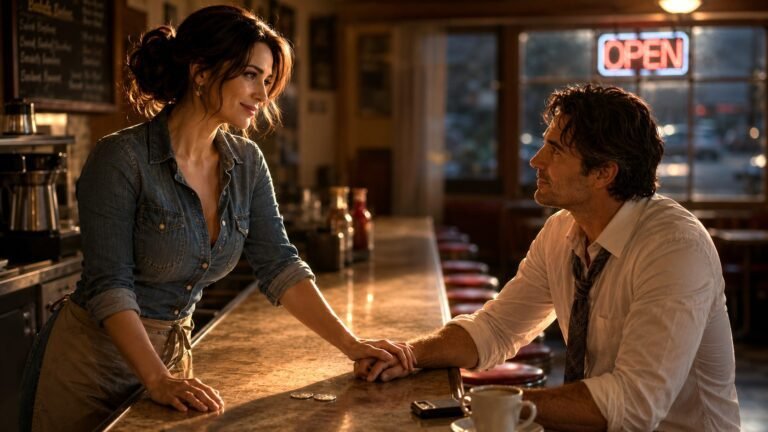
Heartfelt characters sharing love, emotions, and romantic journeys filled with hope, trust, and unforgettable bonds
2 Responses
Great story. Taciturn characters who finally fully recognize each other.
thanks for your wonderful comment. stay connected.