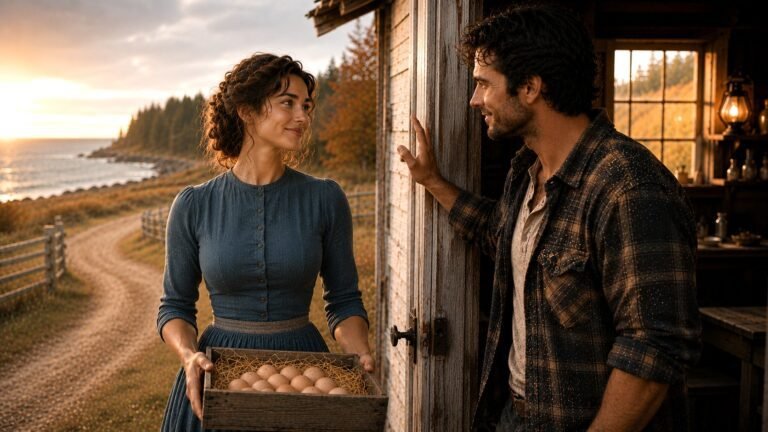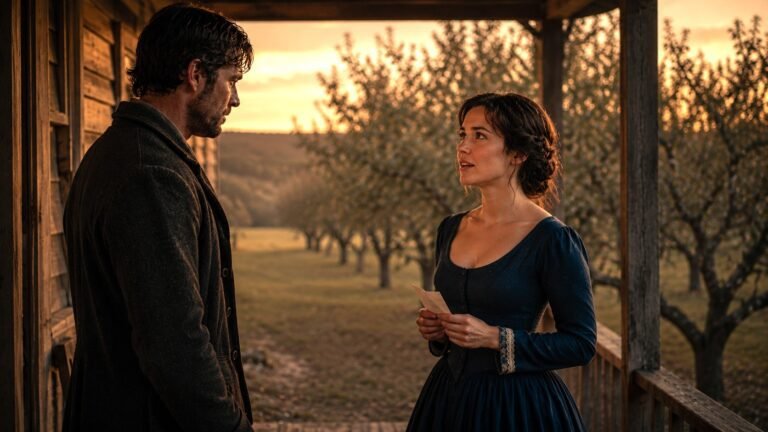

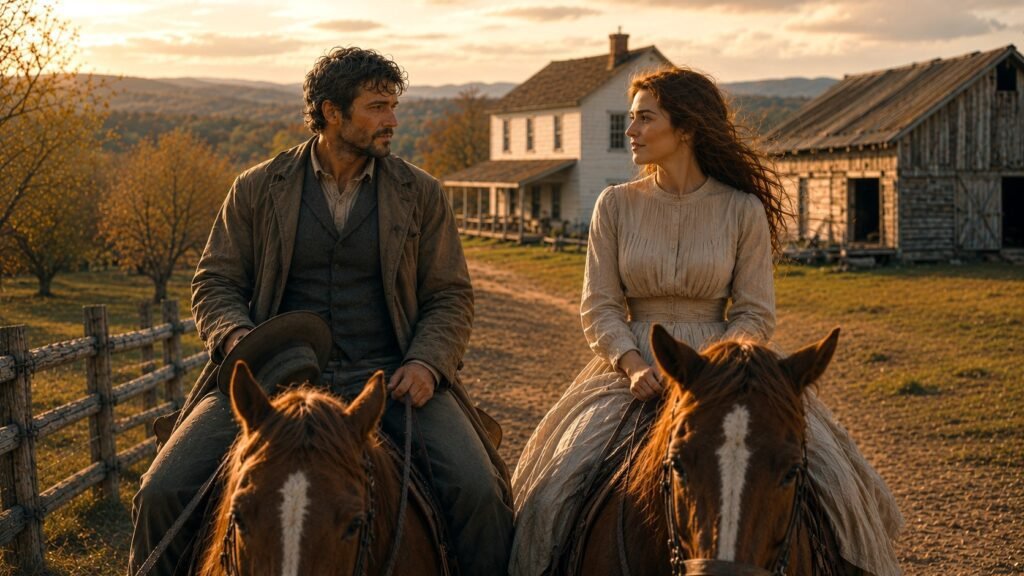
The first frost of October came down hard over Hollow Creek that year, silvering the split-rail fences and turning the tobacco stubble in the low fields the color of old bone. Addie Hargrove was in the smokehouse before dawn, working salt into a slab of pork with hands that had long since stopped feeling the cold, when she heard her stepmother’s voice cut across the yard like a slap.
“Adeline. Inside. Now.”
Corinne Hargrove never raised her voice unless something was about to go badly for someone, and it was never Corinne’s own daughter, Ruth, who bore the weight of it. Addie set the pork down, wiped her hands on her apron, and stepped out into air so cold it hurt to breathe. Behind her, the smokehouse door swung shut on its leather hinge with a groan that seemed, that morning, unusually final.
The farmhouse kitchen smelled of chicory coffee and her father’s pipe smoke, and underneath that, something sourer — worry, maybe, or shame, though Silas Hargrove had never once let shame slow him down before. He sat at the head of the table with a ledger open in front of him, its pages dense with numbers written in red ink, and across from him sat a man Addie had never seen in her life.
He was younger than she expected trouble to look. Broad through the shoulders in a way that spoke of work rather than leisure, his canvas coat still dark with the damp of the ride over Blackjack Ridge, a felt hat resting on his knee. He did not look at her when she entered. He was looking at the ledger, and something in his jaw was tight, as though he found the numbers on the page distasteful in a way that had nothing to do with arithmetic.
“Sit,” Silas said, not to Addie, but to no one in particular, and Addie remained standing because there was no chair offered to her and she had learned a long time ago not to ask for what wasn’t given.
“Papa?”
Corinne folded her hands atop the table, rings catching the low morning light. Ruth stood by the window in her good dress, arms crossed, watching the proceedings with the mild interest of someone observing weather that would not touch her.
“This is Jonah Cole,” Silas said. “Owns the orchard out past Miller’s Bridge. We’ve come to an arrangement.”
“What arrangement.”
Her father did not answer directly. He dipped his pen into the inkwell instead, and the scratch of the nib against paper was, in that overheated, underlit room, the loudest sound Addie had ever heard. He signed his name. He turned the ledger toward the stranger, who read it once, folded it without comment, and slid it into the breast pocket of his coat.
“Papa,” Addie said again, and this time her voice cracked on the word, “what is this?”
“The debt on this place is settled,” Silas said. “Two seasons of failed tobacco, the loan against the north acreage, all of it. Cole’s cleared it.”
“Cleared it how.”
Nobody answered. Corinne examined her rings. Ruth looked out the window at nothing. And Addie understood, in the slow, sickening way that understanding sometimes arrives — not as a lightning strike, but as water rising past your ankles until you realize you have been standing in a flood the whole time — what her father meant.
“You’re giving me to him.”
“You’ll work off the difference,” Silas said, as though this were a technicality, a matter of bookkeeping rather than a human life changing hands in a farmhouse kitchen that smelled of pipe smoke and pork fat. “Keep his house. It’s decent work, Adeline. Better than you’d find most places.”
The stranger — Cole — rose from his chair at last. He was not smiling, and there was no triumph in his face, none of the ownership Addie had braced herself to see. If anything, he looked like a man standing in a room he wished he weren’t in.
“I’ll wait outside,” he said, quiet, to no one and everyone. “Take what time you need.”
He picked his hat up off his knee and walked out into the cold, and the door clicked shut behind him with a gentleness that struck Addie as strange, given everything.
She did not cry. She had learned, long ago in that house, that crying only ever gave Corinne something to work with. She packed her trunk in silence — two dresses, her mother’s sewing box, a Bible with a cracked spine — while Ruth leaned in the doorway and watched without offering to help.
“You’ll write,” Ruth said, not quite a question.
“Would you care if I didn’t?”
Ruth’s mouth twitched, something that might have been guilt passing quickly over her features before she smoothed it away. “Don’t be dramatic, Addie. It’s an orchard, not a prison.”
Addie did not answer that. She closed the trunk, latched it, and carried it out to the wagon herself, because no one offered to help her with that either.
II.
The road to Cole’s place ran west along the creek and then climbed into the hill country, past the old Methodist chapel with its bell tower leaning slightly off true, past Miller’s Bridge where the water ran loud and fast even in the dry months, up through stands of oak and hickory going red and gold with the season. Jonah Cole drove the wagon without speaking, and Addie sat rigid on the bench beside him, her trunk lashed down behind them, her hands folded so tightly in her lap that her knuckles had gone white.
She watched him from the corner of her eye, the way she might have watched a strange dog to see which way it would jump. He drove with a loose, easy grip on the reins, unhurried, and twice he slowed the horses without being asked — once for a doe crossing the road with a half-grown fawn behind her, once for no reason Addie could see at all, though a moment later they crossed a patch of ice-slicked ruts that would have jolted her clean off the bench at speed.
He noticed things. That unsettled her more than his silence did.
“You’ve got kin at the orchard?” she finally asked, because the quiet had become unbearable, because she needed to know the shape of the household she was walking into.
“My nephew,” Jonah said. “Eli. He’s eight.”
“His folks?”
Something in Jonah’s face closed, briefly, like a door pulled to but not latched. “My brother worked the sawmill over in Persimmon Hollow. Accident took him three winters back. His wife passed of the influenza the winter after.” He adjusted the reins, unnecessary, a thing to do with his hands. “Eli’s been with me since.”
Addie said nothing to that, but something in her chest loosened a fraction. A man raising a dead brother’s son alone was not, she thought, a man collecting girls the way some men collected livestock at auction. It didn’t erase what had happened in that kitchen. But it complicated the shape of him in a way she hadn’t expected.
“He’s a good boy,” Jonah added, after a silence long enough that she’d thought the conversation closed. “Quiet. Doesn’t take to strangers easy. I’d ask you not to push him.”
“I wasn’t planning to push anybody,” Addie said, sharper than she meant to, and Jonah glanced at her then — really looked at her, for the first time since the kitchen — and something passed over his face that might have been apology.
“I know,” he said. “I didn’t mean it as an accusation.”
They didn’t speak again until the orchard came into view.
III.
Cole’s place sat in a shallow bowl of a valley, apple trees marching in long rows up the near slope, their leaves gone bronze and rust with the season, a few late fruit still clinging stubborn to the highest branches. The farmhouse itself was modest but well-kept, whitewashed clapboard with a deep porch, lantern light already glowing gold in the windows against the coming dusk. Smoke rose thin and straight from the chimney into a sky gone the color of a healing bruise.
A boy stood on the porch steps when the wagon rolled into the yard, thin-shouldered, dark-haired, watching them with the wary stillness of a rabbit deciding whether to bolt.
“Eli,” Jonah said, climbing down, “this is Miss Hargrove. She’ll be staying on, helping keep house.”
The boy said nothing. He looked at Addie for a long moment, then at his uncle, then turned and went back inside without a word, the screen door clapping shut behind him.
“He’ll come around,” Jonah said, though he didn’t sound entirely certain of it himself. He carried her trunk in without being asked, and Addie followed him down a narrow hallway that smelled of woodsmoke and dried apples, to a small room at the back of the house with a window facing the orchard rows.
“This is yours,” he said, setting the trunk down at the foot of the bed. A quilt in faded blues and creams. A washstand with a chipped white basin. A small iron stove, unlit, waiting. And on the dresser, a cedar box Addie hadn’t noticed him bring in, though he must have carried it separately, tucked under one arm.
He left without explaining it. Addie stood alone in the gathering dark and crossed to the dresser, lifting the lid of the box with fingers that had gone unaccountably unsteady.
Inside lay a square of embroidered cloth, the thread faded to soft pastel from what had once been vivid blue and gold — a quilt patch, the kind sold at county harvest socials to raise money for the church roof fund. She knew this particular patch. She had stitched it herself, six years ago, at the Hollow Creek social, back when she was seventeen and still believed that a little pin money from her needlework might buy her some small independence from her father’s house.
Her breath caught somewhere behind her ribs.
She turned the patch over in her hands, tracing the stitches with a fingertip, and for a long while she simply stood there in the deepening dark, listening to the wind move through the orchard outside her window like something breathing slow and patient in its sleep, and wondering — for the first time since that terrible morning in her father’s kitchen — not why she had been given away, but why this particular man, in this particular valley, had been keeping a piece of her for six long years before she ever arrived.
IV.
She woke before first light out of long habit, dressed in the cold, and found the kitchen already warm, a fire built up in the stove, the smell of coffee thick in the air. Jonah sat at the table with a ledger of his own open before him — apple yields, she would learn later, and the accounts for the cider press — his reading glasses low on his nose. A second mug sat near the stove, already poured, steam still curling up from it.
“Morning,” he said, not looking up.
She picked up the mug and drank, and stopped short. It was exactly how she took it — a splash of cream, no sugar, the coffee itself brewed weak rather than the bitter, scalding stuff her father preferred.
“How did you know that,” she said.
Jonah’s pen paused over the ledger for just a fraction of a second before continuing. “Lucky guess.”
It was not, she thought, a lucky guess. Nothing about this house so far had felt like luck. But she let it lie, because pressing on it felt like pulling a thread that might unravel something she wasn’t ready to see unraveled.
Eli came down not long after, still wary, still silent, and took his place at the table without acknowledging Addie beyond a sideways glance. She set a plate of eggs in front of him and he ate without looking up, and when she asked him, gently, whether he liked school, he shrugged one shoulder and said nothing at all.
“He lost his reading primer in the creek last spring,” Jonah said quietly, once the boy had gone out to do his chores. “Hasn’t wanted much to do with books since. I think he blames himself for losing it, though nobody ever said a word to him about it.”
“That’s a heavy thing for a boy to carry alone.”
“It is,” Jonah agreed, and something in the way he said it made Addie understand that he was not only talking about the boy.
That morning he showed her the smokehouse, the root cellar, the cider press standing idle in its shed waiting for the last of the harvest. He explained the rhythms of the place without ever once telling her what she was required to do.
“If you see something wants doing,” he said, “do it. If you don’t see it, don’t trouble yourself hunting for it.”
“That’s not how anybody’s ever run a house I’ve lived in.”
“Maybe not,” Jonah said. “But it’s how I run mine.”
The absence of demand felt, at first, like a trap she hadn’t yet found the teeth of. She kept waiting for the criticism to arrive the way it always had at her father’s table — a burnt biscuit held up as evidence, a swept floor found wanting in some corner. It never came. Instead there was only the quiet accumulation of the days: mending taken in without complaint, meals eaten without commentary, small courtesies extended and never called in as debts.
It unsettled her more than cruelty would have. Cruelty, at least, she knew the shape of.
V.
Three days into her time at the orchard, she met Otis Pruitt, a lanky, weathered man who worked the neighboring spread and came by most mornings to help with the last of the fence repair before winter set in hard. He had a talkative streak that stood in sharp contrast to Jonah’s careful quiet, and he seemed to find Addie’s presence at the farmhouse a source of some private amusement.
“That bay mare in the north pasture don’t take to strangers,” he told her one morning, nodding toward the paddock where Addie had been brushing snow from the horse’s mane without a second thought. “Bit two hands from town clean through the coat last spring. Wouldn’t let Jonah’s own cousin near her at Christmas.”
“She’s been gentle enough with me.”
Otis grinned, gap-toothed, delighted by something he didn’t explain. “Guess she likes you.”
That evening, mending a torn harness strap by lamplight while Jonah worked at his ledger across the table, Addie mentioned it, mostly to fill the silence. “Otis said that mare doesn’t take to strangers. She’s been sweet as anything with me.”
Jonah didn’t look up from the ledger, but something in his shoulders went very still. “She always did like calm people.”
“How would you know I was calm? You’d not known me a whole day when you brought me here.”
The silence that followed lasted a beat too long. Jonah set down his pen with the particular care of a man buying himself time.
“Lucky guess,” he said again, and this time Addie heard the thinness in it, heard the door he was holding shut against something on the other side, and she filed the moment away with the coffee and the quilt patch and the boy’s lost primer, pieces of a picture she could feel taking shape just beyond the edge of her understanding.
Days folded into weeks. The last of the apples came down off the trees and into the cellar, and the cider press groaned into use, filling the yard with the sharp sweet smell of crushed fruit. Eli began, slowly, to thaw — first tolerating Addie’s presence, then seeking her out in small ways, asking her to check his sums, sitting near her on the porch steps while she shelled beans of an evening, though he still wouldn’t touch a book.
One gray afternoon, dusting the shelf near the parlor fireplace, Addie found a novel wedged between two farming almanacs — a worn copy of a book she had borrowed, and re-borrowed, from the Hollow Creek church reading room more times than the librarian had ever thought polite to mention. The same edition. The same title. When she opened it, the spine cracked in a way that felt achingly familiar, and inside, several torn pages had been carefully mended with strips of old tape, patient and precise.
Someone had read this book until it fell apart. Someone had cared enough to put it back together.
She stood very still, holding it, listening to Jonah’s axe falling steady out by the woodpile, and felt the last of her certainty about this arrangement — that it was a transaction, cold and simple, a debt paid in flesh — begin to crack straight down the middle.
VI.
Widow Pruitt, Otis’s mother, arrived one evening not long after with a pie wrapped in cloth and enough conversation in her to fill the whole house twice over. She settled at the kitchen table while Addie made tea, talking easily of the coming winter, of church business, of a dozen small matters of the valley, and somewhere in the tumbling middle of it, she said, without any particular weight:
“You know, Jonah used to ride into Hollow Creek every harvest social, regular as clockwork. Never bought a thing at the booths, near as anybody could tell. Just wandered round like a man looking for something he couldn’t name.”
Addie’s hands went still over the teapot. “Every year?”
“Near enough. Six, seven years running, at least. Folks used to tease him something fierce about it, though he never let on what he was after.” The widow laughed, fond and a little sad. “He’d come home each time looking like a man who’d lost something all over again.”
Across the kitchen, Jonah had gone very focused on his coffee cup, jaw set, and Addie noticed that too, filed it away alongside everything else.
Later that night, unable to sleep, she took a lantern out to the barn to check on a hen that had been off her feed, and in the dim gold light she noticed a loose board near the stalls, its edges worn smooth as though it had been pried up and set back many times over. Curiosity got the better of caution. She knelt in the straw and pulled the board aside.
Behind it sat a weathered wooden box, dust settled thin across its lid — not much dust, the kind that gathers on something opened and closed with some regularity rather than forgotten outright. She lifted the lid with careful fingers.
Inside: a scatter of old fair tickets gone soft with handling. A dried wildflower pressed flat between two folded pages. A receipt from the dry goods store in Hollow Creek, the ink faded but the date still legible. And beneath all of it, a small scrap of paper with a single line written in a careful, deliberate hand — a date, six years past, the same year, she realized with a cold drop in her stomach, that she had stitched the quilt patch now sitting in the cedar box on her dresser.
The barn was silent around her but for the soft shifting of the horses and the wind working at the loose boards overhead. Addie knelt there a long while, the box open in her lap, and understood — not with shock exactly, but with a slow, settling certainty — that meeting Jonah Cole in her father’s kitchen had not been the beginning of anything at all. It had only been the moment the story finally caught up to itself.
VII.
Winter closed its hand slowly around the valley. Snow gathered in the fence-line hollows and clung to the north sides of the barn roof, and the apple trees stood bare and patient against a sky the color of pewter. Life at Cole’s place had settled into its own rhythm by then — mending in the evenings, bread rising on the warming shelf, Eli’s sums improving under her patient tutoring, the bay mare nickering low whenever Addie crossed the yard.
Nothing was demanded of her, and that, more than anything, was what made it so difficult to keep her guard raised. The longer she stayed, the harder it became to hold onto the cold anger she’d carried out of her father’s kitchen, and some nights that frightened her more than the anger itself ever had.
One afternoon, mending a torn shirt by the kitchen window, she watched Jonah come in from town carrying a sack of flour and a small paper parcel from the dry goods store.
“They’ve got fresh coffee in at last,” he said, setting the sack on the counter. “The lighter roast.” A pause, and then, quieter, almost to himself: “The kind you like.”
The room went very still. Jonah’s hand paused on the counter, and something crossed his face — the realization, Addie thought, of what he had just given away without meaning to. He turned toward the pantry without another word, but she had heard it, and she could not unhear it.
A few days later, Widow Pruitt returned with jars of preserves wrapped in newspaper, and while they stacked them together in the pantry shelves, she said, with the same easy fondness as before, “You’re good for him, you know. That man rode into town for years chasing something he never could put a name to. I think he’s stopped looking now.”
“What was he looking for?”
The widow’s smile faltered, just slightly. “That’s his story to tell, dear. Not mine.” And she would say no more on it, no matter how Addie pressed, gently, over the folding of newspaper and the clink of glass jars.
By late February the days had begun, almost imperceptibly, to lengthen. Addie found herself waking without the old dread that had lived beside her bed at her father’s house, a dread she hadn’t fully realized she’d carried until its absence made itself known. And then, on a gray morning with the smell of thaw just beginning to rise off the fields, trouble arrived to remind her that peace, once found, could still be threatened.
VIII.
She saw the wagon from the porch before she recognized the driver, and something cold dropped through her the instant she did. Ruth sat beside a narrow man in a dark coat, a leather case balanced on his knees — a lawyer, she understood, before anyone said the word.
Jonah came out of the barn at the sound of wheels in the yard, and his eyes met Addie’s across the distance for one steady moment before he crossed to meet the wagon himself.
The lawyer introduced himself in the parlor as Mr. Whitfield, representing certain interests of the Hargrove estate, and unfolded a set of papers across the table with the practiced efficiency of a man who had done this many times before and expected to win. There were irregularities in the original debt arrangement, he explained. Questions of proper witness. Questions of Adeline Hargrove’s legal standing to have been bound over at all, given her age at the time of signing. The matter, he said, required her return to her father’s house pending review.
Addie sat through most of it in silence, recognizing the shape of the game even before Ruth spoke. The papers were never the point. Pressure was the point. Control was the point.
“You belong with family,” Ruth said at last, crossing one ankle over the other with the easy confidence of a girl who had never once had to fight for anything.
Addie almost laughed at the word. Family. It felt strange in Ruth’s mouth, foreign, like a language neither of them had ever truly been taught to speak at home.
Jonah read every page the lawyer set in front of him, slow and thorough, his face giving nothing away. When he finished, he folded the papers with the same careful precision he brought to everything, and set them down.
“No,” he said.
Mr. Whitfield blinked. “I beg your pardon?”
“No,” Jonah said again, no louder, no sharper, only more certain. “The arrangement stands as signed. If you’ve a quarrel with it, take it to the circuit judge in the spring session. Until then, this is her home, if she wishes it to be.”
The meeting broke apart not long after, the lawyer gathering his papers with visible irritation, but Ruth lingered on the porch after the men had gone ahead to the wagon. She caught Addie’s arm before she could retreat inside, her voice dropping low.
“He never told you why he wanted you, did he? Not any other girl in the county — you.”
Addie said nothing, and Ruth’s smile sharpened, satisfied by the silence more than any answer could have satisfied her.
“Ask him,” she said, and then she was gone, the wagon wheels carrying her back down the frozen road toward Hollow Creek, and this time it did not feel like a threat lifted so much as a threat merely postponed.
IX.
That night Addie barely touched her supper. Jonah noticed — he noticed everything, she was coming to understand — but he didn’t ask why, and his restraint, which had once felt like a kindness, now felt like its own kind of wall. The next morning she avoided him, short answers, no meeting of eyes. The morning after that, the same. A distance opened between them that had not been there before, not since the earliest, coldest days of her arrival, and neither of them seemed willing to be the one to close it first.
Three days into that silence, dark clouds gathered heavy over the ridge to the west, and the wind swung hard out of the north. Even the livestock grew restless, the bay mare pacing her paddock, the hens gone quiet and watchful in their coop.
Jonah stood on the porch near dusk, studying the sky with the particular attention of a man who had learned, the hard way, not to underestimate a Bitterroot storm.
“There’s weather coming,” he said, to no one in particular, though Addie was close enough to hear it.
She looked toward the ridge. The clouds were moving faster than clouds had any right to move, and somewhere beyond the tree line, thunder rolled low and long through the valley like something enormous shifting in its sleep. The distance between them remained, unspoken and unresolved. But something else was coming now too, and neither of them, watching that sky, could have said which threat frightened them more.
X.
The storm broke just after full dark, snow driving sideways on a wind that tore the porch lantern clean off its hook and sent it skittering across the boards. Addie had Eli tucked into bed with two extra quilts and a promise that the noise outside was only weather, nothing more, when a fist began pounding at the front door hard enough to rattle the frame.
Jonah had it open before the second knock landed. Otis Pruitt stood on the porch, half-frozen, snow crusted thick on his collar.
“North fence is down,” he shouted over the wind. “Your stock’s headed for the ravine!”
Jonah was already reaching for his coat. “Stay with Eli,” he told Addie, but she was pulling her own coat from its peg before he’d finished the sentence.
“He’s asleep. He won’t wake before we’re back.” Her voice left no room for argument. “I’m coming.”
“You don’t have to.”
“I know,” she said. “I’m coming anyway.”
The storm hit them like a physical wall the moment they stepped off the porch, snow stinging exposed skin, wind tearing at coats and scarves, the lantern light from the house swallowed up behind them within a dozen steps. They found the break in the fence more by sound than sight — the frightened lowing of cattle, the crack of splintering rail — and worked for the better part of an hour in numb-fingered silence, hauling wire, driving temporary stakes into half-frozen ground, turning the panicked animals back from the narrow, treacherous cut that led down toward the ravine.
It was one of the younger steers that bolted first, and Jonah went after it too fast across ice-slicked ground. Addie saw him lose his footing at the very lip of the ravine, saw him pitch sideways into the driving snow and vanish for one endless second that emptied her lungs of air entirely.
She reached him before conscious thought caught up with her body, her gloved hand closing hard around the sleeve of his coat, and Jonah’s own hand found a fence post at the same instant, and together, straining against the wind and the ice and the black drop just beyond their boots, they hauled each other back onto solid ground.
Neither of them spoke. There was, in that moment, nothing that needed saying.
XI.
The ride back to the farmhouse passed in silence, but it was a different silence than the one that had stretched between them for the last three days — softer, worn smooth by fear and relief in equal measure. Inside, the fire still burned low in the stove. Snow melted off their coats in dark puddles on the floorboards while Eli slept on, undisturbed, upstairs.
Addie sat near the stove with a tin cup of coffee warming her hands, and Jonah stood at the window a long moment, watching the storm still raging beyond the glass, before he finally turned and spoke.
“I should have told you sooner.”
She looked up. The room felt suddenly very still, the wind outside a distant thing.
“Eight years back,” he said, settling into the chair across from her, his eyes fixed somewhere in the middle distance, in the past. “There was a harvest social in Hollow Creek. I wasn’t but nineteen, come down from my father’s place to sell a few head of cattle.” He paused, and something moved across his face that looked almost like embarrassment, softened by time. “There was a boy near the livestock pens, crying something awful — lost his mother in the crowd, though nobody seemed much bothered to find out. Folks walked right past him the better part of an hour.”
Addie’s fingers tightened slowly around the cup.
“I watched a girl stop mid-sale at her own table to go to him,” Jonah continued. “Missed half her customers doing it. Didn’t seem to care one bit that she was losing money hand over fist while she sat with that boy in the dirt until his mother came looking.” His gaze finally came back to her, steady, unhurried. “That girl was you.”
Addie remembered it, distantly — a frightened child, a crowded fairground, nothing she’d thought remarkable at the time, nothing she’d thought worth remembering at all.
“Most folks remember the loud moments in their lives,” Jonah said. “The weddings. The funerals. I don’t know why, but I remembered that one. Small as it was.”
Outside, the storm beat on against the windows. Inside, a different kind of quiet had settled over the room — not distance now, not suspicion, but something far gentler, something that had been building itself slowly, patiently, board by board, since the night she’d first opened a cedar box in a room she hadn’t chosen to sleep in.
Jonah rose and crossed to the shelf near the stairs, retrieving a worn leather notebook that he set on the table between them with the same careful precision he brought to everything he touched.
Addie opened it. The first page bore a date eight years past. Beneath it, a single short entry, the handwriting careful and deliberate: A girl selling quilt squares at the harvest social. Stopped to comfort a lost child. Missed her own custom doing it.
She turned the page. Another entry. And another. A young woman singing quietly during the Christmas service at the Hollow Creek chapel. A woman helping an elderly farmer load feed sacks at the co-op, refusing his offered coin. Year after year, page after page — nothing romantic, nothing dramatic, only small moments, the kind most people forgot the instant they happened, gathered and kept safe by a man who apparently never had.
“You remembered all of it,” she said, very quietly.
“I remembered you,” Jonah said. “I didn’t rightly know what to do with that, most years. I told myself I was being foolish, mooning over a girl who didn’t know my name. Then your father showed up at my door owing more than he could pay, and offered me his daughter to settle it, and I—” He stopped, and something raw moved across his face before he mastered it. “I told myself I was doing it to spare you worse. Maybe I was. But I won’t pretend that was the whole truth of it, Addie. I’d been half in love with you a long time before I ever had the right to be.”
The room blurred at the edges for Addie, not from tears exactly, but from the sensation of an old belief cracking loose and falling away — the belief that she had been traded, bought, handed off like livestock at auction. Sitting there with the notebook open in her lap and the fire burning low and the storm finally beginning to ease outside, she understood, with a clarity that felt almost physical, that Jonah Cole had not come to claim her at all.
He had come, quietly, patiently, across eight long years, to be worth choosing.
XII.
The wagon came again just after noon on a day in early spring, when the last of the snow had retreated into the high hollows and the first green was pushing up along the fence lines. Addie saw it from the porch and felt the old cold drop through her stomach, though it was smaller now, more manageable, than it had been in winter.
Silas Hargrove himself sat beside the driver this time, and Corinne beside him, and Ruth behind, and the lawyer Whitfield brought up the rear on his own mount, his leather case strapped to the saddle.
Jonah came out of the orchard rows at the sound of wheels, and Eli, without being told, slipped his hand into Addie’s and stood close beside her on the porch steps — a small thing, but it steadied her more than she would have expected.
Sheriff Amos Calder arrived not five minutes behind the wagon, unhurried, on horseback, and Addie understood then that Jonah had been expecting this, had perhaps known it was coming before she did, and had made his own quiet preparations against it the way he prepared against every storm — early, and without fuss.
“We’re settling this today,” Silas announced, climbing down stiffly, his breath clouding in the cool air.
The sheriff took the papers from Whitfield without hurry, read them through twice, then took the counter-papers Jonah handed him and read those as well. The valley held its breath around them; even the creek seemed to run quieter than usual.
“The original arrangement stands,” Sheriff Calder said finally, folding everything together beneath one arm. “Filed proper, witnessed proper. I see nothing here that changes that.”
“The girl belongs with her family,” Silas said, color rising in his face.
“No,” the sheriff said, mild but immovable. “She doesn’t belong to anybody, Silas. Not to you, and not to Cole either, whatever paper’s been signed between you. She’s free to say where she’ll live, same as any grown woman in this county.”
Addie felt something shift loose inside her chest — not rescue exactly, because she had not needed rescuing, not really, not for some time now. It was something closer to recognition: the plain acknowledgment, spoken aloud at last by someone with the authority to make it matter, of a truth that should have been obvious all along.
The choice was hers. It always had been.
Corinne’s mouth thinned to a hard line. Ruth looked away toward the orchard, and Addie thought, watching her, that there might have been something like envy in it, though she couldn’t be certain, and found she no longer much cared to guess.
“Come home, Adeline,” Silas said, and it was the closest thing to pleading Addie had ever heard from him.
She looked at the man who had signed her away over a ledger of red ink without once meeting her eyes. She looked at the house behind her, the orchard rows climbing the near slope, the boy’s small hand still folded in hers, and the man standing quiet and steady at the edge of the yard, waiting, as he had always waited, for her to decide on her own terms.
“I am home,” she said.
Nobody had an answer for that. Eventually the wagon turned and rolled back down the frozen road toward Hollow Creek, and this time it did not come again.
XIII.
Months slid by in the easy accumulation of ordinary days — planting, then the long green stretch of summer, then the first blush of color returning to the orchard leaves as autumn came round again. One evening in early October, almost a full year to the day since she had first climbed into Jonah’s wagon with her trunk and her fear, Addie asked him to ride out with her.
They followed the old cattle trail up along the ridge, past the spot where the fence had gone down in the storm, to the crest of the hill where a single ancient cottonwood stood with its branches spread wide over the sloping ground. The sun hung low and gold over the valley, spilling long light across the orchard rows below, and for a while neither of them spoke, only stood together looking down at the small, whole world they had built between them.
“If you’re still willing to have me here,” Addie said at last, “I’d like to stay for good.”
Jonah turned to look at her, and for the first time since she’d known him, she saw something like uncertainty cross his face — not fear, but a careful, fragile hope, the kind a man allows himself only after he has learned, the hard way, not to expect too much from the world.
“You would?”
“Yes,” she said, and found she meant it more completely than she had ever meant anything in her life. “I love you, Jonah Cole. I think I have for longer than I let myself know.”
He laughed then, quiet and low, not because anything was funny but because some long-held tension had finally found somewhere to go, and he reached for her hand beneath the cottonwood’s spreading branches, and held it.
They married that November in the little chapel by Miller’s Bridge, nothing grand, nothing showy — Widow Pruitt in the front pew with Otis beside her, Sheriff Calder standing near the door, Eli scrubbed pink and solemn in his good shirt, clutching a small bouquet of late asters he’d picked himself from along the fence line. The chapel smelled of pine boards and beeswax candles, and autumn light spilled gold across the floorboards through windows gone amber with age.
Addie paused at the door a moment before walking in. Years before, she had walked into rooms only because someone else had decided her fate for her. This time was different. This time no one arranged it, no one traded her, no one signed her name in a ledger without asking. She walked forward because she had chosen it — because she had chosen him — and when she reached Jonah’s side at the altar, he looked at her exactly the way he always had: steady, patient, and utterly certain.
Outside the tall windows, the Bitterroot foothills watched in silence as the light failed slowly toward evening, and inside, in that small warm room, Addie Cole stepped forward into a life that belonged, at last and entirely, to her.
Not given. Not traded. Chosen — and that, in the end, made all the difference.