
A Millionaire’s Empty Morning
Rain slid down the floor-to-ceiling windows of the penthouse like it had somewhere better to be, and Julian Voss watched it go, coffee mug forgotten in his hand until it had cooled past drinking. Forty floors below, the city moved in its usual gray hurry, taxis nosing through puddles, umbrellas blooming open one after another like something contagious. He didn’t move to join it. He hadn’t moved much at all in the eleven days since Mara Doyle had set her badge on his desk, said something quiet and final, and walked out of Voss Capital’s glass doors without looking back.
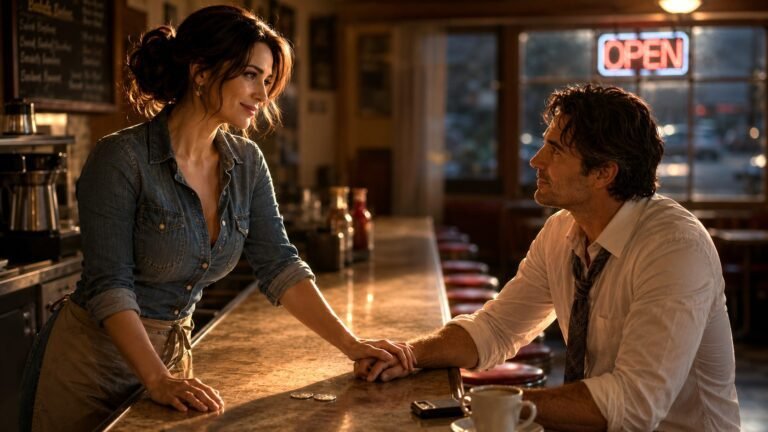
The habit was the tell, if anyone had been there to notice it. Every morning at six-fifteen, before the market woke and before the first call came in, Julian made two cups of coffee. One black, no sugar, for himself. One with too much cream and exactly one packet of raw sugar, stirred four times — never three, never five — the way she liked it. He’d make it, set it on the corner of the desk where her tablet used to sit, and let it go cold while he worked, as if habit alone could summon the person who used to drink it.
It wasn’t about the coffee. He knew that, in the flat, clinical way he knew most things about himself — filed, labeled, rarely felt. It was about being the kind of man people left. His father had walked out during a Tuesday dinner with the excuse still warm on his lips when Julian was nine. His mother had followed two years later, slower and quieter, worn down by something the doctors called illness and Julian privately called grief with nowhere to go. By the time he was twenty-two, and had sold his first company for four million dollars, he’d already built the architecture he would live inside for the next fourteen years: don’t need anyone long enough for them to prove they’ll go.
Mara had been the one exception, mostly because she hadn’t given him a choice in the matter. Assigned to him three years ago by an agency that specialized in assistants who didn’t scare easily, she’d walked into his office on day one, taken one look at the wreckage of his calendar, and said the whole thing was a war crime dressed up as a schedule, then started fixing it without asking permission. She’d learned his coffee order without being told. She’d learned which board members needed flattery and which needed cold numbers. She’d learned, eventually, the silence that meant don’t and the different, softer silence that meant stay.
Eleven days ago she’d learned something else — an old habit of his, planting small untruths to see who caught them, who stayed loyal even when loyalty cost something. She’d caught him mid-test, and the look on her face hadn’t been anger so much as recalculation, like she was running back through three years of kindness wondering which of them had been real.
“You don’t trust anyone, Julian. Not even the people who’ve earned it. Especially not them.”
She hadn’t raised her voice. That was the part that stayed with him — how quietly a door could close.
Since then, the penthouse had gone strange with her absence, rooms rearranging themselves around a shape that wasn’t there. His new assistant, a competent, humorless woman named Priya, ran his calendar with mechanical precision and asked him twice a day if he needed anything, and both times he’d said no, meaning it in a way that had nothing to do with the question.
He’d tried calling. Three times, in the first week, watching the phone ring out into her voicemail, a version of her voice recorded years ago, brighter than he remembered her sounding lately. He hadn’t left a message any of the three times. What was there to say that wouldn’t sound like a man trying to buy back something he’d broken — I’m sorry, come back, I’ll do better — words that had failed his father exactly once and had never been tested since, because Julian had spent a lifetime making sure he never needed to say them.
The rain kept falling. Somewhere out there, past the gray smear of the skyline, Mara had gone home — not to an apartment in the city, he’d learned from her old employment file in a moment of research he wasn’t proud of, but home-home, three hours north, to a town called Ashford Creek where her family ran a diner that had apparently been open, in one form or another, since the Eisenhower administration.
He found himself looking up Ashford Creek more often than a reasonable man should. Population two thousand and change. One traffic light. A diner called The Wooden Spoon with a five-star rating and reviews that used words like homey and the pie alone is worth the drive, words that belonged to a life Julian had never lived and hadn’t known he wanted until he pictured her inside it, moving between booths the way she used to move between his phone calls, competent and unbothered and entirely herself.
He thought about calling a fourth time. He thought about it the way a man thinks about jumping into cold water — the knowledge that it would hurt, and the growing suspicion that it might also be the only thing that woke him up.
Instead, on the twelfth morning, he did something he hadn’t done in years. He canceled his calendar. All of it — the board call, the two investor lunches, the afternoon with the acquisitions team — and told Priya only that he’d be unreachable for a few days, watching her professional face fail to hide her alarm at the idea of Julian Voss going anywhere without his phone surgically attached to his hand.
He packed lightly. He did not, he told himself, pack lightly because he was planning anything as foolish as showing up uninvited at a small-town diner in disguise to see a woman who had every right never to speak to him again. He packed lightly because he needed air, needed distance from the glass tower and the cold coffee and the silence where a war-crime calendar used to be.
That was the story he told himself on the drive north, three hours of gray highway unspooling ahead of him, windshield wipers keeping soft, stubborn time. He almost believed it until he crossed the Ashford Creek town line and felt something in his chest do a slow, unfamiliar thing that had nothing to do with distance and everything to do with hope, an emotion he’d stopped extending credit to years ago and had, apparently, never quite managed to close the account on.
Disguise at the Diner Door
The Wooden Spoon sat on Main Street between a hardware store and a shuttered movie theater, its neon sign buzzing pink against the wet afternoon, and Julian sat in his rental car across the street for eleven minutes before he found the nerve to go in.
He’d bought the disguise at a drugstore forty miles back, feeling like a fool the entire time — a pair of thick-framed glasses with clear lenses, a baseball cap pulled low, a flannel shirt that still had the fold-creases from the package. He looked, he thought, catching himself in the rearview mirror, like a man who had never once in his life worn flannel by choice, which was more or less accurate. But Ashford Creek was small, and Mara’s face had been on the cover of exactly one business magazine two years ago, standing beside him at a gala, and if anyone in this town recognized Julian Voss walking through that door, whatever chance he had of a real conversation would collapse into spectacle before he got his coat off.
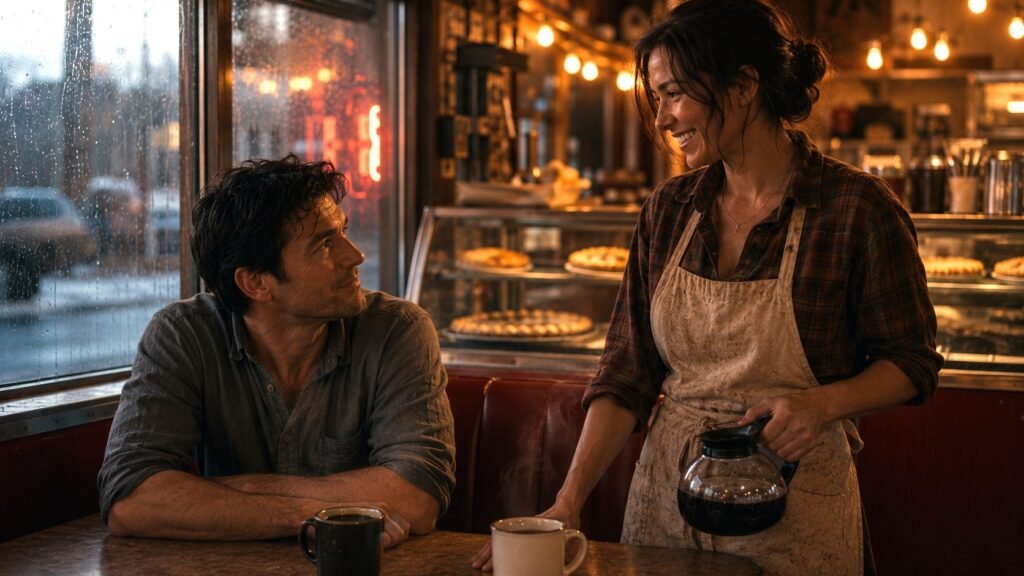
The bell over the door rang bright and cheerful as he stepped inside, and the smell hit him first — coffee and bacon grease and something sweet baking somewhere in the back, a smell that had no business making a man’s throat tighten the way his did. The diner was half full, red vinyl booths and a long counter with chrome stools, a jukebox in the corner playing something low and easy. He found a booth near the window and picked up a laminated menu with hands that were, he noticed with some professional embarrassment, not entirely steady.
And then she came out of the kitchen with a coffee pot in one hand and a stack of plates balanced along her forearm like she’d been doing it her whole life, which, he supposed, she had, long before Voss Capital had ever borrowed her for three years — and something in his chest simply stopped working correctly.
Mara looked different here. Not unrecognizable — the sharp, assessing eyes were the same, the quick economy of her movements was the same — but looser somehow, sun-browned at the cheekbones in a way the fluorescent light of an office never allowed, her dark hair pulled back in a knot instead of the severe bun she wore to board meetings. She was laughing at something an old man at the counter had said, head tipped back, and the sound of it reached Julian across the room and did something to him that eleven days of silence hadn’t managed — made the loss suddenly, physically real.
She worked her way toward his booth without recognizing him, pen already out, order pad flipped open. “What can I get you, hon?”
Hon. The word landed strange in his chest — easy, unguarded, meant for a stranger, which was, he reminded himself, exactly what he currently was.
“Coffee,” he said, pitching his voice lower than usual, throat rough with something he hoped read as a cold. “Black. And whatever pie’s good today.”
“Cherry’s good every day,” she said, not looking up from the pad. “But the peach just came out of the oven, if you want to live a little.”
“Peach, then.”
She scribbled it down, tucked the pen behind her ear, and it was only as she turned to go that her eyes caught on his hands where they rested on the table — his hands, which she had watched sign a thousand documents, which she would know, he realized too late, better than she’d know his disguised face.
She stopped. Looked at him properly for the first time. The order pad went very still in her grip.
“You,” she said, and it wasn’t a question, and it wasn’t warm.
He took off the glasses, because there didn’t seem to be any dignity left in pretending. “Hi, Mara.”
For a moment neither of them said anything, the jukebox filling the silence with something about a summer that was already gone, and Julian watched a whole war play out across her face — shock, then anger, then, underneath both, something more complicated that she visibly fought down before it could surface. He’d spent three years learning to read that face in boardrooms, and he read it now with a sinking, hopeful clarity: she was not, in fact, unmoved to see him. She was simply refusing to let it show.
“Take off the hat too,” she said finally, voice flat. “You look ridiculous.”
He did. She almost smiled — he saw it flicker at the corner of her mouth before she caught it and put it away, professional as ever, even here, even now, in an apron with flour on her wrist and three years of history sitting in the booth in front of her wearing a stranger’s flannel shirt.
“What are you doing here, Julian?”
“Getting pie, apparently.”
“Try again.”
He looked down at his hands, the ones she’d recognized before she’d recognized his face, and thought that if there was ever a moment to be honest, corny and undignified as it might sound in a diner with a jukebox playing behind him, this was probably it.
“I made two cups of coffee this morning,” he said. “I’ve made two every morning since you left. One of them’s just been sitting there going cold, because apparently some part of me hasn’t caught up to the fact that you’re not coming to drink it.”
Something crossed her face that he couldn’t fully name — not forgiveness, nothing so simple as that, but a kind of recognition, like she was hearing, for the first time, a language she’d been waiting three years for him to learn to speak.
“That’s a strange thing to drive three hours to say,” she said, but her voice had lost its edge, just slightly, just enough.
“I had a disguise,” he offered. “It felt like it needed to be a bigger production than a phone call.”
And there it was — the sound he’d driven three hours hoping to hear, the laugh escaping her before she could stop it, short and surprised and real, her hand flying up to cover her mouth like she resented her own amusement. “You look like a substitute teacher having a breakdown.”
“I feel like a substitute teacher having a breakdown.”
“Good,” she said, but there was no bite left in it. “You should.”
The bell over the door rang again, someone else coming in out of the rain, and she startled like she’d forgotten, briefly, that they were standing in the middle of her family’s diner and not somewhere private, somewhere the last three years could be properly excavated without an audience of regulars pretending not to watch over their coffee cups.
“I have a shift,” she said, quieter now, and it wasn’t quite a dismissal.
“I’m not going anywhere,” Julian said, and meant it in a way that went well beyond the booth, well beyond the pie he hadn’t touched, and something in her eyes told him she’d heard the larger meaning too, and hadn’t decided yet what to do with it.
She walked away to refill someone’s coffee, throwing one glance back over her shoulder that she probably didn’t know he caught — and Julian sat in the booth in his ridiculous disguise, watching the woman he loved move through a life he’d never seen her live, and understood, with the particular clarity of a man who’d spent three hours driving toward exactly this, that he had left the penthouse a different man than the one now watching her laugh at the counter, and that there would be no driving back to the version who’d left.
Pie, Silence, and Small Truths
He came back the next morning, and the one after that, no disguise this time — there was no point pretending, and besides, half the diner had already heard the story of the millionaire in the flannel shirt by the time he’d finished his slice of peach pie, Mara’s older brother Sam delivering the tale to the breakfast crowd with the relish of a man who did not get handed material like this often in Ashford Creek.
Mara didn’t ask him to leave. She also didn’t, for the first two days, do much more than pour his coffee and take his order with the brisk courtesy she’d extend to any other regular, and Julian found himself studying that courtesy the way he used to study balance sheets, looking for the places where the numbers didn’t quite add up, where something warmer was hiding underneath the cold column.
He found it on the third morning, in the four stirs.
He hadn’t asked for sugar. He’d ordered his coffee black, same as always, and she’d set the cup down in front of him and turned to go, and it was only after she’d gone that he noticed the coffee wasn’t black at all — it was hers, the way she took it, cream and one packet of raw sugar, stirred exactly four times, and he understood, sitting there with a cup he hadn’t ordered warming his hands, that some part of her had made it without thinking, the same automatic habit that had him brewing a second cup every dead morning back in the city.
He didn’t say anything about it. He drank it anyway, sweet and wrong and exactly right, and when she came back to the booth to check on him, he saw her clock the empty cup, saw the flush climb up from her collar, saw her open her mouth to explain the mistake and then close it again, choosing instead to simply refill it — this time black, this time correct — without either of them naming what had happened.
That was how the days went. Nothing was said outright. Everything circled.
“You’re bad for business,” she told him on the fourth day, sliding into the booth across from him during a lull, arms crossed, though there was no real complaint in it. “Half the town thinks you’re here to buy the place and turn it into a Voss Capital branch office.”
“I don’t want to buy the diner.”
“What do you want?”
He turned his coffee cup a quarter turn on its saucer, buying himself a second the way he used to buy seconds in negotiations, except this wasn’t a negotiation, or it was the only one that had ever actually mattered. “I want to understand what I did that made it so easy for you to believe I’d test you like that. After three years.”
Something flickered across her face — not anger this time, something closer to grief. “It wasn’t easy,” she said. “That’s the part you’re not getting. It was the hardest thing I’ve done in years, and I did it anyway, because staying would’ve meant I’d already decided the answer to the question I was too scared to ask.”
“What question?”
“Whether you were ever going to let anyone all the way in. Or whether I was going to spend the next ten years being the person closest to a door that never quite opens.”
He didn’t have an answer for that, not one that would sound like anything other than a promise he couldn’t yet prove, so he didn’t try to give her one. He just sat with it, let the silence stretch between them the way it used to stretch across his desk in the good years, the silence that had never once felt empty.
She noticed. He watched her notice, watched something in her shoulders come down half an inch, like she’d braced for a deflection and gotten stillness instead.
“The peach pie’s better than the cherry,” he said finally, absurdly, and she huffed something that was almost a laugh.
“I told you that on day one.”
“I didn’t believe you. I believe you now.”
“That’s a lot of trust to extend over pastry, Voss.”
“I’m working my way up,” he said, and meant the sentence to carry more than it appeared to, and from the way her eyes held his a half-second too long before she got up to check on another table, he thought maybe she’d caught the fuller weight of it.
It went on like that for the better part of two weeks — coffee circled around confession, pie standing in for apology, the diner’s easy noise a kind of cover for two people relearning each other in a language made almost entirely of things unsaid. He learned the rhythm of her days: the early shift, the regulars who tipped in stories instead of cash, the way she went quiet and soft-eyed whenever a kid came in with a parent, the particular crease of concentration on her forehead when she was totaling a check by hand rather than by register because her grandmother had taught her that way and she liked to keep the habit alive.
He learned, too, the shape of what she’d left behind for this — a corner office’s worth of respect, a title, a salary that would have made most people in this town blink twice — and understood, watching her carry four plates at once without spilling a drop, that she hadn’t left because the work here was easier. She’d left because it was honest, in a way three years at Voss Capital, however much she’d loved parts of it, had never quite managed to be.
On the eleventh evening, after close, she let him stay while she wiped down the counters, the diner empty and dim except for the string lights over the pie case, and they didn’t talk about anything that mattered — the weather, a leak in the roof Sam kept meaning to fix, a customer who’d tried to pay in Canadian coins — and somewhere in the middle of that nothing conversation, her hand brushed his reaching for the same rag, and neither of them pulled away as fast as either of them should have.
“Julian,” she said, quiet, into the dim light.
“Yeah.”
“You should probably head back to the city soon. Before this becomes something neither of us can walk back from.”
He looked at her — really looked, the way he used to look at a deal he already knew he wasn’t going to walk away from, no matter what the numbers said he should do — and felt the old architecture in his chest, the one built brick by brick out of a father’s empty chair and a mother’s slow decline, groan under a weight it had never been asked to hold before.
“What if I don’t want to walk it back?” he said.
She didn’t answer. But she didn’t move her hand away either, and for one long, charged moment, the diner held its breath around them.
The Silence That Broke Them
It happened on an ordinary Tuesday, which was, Julian would think later, exactly the kind of day that ordinary failures chose.
He’d flown back to the city for what was meant to be one unavoidable board meeting — a vote he couldn’t skip without real cost to people who depended on him, employees whose jobs weren’t philosophical exercises the way his freedom currently felt — and he’d told Mara he’d be back in three days, and he’d meant it the way he meant most things now, which was completely.
The meeting ran long. Then a crisis in the Singapore office ran longer, four hours of calls that ate through his evening and then his following morning, the kind of fire he couldn’t hand off without real damage. He canceled a call with her once, briefly, texting sorry — chaos here, call you tonight — and then the night swallowed itself in more chaos, and he didn’t call.
He didn’t call the next night either. Not out of anything as simple as forgetting — he thought about her more, if anything, buried under the wreckage of a deal gone sideways, phone buzzing with numbers instead of her voice — but each hour he didn’t call made the next call harder to make, the old family arithmetic reasserting itself in the dark: you’ve already let the silence run this long, what’s one more day, she’s better off without the mess of you anyway, better to disappear clean than disappoint her up close. It was the same math his father had run, he understood only distantly, some cold analytical corner of his mind noting the pattern even as the rest of him failed to break it.
Mara, three hours north, watched her phone for two days with a patience that cost her more than she let herself admit, plating eggs and pouring coffee with her mind half in the city, replaying every warm thing he’d said in the diner’s dim light and starting, slowly, to catalogue them instead as things men said before they disappeared. She knew this shape. She’d watched her own mother wait by a window for a man who kept promising soon until soon stopped meaning anything at all. By the third silent day, she was gutting herself quietly at the sink each night, wondering how she’d let herself believe that three weeks of pie and shared silences had rewritten fourteen years of a man’s careful, well-defended distance.
She stopped setting aside the extra cream and sugar. She told herself it didn’t mean anything, that she’d simply run out of the habit, and she knew, even as she told herself that, exactly how much of a lie it was.
When Julian finally surfaced from the wreckage of Singapore and called on the fourth night, voice hoarse with two days of no sleep, she let it ring twice before picking up, and her hello had a wall in it he hadn’t heard since the day she’d set her badge on his desk.
“I’m sorry,” he said, before she could say anything else. “It got—”
“I know how it got,” she said, and there was no accusation in it, which was somehow worse than if there had been. “That’s the problem, Julian. I know exactly how it got. It got the way it always gets, and you disappeared into it, and I spent four days finding out whether I could survive being the person waiting on the other end of your silence. Turns out I already know the answer. I lived it once already, with someone else.”
“That’s not fair—”
“No,” she agreed, quiet and tired. “It’s not fair. None of this is fair. But it’s true, and I think you know it’s true, or you wouldn’t have gone silent instead of just calling to say I’m buried, give me a few days. You went quiet because some part of you decided disappearing clean was kinder than disappointing me up close. I’ve watched a man make that exact calculation before. I grew up watching it.”
He sat with the phone against his ear in an apartment that suddenly felt enormous around him, the old ache in his chest sharpening into something closer to physical pain, a pressure behind his sternum that no amount of controlled breathing was touching. He understood, with the terrible clarity of a man watching his own worst pattern from outside it for the first time, that she was right, and that being right didn’t fix a single thing.
“I don’t know how to prove I’m not him,” he said finally. “My father. I don’t know how to prove it in a way you’d actually believe.”
“That’s the thing,” Mara said, and her voice cracked open just slightly on the words, the first real crack he’d heard in eleven days. “I don’t think you can prove it over the phone. I think you either show up, or you don’t. And I’m tired of finding out which one it’s going to be.”
The line went quiet. Neither of them hung up right away — he could hear her breathing, three hours north, and she could hear his, and for a long moment that silence held everything neither of them had learned to say out loud, before she finally, gently, ended the call, leaving him alone with a phone gone dark and a coffee cup on his desk that had gone cold hours ago, the way it always did now, the way it seemed destined to stay.
What the Coffee Cup Remembered
He didn’t call again. He drove.
It was past midnight when he crossed the Ashford Creek line for the second time, headlights cutting through a fog that had settled low over the fields, and he didn’t stop at a drugstore this time for glasses or a flannel shirt he had no right to wear. He drove straight to the small house behind the diner where he knew, from a conversation weeks ago about her grandmother’s garden, that Mara had been staying since she came home, and he sat in the driveway for a long moment before he made himself get out of the car, because some old, familiar voice in him was arguing, quite persuasively, that showing up now was already too late, that the kind thing, the safe thing, was to turn around and let the silence finish what it had started.
He got out of the car anyway.
The porch light came on before he’d made it halfway up the walk, and Mara stood in the doorway in a flannel robe, hair loose around her shoulders, looking at him like she couldn’t decide whether she was furious or relieved, and from the way her arms were crossed tight over her chest, he suspected she couldn’t decide either.
“It’s midnight,” she said.
“I know.”
“You drove three hours. Again.”
“I know that too.”
She didn’t invite him in. She stood in the doorway with the porch light haloing her, and he understood that whatever happened next would happen right here, on this small patch of wet grass, under a sky finally starting to clear.
He didn’t have a speech. He’d tried to build one on the drive up, something worthy of the moment, something with the polish he used to bring to boardrooms — and somewhere around the second hour, watching the fog roll over empty fields, he’d abandoned it, because polish was exactly the wrong currency here.
“I made two cups of coffee again this morning,” he said instead. “Before I even knew I was getting in the car. Yours went cold on the desk, same as always. And I sat there looking at it, and I finally understood something I should’ve understood weeks ago in your diner, watching you make my coffee wrong on purpose because some part of you remembered how I liked it even when you were furious with me.”
“What did you understand,” she said, and her voice wasn’t quite steady.
“That I’ve spent fourteen years treating distance like proof of safety. Like if I never let the coffee actually get poured — never let anyone close enough to leave a mark — I couldn’t be left the way my father left, the way my mother eventually did too, just slower. And somewhere in the last four days I did exactly what he used to do. I went quiet instead of showing up messy and unfinished and scared. And I am not going to do it again. I’m not saying that because it’s the right thing to say standing on your porch at midnight. I’m saying it because I drove three hours to say it to your face instead of leaving it in a voicemail I’d talk myself out of, the way I talked myself out of three of them the first week you left.”
Mara was quiet for a long moment, arms still crossed, the porch light catching the wet shine building at the corner of her eyes before she blinked it back.
“I don’t want promises, Julian,” she said finally. “I’ve had promises. I want the small stuff. I want to know that on an ordinary Tuesday, when the fire’s ugly and the silence would be easier, you’re going to send the ugly, unfinished text instead of disappearing into the fire alone.”
“Then let me start now,” he said, and pulled out his phone, right there on the porch, and typed something quick — not to her, she watched, confused, as he turned the screen toward her a moment later, showing her a note saved in his phone, dated that very night: Bad night. Buried in it. Still coming. Don’t go quiet. — J. “That’s the text I should’ve sent four nights ago,” he said. “I’m not asking you to trust that I’ve fixed fourteen years of this in one drive. I’m asking you to let me prove it one ordinary Tuesday at a time. Starting with this one.”
Something in her face gave way, slow and total, like a held breath finally let go, and she uncrossed her arms and closed the distance between them on the porch, close enough that he could see the small, disbelieving smile fighting its way up through everything else on her face.
“You drove three hours at midnight to show me a text message,” she said.
“I drove three hours at midnight because I didn’t want you finding out which man I was going to be over the phone. I wanted you to see it.”
She reached out then and took his hand — the same hand she’d recognized across a diner three weeks ago before she’d recognized his face — and pulled him gently over the threshold, into the small warm kitchen where, he saw with a tightness rising fast in his throat, two mugs already sat out on the counter, hers and his, side by side, as if some stubborn, hopeful part of her had set them out hours ago without quite letting herself admit why.
“Sit,” she said, voice thick, reaching for the kettle instead of the coffee pot, because it was midnight and coffee this late was its own kind of foolish, and he sat at her small kitchen table in his rumpled travel clothes, watching her move around a kitchen that was entirely her own, unhurried now, unguarded, and when she set two mugs down between them a few minutes later — his black, hers cream and one sugar, stirred four times, he watched her count them out loud under her breath, a private joke only the two of them would ever understand — the porch light still burning gold through the window behind her, he understood, with a certainty that finally, blessedly, needed no further proof, that he had come home to exactly the right coffee, poured by exactly the right hands, in exactly the only kitchen he ever wanted to sit in again.
Suggested Category: Slow Burn Romance
Suggested Tags: millionaire romance story, small town romance, second chance love, workplace romance to true love