
Daniel Reyes lived by the half hour. Not by the hour, not by the day — by the half hour, marked off in thirty-minute increments on a laminated schedule taped inside his kitchen cabinet, visible only when he reached for a coffee mug, which was often, since coffee was one of the few things that still required doing rather than merely enduring. Six-thirty, coffee. Seven, drive to the district office. Seven forty-five, inspection van. The schedule had survived three years without a single crossed-out line, and Daniel understood, in the part of himself that noticed such things and said nothing about them, that its rigidity was the entire point. A day broken into small enough pieces could not surprise a man. A day broken into small enough pieces could not, for instance, contain an entire life inside a single unscheduled hour, the way a Tuesday in March once had.
He inspected bridges for the state, which meant he spent his working hours suspended over rivers in a harness, running his palm along cable housings and expansion joints, listening for the particular groan of metal fatigue the way another man might listen for a lie. He was good at it. He had built, across fifteen years, an instinct for the moment just before failure — the hairline give in a weld, the corrosion working invisibly beneath a coat of paint — and he trusted that instinct absolutely, more than he trusted almost anything that could not be measured in torque or tension.
He did not wear a watch. This was the detail that would have told anyone paying close attention everything they needed to know, though no one paid that close attention, because Daniel had also become, across those same three years, a very easy man to look past. The watch itself — a simple steel-cased thing, his father’s before it was his, the crystal fogged now from disuse — lived in the shallow drawer of his nightstand, stopped at eleven forty-one, which was not the time of anything anyone could have named for him, because he had never told a living soul the significance of eleven forty-one, and did not intend to. He did not wind it. Winding it felt, to him, like an argument he was not prepared to lose.
His apartment above the hardware store on Cutbank Road had two rooms furnished like a place a man stops in rather than a place a man lives, and on the wall opposite his bed hung no clock at all, a fact his sister Priya had noticed on her one visit that year and commented on lightly, the way she commented on all the things about him that worried her, careful not to press. He had told her he didn’t need one. What he had not told her was that clocks, in his experience, only ever told a man the truth at the worst possible moment — that they were, without exception, instruments for measuring the distance between the last time everything was fine and the first time it wasn’t.
Elyse had been in the passenger seat. This was the fact Daniel returned to, not nightly, not even weekly anymore, but often enough that it had worn a groove in him the way water wears a groove in stone, patient and total. She had been laughing at something, and he had glanced at her instead of the road for perhaps a second and a half, an interval so small it should not have been able to hold the entire remaining shape of his life inside it, and it had anyway. The truck had come from the cross street. He remembered the sound before he remembered the impact — a long tearing note, metal against metal — and he remembered, with a clarity that still woke him some nights at exactly the wrong hour, that his first and only thought in the half second available to him had been to reach for her, and that he had not been fast enough, and that some fundamental promise he had not known he was making until the moment he broke it had broken with the windshield.
She had lived four days. He had held her hand for most of them, in a room very much like the ones he now sometimes had to enter for his own physicals, sterile and beeping and lit with a light that made everyone in it look already halfway gone, and on the fourth day a nurse — young, kind, her name lost now to the particular fog of that week — had come to tell him it was time, and Daniel had understood, watching her cross the room to do this small and terrible job, that the people who stayed in rooms like that were not, could not be, people a person let himself need. They arrived. They did their four days or forty minutes of decent, competent kindness, and then their shift ended, or the patient died, or both, and either way, they left, because leaving was the job, and staying was never actually on offer, not really, not in the way that mattered.
He had not let anyone stay since. Not fully. He dated occasionally, the way a man might occasionally repaint a fence he has no intention of leaning on, and the women were kind and eventually confused and eventually gone, and Daniel let them go with an ease that troubled his sister and did not, he told himself, particularly trouble him.
On a Thursday in late October, working the underside of the Kestrel Creek trestle in a wind that had no business being that strong at that elevation, a coupling he had inspected not four months prior gave way beneath a section of scaffolding he was standing on, and Daniel Reyes fell eleven feet onto a steel crossbeam, and broke, among other less consequential things, four ribs and his collarbone, and lay for the better part of twenty minutes looking up at a sky the color of wet concrete before the second crew found him, and thought, with the strange clean clarity that sometimes visits a person at the edge of consciousness, that it seemed only correct that the thing that finally caught up to him should be exactly the kind of structural failure he had spent his whole career learning to predict in everything except himself.
They brought him into St. Agnes a little after four in the afternoon, and by the time the fog of the emergency room’s first assessment had cleared enough for Daniel to track individual faces instead of a general blur of motion and fluorescent light, it was full dark outside the window of the room they’d moved him to, and the nurse assigned to his overnight monitoring was standing at the foot of his bed reading his chart with an expression of focused, unhurried attention, as though the numbers on the page were a puzzle she intended to actually solve rather than simply process.
Her name, according to the badge clipped crooked to her scrub top, was Mara Voss, and she had the kind of face that did not immediately announce itself — not striking in the way a room notices, but the kind that became, the longer Daniel looked at it through the haze of the pain medication, harder and harder to look away from, all steady dark eyes and a mouth that seemed permanently on the verge of some private amusement it had decided, for professional reasons, not to indulge.
“Four ribs,” she said, not looking up from the chart, “a hairline in the collarbone, and a concussion the ER doctor is calling mild, which is doctor for ‘we are going to wake you up every two hours regardless of how personally you take it.’ You fell off a bridge.”
“Scaffolding,” Daniel said. His voice came out rougher than he expected. “Under a bridge. There’s a difference.”
“I’m sure there is.” She set the chart down and came around to check the IV line taped to the back of his hand, her touch quick and unceremonious, the touch of someone who had done this exact motion ten thousand times and had stopped needing to think about it, which somehow made it more careful rather than less. “You want to tell me the difference, or should I put ‘fell off a bridge’ in the chart and let the next shift sort out your feelings about it?”
“Scaffolding fails predictably,” Daniel said. “Bridges are supposed to hold.”
Something crossed her face — not quite a smile, the shadow of one, arriving and leaving fast enough that he wasn’t sure, in the haze of the medication, that he hadn’t imagined it. “That so.”
“I inspect them. Bridges. For the state.” Talking took more out of him than it should have; every rib complained at the expansion of his lungs. “I would’ve caught it. The coupling. If I’d been the one who signed off on it in June.”
“You’re telling me you’re mad at yourself for a maintenance failure that happened while you were, presumably, not employed by the department of past-June,” Mara said, checking the monitor beside the bed with the same unhurried thoroughness. “That’s an interesting use of a concussion.”
Despite the pain, despite the fog, despite three years of a very deliberate policy against being amused by anyone in scrubs, Daniel felt something in his chest move that was not entirely unlike a laugh, and mostly was. “You always talk to patients like this?”
“Only the ones who fall off bridges and immediately start doing structural analysis on their own accident.” She made a note on the chart, unhurried. “Most people just say ouch.”
“I said ouch. Somewhere around rib two.”
“I’ll add it to the record.” She checked his pupils with a penlight, close enough that Daniel could see, in the narrow beam of it, the particular dark brown of her eyes, flecked at the edges with something lighter, and could smell, underneath the hospital smell of antiseptic and laundered cotton, something faintly green, like rosemary, that he would not be able to explain to himself later, lying awake at three in the morning, why he had noticed at all.
Her shift, she told him later, checking his vitals again near midnight when the pain medication had worn thin enough to let the ache back into the edges of things, was supposed to end at eleven. It was well past that now, the hallway outside his door gone quiet with the particular hush of a hospital at its lowest ebb, and when Daniel, half out of genuine confusion and half out of something closer to hope he did not examine, asked why she was still there, Mara looked at the clock on the wall above his bed — the only clock in the room, its second hand ticking with a small mechanical insistence — and said, in a voice pitched low enough that it seemed meant only for the two of them and the quiet room and whatever was happening in it that neither of them had agreed to yet, “Guess I lost track.”
She did not leave until seven, when the day shift found her there and raised an eyebrow that she did not acknowledge. By then Daniel had slept only in pieces, waking each time to find her either at the desk in the corner charting under a small lamp, or standing at the window with her arms crossed, watching a parking lot lit orange by the sodium lights, and each time he woke he found himself, against every policy he had built his life around, glad of it — glad in a way that felt, even through the haze, like the beginning of an argument with everything he had decided, three years ago, in a room like this one, about what a person was allowed to want from someone whose job was leaving. Near dawn, checking his ribs one last time before the shift change, she had leaned close enough that he could feel the warmth of her breath, and said, so quietly he almost mistook it for something inside his own skull, “I wasn’t supposed to stay this long,” and something in the way she said it — not an apology, not quite a confession, something closer to a fact she was only now discovering about herself — reorganized, without either of them noticing exactly when, the entire shape of what the next several weeks were going to be.
He was in for eleven days, longer than the ribs alone required, because the collarbone had needed a plate and the concussion had needed watching and because, if Daniel was honest with the version of himself that only surfaced at three in the morning, some part of him had stopped being in any particular hurry to leave.
Mara’s rotation kept bringing her back to his hall even on nights she wasn’t formally assigned to his room, a fact neither of them commented on directly, though on the fourth night she appeared at his door at nine with two cups of the vending machine coffee that both of them agreed, after the first sip, was closer to a structural material than a beverage, and sat in the chair by the window instead of the one by the bed, close enough to talk, far enough to pretend the conversation was incidental.
“You never wear a watch,” she said, on the sixth night, apropos of nothing, looking at his bare wrist where it lay on the blanket. “Noticed it in your intake photo. No tan line either, so it’s not new.”
“Don’t need one,” Daniel said. “There’s a clock on every wall in this place.”
“That’s not what I asked.”
He looked at the clock above the bed instead of at her. “Had one. Stopped working.”
“Clocks don’t stop working, they just need a new battery.” She was watching him with that same unhurried attention she’d given his chart the first night, the look of someone solving something slowly and on purpose. “Unless it’s the kind you wind.”
“It’s the kind you wind.”
“So wind it.”
“Some things,” Daniel said, and stopped, and found that the sentence he had not meant to start was harder to abandon halfway through than he expected, “some things you don’t wind back up. Not because you can’t. Because winding it feels like agreeing to something.”
Mara didn’t push it. She had a way, he was learning, of receiving the things he almost said and letting them sit in the room without demanding the rest, the way a good nurse read a chart — noting what was there, not inventing what wasn’t. “My mother was sick for eleven years,” she said instead, which was not an answer to what he’d said and was, somehow, exactly an answer to it. “MS. I was the one who stayed. Not because anyone made me — because I was the only one who could stand to. My father left when I was fourteen because he said watching her get worse a little at a time was like watching a slow accident he couldn’t do anything to stop, and I remember thinking he was a coward for saying that, and then I spent eleven years understanding he’d just been more honest than the rest of us.” She turned the vending machine coffee in her hands, not drinking it. “She died anyway. Eleven years of staying, and she died anyway, and somewhere in there I think I decided that staying was just a slower way of losing something, and if that was true, better to be the one who leaves on a schedule. Shift’s over. Time to go. Nobody left holding anything they didn’t sign up for.”
“That’s why you’re good at the leaving part,” Daniel said. It was the closest thing to an accusation he had made all week, and he watched it land, watched something flicker across her face that was not quite hurt and not quite recognition, but close kin to both.
“That’s why I stayed nine hours the first night I met you,” Mara said, “when I am, in point of fact, extremely good at the leaving part, and it should have taken me exactly the length of your vitals check to walk out that door.” She looked at the clock above his bed, its second hand still ticking its small mechanical insistence, and for a moment neither of them said anything, the silence doing more work than either of them was prepared to do with words. “I don’t know what to do with that information yet. I’m telling you so you know I’m working on it, not so you’ll tell me it’s fine. I’d rather you didn’t tell me it’s fine.”
“I wasn’t going to,” Daniel said, and meant it, and understood, watching her in the low lamp light with the parking lot glowing orange behind her, that some gate in him he had believed permanently welded shut had begun, without his consent, to show a hairline seam.
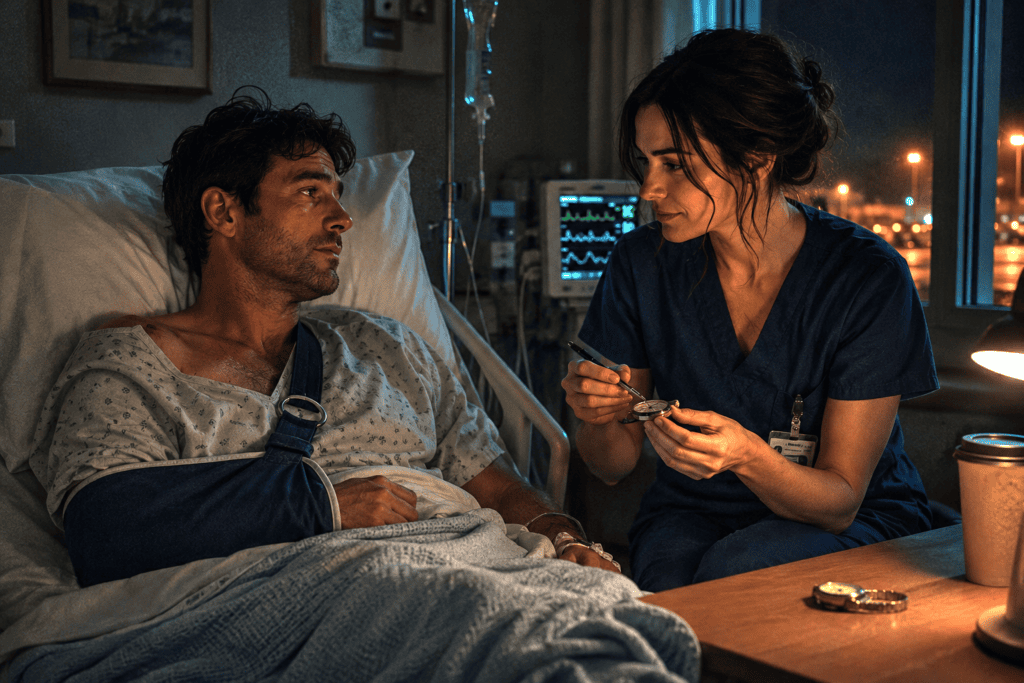
On the ninth night she brought a small tin of tools from home and sat at the foot of his bed and asked, without preamble, for the watch, and Daniel, after a silence that went on long enough to mean something, reached into the nightstand drawer and handed it to her. She opened the case back with a jeweler’s screwdriver no bigger than a matchstick, checked the movement, pronounced it dirty but sound, cleaned it with a corner of her scrub sleeve and a patience that made something in Daniel’s chest go tight and unfamiliar, and handed it back to him running, the second hand sweeping now instead of frozen at eleven forty-one, and said, “Doesn’t have to mean anything. Just seemed like a waste, a good watch sitting in a drawer.”
He did not wind it further that night. But he did not put it back in the drawer either. He set it on the nightstand where he could see it, face up, ticking, and did not examine, lying awake after she’d gone, why that single degree of difference felt like the largest thing he’d agreed to in three years.
He was discharged on a Tuesday, the collarbone healing clean, the ribs still tender enough that he favored his left side without meaning to, and in the strange flattened days that followed — home again, the schedule taped inside the cabinet still there, absurd now, a relic of a version of himself he was no longer entirely sure he wanted back — he found that the apartment’s silence, which had once felt like a discipline he had earned, now felt like something closer to a held breath.
Mara had given him her number the day he left, written on the back of a discharge instruction sheet in handwriting that slanted hard to the right, and for four days Daniel looked at it propped against the coffee maker and did not call, and told himself this was prudence, was the natural caution of a man who understood, better than most, what happened to structures built too fast on ground that hadn’t been tested. He told himself the eleven days in that room had been an aberration produced by proximity and pain medication and the particular unmoored intimacy of hospitals at three in the morning, and that whatever had passed between them belonged to that room and not to the ordinary daylight world of his kitchen and his cabinet schedule and his father’s watch now running on his nightstand.
This was, he understood much later, a lie constructed entirely out of the same fear that had kept the watch stopped for three years — the fear that anything wound up and set moving would eventually, inevitably, be a clock counting down to a leaving. Mara had told him herself, in that low lamp-lit room, that she had spent her whole life understanding staying as a slower way of losing. Daniel had heard this and had done what he always did with information like it: filed it away as confirmation of what he already believed rather than as the fragile, unfinished thing it actually was — a woman working, in real time, against her own oldest instinct, and telling him so, and asking without asking for him to meet her halfway.
Instead, on the fifth day, when she called — not texted, called, which cost her something, he would understand later, to do — he let it go to voicemail, told himself he would call back once he’d figured out what to say, and then did not call back, and the not-calling accumulated the way silence in a marriage accumulates, small and reasonable in each individual instance and catastrophic in sum. She left one message. In it her voice had none of the wry unhurried confidence of the hospital room; it was careful, almost formal, asking if he was healing all right, saying she didn’t want to be the kind of person who stayed past her shift and then made it strange after, and something in the phrase — made it strange — told Daniel she had already begun building her own exit, brick by careful brick, the exact way he had taught her, without meaning to, that leaving was safer than being left.
He did not call back. He told himself it was mercy — that a man who could not promise to stay had no business asking a woman who had spent eleven years learning the cost of staying to do it again for him. He told himself this while the watch ticked on the nightstand, still running, still wound, and did not connect, or would not let himself connect, that a man genuinely committed to sparing someone the disappointment of his own limitations does not usually keep the clock running. He simply stopped answering. He went back to the trestle bridges, harnessed and solitary, and ran his palm along cable housings and listened for the give in metal, and did not examine the ache in his collarbone that flared, some nights, in a rhythm that had nothing to do with the injury and everything to do with a silence he had built himself, brick by careful brick, exactly the way he’d once watched a young nurse cross a room to tell him the thing he did not want to hear.
Three weeks became five. Mara did not call again. She told herself this was professionalism, was the ordinary boundary a person kept with a former patient, and did not examine, on the nights she found herself glancing at her phone at nine, at the hour she used to bring him vending machine coffee, why the silence felt less like a boundary and more like a verdict she had handed down on herself before he’d had the chance to.
It was Priya who broke it, in the end, the way sisters sometimes cut straight through the fences a brother spends years building. She drove up from Missoula the second week of December, ostensibly to see how the collarbone was healing, and found the watch running on the nightstand and a discharge sheet with a phone number on the back of it still propped, unused, against the coffee maker, gone soft and curled at the corner from five weeks of humidity and neglect, and she looked at her brother for a long moment across the small kitchen and said, “You wound the watch.”
“It needed cleaning,” Daniel said.
“You’ve had it running for five weeks and you haven’t called the woman who cleaned it.” Priya was not a gentle interrogator; she never had been, not since they were children, and grief had not softened her, only sharpened the angle. “I’m not going to tell you what to do. I’m going to tell you that you didn’t used to leave things running that you weren’t planning to use, and that scares me more than the collarbone did.”
Daniel did not answer that night. But he lay awake with the small mechanical ticking of his father’s watch loud in the quiet room, and thought of eleven forty-one, and thought, for the first time in three years, not of the moment the truck had come through the cross street but of the four days after — of a young nurse whose kindness had cost her something to give and who had given it anyway, on a schedule that was never going to be enough, and of Mara standing at the foot of his bed on the ninth night with a jeweler’s screwdriver no bigger than a matchstick, choosing, deliberately, to fix a thing that had every reason to stay broken, and he understood, lying there in the dark, that he had spent five weeks punishing her for a fear that had never once been hers to answer for.
He did not call. He drove to St. Agnes the next morning instead, badge-less, injury healed enough now that the nurses at the station did not recognize him at first, and asked, with a directness that cost him everything he had, whether Mara Voss was on shift.
She was. She came around the corner of the nurses’ station with a chart in her hand and stopped when she saw him, her face doing several things in quick succession before it settled into something guarded, careful, a door held slightly ajar rather than open.
“You disappeared,” she said. Not an accusation. A fact, offered the way she’d once offered facts about his ribs.
“I know.”
“I called once. I told myself that was the limit. I don’t call people twice who don’t call back.” Her voice had none of the practiced unhurried warmth of the hospital room at three in the morning; it was flat, protecting something. “I know how that ends. I watched my mother’s friends do it for eleven years. People stay right up until staying costs them something, and then they find a reason.”
“I wasn’t scared of what it would cost me,” Daniel said, and the words came out rough, unrehearsed, nothing like the careful sentences he’d practiced in the truck on the drive over. “I was scared of being the kind of thing somebody has to stay for. I’ve been on the other side of that bed. I know what it looks like when the staying runs out. I decided a long time ago I wasn’t going to let anybody find that out about me twice.” He reached into his jacket pocket, where the watch sat, wound, running, taken off the nightstand that morning without entirely deciding to bring it. “You fixed something I’d let sit broken for three years because fixing it felt like a promise I didn’t think I had any right to make. I came here to tell you I want to make it. I know that’s not much, after five weeks of nothing. I don’t have a bridge-inspector’s proof that it’ll hold. I’ve got the watch, and the fact that it’s still running, and the fact that I drove forty minutes to say the thing out loud instead of leaving it in a drawer again.”
Mara looked at him for a long moment, the chart still in her hand, the hallway humming its low fluorescent hum around them, and something in her face gave the way a good structure gives under exactly the right amount of pressure — not failure, but yield, the particular honest movement of a thing designed, after all, to bend before it breaks.
“I’m on until seven,” she said finally. “That’s four hours from now.”
“I’ll wait.”
“You don’t have to sit in a hospital for four hours.”
“I know,” Daniel said. “I want to.”
He sat in the small waiting alcove near the nurses’ station for four hours, the watch ticking in his jacket pocket where he could feel it against his ribs, and at seven, when her shift ended and she came around the corner in her street clothes, coat over one arm, she did not say anything at first, only crossed the distance between them and took his hand, turning it over, and set something small and cool into his palm — her own watch, plain, battery-run, the strap worn soft — and closed his fingers around it.
“Mine’s kept perfect time for six years and I’ve never once been late anywhere I actually wanted to be,” she said. “Trade you.”
Daniel took his father’s watch from his jacket pocket, still running, the second hand sweeping steady past eleven forty-one without stopping there, without needing to, and fastened it, without asking, around her wrist himself, his hands clumsy on the small clasp, and she let him, standing very still in the hospital’s fluorescent hallway with her coat over one arm and her whole guarded face gone soft and unguarded at last, watching the second hand move.
“I wasn’t supposed to stay this long,” she said again, quieter this time, no longer a confession made to a stranger in the dark but a fact offered freely, a fact she had decided, finally, to keep saying on purpose — and Daniel Reyes, standing in a hospital hallway with someone else’s watch warm on his wrist and his father’s watch ticking now on hers, understood that some structures did not fail from staying too long under weight. Some structures were built, all along, for exactly this — for the particular, unglamorous, daily courage of choosing, again and again, not to leave.


Heartfelt characters sharing love, emotions, and romantic journeys filled with hope, trust, and unforgettable bonds