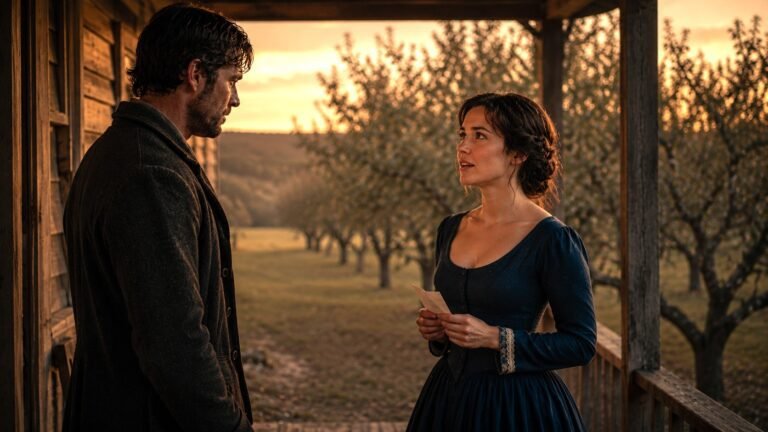


Life Grows Quiet On Maple Lane
The porch light had burned out in October, and Eleanor Whitfield hadn’t replaced it.
It wasn’t that she couldn’t reach the ladder anymore, though at sixty-eight her knees argued about it. It was that the light had never once, in three years, been for her. It had been for Harold, who liked to sit out past dark with his pipe and watch the fireflies do their slow, drunk circles over the Hendersons’ hedge. When he died, the porch had gone on doing what porches do — holding up its roof, catching the rain — but it had stopped being a place anyone sat.
Now the boards creaked under nobody’s weight but the mail carrier’s, twice a week, dropping bills and church bulletins through the slot with a sound like a small sigh.
Eleanor’s mornings had a shape to them, the way a life does after enough years of teaching second grade — a life measured in bells that no longer rang. She woke at six, whether she wanted to or not. She made one cup of coffee, in the same chipped blue mug she’d been using since 1994, the one with a hairline crack running down through the glaze that never quite gave way. She used to make two cups. She’d stopped, somewhere in that first blurred month, and never gone back to two, because two felt like a lie the kitchen would notice.
She watered the ferns on the porch rail — three of them, all that survived of the eleven she used to keep — and she did this at seven, rain or shine, because it was a thing to do with her hands, and her hands, since retirement, since Harold, had developed a restlessness she didn’t like to name. Forty-one years of chalk dust and small handwriting on the board — Good morning, class — and now her hands wanted work and found none.
She did not look at the house next door.
This was its own kind of habit, invisible to anyone but her — the careful, practiced way her eyes slid past the Hargrove place on their way to the mailbox, the way she’d trained herself not to notice whether his truck was in the drive or whether the old man had gotten the gutters cleared before the leaves came down heavy. She had lived beside Walter Hargrove for eleven years and spoken to him perhaps forty times, mostly weather, mostly waves. He was the sort of neighbor who fixed his own roof at seventy-one and didn’t ask for help doing it, a widower of — she thought — six or seven years now, gruff in the way of men who’d spent their lives with their hands in wood and their mouths shut. His wife had been Carol. Eleanor remembered the funeral. She remembered thinking, even then, in her own grief that hadn’t happened yet, how alone a person could look standing at the edge of a grave they didn’t choose to be near.
She hadn’t thought of him since. Not really. Not on purpose.
What she thought of, instead, on these quiet mornings, was the specific, small treachery of an empty house continuing to run exactly as it always had — the furnace still clicking on at the same hour, the refrigerator still humming its same tune, everything mechanical and dumb and faithful, while the man who’d chosen the paint colors and hung the pictures crooked on purpose because he liked to see her straighten them was simply, permanently, not there to laugh about it.
She had, in the eleven months since, developed exactly one new habit, and she was not proud of it. She had stopped believing that anyone stayed. Not out of bitterness — she wasn’t an unkind woman, and she’d have been embarrassed to hear anyone call her hardened — but out of a plain, arithmetic sort of grief. People left. The good ones left soonest, it seemed, as if the world couldn’t stand to keep them. She had watched her mother leave, and her sister, and finally Harold, forty-three years of marriage folded down into a folder of paperwork and a flag someone handed her at the VFW hall, and somewhere in all that folding she had quietly decided that the smart thing, the safe thing, was not to expect anyone to stay long enough to matter again.
So she watered her three ferns. She drank her one cup of coffee. She did not look at the house next door, and she told herself this was simply what a life looked like, once you’d had the good part of it and set it down.
The fence between the two yards was old cedar, gone silver with weather, and it had one flaw Eleanor had never bothered to fix — a knot that had dried and dropped out sometime in the nineties, leaving a hole the size of a silver dollar about waist height, right where the fence met the property line near the mailboxes. Harold used to joke that it was a spy hole, that one day the Hargroves would catch them peering through it like children. Nobody had ever peered through it. It was just a hole in a fence, letting a little daylight through where daylight had no particular business being.
Eleanor did not think about that hole either, as a rule.
She finished with the ferns on a Tuesday in early November, the sky the color of an old dishrag, the air smelling like woodsmoke from somebody’s chimney three streets over. She set the watering can down on the top step, the way she always did, and she was turning to go back inside — coffee gone cold, the day waiting to be filled with nothing in particular — when something pale caught the corner of her eye.
Tucked into the knothole in the fence, rolled the way a note gets rolled when someone means for it to fit through a small space, was a scrap of paper.
She almost didn’t go look. That was the truth of it, later, when she thought back on it — she almost let it be, the way she let most things be now, assuming it was trash blown in from the road, or a flyer some optimistic teenager had shoved through every gap on the street. But her hands, restless as they were, walked her down the steps and across the frost-stiff grass before her mind had finished deciding, and she pulled the little scroll free and unrolled it against her palm.
The handwriting was blunt and slanted, a carpenter’s hand, pressed hard enough into the paper that she could feel the grooves of it with her thumb.
Your ferns look thirsty even when they’re not. You water them like you’re apologizing to something.
There was no name. There didn’t need to be.
Eleanor Whitfield stood at the fence for a long moment, the cold coming up through her slippers, and felt something she had not felt in eleven months — not sorrow, not the low grey hum of missing — but something sharper and more embarrassing. She felt seen, and it startled her the way a hand on the shoulder startles you in an empty room.
She did not write back. Not that day.
But she did not throw the note away either. She carried it inside, and without quite deciding to, she set it on the kitchen windowsill, propped against the glass where the morning light would find it, in the exact spot where, a long time ago, she used to keep the little vase Harold filled with whatever flowers he could steal from the neighbors’ gardens without getting caught.
The First Note Through The Fence
For three days, Eleanor did not go near the knothole.
She told herself this was dignity. A woman her age did not go creeping around fences reading anonymous notes as though she were fifteen and passing folded paper in a school hallway. She told herself this while she watered her ferns at seven exactly as she always had, and she told herself this while her eyes, against every instruction she gave them, drifted toward the pale gap in the cedar boards each and every morning to see if anything new had appeared there.
On the fourth morning, something had.
Carol used to say I water plants like I’m trying to drown my guilt instead of my thirst. She was probably right. I never could do a small thing without doing it too hard.
Eleanor read it twice, standing at the fence in her housecoat with her breath fogging in the cold, and felt the strange vertigo of being handed a stranger’s grief through a hole meant for nothing at all. She thought about Walter Hargrove — gruff, silent, seventy-something, a man she’d have said, if pressed, had all the interior warmth of a cinder block — and she tried to square him with a man who wrote sentences like I never could do a small thing without doing it too hard, and she found she could not, quite, and that failure interested her more than she wanted it to.
She went inside. She sat at her kitchen table with a cup of coffee going cold beside her, and she got out a pad of paper she used for grocery lists, and she sat there for the better part of twenty minutes with the pen in her hand and nothing coming.
What finally came was short.
The ferns aren’t guilt. They’re just the only thing left that still needs me for something.
She folded it small, the way his had been folded, and she carried it out to the fence in her slippers before she could talk herself out of it, and she pushed it through the knothole and went back inside without looking to see if he was watching from his kitchen window. She suspected he was. She did not check.
The notes did not come every day, at first. That would have been too much, too fast, the way a hard rain drowns a garden instead of feeding it. They came every two or three days, unpredictable, sometimes in the morning and sometimes — she found one once at nine at night, when she went out in her coat to bring in the ferns before frost — tucked in like a secret meant for the dark. She began to recognize the shape of his handwriting the way you recognize a voice, the particular slant of his g‘s, the way he crossed his t‘s hard and fast like he was in a hurry to get to the next word.
You taught school. I can tell. You write like someone used to being believed.
I built half the houses on this street forty years ago. Nobody remembers that. They just remember the hardware store closed.
I don’t sleep past five anymore. Never have, since the Army. Some habits outlive the reason for them.
Your dog used to bark at my truck. I miss that dog more than I ever told you, and I never even knew his name.
Buster, she wrote back. He died the same spring as Harold. I didn’t have room to grieve them both properly, so I think I mostly just grieved Buster, because it was easier to look at.
That one she almost didn’t send. She stood at the knothole with it in her hand for a long time, feeling the particular shame of having said something true to a near-stranger through a hole in a fence, and then she pushed it through anyway, because some other part of her — the part that used to stand in front of twenty-six seven-year-olds every September and trust, absolutely, that trying was worth the risk of getting it wrong — some other part of her had missed the specific feeling of being honest with somebody.
The notes were never long. That was, she came to understand, simply how Walter Hargrove was built — a man who trusted a few true words over a great many careful ones, who’d spent a working life measuring twice and cutting once and seemed to write the same way, weighing each sentence before he let it go. But they accumulated, the way sawdust accumulates on a shop floor, an inch at a time until one day you look down and realize there’s a drift of it there, a record of all the hours you spent.
By the second week of December, Eleanor had a shoebox on her closet shelf with eleven of his notes inside it, and she had started, without entirely admitting it to herself, watering the ferns a little more slowly in the mornings, giving the day a few extra minutes to produce something through the fence before she gave up and went inside.
She had not seen him. Not properly — not close enough to note the color of his eyes, or whether he still had all his hair, or what his voice sounded like saying more than “morning” across a shared stretch of driveway. The whole strange courtship, if that was even the word for it, and she balked at the word even privately, was happening in handwriting and cedar and the particular red-gold light of a porch in winter. It should have felt insufficient. It didn’t. It felt, if anything, like the only kind of closeness she had room left for — something that could be taken in slowly, at arm’s length, without asking her to risk the whole of herself on a single afternoon.
Then, on a Thursday, the mail carrier’s truck broke an axle two doors down, and half of Maple Lane came out to watch the tow, the way small towns do, everyone drawn to a small disaster like moths to a porch light. And that was how Eleanor Whitfield found herself standing at the end of her driveway in her good wool coat, arms crossed against the cold, when Walter Hargrove came out of his own house to see what the fuss was, and for the first time in eleven months and eleven notes, they were simply standing three feet apart with nothing between them but December air.
He was taller than she remembered. Broader in the shoulder, though age had started to fold him slightly forward, the way it does to men who spent decades bent over a workbench. His hair was more silver than she’d registered from a distance, cropped close, and his hands — she noticed his hands first, the way you notice a person’s hands when you’ve spent weeks imagining them holding a pen — were scarred and thick-knuckled, a carpenter’s hands, exactly as blunt as his handwriting had promised.
“Cold one,” he said, which was, she would come to learn, roughly ninety percent of what Walter Hargrove said out loud to another human being.
“It is,” she agreed.
They watched the tow truck work in silence for a minute, and then, unbidden, a gust of wind came down the lane and knocked the tow driver’s clipboard clean out of his hands, sent it cartwheeling across two lawns while he swore and chased it, and Eleanor — without any warning to herself — laughed, a real laugh, sudden and surprised out of her own throat, the first one in longer than she wanted to count.
Walter looked at her sideways, and something in his face that had been braced, careful, folded shut for years, came loose by half an inch.
“You laugh like your notes,” he said. “Like you didn’t expect to.”
“I didn’t,” she said, and meant it two ways at once, and watched him understand both.
Neither of them said anything else worth repeating. But when Eleanor walked back up her own driveway ten minutes later, something in her chest had shifted its weight, quietly, the way a house settles — nothing you’d notice in the moment, everything you’d feel later, in the dark, listening to the new silence it left behind.
What The Notes Never Said
Winter deepened, and so, in its slow and stubborn way, did the thing growing along the fence line at the edge of Eleanor Whitfield’s yard.
The notes kept coming, but they had started to carry weight differently now, the way a conversation changes once two people have stood face to face and know what the other one sounds like laughing. She would open the door some mornings and find him already out there, not at the fence exactly, but near it, ostensibly clearing his gutters or checking a downspout, in the transparent way people invent errands to be near a thing they aren’t ready to name.
“Roads are bad,” he said one Saturday, nodding toward the ice glazing the lane, though the roads had been bad for a week and he hadn’t mentioned it before.
“They are,” she agreed, and stood there with her empty watering can, in no hurry at all to go back inside.
They had taken, by late December, to talking across the fence itself, real sentences now instead of folded paper, though the paper never entirely stopped — there was something, Eleanor thought, that each of them could say in writing that neither could quite manage looking the other in the eye, and so the notes kept a private channel open even as the spoken conversation widened.
I keep the porch light off, she wrote him, one night when the words came easier on paper than they would have out loud. It was his light. I didn’t think I had the right to turn it back on for anyone else.
The next morning there was a new bulb sitting on her top step, still in its cardboard box, with a note rubber-banded around it.
Not asking you to turn it on for me. Just seems a shame for a good porch to sit in the dark.
She did not put the bulb in. Not yet. But she carried the box inside and set it on the kitchen counter where she’d see it every morning, and some mornings she picked it up and turned it over in her hands like a question she wasn’t ready to answer.
Their conversations, when they happened, circled things rather than landing on them, the way two people do when both have buried a whole marriage’s worth of feeling and neither wants to be the one who digs first. He told her about Carol in pieces — never the whole grief at once, just a splinter of it at a time, the way you’d hand someone a hot dish, careful, testing whether they could hold it. Carol had loved birds. Carol had made him promise, near the end, that he wouldn’t let the house go quiet, and he’d broken that promise for six years running, he admitted, standing at the fence with his jaw working like there was something caught behind his teeth, until — he didn’t finish the sentence. He didn’t have to.
Eleanor told him about the two coffee cups that had become one. About the ferns. About how she’d stopped believing, somewhere in that first grey month, that staying was a thing people actually did, that it was mostly a promise people made before they found a reason to leave.
“Harold didn’t leave,” Walter said, the one time she said this plainly, standing at the fence in the flat white light of a January afternoon. “He died. Different thing.”
“Feels the same from where I’m standing,” she said.
“No,” he said, and something in his voice went quiet and certain in a way that startled her. “It doesn’t. Leaving’s a choice. What happened to you wasn’t.”
She had no answer for that. She stood there with her hands cold in her coat pockets and let the words settle into her the way water settles into dry ground — slow, and further down than she expected.
There was a particular evening, mid-January, cold enough that her breath hung visible in the porch light — she had put the bulb in, finally, three weeks after he’d left it, without telling him, and she’d watched from her kitchen window the first night it came on, watched him step out onto his own porch and look over at the light with an expression she couldn’t read from that distance but felt, somehow, all the way across the yard — when he came to the fence with no errand to hide behind, no gutter to check, and simply stood there.
“Got something to say,” he told her, “and no polite way to fold it small enough to fit through a knothole.”
She waited.
“Been a long time,” he said, “since I wanted to know what somebody’s whole day looked like. Not just the parts that fit on paper.”
Eleanor felt the words land somewhere under her ribs, warm and frightening in equal measure.
“I don’t know how to do this again,” she admitted, and it cost her something to say it, some old pride she’d been keeping folded like a good coat, unworn. “I’m out of practice at being someone’s whole day.”
“Nobody’s in practice,” Walter said. “You just start.”
Neither of them moved to close the last three feet of distance between them, that evening. It wasn’t time yet — some things, Eleanor understood, watching him standing there in the cold with his hands jammed in his jacket pockets same as hers, could not be rushed any more than a fence could grow back a knot it had already dropped. But something had been said aloud now that couldn’t be folded back up small and tucked away, and they both knew it, and they both, for the first time, let the silence between them hold instead of ache.
The Note That Went Too Far
It was Walter who moved too fast, in the end, and it was fear dressed up as certainty that did it, the way it so often does with men who’ve spent a lifetime deciding rather than waiting.
He’d watched the porch light burning steady every night for three weeks by then, watched Eleanor’s silhouette move through her kitchen in the evenings, watched — he would tell her later, though not for a while yet — the particular way she’d started leaving her door unlatched on Sunday mornings, an invitation neither of them had spoken aloud but that he’d understood anyway, the way you understand weather. Something in him, some old carpenter’s instinct that trusted the measured plan over the slow build, decided the foundation was solid enough to build on.
He wrote the note on a Tuesday in February, sitting at his own kitchen table with Carol’s photograph turned, gently, face-down for the first time in six years — not out of disloyalty, but out of a kind of permission he’d finally given himself to want something new without it costing him something old.
Marry me, the note said. Nothing else. No preamble, no explanation, folded the way all his notes were folded and pushed through the knothole in the cedar fence at seven in the morning, the way he’d pushed through dozens of smaller, gentler truths before it.
Eleanor found it on her way out to the ferns.
She read it once, standing on the frost-stiff grass in her housecoat, and something in her chest didn’t open — it closed, fast and hard, the door slamming shut on instinct before her mind had caught up to why. It wasn’t that she didn’t feel what the note was reaching for. It was that the note arrived exactly where the old wound lived, the one that had never fully healed under all those gentler words — the belief, arithmetic and hard-won, that big declarations were what came right before the leaving. Harold had proposed on a Tuesday too, forty-five years ago, standing in her mother’s kitchen with a ring he couldn’t quite afford, and she had said yes to that boldness gladly, once, because she’d been twenty-three and hadn’t yet learned what a life could take from a person. She was sixty-eight now. She knew exactly what a life could take.
She did not write back.
Not that day, not the next, not the one after that. She watered the ferns at seven and did not look at the fence. She let the porch light burn, because turning it off now would have been its own kind of confession, but she stopped standing on the porch in the evenings, stopped leaving her door unlatched on Sundays, retreated so completely and so quietly into the old shape of her solitary life that it was as though the whole winter of notes had never widened anything at all.
Walter, for his part, read her silence the only way a proud man raised to distrust his own softness knew how to read it — as an answer. As the answer, in fact, he’d half expected all along, the one that confirmed some old private math of his own: that a woman like Eleanor Whitfield, careful and self-contained and dignified in her grief, had let an old fool get ahead of himself, had been kind to him out of loneliness rather than wanting, and that the kindest thing he could do now was stop leaving notes and let her be.
So the notes stopped. Not with an argument. Not with a single unkind word. They simply stopped, the way a tap left dripping finally runs dry, and the silence that filled the space where the notes had been was worse, somehow, than the silence before any of it had started, because now it had a shape — the shape of two people standing eight feet apart on either side of a fence, both of them certain the other had decided against them, neither of them saying so.
The porch light burned every night through the last cold weeks of February. Eleanor watched it from her kitchen window sometimes, at nine or ten at night, and felt the particular ache of a bulb burning for a possibility that had, apparently, already closed.
Walter’s truck sat unmoved in his driveway for three straight days, snow gathering on the windshield, the first time in memory anyone on Maple Lane had seen it stay that still. He was not a man who took to his chair easily. But there was, that week, very little reason he could find to get up out of it.
Neither of them ate quite right, that stretch. Eleanor found herself standing in front of the open refrigerator some evenings, unable to remember what she’d opened it for. Walter’s hands, so long steady at a workbench, fumbled a chisel one afternoon and drew blood, a stupid careless nick he wouldn’t have made in forty years of woodworking, and he sat on his shop stool afterward with the cut wrapped in a rag, staring at nothing, understanding — dimly, the way you understand a bruise before you understand what caused it — that some kind of damage had been done that wasn’t going to heal on its own.
The fence stood between them the whole time, cedar gone grey with winter, the knothole empty, catching nothing but a thin cold draft where daylight and, for two weeks, hope had passed easily back and forth.
One Note, One Answer, Forever
It was the ferns that broke Eleanor open, in the end — the ordinary, stubborn fact of them.
She went out on the first almost-warm morning of March to water them, out of habit more than hope, and found that one of the three, the oldest, the one that had survived eleven years and a husband’s death and a whole hard winter, had gone brown and brittle at the crown, finally giving up the fight it had been quietly losing for weeks while she wasn’t paying close enough attention to notice.
She stood there with the watering can hanging useless from her hand and felt something give way inside her that had nothing, really, to do with a houseplant.
You water them like you’re apologizing to something, he’d written, all those months ago, the very first note, and she understood now, standing over the dying fern in the thin March sun, that she had spent a whole winter doing the same thing to a man — watering a closeness carefully, faithfully, and then, the one time it had asked for more than careful faith, she had let it go dry rather than risk giving it too much and losing it entirely.
He hadn’t proposed too fast, she understood now. He’d simply said, in the only language he fully trusted, the thing his notes had been building toward all along, the same way every small true sentence he’d folded through that knothole had been building toward it. And she had heard, instead of I want to build a life with you, only the old familiar sound of a door about to close, because that was the sound she’d trained her whole grieving self to listen for.
She did not write a note. That was the first thing she understood, standing there with dirt under her fingernails and her heart going hard and unfamiliar in her chest. A note could be folded small and left unanswered, the way this last one had sat for weeks. What she owed him — what she wanted, fiercely, unexpectedly, for the first time in eleven months — could not be folded that small.
She walked across the wet grass in her slippers, no coat, the cold biting at her ankles, and she did not stop at the fence. She went around it, through the gap by the mailboxes where the two properties met the lane, and she walked up Walter Hargrove’s driveway past his snow-dusted, unmoved truck, and she knocked on his front door with a hand that was shaking, though not, she realized, from the cold.
It took him a long moment to answer. When he did, he looked older than she’d let herself remember, unshaven, a rag still wound around one hand, his eyes going carefully blank the way a man’s eyes go when he’s decided not to hope for something and then has that decision tested without warning.
“You said marry me,” Eleanor said, before he could speak, before her own nerve could fail her the way it had for two solid weeks. “I never said no. I just went quiet, and I let you believe quiet was an answer, because quiet was easier than telling you the truth, which is that the last time somebody asked me that, I said yes gladly and then spent forty-three good years and eleven terrible months finding out exactly what it costs to lose it. I got scared. Not of you. Of how much I wanted to say yes.”
Walter stood in his own doorway and said nothing for a long moment, and Eleanor made herself stand there and take it, whatever it was going to be, because she had decided, walking up that driveway, that she would rather risk the whole of herself on one honest morning than spend another winter carefully watering something from a safe distance and calling it enough.
“Ferns dying?” he asked finally, and it wasn’t what she expected, and it was, somehow, exactly right — his particular way of reaching for the smallest true thing instead of the biggest declared one.
“One of them,” she said. “I let it go too long without noticing.”
“I’ve got a spot in my shop,” he said. “South window. Carol used to keep her violets there. Been empty a long while.”
It wasn’t a grand gesture. There was no ring produced from a pocket, no music, no crowd of witnesses the way there’d been in her mother’s kitchen forty-five years before. It was an old man in a doorway offering a dying houseplant a south-facing window, and Eleanor Whitfield understood, standing there with the cold coming up through her slippers, that this — precisely this, small and specific and utterly without spectacle — was what a person who had learned exactly how much staying costs actually sounds like, when he means to stay anyway.
“I’d like that,” she said. “For the fern. And for me, if the offer’s still standing.”
Something in Walter Hargrove’s face came apart and rebuilt itself all in the same instant. He reached out — not for her hand exactly, not yet, but for the fern’s pot, still cradled against her chest where she’d carried it without noticing she’d picked it up, and his rough, scarred carpenter’s fingers closed around the rim of it, close enough that they brushed hers.
“Offer’s been standing since November,” he said. “Just didn’t know how to say it small enough to fit through a hole in a fence.”
“You didn’t need to,” Eleanor said. “You already said it plenty of times. I just wasn’t ready to read it right.”
They stood there a while longer in the doorway, the March sun climbing thin and pale over the rooftops of Maple Lane, and later — not that morning, but a few mornings after, once the fern had taken its place in the south window and started, slowly, to green again — Eleanor found one more note tucked into the old knothole in the cedar fence, the last one either of them would ever need to leave that way.
Light’s still on every night, it said. Figured, from here on, it might as well be on for both of us.
She carried it inside and set it on the windowsill where the vase used to be, where the fern now was, and that evening, when the porch light came on, she was standing outside to see it — not alone this time, but with Walter’s hand, rough and certain, folded easily around hers, both of them watching the small warm bulb catch and hold against the coming dark, exactly as steady as a promise finally believed.
Suggested category: Old People Romance
Suggested tags: old people love story, silver fox romance, slow burn romance, second chance love story


Heartfelt characters sharing love, emotions, and romantic journeys filled with hope, trust, and unforgettable bonds