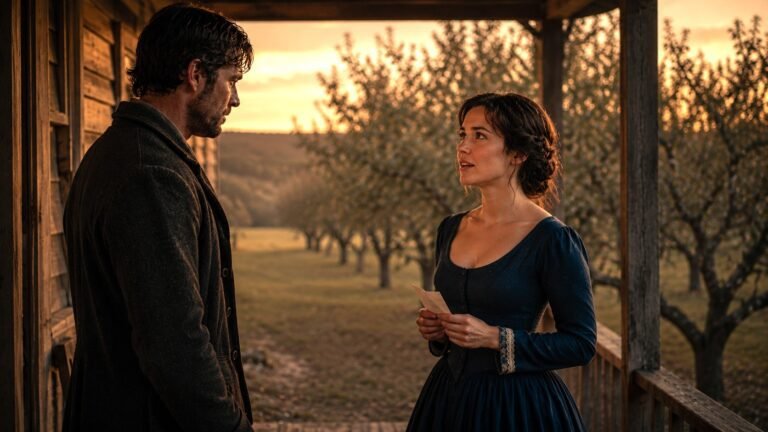


Eleanor Voss opened the shop at nine, though nobody had come through the door before eleven in longer than she cared to count.
She still did it in order. Lights first, the ones over Fiction that had buzzed since spring and that she’d stopped hearing months ago. Then the register, drawer counted out to exactly sixty dollars in small bills, though most days it stayed at sixty dollars because nothing moved through it at all. Then the bell above the door, which she checked by hand, giving it one small ring to be sure the clapper hadn’t seized, a habit that made no sense — a bell announces itself, it doesn’t need testing — except that it had been her sister’s bell, hung the week they opened the store together, and some mornings ringing it once was the only proof Eleanor had that anything in the building still worked the way it was supposed to.
The shop was called Hartwell & Sage, though there had never been a Hartwell. Only Eleanor and Marion, sisters with the same stubborn chin and different ideas about what a bookstore owed its town, and Marion had picked the name because she liked the sound of it more than the truth of it, and Eleanor had let her, the way she’d let Marion win most disagreements that didn’t actually matter.
Now Eleanor ran the place alone, in a town that had decided, gradually and without cruelty, that it preferred to order things online.
She kept Marion’s section exactly as it had been. A low shelf near the window, poetry and letters and the strange, beautiful, unsellable books Marion had loved past all reason — a section with its own little hand-lettered sign, MARION’S SHELF, that Eleanor dusted every morning and never restocked, because restocking it would have meant deciding what Marion would have chosen, and Eleanor had never trusted her own taste enough to make that call.
Marion had been gone fourteen months. Heart, sudden, no warning worth mentioning — gone between one Tuesday and the next, the kind of gone that left no argument to have, no wrong to right, nothing but a shelf that stayed exactly as arranged and a store that kept opening at nine out of something that had stopped being hope and become instead a kind of discipline.
The landlord had been patient. Patience, Eleanor had learned, was a currency that ran out on a schedule nobody told you about in advance, and hers, she suspected, was close to its end. The rent notice sat unopened on the counter for three days before she finally read it, and when she did, the number at the bottom didn’t surprise her so much as confirm something she’d already known and been declining to look at directly, the way she declined to look at the empty half of the apartment she and Marion had shared above the shop, the way she declined to move Marion’s coat from the hook by the stairs.
She had stopped believing, somewhere in those fourteen months, that things came back around. She had stopped believing it so thoroughly that she’d built her days around not testing the belief at all — open at nine, count the drawer, ring the bell once, dust the untouched shelf, close at six, go upstairs to a silence shaped exactly like a person. It was a small life. It fit her like a coat two sizes too big, sleeves rolled, but it was hers, and she had gotten good at wearing it.
The FOR SALE sign two doors down, on the old hardware building, had been up for a year. She barely registered it anymore, one more empty storefront on a street collecting them, until the October morning a truck backed into the loading space beside it and a man in a canvas coat stood in the street with his hands on his hips, looking up at the brick the way people look at something they’ve already decided to love.
Eleanor watched him from her window with the particular flat interest of someone who no longer expected the street to change. Silver at his temples, unhurried in the way he moved boxes from the truck bed, and something in the set of his shoulders that reminded her, obscurely and without permission, of nothing in particular — just a feeling, gone as soon as she noticed it, like catching a scent that belongs to no memory she could name.
She went back to the register and counted out sixty dollars in small bills, though nothing had moved through it at all, and rang the bell once, and did not think of the man again until the following week, when he walked through her door with a box under one arm and asked, in a voice that had no business sounding so certain in a dying bookstore, whether she happened to have anything by a poet named Marion had loved.
He said the name plainly, the way a person says a name they’ve turned over in their mouth for years and no longer notice tasting strange — a minor poet, out of print, the kind of writer only somebody’s private grief keeps alive — and Eleanor’s hand went still on the counter before she’d decided to let it.
“That’s Marion’s shelf,” she said. “By the window. Nobody asks for her by name.”
“I’m not most people, then.” He said it without irony, setting his box down carefully, like it held something worth the care. “Daniel Voss. I bought the building two doors down. Figured a man opening a shop ought to know his neighbors before he knows his inventory.”
“Eleanor Hartwell.” She caught herself. “Voss. Eleanor Voss. There isn’t a Hartwell. There never was.”
Something crossed his face — brief, careful, already deciding whether it was his to say — and he looked past her to the low shelf by the window instead, to the hand-lettered sign, and stood there a moment too long for it to be nothing.
“I knew a Marion,” he said, “who read that poet the way some people pray.”
The bell above the door rang on its own then, some draft finding it at exactly the wrong moment, and Eleanor felt the sound land in her chest like a struck note she hadn’t asked to hear. She had rung that bell by hand every morning for fourteen months to prove it still worked. She had never once heard it ring itself.
“How,” she said, and stopped, because there wasn’t a way to finish the sentence that didn’t require more air than she currently had.
Daniel didn’t push it. He crouched instead at Marion’s shelf, careful, the way a man handles something he already knows the shape of, and drew out a slim volume with a cracked spine that Eleanor recognized without looking — she could have told him the page it fell open to, the poem about a lighthouse that didn’t warn ships so much as keep them company — and he held it a moment before setting it back exactly where it had been.
“Twelve years ago,” he said. “Poetry reading, a bookstore two towns over that isn’t there anymore. I sat behind a woman who cried at the wrong poem — the funny one, not the sad one — and I thought, there’s someone who feels things sideways of how she’s supposed to. Talked to her after. Wrote her a few letters over the years. Never signed my name to more than half of them. She wrote back sometimes. Wasn’t ever anything you’d call — ” he searched for the word and set it down carefully, the way he’d set down the book — “official. Just two people who liked the same lighthouse poem.”
Eleanor sat down on the stool behind the counter because her legs had developed an opinion about the matter.
“You’re the letters,” she said. “There’s a shoebox. I never opened half of them. I thought — I don’t know what I thought. That it was rude to read a dead woman’s mail even though she’d have wanted me to.”
“I’m not asking you to open them.” Daniel’s voice had gone careful in a different way now, gentler, a man walking back from a ledge he hadn’t meant to bring her to. “Didn’t come in here to unearth anything. Came in for a book of poems and ended up finding out the woman who wrote it half her fan mail owned the last shop in town that still sells it.”
There was a silence that should have been terrible and wasn’t. Outside, a delivery truck downshifted on the hill, and somewhere behind the counter the ancient radiator knocked twice, and Eleanor found herself laughing — short, surprised, entirely against her own permission — at the sheer, absurd architecture of it: a dead woman’s secret admirer standing in a dying bookstore, holding a book he’d once mailed love letters in service of, looking as unmoored as she felt.
“She’d have liked this,” Eleanor said. “The strangeness of it. She collected strange things.”
“I’m getting that impression.” Daniel almost smiled — the corner of it, held back, the way a man holds back a thing he’s not sure has been earned yet. “Didn’t mean to walk into your grief holding a box of my own. Seems we’re neighbors in more than the storefronts.”
He left ten minutes later with the poetry book, paid for in full though Eleanor tried to tell him it was on the house, and the door swung shut behind him, and the bell rang again — hand-rung this time, by the draft of his leaving — and Eleanor sat very still at the counter for a long time afterward, aware of something in her chest that had shifted position without her consent, the way a fixture creaks in a house settling after years of standing exactly still.
He came back the following Tuesday, and the one after that, and by the third visit neither of them pretended it was about the poetry anymore, though the poetry stayed a useful excuse, a shelf to stand near while the real conversation happened underneath it.
Daniel’s shop took shape slowly through the window Eleanor could see from her register — a sign going up, letters half-painted, VOSS & SON in gold that made her ask, once, whether there was a son, and Daniel had answered, “There was,” in a tone that closed the subject as gently and as firmly as a door pulled shut by someone who didn’t want it to slam. Eleanor hadn’t pushed. She recognized the shape of a door like that. She had several of her own.
They fell into a rhythm that neither of them named. Tuesdays and Thursdays, closing time, Daniel appearing with two coffees from the place on the corner because he’d noticed, without being told, that she took hers black and strong enough to stand a spoon in. He’d sit on the low stool by Marion’s shelf, not touching the books, just present near them, the way a person sits near a grave they’ve decided to visit rather than avoid.
“You never asked to read them,” he said one evening, meaning the letters, the shoebox Eleanor had mentioned once and not again. “The ones I sent her.”
“I think I’m afraid of what’s in them.” Eleanor turned the bell above the door — not ringing it, just resting two fingers against the clapper, a habit she’d developed since he started coming, some new superstition growing in the space where the old one used to live alone. “Afraid they’ll make her more gone. Like reading them uses up the last of something.”
“Or,” Daniel said, careful, “they might do the opposite.”
He didn’t press it further, and Eleanor didn’t answer, and the silence between them did the kind of work speech couldn’t have managed — it sat there, companionable and loaded at once, until Daniel finally said, apropos of nothing and everything, “The lighthouse poem. She ever tell you why she loved it?”
“She said lighthouses don’t warn you away from danger.” Eleanor knew the words by memory, though she’d never once quoted them aloud to anyone. “She said they just refuse to go dark. That’s the whole job. Not fixing the storm. Just staying lit through it.”
Daniel was quiet a long moment, turning his coffee cup a slow half-circle on the counter.
“I’ve been trying to figure out,” he said, “for about two weeks now, whether coming in here twice a week is me honoring a woman I only half-knew, or whether it’s turned into something else, and I keep landing on something else, and I keep not saying it, because it feels like walking into a house through a door that isn’t mine to use.”
Eleanor’s hand went still on the bell.
“Which door would be yours, then.”
“The front one,” Daniel said. “If you ever decided to open it.”
Neither of them moved. The radiator knocked its two familiar knocks. Outside, the streetlight buzzed on early, the way it did every evening now that the days had started shortening, and in its new orange light Eleanor watched something pass over Daniel’s face that she recognized because she’d been wearing it herself for fourteen months — not quite fear, not quite hope, the particular unsteady footing of a person standing at the edge of wanting something they’d trained themselves not to want.
“I don’t know how to do this,” she said, finally, meaning more than the sentence held. “I’ve gotten good at a very small life. I’m not sure there’s room in it for anything that isn’t grief-shaped.”
“I’m not asking you to make room today.” Daniel stood, unhurried, the way he did everything, and set his empty cup by the register with a care that suggested he understood exactly how much that sentence had cost her. “Just didn’t want to keep standing at your window pretending I was here for the poetry.”
He left before she could answer, and the bell rang once behind him, and Eleanor sat with her fingers still resting on the clapper long after the sound had faded, feeling the whole shape of the evening settle into her chest like something she wasn’t sure yet she was allowed to keep.
The wound, when it opened, opened exactly where fourteen months of habit had worn it thinnest.
It was a Thursday, and Daniel arrived with coffee and, tucked under his arm, a book he’d found at an estate sale — a first edition of the lighthouse poet, worn but whole, the kind of thing a man buys because he’s already halfway to giving it away before he’s decided who to give it to. He set it on the counter between them, not quite a gift yet, testing the weight of the gesture before committing to it.
“Thought Marion’s shelf could use it,” he said. “Seemed wrong to keep it in a box in my truck.”
Eleanor looked at the book, and then at him, and felt something close over in her chest that she couldn’t afterward explain, except that it had been building for two weeks in the small unnamed spaces between their Tuesdays and Thursdays — the growing, unbearable sense that she was being asked to hand her sister over to a stranger by degrees, one shelf, one poem, one memory at a time, until there’d be nothing of Marion left that belonged to Eleanor alone.
“You don’t get to keep doing this,” she said, and heard her own voice come out wrong, sharp in a way she hadn’t planned. “Filling her shelf. Knowing things about her I don’t know. You knew her twelve years and I knew her my whole life, and somehow you’re the one standing here with a first edition like you’ve got more right to her memory than I do.”
Daniel went very still, the book between them like something neither of them wanted to touch now.
“That’s not what I meant this to be.”
“I know that’s not what you meant.” Eleanor heard the words landing on him and could not stop them, could not find the door back to the version of this conversation that didn’t do damage. “But that’s what it is. You come in here twice a week and I keep thinking it’s about me, and then you show up with something else of hers, and I remember it was never about me at all. It was about her. It’s always going to be about her.”
“Eleanor.” Just her name, careful, the way he said everything careful, but she was already reaching for the bell above the door, ringing it herself though he was still standing there, a gesture that made no sense except as a way of telling him the shop was closing, that this particular door was shutting whether he walked through it now or not.
He left the book on the counter and went, quiet, no argument in him, and the streetlight buzzed on outside in the exact orange it always did, and Eleanor stood alone in the shop with her hand still on the bell, feeling the shape of what she’d just done settle into her like cold water finding the lowest point in a room.
For nine days neither of them crossed the space between the two storefronts. Eleanor watched Daniel’s gold letters finish themselves from her window — VOSS & SON, complete now, a shop opening without her having asked what the son’s story was, without her having asked anything at all — and told herself the distance was clarity, was the correction of a mistake she’d nearly made. Her hands didn’t believe it. She caught herself reaching for two coffee cups from the shelf behind the register before remembering there was no reason to. She dusted Marion’s shelf and left the first edition exactly where Daniel had set it, unable to shelve it and unable to throw it away, a small unclaimed weight sitting exactly where the wound had opened.
Daniel, on his side of the street, hung his new sign and did not cross to knock on her door, because he’d heard, in her voice that Thursday, something he recognized from his own life too well to argue with — a person protecting the last thing they had left, and no amount of good intention entitled him to keep pressing on a place that raw. He told himself this was respect. It sat in his chest instead like a door he’d been asked to leave shut, and every day he left it shut, the harder it became to imagine a version of himself that knocked again.
It was Eleanor who crossed the street first, on the tenth morning, before the shop opened, wearing Marion’s cardigan against a cold that had nothing to do with why she was shaking.
She didn’t knock. She stood at the glass door of VOSS & SON with the shoebox of letters under one arm — opened now, all of them, read the night before in a single unbroken sitting that had left her wrung out and strangely, finally, lighter — and waited until Daniel looked up from unpacking a crate and saw her standing there.
He came to the door and unlocked it without a word.
“I read them,” she said, before he could say anything, because she’d rehearsed this part on the walk over and was afraid of losing it. “All of them. Even the ones she never answered. You called her a lighthouse in one of them — you didn’t know that’s what she called herself, and you called her that anyway, and I don’t know how to explain what that did to me except that it felt like she’d left you a piece of her handwriting on purpose, for me to find, fourteen months late.”
Daniel’s hands had gone still on the crate.
“I shouldn’t have said what I said,” Eleanor went on. “About you not having a right. You knew a version of her I never got to see — the one who wrote back to a stranger because a poem made her cry at the wrong line. That’s not stealing her from me. That’s more of her than I had.”
“I kept the letters half-anonymous for years,” Daniel said, quiet, “because I told myself she deserved better than an old man’s crush showing up uninvited. Told myself the same thing walking into your shop that first Tuesday. Kept telling myself right up until you asked me to leave, and I thought — there it is. Should’ve stayed the stranger with the letters. Simpler for everybody.”
“I don’t want you simpler.” Eleanor set the shoebox down on the counter between them, the way he’d once set down a first edition, testing the weight of the gesture before committing to it fully. “I want you to come back on Tuesdays. And Thursdays. And I want the first edition back on Marion’s shelf, because you were right, it belongs there, and I was too scared of losing her twice to say so.”
Daniel came around the crate, slow, careful, a man who’d learned the cost of moving too fast toward something breakable.
“The letters made a habit out of one line,” he said. “You’ve probably already read it. About the lighthouse not fixing the storm. Just refusing to go dark.”
“I read it three times,” Eleanor said. “Then I understood why you kept coming back with coffee even after I told you not to.”
“Wasn’t the coffee that kept me coming,” Daniel said, and reached, finally, for her hand across the counter — not urgent, not a grand thing, just a hand finding another hand the way a door finds its frame, exact and unforced — “and it isn’t the letters keeping me here now.”
Eleanor let her fingers close around his, and felt, for the first time in fourteen months, the particular quiet of a bell that didn’t need ringing to prove it worked.
That evening she carried the first edition back across the street herself, and set it on Marion’s shelf between the cracked-spine copy and the hand-lettered sign, and above the door of Hartwell & Sage the old bell caught a draft from the open door and rang once on its own — the way it had the day Daniel first walked in — and Eleanor stood very still and let it ring all the way out, unrepeated, unrung by hand, exactly enough.
Suggested category: Slow Burn Romance
Suggested tags: silver fox romance, slow burn romance, love story, grief and healing romance

Heartfelt characters sharing love, emotions, and romantic journeys filled with hope, trust, and unforgettable bonds