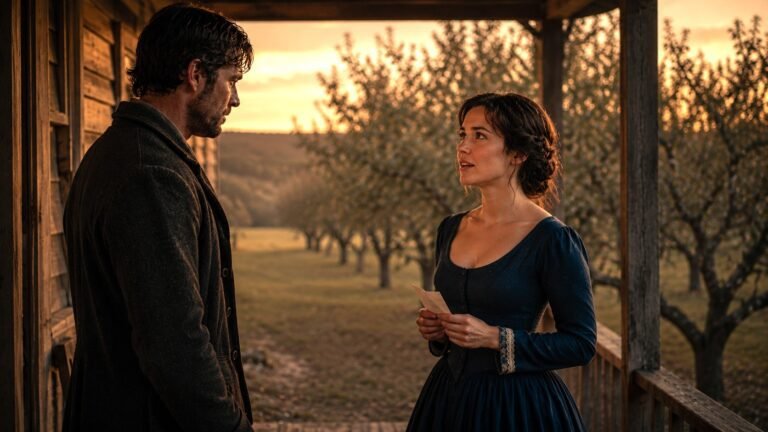

Frost had come early to Sable Creek that year, laying itself down over the wheel ruts and the dead grass like something that meant to stay, and Eli Vance was awake before it, same as always, standing at the forge with his left hand gloved though the fire had not yet been lit and there was no earthly reason for the glove except that his hand had grown so used to the leather it seemed to complain of the cold without it. He kept the shop the way his father had kept it — bellows oiled, tongs hung by size, the quench trough scummed with the same skin of rust it wore every October — and he moved through the dark building a half hour before light the way another man might move through a church he no longer believed in, out of habit, out of some old debt he could not name and would not stop paying.
He struck the flint three times before he let himself look at what he’d made, and on the third strike, when the char cloth caught, he counted nine hammer blows against the cold anvil before he raised his eyes to the growing flame. Nine. It had been nine since he was nineteen years old, and if anyone in town had ever asked him why, he would not have had an answer that fit in a sentence, only the memory sitting behind his sternum like a swallowed stone — his father’s hands closing over his own on the bellows handle the night the roof beam came down, the smell of hair burning that was not wood, the long silence after that had nothing in it but his own breathing and no one else’s. Eight years gone now. He still lit the fire alone. He still sent the boy, Amos, down to the mercantile for nails they did not need whenever the coals wanted waking, because he could not stand to have another person in the room when the flame first took, could not stand for anyone to see his face do whatever it did in that particular light.
He was not, by the town’s accounting, a hard man to look at from the right side. It was the left that undid people — the ear gone to a smooth knob, the eyebrow that never grew back, the skin from cheekbone to jaw pulled tight and shining like the surface of a creek in the last cold of November, before it takes the ice fully and still holds a kind of trembling. Women in Sable Creek had been polite to him his whole life, and politeness, he had come to understand, was a country a man could live in for a great while without ever once being welcomed. He had stopped attending the Baker girl’s wedding two years back, not from any grievance but because the sight of himself in Ruth Baker’s parlor mirror, buttoning a collar among men who did not have to think about which side they showed a room, had seemed to him a kind of theft, wearing a good coat into a place built for whole faces.
The shop had a mirror too, a triangular shard salvaged from a broken window, nailed above the washstand at an angle that showed only the right half of a man’s jaw if he stood just so, and Eli had not once in eight years stood any other way in front of it. He shaved by feel on the left, by sight on the right, and had done so with such long practice that he no longer thought of it as avoidance. It was simply how a man shaved. It was simply how a man lived, if he meant to keep living in the same town where the accident had happened, in the same building where his father had died two rooms from where he now boiled his coffee, black and bitter, standing up, because the one good chair had been his father’s and he had never brought himself to sit in it.
The letter that started everything had come in August, and Eli had not written it so much as let it be written around him. Hollis Pruett, who ran the freight office and fancied himself an authority on a great many things he had no business being an authority on, had shown him the advertisement in the back pages of a Cheyenne paper — a matrimonial bureau out of Chicago, women of good character seeking situations in the western territories — and had said, not unkindly, that a man alone eight years with a forge to run and books he could not keep straight and a house gone to dust in the corners needed someone besides a fool apprentice underfoot. Eli had written the letter at two in the morning with the shop lamp turned low, describing the work, the wages, the house, the size of the town, and had said nothing at all about his face, reasoning that a photograph would do that work for him, cruelly and completely, and any woman who answered after seeing it could not later claim to have been misled.
A woman had answered. Her name was written at the bottom of three careful pages in a hand that slanted forward like someone leaning into wind — Maren Kolb, of Ionia, Michigan — and she had said she could keep accounts, and mend, and did not frighten easily, and would arrive on the last Tuesday of September if that suited. It had suited. He had written back one line: It suits. He had not been able to make himself write more, afraid that more would only be more rope for her to use in changing her mind.
Now the day had come round to it, and Eli stood at the forge in the blue dark with his gloved hand and his nine counted blows, and did what he had done every morning for a week since her letter confirmed the date — he went to the flour tin on the shelf behind the quench trough, worked the lid free, and checked that the train ticket was still there, folded flat beneath the flour, a return fare to Cheyenne and points east, bought with his own money and never mentioned to anyone. He had told himself it was a courtesy. He told himself that again now, thumbing the paper’s edge through the fine white dust before pressing the lid back down. A woman ought to have a door left open behind her, in case the thing she walked into was not what the letter had described. In case what she saw first, stepping off the train into the flat Wyoming light, was more than politeness could carry a person through.
He fed the fire and did not sing to it the way his father used to, some tuneless thing about a girl in Donegal, because a man alone did not sing, and he pumped the bellows until the coals went from red to the particular hungry orange that meant the shop was truly awake, and outside the window the frost on the wheel ruts began, at last, to give up its light to the sun, going first silver, then simply wet, then gone, the way most things a person tried to hold onto went, given enough patient morning.
He had told Amos to have the wagon hitched by ten. He had brushed his good coat the night before and hung it where he would not have to think about it in the morning, and he had, in a moment he was not proud of and would not have confessed to a living soul, held the coat up in the lamplight and turned the left shoulder toward the wall, as if the coat itself might soften what waited beneath the collar. He put it on anyway. He had made himself a promise, somewhere in the sleepless run of nights since her letter, that whatever came off that train, he would not hide from it. He had broken smaller promises to himself a hundred times over the years and expected, without much bitterness, that he might break this one too, the moment he saw her face go still.
The forge ticked and settled behind him, banked low and safe, and Eli Vance took up his hat, and did not look in the mirror shard on his way out, and walked to where the wagon stood waiting in a morning that smelled of coal smoke and cut hay and, underneath everything, faintly, of frost still holding on in the shadow of the building where the sun had not yet found it.
The platform at Sable Creek depot was a plank the length of two wagons, raised on posts against the mud, and Eli stood back from it in the shade thrown by the water tower, the way he stood back from most things, and watched the smoke of the eastbound come up over the rise a full ten minutes before the train itself arrived, a long gray finger unspooling against a sky gone hard and blue with the last of the season’s good weather. He had worn the coat. He had shaved by feel and by sight and had cut himself once, low on the jaw, on the side that could feel it, and the small sting of that was, he thought, almost a comfort, a pain that made sense, that came from a razor and not from memory.
He did not know, precisely, what a woman who had crossed half a continent alone was meant to look like, stepping down onto a plank platform in a town she had never seen, but he had pictured it anyway, more times than he would admit, and none of the pictures had prepared him for the actual sight of her — small, straight-backed, in a gray traveling dress gone dusty at the hem, gloves on both hands despite the heat still holding in the early afternoon, a high collar buttoned to the throat though the day did not call for it. She came down the iron step with a carpet bag in one hand and a wooden trunk being wrestled off behind her by the porter, and she stood a moment on the platform looking down the single dirt street of Sable Creek — the mercantile, the freight office, the church steeple, the low gray line of the mountains beyond — with an expression Eli could not read from where he stood, something that was not quite disappointment and not quite relief, something closer to a person doing careful arithmetic and keeping the sum to herself.
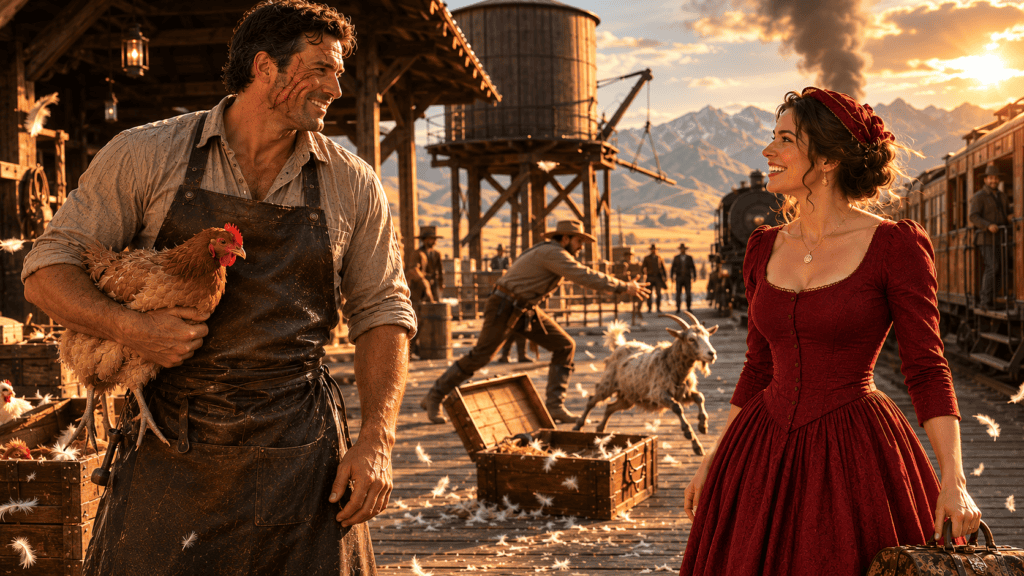
He made himself walk forward. That was the whole of the courage required, he told himself — not speech, just the walking, one boot and then the other across sun-warped planks — and he was three strides from her, close enough now that she had turned and seen him, when the stationmaster’s goat, which had been loose and grazing the weeds along the depot fence since before either of them arrived, took sudden and violent exception to the porter’s handcart and came off its tether at a dead run straight through the small crowd of waiting freight, scattering a crate of chickens that had been set down unattended, so that for the space of ten unbroken seconds the platform at Sable Creek was nothing but white feathers and a bleating goat and the porter shouting and Maren Kolb’s carpet bag abandoned on the boards while she pressed herself, laughing before she seemed to decide to, against the water tower’s post, one gloved hand pressed flat to her own mouth as if she could hold the sound in and failing entirely to do so.
Eli caught a chicken. He had not meant to. It came at him low and frantic and he bent and had it under one arm before he’d thought a single thing about it, and he straightened up holding a furious hen against his ribs with his gloved hand while the goat was finally run down and roped by two boys from the mercantile, and when he looked over, Maren Kolb was watching him with the laughter not yet gone out of her face, a color high in her cheeks that had nothing to do with the heat, and she said, in a voice pitched low and dry, “That’s either the strangest welcome I’ve had in my life, or the town does this for everyone,” and something in Eli’s chest that had been clenched since well before daylight let go, just slightly, just enough that he found himself, to his own surprise, smiling with the whole right side of his face and feeling the pull of the left try, clumsily, to follow.
“Only for the ones we like,” he said, and set the hen down, and it ran off indignant into the weeds, and he became aware, in the small silence that followed, that he had not once thought to angle his face away from her, that he was standing square in the flat afternoon light with the whole ruined left side of him in plain view, and that Maren Kolb was looking at it the way a person looks at weather — taking its measure, deciding what it would cost her, and not flinching from the deciding.
“Mr. Vance,” she said, and put out her gloved hand, and he realized, taking it, how carefully she held her own arm, elbow bent close to her body, wrist turned in a way that seemed less like manners and more like guarding, and he thought of his own gloved hand and understood, without being told anything at all, that they had each brought something to this platform they meant to keep covered.
They gathered up the fallen carpet bag together, both reaching for it at once, and their fingers only just missed touching on the worn handle, and Maren drew back first, tucking the offending hand into her skirts, and said, too quickly, “I can manage it,” in a tone that closed a door Eli had not tried to open. He let her manage it. He went instead for the trunk, hefting it onto his shoulder with the ease of a man who lifted anvils for a living, and when the lid, not properly latched by the porter, sprang open an inch and a spill of neat paper-wrapped parcels threatened to slide loose, he caught them one-handed against his chest, and among them, before she reached over and pressed the lid firmly shut, herself flushing now for a different reason, he saw a bent brass thimble worn thin on one side, and a folded length of cloth scorched black along one edge, kept, he understood at once and said nothing about, the way a man might keep a train ticket folded under flour.
They rode out to the shop in near silence, the wagon creaking, the mountains standing up blue and serrated against the west, and twice Eli opened his mouth to offer some fact about the town — the mercantile’s hours, the name of the creek, anything — and twice found the words did not come, not from any lack of them but from a fullness that had no easy door out. Beside him Maren Kolb sat with her spine straight and her gloved hands folded in her lap and her eyes moving steadily over the country going by, cottonwoods gone gold along the creek bottom, a hawk hanging motionless over the flat, and once, when the wagon dropped hard into a rut and threw her against his shoulder for the length of a breath, she did not pull away as quickly as good manners required, and neither, for that same length of a breath, did he.
“You kept the letter short,” she said at last, when the shop’s tin roof had come into sight ahead, low and unlovely against the gold grass. “One line.”
“Didn’t want to talk you into anything you’d regret,” Eli said, eyes on the road. “Figured the photograph did the talking that mattered.”
She was quiet a moment, and when he glanced over, careful, bracing for whatever her face might do now that the goat and the chickens were behind them and there was nothing left to laugh about, he found her studying the shop roof ahead rather than him, her expression settled into something private and unreadable, and she said only, “It did,” and let the wagon’s noise fill the space after, and Eli could not have said, driving the last stretch home with the sun going long and copper across the grass, whether what she’d meant by it was kindness or simple fact, only that he had not, in eight years, driven this road with anyone beside him, and that the not-knowing, for once, did not feel like the old familiar dread. It felt, unaccountably, like standing too close to the forge on the first cold morning of the year — a heat he had forgotten the shape of, working its way back into hands that had gone a long time without it.
The first weeks fell into a rhythm neither of them named aloud, the way water finds a channel without being told the way to go. Maren kept the shop’s books at the kitchen table in the evenings, a ledger Eli had let go to ruin for two years spread open under the lamp, and she made small sounds over the columns — not quite words, a kind of thinking-aloud that had no need of an answer — and Eli took to sitting across from her with a piece of harness leather he was not truly working, oiling it long past the point of usefulness, because it gave his hands a reason to be in the room. He noticed that she wrote left-handed, awkward and slow, the pen dragging, and noticed too, without remarking on it, that her right sleeve stayed buttoned to the wrist even in the close heat of the kitchen stove, and that she managed the ledger, the mending, the bread dough, all of it, favoring that hand, using the other only when there was no way around it, quick and covered.
He did not ask. He had his own reasons for not asking questions of that shape, and he extended to her, without deciding to, the same silence he wanted kept around himself.
She was neither shy nor forward, which unsettled him more than either would have. She had opinions about the placement of the flour tin and said so. She had thoughts about Amos’s wages and said those too, plainly, over supper, until Eli found himself raising the boy’s pay a dollar a month simply because arguing with her good sense felt like arguing with weather. But there were places in her talk that closed like a hand around a burn — any mention of Michigan, of a sister whose name surfaced once, Louisa, and was not spoken again, of the mill town she had left, which she called only “the place before,” as though it did not deserve its own name in the mouth of a Wyoming kitchen.
“You favor your right hand for everything but writing,” Eli said one evening in October, not meaning to say it, the words simply arriving ahead of his better judgment, and he watched her go still over the ledger, pen lifted, the lamp throwing gold across half her face and leaving the other in shadow the way he was used to seeing his own reflected.
“I do,” she said, and did not look up, and did not offer more, and Eli, recognizing the shape of that silence as his own, native tongue, let it be.
“I don’t ask,” he said instead. “Wasn’t asking. Just noticing.”
“I know the difference,” Maren said, and something eased in her shoulders, some readiness for a blow that had not, after all, been thrown, and she went back to the columns, and after a moment, without looking up, added, “You wear that glove to the table sometimes. I don’t ask either.”
“Habit,” he said.
“So’s mine,” she said, and the pen scratched on, and outside the wind came up off the flat and worked at the shop’s tin roof with a sound like something breathing, and neither of them said another word about it that night, but something had passed between them all the same, a kind of treaty signed in the negative space of two things left unsaid.
The forge became, in those weeks, a place she visited without quite meaning to. She brought his dinner out at noon rather than calling him in, standing in the doorway with the tin pail while he finished a heat, and she watched — not the way the town watched, sidelong and pitying, but the way a person watches a thing they are trying honestly to understand — the play of firelight across the ruined side of his face while he worked, the intent stillness that came over him at the anvil that was nowhere in him at the supper table. Once she asked, “Does it hurt still? The old burn,” and Eli, surprised into honesty by the plainness of the question, said, “Some mornings. Cold gets into it,” and she nodded as if he had confirmed something she’d already reasoned out, and did not offer sympathy, which he found he was grateful for beyond what the moment seemed to warrant.
He began making her things he did not tell her he was making. A hinge for the cellar door that had dragged since before he owned the place. A dipper with a handle wrapped in soft leather, sized, though he’d never have said so, to a hand that favored its left. He worked on these in the last hour before supper, when Amos had gone home and the shop belonged to no one but himself and the fire, and he told himself each time that it was ordinary maintenance, a man keeping his household in repair, and each time some other, quieter part of him understood he was saying, in the only language he trusted, something he could not have said with his mouth.
There was an evening, cold enough that the first hard frost of true winter seemed close behind it, when she came to the forge after dark to fetch him for supper and found him still at the anvil, sleeves rolled, the glove for once forgotten on the bench, working a strip of iron into a slow curve with an attention that had not noticed her arrival. She stood in the doorway a long moment, the cold coming in around her, watching the muscle in his bare forearm and the scarred hand moving sure and unhesitant on the hammer, and when he finally looked up and saw her there, saw her seeing him, whole and unguarded and lit orange by the coals, he did not reach for the glove. He held her look instead, some old reflex fighting to raise itself and losing, and Maren crossed the dirt floor without a word and picked up the tongs from where they’d fallen and held the strip steady for him against the anvil’s edge, her own bare hand — for she had, without either of them marking the moment it happened, taken off her right glove sometime in the last hour and not put it back — close enough to his that the heat coming off the iron touched them both the same.
“You’ll want it holding steady through the bend,” she said, all business, as if this were the most natural thing in the world, two people standing that close over open fire, and Eli, throat tight around nothing he could have named, said only, “Steady,” and struck the iron, and did not, for once, count the blows.
They did not touch, not truly, not with intention — her fingers stayed on the tongs, his on the hammer — but the space between their hands had gone thin as the red line of heat in the iron itself, and when the piece was done, a simple curved bracket for a shelf neither of them needed, Eli found he could not remember what it was he’d meant to make of it in the first place, only that he did not want the evening to end, and that some new and terrible hope had lodged itself under his ribs where the old stone used to sit, and that hope, he understood even then, standing in his own forge with her hand a hand’s width from his own, was a far more dangerous thing to carry than grief had ever been.
“Supper’s cold by now,” Maren said, not moving.
“Was never much good hot,” Eli said, and she laughed, short and real, and the sound of it filled the shop up to its low tin roof, and for the length of that laugh neither of them was watching for the door either one of them might, someday, decide to walk through alone.
Sundays, when the shop stood cold and Amos was off with his own family, had a different weight to them, longer and slower, and it was on one such Sunday, the last mild one before the true cold set in, that Eli found Maren on the porch step mending a shirt of his gone thin at the elbow, her bare left hand quick with the needle, her right kept low in her lap the way it always was when there was nothing to occupy it, and he sat down beside her without being asked, close enough that their shoulders nearly touched, and for a long while neither of them said anything at all, watching the grass move in long silver waves under a wind that smelled of the first snow still two weeks off.
“Your mother teach you to sew,” he said finally, not really a question, watching her hands.
“My mother taught Louisa,” Maren said, and the needle paused half a beat before going on. “I learned it after, from a woman at the boardinghouse who thought a girl ought to have some trade besides grief to occupy her hands with of an evening.” She held the shirt up to the light, checking the seam. “It was that or the mill again, and there wasn’t a floor in that building could hold me a second time.”
Eli did not ask what had happened at the mill. He understood, the way he understood his own silences, that the telling of it would come in its own season or not at all, and that pressing at it now would only teach her the shop was no different from any other room she’d have to guard herself in. “This town’s got no mill,” he said instead. “Only the forge, and I’m slow to burn a person twice.”
Something moved behind her eyes at that, quick and startled, as though he’d come nearer the thing than he knew, and she looked at him a long moment, the needle stilled altogether in her lap, and then looked back down at the mending and said, low, “No. I don’t expect you are,” and took up the needle again, and Eli, watching her hands go steady once more, understood he had been given something just then — not an answer, but a kind of trust laid down carefully, the way a man laid a green plank across a creek to test it before he ever put his full weight on the crossing — and he did not push further, only sat with her on the step while the light went long and gold across the grass, and let the quiet between them do the same slow work the needle was doing, one careful stitch at a time, closing something that had been torn.
The town social came at the tail end of October, held in the church hall on account of the cold, and it was Maren who suggested they go, plainly, over the ledger one evening, saying a marriage that hid itself was no marriage the town would ever properly accept, and Eli had agreed before he’d let himself think through what agreeing meant — an evening of lamplight and close rooms and every eye in Sable Creek finding its way, sooner or later, to the left side of his face.
He wore the good coat. He did not check the mirror shard. He told himself, hitching the wagon in the blue dusk, that eight years of a town’s politeness had earned him at least one evening of standing in a crowded room without flinching, and for the first hour he nearly believed it, Maren beside him greeting the Baker girl and the Pruetts with an ease that seemed to borrow him some of its own, until the fiddler struck up something quick and the room filled with dancing and Eli, who did not dance, who had not danced since before the fire, found himself standing along the wall while Maren was drawn, laughing, into a reel by old Hollis Pruett’s insistent hand, and stood there long enough to hear, over the fiddle, two women by the punch table not troubling to lower their voices, saying what the town had said for eight years and never quite to his face — that it was a wonder, wasn’t it, what a man’s money could buy him from back east, a woman willing to overlook a face like that, though Lord knew what she must have run from, to answer such an advertisement in the first place, a woman that desperate for a situation couldn’t be choosing, could she, not really, not with looks like his in the bargain.
He did not hear what Maren heard, standing nearer the punch table herself, the reel just ended, her color still high from the dancing — did not hear the second voice add, softer, crueler for its softness, that a woman who came that far alone, unclaimed, past the age most girls married, wasn’t likely particular about what she settled for, was probably grateful for whatever she could get, scarred or not, and lucky at that.
Eli only saw her come back to him afterward with her face gone smooth and closed, the laughter wiped from it entire, her right hand — bare, ungloved, for she had stopped wearing the gloves indoors weeks back without either of them remarking on it — drawn up now and folded into the crook of her other arm, hidden the way it had been hidden the first day on the platform. He asked was she tired. She said she was. They left before the last dance, the wagon cold and silent under a sky gone hard with early stars, and Eli, reading her stillness through the lens of his own oldest fear, the only lens he had ever owned, decided in the space of that ride home that the reel with Hollis Pruett, the color in her cheeks, the sudden folding away of herself once she’d returned to his side, added up to a sum he had been waiting eight years for someone to hand him — that she had seen, at last, in that lit and crowded room, what the town saw, what the mirror shard had always shown him, and had simply, quietly, begun the long process of wanting to be elsewhere.
He said nothing of it. That was his particular failure, the one built into him since a boy of nineteen had knelt beside a father who could no longer speak either — that the things which frightened him most were the things he met with silence, as though not naming a wound could keep it from opening.
What he did instead, in the days that followed, was work. He began lighting the forge before dawn again and staying at it long after Amos had gone home and the last of the light had drained out of the sky over the flat, and he took his supper standing at the bench, cold, the way he had eaten for eight years before there had been anyone to cook it hot for him. He put the glove back on. He did not decide to — he simply reached for it one gray morning the way a hand reaches for a familiar rail going down dark stairs, and by the time he noticed what he’d done, the leather was already stiff with a week of sweat and the noticing did not seem worth the trouble of changing it back. The mirror shard above the washstand went unused again for its wider angle; he shaved by feel on the left and did not check his collar on the right either, and told himself this was simple economy of time, a man with too much work to spare on vanity.
Maren, for her part, read his retreat the only way her own history had taught her to read a man’s sudden silence — as the slow, considerate unwinding of a bargain that had turned out to cost more than either party had bargained for. She had heard those two women by the punch table say what she had spent her whole life half-expecting someone to say, sooner or later, in one town or another: that she was the kind of woman a man settled for, not the kind he chose, and she had carried that home in the same folded, hidden place she carried the memory of Ionia, of the mill floor and the fire bell and Louisa’s name, which she did not let herself think in full sentences anymore because a person could not run a household and grieve a sister both, not and keep the household standing. She had thought, riding home from the social with Eli gone quiet beside her, that his silence was simple exhaustion. She did not think so anymore, a week into his absence from the supper table, the ledger going unattended because there was no one across from her to make the keeping of it feel like anything but bookkeeping.
She put the gloves back on too. Both of them, indoors now as well as out, and buttoned her cuff tighter than she had in a month, and told herself, folding down into the old bracing posture she had worn off the train, that she had known from the first letter — one line, it suits — that this was a man who had never truly meant to let anyone stay close enough to see him plain, and that she had been foolish to mistake an evening with the tongs in her bare hand for anything more than the ordinary courtesy of two people sharing a roof out of necessity. She stopped bringing his dinner to the shop at noon. She left it instead on the kitchen table for Amos to carry out, and told herself that was efficiency too.
The cold that November was hard and came early, and Eli’s left hand, ungloved at night when he finally slept, cracked along the old scar tissue where the skin had never learned to flex the way whole skin did, cracked and split at the knuckle and did not heal because he did not tend it, wrapping it instead each morning in a strip of clean rag without looking closely at what lay underneath, the way he had stopped looking closely at most things that autumn. He told himself the ache in it was only weather. He worked through it because working was the one language he had never lost, and some nights, hammering long past any sensible hour on iron that did not need shaping, the pain in his hand was almost a relief, being a hurt with a plain and honest cause, unlike the other one, which had none he could point to and defend.
Maren stopped sleeping through the nights whole, waking instead at the small hours to the distant ring of the hammer carrying across the yard, and lying in the dark counting the blows the way, had she known it, Eli himself had once counted them for an entirely different reason, and telling herself each time that she would not go to him, that a woman who went looking for a man who had made his absence from her table so plain a message was a woman who had not yet learned the lesson the mill and Louisa and every situation since had been trying, patiently, to teach her. She ate little. The bread she made went to Amos and to the hens, because the kitchen with one plate set at it had lost whatever appetite the two of them together had built in it, and by the third week of November she had gone thin in the face in a way Eli would have noticed at once, had he let himself look at her straight on, which he had, without deciding to, stopped doing.
It was Eli who moved the flour tin first, though he could not afterward have said exactly why, only that he stood at the shelf one evening with his cracked hand aching and the shop gone dark around him and some old, familiar conviction rising in him solid as an anvil — that he had known all along how this would end, that a woman did not stay for a face like his once the town’s whispering had finally, plainly, told her what she was worth in the bargain, that the kindest thing left to do was make the leaving easy — and he carried the tin into the house, set it on the kitchen table in the lamp’s low circle, and worked the lid free with his bad hand, wincing, and drew out the folded ticket from beneath the flour, and set it there in plain sight on the oilcloth, and said not one word to explain it, because explaining it would have meant admitting, out loud, in his own kitchen, exactly what he was afraid of, and that admission was the one thing eight years of silence had never once permitted him.
Maren found it near midnight, coming down for water she did not truly want, only an excuse to be moving rather than lying awake counting a hammer that had, for once, gone quiet. The lamp was still lit, turned low, and the ticket lay square in its circle of light, and she stood over it a long while with her bare feet cold against the floorboards, reading the printed destination — Cheyenne, and points east, and beneath it, in pencil, the date left blank, as though he could not bring himself to choose the day she would go — and something that had been folded small and hard inside her chest since the punch table at the social came unfolded all at once, not into anger, though there was anger somewhere in it, but into a plain and terrible clarity, the kind that comes only after a person has spent long enough dressing a wound to finally see its actual shape.
She understood, standing there in her nightdress with the cold coming up through the floor, that the ticket was not an eviction. She had lived too long reading the underside of men’s silences not to recognize, now that she let herself look at it straight on, that a man did not fold a fare in pencil and leave the date blank if he wanted a woman gone — he did that if he could not bear to be the one who made her stay, if he had convinced himself, in some deep and stubborn corner where reason did not reach, that staying was a kindness only she could choose to grant him, never one he had the right to ask for. She thought of the dipper handle wrapped in soft leather, sized without a word to fit her own left-favoring hand. She thought of the bracket he’d made the night she’d held the tongs, the one that hung now over the pantry shelf holding nothing, because he had never told her what it was for and she had never asked, and understood, with the particular ache of seeing a thing whole after weeks of seeing it only in pieces, that she had spent a month reading a frightened man’s silence as an answer, the same way he had spent that same month reading her folded hands and buttoned cuff as one.
She did not sleep. She sat at the kitchen table until the window had gone from black to the deep charcoal blue that comes an hour before true light, and then she rose, and did not put on her gloves, and did not button her cuff, and walked out across the frozen yard in her shawl with the grass crunching white and stiff under her bare feet inside their boots, toward the shop where a thin seam of firelight already showed beneath the door, because Eli Vance, sleepless in his own fashion, had gone out before dawn same as every morning of his life and lit the forge alone.
He heard the door and did not turn at first, standing over the coals with his cracked and unhealed hand held close to the warmth, the glove set aside on the bench for once, and when he did turn, expecting Amos come early, he found instead Maren standing in the gray doorway with the cold pouring in around her and her right sleeve, for the first time since the church hall, unbuttoned and pushed back to the elbow, the bare forearm underneath marked from wrist to elbow with the long puckered ridge of an old burn, pale and shining in the growing firelight the way his own scarred hand shone, a wound he had never once seen and had known, somehow, from the first day on the platform, was there.
Neither of them spoke. She crossed the dirt floor the way she had crossed it once before, over iron and tongs, and came to stand at the anvil across from him, and set her bare forearm down flat upon its cold black face, the burn scar lying open to the firelight and to him, and did not draw it back, and did not look away from what she was doing, though her breath came short and visible in the shop’s chill.
Eli looked at her arm on the anvil a long moment, and then, slow, as a man moves toward a thing he has spent eight years believing he had no right to reach for, he set his own hand down beside hers — bare, unwrapped, the cracked knuckle dark and unhealed, the old burn scar catching the coal-light the same as hers did — close enough now that the two scars nearly touched along the cold iron, his ruin and hers laid side by side in the one room in the county where neither of them had ever needed to explain what a fire could do to a person and still leave them standing.
“Louisa,” Maren said, into the quiet, the name coming out rough from disuse, “was younger than me. The mill floor went up in less time than it takes to say so. I got her as far as the door and the door wouldn’t give, and by the time the men from the next room broke it, there wasn’t a floor left to stand on to go back for her.” Her hand did not move on the anvil. “I’ve told exactly no one that, in the place before or the place since. I told it to you because you’re the only man I’ve ever met who wasn’t waiting for me to finish so he could tell me it wasn’t my fault.”
Eli’s throat worked once before anything came of it. “My father pulled me out from under the beam,” he said, “and went back in for the ledger, of all the fool things, because he said a shop without its books was a shop already closed, and the roof took the rest of it before he’d cleared the door a second time. I have told exactly no one that either. I bought that ticket the week your letter came, before I’d laid eyes on you, because I did not think there was a woman living who’d choose this—” and he lifted the scarred hand an inch from the anvil, not quite pointing, only showing, “—over a whole one, and I have spent every week since trying to prove myself right about it instead of asking you plain.”
“Ask me plain, then,” Maren said.
The coals ticked and settled in the forge behind him, and the light moved warm and low across both their hands where they lay a finger’s width apart on the cold iron, and outside the small window the last of the stars were going out one by one into the coming gray, and Eli Vance, who had not asked anyone for anything since he was nineteen years old, found the words came easier than eight years of silence had ever led him to believe they would.
“Stay,” he said. “Not because there’s nowhere else for you to go. Because I am asking you to.”
Maren did not answer him in words at all. She turned her hand over on the anvil, palm up, the burned skin catching the firelight full, and after a moment, watching her, Eli turned his own hand the same way, and closed it, slow, around hers, scar against scar, both hands resting together on the cold iron between them.
Outside, the sun cleared the ridge at last and came flooding gold and plain through the one small window, catching the hanging tools in a long bright row and finding, too, the two joined hands on the anvil’s black face, and Eli did not move to angle himself out of that light, and Maren did not draw her sleeve back down over her arm, and the coals in the forge, banked all night and nearly spent, caught the new draft from the open door and woke, quietly, into flame, and neither of them so much as turned to look at it, both of them watching instead the plain, ordinary sight of two scarred hands, holding, in the first clean light of a Wyoming morning.
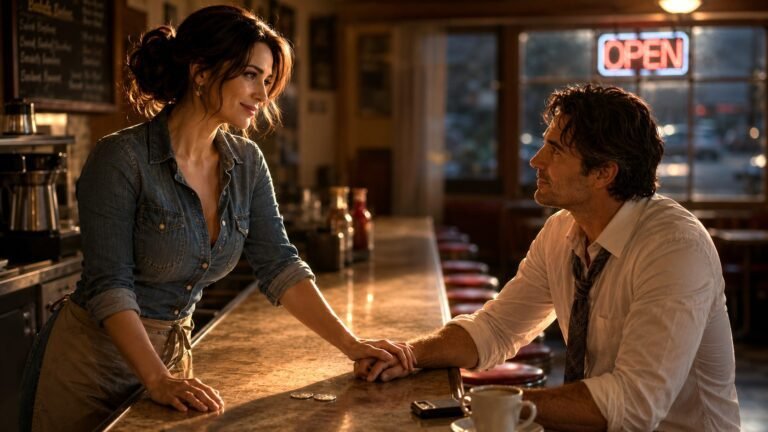
Heartfelt characters sharing love, emotions, and romantic journeys filled with hope, trust, and unforgettable bonds